




Abstract
Both organizational and management research suggest that schools and their leaders need to be ambidextrous to secure prosperity and long-term survival in dynamic environments characterized by competition and innovation. In this context, ambidexterity refers to the ability to simultaneously pursue exploitation and exploration and thus to deliver efficiency, control and incremental improvements while embracing flexibility, autonomy and discontinuous innovation. Using a unique, randomized and representative data set of N = 405 principals, we present findings on principals’ exploitation and exploration. The results indicate: (a) that principals engage far more often in exploitative than in explorative activities; (b) that exploitative activities in schools are executed at the expense of explorative activities; and (c) that explorative and ambidextrous activities of principals are positively associated with the (perceived) competition between schools. The study brings a novel perspective to educational research and demonstrates that applying the concept of ambidexterity has the potential to further our understanding of effective educational leadership and management.
Introduction
Schools are learning organizations that must respond quickly and flexibly to their dynamic environments, with external driving forces being mainly a competition between institutions in the surrounding system and the regressive effects of large-scale, standardized reform strategies (Sahlberg, 2016). To cope with competition between schools and implementing educational reforms without losing sight of everyday duties, schools need to handle the tension between exploring new possibilities (learning and changing) and exploiting existing accomplishments (routine and repetition) (Jansen et al., 2005; Tushman and O’Reilly, 1996). March first described this tension, which later came to be known as ambidexterity, noting that the ‘basic problem confronting an organization is to engage in sufficient exploitation to ensure its current viability and, at the same time, devote enough energy to exploration to ensure its future viability’ (Levinthal and March, 1993: 105).
In this regard, a key challenge is the tendency to favor exploitation over exploration, as the former offers predictability and success, at least over the short term (Levinthal and March, 1993). Exploration, by contrast, is marked by short-term inefficiency (for example, due to trial and error), uncertainty and occasional failures. However, organizations focusing solely on exploitation are likely to fail in the long run because they are unable to cope with change (O’Reilly and Tushman, 2013). Thus, in order for organizations, including schools, to be successful in both the short and long terms, it is necessary to apply both strategies simultaneously in a reasonable relationship (Raisch and Birkinshaw, 2008).
This holds true not only for organizations but also for their managers and leaders, as organizational ambidexterity is rooted in the ambidextrous behaviors of employees, which are characterized by integrative and paradoxical thinking or quickly shifting between entrepreneurial and administrative leadership roles (Birkinshaw and Gupta, 2013). Recent research provides strong empirical indications that individuals are also able to act in an ambidextrous manner (Mom et al., 2009), that their ambidextrous activities are affected by contextual factors and that those activities are linked to the innovativeness and success of their organizations (Mu et al., 2020). Here, as O’Reilly and Tushman (2011: 118) state, ‘ambidexterity as a dynamic capability rests on the ability of leaders not only to articulate a strategic intent and vision that justifies exploration and exploitation, but – more importantly –to manage the inherent tensions associated with incompatible organizational architectures’, by which they mean structures, processes and cultures. This also applies to schools, whose leaders are tasked to ensuring that the status quo is at least maintained and ideally optimized while simultaneously developing visions, setting milestones and innovating (Bush, 2010). Consequently, principals are constantly faced with the challenge of finding the optimal balance between these conflicting expectations within the dynamics of the school environment (Benoliel and Schechter, 2017).
While there have recently been several studies that examine the issue of ambidexterity in the public sector (Cannaerts et al., 2019; Gieske et al., 2020; Kobarg et al., 2017), there is a lack of research studying it with regard to schools and, especially, to principals. The few studies on the subject are either theoretical or based on small convenience samples (Bouwmans et al., 2019; Finnigan and Daly, 2012). Hence, the purpose of this study is to test whether the key assumptions and empirical findings of general research on the ambidexterity of organizational leaders also apply to schools. Using a unique principal (N = 405) data set that is representative of Germany, our analyses examine the relationship between principals’ exploitative and explorative activities in the context of (perceived) school competition.
Background and conceptual grounding
Conceptualizing ambidexterity in the context of education
Ambidexterity has been a subject of enduring interest in organizational and management research. While the term ‘ambidexterity’ was first used by Duncan (1976), the concept is often attributed to March (1991), though the term does not appear in that work. The concept borrows from the physiological meaning of ambidexterity, which is the ability to use one’s left and right hands equally well, and refers to an organization’s or individual’s ability to manage current demands while being adaptable to changes in a dynamic environment (Birkinshaw and Gupta, 2013). While the concept of ambidexterity was originally framed at the organizational level, it was later applied to managers and their approaches to leading an organization (Kobarg et al., 2017); indeed, a key assumption in ambidexterity research is that organizational ambidexterity is rooted in the ambidextrous behaviors of employees (Birkinshaw and Gupta, 2013). Hence, ambidexterity could be defined as the ability of an organization or an individual to pursue both exploitation and exploration at the same time (Mom et al., 2009; O’Reilly and Tushman, 2004). This ability should help organizations to reconfigure existing capabilities and to sense and seize new opportunities (O’Reilly and Tushman, 2008). Engaging simultaneously in both processes has been reported to be crucial for the success and long-term survival of organizations (Gibson and Birkinshaw, 2004), particularly in competitive, more dynamic and unpredictable contexts where a disruptive change that renders current methods or products obsolete is more likely (Tushman and O’Reilly, 1996).
In this regard, exploitation emphasizes the known context and competencies and seeks to make central processes as reliable and efficient as possible (March, 1991). This is achieved by focusing on aspects such as ‘refinement, choice, production, efficiency, selection, implementation, execution’ (March, 1991: 71). Changes that are exploitative in nature are therefore typically incremental and focus on better serving needs or demands of customers or clients by building on pre-existing knowledge (Benner and Tushman, 2003) and by operating within the pre-existing paradigm(s). Exploration, meanwhile, describes the often risky process of experimenting with new alternatives (March, 1991) and searching for innovations. The fruits of such efforts are ‘uncertain, distant, and often negative’ (March, 1991: 85), but they can also lead to innovations that – while they may not serve the existing needs or desires of customers – can respond to customers’ emerging or future needs (Levinthal and March, 1993). As such, exploration can lead to the disruption of current markets, the creation of new ones and paradigm shifts around central processes. Explorative behavior on an individual level refers to the ability to distance oneself from the status quo, to break with established routines and to think about things differently (Good and Michel, 2013). Exploitation, on the other hand, emphasizes working within existing frames of knowledge, routines and regulations and using one’s familiarity and experience with them to optimize the status quo. Being able to do both allows an individual to become aware of changes in the ‘market’ or environment of one’s organization, to see opportunities for that organization in such a changing environment and to adapt accordingly (Good and Michel, 2013).
Ambidexterity is viewed as key for organizational success because it mitigates risk. An organization that is too focused on exploitative activities might achieve short-term success by executing its core processes with maximal efficiency. However, any significant change in the market (like a technological advance or a shift in consumer preferences) will pose a significant challenge, as organizations that are heavily or solely exploitative in outlook lack the capability to adapt (Benner and Tushman, 2003). By contrast, an overemphasis on exploration can leave an organization at risk because of inefficient processes and the limited number of failures in experimentation it can absorb while remaining viable (Levinthal and March, 1993). However, the exact nature of the relationship between exploration and exploitation is a matter of contention. On the one hand, exploration and exploitation are usually understood as occupying opposite ends of a continuum (March, 1991). Hence, March (1991) notes that trade-offs between exploration and exploitation are unavoidable, as they inherently place conflicting resource and managerial demands on an organization. Thus, ambidexterity largely involves managing trade-offs to find an appropriate balance between them. On the other hand, exploration and exploitation can also be viewed as complementary processes, with exploration often requiring a different skill set and different resources from exploitation, and with exploitation often resulting in improving existing processes, which in turn can lead to more effective exploration (Gupta et al., 2006). In this view, ambidexterity has been emphasized as pertaining to the capacity of an organization to pursue high levels of exploration and exploitation concurrently rather than managing trade-offs to find the most appropriate balance between the two.
The applicability of the concept of ambidexterity to schools and school leaders remains largely untested, but we argue that ambidexterity is well suited to adaptation for the school context, especially on the individual level, because the duality of optimizing within the current framework (exploitation) and innovating (exploration) is a common dynamic in schools. For example, in Germany, schools have gained more autonomy over time but are also facing increased demands for accountability (Tulowitzki, 2019). Furthermore, the concept has similarities with the notion of educational leadership versus management. School leaders are tasked with ensuring that the status quo is at a minimum maintained and ideally optimized (management) and with developing visions, setting milestones and innovating in schools (leadership; Bush, 2010; see Tulowitzki, 2015 for the German context). Innovation is key for today’s schools and ‘essential to bring about qualitative changes in education’ (Organisation for Economic Co-operation and Development [OECD], 2016a: 9). Real or merely perceived competition between schools is understood as a pathway to more dynamic and effective activities of principals, as they strive to continuously redesign their organizations in response to rapidly changing demands (Leithwood, 2001) and have greater control and more options for designing and managing the school thanks to the increased autonomy afforded to individual schools (Cravens et al., 2012). It is thus reasonable to hold that competition between schools should be accompanied by a stronger focus of principals on the improvement and innovation of learning and teaching rather than on daily operational or managerial tasks (Austin, 2019). Given the current evidence, it is plausible to suggest that school leaders respond to competitive pressure to attract and retain students mainly by focusing on educational quality and matching current and future students’ educational needs as a way to improve their schools (Jabbar, 2015). This becomes more crucial as the environment in which a given school operates becomes more dynamic, because school choice and competition between schools are designed to stimulate precisely such dynamic environments in the hopes of increasing school quality and fostering innovation in education (Waslander et al., 2010).
Consequently, the argument can be made that being successful in school competition should be positively associated with principals’ ambidextrous practices, as ambidexterity requires them to accomplish two different tasks (O’Reilly and Tushman, 2008). First, they must be able to ensure the safe, reliable and efficient functioning of their schools. Second, they must be able to accurately sense changes in their competitive environment, including potential changes in neighboring schools’ profiles, clients (both students and parents) and regulatory bodies (supervisory and legislative authorities). Additionally, they must be able to act on these opportunities and threats by reconfiguring both tangible and intangible assets to meet new challenges. More than the actual number of competitors or general market density, the perceived state of competition appears to be key in predicting the strategies (or lack thereof) adopted by school principals (Jabbar, 2015; Levačić, 2004).
Antecedents and effects of ambidexterity
Empirical research has demonstrated that organizational and individual ambidexterity are linked to performance measures. Thus, in a meta-analysis on organizational ambidexterity, Junni et al. (2013) found that ambidexterity and exploitation and exploration were positively associated with the performance of organizations, organizational sub-units and individuals within organizations. Their study demonstrated that additive measures of ambidexterity that conceptualize it as complementary rather than contradictory are more strongly related to performance (r between 0.38 and 0.48) than difference measures that conceptualize it as striking a balance between the two ends of the continuum (r = 0.17). In another meta-analysis, Shi et al. (2020) found that exploration and exploitation on the organizational level are positively correlated with each other and that exploration and exploitation are positively influenced by organizational capabilities, organization size and market orientation. On the other hand, the authors showed that exploration is positively associated and exploitation is negatively associated with competitive intensity and that resources and capabilities influenced organizational performance only through explorative processes and activities. Further, in a systematic review on individual ambidexterity, Mu et al. (2020) found that the organizational context is a relevant antecedent of individual ambidexterity and that the extent to which employees are ambidextrous varies within and across contexts. Their study shows that many types of interactions between exploration and exploitation are observable and that ‘the relationship between exploration and exploitation (complementary, conflicting, or interrelated) results from different perceptions of different individuals, who can then make their own judgments as to how to best spend their time and implement specific management approaches’ (Mu et al., 2020: 14). In a recent multi-level study, Mom et al. (2019) demonstrated that organizational and individual (within-organization) ambidexterity are strongly coupled, in that the organizational climate shapes the ambidextrous practices of managers and leaders, which in turn influence the ambidexterity and success of the organizations.
The current study
Purpose
Against this background, our study focuses on the following main questions. How does ambidexterity manifest itself at the level of individual principals? How do exploitative and explorative practices of school leaders relate to each other? Are the exploitation, exploration and ambidexterity of principals associated with the dynamic environment of a school as measured by the level of (perceived) competition between schools for students? With these aims in mind, the following hypotheses are tested: H1: Exploration and exploitation are (positively or negatively) related to each other. H2a: Exploration is positively associated with the degree of competition between schools. H2b: Exploitation is negatively associated with the degree of competition between schools. H3: Ambidexterity is positively associated with the degree of competition between schools.
Context and sample
To test our hypotheses, we rely on a randomized and nationally representative sample of German principals (N = 405). Under Germany’s federal constitution, education is the responsibility of the 16 states (Länder) and thus differs between states. However, all German states provide education for students from ages 6 to 10 in comprehensive primary schools (Grundschulen). At about 11 years old, students enroll in 5th grade in secondary schools. At this transition point, students of varying abilities are tracked into different types of schools, which usually differ in both duration and curriculum. While German states traditionally have three different secondary school types – lower secondary (Hauptschule), middle (Realschule) and upper secondary (Gymnasium) schools – most have introduced one or more types of comprehensive secondary schools in the course of various educational reforms.
Since the beginning of this century, nearly all German states have introduced market-like mechanisms into their education systems. There have been several reforms that are relevant to the level of school competition across German states: abolishing catchment areas (Thiel et al., 2014), strengthening private schools (Unger, 2015) and, in some states, merging different forms of secondary education (Baumert et al., 2017). With regard to school choice policies, parents in most states are bound to school districts and assigned public schools at the primary level (Riedel et al., 2010). For primary education, then, students’ families regularly must choose a certain school from a limited set of schools, often within a pre-defined catchment area. For secondary education, by contrast, most states permit students’ families to freely choose a secondary school. In most states, these choice policies are accompanied by typical market incentives and mechanisms, like legally mandated image management and marketing of schools that entails the development and publication of school profiles and school programs and, in some states, the publication of school inspection reports. League tables of examination results and student achievement measures, however, are generally not publicly reported.
German principals were long viewed as primarily administrators before their role shifted over the past two decades to include more management and leadership domains (Huber, 2016; Tulowitzki, 2015). Principals are recruited from the teaching corps, and the appraisal of their instructional abilities as teachers often still plays a major part in determining their aptitude for a principal role (Brauckmann et al., 2016). The level of mandatory pre-service training for principals varies from state to state but a maximum of 37 days is common (Tulowitzki et al., 2019). From an international perspective, Germany’s principals have rather limited little autonomy over teacher recruitment, appointment, salaries and promotion, as principals control less than 20% of the resources; the OECD average is 39% (OECD, 2016b: 115). In recent years, school principals in German-speaking countries have paid increased attention to their schools’ competitive capacity (Kanape-Willingshofer et al., 2016; Pietsch and Leist, 2019). In many cases, the salary of principals, their relief from non-administrative (i.e. teaching) duties and the resources available to them are influenced by the number of students at their school.
Sample
The underlying population for the data consists of all principals in Germany working at public schools of all types. The data was gathered between August and November 2019 by forsa GmbH, a leading German survey firm, using a piloted and standardized online questionnaire. To achieve a certain degree of comparability with international research in the field, internationally established items and scales were employed. To minimize common method biases, the procedural remedies suggested by Podsakoff et al. (2012) were implemented. For example, items or item blocks were presented in random order to the principals to reduce the likelihood of obtaining uniform answers, eliminate local dependencies and avoid primacy-recency effects.
Measures
The ambidexterity of principals and the underlying dimensions of exploitation and exploration were surveyed by items and scales developed by Mom et al. (2009). These scales are based on the features by which March (1991) characterized exploration and exploitation in the context of organizational learning. The exploration scale determines the extent to which a principal engaged in exploration activities during the previous year, while the exploitation scale determines the extent to which the principal engaged in exploitation activities during the previous year (base question: ‘To what extent did you, during the last 12 months, engage in work-related activities that can be characterized as follows?’). Six items from the original scales were used, three per dimension. Thus, the principals answered three items measuring exploitation (ω = 0.64), behaviors or activities characterized by focusing attention on what is already known rather than scanning for new information (e.g. ‘I engaged in activities of which it is clear to you how to conduct them’). They then answered three items indicating exploration (ω = 0.69), behaviors or activities focusing on searching for novelty in the school context (e.g. ‘I engaged in activities of which the associated yields or costs are currently unclear’). All items were measured on a 4-point Likert scale ranging from ‘a very small extent’ to ‘a very large extent’ of engagement in explorative or exploitative activities.
In accordance with other studies on ambidexterity (Cao et al., 2009; Gibson and Birkinshaw, 2004; Rosing and Zacher, 2017), we calculated three new measures indicating the individual ambidexterity of principals based on the two underlying dimensions. First, we conceptualized ambidexterity as the sum of exploitation and exploration. This approach implies a compensatory understanding of exploration and exploitation; while elevated levels of both exploration and exploitation are needed for being highly ambidextrous, each can compensate for a lower level of the other (Rosing and Zacher, 2017). Second, we conceptualized ambidexterity as the product of exploitation and exploration. This approach assumes that exploration and exploitation are independent dimensions and that the effects of exploration and exploitation depend on one another. Seen from this angle, principals can be considered highly ambidextrous when they engage in elevated levels of both activities, as compared to low levels of one or both of them (Gibson and Birkinshaw, 2004; Mom et al., 2019). Third, we conceptualized ambidexterity as the difference score of exploitation and exploration and thus as (im)balance. This approach implies that ambidexterity is most advanced when exploration and exploitation are at approximately the same level relative to each other; their absolute levels are not relevant in this case (Cao et al., 2009). The difference score only captures the degree but not the level of (im)balance. This means that a principal with low levels of both exploration and exploitation could be considered just as ambidextrous as one with high levels of both dimensions (Rosing and Zacher, 2017).
Competition between schools, as reported by their principals, was measured with two items. As some studies demonstrated that objective measures of competition such as local school market size and school leaders’ perceptions of competition may differ in their influence on schools’ responses (Jabbar, 2015; Levačić, 2004), we surveyed both local school market size and perceived degree of competition for students between schools in that market. Thus, we first adapted an item from the Program for International Student Assessment 2012 study (PISA 2012) school questionnaire: ‘How many schools in your region compete for students with your school? (OECD, 2013)’ This item reflects the number of perceived competitors within the local schooling market. Second, principals who stated that their school competes with at least one other school were asked to specify the perceived overall degree of competition (‘How do you perceive this competition for students?’). This item indicates the intensity of the competitive pressure that principals felt; responses were measured on a 4-point Likert scale that ranged from ‘weak’ to ‘strong’.
Because several contextual factors could influence the ambidexterity of principals, we use the information below to control for possible confounding effects.
School type applies the International Standard Classification of Education (ISCED; UNESCO Institute for Statistics, 2012). ISCED classifies education systems according to uniform criteria: ISCED 1 refers to ‘primary education’ and covers the 1st to 4th school years in Germany, ISCED 2 refers to ‘lower secondary education’ and covers the 5th to 10th school years, and ISCED 3 refers to ‘higher secondary education’ and covers the 11th to 13th school years.
Thus, within our analyses we differentiate between primary schools, secondary schools, special needs schools and other schools, which are mainly schools that have both primary and secondary branches. We constructed four dummy-coded variables (coded 0 and 1) and defined primary schools as the reference group. Within our sample, 51.9% are primary, 38.1% secondary, 6.5% special needs and 3.5% other schools.
School size is measured by the total number of students enrolled in a school. This variable was added to our analyses partly because school size is strongly coupled with success in the local school market, as good (effective) schools are expected to grow in size and flourish over time. In addition, many students may choose a school because of its size. Just as large schools may be right for many students, especially those who seek a rich variety of both curricular and extracurricular offerings (Stiefel et al., 2000), small schools may be better for other students. Furthermore, school size may affect interpersonal distance and organizational structures (Bush, 2010), which may be relevant to a principal’s choice of management and leadership practices. Within our sample, school sizes ranged from 25 to 2000 students enrolled, with a mean of 363.27 (SD = 305.60).
School in challenging circumstances refers to schools in social hotspots, areas with high unemployment rates and low socioeconomic infrastructure. We included this variable in our analyses because other authors have shown that there ‘is almost nothing left for marketisation to explain’ (Fitz et al., 2003: 186) when variables such as the diversity of the local population, local levels of residential segregation and school organization factors like the nature and the number of local schools are considered as potential confounders in multivariate analyses. Further, in areas with a lower mean socioeconomic status, higher-income families are likely to choose a school in a different area and thus exit the local school market no later than the transition from primary to secondary school (Lauder and Hughes, 1999; Leist and Pietsch, 2017). On this topic, the surveyed principals were asked: ‘Is your school in a social hotspot?’; their answers were binary coded (0 = no, 1 = yes). Within our sample, 59 (14.6%) schools were in social hotspots.
School location refers to the urban–rural character of the area in which a school is situated. The rationale for including this variable in our analyses is that competition among (rural) schools depends on catchment areas and the ease with which parents from outside the catchment area can engage in the daily commute to a school other than their local option (Walker, 2010). For example, small rural districts or villages, unlike their urban counterparts, often have only a primary school or perhaps a single school at each level of education. If parents choose a school other than the local option, students must travel long distances every day. Thus, school choice in rural areas is often not really an option, and competition for students between schools may not occur (Morgan and Blackmore, 2013; Walker, 2010). To survey the urban–rural profile, we applied an item from PISA 2012: (OECD, 2013). Within our sample, 77 schools (19%) are in a village, hamlet or rural area (fewer than 3000 people), 135 (33.3%) in a small town (3000 to about 15,000 people), 121 (29.9%) in a town (15,000 to about 100,000 people), 53 (13.1%) in a city (100,000 to about 1,000,000 people) and 13 (4.4%) in a large metropolitan city (over 1,000,000 people).
Analytical strategy
To answer our research questions and test our hypotheses, we conducted latent correlation and multivariate regression analyses using MPlus 8.0 (Muthén and Muthén, 2017). Multivariate regression analysis is used in our study because it allows the dependent variables – ambidexterity, exploitation and exploration – to be jointly regressed on several predictor variables. More precisely, we used a sequential regression approach to test whether the competition measures explain a statistically significant amount of variance in the dependent variables after accounting for successively added control variables. As the amount of missing data in our data set was low (< 5%), we handled missing data by applying full information maximum likelihood (FIML) estimation in MPlus 8.0. As the data stems from a single data source, we also tested for common method variance by applying Harman’s (1960) single factor test, which indicates problematic common method variance if an exploratory factor analysis loads all items onto a single factor, suggesting that, due to the method chosen, the factor accounts for a large amount of shared variance among the variables. If the shared variance lies between 10% and 50%, the common method usually does not lead to material biases in statistical analyses and can be ignored (Fuller et al., 2016; Lance et al., 2010).
Results
Principals’ ambidexterity
As far as we aware, no study has surveyed the ambidexterity of principals in Germany or internationally on a large scale. Because we were able to use a randomized and nationally representative sample of German principals for our analyses, we first wanted to obtain an impression of the overall ambidexterity of German principals and their exploitation and exploration activities. For this reason, we began by computing scores for all scales from single items before calculating means and standard deviations for the scales in a second step and estimating the correlations between those scales in a final step. Table 1 shows the means and standard deviations of the scales and the correlations between the constructs.
Means, standard deviations and latent correlations of ambidexterity measures.
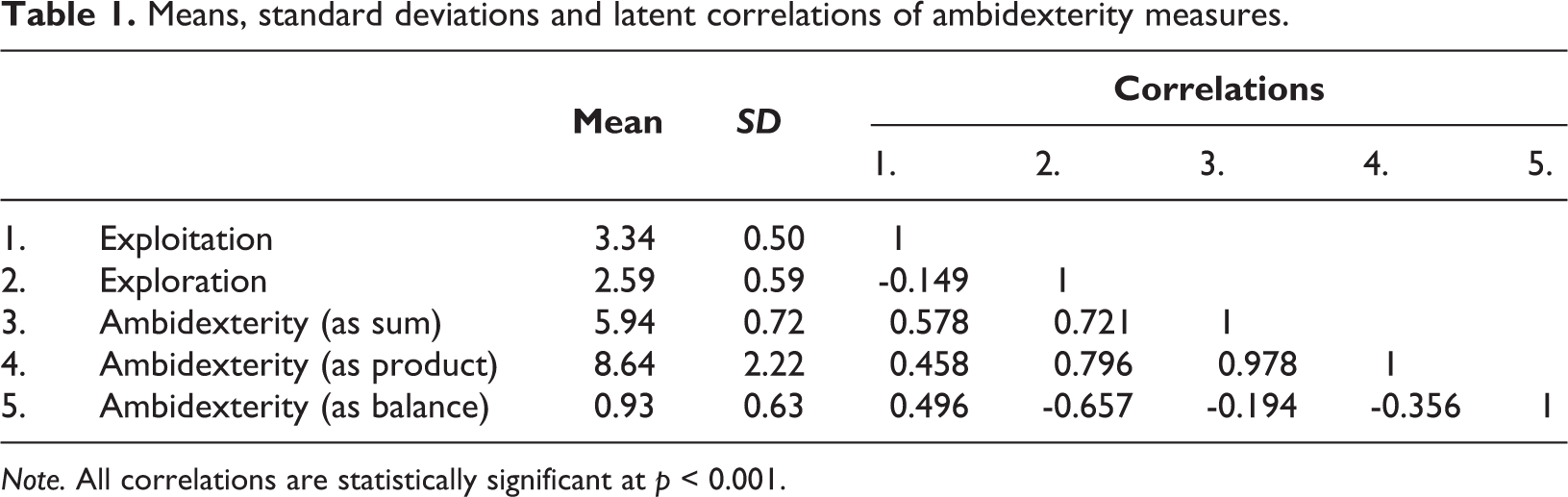
Note. All correlations are statistically significant at p < 0.001.
The results show that principals in German schools carry out exploitation activities far more often (mean = 3.34) than exploration activities (mean = 2.59), which indicates that they focus more on refining existing competencies, processes and results than on experimentation, flexibility, discovery and innovation. Both dimensions of principal ambidexterity are negatively correlated (r = -0.149, p < 0.001); a higher degree of exploitation activities goes along with a lower degree of exploration activities and vice versa, so there is a trade-off between exploration and exploitation. Consequently, the exploration dimension is also negatively correlated with ambidexterity, defined as the (im)balance between exploitation and exploration activities of principals, and H1 is confirmed.
School markets and competition as perceived by principals
Not much is known about school markets in Germany on a national level, and nothing is known about the perceptions of German principals regarding school competition. The research that is available, however, demonstrates that about 80% of all secondary schools in Germany compete for students with at least one other secondary school in their vicinity (Musset, 2012) and that school competition in some states (e.g. Hamburg; see Pietsch and Leist, 2019) appears to be exceptionally pronounced, even when compared to other countries.
According to our representative data, about 75% of all (primary and secondary) school principals in Germany stated that their school is exposed to a competitive situation, with an average of 3.3 competing schools. Consequently, with regard to the distribution of competing schools, the results show that only 17% (N = 69) of German principals reported that their school has no competitors; 60.2% (N = 244) of them reported between 1 and 5 competitors, 12.3% (N = 50) between 6 and 10, and 2.7% (N = 11) more than 10. A small portion of respondents (7.7%; N = 31) did not answer this question.
When asked about the intensity of the perceived competition between schools for students, 47.5% of principals reported it was strong (N = 41) or rather strong (N = 103), 28.7% (N = 87) rather weak and 23.8% weak (N = 72). A series of analyses of variance (ANOVAs) showed that perceived competition is significantly associated with school type (F(2,300) = 24.794, p < 0.001), school size (F(5,297) = 5.354, p < 0.001) and urban characteristics (F(4,298) = 4.538, p < 0.05) but not with challenging social circumstances for teaching and learning (F(2,300) = 0.591, p > 0.10). Primary schools reported fairly weak competition (mean = 1.96, SD = 0.92), whereas secondary schools (mean = 2.71, SD =0.91) and schools providing both primary and secondary education (mean = 2.58, SD = 1.00) reported rather strong competition.
Associations of competition and ambidexterity
To test H2 and H3, we estimated sequential regressions in MPlus 8.0. As the data stems from a single instrument, we first tested for a potential common method bias by applying Harman (1960) single factor test by conducting an exploratory factor analysis that included all items from the intended full regression model in the analysis. The results showed no common factor loading on all measures, as the factor solution resulted in four factors and the first factor accounted for 18.56% of variance, indicating that this factor accounted neither for the majority nor even a high percentage of the model variance. Therefore, in accordance with recent recommendations (Fuller et al., 2016; Lance et al., 2010), we elected not to correct post hoc for potential common method bias within our regression analyses, particularly since no serious further distortion was expected in the context of regression analyses, even if such a bias might exist (Siemsen et al., 2009).
Effects of competition on exploration and exploitation
Table 2 shows the results of the sequential regressions for principals’ exploitation and exploration activities. Here, the baseline models (Model 1) examine the associations of the number of reported competitors and the principals’ exploitation and exploration activities, respectively. In Model 2, we added the perceived intensity of competition, while we further added structural control variables in Model 3.
Regression models: Associations of context and principals’ exploitation and exploration.
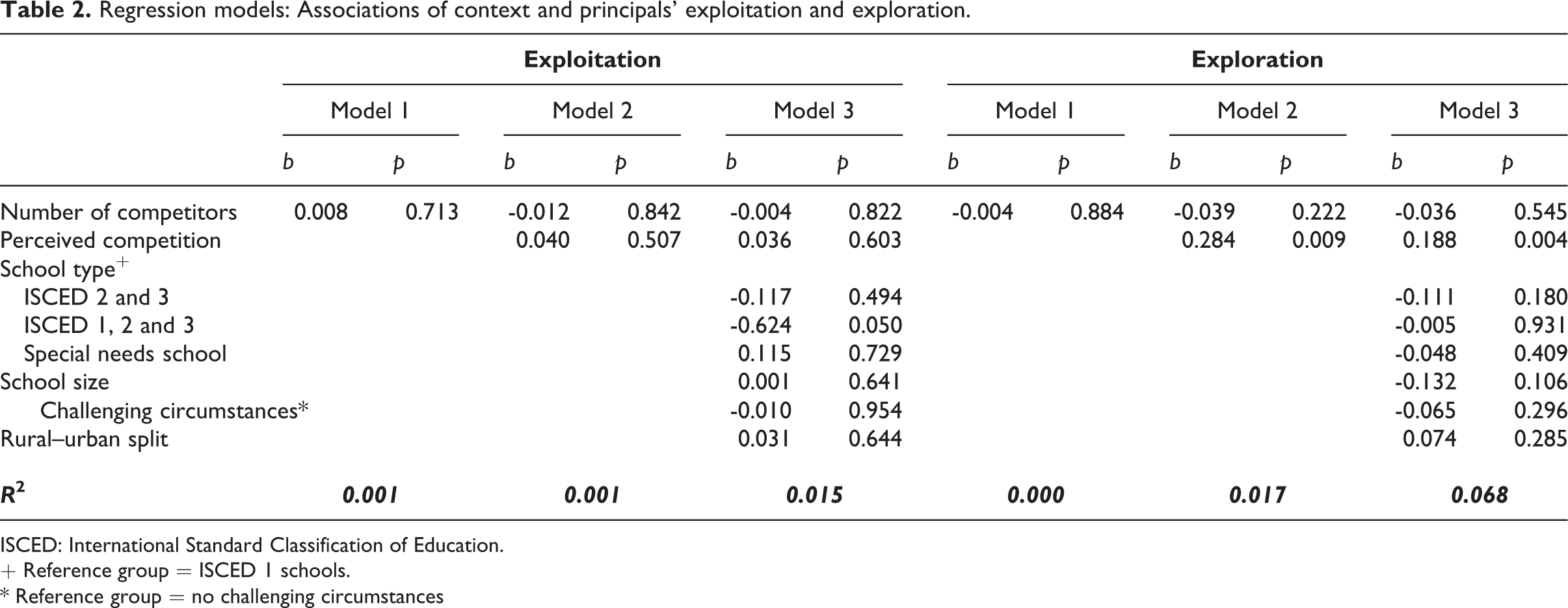
ISCED: International Standard Classification of Education.
+ Reference group = ISCED 1 schools.
* Reference group = no challenging circumstances
The results, reported as standardized regression coefficients, reveal that the number of competitors within the local school market and the perceived competition with these schools are not associated with German principals’ exploitative activities. Thus, rivalry between schools is not associated with a school leader’s exploitative behavior. This is, however, not so for principals’ explorative activities, for which regression analyses demonstrate that, even when controlling for structural context factors, the perceived competition for students significantly (p < 0.05) predicts principals’ explorative activities (βPerceived competition, model3 = 0.188). It is also notable that neither the number of potential rivals in the local schooling market nor other contextual factors are significantly associated with explorative behavior by German school principals. In this respect, H2a was confirmedand H2b refuted.
Effects of competition on ambidexterity
Table 3 presents the findings from the regressions for various ambidexterity measures. In accordance with the literature on individual ambidexterity, we constructed three ambidexterity measures as dependent variables: ambidexterity as the sum of exploitation and exploration, as the product of exploitation and exploration and as the (im)balance between exploitation and exploration. For all measures, we estimated full regression models by simultaneously including the number of reported competitors, the perceived intensity of competition and the structural control variables as regressors in the multivariate models.
Regression models: Associations of context and principals’ ambidexterity, modelled as sum, product and (im)balance.
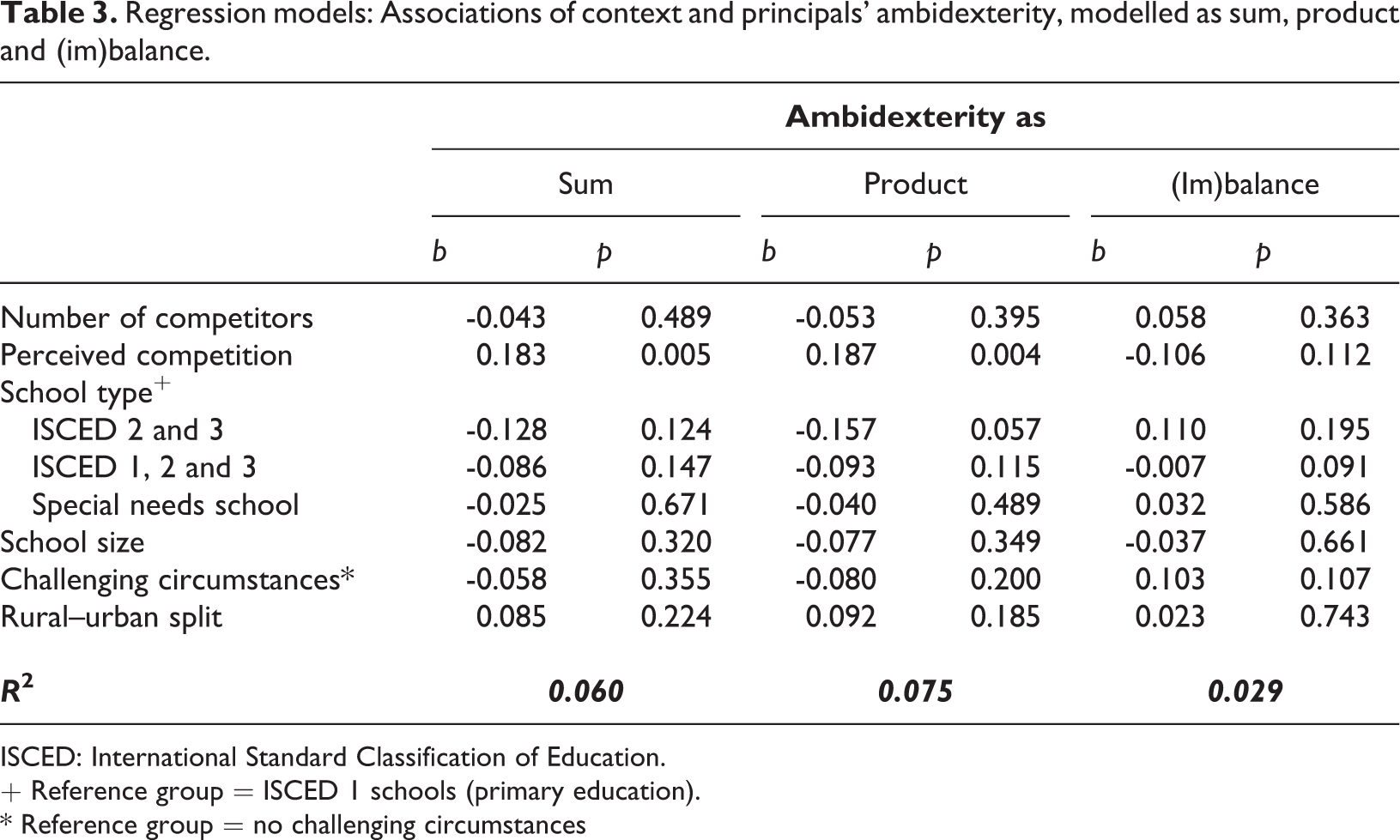
ISCED: International Standard Classification of Education.
+ Reference group = ISCED 1 schools (primary education).
* Reference group = no challenging circumstances
The regression results indicate that the level of principal ambidexterity is significantly associated with the perceived intensity of competition for students between schools. This is true for both the sum (βPerceived competition = 0.183, p < 0.05) and the product (βPerceived competition = 0.187, p < 0.05) of exploitation and exploration. This implies that principals who perceive stronger competition between schools tend to engage more often in exploitative and/or explorative activities. For all other contextual variables, however, the coefficients are not statistically significant, suggesting that none of a school’s social context, its urban–rural profile or organizational factors like school type and size and school size plays an important and verifiable role with regard to a principal’s engagement in these ambidextrous activities.
As to ambidexterity defined as the (im)balance between exploitation and exploration, the analysis revealed no statistically significant associations with the perceived competition for students between schools (p > 0.10). As in the previous analyses, there were also no statistically significant associations with most of the control variables. Only one coefficient becomes statistically significant when a one-sided p-value is considered, suggesting that principals working at schools that serve both primary and secondary school students are likelier to engage in a more balanced ambidexterity than principals working at schools serving only students at ISCED level 1. Thus, H3 is supported with regard to the concept of ambidexterity as both a sum and product of exploitation and exploration, but it is not supported for the concept of ambidexterity as an (im)balance between those both dimensions.
Limitations
Our research provides initial insights into the ambidextrous practices of principals in the dynamic environment of a competitive school market. Despite the study’s strengths, which arise from a randomized, representative sample of German principals, it does have certain limitations. First, all data stems from a single instrument, the survey of principals, which means the possibility of common method bias cannot be completely ruled out. Second, it is a correlational study; on the one hand, causality can thus be inferred but cannot be demonstrated and, on the other, the potential dynamics of both principals’ ambidexterity and school markets could not be taken into account in our analyses. Third, our study lacks outcome measures, making it impossible to test whether the ambidexterity of school leaders is associated with schools’ process variables, such as instructional practices of teachers, provable innovations and student achievement. Fourth, principals are treated generically in our study, as we have not controlled for personal characteristics like motivation, career stage or role identity. Hence, future research should try to apply longitudinal designs, gather data from different sources and incorporate background, mediating and outcome variables into study design and analysis.
Discussion of results
The goal of this article is to report the first findings on the concept of school leaders’ ambidexterity on a large scale. We applied an instrument measuring the individual ambidexterity of managers using data from a randomized, representative sample of principals in Germany. Our goal was to analyze how the two underlying dimensions of exploitation and exploration are related to each other and if the basic assumption that the ambidextrous behavior of employees is associated with the competitive context of an organization also holds true in an educational context. Our key findings are: (a) that principals focus more often on exploitative than on explorative activities in school; (b) that exploitation is conducted at the expense of exploration; and (c) that explorative and ambidextrous activities of principals are positively related to (perceived) competition between schools.
The results show that the concept of ambidexterity is applicable in educational research, as our results were in line with both the general theoretical assumptions and the empirical research on the exploration and exploitation of organizations and the individuals within them. Thus, in accordance with findings from Jansen et al. (2005), we found that a competitive environment encourages the pursuit of ambidexterity by leaders. It is particularly striking that principals respond to a school’s competitive context by exhibiting a more powerful focus on explorative activities that are theoretically relevant antecedents to the long-term survival and flourishing of their organizations in terms of successfully navigating innovation and change (Mu et al., 2020). In addition, our results lend themselves to an interpretation of principals’ exploitation and exploration as two ends of a continuum in that exploration and exploitation are conflicting activities requiring different resources that can counteract each other (Gibson and Birkinshaw, 2004).
The findings also provide ample connections with the discourse in research around educational leadership and management (Bush, 2010) and broaden our understanding of effective school leadership (Daniëls et al., 2019) to take into account the temporality and modes of leadership actions as geared toward maintenance (exploitation) or innovation (exploration). In this context, our findings are even more relevant, as empirical evidence has demonstrated that exploration is a distinct characteristic of leaders, so ambidexterity in the context of organizational learning stimulates innovation and change above and beyond more conventional classical approaches like transformational leadership (Keller and Weibler, 2014).
From a practitioner’s viewpoint, our results echo Cuban’s (1988: xxi) longstanding argument that schools and education systems are more geared toward maintaining what already exists rather ‘than moving toward what can be’. The notion of school principals as leaders who act as change agents (Fullan, 1993) is not apparent in our findings. Even in an era of increased autonomy and accountability (Easley and Tulowitzki, 2016), the predominant mode of operation is geared toward maintaining the status quo. One possible explanation could be that the daily working life of principals places so many demands on them (Pont et al., 2008) that there is scant time for exploration. If so, steps to improve the ambidexterity of principals could include not only shifting responsibilities to free up time, but also changing principal preparation programs to focus more on strategic management and reconfiguring accountability systems in education to place a higher value on principals’ strategic management skills.
As schools are complex organizations (Byrne, 1998), we are far from declaring school competition as the primary reason for the behavior of German principals we report here. Indeed, while competition between schools can be beneficial by encouraging explorative activities and can coexist with cooperation, it can also have unwelcome effects, such as a reluctance to share best practice with potentially competing schools, and thus inhibits cooperation in professional learning communities and the overall development of schools (Muijs and Rumyantseva, 2014). Obviously, schools are not organizations that follow economic rationalities exclusively or even predominantly. Rather, they are educational institutions that partially evade control by individual players and follow their own dynamics, which are peculiar to the field of education. In addition, competition can lead not only to winners but also to losers, with the result that students in already structurally disadvantaged schools may suffer even more from competition. Thus, the concept of ambidexterity adds value to the discussion but does not claim to explain all mechanisms of school development.
As our study is, to the best of our knowledge, the first to research ambidexterity in the field of educational research on a larger scale, the possibilities for further research are vast. First, future studies could replicate our approach using different samples in other contexts to secure further generalizability. Second, it is essential to analyze the potential effects of ambidexterity in schools, particularly at the organizational level, as a large number of studies demonstrate that the short- and long-term success of organizations both depend on the exploitation and exploration of organizations and their leaders (Junni et al., 2013; Mu et al., 2020). Third, it would be worthwhile to incorporate individual characteristics into further analyses, as it has been shown that factors like motivation, prior experience and personal skills might influence the ambidexterity of individuals within organizations (Mu et al., 2020).
As the pressure on schools and school principals to innovate and adapt continues to rise, this study provides new insights into current leadership practices and modes of organizational learning. It also brings a novel perspective to educational research that has the potential to further our understanding of effective educational leadership. By reporting the first reliable results on the ambidexterity of school leaders, we hope to inspire and stimulate further research and vigorous debate about the pivotal role of principals in the processes of school improvement, change and innovation. This could in turn benefit the practice of educational leadership and management in increasingly dynamic contexts.
Supplemental Material
Supplemental Material, Ambidexterity_Schools_AppendixA - Principals between exploitation and exploration: Results of a nationwide study on ambidexterity of school leaders
Supplemental Material, Ambidexterity_Schools_AppendixA for Principals between exploitation and exploration: Results of a nationwide study on ambidexterity of school leaders by Marcus Pietsch, Pierre Tulowitzki and Colin Cramer in Educational Management Administration & Leadership
Footnotes
Declaration of conflicting interests
The author(s) declared no potential conflicts of interest with respect to the research, authorship and/or publication of this article.
Funding
The author(s) declared the following potential conflicts of interest with respect to the research, authorship, and/or publication of this article: The study has been supported by the German Federal Ministry for Education and Research (BMBF).

Supplemental Material
Supplemental material for this article is available online.
References
Supplementary Material
Please find the following supplemental material available below.
For Open Access articles published under a Creative Commons License, all supplemental material carries the same license as the article it is associated with.
For non-Open Access articles published, all supplemental material carries a non-exclusive license, and permission requests for re-use of supplemental material or any part of supplemental material shall be sent directly to the copyright owner as specified in the copyright notice associated with the article.
