




Abstract
Introduced in England in 2011, the pupil premium policy was an ambitious reform aimed at tackling the persistent attainment gap between disadvantaged pupils and their more affluent peers. The policy provides school leaders with the professional autonomy to determine how pupil premium funding should be used. This article examines the decision-making processes and influences involved in the use of these additional resources. We conducted interviews with 21 school leaders from different contexts across the Midlands in order to investigate the approaches, perceptions and experiences that influenced their engagement with the pupil premium policy. The findings highlight the range of strategies employed to determine how the funding should be used and the factors that influence the decisions made. Our data also indicate the tensions and challenges that are experienced by school leaders in relation to effective use of the funding. We conclude with recommendations for policymakers and practitioners in relation to the requirement for high-quality, accessible information to support pupil premium use, the role of accountability mechanisms and the need for wider societal reform in order to tackle social disadvantage.
Introduction
In the UK, as in many other countries, there is a persistent attainment gap between pupils from socioeconomically disadvantaged backgrounds and their more affluent peers (DfE, 2018, EEF, 2017). The pupil premium (PP) policy was announced in England in 2010, presented as strategy to reduce this gap and improve outcomes for children from poorer households. The policy provides additional funding to schools from central government, based on each pupil eligible for free school meals (FSM), a proxy measure for poverty, and for those who are in the care of the local authority (looked-after children (LAC)). In the first year of the policy, schools were allocated £488 per pupil eligible for FSM. This amount has increased each year since, with primary pupils now being allocated more than those of secondary age. For the academic year 2019–2020, primary schools receive £1320 for each FSM eligible pupil and secondary schools receive £935 per pupil. Schools are currently allocated £2300 per LAC pupil at both primary and secondary level.
This article examines the decisions that leaders make in relation to PP and the factors that influence these. It focuses on the processes involved when schools and, more precisely, individuals or groups of individuals, are required to make choices about how allocated resources are to be used. In establishing the policy, the government argued that schools themselves are best placed to determine how to use this funding for their pupils effectively. Yet, although they have significant freedoms to decide how the money is spent, schools are expected to report annually on their PP use, publishing this information on their websites. They are also held accountable for it via Ofsted inspections and performance measures, mechanisms that ensure it is taken seriously by leaders and should, in theory, encourage them to spend the funding judiciously. It is within this complex context of increased school and professional autonomy and government-imposed constraints (Higham and Earley, 2013; Wermke and Salokangas, 2015) that we examine the decisions made, the information used and the perceptions of the impact of PP. Our findings reveal a number of important tensions associated with the policy, bringing to the fore the challenges that school leaders face in effective implementation.
The introduction of the PP
The PP was conceived as an approach to supporting social justice within education (Freedman and Horner, 2008), challenging the ongoing association between social deprivation and educational underachievement, and increasing the opportunities available to those from poorer backgrounds. Through the lens of Rawls’ ‘difference principle’, the PP policy permits the provision of unequal use of resources with a view to benefiting the least advantaged in society (Rawls, 1971). Rather than permitting all pupils to receive equal amounts of financial resources to support their schooling, instead, the policy acknowledges the need to allocate more money to those from lower socioeconomic backgrounds, in the hope of rebalancing inequalities that are often entrenched even before children start school. During its inception, the PP policy was also viewed as a potential mechanism for incentivising ‘good’ schools to increase their numbers of disadvantaged pupils (Freedman and Horner, 2008; HM Treasury, 2010); this, it was argued, would further increase a sense of justice across schools because pupil clustering would be reduced and schools would have more balanced intakes. Thus, the policy aimed to provide more equitable distribution of both funding and pupils and, in turn, improve the outcomes of those from socioeconomically disadvantaged backgrounds.
The PP policy acknowledges that different pupils may require different levels of support in order to reach a certain level of achievement. By providing additional financial resources, advocates argue that schools can target the factors that contribute to underperformance and ‘close the gap’ in attainment between richer and poorer pupils (Clegg, 2012; DfE, 2010). Of course, the PP is not the first education funding policy to be aimed at improving outcomes for disadvantaged children. Previous initiatives, however, have tended to allocate additional funding to specific geographical areas (Excellence in Cities, Education Action Zones, London Challenge) rather than be based on demographic characteristics of individual children. The introduction of the PP policy in 2011 by the Conservative–Liberal Democrat coalition government formed part of a wider package of initiatives designed to improve the school system and provide better opportunities and outcomes for young people. However, its introduction should also be situated within a wider political and economic context of government austerity, including reduced spending on public services and significant welfare reforms (see Lupton et al., 2015 for a comprehensive summary). Although financial resources via the PP were welcomed, evidence suggests that due to cuts in other areas, it was not really ‘new’ or ‘additional’ money and that it was unlikely to reduce inequalities due to being ‘part of a suite of education and social policies designed to work in the opposite direction’ (Lupton and Thomson, 2015: 17).
Continuing a trajectory from previous administrations, the government implemented a number of policies to increase autonomy and competition, and promote greater choice and diversity for parents (Gove, 2012). Although some, such as the academies programme, were extensions of existing policies, the PP initiative marked a more radical development, providing schools with the freedom to determine how they would improve the outcomes for their disadvantaged cohorts and close the attainment ‘gap’. In giving these additional freedoms, the government simultaneously sought to promote a more ‘evidence-informed’ approach to school-based decision-making. The Education Endowment Foundation (EEF), an organisation tasked with generating robust evidence in relation to improving pupils’ attainment, was set up in 2011 with a specific focus on improving the outcomes of disadvantaged children. To establish an information base to support the spending of the PP, the EEF have produced a range of materials aimed at practitioners, including the Sutton Trust/EEF Toolkit (Higgins et al., 2014) and the recent The EEF Guide to the Pupil Premium (EEF, 2018). Although welcomed by many in the education sector as a step towards a more research-informed profession, others have challenged the high status placed upon experimental studies, the statistical underpinnings of the toolkit and the focus on simple pedagogical interventions rather than larger, more significant educational issues (Gorard, 2016; Seith, 2017; Wrigley, 2018). In the section below (The allocation and use of additional school funding), we discuss practitioner engagement with evidence (such as that from the EEF) to inform PP spending decisions.
Increasing financial resources for schools tends to be viewed favourably by those working in the education sector and by parents. However, economic analyses have concluded that there is limited evidence pointing towards a positive relationship between expenditure and pupil attainment (Allen et al., 2012; Hanushek and Woessmann, 2017). Simply injecting more money into the system or into schools is not enough to guarantee academic improvement. Indeed, recent research reiterates the relatively limited influence that schools have on pupils’ outcomes, with wider structural and social inequalities accounting for a much higher proportion of the variation in pupil attainment (Bryson et al., 2019). Despite this, however, there is consistent evidence that some classroom-level factors – and particularly teacher quality –are important predictors of pupil performance (Muijs et al., 2014).
Research into similar initiatives worldwide also presents a mixed picture. The decile system in New Zealand that uses five indicators of disadvantage to determine targeted funding for disadvantaged pupils has been shown not to be associated with improved outcomes for this group (Clark et al., 2017). In the Netherlands, researchers have also found that schools receiving high proportions of funding because of ‘weighted’ (or disadvantaged) pupils had almost 60% more teachers per pupil, but that despite these large resource advantages, there were still considerable quality differentials in the learning experiences that pupils in these high-weight schools received (Ladd and Fiske, 2011).
Freedom to make decisions
PP funding is directly allocated to schools with the government arguing that it is leaders and teachers who are best placed to determine how the money should be used to support pupils. This argument is built on two key premises: first, when provided with professional autonomy, educators have the capacity and motivation to use their knowledge and skills to inform effective decision-making; and, second, the local knowledge and understanding that schools and teachers have in relation to their pupils and communities is important in ensuring that improvement initiatives are appropriately targeted and implemented. These issues are examined in more detail below and provide a framework within which to understand our exploration of factors influencing PP decision-making.
School autonomy emerged as an important factor in the coalition government’s discourses with regard to the PP and its successful implementation (DfE, 2010). For the purposes of this article, we draw upon Caldwell’s (2016) distinction between structural and professional autonomy – the first relating to the policies, regulations and procedures that permit the school to operate autonomously and the second referring to ‘teachers and principals having the capacity to make decisions that are likely to make a difference to outcomes for students’ (Caldwell, 2016: 3). Here, we focus on the latter. We consider the extent to which these freedoms are experienced and how they are utilised by those involved in school leadership.
In earlier work, Caldwell and Spinks (1988: 5) introduced the concept of self-managing schools, arguing that there has been a significant and consistent decentralisation to the school level of authority to make decisions related to the allocation of resources. This decentralisation is administrative rather than political, with decisions at the school level being made within a framework of local, state or national policies and guidelines. The school remains accountable to a central authority for the manner in which resources are allocated.
Yet, despite policy reforms that have emphasised such ‘operational power’ (Simkins, 1997) for school leaders, research in the field suggests that schools’ capacity and inclination to utilise such freedom is varied. Factors associated with school accountability measures and context, as well as the individual values of leaders, appear to have a considerable impact on how policy is implemented or enacted (Braun et al., 2011; Bush, 2008; Perryman et al., 2018). In work published in this journal, Higham and Earley (2013) also found links between school-level factors and head teachers’ feelings of capacity and freedom to act in relation to new policy. Their study highlights the constraints that many school leaders are operating within, predominantly associated with external accountability issues (performance measures, inspection judgements) and wider central government control.
The allocation and use of additional school funding
When introducing the PP policy, the government opted to use FSM eligibility as an indicator for the pupils who would be allocated additional funding via their school. This was an important move, signalling an individual focus, rather than the money being allocated based on school-level features or geographical context. Following the first year of the policy, PP funding was expanded to include children who had been eligible for FSM at any point in the previous six years (known as FSM Ever6).
Despite the extensive use of the measure, a number of studies have questioned FSM eligibility as a satisfactory proxy for poverty, particularly pointing out the limitations in terms of children who experience deprivation but who are not eligible for additional support (Hobbs and Vignoles, 2010; Taylor, 2018). The problem of missing data is also highlighted by Gorard (2012) who argues that pupils without FSM information are likely to form part of a ‘super-deprived’ group who may actually require even more support than their FSM peers. Instead, due to lack of accurate identification, these pupils and their schools miss out on the funding support. In follow-up work, Gorard (2016) also examines the variation that occurs within the measure. Analyses of attainment show that pupils who are eligible for FSM in the long term (as opposed to those who move in and out of the category) perform less well overall. As such, the author argues that allocation of additional funding based on pupils’ current socioeconomic status would be a fairer way of supporting pupils and schools most in need.
Once in receipt of the funding, what do schools do with it? There have been a small number of studies that have attempted to map what schools choose to use the money for (Carpenter et al., 2013; Ofsted, 2013) A government-funded evaluation (Carpenter et al., 2013) highlighted the range of different types of support that schools were providing with PP funding. In addition to a gamut of academically focused resources and activities, many schools were also keen to support the development of their pupils’ social and cultural capital. More recently, a survey of teachers and leaders has highlighted the extensive use of the PP to plug financial gaps due to budget cuts, either absorbing it into the general school budget or using it to cover the salaries of teachers and teaching assistants (Sutton Trust, 2019).This same poll also pointed to an increase in school staff using research evidence to inform their spending choices; in 2019, 74% of school leaders reported the consideration of evidence compared with 61% three years earlier. Despite this, however, there is still little indication that simply making available such evidence will have a positive impact on teachers’ practice or on pupils’ outcomes (Lord et al., 2019). Brown and Greany (2018) argue that evidence-informed practice needs to be more systematically directed in schools and that careful targeting is required to address teaching and learning issues. They recommend a change in the current inspection framework (one of the key accountability mechanisms linked to PP spending) in order to support the use of effective evidence as part of a more coherent approach to systemic school improvement.
Methods
Our study aimed to address the following overarching research question: how are school leaders making spending decisions in relation to their PP budgets? As noted above, this differs from much previous work in the field as our project was not only interested in what schools decide to spend their funding on, but also sought to examine the processes and influences involved in decision-making. In order to gain detailed perspectives on these issues, and to understand the potential complexities involved in financial decision-making, we conducted a series of in-depth, semi-structured interviews with 21 school leaders, governors and local authority representatives responsible for PP spending. Acknowledging that responsibility for PP spending is organised and delegated in different ways across schools, we sought to capture variation in relation to the roles and contexts of the school leaders involved. This variety is also important in helping us to explore policy implementation on both the micro- and meso-level (Coldron et al., 2014); a number of participants hold positions that allow them insights into decision-making and outcomes both in relation to individual schools and on a local level (e.g. local authority or multi-academy trust).
Participants were selected and recruited through the authors’ existing professional networks. Both have taught in schools across the Midlands and have worked on teacher preparation, leadership and other education courses at university. As such, the authors had a strong field of appropriate contacts across a range of settings and with varying experiences of teaching and leadership. Potential participants were provided with detailed information about the study prior to agreeing to take part. Further details of those who agreed to be interviewed are provided below.
Our participants work across nine different local authorities in the West Midlands. The majority of them have leadership responsibilities within schools and are head teachers or deputy/assistant heads, special educational needs co-ordinators (SENCOs) or phase/curriculum leads (n = 16). A small number of participants work for a local authority (n = 2), one is a school improvement adviser and another has responsibility for supporting education for LAC. Three participants were school governors (two chairs of governors and one lead for PP strategy and support). Our sample reflects a broader understanding of leadership within educational settings, one that acknowledges that decisions in autonomous settings are often made and influenced by a wider group of actors beyond the principal or head teacher (Cheng et al., 2016). The interactions between these groups and individuals are an important area of study for work relating to policy implementation and enactment in schools. Further details of the participants, including their settings and roles, are included as an appendix and are referred to in the section entitled ‘Findings and discussion’ where relevant.
Interview schedules focused on issues such as knowledge of the PP policy and its objectives, information availability and its use in informing spending decisions, outcomes of spending decisions and perspectives on these, the influence of job role, school and local context, and participants’ views and experiences of wider policy implementation within their own settings. The instrument was piloted to assess for clarity of the questions; where needed, minor changes were made prior to the main data collection phase. The interviews were carried out during the spring and summer of 2017 and were conducted at the participants’ or authors’ place of work. All interviews were digitally recorded and professionally transcribed. Following this, the data were analysed using an initial process of open coding, and then following Braun and Clarke’s (2006) steps for robust thematic analysis.
A key limitation of this study is its small scale. The project was designed as an in-depth scoping exercise in order to examine some of the issues in relation to decision-making and the PP that we felt were emerging from the literature and from our professional interactions with school leaders. We also wished to learn the extent to which leaders with different roles would be willing to talk about these issues and provide detailed insights into the topic, with a view to determining the feasibility of such an approach as part of a larger programme of research into PP policy implementation. Although we are not attempting to provide a representative picture, our findings do confirm this is an area that our participants were able to engage with knowledgeably and enthusiastically. Their insights also point towards a number of important issues that warrant further academic study. These are discussed in the sections below.
Findings and discussion
Our findings highlight the challenging positions that school leaders and others responsible for determining PP spending are in. Reports of wider financial issues – both in relation to school budgets and economic difficulties for parents and households – permeated our interviews and in many cases framed the more specific discussions in relation to the financial resources available to support disadvantaged children. We also found evidence of interesting intersections and tensions with other areas of education/social policy and practice; the PP was rarely viewed as a standalone policy but, instead, was situated within a wider educational ‘policy bundle’ (e.g. linked to school funding, curriculum, special educational needs (SEN)). Although schools’ freedom to determine spending was generally reported positively by our participants, it was also clear that this freedom was not total. A sense of ‘bounded autonomy’ (see e.g. Grossman et al., 2011) emerged, whereby our interviewees highlighted the constraining factors or frame within which decision-making could take place. These issues are discussed in further detail in the three subsections below.
Spending decisions and what influences them
In line with previous work (Carpenter et al., 2013), our participants reported that PP budgets were used to fund a wide range of provision for pupils. Table 1 summarises the four main categories of spending.
Main areas of spending described by participants.
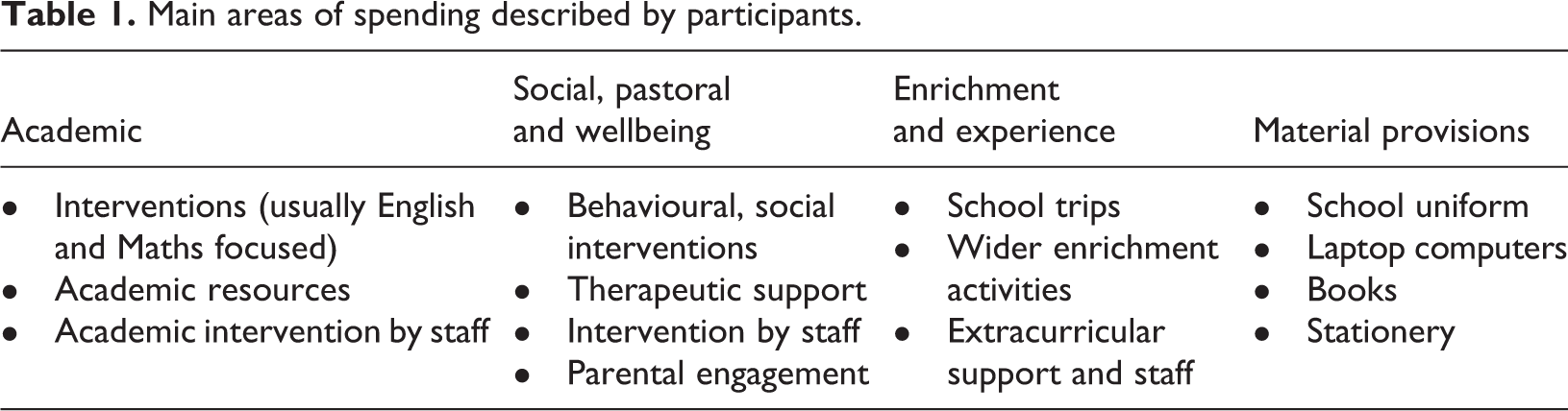
Throughout our discussions with practitioners it was clear that these categories were not always perceived as being distinct. Rather, they highlighted considerable overlap in the different ways the funding is used and the potential this might have for achieving different outcomes. Spending on social interventions, for example, was very often reported as being an important ‘stepping stone’ to supporting pupils with accessing their academic studies. Similarly, a number of participants felt that paying for pupils to go on school trips or participate in extracurricular activities would have a positive impact on the development of social and behavioural skills and enhance cultural capital.
The experiences and values of our participants, and of their schools, emerged as key drivers for the way they prioritised PP funding, and for the decision-making process with regard to spending. School leaders reported that personal and professional experiences such as parenting or working with disadvantaged children in previous settings often informed their existing practices. This head teacher of a special school, for example, describes how going through the adoption process encouraged her to see the potential value in transferring nurture-based strategies to schools. The school then used PP funding to invest in resources such as a specialised nurture room and staff to support children and participation in the nurture group network: I’ve got a child who’s adopted, so we did a lot of training around nurture when we went through the whole adoption process…we had to do something a bit different, so nurture was about really bridging that gap between home and school and actually having that consistent person, having those consistent values, modelling positive adult children relationships so it’s been used in a quite mercenary way to get the results to kind of keep Ofsted off our back. Now, I know that all sounds for the wrong reasons, but it has been used that way.
One phase leader and SENCO at a ‘good’ primary school in an area of high deprivation in the Midlands explained that in addition to a small number of literacy and maths interventions, the school used PP funding for a private speech and language therapist, for trips and enrichment activities and to employ another member of staff to help run the breakfast club. She described the school as taking a ‘holistic’ view of the children’s education, ‘because obviously we’re trying to educate the whole child and it’s not just about academia’. This commitment to supporting a child’s wider development and outcomes was clear from the majority of our participants. Unsurprisingly, perhaps, it was particularly highlighted by those who had roles that were directly linked to pastoral support, wellbeing or inclusion. One assistant head, for example, who was also a SENCO, the safeguarding lead and head of LAC provision, championed the use of PP funding to pay for an educational psychologist to work with specific children, the development of a new forest school and the employment of a specialist sports coach. Interestingly, this view of the different ways in which the funding can be used contrasts with that of one of our participants who is a virtual head, responsible for LAC educational achievement in a large urban local authority. His role includes supporting and facilitating the spending of the PP specifically provided for LAC: it’s meant to be used, the difference between obviously the LAC pupil premium and the general free school meals pupil premium, that money is meant to be used specifically to support that child’s individual learning targets as contained in their PEP, their personal education plan…it’s meant to be linked to their targets and used in the best possible way to raise their attainment. So, it’s not kind of SEN money, if you like, it’s not meant to be used particularly for alternative provision, it’s certainly not meant to be used for things like school uniform, school transport, it’s meant to be to raise attainment and we work with schools in a kind of role of challenge and support around how that is done. they [the students] go in if we have outside agencies, so we’ve nurses in, we have EPs [educational psychologists], social workers and everything else, so they can go in there with them, have that privacy and comfort, but the main thing was that they start seeing school as a positive…even just playing a simple game, like in maths, I’ve done battleships with them, they didn’t want to play it, it’s rubbish and at the end, they’ve actually asked for the sheets to do at break time.
When asked what information influenced the decisions in relation to PP spending, a range of sources were cited. Reflecting earlier work, we found that the majority of leaders used their previous experiences to inform their PP spending choices (Carpenter et al., 2013). A third made reference to strategies or approaches that they had heard had been successful in other schools, and three participants (all head teachers) made reference to the Sutton Trust/EEF Toolkit. The governors in our study provided an interesting perspective on this issue too. They noted that decisions about spending were taken by the school leadership team and tended to be presented to the governing body along with data that justified the need to target certain groups/pupils with particular spending strategies or interventions. None of them reported being made aware of a wider evidence base for the spending choices.
The apparent lack of engagement with ‘harder’ research-informed evidence by the majority of participants is important. It indicates that despite growing numbers of leaders and teachers reportedly using research to determine spending decisions (Sutton Trust, 2019) there is still a substantial proportion who do not. This raises a number of questions about how aware leaders are of resources such as the Sutton Trust/EEF Toolkit but also about barriers or challenges that leaders might face in its use. This head teacher reported her experience of engaging with research evidence: as that money came in, there was more research around it, certainly the Sutton Trust, but it was up to head teachers to kind of go out and find that research. It did become more obvious when you went to train, but you had to put yourself on the training. It wasn’t something that was rolled out with training with this is the best use, research shows us that. That was something that you had to do as an individual. We did a lot of research with the Education Endowment Foundation and Sutton Trust and looked at their websites, but actually most of the money went on staffing, if I’m honest, staffing and staffing to be able to deliver interventions.
Conceptions of disadvantage within a school and community context
All of the participants in our study were clear that the PP funding had been introduced to support pupils deemed to be disadvantaged. Interpretations of how ‘disadvantage’ was to be presented, however, varied and were often linked to school/intake characteristics and the local context within which the school was based. Although leaders understood that the number of pupils eligible for PP is based upon an indicator of socioeconomic disadvantage (FSM), the majority tended to equate this with these pupils also experiencing a lack of social and cultural capital. As noted above, this issue was then targeted by PP spending. The area in which a pupil was living or the social background of his/her parents were often used as explanations for a deficit beyond just financial disadvantage. For schools in socially deprived areas or serving a high proportion of disadvantaged pupils, leaders tended to share information about the additional challenges that they assumed their pupils faced, predominantly focusing on areas such as a lack of parental support and learning resources at home, and a lack of opportunity to travel outside of the area or to engage with wider experiences. As such, those responsible for the PP felt that addressing these issues was an appropriate use of the funding irrespective of whether it had a direct link with improving pupils’ educational attainment: they don’t have very many life experiences, they’re born in this area, they die in this area and they don’t really go outside the area at all really. A lot of our children have never been to the seaside [on a trip to a local park we] saw Canada geese and you know how the geese are, they start snapping and all of this and that and two of the boys thought they were penguins, because they’d never, ever, ever been out and about and actually seen them before we’ve used the pupil premium money to buy in the services of a private speech and language therapist, because the services that we were getting from the National Health, because obviously of the cutbacks, it was taking up to seven months for obviously a child to be seen by an actual National Health speech and language therapist
By contrast, a leader and SENCO in a primary school in an affluent suburb of the city explained that they have just a single pupil on the PP register: I think that it meets the needs of this child, so in my school, being such an affluent area, for example, if this child was not able to participate in the trips or the after school clubs or the music lessons, she would be disadvantaged sort of socially and feel excluded from her peers.
Accountability and demonstrating impact
A final key finding from our study is the high priority that school leaders place on justifying PP spending and attempting to demonstrate the impact it has. Our participants explained how spending choices were often driven by the need to report on the money spent and all were aware that schools were required to publish their PP strategy and spending on their websites. Having these documents publicly available meant that leaders wanted to ensure that the reported funding use was seen as sensible and uncontroversial. They were also acutely aware that the school inspection body, Ofsted, was likely to look at this PP strategy document, and potentially use it to inform judgements about the school and its performance.
In line with other studies on the role of Ofsted in policy implementation (Perryman et al., 2018), our findings suggest that decisions surrounding the use and reporting of PP funding were sometimes influenced by perceptions of what the inspection body would want or expect to see. To respond to these, schools and leaders employed a series of strategic behaviours in order to ensure that they were both adhering to the bureaucratic regulations (i.e. recording and publishing PP use) and demonstrating impact at a pupil and school level. In relation to the first of these issues, some participants shared their experiences of creating spreadsheets and folders, including meticulous detail on expenditures for each individual PP child. There were mixed views on this kind of monitoring and accountability. A small number of participants questioned the extent to which the PP documents and strategies were accurate reflections of actual decision-making and spending. By contrast, this primary school head teacher felt that rather than simply reporting PP use in an ad-hoc fashion, there was value in setting out a clear strategy for informing spending and indicating impact: it can be an empowering, informative tool, because if you actually have a designated provision map for how that money is spent and measure the impact always for that, then actually you do get value for money and you do utilise that money and help children that really, really need it. I don’t feel like there’s enough rigour from a kind of national point of view to assess how you spend it. Even during Ofsted, I had an hour’s interview with Ofsted back in February, March, over SEN and pupil premium…I thought, you know, and I’m confident talking about it and I feel like I know what I’m talking about, but she just sort of fluffed over it and I thought, you’ve actually genuinely no idea whether I’m spending that properly or not.
Indeed, our findings remind us that demonstrating the impact of the PP on a pupil and at school level, is a nearly impossible task for either Ofsted or school leaders. Although some of our participants employed the policy discourses associated with ‘progress’ and ‘closing the attainment gap’, and felt optimistic that the PP funding was positively affecting the areas in which they had invested it, a small number of other leaders were more sceptical: they do attribute it to the pupil premium funding because they’re required to do so. There are many other factors and you can make out a case that we’ve done this with this group of students and they’ve achieved this…but of course, there are so many other potential factors there, you couldn’t attribute it to the pupil premium. We had an Ofsted and our pupil premium children did very well, we had a letter from Government to congratulate us on our pupil premium outcomes and invite us to the Pupil Premium Awards…but I’m not sure how much of that was down to quality first teaching and making sure we got our teaching right for all children and then it kind of followed because we had such a high percentage, so had they not done very well, actually the school would have not done very well, so I think that was more to do with actually…I don’t think of that pot of money in isolation, if the school is not doing very well, you tend to find that pupil premium children aren’t doing very well
Discussion and conclusions
Our findings here provide important and original insights into factors that influence school leaders’ spending decisions in relation to their PP budgets. In line with previous studies, we note the range of interventions, services and resources that PP money is used for. However, due to the in-depth nature of the data collected, we go beyond this in order to better understand the context and mechanisms involved in driving choices about spending. Our participants highlight the ongoing role of professional (and sometimes informal) networks as well as professional and personal experience. The use of research evidence was, seemingly, less important, with some leaders showing awareness of organisations like the EEF and their outputs, but indicating fairly limited engagement with these. Although the emphasis on evidence-informed practice continues to receive considerable attention from policymakers and others, there continues to be a clear evidence–practice ‘gap’ (Morris et al., in press). Further work is needed to better understand how teachers can be encouraged to engage with and use research evidence effectively in their practice.
Crucially, however, there are also questions about the extent to which simply providing research information to schools will have an impact on pupil outcomes (Lord et al., 2019). Having access to high-quality evidence is a positive thing in itself but it would seem that in order for leaders to see the relevance and application of this in their own context, further strategies are needed. It is also noteworthy that the leaders in this study working in alternative provision or special schools reported very little use of research evidence in informing their PP spending. The reasons for this are beyond the scope of the data here, but it is perhaps the case that they do not see the sources of evidence available as being particularly targeted at the needs of their children. The majority of EEF trials, for instance, are carried out in mainstream school settings, and although many of the findings are potentially applicable to other contexts, this transferability may not be clear.
In line with policy aims, the school leaders within our study indicated a focus on using the funding to support the academic attainment of their PP pupils. In order to achieve this, however, they often reported the importance of investing in non-academic interventions (social, behavioural, cultural, attendance), which they felt would lead to pupils being able to achieve better in their curriculum subjects. These discussions were framed within a notion of personalisation and meeting individual needs in order to improve attainment. However, some of the examples shared raise questions about the causal links being made between these spending choices and their actual outcomes. The research evidence in relation to, for example, the effect that school uniform or parental engagement strategies have on attainment is inconclusive (EEF, 2018; Gorard, 2012). Using PP funding for these approaches may well be positive for other reasons, such as supporting an equitable ethos and promoting community involvement, but may have little impact on attainment. It is vital that leaders are informed and realistic about what might actually work to improve disadvantaged pupils’ outcomes if these limited funds are to be used most effectively.
A further key issue to emerge from our work was the significance of school- and community-level characteristics in influencing leaders’ knowledge and perceptions about their intake and, in turn, decisions on PP spending. Use of the PP was often justified as a way of addressing a deficit in economic, social or cultural capital linked to pupils’ lives outside of school. ‘Disadvantage’ was often discussed as a ‘catch-all’ term, a way of describing those eligible for the PP, but also those with SEN or behavioural difficulties, pupils from ethnic minority backgrounds and, sometimes, those with English as an additional language. Of course, some of these pupils may be eligible for the PP, but there is an indication from our data that the proportion of pupils with certain ‘labels’ and the perceptions of ‘disadvantage’ in the local community may have influenced the way that the PP funding was used. This raises important concerns about the extent to which the money is being used to meet the individual needs of specifically poorer children who are falling behind academically (the purpose of PP) and also forces us to consider whether allocation based on a non-academic measure (socioeconomic background) is sensible or not. Directing additional funds towards those who are disadvantaged is well meaning and potentially valuable, but if schools conflate poverty with other characteristics (some of which have actually been shown to be positively associated with academic achievement), then we run the risk of unhelpful stereotyping of both individuals and communities and, potentially, poorly targeted or unfair resource use.
Our study also highlights the importance of understanding education initiatives within a broader policy and societal context. Some leaders reported the need to use PP funding to cover gaps in their wider school budgets and a lack of investment in schools in recent years. Again, in situations in which this was the case, leaders were aware that this was not what the PP was designed for. If leaders are having to use it in order to retain teaching or support staff, or to contribute to costs associated with running the school as a whole, this is not the purpose for which it was intended, and further runs the risk of having no impact on the pupils it is targeted at.
The role of policy and practice relating to accountability in schools also pervaded our data. Leaders demonstrated their awareness of needing to present sensible and impact-focused accounts of how PP funding had been used in schools. Perhaps unsurprisingly, a school’s existing performance level (as determined by Ofsted or attainment data) was frequently linked to the necessity of demonstrating that PP spending was having a positive impact. For those with lower performance, there seemed a particular emphasis on ensuring that the reporting of spending was coherent and that it highlighted effectiveness, because this is an area that Ofsted focuses on in inspections. This puts schools in a difficult position in relation to the PP: they are incentivised to confirm that the interventions or strategies funded by PP money have ‘worked’, whether or not they believe that they have. This is problematic for a number of reasons: first, it is almost impossible for teachers or leaders to really know if an intervention that a child – or PP cohort – has received has improved their attainment (or other outcomes) as we do not know how the child would have done without it, or whether other factors might have contributed to any improvement that is observed; second, the emphasis on demonstrating positive impact encourages a confirmatory approach, potentially discouraging leaders from being honest and reflective about the approaches chosen, and providing no incentive to try different or innovative strategies; and, finally, the emphasis on creating a clear and transparent narrative about spending potentially encourages a preference for tangible purchases (school trips, resources, uniform). These items would appear more straightforward to log and account for compared to, for example, a professional development programme to support high-quality teaching for all pupils in the school.
A final issue that emerges from our work is a question about who is best placed to determine how PP funding is used? The policy assumes that schools will use the freedoms they have to spend the money effectively because they know the needs of their pupils and their cohorts best. However, our findings indicate that there are other stakeholders involved in supporting decision-making too. In some instances, parents have shown interest in how the money should be used to support their own children. In relation to LAC, we have also highlighted the role of the virtual head. In addition, school governors are expected to have an understanding and oversight of how disadvantaged pupils are being supported within schools. Interestingly, none of the leaders spoke about the role of the child in determining the support he/she might need. This is perhaps understandable: leaders may feel that children do not have the knowledge or expertise about their schooling to make the most informed decisions. Schools might also be concerned about the stigma attached to PP and may not want to remind children of their PP status. However, there is, perhaps, a case to be made for older disadvantaged children to have some choice and agency over how the money allocated to them could be best used. They may have needs, interests and aspirations that the school is unaware of but that might be supported through a dialogue on the issue, and may lead to improved ownership of their achievement. This additional information channel is likely to be useful in supporting leaders’ professional autonomy and their decision-making within the current challenging policy context.
Despite the PP being targeted funding, it is not always clear that those children eligible for PP are actually receiving the opportunities that it might bring or getting better outcomes than they would without it. Without careful use, the funding may lead to a limited, null or negative impact for individual pupils and at cohort level. Although it appears that a growing number of school leaders are reporting the use of evidence to inform PP spending, it is clear that there are questions and challenges in relation to the kind of evidence that might support decision-making and its accessibility or interpretation. However, even with considerable improvements in this area, it is still not clear how much difference the PP can make for disadvantaged pupils. The PP is allocated based upon inequalities that are beyond the control of the school, that is, LAC or socioeconomic status. Schools play an important role in children’s lives, but even with additional resources it is unlikely that they can compensate for the inequalities that children experience beyond the school gates. Developing and investing in policies that seek to reduce poverty, and that address and improve the home, community and school intersections associated with disadvantage and underachievement is likely to be an important and beneficial approach.
Supplemental Material
Supplemental Material, Appendix - Spending the pupil premium: What influences leaders’ decision-making?
Supplemental Material, Appendix for Spending the pupil premium: What influences leaders’ decision-making? by Rebecca Morris and Graeme Dobson in Educational Management Administration & Leadership
Footnotes
Declaration of conflicting interests
The authors declared no potential conflicts of interest with respect to the research, authorship and/or publication of this article.
Funding
The authors disclosed receipt of the following financial support for the research, authorship and/or publication of this article: The authors are grateful to the School of Education, University of Birmingham for funding this study.

Supplemental Material
Supplemental material for this article is available online.
References
Supplementary Material
Please find the following supplemental material available below.
For Open Access articles published under a Creative Commons License, all supplemental material carries the same license as the article it is associated with.
For non-Open Access articles published, all supplemental material carries a non-exclusive license, and permission requests for re-use of supplemental material or any part of supplemental material shall be sent directly to the copyright owner as specified in the copyright notice associated with the article.
