




Abstract
This Australian case study explored the implementation of strategies to support the development of a positive school culture among whole school staff. A participatory action research approach was used to involve leadership staff in the development of a mixed method assessment of the school organisation. Baseline data from the School Organisational Health Questionnaire (n = 28) and qualitative data from focus groups (n = 15) were collected and presented to the leadership team who identified four foci for the study: appraisal and recognition, participative decision-making, professional growth and supportive leadership. After a range of interventions, findings from both post-test surveys (n = 22) and qualitative data (n = 30) suggested a change in leadership style was a key factor of school cultural change across all factors. The case study highlights a number of visible strategies that were employed to increase morale and improve staff wellbeing.
Introduction
School leadership behaviours are consistently acknowledged as a core factor in influencing school improvement (Leithwood, Aitken and Jantzi, 2006; Sigurðardóttir and Sigþórsson, 2016), and have been linked to teachers’ emotions (Berkovich and Eyal, 2017) and wellbeing (Berkovich and Eyal, 2018). This Australian secondary school case study employed a Participatory Action Research (PAR) design to explore staff school culture. The literature suggests that visible leadership (Austin and Harkins, 2008a; Devos et al., 2013; Benoliel, 2018) leads to a strong school culture and the ability to respond to staff needs and support ongoing development in school organisations. Their actions are influential on school morale, culture and climate (Devos et al., 2013; Minckler, 2013). However, there appears to be less literature on how to achieve positive school culture and climate through active intervention.
One issue that is identified in the literature is a conflation of the terms school morale (Guidetti et al., 2015) and school culture with school climate (Maier, 2017): for example, the main instrument used in this study, the School Organisational Health Questionnaire (SOHQ) (Hart et al., 2000), measures school organisational climate through morale and a number of associated factors. For the purposes of this research, we used the term school culture to mean the collective values and beliefs of school staff, encompassing how these are enacted in practice (i.e. how the culture affects school climate). This definition was applicable to this study as its focus was on the PAR process and how strategies were implemented (i.e. the behaviours and practices introduced) in order to shape the school culture.
Three research questions formed the basis of the study: What factors contribute to the development of staff morale and the school organisational climate? What foci do school leadership staff view as being important for the development of a positive school culture? Does the attention paid to particular foci improve staff morale and the organisational climate over time?
The aim of the project was to engage secondary school leaders in Participatory Action Research in order to explore the research questions. Central to this study was the notion of supporting school leaders to collect and use data to direct school change, critical to a school’s success in this educational climate of increased accountability (Gurd, 2013).
Literature review
This literature review considers previous research in a number of areas: supportive leadership and communication, professional growth, which affect staff morale and the school culture; as well as data and accountability, which was a key reason for the case study school moving towards evidence-based measures to justify interventions into their practices. The literature presented draws on different studies in a number of countries using a variety of methods to identify issues concerned with supporting positive school culture through interpersonal relationships (Austin and Harkins, 2008a, 2008b).
Supportive leadership and communication
Hallinger (2018) notes the important role contextual factors play in the development of leadership practice theories. Zhu et al.’s (2013) comparison of teachers in 44 Flemish and 40 Chinese schools found that individual school contexts can cause differentiation in participative decision-making and leadership, among other broader cultural factors. However, the notion of supportive leadership as a general practice is consistently noted in the successful implementation of reform and changed behavioural practices in schools (Leithwood, Aitken and Jantzi, 2006; Levin and Datnow, 2012; Nguyen and Hunter, 2018), especially when they draw on staff’s collective strengths in collaborative practices (Leithwood et al., 2007). An Australian study (Austin and Harkins, 2008a, 2008b) also found that effective communication by a supportive and inclusive leadership is useful in changing school organisational climates, but caution that collaboration takes time and may add to workload stresses, and conflicts between diverse perspectives can threaten interpersonal relationships. Nguyen and Hunter (2018) also consider the importance of interpersonal dynamics, as the distribution of leadership changes the ‘status and normative roles of teacher leaders’ (p. 558).
In discussing Hong Kong public secondary schools, Walker et al. (2014) emphasise communication, professional development, the strategic use of resources, appraisal and recognition and encouraging engagement in decision-making as important to school goals, accountability and successful organisational change. They note that these leadership practices, and specifically communication, account for significant differences in students’ academic outcomes, which was also supported by Sebastian et al. (2017), Hallinger (2018), and Robinson, Lloyd and Rowe (2008). Communication also has a substantial effect on teachers’ job satisfaction, with fairness of decisions regarding work assignment (You et al., 2017) and the perception of fairness in teacher evaluation and promotion (Liu et al., 2018) being three key areas where communication strategies make a difference. Job satisfaction, as well as morale and wellbeing, also improve when staff feel that principals have empathy and care (Van der Vyver et al., 2013). These factors have prompted investigation into principals’ conversations with staff, emphasising reciprocity and trust as key foundations for positive interpersonal relationships (Le Fevre and Robinson, 2014; Meyer, Le Fevre and Robinson, 2017).
Professional growth
School leadership plays a significant role in staff members’ professional growth. The promotion of staff learning (or lack thereof) is one factor that affects a school’s culture (Grosemans et al., 2015; Kwakman, 2003). While teachers and other staff members may be individually motivated to participate in professional learning, leadership practices can create a culture that shapes how collaborative professionals are within the school context (Grosemans et al., 2015; Kwakman, 2003; Leithwood, Harris and Hopkins, 2008). It can also affect how diverse professional learning is in the school, where some schools may focus on a whole-school approach to learning and others may encourage more diversity between departments and individual staff members (Grosemans et al., 2015).
Professional growth is also linked to supportive leadership, as opportunities for communication and participative decision-making also develop staff as professionals. Austin and Harkins (2008a) found that leadership was instrumental in creating learning practices that relate to a shared vision and celebrating and recognising staff learning. Staff who feel safe and valued by leadership are more likely to contribute to decision-making and embrace opportunities to contribute to the school (Austin and Harkins, 2008a).
Data and accountability
Schildkamp et al. (2017) examined the extent, purposes and challenges of data use in schools for evidence-based decision-making. Their study involving 1,073 teachers throughout the Netherlands showed that schools make effective use of data with respect to accountability and school development, but less so for classroom instruction. Schools in both the UK and USA have also experienced similar issues in terms of school accountability and its impact on staff and the school community (Gurd, 2013; Sterrett and Irizarry, 2015), finding a need for evidence to contribute to and justify decision-making at a school level.
The issue of school accountability has led to intensification of teachers’ roles, as they have increased administrative work (De Nobile et al., 2013; Timms et al., 2007). Administrative and leadership staff are also required to maintain organisational standards compliant with national bodies, and in Australia this includes reporting to the Australian Institute for Teaching and School Leadership (AITSL) and state education departments (AITSL, 2011; Gonski et al., 2011; Watterston and Caldwell, 2011). In a culture of accountability, the use of data has also attracted the attention of researchers and supported school and university partnerships: for example, the Principals as Literacy Leaders national Australian project (Dempster et al., 2012) examined the role of principals in promoting children’s literacy development in their schools, utilising research methods and researcher support to assist principals’ use of data in promoting quality learning and teaching.
Methodology
Participatory Action Research (PAR) using surveys, interviews and focus groups was employed in this research, underpinned by a case study approach (Sanders, 2016). The research was informed by a constructivist epistemology, whereby the researchers worked across all organisational levels of the school (leadership, teaching staff and support staff) in order to co-construct an understanding of the school culture. PAR involves participants actively engaging in a cycle of identifying, acting and reflecting to develop ‘practical knowing in the pursuit of worthwhile human purposes’ (Reason and Bradbury, 2001: 4), and in this research the researchers co-developed the interventions and overall project with participants. The rationale for actively engaging participants in this process is to encourage social change through critical self-reflection and transformative action (MacDonald, 2012; McIntyre, 2007; Stapleton, 2018).
In PAR, there is an emphasis on whose voices are being heard and how practical actions can be implemented (James et al., 2008; Kemmis and McTaggart, 2007; Stapleton, 2018). The implementation of research findings occurs in a non-hierarchical and usually confidential setting within a workplace situation, where participants make informed decisions to activate social change through specific actions based on their own knowledge alongside the evidence (James et al., 2008; MacDonald, 2012).
School context
The case study school is a metropolitan secondary school. It has been operating for the past 15 years, making it a relatively young school in the district. The staff at the school are predominantly early career teachers (in their first 5 years), mentored by mid-career teachers with a small leadership group (<10 staff). Both staff and student populations have low transience, with a predominantly Eurocentric demographic. However, the population in the area is growing and enrolments are increasing. Three principals have led the school; however, the current principal was in the role for approximately 6 months at the commencement of the research. Staff explained how the ‘new’ principal had a different leadership style to the previous principal and was very approachable as an individual. However, many staff were apprehensive about the leadership change as resulted in reforms to established school practices, partly as a consequence of the principal’s aspirations to grow the school.
Research procedures
This research included three phases, with a summary of procedures provided in Table 1.
Overview of research procedures.
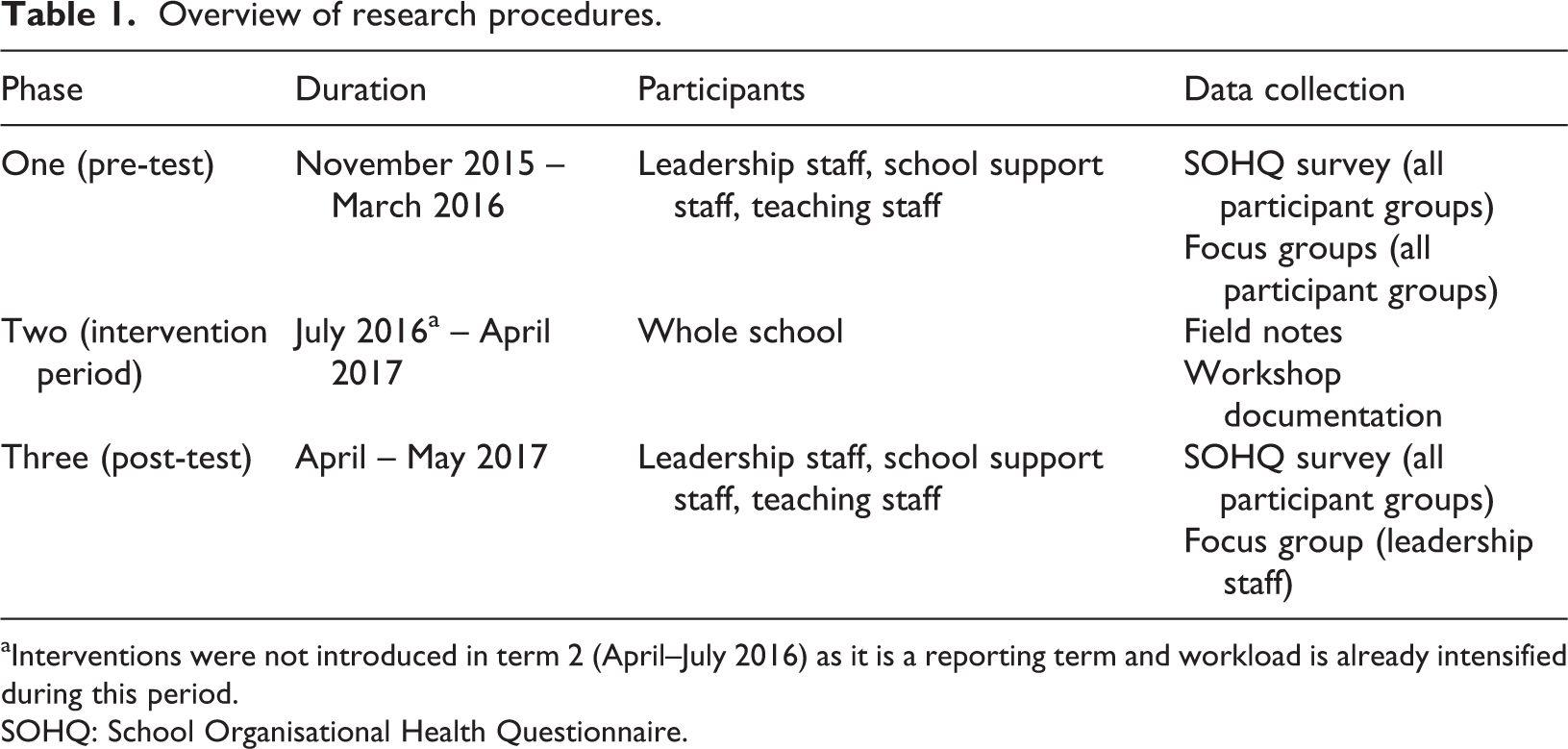
aInterventions were not introduced in term 2 (April–July 2016) as it is a reporting term and workload is already intensified during this period.
SOHQ: School Organisational Health Questionnaire.
In the first phase baseline quantitative data were collected using the School Organisational Health Questionnaire (SOHQ) (Hart et al., 2000). In accordance with the University’s Human Research Ethics Committee approval and permission from the local education department, the survey was made available online to all school personnel and data were collected anonymously. The first phase quantitative data were supported by qualitative data collected through focus groups. With the exception of the leadership team, these events were held at a location away from the school to enable participants to speak freely and to avoid interruptions likely to occur if they were in the work location. Each group comprised staff from the same category (leadership staff, teaching staff or support staff) to minimise the potential for significant power differential among participants, and teaching and support staff attended on different days to maintain participant confidentiality. All of the non-leadership participants were female, with aggregate data across the focus groups presented to protect participants’ confidentiality when reporting back to the school. Each focus group conducted was audio recorded and transcribed by an independent organisation.
In phase two, the school leadership team developed their own interventions based on the phase one findings. They opted to focus the research on areas that had the lowest scores in the SOHQ, substantiated by qualitative data. To support the development of the intervention, the researchers arranged for a workshop to be conducted by a well-respected retired secondary school principal, and the school leadership team chose a range of school staff to unpack the data as part of the workshop and feedback potential phase two interventions. The leadership staff actively chose diverse staff to participate in this workshop as staff-designed interventions were expected to increase their potential success; decision-making styles of the leadership (Hariri et al., 2016) and participative decision-making (James et al., 2008) improve teacher job satisfaction and change implementation. Nguyen and Hunter (2018) discuss the relevance of using external consultants to complement ‘professional development planned, implemented, and evaluated by teacher leaders’ (p. 540). The researchers attended the day and took field notes, and the facilitator provided additional documentation from the workshop. The school leadership team took responsibility for monitoring and recording the interventions so they could report on them during phase three and refined the interventions with support from the staff who attended the workshop. In terms of appraisal and recognition, the leadership team implemented structures for formal recognition of inspirational staff as well as seeking opportunities to bring staff together socially in order to build morale, such as morning teas. Participative decision-making approaches were applied through a new development process for the school business plan, and professional growth was enhanced through a restructure of budget allocation as well as increased professional learning occurring on school grounds. Leadership sought to be more visible and consultative in order to be viewed as more supportive. All of the interventions were implemented for approximately 30 weeks prior to post-intervention testing; however, many interventions were ongoing.
In the final phase, the research team conducted post-intervention testing to determine whether the phase two activities played a role in improving the school culture. In phase three, the researchers again provided access to the SOHQ, on the same basis as phase one. Although not all the factors in the SOHQ appeared important in this case study during phase one, it was decided to provide the same instrument in case any significant differences were found between testing occasions. Reason and Bradbury (2001) reiterate that the unexpected results of interventions are ‘one of the best sources of cultural data’ (p. 276). Due to time constraints and low attendance at the phase one focus groups – also noted as issues in conducting PAR (Reason and Bradbury, 2001) – qualitative data were instead collected through two open-ended questions added to the SOHQ, to encourage information from all school staff. This approach also mitigated the confidentiality and unequal relationships ethical issues addressed in the phase one focus groups. However, the school leadership team did complete a post-implementation focus group in order to provide qualitative data about how the interventions worked for the school. Importantly, in order to minimise the issue of power relationships, the principal was excluded from the focus group. This exclusion, which was supported by the principal, enabled staff to talk freely without inhibition from the presence of their senior colleague. The post-intervention focus group included questions about the initiatives put in place across the areas identified in phase two of the process. Questions to guide the group discussion included: What interventions were enacted since the workshop? How have they been going? What has feedback from staff been like? The focus group was conducted by two of the researchers. A digital recording of the focus group was transcribed, analysed and presented as a thematic analysis (Braun and Clarke, 2006) alongside the qualitative data collected through the SOHQ.
It is important to note that, in order to protect participant confidentiality, school staff did not take an active role in collecting data. However, they were involved in data analysis through the phase two workshop, during which the facilitator supported the staff to unpack the data and researchers’ analysis in order to make sense of it and shape potential interventions for this phase. Other staff members were encouraged to read the baseline data report and talk to their colleagues in order to give feedback about the interventions occurring in the school.
Instrumentation and analysis
The SOHQ measures teacher morale and school organisational climate and assesses a series of organisational behaviour and human resource management issues within schools (Austin and Harkins, 2008a; Hart et al., 2000). This instrument was designed to measure staff morale and 11 associated factors of school organisational climate: Appraisal and recognition; Curriculum coordination; Effective discipline policy; Excessive work demands, Goal congruence; Participative decision-making; Professional growth; Professional interaction, Role clarity; Student orientation; and Supportive leadership. The SOHQ uses a scale of one to five with higher scores representing better school health. The instrument was validated in Hart et al. (2000); the following examples are indicative of the types of items in this instrument:
Appraisal and recognition. I am regularly given feedback on how I am performing my role;
Participative decision-making. There are forums in this school where I can express my views and opinions;
Professional growth. I am encouraged to pursue further professional development;
Supportive leadership. The administration in this school can be relied upon when things get tough.
This instrument has been employed in research across different disciplines and is recognised as being relevant in different contexts (Austin and Harkins, 2008a; Neal et al., 2000). It has been used in international research on teacher motivation (Burns and Machin, 2013) and in overall school health in an economically challenged location (Austin and Harkins, 2008a). Sun and Stewart (2007) employed this scale as part of their large research project examining resilience measures in primary school settings. Subscales from the instrument have also been applied in recent research (Austin and Harkins, 2008b; Gore et al., 2015).
Central tendency and distribution were computed on the data before Cohen’s d effect sizes were used to determine the size of the difference between phase one and three. Cohen’s d was applied since tests of significance on their own provide insufficient information about the magnitude of the difference (Sullivan and Feinn, 2012). This approach is supported by the American Psychological Association’s publication manual (2010). Cohen’s d (Cohen, 1992) indicates a small effect size at .30; a medium effect at .50; and a large effect at .80.
The structure of the SOHQ was employed to develop semi-structured focus group questions for both phases one and three. All focus groups were audio recorded and then transcribed. The researchers conducted a thematic analysis of the transcripts, combining the data for all three focus groups, until a schema of common themes emerged from the data. This analysis was then presented alongside the quantitative findings, to further unpack and give context to the changes that occurred as a result of the interventions. In phase three, only the school leadership staff participated in a focus group. Qualitative data from teachers and support staff were collected through the survey, and consequently, these data were added to the leadership data after transcription and prior to the thematic analysis (Braun and Clarke, 2006).
Results
The quantitative findings from the phase one and three SOHQ surveys are outlined in Table 2. Only eight of the 11 scales returned reliability scores (α < .70) that allowed further analyses to be conducted, so central tendency and effect sizes were only calculated for these scales. These eight factors appeared to be consistently contributing to the development of staff morale and the school organisational climate for this case study school.
Pre and post scores for eight scales of the SOHQ (Hart et al., 2000).
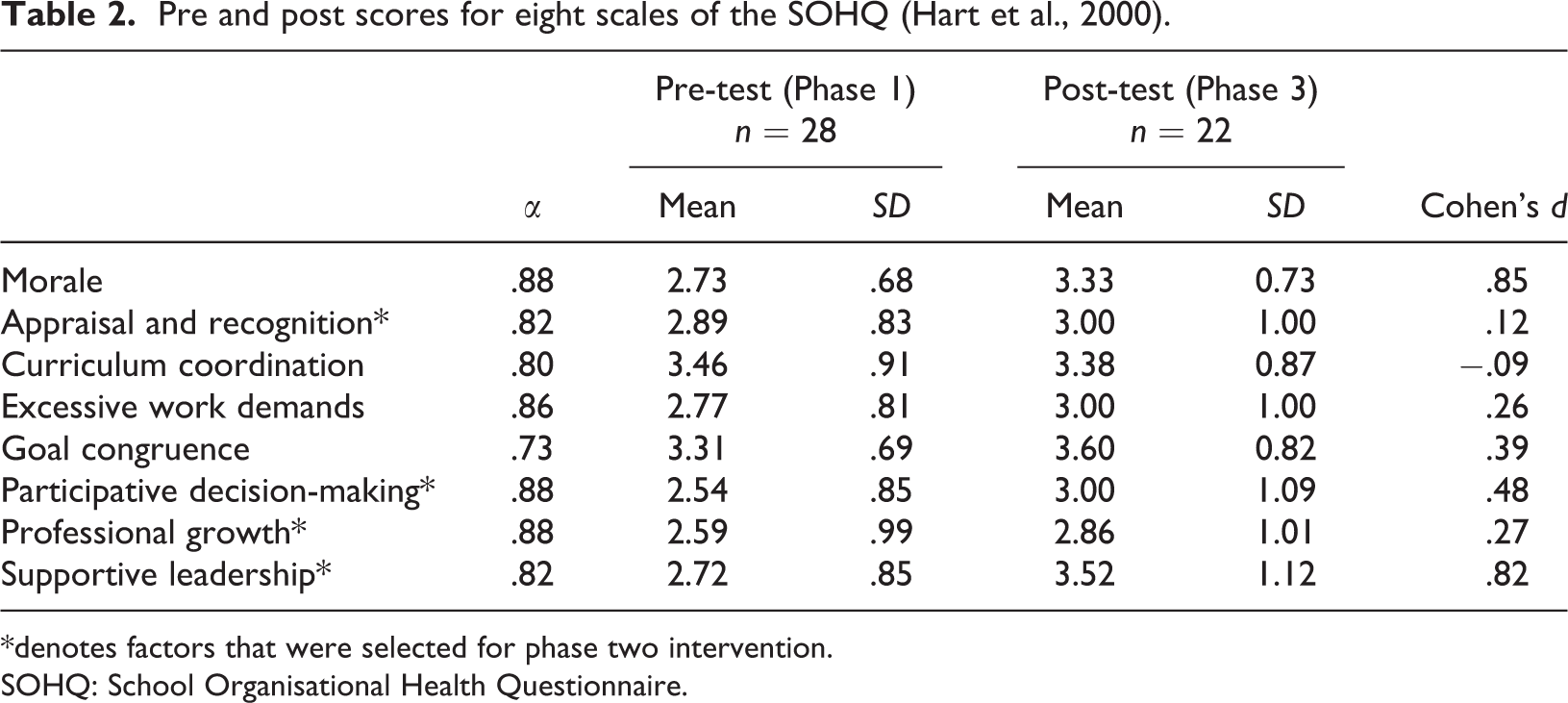
*denotes factors that were selected for phase two intervention.
SOHQ: School Organisational Health Questionnaire.
There were small sample sizes in both phases, with the sample comprising approximately 40% of the school staff in both phases. While the participation rate may seem relatively low, the total school population includes staff on short-term contracts and those who do not work during school hours (e.g. cleaners). Given their employment situation, these staff are less likely to see the benefit of engaging in a research project on school culture. The responses to the post-test were only inclusive of participants who had given consent during the phase one research, with statistics computed where cases could be matched.
As the SOHQ is scored from one to five, higher scores indicate healthier situations. The results from the case study school indicate increases across most factors ranging from small to large effect sizes; and although curriculum coordination shows some decline, the effect size is negligible. However, the items within excessive work demands are phrased differently to those in the other factors and as a result the mean score is in opposition to the other results. In this factor, the small increased mean for phase three indicates a small increase in work demands with a corresponding small negative impact on overall school health (Stapleton, 2018). Regardless of these two negative trends, the positive effect on staff morale was large (d =.85), indicating an overall improvement in morale.
A positive change was observed on all four factors that were selected for the phase two intervention, although the effect size of these changes varied. Based on the phase one pre-test findings, the school leadership staff decided to intervene in appraisal and recognition, participative decision-making, professional growth and supportive leadership. These formed the basis of the phase two intervention workshops, and small strategies were applied within the school that aimed to improve the scores on these scales. Negligible to large effect sizes were found across all four factors, with the smallest effect for appraisal and recognition (d = .12) and the largest effect for supportive leadership (d = .82).
In order to understand how and why the improvement occurred for each of the four factors chosen, qualitative data were collected on both pre- and post-test occasions. The sections below outline aggregated responses from staff across three groups: leadership staff, teaching staff and support staff. In the pre-test an additional 15 staff took part in focus groups; however, more qualitative responses were collected on the post-test occasion (n = 30).
Appraisal and recognition
Appraisal and recognition had the smallest improvement overall. The pre-test data showed that staff responded ambivalently or negatively to the items in this scale, which included statements about work performance (e.g., ‘I have the opportunity to discuss and receive feedback on my work performance’). However, in the phase three post-test there were marginally fewer negative responses and most participants’ responses tended toward ambivalence (indicated in the mean difference +.11).
Core issues identified by the staff in phase one included a lack of appraisal for teaching staff beyond mandated performance management activities. Some staff explained that ‘[our] only feedback is from the students’ and we ‘don’t see [struggling staff] getting the skills they need’. Staff also consistently stated the lack of social opportunities for staff to recognise each other’s successes.
The phase three data showed a number of interventions around recognition that were apparent to the whole staff. There were more examples of opportunities for acknowledgement of staff: Every week we are asked to nominate staff…through a survey monkey…who [are] inspirational…who go above and beyond. [Staff are being congratulated for] doing a good job…not just from the Executive, but [other staff]…that’s been really powerful…everybody is aware that what they’re getting is getting acknowledgement and they can get acknowledgement from everybody in the staff.
Participative decision-making
There was a small-medium effect size (d = .47) on participative decision-making, and while there was greater variance in the phase three data, the mean score had increased (+.44). In phase one, the focus groups elicited emotive data about decision-making processes in the school. Staff stated: ‘It just gets made and then we’re told’ and ‘sometimes decisions are already made and it’s a process of false consultation.’ However, even in phase one, staff did note that the current school principal had an open-door policy that was different to past principals and indicated to staff that they could raise issues with the principal directly.
In phase three, the data from focus groups changed considerably. The staff explained how the research itself had been the catalyst for improved decision-making processes: ‘Yes, the leadership team made significant changes to all four areas and ensure all staff have been part of the change.’ A notable comment was made about the school’s business plan: ‘Staff were consulted…and [the plan has] been sharpened as a result of the consultation…[we produced a] visual in every staffroom [to share changes].’ The staff explained that as more people were consulted ‘people push in the same direction’, which allowed for consensus decision-making. However, staff noted that there was still further improvement to be made. There was still some disagreement around timetable decisions, although staff explained this was unlikely to be resolved: ‘Timetabling – I don’t know whether we will ever agree, but there isn’t a perfect timetable and compromises must be made. There is a lot of thought that goes into the timetable.’
Professional growth
There was a small effect size (d = .37) for the professional growth scale and while there was not a great change in mean scores (+.37) more staff were ambivalent to the statements in phase three compared to the higher levels of disagreement in phase one. In explaining the support for professional growth, the focus group data from phase one emphasised a number of issues. First, internal promotion was not seen to be merit based: ‘it’s not open to the staff to put their hand up…someone will just get tapped on the shoulder.’ Due to the small population of the school it was not always possible for staff to gain a breadth of experiences to support them in applying for external promotion to other schools and, as a consequence, there was a feeling that staff were stagnant in their development. Second, applying for professional learning was seen as a key issue. The lengthy administration process for applying for professional learning caused staff to miss opportunities to enrol in courses. Budgetary constraints also limited staff opportunities, as they were not always allocated teacher release in order to attend workshops. Consequently, many staff were engaging in weekend professional learning, some of which was self-funded.
By the time of the phase three focus groups it was evident that professional learning had been initiated by the leadership group to focus directly on managing student behaviour in general, and more specifically classroom behaviour. Staff were provided with 3-hour courses as well as one-on-one mentoring for individual teachers, an approach that involved a great deal of planning and teacher release as part of the school-wide initiative. The participants valued the significant commitment to professional learning, especially through a whole-school approach that was open to everyone: I would like to say and in terms of managing behaviour and classroom behaviour, we’ve actually had a whole school approach…[I see] classroom management strategies that work…every individual staff has been…inducted here…conferenced…in the short time I’ve been in my position. A lot [has been done] to support staff with behaviour management with students at school. That’s a huge commitment…it’s not usually done as a whole school…normally there’s only 10 people or less go…every single staff member has had this professional [learning]. You’re always going to have different levels of budgeting…[because] core subjects are always going to have [more] levels…I think that’s a decision made by senior management…we get a printout of everyone’s [budget] what they have…it’s transparent…And the subjects are now related to the number of students that actually sit the subjects. You can have some really unusual things that you do need to deal with…having that conversation with someone, a colleague…or within a team, that you have to work with and have a really personal close relationship with, and then have to have a really hard, difficult conversation with them, that takes more skill than working with the kids because staff is probably the hardest thing to deal with when it goes wrong. It affects everybody in the team. So, I think we need to acknowledge that. We could probably use some more training.
Supportive leadership
There was a large effect size (d =.70) for supportive leadership, with a substantial increase in this factor from phase one to phase three (mean score difference +.67). Two core issues were raised in the phase one focus groups to explain significant unease in this factor. First, the community was not being maintained by the leadership team, evidenced as ‘developing [community] is left to the individual to control…leadership are busy on the phone, doing something else’; second, the leadership team were perceived to be supportive and were increasing workload and stress for staff, ‘they’ve lost some trust…morning tea…that is a social thing…the executive keep turning it into another meeting…lately staff are deciding not to go.’
In the phase three focus groups there was agreement that the school’s senior and executive staff had become more visible since the commencement of the research, talking to students and staff. There was a greater perception of leadership staff as collaborative overall: ‘I’ve been here since the start of the school year…I’ve seen senior staff going around monitoring the impact of the [building program]…speaking to the students, speaking to the staff…collaboration is evident.’
Morale
The positive comments about leadership also related to staff morale, overall. Where staff had commented that all group occasions were becoming ‘staff meetings’, opportunities for social gatherings had been re-established by the leadership team in order to improve morale. Staff focus group data from phase three showed consensus of ‘a history of being very collegial and going to events after school. That seemed to wane off for a while, but now we’re bringing things back.’ School staff estimated participation in these events as 40% to 50% of the school population. We’ve also got a couple of [social] things…people on the social committee who work really hard…they’ve brought in [a] little spinning wheel…we do raffles…there is a ‘bunky prize’…your wine, your chocolate and then someone gets the dud. It’s a bit of humour…they have the spin wheel which is $10 in and they have prizes…the staff are actually getting into that sort of carnival atmosphere…and that all helps to raise morale.
Discussion
There were eight factors that contributed to staff morale and school organisational climate in this case study school. The phase one data indicated morale at the school was low, showing clear areas that would benefit from attention during the phase two intervention period. The eight factors that measured reliably across staff (Table 2) were supported by evidence in the focus group discussions in order to determine the specific areas that would be addressed by this research. Four of these factors were selected by the leadership teams as being important foci for the development of positive school culture; namely, appraisal and recognition, participative decision-making, professional growth and supportive leadership. These four factors had some of the lowest mean scores in the phase one survey data, and their selection was triangulated and supported by the qualitative data.
The phase three results showed that most staff responded positively to the changes made in the school. The most significant change was to the perception of leadership staff within the school. Devos et al. (2013) and Benoliel (2018) discuss the importance of visible leadership in establishing a positive school culture; a notion reinforced in this case study. While the phase one data indicated that the principal’s open-door policy helped to construct a perception of the leadership staff as approachable, the absence of leadership staff outside of their offices had resulted in a disconnection with the rest of school staff. After the intervention phase, participants commented on increased visibility of the leadership team, particularly as they actively consulted staff on the implementation of interventions in the school during phase two. Consequently, visible leadership also appeared to have an effect on improving the level of participation in decision-making. Highly evident in this case was the critical role of leadership staff in establishing and actively driving school change with school staff, consistent with Nguyen and Hunter (2018) who discuss the important role of teacher-leaders in increasing the ownership and uptake of school reform and Leithwood et al. (2007) who discuss the need to draw on collective strengths of school staff as a function of good leadership.
Participative decision-making had the second largest improvement in the study, although qualitative data showed close connections between the leadership and decision-making factors. The PAR method employed in this study was a catalyst for the broader involvement of staff in decision-making, as the development of interventions based on the phase one data presented an opportunity for staff consultation. Unlike a more traditional ‘top-down’ implementation of interventions (Veugelers and Zijlstra, 2005), this case study school opted to have teachers and support staff attend the phase two development workshop where interventions were devised based on the report’s findings. The leadership staff were cognisant that the staff should unpack the data and take ownership of the school’s involvement in the research without feeling coerced by leadership. This approach supported the notion of principals’ communicative connection between educational reforms and the realities of teaching and school practices (Walker et al., 2014), as it afforded staff with an opportunity to think about realistic interventions grounded in their everyday experiences. It could have also acted as a significant event in changing staff attitudes, as they felt that past decisions (prior to phase two) were made with a process of false consultation. The diversity of the workshop attendees was also an opportunity for professional learning as many staff members had no prior opportunities to participate in school-level planning. Consequently, decision-making was linked to professional growth because the staff were developed as individuals when they contributed to collaborative decision-making (Austin and Harkins, 2008b), with leadership having a key role in establishing this culture (Leithwood et al., 2008). The phase three data consistently outlined how the whole school was involved in the project and the interventions, suggesting that even those who did not participate in the research were involved in the changes made by the school.
Professional growth was a substantial issue for staff at the school. With a mean score of 2.59 (SD = .99) in phase one, the staff clearly and consistently disagreed that they had opportunities for ongoing professional learning. However, the staff engaged in whole-school professional learning on classroom management as part of the intervention phase. The breadth of staff involved in this experience is likely to have contributed to the overall improvement in morale as whole-school professional learning contributes to the shared vision of a school (Grosemans et al., 2015) and the promotion of staff learning affects a school’s culture (Kwakman, 2003). Importantly, this case study supports the findings of Austin and Harkins (2008a) and Leithwood et al. (2007) regarding organisational learning in schools and the instrumental role of leadership in creating a common vision, evidenced here in the leadership team’s decision to invest in whole-school professional learning to support a common issue for their teachers. As noted in the focus groups, many schools only send a few key staff members to professional learning; in contrast, this school opted to include this learning experience for every staff member, including in the induction of new staff to the school.
Appraisal and recognition had the smallest improvement of all the factors selected for the phase two intervention. One possible reason for the small statistical change is the wording of the items. While the items more consistently focus on feedback on work performance, the qualitative data for this factor showed that the school had focused on increased recognition of staff rather than on changing formal work appraisal procedures. The staff explained that there were frequent opportunities to nominate inspirational staff members for acknowledgement, and also noted the supportive role of leadership in publicly acknowledging these staff at events. Leadership not only verbally recognised their staff, they also acted in ways that made staff feel valued: for example, the focus group data highlighted how providing catering for staff at parent-teacher nights improved morale during the event and was recognition of their hard work during the year. While recognition is highly important in enhancing staff morale (Willis and Varner, 2010); Walker et al. (2014) discuss the importance of appraisal to staff accountability. Given the increased accountability in contemporary education (Gurd, 2013), it is equally important to consider how staff can best receive and enact constructive feedback on their work, in addition to recognising their positive achievements.
Although each factor of school culture was individually addressed in phase two planning documents, the phase three data showed many connections between the interventions implemented and staff morale. Morale significantly increased in the school, with the largest effect size in the study. The focus group discussion for morale showed that the staff were more collegial, not only professionally but also socially. The consensus from the qualitative data was that the reinstated Social Committee played a large role in this change due to implementing a range of social activities. This type of social capital was identified by Devos et al. (2013) as important to school culture. While it was noted that the Social Committee (made up of staff) meant extra workload, the benefits of these activities resulted in a committee whose members were positive about the impact they were making and the committee’s sustainability. This finding is consistent with Burns and Machin (2013), who suggest the negative impacts of extra workload may be outweighed by the positive aspects of improved organisational characteristics, particularly when they are seen as ‘real action’ in an environment (Stapleton, 2018: 16). The notion of a shared vision was also common in the phase three data, especially in leadership co-designing the school’s vision with the school staff. The general improvement in awareness about vision in this study is consistent with investigations into the role of direction setting (Sun and Leithwood, 2015) and is also likely to have enhanced collegiality between staff.
Limitations of the research
Working within a PAR process, the researchers maintained notes about the school during the period of the research. These field notes included documentation of a new building program at the school that was negotiated during the study, which resulted in additional workload for the staff. Whilst there were intersections between the building program and this research, namely in the consultation of staff (participative decision-making) and improvement in the school environment (likely to contribute to staff morale), it put pressure on resource distribution to meet the needs of both projects.
The heavy workload may have reduced participation in surveys (Reason and Bradbury, 2001). Field notes suggested workload was an issue in completing either surveys or focus groups for some participants. There were a limited number of responses in the phase three survey, which was opened 39 times but only provided 22 usable responses. This might suggest that although people were interested in completing the survey, they were interrupted and did not return to it due to time constraints (noted as a limitation of PAR by Reason and Bradbury (2001)). It is important to note that family and childcare also inhibited focus group attendance for some individuals as the focus groups were conducted outside of school hours to maintain participant confidentiality. Interestingly, given the aforementioned, work demands was not mentioned as an issue by participants and only marginally increased in the phase three data (d = .26). Stapleton (2018) comments that increased workloads caused by participatory research may not be seen as an issue if staff feel valued and well supported in self-initiated projects with the potential to enact social change, and this could be a factor in the small increase seen in this sample.
Significance of the study
As a result of the small sample size and the case study approach used, the results are highly contextual. Yet, as Hallinger (2018) emphasises, context is an essential factor when investigating leadership and school change. The role of leadership to effect change across three factors of school culture (appraisal and recognition, participative decision-making and professional growth) is crucial, and this case provides some strategies for other leaders who are looking to improve staff morale and develop collegiality through re-considering a school’s shared vision. In addition, this case study provides an example of PAR to gather evidence for school development, particularly in broadening consultation with staff when changes occur that affect their work or community, and in developing a leadership team who are willing to listen and act on staff consultation. This method appears to have positive implications for change implementation in schools.
Conclusions
PAR is a cyclical process that may include multiple cycles of identifying the issue, acting upon it and reflecting on the outcome. This case study shows the benefits of using evidence-based measures to change school leadership practices. While the use of data has led to increased administrative load on schools (De Nobile et al., 2013; Timms et al., 2007) this study demonstrated the positive effects of the engaging in PAR to facilitate school cultural change within a 12-month intervention period, with data providing the impetus for reflection. While this case study occurred over a relatively short period of time, substantial changes were reported by school staff and were supported by significant effect sizes from the quantitative data. School staff believed the school leadership were intent on maintaining the processes started during the research, and this was a positive finding in relation to the research implementation aim of the study.
The leadership group’s action on the foci determined by the school staff who attended the phase two workshop was evident in the data; rather than a ‘top-down’ approach, they acted on the direction of the diverse school staff who examined the phase one data. In this case, the leadership staff actively listened to their staff and allowed the data to direct the study rather than other competing agendas. The inclusivity of staff in this study is likely to be a contributing factor to the positive change, as there was shared ownership of the research and the opportunity for significant collaboration by school staff. This case study adds to the body of work on the role of leadership in rebuilding school culture and supporting staff wellbeing.
Footnotes
Declaration of conflicting interests
The authors declared no potential conflicts of interest with respect to the research, authorship, and/or publication of this article.
Funding
The authors received financial support from the Edith Cowan University's Industry Collaboration Scheme for this research.
