




Abstract
Metaheuristics are commonly used in computer science and engineering to solve optimization problems, but their potential applications in clinical trial design have remained largely unexplored. This article provides a brief overview of metaheuristics and reviews their limited use in clinical trial settings. We focus on nature-inspired metaheuristics and apply one of its exemplary algorithms, the particle swarm optimization (PSO) algorithm, to find phase I/II designs that jointly consider toxicity and efficacy. As a specific application, we demonstrate the utility of PSO in designing optimal dose-finding studies to estimate the optimal biological dose (OBD) for a continuation-ratio model with four parameters under multiple constraints. Our design improves existing designs by protecting patients from receiving doses higher than the unknown maximum tolerated dose and ensuring that the OBD is estimated with high accuracy. In addition, we show the effectiveness of metaheuristics in addressing more computationally challenging design problems by extending Simon’s phase II designs to more than two stages and finding more flexible Bayesian optimal phase II designs with enhanced power.
Keywords
Introduction
Nature-inspired metaheuristic algorithms have been widely used in computer science and engineering to tackle complex optimization problems for at least the last three decades.1–4 Their popularity has skyrocketed in both industry and academia, spreading across various disciplines.5–7 These algorithms, inspired by natural phenomena such as animal behavior, are employed in diverse research areas, including machine learning.8,9 Each algorithm begins with a randomly generated set of candidate solutions, known as particles, and the number of particles used in the search is referred to as the swarm size. These algorithms incorporate stochastic components and tuning parameters, with default settings typically performing well. During each iteration, the particles improve their proximity to the global optimum, with each algorithm employing different methods for their improvement. Generally, these algorithms are fast, easy to implement, and often capable of finding a solution or an approximate solution to the optimization problem. They are intriguing because they do not require technical assumptions to work effectively, despite lacking rigorous proof of convergence. Consequently, these algorithms are sometimes referred to as general-purpose optimization tools or last-resort algorithms, meaning they should be used when other optimization methods fail.
In recent years, there has been a noticeable increase in papers using nature-inspired metaheuristic algorithms to address challenging optimal design problems in the statistics literature. The trend is primarily due to the limitations of traditional optimal design models, which often involve a few variables and assume additivity for analytical derivations. As models become more complex, these assumptions become impractical. While numerical approaches are useful, many are ad hoc and limited in scope. They tend to perform well for low-dimensional problems but struggle with high-dimensional optimization problems, even when the algorithm has proof of convergence. Metaheuristics have shown potential in overcoming these computational challenges. Recent publications have demonstrated their utility and flexibility in finding optimal designs for nonlinear models with multiple interacting factors.
An exemplary nature-inspired algorithm is particle swarm optimization (PSO). It is highly popular, and numerous modifications, known as variants, have been developed to enhance its performance in various ways. Qiu et al. 10 and Lukemire et al.11,12 have utilized these variants to address diverse optimal design problems for various statistical nonlinear models. These include high-dimensional optimal design problems with multiple interacting variables, as well as problems with non-differentiable or implicitly defined objective functions. One example of a design problem with a non-differentiable criterion is the standardized maximin criterion, where the goal is to find a design that maximizes the minimal D-inefficiency across all designs, with unknown parameters assumed to belong to a user-selected plausible region. 13 Another example involves design problems with implicitly defined objective functions, such as the case studied here. Lukemire et al.11,12 also applied metaheuristics to obtain optimal designs for various statistical models, including Bayesian optimal designs. Their flexibility extends to finding optimal designs for quantile regression models. 14
The aim of this article is to introduce nature-inspired metaheuristics to researchers in clinical trials and demonstrate their usefulness in finding flexible and practical dose-finding designs. There are many such algorithms, including genetic algorithms (GAs), differential evolution (DE), PSO, and various PSO variants. These algorithms share common features: they begin by randomly generating a user-specified pool of candidate solutions (particles) to search for a global optimum, and they explore and exploit the search domain in different ways. The algorithm stops when it reaches the specified number of function evaluations or iterations, or when it finds the optimal solution based on a pre-specified tolerance level. Metaheuristic algorithms have several commonalities, including (a) stochastic components; (b) tuning parameters; (c) variants; and (d) hybridization.
Stochastic components introduce randomness into the search process, allowing the algorithm to escape from local optima. Each algorithm typically has a few tuning parameters that define the behavior of the search agents. Algorithm proponents often provide default values for these tuning parameters, and the algorithm’s performance can depend significantly on these defaults. Variants are modifications of the original metaheuristic algorithms designed to enhance their performance. For example, a variant might achieve faster convergence, be less sensitive to tuning parameters, or better avoid local optima. Hybridization is a common strategy that combines two or more algorithms into a new, more effective algorithm. The hybridized algorithm often outperforms the individual algorithms used in its creation.15,16 A specific application of hybridization was demonstrated by Shi et al, 17 who combined PSO-quantum and random forest to predict disease progression for patients with idiopathic pulmonary fibrosis using baseline data only.
PSO
PSO, proposed by Kennedy and Eberhart, 18 is a prominent nature-inspired metaheuristic algorithm. Despite the introduction of many newer algorithms over the past two decades, PSO remains one of the most widely used optimizers. All nature-inspired metaheuristic algorithms are motivated by natural phenomena or animal behavior. PSO can be visualized as a flock of birds searching for food (the global optimum) on the ground. Each particle (bird) represents a candidate solution for the global optimum and has its own perception of where the food is (local optimum). As the particles explore and exploit the search domain, they share information with each other, guided by two key equations below.
For a swarm of

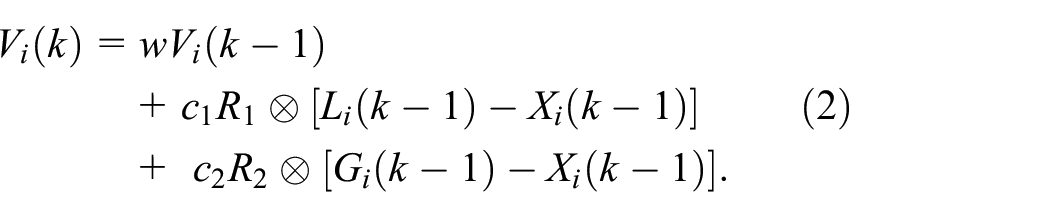
Several parameters in equation (2) influence the behavior of PSO. The inertia weight, denoted by
Our experience suggests that the number of iterations and the swarm size have a greater impact on the performance of PSO than the choice of the tuning parameters. A larger swarm size allows for broader exploration of the search space, increasing the likelihood of finding a global optimum. In addition, a higher number of iterations give particles more opportunities to refine their search through random perturbations. Users need to specify the swarm size and the duration for which PSO is allowed to run. This duration can be defined by the maximum number of function evaluations, the maximum number of iterations, or the CPU time. The swarm size refers to the number of particles in the swarm that search for the optimum, with each particle representing a candidate solution for the global optimum. In this context, the global optimum is the optimal design with the best design criterion value among all designs for the given setup.
To date, there are only a few of papers that directly apply metaheuristics to design clinical trials. Lange and Schmidli
19
are probably among the first to use PSO to find optimal designs to estimate parameters in a modified
The next section illustrates how metaheuristics can be used to develop improved and more practical designs. We focus on dose-finding designs, a field with a long history, and it is still an active area of research. Wong and Lachenbruch 23 provide a tutorial on this topic. Many dose-finding designs are often determined numerically without a formal optimality criterion, making it unclear whether the sought design is truly optimal or if the same numerical method would yield the optimal design for another model or criterion. Sometimes, a mathematical approach is used, but this method can be highly sensitive to all aspects of the model assumptions and is difficult to adapt to a slightly altered model. In contrast, metaheuristics address the optimization problem quite independently of the statistical model or design criterion or the nature of the problem.
New applications of metaheuristics to tackle dose-finding design problems in clinical trials
The aim of a dose-finding trial is to determine a recommended dose for later-phase testing. Researchers increasingly embrace a model-based approach for improved statistical inference over algorithm-based designs, like the 3 + 3 design and its many modifications, that have little statistical justifications. 24 Our application of metaheuristics focuses on designing phase I/II studies that jointly consider toxicity and efficacy outcomes. The dose–response relationship in these studies is described using nonlinear models, such as the four-parameter continuation-ratio (CR) model.25,26 Optimal design problems for the CR model are discussed in works by Fan and Chaloner, 27 Rabie and Flournoy, 28 Alam et al, 29 and Qiu and Wong. 30 These optimal designs have complex structures, and currently, there is no commercial software to find them.
Let
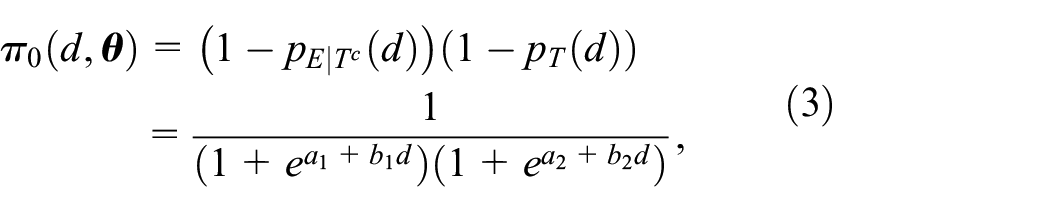
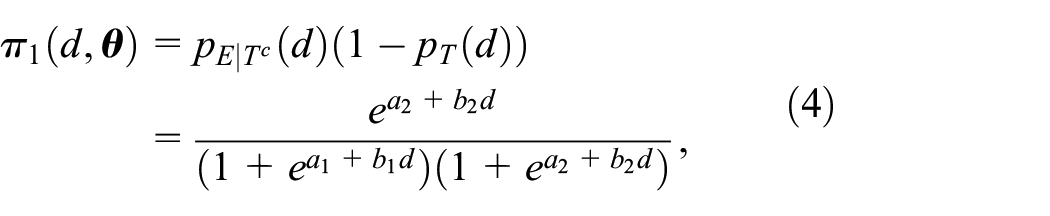

Equations (3)–(5) are obtained from two logistic regression models, one for the conditional probability of efficacy given no toxicity,
The CR dose–response relationship is characterized by the parameter vector

The optimal biological dose (

Figure 1 displays an example of a CR dose–response on the dose interval
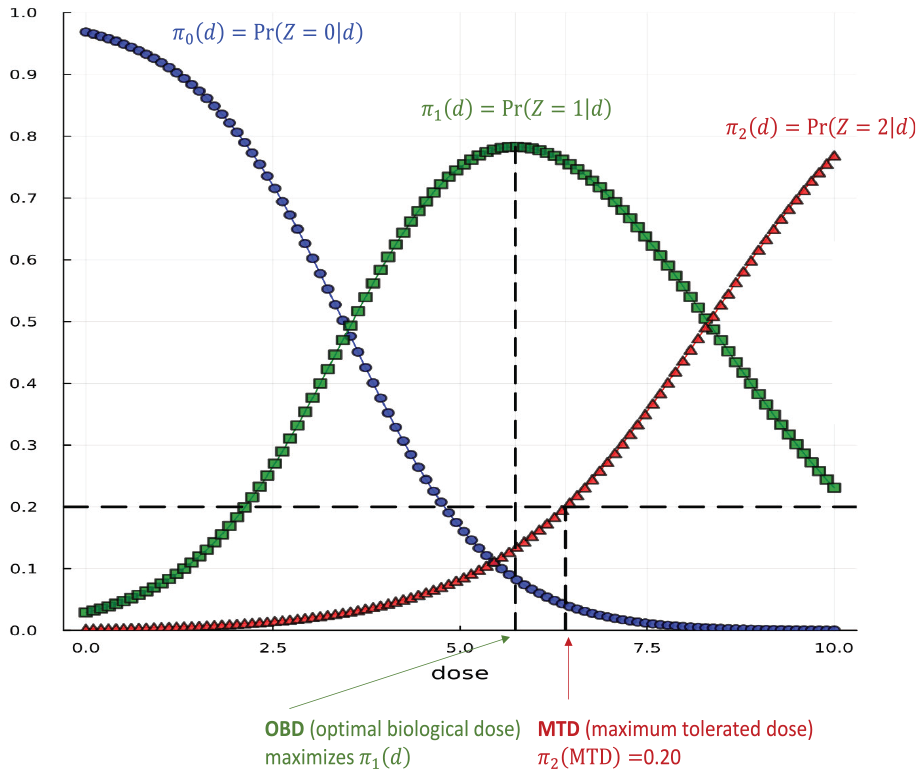
This figure illustrates a dose–response relationship for a four-parameter continuation-ratio (CR) model, determined by
Throughout, we consider continuous designs as probability measures on

where
We consider the following four optimal designs:
I. The unrestricted
II. The restricted
III. The unrestricted
IV. The restricted
The CR model is nonlinear, and the design criteria are formulated in terms of FIM, which includes unknown model parameters that need to be estimated. Therefore, the criterion cannot be directly optimized without nominal values for these parameters. Nominal values, which represent best guesses for the model parameters, can be obtained from expert opinions or pilot studies. As a result, the optimal designs for the CR model are locally optimal, meaning they depend on the nominal values of
Table 1 presents PSO-generated locally optimal designs (I–IV) assuming the true value of
The structure of four locally optimal designs for the dose–response in Figure 1.
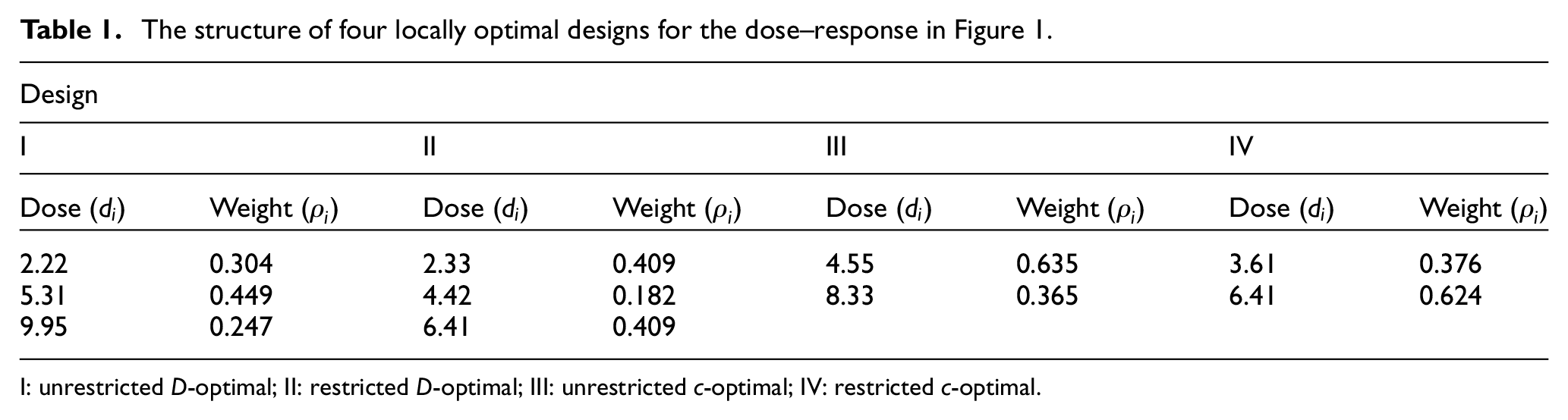
I: unrestricted
The optimality of a continuous design found by PSO can then be verified using a technical result known as a General Equivalence Theorem (GET),
31
which is specific to each convex criterion. To apply this result, we first evaluate the sensitivity function of the design, which is the directional derivative of the convex criterion evaluated at the candidate design in the direction of design with the single dose at
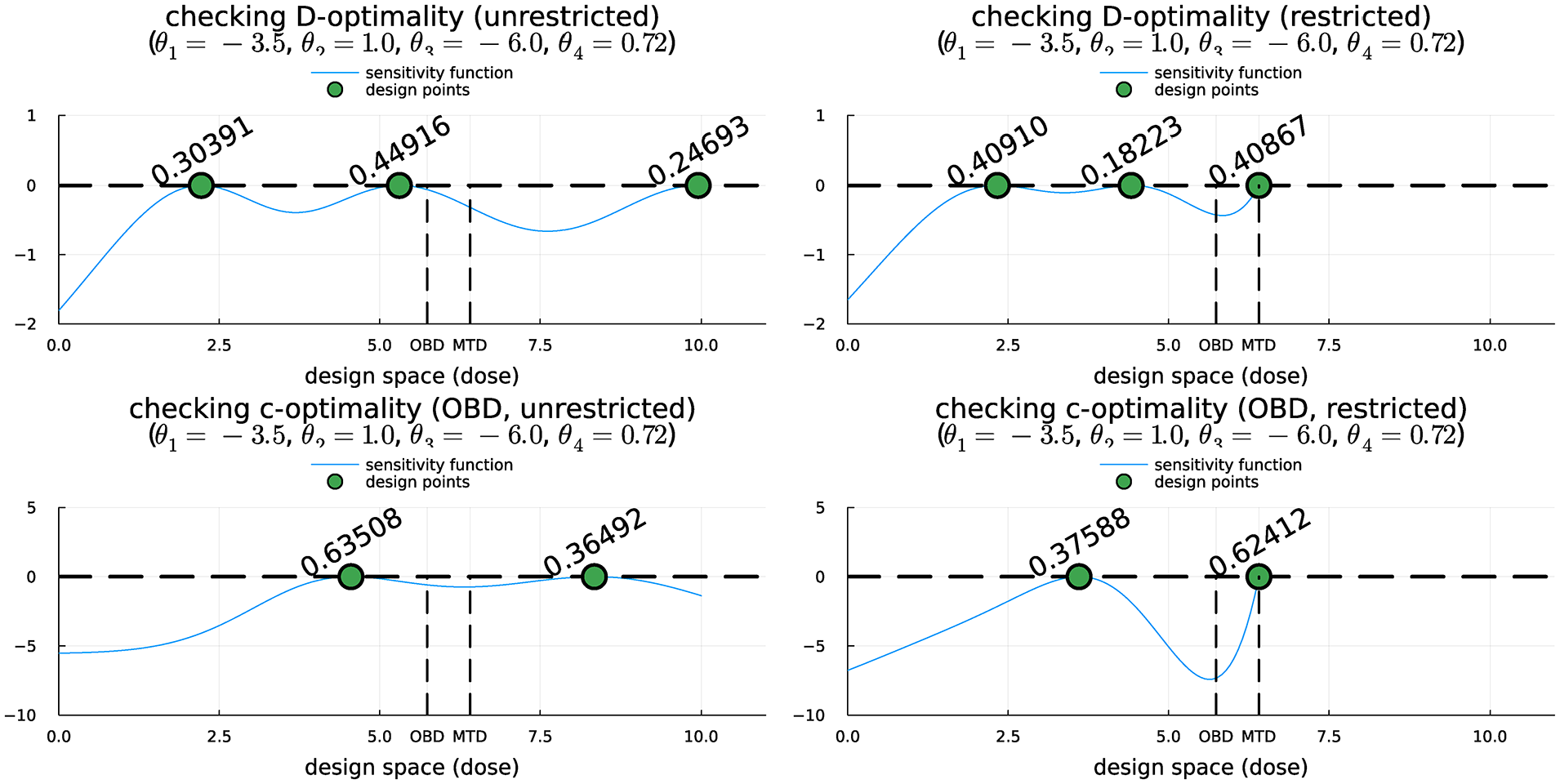
The fulfillment of the GET conditions for the four locally optimal designs.
Continuous optimal designs cannot be implemented in practice because they are defined by the percentage of the total number of observations to be taken at specific dose levels. To address this, let
Design
Design
Design
Design
To investigate the design operating characteristics, we performed simulations and evaluated the Bias, Standard Deviation (SD), and Root Mean Squared Error (
Operating characteristics of the four locally optimal designs with
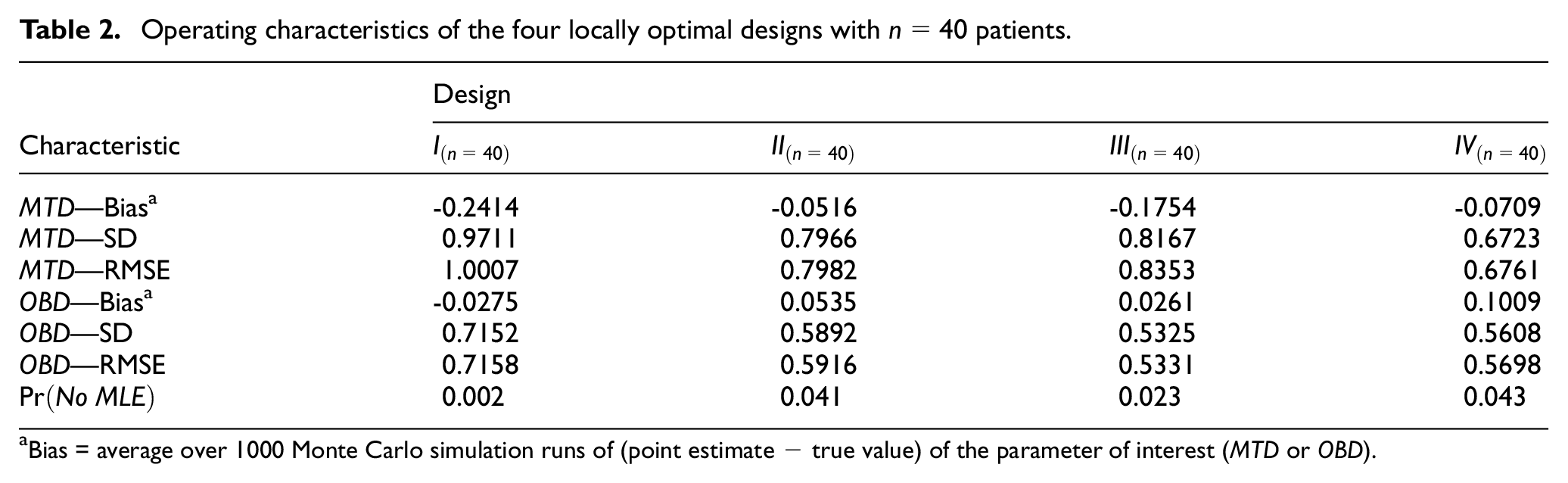
Bias = average over 1000 Monte Carlo simulation runs of (point estimate − true value) of the parameter of interest (
Conclusion
Dose-finding designs are an active area of research.36,37 However, many designs are still determined numerically without a formal optimality criterion. Consequently, it is unclear whether such designs are truly optimal or even generalizable. Sometimes, a mathematical derivation is presented, but this approach can be highly sensitive to model assumptions; if the model changes slightly, the derivation usually cannot be amended.
Metaheuristics address the optimization problem regardless of the statistical model or design criterion and can handle multiple constraints. The dose-finding locally optimal designs reported here are more practical than those reported in the literature for the CR model. For example, Fan and Chaloner
27
presented optimal designs on an unrestricted dose interval, and Qiu and Wong
30
found optimal designs that may require doses higher than the
In conclusion, we hope this article will encourage clinical researchers to learn more about metaheuristics and incorporate them into their research. Metaheuristics have the potential to design more flexible and effective trial designs not only for dose-finding but for any computationally challenging trials, including cluster randomized controlled intervention trials for cancer control, 42 trial designs for a variance heterogeneity model,41,43 modern molecularly targeted early phase oncology trials, 44 or trial recruitment, 45 among others. Finally, metaheuristics can also be creatively used to analyze different types of massive complex data46,47 and as important tools for machine learning.8,9
Supplemental Material
sj-pdf-1-ctj-10.1177_17407745251346396 – Supplemental material for Nature-inspired metaheuristics for optimizing dose-finding and computationally challenging clinical trial designs
Supplemental material, sj-pdf-1-ctj-10.1177_17407745251346396 for Nature-inspired metaheuristics for optimizing dose-finding and computationally challenging clinical trial designs by Weng Kee Wong, Yevgen Ryeznik, Oleksandr Sverdlov, Ping-Yang Chen, Xinying Fang, Ray-Bing Chen, Shouhao Zhou and J Jack Lee in Clinical Trials
Footnotes
Acknowledgements
W.K.W. is grateful for the invitation to present his research as one of eight invited speakers at the 16th Annual Conference on Statistical Issues in Clinical Trials, held at the University of Pennsylvania in April 2024. The authors thank the two anonymous reviewers and the associate editor for their constructive comments on the original manuscript.
Declaration of conflicting interests
The author(s) declared no potential conflicts of interest with respect to the research, authorship, and/or publication of this article.
Funding
The author(s) disclosed receipt of the following financial support for the research, authorship, and/or publication of this article: The research of W.K.W. is partially supported by the Yushan Fellow Program by the Ministry of Education (MOE), Taiwan (MOE-108-YSFMS-0004-012P1). P.-Y.C. gratefully acknowledges the financial support from the Department of Statistics, National Taipei University, New Taipei, Taiwan. The research of R.B.C. is partially supported by the National Science and Technology Council with grant no. NSTC 111-2118-M-006-002-MY2 and the Mathematics Division of the National Center for Theoretical Sciences in Taiwan. The research of S.Z. is partially supported by the Pennsylvania State University Early Career Research Award and the Pennsylvania Department of Health TSF Cure Program. The research of J.J.L. is partially supported by the grant P30CA016672 from the National Cancer Institute.

Supplemental material
Supplemental material for this article is available online.
References
Supplementary Material
Please find the following supplemental material available below.
For Open Access articles published under a Creative Commons License, all supplemental material carries the same license as the article it is associated with.
For non-Open Access articles published, all supplemental material carries a non-exclusive license, and permission requests for re-use of supplemental material or any part of supplemental material shall be sent directly to the copyright owner as specified in the copyright notice associated with the article.
