




Abstract
Background
The contribution of the statistician to the design and analysis of a clinical trial is acknowledged as essential. Ability to reconstruct the statistical contribution to a trial requires rigorous and transparent documentation as evidenced by the reproducibility of results. The process of validating statistical programmes is a key requirement. While guidance relating to software development and life cycle methodologies details steps for validation by information systems developers, there is no guidance applicable to programmes written by statisticians. We aimed to develop a risk-based approach to the validation of statistical programming that would support scientific integrity and efficient resource use within clinical trials units.
Methods
The project was embedded within the Information Systems Operational Group and the Statistics Operational Group of the UK Clinical Research Collaboration Registered Clinical Trials Unit network. Members were asked to share materials relevant to validation of statistical programming. A review of the published literature, regulatory guidance and knowledge of relevant working groups was undertaken. Surveys targeting the Information Systems Operational Group and Statistics Operational Group were developed to determine current practices across the Registered Clinical Trials Unit network. A risk-based approach was drafted and used as a basis for a workshop with representation from statisticians, information systems developers and quality assurance managers (n = 15). The approach was subsequently modified and presented at a second, larger scale workshop (n = 47) to gain a wider perspective, with discussion of content and implications for delivery. The approach was revised based on the discussions and suggestions made. The workshop was attended by a member of the Medicines for Healthcare products Regulatory Agency Inspectorate who also provided comments on the revised draft.
Results
Types of statistical programming were identified and categorised into six areas: generation of randomisation lists; programmes to explore/understand the data; data cleaning, including complex checks; derivations including data transformations; data monitoring; or interim and final analysis. The risk-based approach considers each category of statistical programme against the impact of an error and its likelihood, whether the programming can be fully prespecified, the need for repeated use and the need for reproducibility. Approaches to the validation of programming within each category are proposed.
Conclusion
We have developed a risk-based approach to the validation of statistical programming. It endeavours to facilitate the implementation of targeted quality assurance measures while making efficient use of limited resources.
Introduction
The contribution of the statistician to the design and analysis of a clinical trial is acknowledged as essential. Ability to reconstruct the statistical contribution to a trial requires rigorous and transparent documentation as evidenced by the reproducibility of results. Statistical activities including data transformation, analysis and reporting and corresponding quality control activities form key components of the clinical trial data life cycle and fall within the scope of a Good Clinical Practice inspection by regulatory authorities.1–3 The objective of examining statistics functions during Good Clinical Practice systems inspections is to establish that the processes in place give assurance that the trial data are managed and analysed to give accurate and credible trial results. 3 This is an important step in the reproducibility of research. 4
Challenges relevant to data integrity faced by academic clinical trials units (CTUs) for compliant data management and underlying information technology and systems infrastructure have been previously reported5,6 and guidance developed. 7 However, data integrity challenges remain for clinical trials globally and these issues continue to be a source of regulatory focus and compliance findings. New guidance focusing on data quality and integrity6,8–11 has been published by regulatory bodies with a common thread being an emphasis on a risk-based approach.12–16
While there has been a focus on compliant systems and data management, there has been limited attention regarding statistical processes specifically. In 2014, a member of the Good Clinical Practice Medicines and Healthcare products for Regulatory Agency (MHRA) inspectorate was invited to talk to the United Kingdom Clinical Research Collaboration (UK CRC) Registered Clinical Trials Unit (RCTU) Network about regulatory inspections and findings of particular relevance to statisticians within academic RCTUs. The talk highlighted not only the data integrity strengths but also the potential to further improve practice as control of the data moved from data management to statisticians, and in particular approaches to validation of statistical programming. This raised concerns regarding the extent of validation requirements and resources necessary to achieve compliance within the academic setting. There is little content within Good Clinical Practice that relates to the practice of statisticians 17 and in particular translates into statistical programming and their validation responsibilities directly.
Statistical programmes can be considered as ‘one-off’ programmes, defined as a programme used with a specific set of data from a single study. 18 As a generic definition, any syntax used to deliver an output is considered to be programming, and every programme has the potential for human error. The likelihood of and impact of error vary considerably, depending on the method of programming and the intended use of the programme.
While some form of validation is important, formal methodologies used for software development, for example, waterfall, 19 agile, 20 and in particular their testing approaches may be excessive for the purposes of statistical programming. However, there is a need to acknowledge that cross-disciplinary knowledge exchange is useful and can be referenced in order to improve robustness of statistical programming practices and provide resources 21 to support their validation.22,23
A risk-proportionate approach is acceptable to regulators12,13,14,15,16 Regulatory guidance states that ‘it is acceptable for quality control checks to be undertaken using a risk-based approach with the detail and level of checking varying depending on the item being checked’. 5 Our objective was to develop a framework to achieve a risk-proportionate approach to the documentation and validation of statistical programming consistent with regulatory requirements but realistic in the confines of resources allocated to this type of activity within academic CTUs. These units have a breadth of trial experience, differing levels of programming expertise and are not comparable in terms of staffing and available resource. Our intention was to develop a framework which did not dictate a particular algorithm to inform which approach was best but would provide a pathway as to what would be acceptable to ensure trial results were reproducible.
Methods
The delivery of this project was centred on the engagement and collaboration of two operational groups of the UK CRC RCTU network, the Statistics Operational Group and the Information Systems Operational Group. The aim of the operational themed groups is to share best practice among its RCTU membership (48 UK CRC RCTUs at the time of this work) and to recommend standard approaches to common issues.
In April 2015, the Chair of the Information Systems Operational Group attended a statisticians’ network meeting to discuss statistical programming. Attendees interested in contributing to the project were asked to share relevant MHRA experience as well as materials, including related inspection findings, standard operating procedures, statistical programming documents developed in-house or otherwise that they felt were relevant, and relevant publications. In addition, a review of the published literature, regulatory guidance and knowledge of relevant working groups was undertaken.24–26
Two surveys were developed to determine current practices across the RCTU network. One survey targeted clinical trials’ statisticians and the other targeted information systems’ managers. Both surveys were piloted within their respective operational subgroups before being circulated for completion by attendees at the network meetings taking place in October 2017. The survey results were presented, followed by round table discussions to allow attendees to elaborate on responses and offer additional information on their practices.
The information from these meetings was then used to draft the risk-based approach which formed the basis of a small workshop (April 2018). Attendees for this Workshop 1 (n = 15) were selected to ensure representation from statisticians (n = 7), information systems (n = 5), quality assurance managers (n = 2) and an RCTU secretariat representative. Consideration was also given to ensuring variety in RCTU selection (n = 7) in terms of their trial portfolios and trials experience.
Following discussion at this workshop, the approach was modified. A second, larger scale workshop (n = 47) was held in June 2018, aiming to achieve a wider perspective and discussion of the approach and its implications for delivery. Workshop 2 supported attendance from a larger number of RCTUs (n = 35) and importantly engaged with the MHRA inspectorate to create dialogue around the issues identified. Attendees at this meeting also included the RCTU Quality Assurance subgroup Chair, the Chair of the Data Sharing group, a member of the RCTU network secretariat and an IS consultant leading a National Institute for Health and Care Research project across the RCTU network. The approach was revised based on these discussions.
Results
Survey findings
The results of the RCTU surveys (n = 31 of 48 RCTUs responded) indicated variation in the approach and extent of validation practices. Programmes for final analyses were routinely validated (97%), with routine validation of programmes for interim analyses reported less frequently (57%).
Free-text responses indicated 77% (24/31) used independent programming, with 33% (10/31) using code review and 7% (2/31) having existing code rerun by another statistician. Where independent programming was used, the majority focused on the primary outcome and only 13% (3/24) indicated that the approach or the extent of its application was considered within a formal risk assessment.
Identification of relevant resources
The following resources were identified through the literature search and/or suggested by the RCTU operational groups:
Good Clinical Practice Guide, MHRA, TSO information and publishing solutions, 2012, known as the ‘grey book’. 3
Computerised Systems validation in clinical research, A practical guide, 2nd edition, Association for Clinical Data Management. 18
Guideline for good clinical practice E6 (R2) (EMA/CHMP/ICH/135/1995). 1
Statistical Principles for Clinical Trials E9 (CPMP/ICH/363/96). 2
The Global Healthcare Data Science Community, Pharmaceutical users software exchange. 26
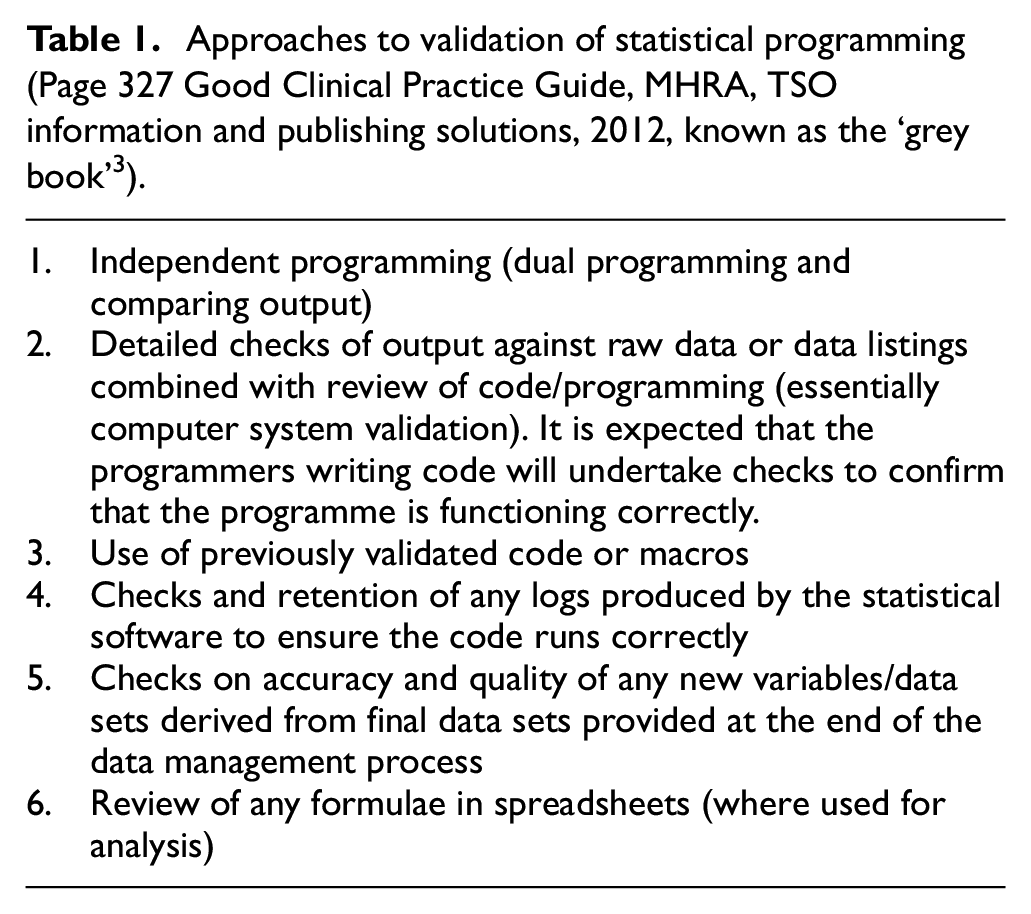
While there are no recommendations or regulations specific to validation of statistical programmes, it was established that statistical programmes do fall under the definition of a one-off programme: a programme to be used with a specific set of data from a single study. 18 With a one-off programme, the approach to validation corresponds to the programme’s complexity and the consequences of an error. Examples of a range of MHRA-acceptable methods to validate statistical programming are summarised in Table 1.
Approaches to validation of statistical programming (Page 327 Good Clinical Practice Guide, MHRA, TSO information and publishing solutions, 2012, known as the ‘grey book’ 3 ).
Development of a risk-proportionate approach
A risk-proportionate approach typically involves: (1) identification of the risk or error; (2) assessment of the likelihood of the error occurring; (3) consideration of the impact of such errors on trial participants and trial integrity and (4) judgement of the extent to which such errors would be detectable. In applying these steps to statistical programming, we first identified categories of statistical programmes defined by their purpose (see Table 2).
Categories of statistical programming and potential errors.
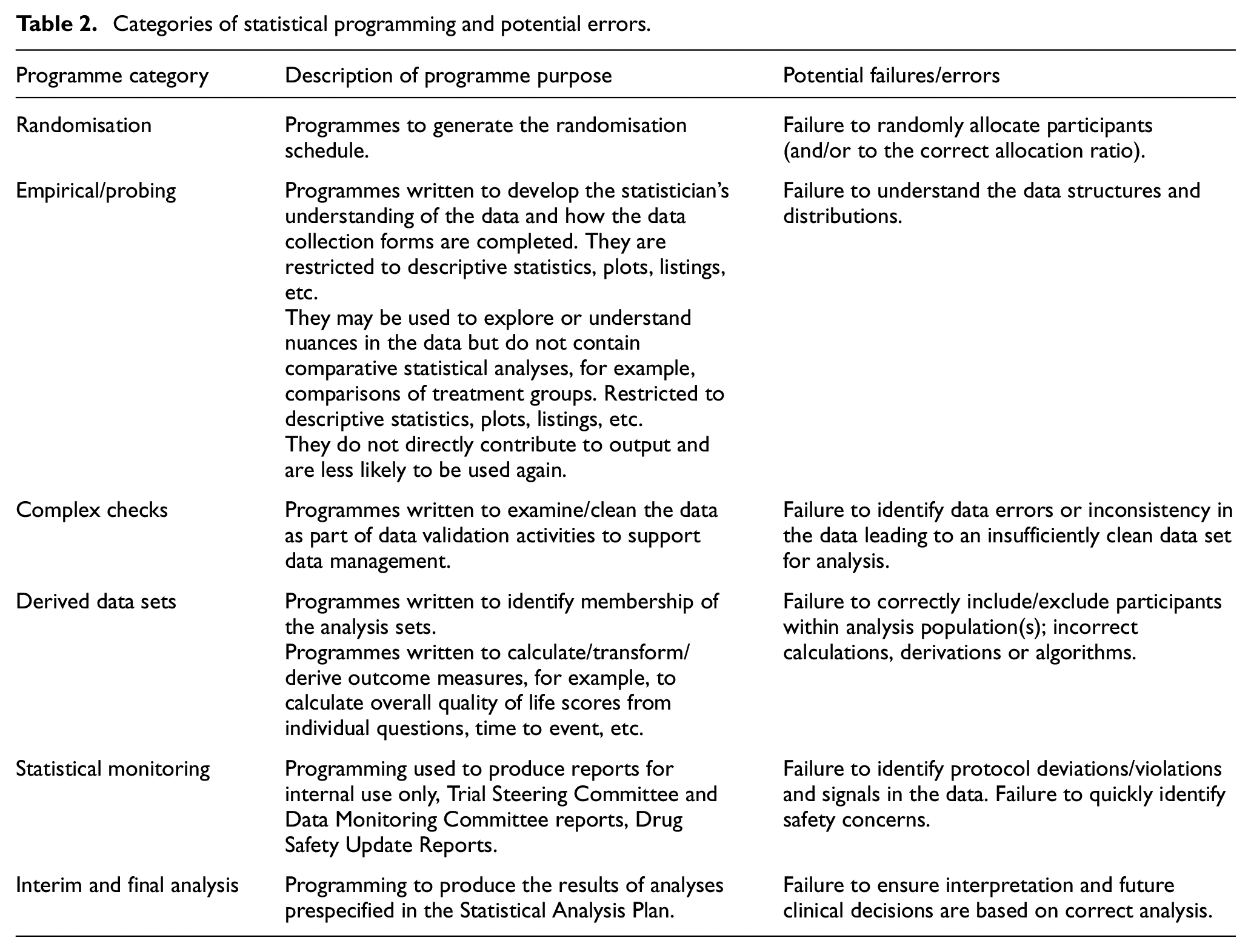
The categories were discussed at Workshop 1 and taken forward unchanged to Workshop 2. The programming categories were used to identify potential failures or errors and a set of questions were developed to be considered during discussions around likelihood (see Table 3). The questions were discussed in both workshops and applied to each programming category as defined in Table 2.
Validation considerations.
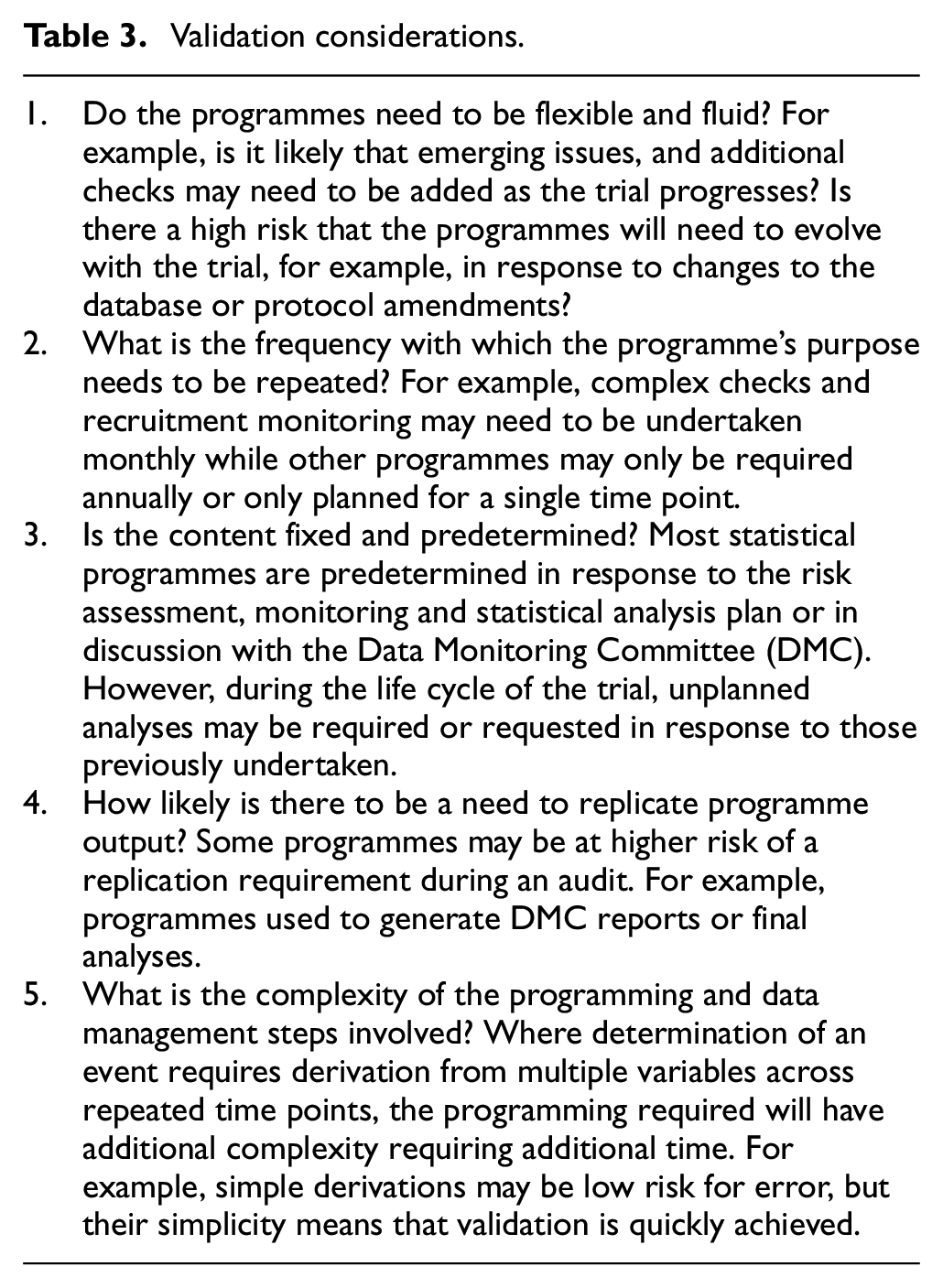
The questions originally included ‘What is the impact of an error?’, but this was removed and incorporated into the main body of the risk assessment. An additional question was added to the ‘randomisation’ category only: ‘Is bespoke programming required to generate the allocation or the allocation delivery system?’ This was considered particularly relevant to this category as validated software functions may often be used, for example to generate allocation lists, which carry very different risks to dynamic allocation methods. Table 1 provides MHRA-acceptable approaches to validation of statistical programming. Whichever validation approach is taken, it is important to consider where potential errors may occur and ensure mitigation as appropriate.
Table 5 provides the risk assessment with illustrative responses. To guide validation requirements in a risk-proportionate manner for each category of statistical programming identified in Table 1, the validation considerations described in Table 3 were applied to the risk assessment framework (impact; likelihood; detectability).
Additional points discussed at Workshop 2 included identification of the start and end points of the validation activities. For example, does this start from extracting raw data and importing it into the analysis package, from determining membership of the analysis populations or from a later point? The starting point will depend on the use of previously validated programmes while the end point of validation activities may depend on the approach used to populate the clinical study report (Table 4).
Risk-based approach to the validation of the clinical study report.
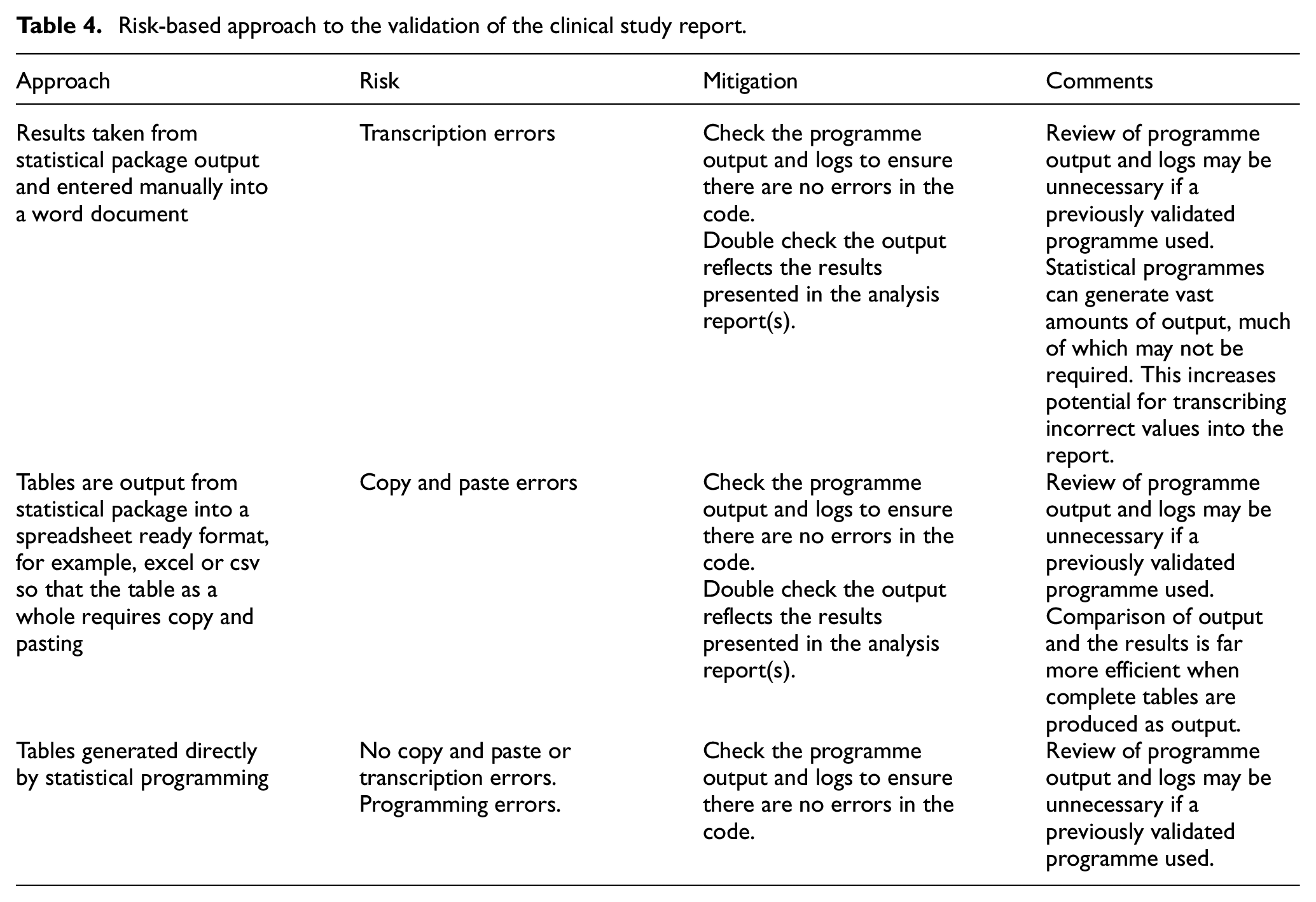
Generating the clinical study report directly from the statistical programming was considered by attendees as best practice, given it removes the possibility of introducing transcription and typographical errors and simplifies the ability to reconstruct the analysis. The need for a risk-proportionate approach to quality control the report was discussed, and for each approach, the risks and mitigations were identified. In reality, the approach used will require consideration of the type of report, resources, amenability to change or reformatting and the requirement for repeated use. For example, the time taken to programme tables produced directly into the report may be greater than the alternatives, and less amenable to changes if required. This is likely to be led by resources available; however, these aspects could be formalised within the risk assessment framework of Table 5.
Risk-proportionate approach. a
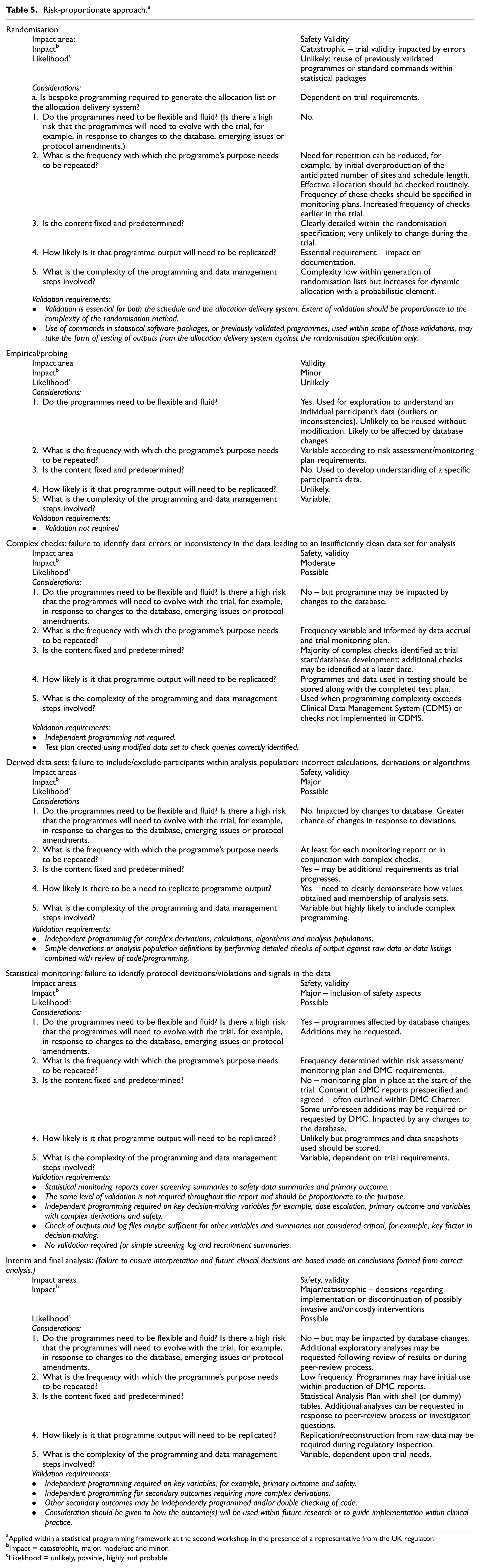
Applied within a statistical programming framework at the second workshop in the presence of a representative from the UK regulator.
Impact = catastrophic, major, moderate and minor.
Likelihood = unlikely, possible, highly and probable.
Discussion
The contribution of the statistician to the design and analysis of a clinical trial is acknowledged as essential (International Council for Harmonisation Good Clinical Practice). 1 There is therefore a need to ensure that the statistical contribution to a trial is rigorously and transparently documented as evidenced by the ability to reconstruct the results; validation of statistical programming is a key component. A risk-proportionate approach to the management of clinical trials is supported by regulators;12–16 however, this is yet to be formalised throughout statistical practice.
We sought to develop and apply a risk assessment framework to support the validation of statistical programming within an academic CTU. This is benefited from the engagement of the UK CRC RCTU network, knowledge exchange between statisticians, information systems managers, quality assurance managers and the involvement of a member of the MHRA inspectorate, the UK regulator. This ensured that the approach developed was suitable across a broad range of RCTUs with diverse clinical trial portfolios and available resources. The presence of the MHRA inspector allowed a regulators perspective to be included within the discussions considering examples of previous inspection findings.
Implementing the proposed risk assessment is a non-trivial exercise requiring input from experienced statisticians. It may be argued that this increases bureaucracy and uses scarce resources itself. An alternative would be to undertake a consistent approach across all trials within an RCTU, for example, routinely validating primary outcome and safety results via independent programming. This was prevalent among many RCTUs responding to the survey and can be justified as these results are most likely to achieve impact and change clinical practice. However, this means that programmes may not be considered to be fully validated, thereby necessitating further validation for reuse. In addition, potentially greater risks are left unconsidered, for example, programming complex derivations and key secondary outcomes.
The risk assessment of the statistical programming proposed should be a component of the main risk assessment for the trial. It may need to consider the nature of the trial interventions and intentions with respect to regulatory requirements, inspections, marketing authorisation applications and use for future research. While RCTUs may wish to implement best practice across all trials in their portfolio, there may be benefits in considering these aspects given academic RCTUs frequently cite concerns regarding limited resources.27,28 As resources will invariably be restricted prioritisation may be considered when deciding which approach is required and the level of inherent risk. During the risk assessment and validation approach selection, this should be clearly justified.
We do not prescribe when the risk assessment for statistical programming should be undertaken. This could be beneficial when preparing a grant application, as these activities need to be costed by the RCTU, but the utility may be reduced as any risk assessment conducted at this time would be susceptible to substantial change. Changes to the risk assessment may be required due to amended specifications, error detection or accumulating knowledge across trials.
Guidance has been established on the content of statistical analysis plans for late phase trials, with an extension developed to early phase.29,30 Following agreement of the analysis plan, dummy tables for the clinical study report may be drafted. While there is guidance on the content of the study report, there is no best practice on simple techniques to aid reconstruction. For example, when the clinical study report is populated with results, inclusion of a line underneath each table documenting the version, location of the validated programme, its validation status, and other related validation activities could be a valuable addition. This could enable transparency and wider scrutiny of the process while also increasing understanding of the associated workload. Establishing a suite of best practices could support statisticians during reconstruction of trial results.
This article does not cover best programming guidelines. There are numerous examples available; 26 however, they often stem from a pharmaceutical/industry setting or are specific to a particular programming language. The translation of these guidelines across a large network of academic CTUs is not straightforward due to differences in infrastructure, time and staff resources. Generating best programming guidelines for academic statisticians, 31 independent of programming language, would be valuable future work and would support validation activities within an academic trials unit.
It is expected that statistical results can be reconstructed and that there should be consistency between any publications and the clinical study report. Reconstruction of a result may be required during a regulatory inspection and must be achievable within a reasonable timeframe. This is made increasingly difficult when statisticians are required to make changes to statistical output with tight deadlines, often as part of the peer-review process. Consideration must be given to how the validated status of the programmes can be maintained with an appropriate change control process in place. This means that the changes requested can themselves be risk assessed to determine whether further validation is required and the level of testing needed.
A clear advantage of establishing and retaining validated programmes is the reduction in the need for repeated testing. However, workshop attendees voiced concerns regarding unthinking reuse of programmes. While the primary purpose of analysing the data is to produce aggregate level information summarising the data set as a whole, the data collected on an individual trial participant tells their story during their time in the clinical trial. Achieving a quality analysis is dependent upon in-depth knowledge of the data at the participant level. This underlies the reluctance of statisticians to rerun programmes without careful exploration of data.
We have developed a framework for a risk-proportionate approach to the validation of statistical programming that can be readily adapted within academic-led CTUs. This was informed by engagement of the UK CRC RCTU network and input from the MHRA inspectorate. The proposed risk-based approach endeavours to facilitate the implementation and prioritisation of targeted quality control validation techniques while directing limited resources efficiently.
The importance of knowledge sharing and consolidating practices between information systems professionals and statisticians is apparent. Future developments should ensure this engagement continues and reflects best practice across both professions. We recommend that an adaptive risk-proportionate approach to validation is adopted where the risks associated with each statistical programme and the impacts considered are documented, mitigated and prioritised, as appropriate.
Footnotes
Declaration of conflicting interests
The author(s) declared no potential conflicts of interest with respect to the research, authorship and/or publication of this article.
Funding
The author(s) disclosed receipt of the following financial support for the research, authorship and/or publication of this article: The National Institutes for Health Research, Efficient/Innovative Delivery of NIHR research.
