




Abstract
In this article, the networked filtering problem for a class of robotic manipulators with semi-Markov type parameters is investigated under the passivity framework. In particular, the mode-dependent quantization and event-triggered communication scheme are both proposed for increasing the network transmission efficiency. Sufficient stability conditions are first derived by choosing mode-dependent Lyapunov–Krasovskii functionals. Then, the mode-dependent filter gains and the event-triggering parameters are further designed with the help of matrix convex optimization. In the end, a simulation example is provided such that the effectiveness of the proposed filtering method can be well demonstrated.
Keywords
Introduction
Robotic manipulators have been widely utilized in various applications during the past years. 1,2 In particular, with the rapid development of network technology, novel networked control schemes have been developed for the stability and state estimation problems of manipulators. It is worth mentioning that there still exist certain constraints brought by the communication network, such as limited bandwidth, transmission delay, data packet dropout, and so on. 3 –6 These constraints would lead to instability of control systems or system control performance degradation. To deal with these issues, many effective networked analysis and synthesis strategies have been reported. Recently, the so-called event-triggered communication methods have been extensively studied. 7 –12 To name a few, a novel event-trigger-based adaptive control approach is proposed for nonlinear systems with switching threshold strategy in the literature. 11 Moreover, by applying the improved event-triggered adaptive backstepping control method, the stability of uncertain networked control system has been successfully solved with desired results in the literature. 12 In contrast to traditional time-triggered mechanisms, the information transmission architecture of event-triggered schemes is waken-up by certain event rather than time sequences, which can further decrease network load and increase information exchange effectiveness. 13 Since robotic manipulators are always with networked communication environment, it is necessary to apply the event-triggered schemes to improve the communication efficiency. Meanwhile, it is noted that many digital communication networks have bandwidth limitations. As a result, another useful method that can reduce the communication burden is the quantization strategy. By reducing the data packet size to be transmitted, the network bandwidth utilization efficiency can be correspondingly improved. 8,14 –16
On another active research area, much effort has been paid to Markovian jump systems (MJSs), for the reason that MJSs have a powerful ability to model control systems with jumping parameters. Model examples of MJS in practical applications can be found with power systems, neural systems, robotic systems, and other actual examples that have taken advantage of MJS. 17 –20 Under this context, the transition probability of MJS plays a key role in conducting the system dynamics. As a result, there are many research merits of MJS with fixed or partially unknown transition probability cases. 21,22 However, it should be pointed out that sometimes the transition probability may be time varying, which gives rise to a growing research interest in the semi-Markovian jump systems (SMJSs) owing to the superiority of SMJS. 23 –25 With this regard, the payloads of manipulators could be varying in an unstructured and complicated environment, which has a significant impact on stable control and state estimation of manipulators. Therefore, it is essential to investigate the manipulators with stochastic jumping dynamics, which can be modeled by Markovian or semi-Markovian systems. Although some remarkable attempts have been made toward the switched manipulators with time-dependent switching rules, there still remain certain drawbacks on the constrictions of different manipulator dynamics. 26,27 In addition, the corresponding mode-dependent networked filtering strategy is also needed for semi-Markovian manipulators when the true states are difficult to acquire in some applications. However, according to the most reported literature, research on state estimation or filtering of semi-Markovian manipulators is still at a primary stage and is challenging work, especially in the condition of limited networked environment. This motivates us for this study.
Inspired by the above discussions, this article aims to deal with the networked filtering problem for a class of robotic manipulators with semi-Markovian type parameters based on passivity theory. More precisely, a novel mode-dependent quantization with related event-triggered communication scheme is proposed. Compared with the existing literature, our main contributions of this article are as twofolds: (1) The mode-dependent event-triggered strategy with mode-dependent sampling interval is proposed into the semi-Markov manipulators. In comparison with the mode-independent strategies, it can well utilize the jumping mode information to reduce the conservatism and can effectively improve the network communication flexibility. 10,28 (2) Under mode-dependent quantization circumstance, the problem of information data packet transmission can also be more efficiently solved than the mode independent cases. (3) Based on the semi-Markov manipulator model, a reasonable mode-dependent Lyapunov–Krasovskii functional is constructed and sufficient conditions are established for ensuring the desired filtering performance with passivity.
The rest of the article is arranged as follows: In the second section, the networked filtering problem for single-link semi-Markov manipulator is formulated and the novel mode-dependent quantizator with event-triggered mechanism is introduced. In the third section, the main theoretical results are presented with proven details. In the fourth section, the usefulness of our proposed method is demonstrated by a simulation example. In the final section, we summarize the article and consider further study.
Notations:
Preliminaries and problem formulation
Firstly, fix a probability space

with
For simplicity, the following single-link manipulator model depicted in Figure 1 is considered

where

Single-link robotic manipulator.
Let

where




By denoting

Under the networked environment, it is assumed that the sensor is time driven with sampling period hi according to mode i and there is no Zeno behavior. To estimate the system state, the following mode-dependent observer is designed

where

where

where
Remark 1. It is worth mentioning that the above-formulated system model can also be applied to common nonlinear SMJSs with Lipschitz nonlinear characteristics, such that our developed results have broad applicability for SMJSs.
Remark 2. In comparison with mode-independent event-triggered strategy, the mode-dependent strategy can lead to less conservatism and is more applicable for the semi-Markov systems, since the precise mode information can be effectively used by mode-dependent strategy. 29,30 Recently, some novel hybrid-triggered schemes have been investigated with satisfying results, which can further combine the advantages of event-triggered and time-triggered mechanisms. 13
Once the event-triggering function is satisfied, the latest data will be transmitted to the corresponding mode-dependent quantizer

where

where

Remark 3. The logarithmic quantizer strategy is adopted with mode-dependent features in this article, such that each corresponding mode-dependent quantizer can effectively deal with the system jumping behaviors accordingly.
In addition, the mode-dependent network-induced transmission delay is assumed to be bounded by

the event-triggering function can be rewritten by

where

The illustrative structure of mode-dependent filter.
As a result, by letting filtering error be

Then, one can obtain that

where



The structure of mode-dependent filter is shown in Figure 2. For the filtering problem, the passivity performance is adopted with the following definition.
Definition 1.
32,33
If there exists a positive constant

then the system is said to satisfy the passivity performance.
Remark 4. Different from the common
To this end, the following lemma is provided for deriving the main results.
Lemma 1.
36
Let

Main results
In this section, the mode-dependent filter design procedure will be given in detail.
Theorem 1. Based on the event-triggered function and designed mode-dependent filter gains Ki
, the passivity performance of augmented system (18) can be satisfied according to Definition 1 such that the filtering problem of semi-Markov robotic manipulator can be solved, if there exist mode-dependent matrices





Proof. For each mode i, construct the following mode-dependent Lyapunov–Krasovskii function

where



Define weak infinitesimal operator

In addition, it can be verified that



where
Then, one can derive that
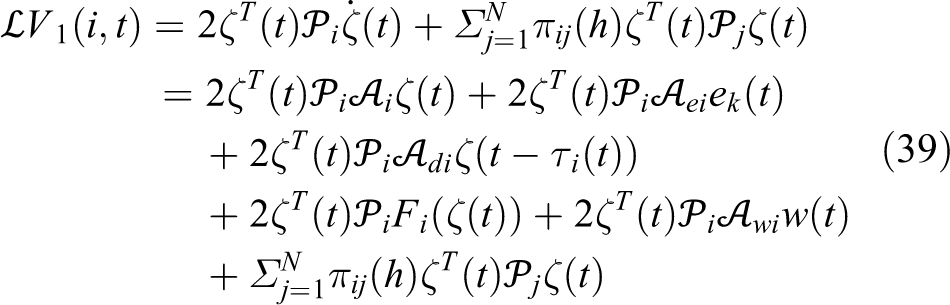


Moreover, it holds that
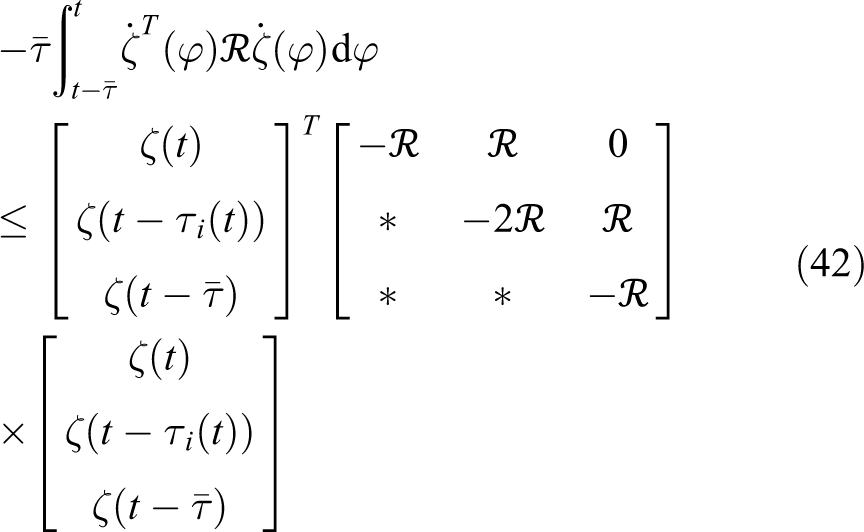
It can be verified that

where
From the event-triggering function, one has

Furthermore, it holds that

where
Consequently, if it holds that


then, one has
In addition, by taking into account the time-varying dwell time
Based on the derived conditions in Theorem 1, the following theorem can be given for calculating the desired filter gains.
Theorem 2. Based on the event-triggered function, the passivity performance of augmented system (18) can be satisfied according to Definition 1 such that the filtering problem of semi-Markov robotic manipulator can be solved, if there exist mode-dependent matrices




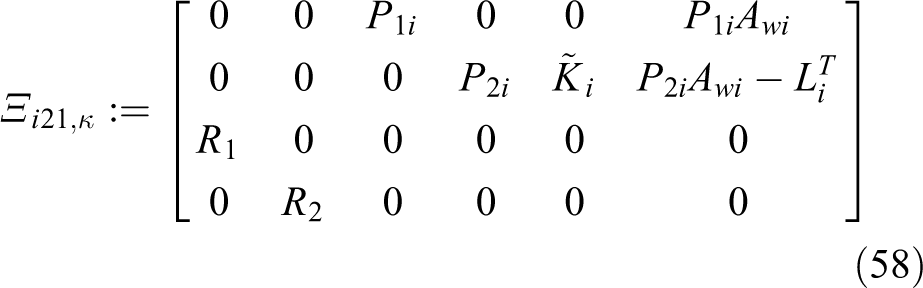


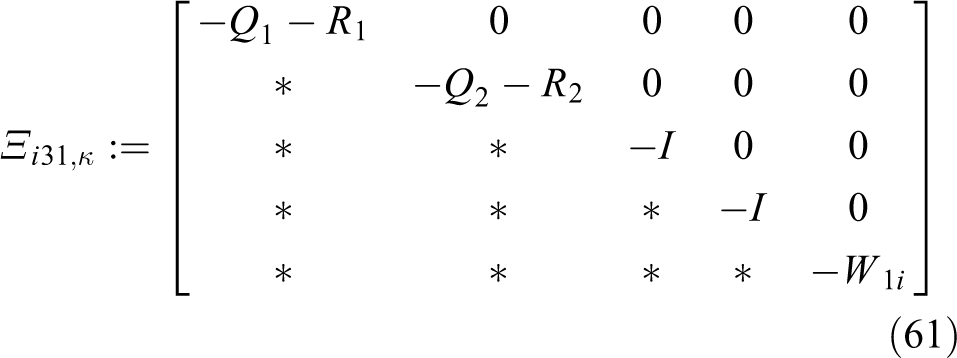


When the above conditions are satisfied, the mode-dependent filtering gains can be calculated by

Proof. Based on Lemma 1 and matrix transformation, the proof follows directly from Theorem 1 by letting
Remark 5. The established convex optimization conditions are with strict LMIs, which can be easily solved by MATLAB LMI toolbox or YALMIP with feasible solutions. It can be seen that the computation complexity is mainly related with the number of system modes
Illustrative example
In this section, a numerical simulation is given to validate our proposed filter design.
Consider the formulated semi-Markov robotic manipulator model (2) with two modes, where
Furthermore, the transition rates are supposed to be
In the simulation, it is assumed that

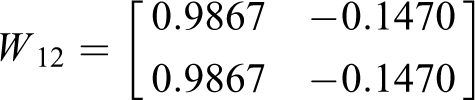


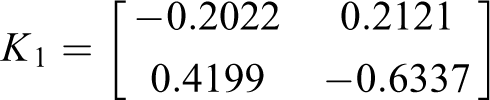

From Figures 3 and 4, it can be seen that our designed mode-dependent filters can well estimate the interested states with disturbances under the passivity framework. More precisely, Figure 3 shows that the mode-dependent filter can well obtain the true state of manipulator, such that the filtering errors can converge to zero. Figure 4 depicts that the objective signal


The state responses of filtering error.

The state responses of

The event-triggered release intervals.

The illustration of bandwidth utilization of event-triggered and time-triggered schemes.

The quantized output of
Conclusion and discussions
This article is concerned with the filtering problems of networked semi-Markov robotic manipulators with quantization and event-triggered communication. Furthermore, a new design strategy with mode-dependent characteristics is firstly developed for this problem. Then, the passivity performance is adopted to deal with the external disturbance. Sufficient filtering criterion is established for ensuring the prescribed performance of the augmented filtering system, based on which the desired mode-dependent filtering gains are designed in correspondence with these derived conditions via matrix transformation. Finally, the simulation results are presented to illustrate the effectiveness and availability of our design scheme. It can be found that our developed filtering method can well estimate the semi-Markov manipulator with disturbances. Meanwhile, it should be pointed out that the mode information is needed as a prior knowledge, which has certain conservatism in practical applications. In our future research, we will focus on extending our current theoretical results to the case with asynchronous semi-Markov processes and relevant experiments, which means that the modes of the observer could be asynchronous to the modes of the manipulator and is more practical for real-world applications.
Footnotes
Declaration of conflicting interests
The author(s) declared no potential conflicts of interest with respect to the research, authorship, and/or publication of this article.
Funding
The author(s) received no financial support for the research, authorship, and/or publication of this article.
