




Abstract
Cooperative tracking control problem of multiple water–land amphibious robots is discussed in this article with consideration of unknown nonlinear dynamics. Firstly, the amphibious robot dynamic model is formulated as an uncoupled nonlinear one in horizontal plane through eliminating relatively small sway velocity of the platform. Then cooperative tracking control algorithm is proposed with a two-stage strategy including dynamic control stage and kinematic control stage. In dynamic control stage, adaptive consensus control algorithm is obtained with estimating nonlinear properties of amphibious robots and velocities of the leader by neural network with unreliable communication links which is always the case in underwater applications. After that, kinematic cooperative controller is presented to guarantee formation stability of multiple water–land amphibious robots system in kinematic control stage. As a result, with the implementation of graph theory and Lyapunov theory, the stability of the formation tracking of multiple water–land amphibious robots system is proved with consideration of jointly connected communication graph. At last, simulations are carried out to prove the effectiveness of the proposed approaches.
Introduction
Multi-agent system (MAS) control has attracted attentions from various fields in recent years for its broad application aspects. 1,2 Especially for multi-robots system, massive studies have been carried out for consensus, formation, flocking, and rendezvous problems. 3 –6 Multiple underwater vehicles are also widely discussed for its potential applications in marine environment such as seafloor mapping, target searching, and ocean monitoring. 7,8 In addition, water–land amphibious robots have attracted much more attention recently as a special form of underwater vehicles with abilities such as autonomous charging and data uploading. 9 –11 Among all problems in cooperative control of MAS in previous studies, the dynamics of agents and communication graph are mostly discussed.
At the beginning, studies about cooperative control of MAS mainly concentrate on agents with integral high orders. 12 However, even though most systems can be formulated as integral dynamics with various approaches such as feedback linearization, 13 this kind of formulation always fails to present the characteristics and properties of the agents. As a result, extensively discussions are proposed considering about nonlinear agents and nonholonomic agents. In Yu et al., 14 second-order nonlinear agents are discussed aiming at reaching states consensus. In Li et al., 6 rendezvous problem for multiple nonholonomic agents is studied. Nonsmooth Lyapunov theory and graph theory are applied to prove the stability of the proposed feedback controller. Furthermore, concerning about difficulties in mathematical modeling of complex dynamics system, cooperative control with unknown dynamics are more and more appealing. 15 Neural networks (NNs) and adaptive algorithm are widely used in this case to estimate the dynamics of agents. 16
In addition, the structure of communication graph forms another important aspect in researches of MAS due to its decisive impacts on information interactions between agents. Based on algebraic graph theory, the state of agents in a MAS can be analyzed as a whole and traditional tools such as Lyapunov theory and matrix theory can be applied directly to obtain proper control protocols. As a double-edged sword, communication graph also brings obstacles including unreliability, time-delay, and bandwidth limitation into the system, 17,18 especially in underwater environment where acoustic communication is usually deployed. One significant feature results from above-mentioned characteristics is the time-varying communication graphs. In many previous researches, joint connectedness of the communication graph that represent a typical situation is massively discussed. 19,20 In Yu and Xia, 20 authors discussed about the adaptive consensus problem of nonlinear multi-agents under jointly connected topologies and results provide great inspirations in the researching process of this article.
Among all possible applications of MAS, formation tracking aiming at maintaining desired distances between agents and tracking predefined trajectory has been a hot topic discussed due to practical scenarios. Lots of results have been obtained regarding robotic systems including unmanned air vehicles and unmanned underwater vehicles. 21,22 In Peng et al., 23 authors considered about cooperative control problem of surface vehicles with nonlinear dynamics, system was proved bounded with proposed NN based algorithms. Elmokadem et al. 24 presented a trajectory tracking method basing sliding mode control in horizontal plane. However, assumption that all followers were connected with leader was made in both case.
Combining with above discussions, in this article, we will deal with the formation tracking problem of multiple water–land amphibious robots (multi-ARs) system from a new point of view. Since consensus of depth among multi-ARs system can be neglected with vehicles maneuvering on the sea floor, horizontal plane is mainly discussed here. To handle unreliable communication problem, a two-stage control strategy is carried out consisted of dynamic stage and kinematic stage. In dynamic stage, a NN-based adaptive cooperative controller is proposed with graph theory. Through proving the stability of the multi-ARs system with time-varying surge velocity and yaw angular rate of the leader, consensus of velocities and angular rates among amphibious robots is guaranteed in dynamic stage. Once reaching consensus in dynamic stage, kinematic stage control can be presented in which results in relative movement in north, east and yaw between followers and the leader in order to form a desired formation. By proving stability for both stages, formation tracking problem of multi-ARs with unknown nonlinear dynamics and unreliable communication links is solved.
The remainder of the article is organized as follows. In the second section, the problem is formulated and some basic definitions are put forward. The main results of the article concerning the stability of control protocols designed are presented in the third section. At last, simulations are carried out in the fourth section and conclusions are made in the fifth section.
Problem formulation
Amphibious robot model description
General model of underwater vehicle has been widely discussed as 6-DOF rigid body system with consideration of fluid-induced forces which results in quite complex form as equation (1)

where
For amphibious robot studied in this article as shown in Figure 1, only system states in planar coordinate are discussed, items related with

where

Design of amphibious robot.
And the kinematics of robot can be presented as
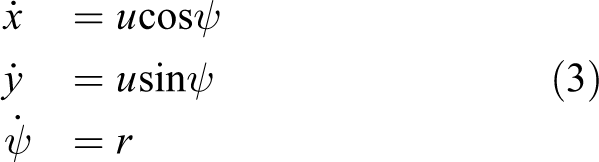
where u and r are surge velocity and yaw angular rate of robot, respectively. And x, y, ψ represent position and orientation of robot. Since dynamics of u and r are independent, model in horizontal plane can be presented as two nonlinear systems

where
Formation tracking objectives
For multi-ARs formation tracking, states of leader are defined as

where

where

For illustration, condition of equation (7) means that
Graph theory
Graph theory has played an important role in the analysis of MAS for its natural advantages in modeling the interactions between agents. For the multi-ARs system studied in this article with N nodes, define the vertex set as

According to the definition of Laplacian matrix L, it can be derived that if the graph is connected, L has a simple zero eigenvalue with
Formation tracking control algorithm
In this section, an adaptive formation tracking control protocol is proposed with stability analysis based on Lyapunov theory and graph theory. Depending on the relative position information among robots and the leader, the control protocol can guarantee equations (6) and (7) with jointly connected graphs even though the dynamics of robots and velocities of the leader are unknown.
Firstly, by deploying the linear parameterization process, the unknown nonlinearity of

where

and

Similarly, without loss of generality, assuming

where
Even though in above descriptions, dynamics of surge and yaw are independent, the formation tracking problem will still be coupled if we directly take equations (3) and (4) as a whole. This kind of tightly coupling will lead to estimation of nonlinear dynamic quite difficult in jointly-connected communication graph scenarios. As a consequence, we propose a two-stage control strategy to further decouple the system by dividing the whole process into two sub-processes concerning about dynamics and kinematics individually.
The basic intuition behind this idea is that once we obtain kinetics consensus among multi-ARs system, following robots are static with respect to the leader regarding velocity and angular rate. Then relative position adjustments can be easily carried out. If in both stage, stability of the control is obtained, formation tracking of the multi-ARs system can be reached. In the following, we will discuss about controller design in each stage.
Dynamic stage
In dynamic control stage, consensus of surge velocity u and yaw angular rate r among multi-ARs system is considered. According to equations (4) and (5), independency and similarity of u and r allow us to handle consensus problem in the same way. So in this section, we only take surge velocity into consideration, and the result obtained can be directly extended to the case of yaw angular rate. Based on equations (9) and (10), we can take estimation of

and

Now, we can formulate the distributed control protocol based on only neighbored information for trajectory tracking as

where

Then adaptive updating laws for parameters estimation can be formulated distributively depending on the tracking errors of robots as follows
Adaptive law for

Adaptive law for

In addition, define
To handle this problem, we assume that there exists time sequence t
1,t
2,
Assumption 1
The time-varying graph is jointly connected, which means that there exists a l such that the union of graphs related with
Based on definition of jointly connected graph, following lemma is introduced and Theorem 1 is proposed.
Lemma 1
Graphs Gk
,

where
Theorem 1
For multi-ARs system consists of agents with dynamics as equation (4), the tracking errors are asymptotically converging to zero with the designed control protocol (13) and parameter updating laws (15)–(16) if the communication graph of the system is jointly connected.
Proof
First consider about the problem with connected graph as a special case for jointly connected graph. According to the definition of tracking error and the controller, the dynamics of

where

and


We can present the dynamics of tracking error in compact form as

where

Choose the Lyapunov candidate as

The derivative can be obtained

According to update laws in equations (15) and (16), we have

Combining equations (19), (21), and (22), the derivative of Lyapunov candidate is

Since the time-varying communication graph associated with

Define the variable

We have

Since
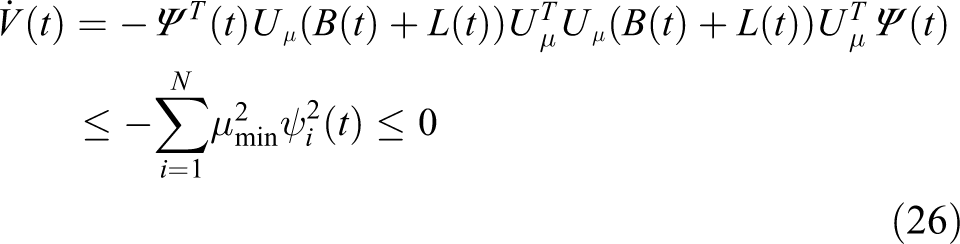
Even though the condition is conservative, the stability of control algorithm can be guaranteed. Next, we are going to discuss about the situation where only jointly connected graph is available. To better illustrate this problem, introduce a graph related error variable as

and

It can be derived that for

where

According to Lemma 1, Assumption 1 and based on Lemma 8 in the study by Yu and Xia,
20
there exist coefficients

As a consequence, it can be concluded that if

Because under Assumption 1, the non-singularity of matrix

Since the derivative of

Then derivative of Lyapunov function is

with

where ρ is an arbitrary small value. Since

Combining with equation (34)

With a simple transformation, we have

Suppose that for any time instance tk
, there is

As for the variable ρ is arbitrarily small, it can be concluded that

According to equation (30), there exist positive coefficients

We can conclude that

Based on the definition of graph related error
According to Theorem 1, the consensus of multi-ARs system regarding surge velocity and yaw angular rate can be reached even though unknown nonlinear dynamics and unreliable communication links exist. In next section, we will directly consider about formation tracking in kinematics under assumption that consensus has already been obtained in dynamics.
Kinematics stage
From dynamic control process, consensus in multi-ARs system results in

Considering about formation requirements in equation (6), formation error of

Equation (44) implies connection exists between

where

where

with kr as the parameter. As a result, dynamics of position errors can be calculated as

and

Choose Lyapunov function Vx
, Vy
as

Since
Furthermore, for

Based on definition of jointly connected graph, it will not be difficult to conclude that both
Remark 1
We implicitly take
Remark 2
Time-varying desired distances
To conclude, in this section, we have proved that with proposed formation tracking algorithms, stability of the multi-ARs system can be guaranteed in two-stage strategy. In the next section, simulations will be carried out to demonstrate the feasibility and effectiveness of the methodology proposed.
Simulations
In the simulations, trajectory tracking problem in two-dimensional space is discussed with jointly connected communication graph. The dynamic model of robot is depicted as below in water and land, respectively.

and

In the following simulation, switching instance of dynamics is 1500 s and trajectory of the leader is formulated as

with
Consensus of dynamics
Firstly, Theorem 1 in dynamic stage is verified with three robots as followers. Communication graph is jointly connected with topologies in Figure 2. Based on the control inputs and adaptive updating laws, consensus of multi-ARs system in surge velocity and angular rate is shown in Figures 3 and 4.

Topology of communication graphs.

Surge velocity errors.

Angular rate errors.
In addition, estimations of coefficients for dynamics of surge and yaw are demonstrated in Figures 5 and 6, respectively, and the estimated values are the correct as shown in figures. In addition, change of dynamics are adaptively estimated by the algorithms proposed.

Estimation process for model of u.

Estimation process for model of r.
Results in Figures 7 and 8 have shown the effectiveness of updating laws for trajectory estimation. Even though change of dynamics introduce disturbances of estimations, but results converge to true values asymptotically.

Estimation process for inputs coefficients of u.

Estimation process for inputs coefficients of r.
Formation tracking
Based on consensus on kinetics of the multi-ARs system, kinematics control strategies in above section have been implemented in simulations. With relative positions between followers and leader as equation (55) which can form a triangle with leader in the center. Simulation result is shown in Figure 9, which demonstrates the feasibility of control strategies proposed in kinematic control stage. It should be notice that in the circle area of Figure 9, the formation cannot be maintained due to the change of dynamics until estimation of the updated coefficients.


Formation tracking trajectory.
In this section, simulations have been carried out to verify all algorithms obtained in this article, results have shown that with dynamic stage control and kinematic stage control, formation tracking of multi-ARs system with nonlinear dynamics and unreliable communication links can be reached with complex trajectories of the leader.
Conclusions
In this article, we have discussed about cooperative formation tracking of multi-ARs with unknown nonlinear dynamics and unreliable communication links. To ensure the stability of the system, a two-stage control algorithm has been proposed to deal with consensus control of dynamics and formation control of kinematics respectively. With an adaptive control protocol, cooperative consensus of surge velocity and yaw angular rate among robots can be reached even though unknown nonlinear dynamics and unreliable communication links exist. With this consequence, control strategy in kinematic stage to keep desired formation can be easily carried out with only consideration about relative movements in position and yaw between robots. At last, simulations have been carried out and demonstrated feasibility and effectiveness of algorithms proposed in this article.
Footnotes
Declaration of conflicting interests
The author(s) declared no potential conflicts of interest with respect to the research, authorship, and/or publication of this article.
Funding
The author(s) received no financial support for the research, authorship, and/or publication of this article: This work was supported by the National Natural Science Foundation of China under Grant 51909044, 51609048 and 51679057, the Distinguished Youth Scholars Foundation of Heilongjiang Province under Grant J2016JQ0052, the Heilongjiang Province Science Foundation for Youths under Grant QC2017051, and the Harbin Science and Technology Bureau of China under Grant 2016RAQXJ080.
