




Abstract
The target-encirclement guidance problem for many-to-one missile-target engagement scenario is studied, where the missiles evenly distribute on a target-centered circle during the homing guidance. The proposed distributed target-encirclement guidance law can achieve simultaneous attack of multiple missiles in different line-of-sight directions. Firstly, the decentralization protocols of desired line-of-sight angles are constructed based on the information of neighboring missiles. Secondly, a biased proportional navigation guidance law that can arbitrarily designate the impact angle is cited. The missiles can achieve all-aspect attack on the target in an encirclement manner by combining the biased proportional navigation guidance law and dynamic virtual targets strategy. Thirdly, the consensus protocol of simultaneous attack is designed, which can guarantee that all missiles’ time-to-go estimates achieve consensus asymptotically, and the convergence of the closed-loop system is proved strictly via the Lyapunov stability theory. Finally, numerical simulation results demonstrate the performance and feasibility of the proposed distributed target-encirclement guidance law in different engagement situations.
Keywords
Introduction
With the rapid development of new and high-tech weapon equipment, the survivability of conventional missile attacker has been seriously weakened because of a variety of advanced defense systems such as antimissile defense system and close-in weapon system. 1,2 Hence, strenuous efforts have been made to develop a new high-performance missile attacker with terminal evasive maneuverability, hypersonic cruise capability, good stealth performance, or sea-skimming flight capability despite a huge cost. An alternative countermeasure which can facilitate missile attacker surviving the threats of the defense systems is to conduct a simultaneous attack with multiple missiles coming from different directions. 1 –6 Obviously, it is difficult to defend against a group of incoming missile attackers cropping up at the same time along different directions, even though the attackers are conventional ones in performance. 1,3 In view of the abovementioned facts, cooperative attack of multiple missiles has been considered as an effective countermeasure to improve missile’s penetration probability, and it has been an active and attractive research topic.
The first attempt to achieve salvo attack is to take an open-loop cooperative guidance scheme, in which a common predesigned impact time is set in each individual missile before the attack, and then each missile will try to arrive at the target on time independently. 6,7 An original research work has been made by Jeon et al., 8 in which an impact time control guidance (ITCG) law was proposed by utilizing small lead/heading angle assumption and optimal control theory. For better damage effect, Jeon et al. 9 presented an extension of ITCG law, which was called impact time and angle control guidance (ITACG) law. Since Jeon first proposed the issue of ITCG, there have been many achievements in this field. 10 –15 It should be pointed out that a suitable common impact time should be predesigned when aforementioned guidance laws are used to conduct a salvo attack of multiple missiles. However, it may not be easy to determine a suitable common impact time for multiple missiles. And it is also unnecessary to command them to arrive at the target at a predesigned common impact time; instead, they only need to arrive simultaneously.
For overcoming the aforementioned drawback, another scheme to achieve salvo attack is closed-loop cooperative guidance, in which the missiles have dynamic information shared by online data links during the course of guidance. 6,7 The distributed closed-loop cooperative guidance represents the development trend of cooperative guidance law and has been paying more and more attention from scholars. 1 –7,16 –24 Zhou and Yang 3 and Hou et al. 16 concentrated on the finite-time consensus problem of cooperative guidance for simultaneous attack. Based on the consensus of missiles’ time-to-go estimates, simultaneous attack with the target of unknown maneuverability was achieved in the study by Zhou et al. 17 A fault-tolerant cooperative guidance law and a robust cooperative guidance law for simultaneous arrival were proposed by Li et al. 19 and Li and Ding, 20 respectively. Moreover, switching topology is an important research topic in the field of coordination and control of complex network systems. 21,22 In the study by Zhao et al. 23 and Zhou et al., 24 the communication topology problem of cooperative simultaneous attack was investigated. Note that, although the references above have studied many aspects of simultaneous attack, they rarely considered the problem of space-cooperation.
Space-cooperative guidance means that multiple missiles coordinate their line-of-sight (LOS) angles toward the target so that they can attack the target in different LOS directions. As mentioned by Lyu et al., 4 space-cooperative guidance can significantly improve the penetration probability and guidance accuracy of multiple missiles. To the best knowledge of the authors, there are a few studies 4,6,25,26 on distributed closed-loop cooperative guidance considering space coordination at present. The guidance laws proposed by Wang et al. 6 and Wang and Lu 25 can make multiple missiles hit the target simultaneously along predesigned desired LOS directions. In the studies by Lyu et al. 4 and Shaferman and Shima, 26 although the desired LOS angles are unnecessary in advance, the desired relative LOS angles are needed to designate to multiple missiles before salvo attack. How to break through the limitation of designating desired LOS angles or desired relative LOS angles to realize target-encirclement salvo attack is a focus of this article.
There are many interesting research branches in the field of multi-agent cooperative control, such as the formation-containment control problem, 27 –29 the target-encirclement control problem, 30 –32 and the pinning control problem 33,34 . Inspired by the problem of target-encirclement control, we raise the target-encirclement guidance problem and propose the distributed target-encirclement guidance (DTEG) law which can realize simultaneous attack of multiple missiles in different LOS directions. The proposed DTEG law is applicable to both the midcourse and terminal guidance phases of a many-to-one missile-target engagement scenario. Unlike the extant studies, 4,6,25,26 the proposed guidance law does not need any relative information about predesigned desired LOS angles. The desired LOS angles of multiple missiles can be obtained online through the proposed decentralization protocols. Then, by means of virtual targets strategy and all-aspect attack guidance law, the multiple missiles can be guided to a target-centered circle in desired LOS directions. Next, with the virtual targets moving to the real target evenly, multiple missiles are guided to the real target along their desired LOS directions; thus, space-cooperative guidance is achieved. Moreover, the proposed guidance law can also realize the consensus of time-to-go estimates so that the multiple missiles can attack the target simultaneously.
Compared with the existing works, the main contributions of this work can be concluded as follows: (1) focused on the target-encirclement guidance problem raised in this article, a novel DTEG law is proposed which can make missiles hit the target simultaneously in different LOS directions. It can further improve the penetration probability and guidance accuracy, and the collision avoidance between missiles can be achieved due to their space coordination. (2) Compared with the extant studies, 4,6,25,26 where desired LOS angles or desired relative LOS angles need to be predesigned, the proposed DTEG law can calculate desired LOS angles online through the decentralization protocols. (3) Under the proposed DTEG law, the lead angles of the missiles are usually small enough during terminal homing guidance, which is quite useful to satisfy the field-of-view constraint. (4) The proposed DTEG law can handle the case that the number of missiles varies during the target-encirclement homing guidance.
The remainder of this article is organized as follows. In the second section, some necessary preliminaries and problem formulation are introduced. The third section gives the main results of this article, namely the proposed DTEG law which consists of decentralization protocols of desired LOS angles, all-aspect attack guidance law along with dynamic virtual targets strategy, and consensus protocol of simultaneous attack. In the fourth section, numerical simulations of the proposed DTEG law are set up. Finally, the conclusions of this article are drawn in the last section.
Preliminaries and problem formulation
This section introduces some necessary preliminaries firstly. Then the many-to-one engagement geometry and the engagement kinematics are given. Finally, the target-encirclement guidance problem is formulated.
Preliminaries
In this subsection, some basic concepts and results in algebraic graph theory are introduced, which mainly come from the studies by Ren and Cao
35
and Olfati-Saber and Murray
36
. Algebraic graph theory is an important analytical tool in the field of multi-agent systems. It can be used to describe the situation of communication connection, namely communication topology, among the multiple agents. Herein, the graph

The Laplacian matrix of

From equation (2), we have the following lemma
Lemma 1

and all other eigenvalues have positive real parts (
Assumption 1
In this article, the graph
Remark 1
For multi-agent systems, a necessary condition to guarantee consensus is that the undirected graph is connected or the directed graph has a directed spanning tree.
35
Herein, we suppose that the graph
For the n missiles subjected to an undirected and circularly connected communication graph
Engagement geometry
The target, such as an enemy’s warship, can be modeled as being stationary, because its velocity and maneuverability are not comparable to those of a missile at all. So, without loss of generality, a planar many-to-one engagement scenario of n missiles attacking a stationary target is considered. The following assumptions are made before analyzing and designing the cooperative guidance laws for multiple missiles.
Assumption 2
Assumption 3
Compared with the guidance loop dynamics, the seeker and autopilot dynamics of a missile are so fast that they can be ignored during the design of guidance laws. 2,4,7
Assumption 4
The velocities of missiles are not assumed to be constant, but adjustable. The same assumption can be found in some other similar studies. 3,4,25 For most subsonic cruise missiles equipped with aeroengines, their velocities are adjustable.
Based on the aforementioned assumptions, the planar many-to-one homing engagement geometry of n missiles attacking a stationary target can be illustrated in Figure 1. The Cartesian inertial reference frame x–o–y is horizontal. The notations Mi and T denote ith missile and target, respectively. In the following text, subscript i of a variable represents the variable associated with ith missile.

Illustration of many-to-one missile-target homing engagement geometry.
The relative range between the ith missile and the target, or the so-called range-to-go, is represented as ri
. The ith missile’s velocity, heading angle, LOS angle, lead angle are denoted by Vi
,
According to the engagement geometry shown in Figure 1, the ith missile’s point-mass kinematic equations can be written as

The missile-target relative kinematics equations can be given by

Using the ith missile’s initial position

where the function
The ith missile’s time-to-go can be expressed by
Target-encirclement guidance problem formulation
The meaning of multiple missiles’ target-encirclement guidance problem is elaborated in this subsection. Taking four missiles for example, the schematic diagram of multiple missiles’ target-encirclement guidance is illustrated in Figure 2, in which the red pentagram represents the target. It can be seen that the missiles are guided to evenly distribute on a target-centered circle and strike the target along different LOS directions finally.

Illustration of multiple missiles’ target-encirclement guidance with dynamic virtual targets strategy. The circle’s radius is R max.
Next, we give the formulaic description of multiple missiles’ target-encirclement guidance problem.
Definition 1
The multiple missiles are said to have achieved many-to-one target-encirclement guidance, if




where
Remark 2
The left neighbor
Remark 3
From equation (8), it is clear that all the missiles distribute on a target-centered circle at the time
In summary, for the n missiles subjected to an undirected and circularly connected communication graph
Distributed cooperative target-encirclement guidance law design
In this section, a DTEG law is proposed for many-to-one target-encirclement simultaneous attack of multiple missiles. Firstly, the decentralization protocols of desired LOS angle are constructed based on the information of neighboring missiles. Then we introduce a biased proportional navigation guidance (BPNG) law and a dynamic virtual targets strategy so that each missile can attack its corresponding virtual target with corresponding desired LOS angle constraint. Finally, the consensus protocols of multiple missiles’ time-to-go estimates are designed for simultaneous attack.
The decentralization protocols of desired LOS angles
Unlike the extant studies in which the desired LOS angles or impact angles need to be designated before salvo attack, the method proposed in this article can make multiple missiles coordinate their desired LOS angles based on the online neighboring missiles’ information.
The desired LOS angles’ evolution dynamics in discrete-time steps can be established as follows

where
For the convenience of design and proof hereafter, we can label the desired LOS angles in accordance with their initial values as follows

Then, the angular distance

It is noteworthy that the even decentralization of desired LOS angles can be achieved when the angular distances
Distributed decentralization protocols of desired LOS angles are proposed as follows

where
Lemma 2
For a row stochastic matrix
Now, we are ready to analyze the convergence of the proposed distributed decentralization protocols of the desired LOS angles.
Theorem 1
Considering a group of desired LOS angles subjected to the dynamics (11), the initial condition (12) and
Proof
For

Similarly, one has


Equations (15)–(17) can be rewritten in a highly compact form as follows

where

From equation (18), it is clear that

In view of

where

where
This completes the proof of Theorem 1.
Remark 4
The above proof implies that the convergence to even decentralization relies on the assumptions that each missile can communicate with its two neighbors and the product meets
Remark 5
A missile can judge its desired LOS angle’s label is 1 or n or others by comparing its initial desired LOS angle with its two neighboring missiles’ initial desired LOS angles. Then the decentralization protocol
Next, some examples are presented to illustrate the validity of the proposed decentralization protocols of desired LOS angles. Let the step size τ in equation (11) and the adjustable feedback gain G in equation (14) be 0.1 and 1, respectively. The arbitrarily designated initial LOS angles of n missiles are listed in Table 1, and their time evolutions under the decentralization protocols are shown in Figure 3. From the steady-state desired LOS angles we can see that any two neighboring LOS angles have an expected deviation of
Initial desired LOS angles and steady-state desired LOS angles under the decentralization protocols.

LOS: line-of-sight.

The time evolutions of desired LOS angles. The case of: (a) n = 3, (b) n = 4, and (c) n = 5. LOS: line-of-sight.
All-aspect attack guidance law along with dynamic virtual targets strategy
In the study of ITACG law for a single missile, Zhang et al.
12,13
proposed a novel BPNG law which can attack the target with arbitrary designated impact angle
The all-aspect attack guidance law based on BPNG law is given by


where
Lemma 3
t
0 and
Remark 6
From Lemma 3, it is clear that the BPNG law can only be applied to the case of
From equation (24),
Initially, all the virtual targets evenly distribute on a circle that takes the real target as the center. Each missile is guided to its corresponding virtual target under the BPNG law. When they arrive at their virtual targets, their desired LOS angles will be achieved, and at that time their velocities will point to the target, which can be known from Lemma 3. Next, all the virtual targets move toward the real target at the same speed along their desired LOS directions, until they reach the real target point. The multiple missiles are guided to their corresponding virtual targets, and so space-cooperative guidance will be achieved by then.
The positions of the dynamic virtual targets can be computed as follows


where
Remark 7
From equations (25) and (26), it is clear that the virtual targets are statically distributed on a target-centered circle at first. When a missile arrives at the target-centered circle, the virtual targets begin to move simultaneously until they reach the real target point.
Remark 8
The operation distance of seeker can be chosen as the designated value of
Remark 9
By combining the BPNG law and the dynamic virtual targets strategy, equations (8) and (9) can hold, namely space-cooperative guidance can be achieved, but they cannot make sure that multiple missiles arrive at the target simultaneously.
The consensus protocol of simultaneous attack
To achieve simultaneous arrival, the consensus protocol of simultaneous attack is proposed in this subsection, and the convergence of the closed-loop system is proved strictly via the Lyapunov stability theory. As mentioned earlier, the key to realize simultaneous attack is to realize the consensus of multiple missiles’ time-to-go estimates. Under the assumption of small angle and Taylor series expansion, an estimation expression of the ith missile’s time-to-go when using BPNG law is given in the extant study 12

where C 1, C 2, C 3, C 4, and C 5 are coefficients whose value can be found in the extant study. 12
Remark 10
Note that, the approximation
Let

In essence, Ui
is a modified range-to-go. Substituting equation (28) into equation (27), and taking time derivative of

where
In view of the fact that the lead angles are very small after forming the situation of target-encirclement, one has

Next, before proposing the consensus protocol of simultaneous attack, the definition of consensus error of the missiles’ time-to-go estimates is given firstly.
Definition 2
For a group of n missiles, the consensus error of ith missile’s time-to-go estimate is defined as

where
From its definition, it is clear that consensus error ei represents the time-to-go estimates’ difference between ith missile and all its neighbors.
According to the consensus error ei , a novel distributed consensus protocol of simultaneous attack is proposed as follows

where Ki
are constants that satisfy
Theorem 2
Considering a group of n missiles guided by BPNG law, and they subjected to communication graph
Proof
Given

The Lyapunov function candidate can be selected as

where
From Lemma 1 and equation (31) we can obtain

where

From equation (31), one has

So, according to Lyapunov stability theory we can get

which indicates that the proposed consensus protocol (32) can guarantee that all missiles’ time-to-go estimates achieve consensus asymptotically, namely equation (10) can be achieved asymptotically. The proof of Theorem 2 is completed.
Remark 11
According to the kinematic equations (4) and proposed consensus protocol (32), multiple missiles’ velocities will be invariant after the consensus of time-to-go estimates. Furthermore, from equation (30) we can know that the derivative of time-to-go estimates will be equal to −1 once the time-to-go estimates achieve consensus. The above facts can also be found in the following numerical simulations.
Remark 12
As shown in equations (31) and (32), only neighboring missiles’ time-to-go estimates are needed to exchange via the communication network for achieving multiple missiles’ simultaneous attack. In addition, taking Remark 5 into account, the proposed DTEG law is fully distributed and thus has a great advantage in implementation.
In summary, equations (13)–(14), (23)–(26), (31), and (32) constitute the complete DTEG law, which can realize multiple missiles’ target-encirclement cooperative attack. Specifically, the decentralization protocols of desired LOS angles, namely equations (13) and (14), can coordinate multiple missiles’ desired LOS angles; the dynamic virtual targets strategy, namely equations (25) and (26), can generate each missile’s virtual target according to its corresponding desired LOS angle; the BPNG law, namely equations (23) and (24), can steer the missiles to attack their virtual targets with desired LOS angles. The consensus protocol of simultaneous attack, namely equations (31) and (32), can ensure that multiple missiles arrive at the target simultaneously. The proposed DTEG law has many outstanding advantages. First of all, it is fully distributed and thus has a great advantage in implementation; then, it can realize multiple missiles’ target-encirclement cooperative simultaneous attack without any predesigned information about desired LOS angles; last but not least, it can also handle the case that the number of missiles varies during homing guidance.
Numerical simulation and analysis
In this section, the performance of the proposed DTEG law is demonstrated by four cases as follows: (1) Taking four missiles to strike a single stationary target for example, distributed target-encirclement cooperative attack is conducted to demonstrate the performance and feasibility of the proposed DTEG law. (2) Cooperative attack is conducted on the engagement scenario that the number of missiles varies, specifically from four to five, during homing guidance. (3) A great many missiles are considered for the distributed target-encirclement cooperative attack. (4) The feasibility of the proposed DTEG law is explored for attacking a moving target.
In all the cases, the initial position of the target is located at (0,0) km. We assume that the missiles travel with an initial velocity of


where
Case 1: Distributed target-encirclement cooperative attack of multiple missiles
In this subsection, distributed target-encirclement cooperative attack of four missiles is conducted to demonstrate the performance and feasibility of the proposed DTEG law. The initial states of missiles can be arbitrarily designated, and a group of initial states are set as presented in Table 2. Based on initial states, the desired LOS angles will be generated by the proposed decentralization protocols. Then the positions of virtual targets can be obtained by dynamic virtual targets strategy. Next, the normal acceleration
Initial states of the four missiles in case 1.

LOS: line-of-sight.
The simulation results for case 1 are shown in Figure 4. It can be seen from Figure 4(a) that the situation of target-encirclement is achieved, and the multiple missiles hit the target precisely in different LOS directions. Meanwhile, it is clearly shown in Figure 4(b) that the ranges-to-go converge to zero at the same time, which indicates that the missiles can attack the target precisely and simultaneously. From Figure 4(b) and (c) we can see that, during terminal homing guidance (when the ranges-to-go are less than 30 km), the ranges-to-go are equal to each other and any two neighboring LOS angles have an equal deviation, which means that the missiles evenly distribute on a target-centered circle during that time.
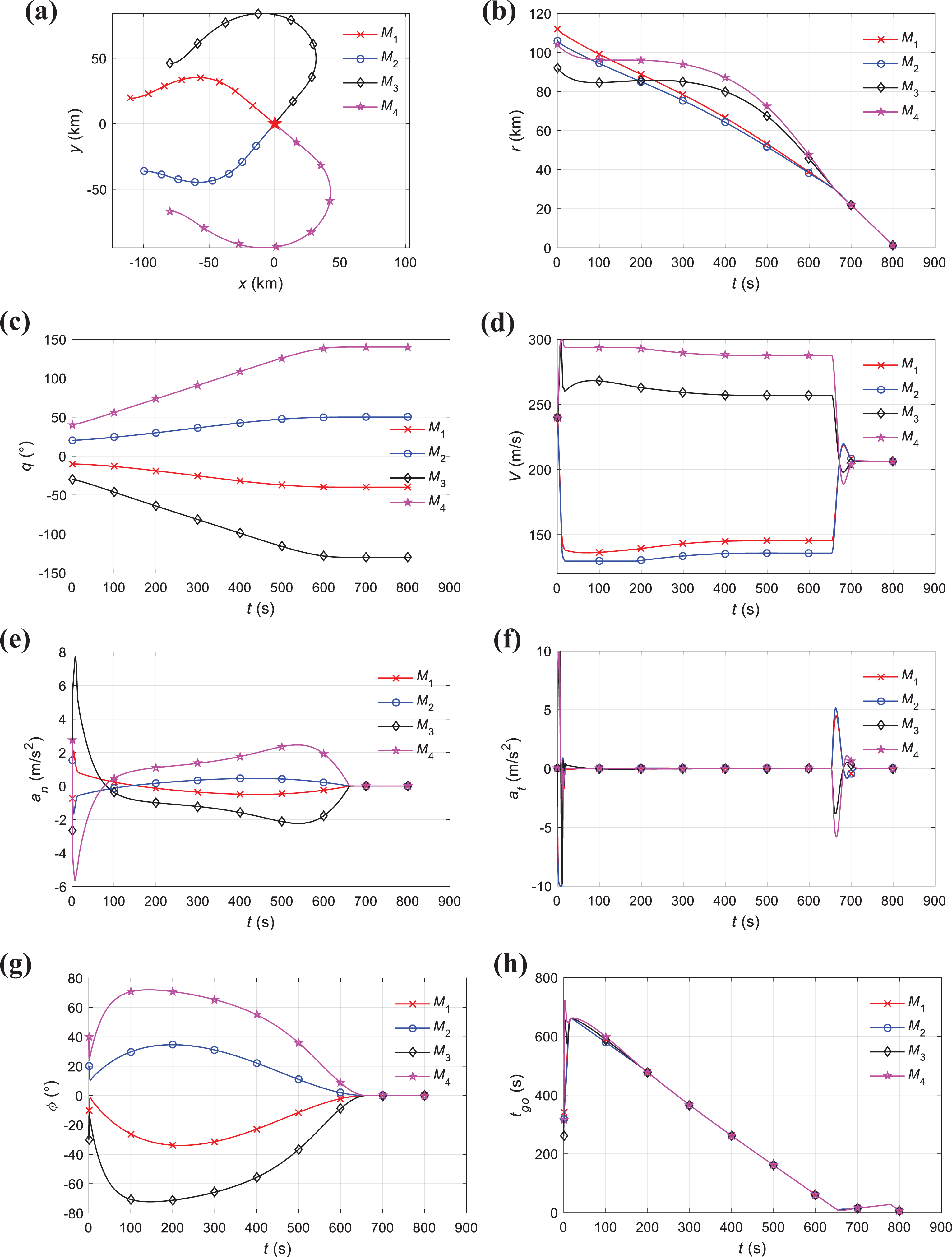
Numerical simulation results for case 1: (a) missiles-target trajectories in horizontal plane, (b) missiles-target relative distances, (c) missiles’ LOS angles, (d) missiles’ velocities, (e) normal accelerations achieved by autopilot, (f) tangential accelerations achieved by autopilot, (g) missiles’ lead angles, and (h) time-to-go estimates relative to virtual targets. LOS: line-of-sight.
It is shown in Figure 4(d) that the velocities of M 1 and M 2 are smaller than that of M 3 and M 4 in midcourse guidance, which corresponds to the fact that the trajectory arc lengths of M 1 and M 2 are shorter than that of M 3 and M 4 as seen in Figure 4(a). Moreover, the time histories of normal accelerations and tangential accelerations achieved by autopilot are shown in Figure 4(e) and (f), respectively. It can also be seen from Figure 4(g) that the lead angles of multiple missiles are all close to zero during terminal homing guidance, which can easily meet the seekers’ field-of-view constraint. Furthermore, the time-to-go estimates relative to virtual targets are shown in Figure 4(h), and it is also noted that the broken lines appearing in terminal homing guidance result from the motion of virtual targets. From the above results, it is concluded that the performance and feasibility of the proposed DTEG law is verified.
Case 2: Cooperative attack when the number of missiles varies
Because there is no need to designate the desired LOS angles in advance for space-cooperative guidance, this method can handle the case that the number of missiles varies during the target-encirclement homing guidance phase. This is a huge advantage in implementation.
In this subsection, cooperative attack is conducted on the engagement scenario that the number of missiles varies, specifically from four to five, during homing guidance. Within the first 200 s, the missile group consisting of M 1, M 2, M 3, and M 4 are guided by the proposed DTEG law, and the states of each missile in this period are exactly the same as those in case 1. At 200 s, a new missile M 5 joins the group with an initial range-to-go 92 km and an initial LOS angle −150°. A new set of desired LOS angles will be generated by the proposed decentralization protocols, and then a new set of virtual targets will be obtained. Steered by the proposed DTEG law, the missile group with a new member can achieve distributed target-encirclement cooperative attack in a new state.
The simulation results for case 2 are shown in Figure 5. It is clearly shown in Figure 5(a) that, compared with Figure 4(a), the situation of target-encirclement is achieved in a new state, and the multiple missiles hit the target precisely in different LOS directions. Meanwhile, it can be observed from Figure 5(b) that the ranges-to-go converge to zero at the same time, which indicates that the missiles can attack the target precisely and simultaneously. Note that, the total time to achieve simultaneous attack in case 2 is shorter than that in case 1, because the participation of M 5 makes the trajectory arc lengths of M 3 and M 4 shorter than that in case 1. From Figure 5(c), we can see that the desired LOS angles are redistributed when a new member joins the missile group, and any two neighboring desired LOS angles have an equal deviation in the state of stability. Additionally, the velocities of the multiple missiles are shown in Figure 5(d). From the above results, we can securely conclude that the proposed DTEG law can handle the case that the number of missiles varies during the target-encirclement homing guidance.
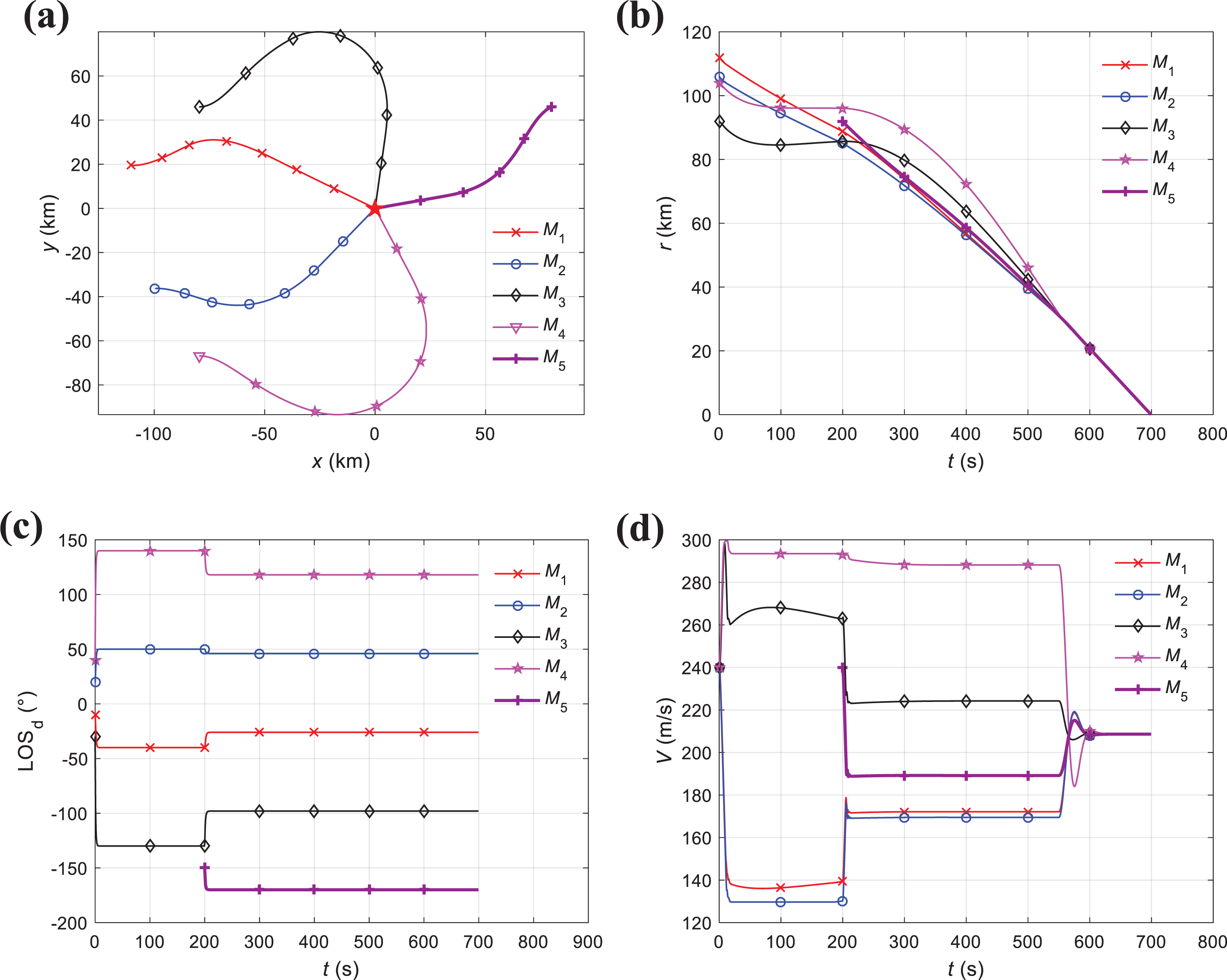
Numerical simulation results for case 2: (a) missiles-target trajectories in horizontal plane, (b) missiles-target relative distances, (c) missiles’ desired LOS angles, and (d) missiles’ velocities. LOS: line-of-sight.
Case 3: Cooperative attack of a great many missiles
In this subsection, a great many missiles are considered for the distributed target-encirclement cooperative attack. Theoretically speaking, the number of missiles can be arbitrarily large when using the proposed DTEG law. Herein, taking 12 missiles for example, the effectiveness of the proposed DTEG law is validated when the method is applied to cooperative attack of a great many missiles. In addition, to illustrate the function of dynamic virtual targets strategy, the contrastive simulations are carried out with and without dynamic virtual targets strategy, respectively. The initial states of the 12 missiles are set arbitrarily, and their values can be seen in the simulation results, which are not listed in detail here.
The simulation results for case 3 are shown in Figure 6. It is clearly shown in Figure 6(a) and (b) that the multiple missiles hit the target precisely in different LOS directions, and the space-cooperation is achieved better with dynamic virtual targets strategy. It can be observed from Figure 6(c) and (d) that the ranges-to-go converge to zero at the same time, which means that the missiles can attack the target precisely and simultaneously. By comparing Figure 6(e) with Figure 6(f), an obvious advantage of dynamic virtual targets strategy is that the lead angles are small enough during terminal homing guidance, such that the seekers’ field-of-view constraint can be easily met. From the above results, we can draw a conclusion that the proposed DTEG law is effective when it is applied to cooperative attack of a great many missiles; in addition, the dynamic virtual targets strategy is quite useful to satisfy the field-of-view constraint.

Numerical simulation results for case 3. The trajectories (a) with and (b) without dynamic virtual targets strategy, the ranges-to-go (c) with and (d) without dynamic virtual targets strategy, and the lead angles (e) with and (f) without dynamic virtual targets strategy.
Case 4: Cooperative attack a moving target
In this subsection, although the proposed DTEG law is designed for attacking a stationary target, the feasibility of the proposed DTEG law is explored for attacking a moving target, such as a low-speed warship. We assume that the target is found moving at a velocity of 15 m/s along the x-axis when the seekers are activated, and at that moment the position of the target is located at (0,0) km.
The simulation results for case 4 are presented in Figure 7 and Table 3. It can be observed from Figure 7(a) that the situation of target-encirclement is achieved basically, and the multiple missiles hit the target precisely in different LOS directions. From Figure 7(b) we can see that the ranges-to-go converge to zero at slightly different times, which indicates that the missiles impact times are roughly the same. The missiles’ LOS angles are illustrated in Figure 7(c), and it can be seen that any two neighboring LOS angles have an approximate deviation of 90° during terminal homing guidance. In addition, the velocities of the multiple missiles are shown in Figure 7(d). The terminal states of the four missiles are presented in Table 3 in detail. It can be observed from Table 3 that the miss distances are all small enough so that the missiles can be considered to hit the target precisely. What’s more, it can also be observed that the maximum impact time error is 0.436 s, and the deviations of neighboring LOS angles are 85.282°, 88.129°, 89.057°, and 97.532°, respectively. Therefore, although more efforts need to be paid for improving guidance performance, we can say that the distributed target-encirclement simultaneous attack is realized basically.

Numerical simulation results for case 4: (a) missiles-target trajectories in horizontal plane, (b) missiles-target relative distances, (c) missiles’ LOS angles, (d) missiles’ velocities: LOS: line-of-sight.
Terminal states of the four missiles in case 4.

LOS: line-of-sight.
Conclusion
In this study, a novel space and time cooperative guidance law, which is called DTEG law, is proposed for the problem of distributed target-encirclement simultaneous attack. The proposed DTEG law can make the missiles evenly distribute on a target-centered circle when they are guided to the target and can ensure them arrive at the target simultaneously. The proposed DTEG law mainly includes three components as follows. Firstly, the decentralization protocols of desired LOS angles can coordinate multiple missiles’ desired LOS angles. Then, the BPNG law and the dynamic virtual targets strategy can ensure that the space-cooperative guidance is achieved. Finally, the consensus protocol of simultaneous attack can make sure that multiple missiles arrive at the target simultaneously. The proposed DTEG law is fully distributed, can realize multiple missiles’ target-encirclement cooperative simultaneous attack without any predesigned information about desired LOS angles, and can also handle the case that the number of missiles varies during homing guidance. Moreover, a noteworthy feature of the proposed DTEG law is that the collision avoidance between missiles can be achieved naturally because of their space coordination. Numerical simulations demonstrate the performance and feasibility of the proposed DTEG law in four different engagement situations. Note that, the proposed DTEG law needs an undirected and circularly connected communication topology. Hence, it is of great interest to further study the target-encirclement guidance problem of multiple missiles under time-varying communication topologies or with a highly maneuvering target.
Footnotes
Declaration of conflicting interests
The author(s) declared no potential conflicts of interest with respect to the research, authorship, and/or publication of this article.
Funding
The author(s) disclosed receipt of the following financial support for the research, authorship, and/or publication of this article: This work was supported by the Aeronautical Science Foundation of China, under Grant 20180753007.
