



Abstract
This study investigates an adaptive chattering-free sliding-mode control method for n-order nonlinear systems with unknown external disturbances and uncertain models. The proposed method takes the advantage of finite-time fast convergence to avoid singularity problem and ensure its robustness against system uncertainty and unknown disturbance. To achieve fast convergence from any initial condition to system origin, a full-order terminal sliding-mode controller containing differential terms is proposed based on the property of n-order nonlinear systems. Then the continuous and smooth actual control law is obtained by integrating the differential control law containing the discontinuous sign function to realize chattering free. Meanwhile, instead of evaluating the fixed upper bound of system uncertainty and interference in practical implementations, an adaptive method is utilized for its unknown upper bound estimation. The convergence of the adaptive terminal sliding-mode controller in finite time is verified based on Lyapunov stability theory. Finally, two simulation results demonstrate the effectiveness of the proposed control method.
Keywords
Introduction
Nonlinear dynamical systems suffer from the performance degradation caused by uncertainties and external disturbances. 1 Various nonlinear control methods, such as adaptive method, 2 fuzzy control method, 3 –7 and sliding-mode control (SMC) method, 8,9 have been successively applied to guarantee the nonlinear system stability. Among all of these methods, SMC has wide acceptance in practical implementations and achieves many research results because of its relatively simple design, rapid response, and robustness to unknown interference and model uncertainty. The sliding-mode technique is designed to drive the system state variables to equilibrium using a discontinuous feedback control law, 9 which is widely used in the fields such as motor control, 10 –13 mechanical arm control, 14,15 and multi-agent system. 16 –19
Slide mode control is divided into linear slide mode (LSM) control and terminal slide mode (TSM) control. The sliding-mode surfaces selected by LSM are linear functions containing the state of the system, which are suitable for systems with low requirements on state accuracy. However, it has poor control effect and cannot converge in finite time for a complex nonlinear system such as robot. Compared with LSM, TSM, 1,20 –23 a nonlinear sliding-mode surface, has a series of advantages such as convergence in finite time and high control precision. By introducing the nonlinear part, the trajectory of the system reaches the sliding-mode surface in finite time and generates sliding-mode dynamics on the sliding-mode surface. Moreover, it has strong robustness to the uncertainty of the system. For the robot manipulators with uncertainties and external disturbances, an adaptive terminal SMC method was proposed 24 to eliminate the chattering problem of the controller. In Feng et al., 25 a robust adaptive end-sliding-mode controller was applied to n-link rigid robotic manipulators, and the unknown parameters of the upper bound of the system uncertainty were estimated by adaptive techniques. These estimates are used as controller parameters to eliminate the effects of uncertain kinetics and to guarantee that the error of the TSM converges in finite time.
However, singularity problem, which is caused by the fact that the output of the controller may approach infinity when the system state converges to the equilibrium point, is a serious problem for LSM and TSM. Many research studies have been conducted to overcome the singularity of TSM control system. A full-order terminal-SMC designed in Yi and Zhai 26 is suitable for full-order nonlinear systems but fails to consider the uncertainty of the model and unknown interference. A chattering-free second-order fast nonsingular terminal SMC scheme was proposed 27 in combination with nonlinear observers. Although it can converge in fixed time, the result of the controller is complex and fails to be applied to high-order system. A nonsingular TSM control based on the anti-step method proposed by Jianqing and Zibin 28 is only applicable to specific higher order systems. Other methods such as integrated TSM control 29 and TSM 30 combined with homogeneous methods are only applicable to second-order or specific high-order systems, although unknown interference and model uncertainty are considered in the process of solving singularity problem.
Since the chattering phenomenon triggering by discontinuous characteristic of symbol function itself, singularity problem is not the only problem of TSM. In nonlinear system, discontinuous characteristic will activate its high-frequency characteristic, weaken the control effect, or even result in incontrollable state directly, which are inevitable for the SMC. To avoid chattering phenomenon, the key is to transmit the discontinuous sign function to a bounded continuous function so as to keep the continuity of the SMC law. 31 The boundary layer method was adopted 32 to reduce chattering, whereas it leads to the steady-state error of wide boundary layer and unobvious chattering effect reduction of narrow boundary layer. Several studies 33 –35 verify the application of high-order SMC. However, the finite-time convergence system based on high-order SMC may give rise to stronger chattering effect 36 compared with asymptotic convergence system. A reaching law method was proposed 37,38 to eliminate or reduce chattering by controlling the parameters of the reaching law. A terminal SMC based on disturbance observer was used to avoid chattering. 39,40 Although these methods can eliminate or reduce chattering effect, they are not applicable to all-order systems.
After in-depth study of full-order terminal SMC system based on the above analysis, an adaptive chattering-free full-order sliding-mode controller is proposed. By integrating the differential control law with sign function, a continuous and smooth control law is obtained to avoid the influence of chattering. An adaptive method is applied to estimate the unknown upper bound of system uncertainty and unknown disturbance. The algorithm stability is analyzed and proved by Lyapunov stability theory.
The remainder of this article is organized as follows. The second section introduces the adaptive chattering-free full-order sliding-mode controller designed for the second-order system. For high-order systems, the adaptive chattering-free full-order sliding-mode controller with Lyapunov stability analysis is presented in the third section. Simulation studies performed on the second-order system and the third-order system are provided in the fourth section. Finally, conclusions are offered in the fifth section.
Adaptive chattering-free full-order sliding-mode controller of the second-order systems
Consider the following second-order nonlinear systems with unknown disturbances and model uncertainties

where
Assumption 1
The first derivative

where h
0,
In this section, the control goal is to design an adaptive chattering-free sliding-mode controller to stabilize the nonlinear system (equation (1)) from any position
For system (equation (1)), the TSM manifold can be designed as follows

where C
1,

where
When the sliding-mode surface s is reached,

and

The parameters
Theorem proves that the actual control law is continuous and smooth without any high-frequency switching term by integrating the differential control input containing the sign function, so that the proposed adaptive chattering-free sliding-mode controller is completely free from chattering. The unknown upper bound of external disturbance and model uncertainty term is obtained by designing an adaptive tuning method.
The flowchart of adaptive chattering-free sliding-mode controller is shown in Figure 1.

The flowchart of the adaptive chattering-free sliding-mode controller.
Theorem 1
Considering the uncertain second-order system (equation (1)) will reach the sliding-mode surface

where

where β is a switching gain constant and also a positive constant.

where B 0, B 1, and B 2 are positive constants.
Proof

Substituting equation (7) into the above expression gives

Differentiating s with respect to time yields

Define the adaption error as

Differentiating V with respect to time and using equation (12) yields
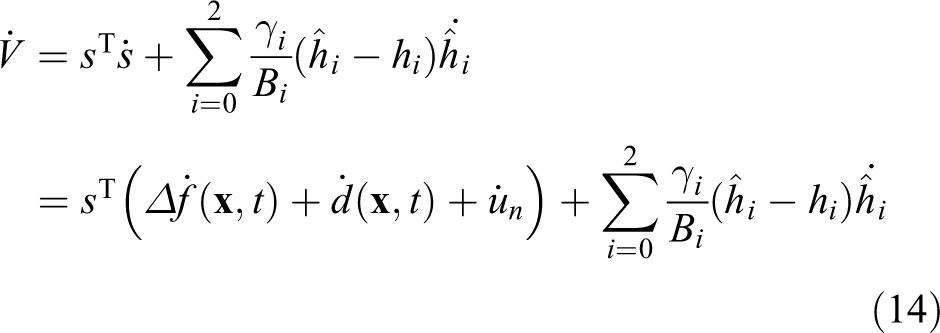
Applying equation (8) yields


Considering the update laws (equation (9)) yields


where

Hence

where

where
Remark 1
If the condition of
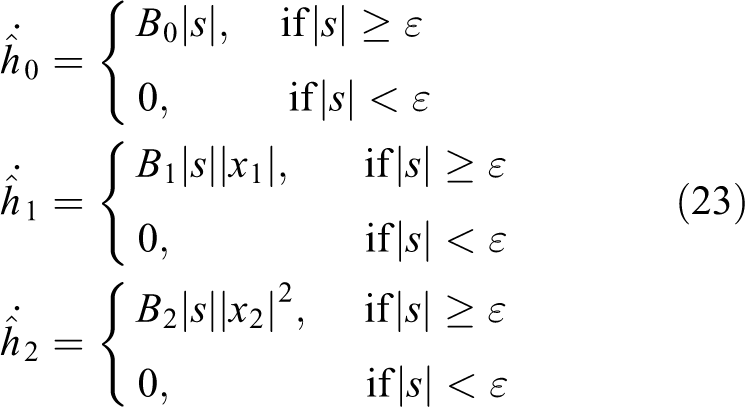
where ε is a small positive constant.
Remark 2
The parameter ε is quite important for the adaptive law, because it will affect the convergence rate of the sliding-mode surface. The large value of ε will drive the required control input to be large, which is infeasible in the actual control. Moreover,
Remark 3
The parameter Bi
in the adaptive law (equation (9)) determines the convergence rate of
Remark 4
In the process of obtaining the actual control law, the
Adaptive chattering-free full-order sliding-mode controller of the high-order systems
Consider the following high-order nonlinear systems with unknown disturbances and model uncertainties

where
Remark 5
The uncertainty

where hi is the positive unknown constant.
The TSM for the nonlinear system (equation (24)) drives the system to the terminal sliding-mode surface from any initial state
To make the sliding-mode variable converge to the origin in finite time and drive the state variable to converge to the origin in finite time, TSM manifold of system (equation (24)) can be designed as follows 22

where Ci
and

where
When the terminal sliding-mode surface is established,

or

Ci
is chosen based on the Hurwitz polynomial
The adaptive chattering-free SMC law is expressed as follows


The definition of adaptive law is consistent with equation (9). Although the control law
For nonlinear high-order system (equation (24)) and control law (equation (29)), the TSM manifold (equation (25)) can be rewritten as follows
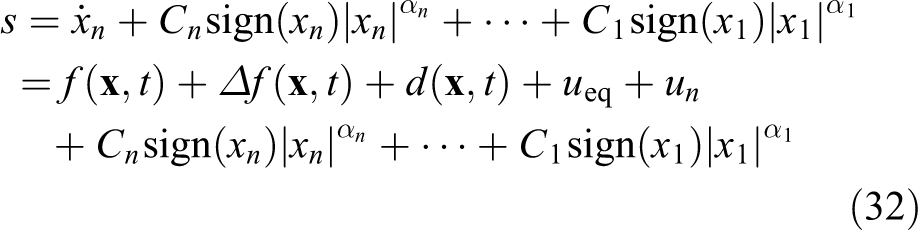
Substituting the control (equation (30)) into equation (32) gives

The first derivative of s can be given as follows

The adaption errors are given as

Using equation (34), the time derivative of V is

Using equation (31) yields


Hence, a conclusion similar to the proof of the stability of the second section can be drawn as
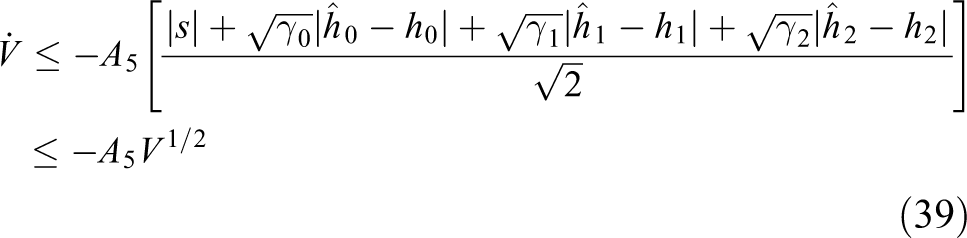
where
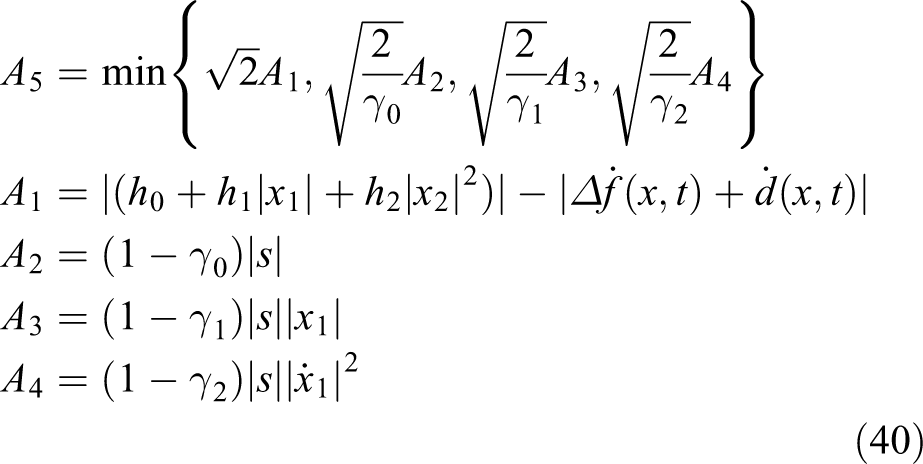
where
Practically,

Remark 6
To calculate


where η is the time delay. By reason of

an appropriate sample time can be chosen as η.
Simulations
In this section, the performance of the proposed algorithm is demonstrated, and the following two simulation examples are given.
Example 1 (TSM control of a second-order system)

A TSM manifold for equation (3) is designed as follows

where the parameters
The control law (equations (7) and (8)) can be rewritten as



where
The adaptive tuning laws are given as



Taking the second-order system as the control object and the simulation time as a fixed step of 0.01 s, the simulation was carried out in the MATLAB R2016a-Simulink platform. The initial conditions of the adaptive parameters are
The simulation results are shown in Figures 2 to 5. The sliding-mode variable s of the second-order system is depicted in Figure 2, which shows that the numerical change of the sliding-mode variable s is relatively reasonable and smooth, and converges to zero in a finite time. Figure 3 shows that the curve of the control law is relatively smooth and there is no high-frequency oscillation phenomenon though the control law (equations (7) and (8)) contains discontinuous sign functions. Hence, the algorithm effectively eliminates chattering. The convergence of the adaptive parameters

Sliding manifold of the second-order system.

Control input with the uncertainty and disturbance of the second-order system.

((a) to (c)) Adaptation of parameters of the second-order system.
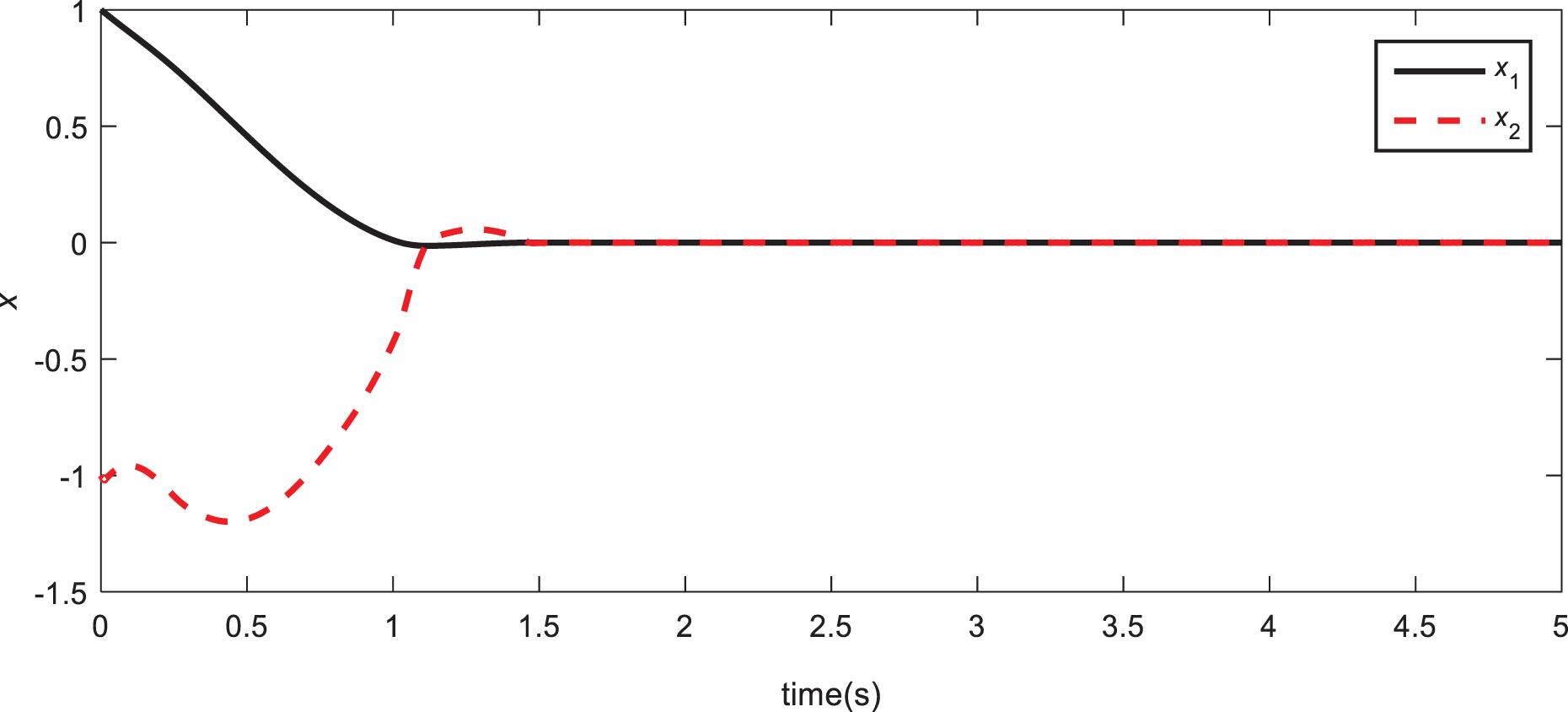
System states of the second-order system.
Example 2 (TSM control of a third-order system)

Based on equation (41), a TSM manifold is established as follows

where the parameters
Based on equations (29) to (31), the control law for the third-order system can be given as

where
The adaptive tuning laws are given as

The simulation is carried out in the MATLAB R2016a-Simulink platform with the third-order system as the control object and the simulation time as a fixed step of 0.005 s. The initial conditions of the adaptive parameters are
The simulation results are shown in Figures 6 to 9. The convergence of the sliding-mode variable s for the third-order system is shown in Figure 6, which guarantees that the states converge to zero in finite time. The actual control u of the third-order system is depicted in Figure 7. The figure shows that the control law curve is relatively smooth, and the algorithm can effectively avoid chattering accordingly. The convergence of the adaptive parameters

Sliding manifold of the third-order system.

Control input with the uncertainty and disturbance of the third-order system.

((a) to (c)) Adaptation of parameters of the third-order system.
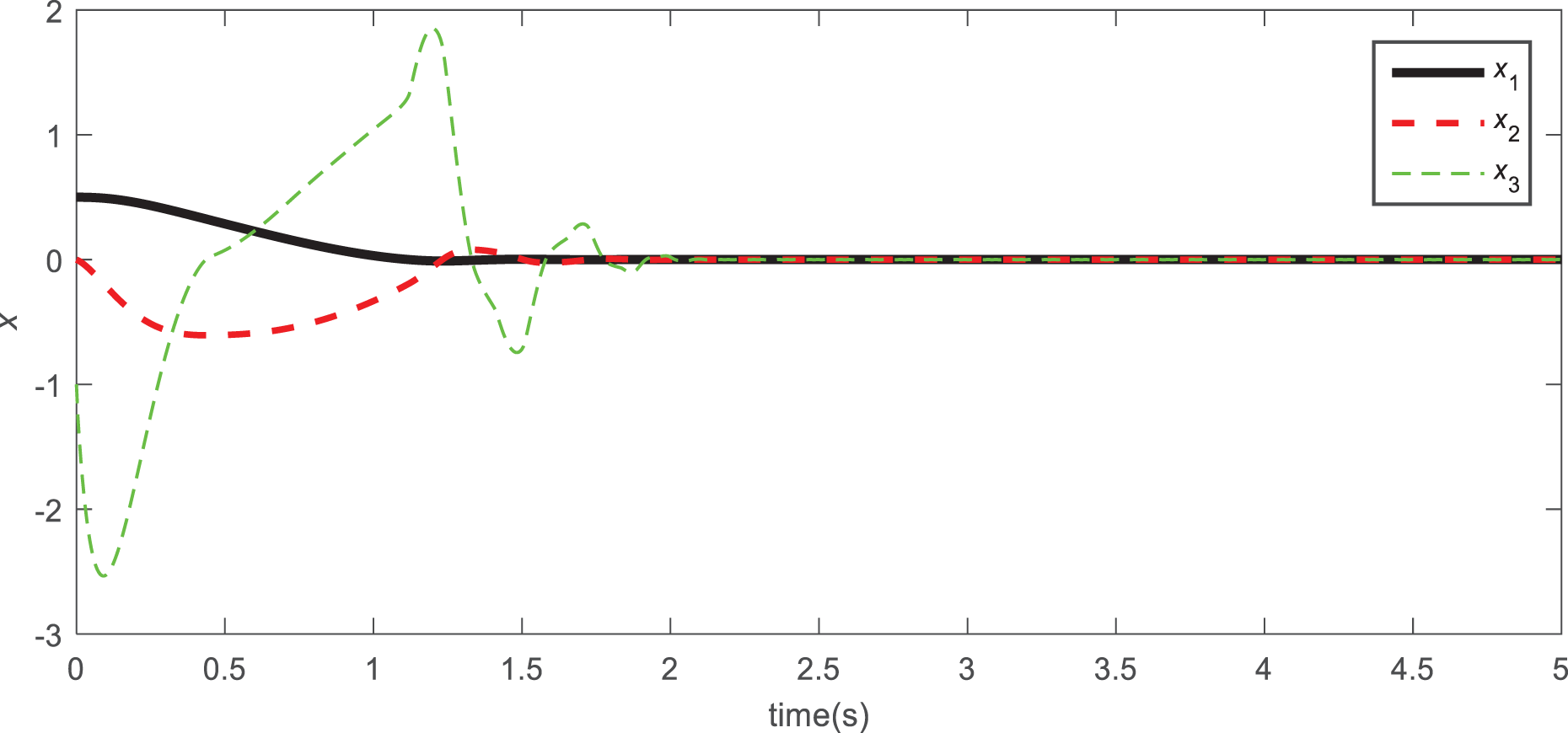
System states of the third-order system.
Conclusion
An adaptive chattering-free full-order sliding-mode controller method is proposed for n-order in this article. The continuous actual control law is obtained by integrating the constructed differential control law containing discontinuous symbol function to avoid chattering. Without the demand of prior knowledge concerning the upper bound of system uncertainty and unknown disturbance, an adaptive law is introduced to estimate the upper bound. The stability principle of Lyapunov demonstrates that the algorithm can guarantee the finite-time convergence of sliding-mode variable and the adaption error. Two simulation examples are utilized to verify performance of the proposed algorithm. The simulation results indicate that the control strategy can drive the system state to converge to zero in finite time under the premise that the parameters satisfy the simulation conditions of the second-order and third-order systems.
Footnotes
Declaration of conflicting interests
The author(s) declared no potential conflicts of interest with respect to the research, authorship, and/or publication of this article.
Funding
The author(s) disclosed receipt of the following financial support for the research, authorship, and/or publication of this article: This work was supported by the National Natural Science Foundation of China, under grant nos 51979058 and 51979057.
