



Abstract
This article studies coordination control of the multirobot system for target tracking problem with disturbances in time-varying communication environment. An adaptive sliding mode control is designed to complete the target tracking task with the effect of disturbances and continuously time-varying topologies. This means that the communication between the robots is not switching among constant topologies but changes continuously along with time. The continuously time-varying topology is constructed by a set of fixed Laplacian matrices and variable scheduling functions, which is known as polytopic model structure. The designed adaptive sliding mode control can effectively lower the influence of disturbance and improve tracking performance even under the continuously time-varying topology. Furthermore, numerical simulations are given to demonstrate the effectiveness of the obtained results.
Keywords
Introduction
Collaborative distributed control of multirobot systems, such as swarm, formation, and collective missions, have raised widespread attention in the past decade. 1 –7 Consensus is the basic theory in multirobot coordination control, which is often done by designing a distributed consensus protocol to make a set of robots to agree on a common state. 8 –12 Target tracking is a typical application of multirobot systems, in which the robots’ states reach consensus with the target. 4 –6
Sliding mode control is known as a powerful tool for handling system operation under uncertain conditions. The corresponding process is divided into two steps. First of all, to achieve the required specifications, a sliding manifold is designed. Secondly, a discontinuous control law is designed so as to make the system trajectory reach the manifold in fixed time and stay close to the equilibrium point near the sliding mode manifold. Due to the effectiveness and simplicity of sliding mode control in practical application, it has been widely used in many fields and applications. 13 –17
Since disturbance is inevitable in most cases, some scholars have designed sliding-mode controller of multirobot system under disturbance. 18 –20 In the case of modeling and input uncertainty, faced with consistency tracking control problem of second-order multirobot system, a new nonsingular fast-sliding model surface is designed, in which the surface has a bounded convergence time without considering the initial state. 18 A sliding mode nonsingular terminal distributed protocol is proposed to accomplish consensus tracking problem of second-order multirobot systems in fixed time. 19 The authors propose a finite-time robust event trigger control strategy based on integral sliding mode with the purpose of solving the fast distributed coordination problem of multirobot systems with limited disturbances. 20 According to the definition of the new measurement error, the fast approach law is adopted to enhance the convergence speed of the algorithm, and the system triggering conditions suitable for model uncertainty and disturbance are derived.
Due to the limitation of communication technique, the topology of the system may be time varying. 21 –24 Recently, researchers have proposed different methods to deal with control problems with switching network structure. For example, stabilization of Boolean control networks which are switching among different Boolean networks is investigated. 22 Several new multiple Lyapunov functions are constructed to solve the multirobot tracking control system with switching topologies. 23 There also have been some results on the adaptive sliding mode control of the system with switching topologies. Specifically, under switching topologies, an adaptive sliding mode control approach for multirobot systems is presented, in which the model parameters of high-order robots remain unknown. 25 The results are used to a set of flexible joint multiple single-link manipulators. An adaptive fixed-time distributed consensus protocol with switching topologies for consensus tracking of uncertain high-order multirobot systems is investigated. 26 The protocol is designed by dynamic surface control technique and backstepping method, making sure that the tracking errors converge although the communication topologies between robots change dynamically as time goes by.
The aforementioned results in the literature are based on fixed or switching topologies, as shown in Figure 1, namely, the communication topology between robots switches among several constant topologies. It is constant during time intervals. However, in real applications, it is possible that the communication topologies are changing continuously along with time, as shown in Figure 2. Therefore, in this article, an adaptive sliding mode control for multirobot systems performing target tracking task with disturbances and continuously time-varying topologies is studied. The continuously time-varying topology is constructed using a set of constant Laplacian matrices and variable scheduling function. This is known as a polytopic model structure. Simulation results are presented to verify the effectiveness of the proposed distributed adaptive control scheme.

Illustration of switching topologies.

Illustration of continuously time-varying topologies.
Preliminaries and problem description
Consider that there are n robots deployed in the three-dimensional space aiming to track any target in this space. The dynamics of the i’th tracking robot with disturbances is described by

where
In a target tracking system, the robots are designated to track a target, whose dynamics is assumed to be as follows

where
In this article, the nonlinear function
Assumption 1
The nonlinear function

where lx and lv are positive constants.
We can model the topology of robots and the target as a dynamic graph, with each node representing a robot. Consider the multirobot target tracking system with n robots,
The main purpose is to design an adaptive distributed tracking controller that enables the robots to successfully track the target with continuously time-varying topologies. In a continuously time-varying communication topology, the connection between robot j and robot i changes along with time, then,
Polytopic model of Laplacian matrix
In this article, the continuously time-varying topology is established as a polytopic model. Denote
Remark 1
Using the proposed polytopic model to describe the continuously time-varying topology has certain advantages. Currently, the results on multirobot systems with continuously time-varying topology in the literature are usually based on the eigenvalues of the corresponding time-varying Laplacian matrix. It requires the eigenvalues of Laplacian matrix to be positive, while the eigenvalues of the derivative of Laplacian matrix to be negative. The proposed polytopic model avoids such conservative constraints on the time-varying topology. However, this structure also suffers some limitations. For example, the time-varying Laplacian matrix is not always easy to be decoupled as appropriate scheduling functions and constant Laplacian matrices.
Definition 1
We can say that robot i (1) successfully tracks the target (2) if the following equation exists

According to Definition 1, successful tracking is achieved if the tracking errors tend to be zero. Therefore, we reorganize the target tracking multirobot system into an overall tracking error system as follows.
Define the tracking position and velocity errors of the ith robot and the target as
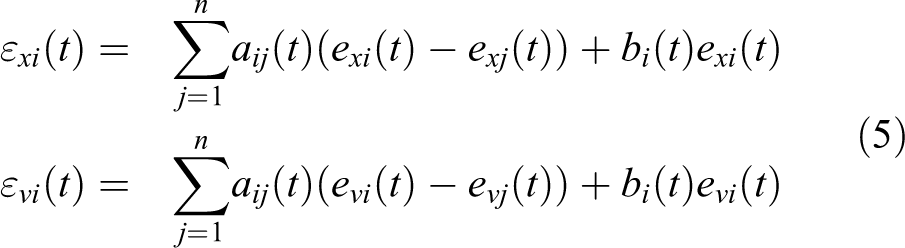
Based on the characteristics of Laplacian matrix

Then, the whole tracking system with disturbances under time-varying topology turns to be

where
Before addressing the main results, we introduce the following lemma.
Lemma 1
For vectors x,y with any suitable dimensions, there exists a symmetric positive definite matrix Z such that the following inequality holds 27

Adaptive sliding mode controller design and stability analysis for disturbed systems with time-varying topology
In practical applications, disturbances are not avoidable since these robots move in an uncertain environment. To successfully perform target tracking for multirobot system (7) with disturbances, this section designs an adaptive sliding mode control method. Then, the stability is analyzed.
The sliding mode is defined as

where
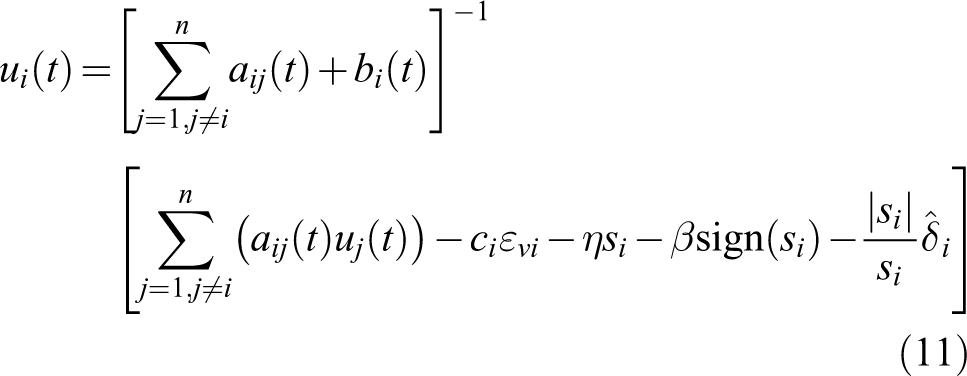
For multirobot system with disturbances (7), an adaptive overall sliding mode control law is designed as

where

It should be noted that here we use
The tracking control protocol for the ith tracking robot becomes
Under continuously time-varying topologies constructed by polytopic model structure, the following theorem provides a sufficient condition for disturbed multirobot systems realizing successful target tracking.
Theorem 1
Consider the multirobot system (7) with disturbances and continuously time-varying topologies. The designed adaptive sliding mode controller (11) can solve the disturbed target tracking problem of (7) if there exists a symmetric positive definite matrix Pk
with suitable scale satisfying the condition (12) with known positive constants

where
Proof
The Lyapunov function is designed as

where
Along the trajectory of the system (7), the derivative of Lyapunov function (13) is

with

In the light of the fact that

According to system (7),

Considering the form of sliding mode S and the system (7), we have

Substituting the overall sliding mode control (9) into (18) and considering the fact that
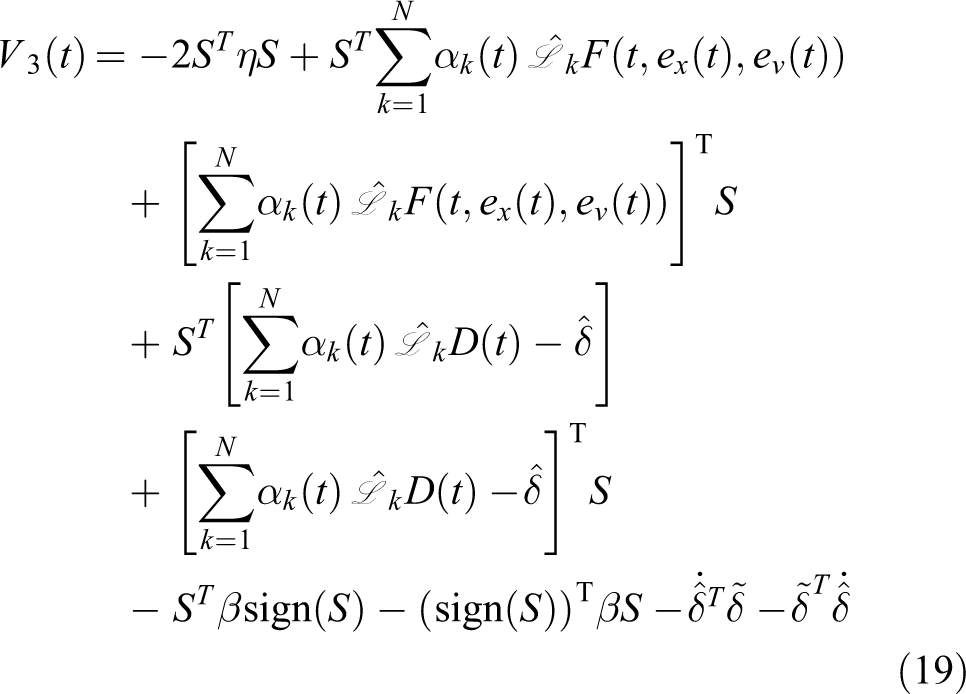
Recalling

According to the adaptive law (10) and using equation (6), it can be further derived that

Given the above inequalities, we are able to organize the derivative of Lyapunov function (14) in a compact form
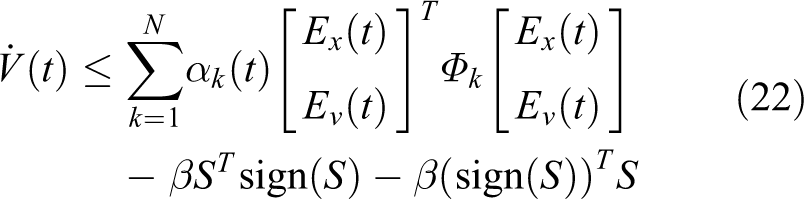
It is obvious that inequality (12) gives rise to
Numerical results
Numerical examples are conducted to demonstrate the foregoing research result. It is assumed that three robots track a moving target in a three-dimensional space. Numerical comparisons are made to verify the advantages of the designed adaptive control law for disturbed multirobot systems with continuously time-varying topologies.
Simulation of tracking system with time-varying topology and disturbances
The target is assumed to start moving at the origin

which satisfies Assumption 1. The Lipschitz constants are
In the simulations, the continuously time-varying topology of the system is shown in Figure 3. The left-hand side figures represent the decomposed two constant topologies and the right-hand side figure is the time-varying topology in polytopic model. The corresponding Laplacian matrix is

where the corresponding scheduling functions are

The time-varying topology in polytopic model.
The derivative of

The disturbances of the robots are

Now, we conduct the simulation for tracking system under the effect of disturbances (25) and the sliding mode control law (9) without the adaptive part

Tracking trajectories for systems under disturbances without adaptive control law.

Position error trajectories for systems under disturbances without adaptive control law: (a) robot 1, (b) robot 2, and (c) robot 3.

Velocity error trajectories for systems under disturbances without adaptive control law: (a) robot 1, (b) robot 2, and (c) robot 3.
Comparison simulation of tracking system with designed adaptive sliding mode control
In the following, we show the advantage of the proposed adaptive sliding mode control law (9). All the initial configurations of the robots and the target are the same as those in the above simulation. Figure 7 shows the trajectories of the target and three tracking robots with the proposed adaptive control under the same effect of disturbances, as used in the above simulation. Figures 8 and 9 show the robots’ position and velocity tracking errors suffering disturbances and with the adaptive control law, respectively. Compared to the results in Figures 5 and 6, the tracking errors are significantly reduced. Under the continuously time-varying topology (24), it is shown that the tracking robots can track the moving target successfully.

Tracking trajectories for systems under disturbances with adaptive control law.

Position error trajectories for systems under disturbances with adaptive control law: (a) robot 1, (b) robot 2, and (c) robot 3.

Velocity error trajectories for systems under disturbances with adaptive control law: (a) robot 1, (b) robot 2, and (c) robot 3.
To clearly show the effectiveness of proposed adaptive sliding mode control for multirobot systems, tracking errors are compared in a quantitative way. The maximum and minimum values of position and velocity errors over time interval
Quantitative comparison of position errors with and without adaptive control law.

Quantitative comparison of velocity errors with and without adaptive control law.

Conclusions and discussion
In this work, an adaptive timing consensus tracking method for second-order multirobot systems with disturbances is proposed. The time-varying communication topology between the tracking robot and the target is modeled by constant Laplacian matrices and corresponding time-varying scheduling functions, which is called polytopic model. Through constructing the polytopic model, the tracking strategy is less conservative. Numerical examples show that the proposed adaptive sliding mode control tracking strategy is superior to previous related work. With designed adaptive sliding mode control, the disturbed robots can effectively track the target with nonlinear dynamic characteristics under continuously time-varying topology.
This article mainly deals with disturbed target tracking systems continuously time-varying topology and some significant results have been presented. However, there are still some issues to be solved in future research. For example, the time delays are existing in most systems since the robots are exchanging information using wireless communication techniques. How the time delays will affect the control performance of designed adaptive sliding mode control method especially with polytopic structure is worth further investigating.
Footnotes
Declaration of conflicting interests
The author(s) declared no potential conflicts of interest with respect to the research, authorship, and/or publication of this article.
Funding
The author(s) disclosed receipt of the following financial support for the research, authorship, and/or publication of this article: This work was supported by the National Natural Science Foundation of China under Grant Nos. 61903022 and 61803006, funded by Beijing Advanced Innovation Center for Intelligent Robots and Systems under Grant No. 2019IRS11.
