



Abstract
As one of the typical application-oriented solutions to robot autonomous navigation, visual simultaneous localization and mapping is essentially restricted to simplex environmental understanding based on geometric features of images. By contrast, the semantic simultaneous localization and mapping that is characterized by high-level environmental perception has apparently opened the door to apply image semantics to efficiently estimate poses, detect loop closures, build 3D maps, and so on. This article presents a detailed review of recent advances in semantic simultaneous localization and mapping, which mainly covers the treatments in terms of perception, robustness, and accuracy. Specifically, the concept of “semantic extractor” and the framework of “modern visual simultaneous localization and mapping” are initially presented. As the challenges associated with perception, robustness, and accuracy are being stated, we further discuss some open problems from a macroscopic view and attempt to find answers. We argue that multiscaled map representation, object simultaneous localization and mapping system, and deep neural network-based simultaneous localization and mapping pipeline design could be effective solutions to image semantics-fused visual simultaneous localization and mapping.
Introduction
Autonomous robots are capable of performing specific tasks independently without any human interventions. As one of the principal attributes of autonomous robots, autonomous motion depends largely upon accurate ego-motion estimation and high-level surrounding environment perception. However, in cases where the artificial landmarks are unknown or the robots themselves are in GPS-denied environments, estimating ego-motion or perceiving scenes encounter great difficulties.
The term “SLAM” stands for simultaneous localization and mapping (proposed by Smith and Cheeseman 1 in 1986), being recognized as an eminent tool for mobile robot ego-localization at an unknown location within an unknown environment. 2 Technically, the mobile robot incrementally builds a globally consistent map of concerned environment while simultaneously determines its location within this map. From the point view of mathematics, SLAM process can be abstracted as a concurrency estimation problem, which mainly covers the robot pose estimation and location estimation of available landmarks. The diagrammatic representation of SLAM problem is shown in Figure 1. For a long time, SLAM problem is basically solved via a series of range sensors, 3 like light detection and ranging, infrared radiation, or sound navigation and ranging within small-scale static environments (forms of range sensors conform to their individual physical principles). However, range sensor-based SLAM may have to face major challenges in dynamic, complex, and large-scale environments.

Diagrammatic representation of SLAM problem. SLAM: simultaneous localization and mapping.
The SLAM that is implemented by means of external cameras (as the only external sensors) is termed as visual SLAM (V-SLAM). The significant advantage of V-SLAM over other typical SLAM frameworks (like range sensor-based SLAM) is its adaptability to the practical applications owing to richer image textures and simpler sensor configurations. Moreover, the development and maturation of computer vision (CV) allow V-SLAM to have access to graphical and visual supports. It is important to appreciate that solutions by CV have addressed some major difficulties in V-SLAM areas, such as detection, description and matching of image features, loop closure detection and 3D map reconstruction, and so on. Currently, with many open-source algorithms, the architecture of a V-SLAM system has been well-established. However, we must admit V-SLAM is vulnerable when either the motion of the robot or the environment is too challenging (e.g. fast robot dynamics, highly variable environments, severe illumination variations, highly limited visibility, or complex texture-less scenes).
Cadena et al. 4 firstly divided the timeline of SLAM into three periods and further summarized the individual achievements, as shown in Figure 2. Technically, they state that we are now entering the third stage of SLAM, videlicet, a stage of robust perception: the realization of robust performance, high-level understanding, resource awareness, and task-driven perception represent the themes in this age. The researchers of SLAM have worked on methods for solving high-level perception and understanding. Their efforts have been directed at semantics owing to their superiorities in aspects including improved robustness, intuitive visualization, and efficient human–robot–environment interaction. The studies that are associated with either semantic-based robustness/accuracy enhancements or semantically mapping are termed semantic SLAM. As V-SLAM could perform localization and mapping within a joint formulation, naturally, the above two processes of semantic SLAM could also be simultaneously evaluated by one estimator.

The development of SLAM. SLAM: simultaneous localization and mapping.
Table 1 lists the main surveys on SLAM from 2006 to present. As indicated, there have been few review articles that cover semantic SLAM (only Cadena et al. 4 mention the semantic concept-based mapping). Along the principal line of SLAM evolution, we attempt to conduct a broad review on current semantic SLAM area and to further illustrate some open problems and our insights into future research.
Summary of SLAM-related review articles.

BA: bundle adjustment; SLAM: simultaneous localization and mapping.
The outline of the remainder of this survey is as follows. The second section primarily presents a detailed description of semantic extractors, fundamental architecture of a modern V-SLAM system, and mainstream open-source algorithms. Special attention is then paid to the distinguished natures of a semantic SLAM. The perception, robustness, and accuracy problems that are, respectively, related to human–robot–environment interaction, environment adaptation, and reliable navigation are elaborated in paralleled third, fourth, and fifth sections. The sixth section focuses on the challenge discussions about semantic SLAM, seeking answers to these essential concerns. The seventh section draws conclusions.
The components of a semantic SLAM system
A semantic SLAM system is constructed of two essential components: a semantic extractor and a modern V-SLAM framework. Specifically, the semantic information is mainly extracted and derived from two processes. They are object detection and semantic segmentation.
Semantic extractor
Object detection is characterized by lightweight applicability, which not only can be applied to classify objects on the so-called object-level but also can be used to determine 2D positions of concerned objects. By contrast, semantic segmentation leads to pixel-level classification acquisition, that is, all pixels in an individual image have their own unique categories. Apparently, the latter exhibits more favorable precision owing to accurate boundaries. A section-by-section description follows.
Object detection
Object detection is recognized as an important branch of CV, whose development can be roughly divided into handcraft feature-based machine learning stage (2001–2013) and learning feature-based deep learning stage (2013 to present). The former is extremely dependent on handcraft features of images. 20 –24 In fact, during that period, researchers were devoted to strength the representations of handcraft features by means of more diversified descriptor design. Moreover, due to the limited computational resources, they had to explore more efficient and practical calculation approaches. In spite of their struggle to balance the handcraft feature representations and calculation efficiency, object detection experiences unexpectedly complex design with poor robustness.
In recent years, due to the introduction of deep learning and graphics processing unit, object detection with high accuracy has made great progress in either theory or practice. Especially, deep neural network (DNN)-fused object detection has arrived at a preferred robustness and accuracy, whose pipeline can be approximately designed following the two stages below: Stage 1: To obtain 2D positions of objects. Stage 2: To classify objects.
Region convolutional neural network (R-CNN) series belong to typical two-stage networks, including R-CNN, 25 fast R-CNN, 26 faster R-CNN, 27 and the newest mask R-CNN. 28 R-CNN is not only the pioneering work of R-CNN series network, but also the earliest method adopted in CNN-based object detection tasks. In principle, R-CNN generates the region proposals via a selective search, 29 and the feature extraction and classification are, respectively, achieved via AlexNet 30 and support vector machines (SVMs). 31 Differing from which, fast R-CNN changes the order of generating region proposals and extracting image features and replaces SVMs with softmax. Faster R-CNN benefits from the generated object proposals for detection speed promoting via region proposal network, supplementary anchor, and sharing features. Quite clear, faster R-CNN would be faster, but it is still not fast enough for real-time SLAM tasks. By contrast, mask R-CNN sacrifices partial detection speed for more precise semantic segmentation purposes. As a consequence of which, it arrives at an instance-level result, that is, all pixels in each detected object have their own unique categories.
It is noteworthy that the latest type of object detection algorithms fulfills positioning and classification of objects simultaneously rather than deduce 2D positions of objects first. The representative Yolo series 32 –34 (known as the most fast semantic extractor) employs S × S grids to replace region proposals, and the classification of these grids is consequently an ideal candidate for the final detection. Generally speaking, speed of Yolo series can be accepted by a real-time semantic SLAM system, but for higher accuracy, latest Centernet 35 provides a novel keypoint-based method. To clearly describe the development of object detection networks, a chronological overview is illustrated in Figure 3.

The development of deep learning object detection networks.
Semantic segmentation
In cases where the scenes with fantastic complexity are concerned, some care should be needed, and for guaranteed robust localization and mapping, the fine scene inference, videlicet, the deep association mining between numerous objects should be further considered. In comparison, object detection is suitable for coarse scene inferences, 36 and semantic segmentation is more general in that it applies to fine scene treatments. Analogously, the evolution of semantic segmentation has experienced “machine learning-based” to “deep learning-based” transform. Nowadays, the introduction of CNN has greatly upgraded the level of accuracy and efficiency for segmentation; thus, for cases where semantic SLAM systems are constructed, CNN-based solutions are generally to be preferred to the others.
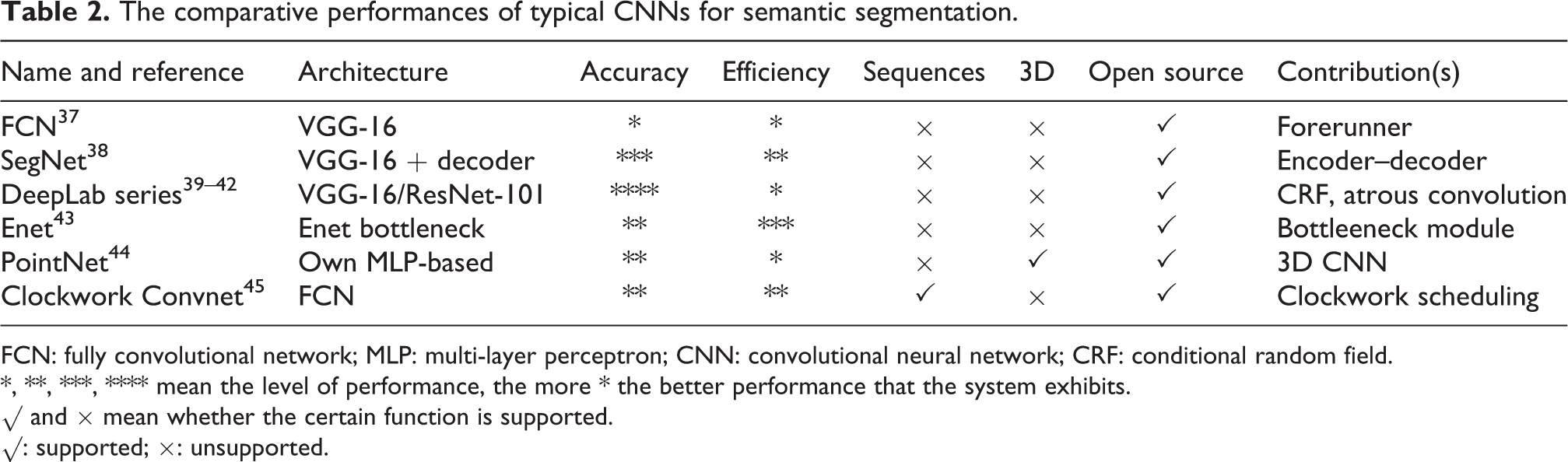
Considering the practical applications of semantic segmentation in semantic SLAM systems, two things associated with networks (for semantic segmentation purposes) should be investigated. One is technical index (including accuracy and efficiency), one is applying condition (representing whether a network is valid for video segmentation or 3D image segmentation). The section is devoted to a description of deep learning-based semantic segmentation networks, mostly following the above lines of thought. The comparative performances of typical CNNs for semantic segmentation are listed in Table 2.
The comparative performances of typical CNNs for semantic segmentation.
FCN: fully convolutional network; MLP: multi-layer perceptron; CNN: convolutional neural network; CRF: conditional random field.
*, **, ***, **** mean the level of performance, the more * the better performance that the system exhibits.
√ and × mean whether the certain function is supported.
√: supported; ×: unsupported.
In general, almost all the deep learning-based networks for semantic segmentation inherit the model from fully convolutional network (FCN) (being recognized as landmark work by Long et al. 37 ). As its name suggests, the authors modified all the most popular networks for classification (AlexNet, VGG-16, GoogleNet) to form the matched FCNs, so as to allow dense segmentation from arbitrary-sized image inputs. In addition, the encoding of CNNs enables the generations of different fine-grained semantic segmentation maps, and as the maps fuse in a skipping-connection-structure, a desired semantic segmentation result is achieved. However, FCNs themselves are not actually valid for both technical index and applying condition that a semantic SLAM requires (see Table 2 for reasons). The “SegNet” which is more concerned with decoding process appears available, so that a convolutional encoder–decoder structure is applied instead. 38 The contribution of DeepLab series networks 39 –42 (including DeepLab-v1, DeepLab-v2, DeepLab-v3, DeepLab-v3+) consists in that they fully integrate the information of an image on various scales (termed “global context of image”) and that they efficiently address “ambiguous boundary” problems likely to be encountered in FCN or SegNet. Specifically, DeepLab-v1 inserts a probabilistic graphical model (like conditional random field (CRF)) into a CNN-based pipeline and further model the segmentation result as a probabilistic graph. This probabilistic graph surely considers the global context of an image (i.e. the interactions between all pixels, not adjacent pixels only are considered) and contributes to finer segmentation results, but it indispensably burdens the load of calculation. DeepLab-v1 pioneers the use of “atrous convolution” in CNN models, and it derives a wider range of receptive fields without any load of complexity. By contrast, DeepLab-v2’s pioneering work in contextual information capture on various scales is the adoption of atrous spatial pyramid pooling. DeepLab-v3 and DeepLab-v3+ further make some small revisions.
We believe that Segnet and DeepLab (with no CRF) meet the technical index demands of building semantic SLAM systems. To take some specific examples, let us refer to some research. 46,47 Yu et al. 46 successfully constructed a dynamic scene-oriented SLAM system using SegNet. Li et al. 47 effectively solved the online monocular semantic SLAM construction by means of DeepLab-v2 (with no CRF). If heavy emphasis is placed upon the fine-grained semantic maps rather than upon the efficient mapping, DeepLab series networks (with CRF) are considered to be ideal tools. 48 On the contrary, if high efficiency mapping is strongly required, certain networks should be evaluated and be further applied. Enet 43 is reminiscent of specially designed network for the purposes of real-time semantic segmentation, but whose accuracy in semantic segmentation is relatively poor.
When it comes to issues of “applying conditions” of semantic segmentation processes, let us review two candidate networks: PointNet 44 and Clockwork Convnet. 45 The former is valid for direct segmenting of unstructured 3D point clouds, and the latter is concerned with time clues of a video or image sequences (image context established on the temporal scale). These two represent the leading favorable tools even though they do not seem to have significant advantages in either accuracy or efficiency. But we still hold the opinion that, with the rapid advance of computers, the relevant studies with respect to PointNet and Clockwork Convnet would be of practical significance.
Modern V-SLAM system
The architecture of a modern V-SLAM system
A modern V-SLAM typically includes: Sensor data acquisition: Acquiring images or a video via cameras. Visual odometry (VO): Preliminarily estimating the robot pose and landmark position via adjacent frames in an image sequence. State estimation: Globally estimating the state by means of the fused results that VO and loop closure detection provide. Relocalization: Relocating when tracking fails or map is reloaded. Loop closure detection: Determining whether the robot is located at the previous position. Mapping: Mapping according to the requirements of tasks.
Concerning the flow direction of sensor data and task level, a V-SLAM system generally contains two parts: the front end and the back end, whose schematic interpretation is given in Figure 4. As indicated, the VO and loop closure detection module simultaneously receive the inputs that certain sensors supply. Here, the function of VO is to provide preliminary robot pose estimation and the function of loop closure detection module is to provide scene similarity. The derived robot poses and scene similarity constitute the sources from which the robot globally optimizes the poses and landmarks and further plots the motion trajectories and environmental maps. Mathematically, the front-end task and the back-end task can be separately abstracted as “data association” problem and “state estimation” problem.

The architecture of a modern V-SLAM system. V-SLAM: visual simultaneous localization and mapping.
The front end: Data association
The process that the front end tracks the same features (feature points or representative pixels) on different frames of one image sequence is referred to as “data association.”
Generally, early V-SLAM systems deal with “data association” via feature matching. Obviously, the insufficient description of local image features causes faulty data association with a high probability, which then leads to incorrect pose and landmark estimation. Some research that focus on eliminating the errors in data association (e.g. random sample consensus RANSAC) are proposed, but the not-yet essentially solved problems make it still unsatisfied. Later researchers begin to evaluate “data association” in probability ideas (i.e. making a soft decision to assign new features into tracking sequence). Probabilistic data association fully takes into account the uncertainty in feature assignments and minimizes erroneous associations. This is illustrated by the features in Figure 5.

The diagrammatic interpretation of probabilistic data association.
Concerning the expression of data association in SLAM problems, Bowman et al.
49
were the advocates of expression
The back end: State estimation
Lu et al.
50
and Gutmann et al.
51
define SLAM as a maximum a posteriori estimation problem, which aims to estimate variable X (including robot poses and landmark positions) from a set of observations (

Equation (1) conforms to the Bayesian theorem. Let
One of the most significant SLAM results is proposed by Davison et al., 52 who pioneered the updating of the states of the camera and the landmark points by an extended Kalman filter (EKF). Differing from which, the representative bundle adjustment (BA)-based nonlinear optimization addressed the maximum posterior probability estimate problem by having the fused global constraints of the state variables be optimal rather than the pure iterations of EKF. By contrast, EKF-based SLAM has superior efficiency than optimization-based SLAM when dealing with small-scaled scene applications, but for the large-scale scene SLAM purposes, filter-based solutions appear insufficient superiorities due to the huge covariance matrix.
Honestly, the present V-SLAM frameworks involve a large quantity of image features, which restricts the conventional EKF-based solutions in SLAM tasks; special attention is therefore placed upon BA-based nonlinear optimization approaches. The BA ideas can be traced back to their use in the early 21st century. It is about solving structure from motion problem related to 3D reconstruction. Inspired by which, early SLAM researchers realized that BA would be probably helpful to high-precision state estimation, but they immediately found V-SLAM was actually an incremental process; the accumulated computing load made it not feasible to directly apply BA to a V-SLAM that emphasizes real-time requirements. The applicability demands of BA-based solutions were the original inspiration for the exploration of attributes of a V-SLAM; one of the major advances lies in that researchers exploited the sparsity of normal equations. They proved that the dependencies between state variables can be naturally represented in terms of a factor graph. This allows BA to have access to use a faster linear solver or an incremental solver, guaranteeing its adoption to a real-time required V-SLAM system. The current optimization libraries (e.g. g2o, Ceres) make it easy to build solvers and process thousands of variables in one single second, which, therefore, makes BA-based graph optimization method to be the mainstream tool for the back-end state estimation.
Open-source V-SLAM system
We would like to review some open-source algorithms of V-SLAM, since this is so essential. Generally, V-SLAM systems can be classified according to the camera types, including but not limited to monocular, stereo, and RGB-D cameras. For a detailed demonstration, Table 3 further summarizes their characteristics containing the descriptions of front end, back end, relocalization, loop closure detection, and so on. We insist that key factors for a V-SLAM assessment would always be whether it enables dense mapping and loop closure detection, whether it supports a number of sensors, and whether it possesses real-time performances. It is important to appreciate that, for simplifying the present semantic SLAM designs, lots of studies directly refer to the well-established V-SLAM frameworks. 47,48
Open-source V-SLAM systems.

V-SLAM: visual simultaneous localization and mapping; PTAM: parallel tracking and mapping; SVO: semi-direct monocular visual odometry; ORB-SLAM: oriented FAST and rotated BRIEF SLAM; RTAB-MAP: real-time appearance-based mapping; ICP: iterative closest point; DSO: direct sparse odometry.
√ and × mean whether the certain function is supported, √: supported; ×: unsupported.
Human–robot–environment interaction: Perception
We argue that the perception defined in area of semantic SLAM should consist of two aspects: understanding of environment and understanding of human. This perception is referred to as human–robot–environment interaction. Undoubtedly, an environment model (defined as semantic map) will play roles in these two understanding processes. Technically, the more information rich the semantic map is, the higher the so-called semantic level is. Since semantic map increasingly reveals its superiority in complex and autonomous robot tasks (e.g., avoid muddy road while driving), semantically mapping has become a significant and ongoing subject in present semantic SLAM studies. We would like to summarize the present research work and further state our vision for semantic maps within such semantic SLAM frameworks. Table 4 summarizes some semantic mapping studies.
Summary of semantic mapping studies.

CRF: conditional random field; R-CNN: region convolutional neural network; CNN: convolutional neural network; VO: visual odometry; SLAM: simultaneous localization and mapping; PSPNET: pyramid scene parsing network.
Semantic map
Semantic maps can be categorized into object level and pixel level in a broad sense. Previous studies 75 –78 established an embryonic concept of object-level semantic map by inserting some preestablished 3D models of known objects into meaningless sparse point cloud maps. Quite different, research 79 –84 attempted to construct superior pixel-level semantic maps via applying some traditional tools, like SVM (even though SVM is commonly used in addressing industrial problems of prediction, 85 –87 classification, 88 or fault diagnosis 89 ), CRF, and so on, since these tools are considered to be useful for object identification and scene segmentation. However, the limited means, in most cases, tend to an unsatisfactory classifying precision. Inspired by the advances in deep learning, there has been more research in the area of CNN-based object identification, detection, and segmentation. 90 –92 The sufficient achievements subsequently provide a guarantee for constructing more accurate semantic maps with pixel level. 93
Li and Belaroussi 47 present a blend of most advanced semantic segmentation strategy (DeepLab-v2) and V-SLAM framework (large-scale direct monocular, LSD-SLAM). It distinguishes itself by successfully constructing a semi-dense 3D semantic map via a multiple-view monocular camera (rather than acquire a dense 3D semantic map with an RGB-D camera, as the study of McCormac et al. 48 indicates). It should be stressed that the highlight of such a blend also consists in its inversion back to enhance the performances of a large wider range of 2D single-view semantic segmentation approaches. Apparently, SLAM essentially elevates the accuracy of semantic segmentation.
Open problems
Time-varying semantic map
The semantic map lays the groundwork to the high-level semantic understanding, while its applicability to long-term robust positioning is still unsatisfactory. An ideal solution is to build a time-varying semantic map; if it were not for this fact, a model about spatiotemporal relations between objects in concerned scenes would not be established, and the following spatial changes (viz. the motion) of objects would not be predicted. Thus, we believe the introduction of time-varying semantic maps helps for both long-term and dynamic localization. We also believe that, fundamental to the development of such maps are certain artificial intelligence (AI) ideas about spatial and temporal reasoning. As far as we know, the present semantic SLAM rarely covers such studies.
Panoptic semantic map
As already discussed, the CNN-based semantic segmentation leads to superior fine-grained results. Even though they seem to be subtle enough, for some certain purposes, the segmented regions are not quite tiny (e.g. different styles of cars cannot be distinguished), which somehow limits their understanding level for scene perception. One of the important contributions of instance segmentation network in SLAM area just consists in its idea of further subdividing objects within the same category; nevertheless, it appears to be not available for irregular backgrounds.
Panoptic segmentation fully integrates the advantages of these two-segmenting means; as a new direction in CV community, it is expected to generate fine-grained results with globally consistent labelings in an elegant manner. The panoptic semantics mapping, therefore, is recognized as powerful and eminent tool for fostering the intelligence of autonomous robot as well as the contextual knowledge of augmented reality. Panopticfusion was a pioneering study in panoptic semantics-based 3D reconstruction, 74 which, however, unfavorably neglected the useful exploration of semantics-based positioning ideas. Due to the fact that semantic positioning is frequently overlooked in practical applications, we are firmly convinced that the semantic SLAM framework which simultaneously focuses on mapping and localization is still being explored.
Environmental adaptation: Robustness
As previously mentioned, V-SLAM is now at a robust-perception age. In a sense, a primary concern of semantic SLAM would be the “robustness” enhancements. We will concentrate on this central issue in terms of feature selection mechanism and optimized data association. Before a detailed review, we firstly summarize the relevant researches in robustness enhancements, as summarized in Table 5. More about object SLAM will be presented in Discussions section.
Summary of semantic SLAM research in robustness enhancements.

CNN: convolutional neural network; SLAM: simultaneous localization and mapping.
Feature selection mechanism
The acquisition of prior semantics of feature points leads to enhanced robustness of VO. Since we have initially assessed whether these feature points are suitable for a specific task, thus the selected robust features will contribute to better robot ego-motion tracking. Much more interesting, feature selection strategy could be flexibly changeable for purposes of various tasks. We will review the recent studies from the following aspects.
Interested region feature selection
Liang et al. 98 proposed a VO framework for feature selection on basis of a visual saliency map (defined by visual saliency to each pixel of a single image, the closer to the red color, the higher the degree of visual saliency) filtered by semantics segmentation results. In fact, it is this blend map (integrates visual saliency map and semantics segmentation map) that consequently drives the feature selection process. The robustness of VO is tested to be superior with such robust feature points (selected by this blend map). Please see the research of Liang et al. 98 for more details.
In research, 95 the feature points derived from the parking cars are no longer used for mapping due to the fact that temporary objects should not be maintained in environmental maps. Also, such maps with no temporary objects lead to better robustness in lifelong localization tasks.
Informative region feature selection
The accuracy of pose estimation cannot be highly improved via feature points in regions with low information entropy. 104 Tracking with such features will consequently increase the risks of faulty data associations. Ganti and Waslander 97 propose an information-theoretic feature selection method by inviting the uncertainty concept of semantic segmentation for the calculation of information entropy. This immediately reduces the numbers of features, thus significantly improves the system performances of real time and robustness without any appreciably compromising in accuracy.
Dynamic feature selection
The extracted feature points (from images) probably belong to moving objects (so-called dynamic feature points), which greatly decrease the robustness of V-SLAM systems. Fortunately, high-level semantics can efficiently perform the division of stationary and dynamic feature points (so-called motion segmentation), so that certain positive mechanism works in dynamic scenes within which V-SLAM systems possess enhanced robustness.
Reddy et al. 94 employed a multilayer dense CRF tool to segment images. The distinguishable stationary feature exhibits stillness, making it feasible to separately track the stationary feature points. Consequently, a robust VO adapts to a dynamic scene. SLAM toward dynamic environments 46 seeks to joint semantic segmentation and moving consistency check to eliminate ORB feature points that initially exist in a dynamic object, which not only outperforms ORB-SLAM2 63 regarding accuracy and robustness in a dynamic environment but also builds a dense semantic octo-tree map for further 3D representation. Moreover, a lightweight 3D box inference tool is put forward by Li and Qin; 96 in their studies, the conventional semantic segmentation is even no more necessary for real-time semantic reasoning.
Optimized data association
In V-SLAM frameworks, in terms of the update frequency, the data association could be divided into two categories: short-term association (e.g. feature matching) and long-term association (e.g. loop closure detection). This mechanism ensures a maximum of data association reliability. However, in cases where the loop closure detection fails (e.g. unmanned vehicles are driving on long straight roads), VO will irreversibly drift and this consequently leads to the divergence of navigation systems. A study of semantic SLAM proposes image semantics based on medium-term association mechanism. 99 From an experimental point of view, this mechanism largely reduces the VO translational drift in unmanned driving scenes. There are several problems that confront the advocate of such image semantics-based mechanism. Bowman et al. 49 found a defect of such semantics associations in application, that is, invalid data association of objects’ semantics greatly affects the results of localization and mapping. They therefore proposed a so-called probabilistic data association mechanism to fully consider the uncertainty during the process of data association.
Open problems
Mainstream semantic SLAM methods improve the robustness of a VO via selecting features or optimizing data associations. However, with the full-scaled improvements of algorithms, the efforts for VO robustness enhancements by purely feature selecting or data association optimizing appear unsatisfactory. Recently, the CNN-based feature extractors appeared to be noticeable in the field of CV, 100 and they led to much more robust visual features that handcraft solutions never derive. Inspired by which, researchers in SLAM area are now making their attempts to reconstruct VO by so learned features, 101 so as to substantially improve VO robustness. Following this line of thought, we believe that the pursuit of enhanced feature stabilization and generalization ability for enhanced VO robustness would continue.
Reliable navigation: Accuracy
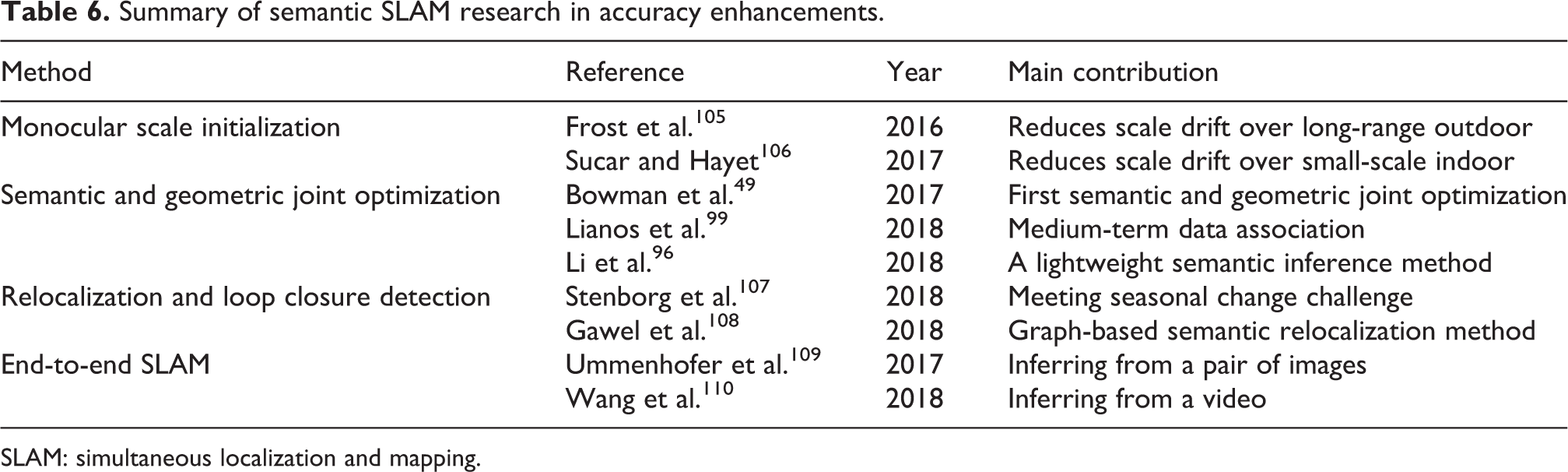
The accuracy of localization and mapping could suggest a reliability assessment of autonomous navigation systems. Generally speaking, if it were desired to elevate the accuracy enhancements, semantics could be included in nearly all the sessions of classic SLAM algorithm frameworks, such as initialization, back-end optimization, relocalization, loop closure detection, and so on. Before delivering a detailed discussion followed in this section, we would like to firstly summarize the relevant semantic SLAM research that devote to accuracy enhancements, as summarized in Table 6.
Summary of semantic SLAM research in accuracy enhancements.
SLAM: simultaneous localization and mapping.
Monocular scale initialization
As a consequence of no absolute baseline length between images, the scales of monocular V-SLAM systems indispensably appear to be both ambiguous and drifting over time. Thus, a key problem in the development of monocular V-SLAM initialization would be how to rectify the scale ambiguity and drift. The highlight of both studies 105,106 consists in that they identically invite the concept of image semantics. As one form of image semantics, the size of object has been fully considered and the monocular scale initialization process is recognized to be more efficient with excellent concision. The experimental results based on public data sets also validate their effectiveness over a wide range of applications, that is, as small as small-object indoor scenes or as large as long-range outdoor scenes.
Semantic and geometric joint optimization
One of the most significant tightly coupled semantic and geometric joint optimization framework is proposed by Bowman et al., 49 who pioneered the ideas of probabilistic data association models. If both continuous and discrete data are already involved in data association tasks, a solution by MLE method, directly, is not possible. For this, the authors skillfully broke their main problem down into subproblems, that is, they divided the so-called mixed association into two processes: discrete semantic association and continuous pose estimation. This two-step iterative computation problem could be easily solved by typical expectation maximization algorithm. Moreover, the principal importance of semantics that extracted by object detection is that they play roles in back-end optimization.
One of the ideas of incorporating the semantics (extracted by semantic segmentation) in SLAM back end is put forward by Linaos et al. 99 Given the fact that 2D object boundaries cannot precisely express boundaries of matched 3D objects, Linaos’s theories are considered to be more valid in practical applications. The latest study 96 employs 2D object detection results to infer the bounding box of 3D objects. From an engineering perspective, this strategy can even be accepted by real-time semantic SLAM systems where the demands of accuracy could be moderately loose.
Relocalization and loop closure detection
Relocalization and loop closure detection usually employ identical techniques; they, however, tackle different problems. The purpose of relocalization is to restore the camera pose, while the function of loop closure detection is to derive geometrically consistent map. Regardless of how differently the individual techniques function, we are generally concerned with the identical theories. Therefore, this subsection is devoted to a description of semantics-based relocation algorithms, mostly following the application-oriented lines of thought.
The principal limitation of geometric localization lies in its long-term applicability to locating in changeable scenes (over time) within pre-built maps. However, the semantics-based solutions are the answers to this challenging issue. The evidence can be seen from a recent study, 107 where a semantics based cross-season localization algorithm is proposed. In principle, the geometric localization methods are dependent on similarities between image appearances, and this has apparently confronted the researchers that, even though the images are collected under identical positions, seasonal changes seem to be enough to make the concerned images unidentified, so that the matching relationship becomes unreliable. In this case, the semantics are certainly reminiscent, and one of the important contributions of research in cross-season localization has been the fact that topologies of semantic objects in a single image would be consistent over time. This cross-season localization method appears to be sufficiently reliable when applied to unmanned vehicles. A novel graph-based semantic relocalization idea was proposed by Gawel et al., 108 in such a system, the keyframes with semantics are transformed into a large set of 3D graphs, and these 3D graphs are used to further match with the surrounding’s map that is globally pre-built.
Apart from the seasonal changes, the introduction of semantics also helps to deal with the variation of larger viewpoint or illuminatio, or even partial structure changes of scenes caused by time. This relocalization and loop closure detection scheme produces a verification of accuracy enhancement of V-SLAM systems as an added benefit.
Open problems
Parts of semantic SLAM researchers pay their attention to the pipeline design of deep learning-based solutions, so as to build a trainable end-to-end SLAM system. Attempts have been made to estimate depth from a single image by means of CNNs in recent years. 111 –113 Even if the feasibility has been testified, the difficulties caused by confining generalization ability of CNNs still remain as an inherently ill-posed problem. The efforts of researchers have been directed at exploiting some end-to-end pipelines to jointly estimate depth and camera motion from a pair of images. 109 In addition, Wang and Clark 110 provide an alternative solution and can be reference to further study, which directly infers poses and uncertainties from a video.
From their experiments, it has been learned that the hierarchical network design, together with careful parameter configuration and sufficient training, could result in the state-of-the-art accuracy on the given data sets. Meanwhile, opponents are still standing in the way of arguing the poor performance of pipeline-formed SLAM in practical applications; they emphasize the “interpretability” and “generalization capability” issues. For this, researchers are now working on deep learning modeled methods for better interpretability and multidimensional visualization.
Discussions
In the former sections, the issues associated with perception, robustness, and accuracy of semantic SLAM are currently referred to. Furthermore, among technical tools for SLAM performance enhancements, the matched open problems are posted. One of the major concerns of this survey is to present the feasible solutions to above open problems from a macroperspective. Therefore, this entire section is devoted to a macroscopic discussions. It is mainly related to multiscaled map expression, object SLAM, and weakly supervised and unsupervised learning SLAM.
Multiscaled map expression
We believe that the time-scaled maps contribute to the long-term autonomous location of robots. For a few years, the advocates of V-SLAM have ignored the existent problems in their research. For example, the spatiotemporal context (STC) in image sequences has been not taken into account in the process of mapping expression, which consequently makes it impossible to reconstruct the expected time-varying semantic maps. Lately, the research on recursive neural network (RNN) has helped to develop the ideas of STC in image sequences; 114 from our point of view, RNN could be identically invited for the mapping tasks of a V-SLAM that requires long-term locating with strong autonomy.
Together with time-varying map (contains the entire environmental information over a certain period of time), panoptic semantic map constitutes the main forms that may be taken in multiscaled expression. If it were desired to construct a panoptic semantic map within a V-SLAM framework, the keyframes need to be semantically segmented in a global perspective. As one source of the difficulty in CV community, several methods have been developed for segmenting foreground objects on pixel level; however, the problems of unifying labelings of foreground and background still remain. The rising panoptic segmentation network represents a solution to this class of problems. 93 It produces globally constraint labelings by fusing results derived from semantic segmentation and instance segmentation; a better understanding of the things being perceived, therefore, is achieved as expected.
According to the analysis above, in semantic SLAM field, we are convinced of the promising advance of multiscaled maps, which have same general characteristics in high-level human–robot–environment interaction and long-term autonomous location.
Object SLAM
From our point of view, DNNs are novel but unpractical ways in improving the robustness of a VO. In most cases, due to the overemphasized robustness of feature points, the overtrained DNN pipelines not only produce unexpected consumption of time but also exhibits unavailability in certain SLAM tasks under totally new scenes. A reliable object SLAM framework is illustrated in Figure 6, where the independent tracking for individual objects in a 3D scene is established. It enables the efficient feature selection and data association to be implemented in terms of 2D to 3D and single thread to multithread, so that practically improves the robustness and accuracy of a VO.

The architecture of a semantic SLAM system. SLAM: simultaneous localization and mapping.
SLAM++ 78 represents the earliest research in area of object SLAM. Due to the fact that the object data sets should be built beforehand, SLAM++ is still invalid for online tasks. Lately, the research on SLAM++ can be developed alternatively along two directions: one is represented by CubeSLAM 102 with an object description by cube, the other one is represented by QuadricSLAM 103 with an object description by ellipsoid.
We believe that object SLAM has broad prospects, and the point of the whole process is to directly track dynamic targets under 3D scenes. With the rapid advance of 3D object tracking (includes a 3D semantic estimator) in area of CV, there are reasons to believe that it simultaneously helps to construct an object SLAM system with more efficiency.
Weakly supervised and unsupervised learning SLAM
With the existing data sets, the end-to-end semantic SLAM pipeline generally leads to optimal localization accuracy, but the interpretability and generalization ability restricts its applicability to a wider range of applications. Take DNN as a specific example, the reduced generalization ability is often accompanied by overfitting due to over meticulous parameter configuration and training. The weakly supervised and unsupervised learning-based pipelines have been employed in the development of improved generalization ability of DNNs. However, the study is still in the preliminary stage. In fact, in end-to-end SLAM filed, unsupervised learning-based monocular depth estimation has been recognized as a main research direction; 115 –117 meanwhile, interests of experts in machine learning are now focused upon the interpretability of DNNs. These clues make us believe that the advanced learning strategies would be powerful and practical tools for the semantic SLAM pipelines. It is important to appreciate that semantic SLAM pipelines can be easily integrated into deep reinforcement learning paradigm to construct a robot system with general intelligence.
Conclusions
For autonomous robot navigation tasks, a semantic SLAM that aims at better understanding and perceiving a message from the robot work volume has drawn an increasing attention. In this survey, we review the development of semantic SLAM concerning its perception, robustness, and accuracy and then discuss the open problems associated with the recent progress and challenges. Specifically, we attempt to seek possible solutions to these open problems from a macroscopic view and further state the suggestions in a constructive manner. We believe that SLAM frameworks are well-established and proven by practice, and semantic SLAM will distinguish itself by the eminent fusion of image semantics. The evolution of deep learning-based methods has apparently exploited the opportunity for researchers to use their powerful image processing capacities to estimate poses, detect loop closures, build 3D maps, and so on. From our point of view, deep learning and semantic SLAM are now inseparably related, and a blend of them must be experiencing a booming in the future studies.
Footnotes
Declaration of conflicting interests
The author(s) declared no potential conflicts of interest with respect to the research, authorship, and/or publication of this article.
Funding
The author(s) disclosed receipt of the following financial support for the research, authorship, and/or publication of this article: This research was funded by Natural Research Fund of Science and Technology Department, Jilin Province under Grant 20170101125JC, Science and Technology Program of Department of Education, Jilin Province under Grant JJKH20200117KJ, and Research Fund for Distinguished Young Scholars of Jilin City under Grant 20190104128.
