



Abstract
With the development of economy, the research of urban intelligent transportation system is becoming more and more important. The research and development of plate number recognition system is an important factor to realize the intelligence and modernization of transportation system. It uses each car to have a unique plate number and recognizes the vehicle number through the vehicle image captured by the camera. On the basis of image recognition, this article takes plate number image as the research object and discusses the key technologies of plate number recognition system. First, this article uses image preprocessing technology to process images to improve image quality. Second, the plate number location algorithm based on the connected region search is analyzed. According to the characteristics of the plate number itself, the regional features of the plate number are extracted to locate the plate number accurately. Then, an improved vertical projection-based plate number character segmentation method is proposed to segment plate number characters. Finally, combined with character characteristics, the template matching method is used to recognize plate number characters. The simulation results show that, on the basis of image recognition, this article studies the key technologies of plate number recognition system, which effectively improves the performance of the system and makes the recognition of plate number more effective and accurate.
Keywords
Introduction
With the rapid development of society and economy, people’s living standards are constantly improving, and the total number of motor vehicles is increasing rapidly. To adapt to this situation, it is urgent to improve the efficiency of vehicle management in road network, toll station, parking lot, and other places. Therefore, the research and deployment of intelligent transport system (ITS) 1,2 has been put in an important position. The purpose of ITS research is to realize a new type of information; intelligent and efficient traffic management system improves the load capacity of the road network and alleviates the increasing traffic congestion. As early as the 1980s, China began to apply information management technology in traditional transportation and management, but ITS is still in its infancy. With the rapid development of social economy, China’s road traffic will still be in a large number of construction stages in the next few years. 3 To alleviate the increasing traffic load problem, the demand for intelligent transportation system is increasingly urgent. To improve traffic efficiency and ensure traffic safety, it is necessary to discuss the application of intelligent transportation system in China’s highway network according to the actual development of highway traffic.
ITS is a real-time, accurate, and efficient integrated management system that integrates advanced information technology, sensor technology, control technology, and computer processing technology on the basis of perfect road facilities. 4,5 In essence, it is to transform the traditional transportation system by using high and new technologies such as information processing technology and pattern recognition technology. Thus, we can make the best use of the existing transportation infrastructure and improve the quality of service of the transportation system. Realizing the new transportation system of informationization, intellectualization, and socialization improves the social environment and better promotes the development of social economy.
ITS provides an advanced traffic management system on the basis of advanced traffic information service system to improve the safety, reliability, and efficiency of public transport and to provide better public transport services for the public. ITS provides unattended electronic toll collection system, which can realize unattended management, nonstop, and bill-free services in toll lanes, parking lots, and other places, reduce delays caused by traditional management methods, and improve the traffic capacity and operation efficiency of various traffic places, but also provide real-time and accurate traffic operation data for system management. 6 Perfect ITS should also include emergency handling system, which can provide early warning and rapid response capability of road traffic to various emergencies.
Generally speaking, ITS should have the characteristics of perception and adaptation, memory and logical thinking, expression, and judgment. ITS can provide travelers with information services, rapid emergency services, safe driving services, early warning mechanisms to reduce traffic congestion, high-quality and low-cost transportation, and convenient and fast means of payment.
To meet the characteristics of its, this article mainly discusses the key technologies of license plate recognition system in the research of key technologies of intelligent transportation, taking the license plate image as the research object. The specific contributions are as follows: In this article, image preprocessing is carried out by image enhancement methods such as gray scale image, deviation correction, and weighted median filtering. The plate number location algorithm based on a connected region search is analyzed. According to the characteristics of the plate number itself, the regional features of the plate number are extracted to locate the plate number accurately. An improved vertical projection-based plate number character segmentation method is proposed to segment plate number characters after location. Combining character features, template-matching method is used to recognize plate number characters.
The content of this article is arranged as follows: The second section introduces the particularity of license plate character recognition, the third section gives the processing process and method of license plate character image recognition, the fourth section provides image-related data and processing flowchart, the fifth section discusses the effect and advantages of this article on license plate character recognition, and we conclude this article in the sixth section.
Related work
Traffic information service system is an important part of ITS, and it is the key to maintain the normal operation of ITS. Vehicle automatic identification system responsible for automatic identification of vehicles is the basis of traffic information service system. 7 As an important identification sign of vehicle in traffic management, vehicle plate number recognition system has important practical significance as a vehicle information acquisition means in various traffic management occasions.
The characters in the plate number have their own characteristics compared with other characters, mainly in the following aspects:
8
–11
The character set is small. The Chinese characters on the plate number only include the abbreviations of provinces, municipalities, and municipalities directly under the Central Government, military units, police officers, 26 English letters, and 10 numbers. Compared with other optical character recognition (OCR) systems, the number of characters on the plate number is relatively small. Character dot matrix resolution is low. Due to the limitation of camera resolution, the plate number characters segmented from an automobile image occupy fewer pixels, and their height generally does not exceed 40 pixels. Such resolution is relatively easy to handle for English letters and numeric characters, but for Chinese characters, it may lead to too much loss of feature information of Chinese characters and may cause strokes to adhere, which increases the difficulty of recognition. Environmental impact is great. Generally, the working environment of OCR system is generally indoors, and the lighting conditions are good and stable. However, the plate number recognition system needs to work outdoors all day, the illumination condition changes frequently, and affected by weather conditions, all kinds of interference cannot be predicted. The size, thickness, position, and tilt of the actual plate number character images are often different. In addition, the clarity, cleanliness, new and old background color, and illumination background of the plate number may cause serious interference to the collected image. Therefore, the recognition method adopted has strong anti-interference and environmental adaptability. Real-time requirements. As the application of automatic plate number recognition system is intelligent traffic management, it requires a series of operations such as timely image acquisition, image processing, plate number recognition, and automatic database login for passing vehicles. The real-time requirement is high. Considering the above factors, the recognition of plate number characters is more difficult.
Image refers to the impression or recognition formed in the brain when light passes through or is reflected by an object and enters the human visual system. It is a subjective response to objectivity and a combination of objectivity and subjectivity.
Image processing is the behavior of processing image information to satisfy people’s visual psychology or application needs. 12 It is very important for people’s information processing work. Vision is very important to human beings. There are many ways for human beings to obtain external information, such as vision, hearing, touch, smell, and taste. But most of the information comes from the image information received by vision. Traditional methods of image information processing include optics, electronics, and so on.
Digital image processing is to use a computer system to process digital signals converted from images to meet the needs of people for their information. 13 –15 Digital image technology originated in the 1920s and digital image processing, which has high processing accuracy, abundant processing content, and the ability to perform complex nonlinear operations, has promoted its own high-speed development. 16
Engineering is a new discipline formed by applying the principles of natural science to engineering practice. Image engineering refers to the application of mathematics, optics, physics, logic, and other basic disciplines in the field of image processing, which has developed into a new discipline covering the whole field of image processing. Image engineering can be divided into three levels from bottom to top: image processing, image analysis, and image understanding.
Image processing is the bottom operation, referring to the transformation between images, which belongs to physical space. Image analysis is the selection and extraction of image features and the description of images, which belongs to mathematical space. Image understanding is the highest level of operation. It belongs to logical space to study the relationship between descriptive symbols and get the understanding of image content and the interpretation of objective existence. The level of abstraction increases from the bottom to the top, while the amount of data decreases accordingly. Image engineering is a systematic study of image theory, technology, and application. It is related to pattern recognition, computer vision, computer graphics, and other disciplines. It is also closely related to artificial intelligence, neural network, genetic algorithm, fuzzy mathematics, and other disciplines.
In the image engineering system, image conversion is done through image processing. Through image analysis, image data can be obtained; image symbols can be obtained through pattern recognition. Information can be provided to people through the understanding of images and data.
Proposed method
Image preprocessing
Image gray scale
The preparation of plate number recognition is to collect a large number of vehicle image samples. At present, digital cameras capture most of the automobile images, so the preprocessing images are color images. Color image contains a lot of color information, which not only costs a lot of storage but also reduces the execution speed of the system in processing. Because each pixel of an image has three different color components and there are many information unrelated to recognition, it is not easy to carry out further recognition work, so it is necessary to transform the color image into gray image. From the point of view of practical application, the plate number image and recognition result need to be transferred from recognition point to backstage data center for archiving. In terms of image processing speed, storage, and transmission, an 8-bit gray scale image is much less expensive than a 24-bit true-color image, and gray scale image processing results can also be satisfactory. This is very necessary for real-time demanding systems. There are mainly three ways to gray scale processing:
17
–19
(1) Maximum value method. Make the value of M, N, and P equal to the largest of the three values.

(2) Average method. Make the value of M, N, and P equal to the average of the sum of three values.

(3) Weighted average method. According to the importance or other indicators, M, N, and P are equal to their weights and averages, that is, M, N, and P are given different weights. Because the human eye has the highest sensitivity to green, the second to red, and the lowest to blue, the conversion formula of image gray value is as follows:

According to the actual use of plate number, the system chooses to use the weighted average method to gray, which is closer to the human visual system.
Image pre-correction
Generally, the charge coupled device (CCD) camera is installed on the side of the lane, so the plate number deforms obliquely in the image taken, which is disadvantageous to our later processing, because our later processing is basically based on horizontal line scanning line. Therefore, in this article, the image must be basically corrected in the preprocessing, so that the plate number, which becomes a parallelogram in the image is approximately rectangular or at least the bottom border should be horizontal. At the same time, considering the real-time requirement of the system, the time complexity of the algorithm cannot be too high.
Because our rough location algorithm is sensitive to the horizontal deformation of the plate number but not to the vertical deformation, we can only correct the horizontal deformation of the plate number before the precise location of the plate number. Because the height, pitch angle, and offset angle of the camera are fixed at a certain exit or toll station, the direction of the plate number distortion is relatively fixed in the statistical sense.
The e, f is the coordinate before transformation, and E, F is the coordinate after transformation. Observed, we can make the bottom border of plate number image level by simple image rotation, to facilitate rough positioning when we scan horizontally. The rotation angle a can be obtained by image statistics. The formula for rotation transformation is as follows:

This method is simple and feasible, and the method divides the correction of plate number image into two parts. First, the horizontal correction before rough positioning and then the vertical correction after rough positioning. The former part only involves horizontal rectification. The purpose is to ensure the effectiveness of rough positioning. Simple rotation can be achieved, and the transformation is reversible. The original image can be restored completely when needed.
Weighted median filtering
To suppress noise, we usually use the low-pass filter, 20 because the edge contour also contains a lot of high-frequency information, so low-pass filter filters noise, but also makes the boundary blurred. To improve the edge contour after low-pass wave, high-pass filter 21 is also needed. At this time, the existing noise will be strengthened. In addition to filtering noise, 22 it can protect edge contour information very well. Usually, the median filtering method is used. 23,24
The principle of median filtering is very simple. It is a neighborhood operation. The image pixels in the neighborhood are arranged in ascending or descending order according to the gray level. By taking the gray level of the pixels in the middle of the gray level as the gray level of the neighborhood central pixel, the median filtering is completed. Obviously, the median filtering is a nonlinear processing method. In median filtering, if you want to emphasize the role of the midpoint or the nearest points to the midpoint, you can use the weighted median filtering method. 25 The basic principle is to change the number of variables in the window. By properly selecting the weights of each point in the window, the weighted median filter can recover step edges and other details better than the simple median filter. The original 3 × 3 window is

Weighted median filtering is

Plate number location
Whether the plate number image can be correctly extracted from the vehicle image is the premise of automatic plate number recognition, so image location and extraction need very high accuracy. 26,27 Generally, the color automobile image collected in a complex environment contains a lot of edge information, especially the front edge information of the body. If the conventional gray level jump statistics method is used, it is difficult to eliminate the interference edge, which leads to the inaccurate location of the plate number area. In this article, a color filtering based localization algorithm is presented. The algorithm does not need to detect the edge of the whole image, but directly finds the connected regions of the color, shape, and texture in the image, which conform to the characteristics of the plate number. A large number of experiments show that the algorithm is effective. In our country, the number of vehicles with blue plate numbers is the largest. The frequency of the occurrence of various plate numbers is blue, yellow, white, and black in turn from high to low. The two most frequently occurring plate numbers are color.
Through the analysis of a large number of plate number images, it can be found that for the pixels with a certain target color, they can be filtered out directly by setting a range of H, S, and V components, without complicated calculation of color distance, which can save a lot of time in color segmentation. This kind of filtering is especially effective for blue and yellow plate numbers, and the saturation and brightness components of blue and yellow have the same range, so they can be filtered at the same time. But for black and white, the effect of color filtering is not ideal. Considering that blue and yellow plate numbers account for a large proportion of all vehicles in China, their occurrence frequency is quite high. In this article, two positioning algorithms are used: one for locating color plate numbers and another for locating black and white plate numbers.
The specific process of color plate number location algorithm
Color space conversion. In MNP space, each color component value is normalized first and divided by 255. The original image is then converted from MNP color space to HSV color space.
Set the range of color values. According to the rule of blue and yellow values, set the filtering range of H, S, and V components, respectively. The chromaticity components should first be normalized and divided by 360 degrees.
Color filtering. The image is filtered with a set range of values, and all the pixels are merged into the target color and background color. The two-value image is obtained. The blue and yellow pixels in the image are 1, and the other color pixels are 0.
Delete isolated point. Open an image with a certain size of structural elements. We think that an image block whose area is smaller than that of the structural elements is an isolated point, and delete it.
Formation of connected regions. A rectangular region is used to close the image and form connected regions.
The filtering of interference area. The area and shape of each connected area are analyzed, and the interference area is filtered.
Texture feature analysis. The texture feature analysis is performed on the area conforming to the shape characteristics of the plate number, and the texture feature of the character area in the plate number is filtered again to finally locate the effective plate number area.
End or jump positioning process. Judge the results of the next step, check whether there is a valid plate number area, if positioning is successful, end the plate number positioning process; otherwise, jump to the black and white plate number positioning process.
The specific process of black and white plate number location algorithm
Conversion of color space.
Set the range of white S components and V components.
Color filtering is done by setting the range of values.
Delete isolated point and perform morphological closure operations.
Take a larger edge threshold and get the edge in the brightness image.
The edge points are counted in each region, which meets the condition of color filtering. According to its projection in horizontal and vertical directions, the area where plate numbers may exist in the connected region is determined.
The area, shape, and texture features of several possible plate number regions obtained in the previous step are analyzed to verify whether effective plate number regions can be found. If the location is successful, the process is completed; otherwise, set the value range of the black V component and repeat steps (3) to (7). If the black plate number can be found, the location will be successful, otherwise the location will fail or there will be no plate number image in the image.
Plate number character segmentation
Vertical projection refers to the projection of two-dimensional images in the x-axis direction, where the vertical projection refers to the sum of the number of character pixels in column j. Vertical projection:

The vertical projection of the plate number after pretreatment will form a valley bottom between the adjacent characters, and there is a valley bottom on both sides of the separator. Therefore, if the valley bottom is used as the basis of character segmentation, it may cause error segmentation. Based on this method, a new character segmentation algorithm is proposed in this article.
First, the average segmentation projection, the average width of each character in the plate number is roughly the same. If the plate number is divided into seven parts on average, the position of each character’s body is determined.
Second, we accurately determine the segmentation line of adjacent characters. Centering on the average partition line, the minimum projection value is found in a certain range on both sides of the projection. The location of the minimum projection value is the partition line of the two adjacent characters.
Finally, a single character boundary line is determined. To save storage space and simplify character recognition, it is also necessary to determine the right and left boundaries of each character. After the above two steps, the maximum range of left and right boundaries of a single character has been determined. Based on the left boundaries, it searches automatically to the right until it finds the character area, which is used as the exact boundary on the left side of the character. Based on the right boundary, search left automatically until the character area is found and use it as the exact boundary on the right side of the character.
Because of the left and right border and small dots of the plate number, special treatment should be taken to determine the left boundary of the first character, the left boundary of the third character and the right boundary of the seventh character. Take small dots as an example. In image preprocessing, small dots cannot be removed completely sometimes. Average segmentation will merge small dots into the third character area, and it will not be removed in accurate segmentation. Based on the above determined left boundary line, continue to search to the right. If the zero projection value is detected in the left half area, then continue to search to the right until the point whose projection value is not zero is re-searched, and use it as the left boundary line of the third character.
Plate number character recognition
To facilitate recognition, a single character should be normalized before recognition to ensure consistent standard input in the process of character recognition.
Set the size of the original image to M * N, and the normalized image size is P * Q. This method is divided into two processes, namely, splitting and merging. In the splitting stage, each point of the original image is replicated and enlarged P * Q times, that is, the pixel value of the point is copied into the array of P * Q, then the array of M * N becomes an array of MP * NQ size; next, in the merging stage, divide the MP * NQ array into P * Q regions of M * N size, averaging the pixels of M * N region, and reducing the array M * N to a point. The original image of M * N size is normalized into P * Q size images. In this article, the character size is normalized to 22 * 14 pixel size.
Template matching is one of the most classical and representative methods in character recognition. The template matching method compares the gray value of the image to be recognized with the corresponding gray value of the template, calculates the distance between the image and the gray value of the template, and uses the minimum distance method to determine the category. Template matching establishes a standard template library beforehand. The standard template in the template library is usually a binary digital template. 28 –30
According to the method of character segmentation in the previous chapter, a large number of character images are acquired, and their sizes are normalized to 22 *14 pixel size black-and-white template images, and the character strokes are refined. According to the frequency of the collected characters, the number of templates for different characters is different, which is helpful to improve the final recognition rate. The distance between the normalized sample to be recognized and the character template in the template library is compared, and the template result with the smallest distance is used as the recognition result. Commonly used distance measures include Euclidean distance, city distance, correlation distance, and weighted distance. 31 –34
In this article, Euclidean distance is used as the distance measure for real time. The vector of the sample to be identified is represented by x, the vector of template library is represented by y, and the distance is represented by d.


The recognition results are taken from the template results corresponding to min (d). When this distance is minimal, the closer the character images to the template, the higher the reliability.
Experiments
To locate the plate number accurately and quickly, many location algorithms have been proposed. Most of the algorithms are designed according to the characteristics of the plate number. The characteristics of plate number are as follows:
Shape characteristics. The edge of the plate number is a regular rectangle surrounded by line segments. The size is standard, generally 440 × 140. The relative position of the plate number in the original image is relatively centralized, and the size change has a certain range.
Color characteristics. The existing plate numbers mainly have four color types: blue, yellow, white, and black.
Gray jumps characteristics. The difference between the background and character color of the plate number is obvious, and the gray level of the gray scale image is different. In this way, the gray-level mutation boundary is formed at the edge of the plate number, that is, the horizontal straight line through the plate number presents a continuous distribution of peaks, valleys, and peaks, showing regular texture features.
Based on these characteristics, this article studies the plate number recognition algorithm. In this article, 100 plate number images are used for simulation experiments. Among them, the number of blue, yellow, white, and black is given in Table 1.
Number distribution of plate numbers.

Usually, plate number character size, font, and spacing have certain rules. Most of the plate numbers are only one line and consist of seven characters. The first is Chinese characters and the second is English characters. After a larger margin, the third, fourth place is English alphabet or digits, and the remaining three figures are numbers. The size of the seven characters in the plate number is basically the same. In addition to the number “1” and Chinese characters, the width of each character is about 40 pixels, and the spacing between the characters is basically the same. This transcendental knowledge can avoid the Chinese character “Chuan” from being divided into three characters. Apart from Chinese characters, numbers are connected. If the number of connected pixels in the binary image is less than the above reference value, it is considered as noise and filtered. The number of Chinese characters, letters, and numbers contained in the 100 plate number images is given in Table 2.
Character distribution of plate number.

In this article, the image is processed by image enhancement techniques such as gray scale image processing, deviation correction, and weighted median filtering, and the plate number location is carried out. Accurate location is helpful to the following character cutting. Then the size of the segmented characters is normalized to 22 * 14 pixels for recognition, thus the plate number recognition is realized. The flowchart of this article is shown in Figure 1.

Plate number recognition process.
Discussion
Before the simulation of plate number recognition, the plate number image needs to be preprocessed. Because the human eye has the highest sensitivity to green, the second sensitivity to red, and the lowest sensitivity to blue, this article chooses the weighted average method to gray, which is closer to the human visual system. Figure 2 shows the comparison of the results of gray processing. Figure 2(a) is the original image, and Figure 2(b) is the result of gray processing. As can be seen from Figure 2, the image information is basically preserved, but the image dimension is reduced from three-dimensional to two-dimensional.
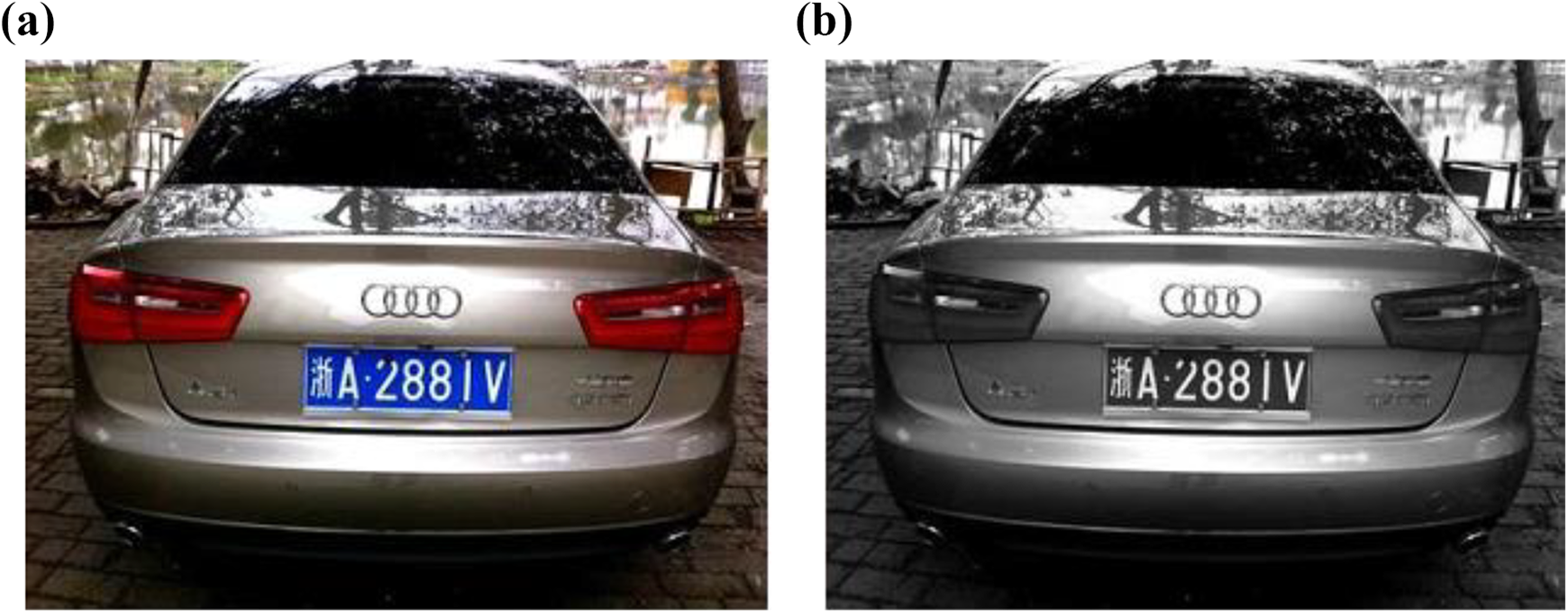
Gray scale processing: (a) original image and (b) gray scale image.
In the process of system processing, there will inevitably be noise, and noise will affect the subsequent image processing, so it is necessary to denoise the image. In this article, salt and pepper noise is added to simulate denoising. The denoising results are shown in Figure 3. Figure 3(a) is the image of salt and pepper noise, and Figure 3(b) is the result of weighted median filtering. It can be seen from Figure 3 that median filtering can effectively filter noise and improve image. In addition, compared with median filtering, weighted median filtering can better recover step edges and other details from noise-contaminated images.

Median filter processing: (a) noisy image and (b) filtered image.
Considering the large proportion of blue and yellow plate numbers in all vehicles in China, the frequency is quite high. In this article, two positioning algorithms are used: one for locating color plate numbers and another for locating black and white plate numbers. Two kinds of location algorithms are used to locate the 100 plate number images selected in this article. The results are given in Table 3. From Table 3, we can see that in the location algorithm, there will be positioning errors in color plate number positioning, leading to inaccurate positioning, while black and white plate number can be positioned accurately.
Plate number location results.

After location, this article carries out plate number character segmentation for 97 plate numbers, which have been successfully located. The result of plate number character segmentation is given in Table 4. From Table 4, we can see that this article can accurately segment plate number characters. The correct rates of blue, yellow, white, and black segmentation are 94.7%, 91.7%, 95%, and 93.3%, respectively. Figure 4 shows the histogram of the correct segmentation rate of the four colors.
Segmentation results of plate number characters.


Histogram of character segmentation result.
Experiments show that the algorithm can accurately segment the plate number characters and has strong adaptability. The algorithm not only achieves ideal segmentation results for general images but also can segment the disturbed images with different sizes, such as uneven illumination, tilt, dirty, white background, and black characters. Because the quality of a small part of the image in the experimental database is too poor, a small number of plate number image segmentation has also been wrong. The causes of the errors are analyzed, and the following situations are summarized.
Segmentation errors caused by strong noise points. For example, the position of the rivet is particularly prominent, which takes up the location of one character and causes errors. Only a small number of images in the experiment are wrong.
The reason for another image error is that the plate number characters contain “U” and “H” characters. Because the vertical projection of these characters is easy to produce valley values smaller than the eigenvalues, if these characters become independent two parts in the process of binary, they are similar to the vertical projection of narrower characters such as “1,” “I,” and so on, so these characters are easy to be divided into two parts.
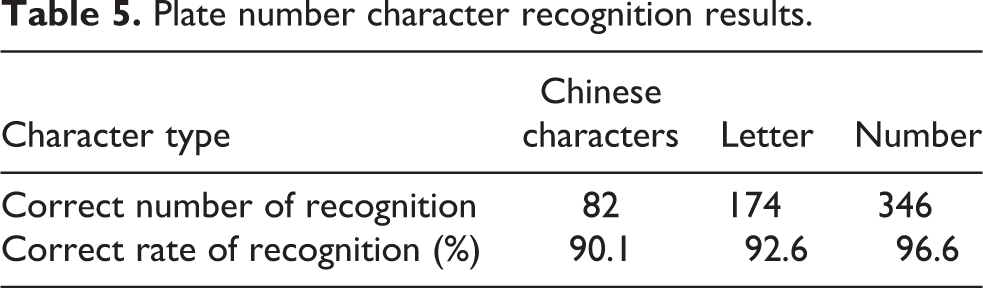
After the plate number character segmentation, 91 pairs of plate numbers, including 91 Chinese characters, 188 letters, and 358 digits, are correctly segmented. The plate number character recognition results are given in Table 5, and the result histogram is shown in Figure 5. Combining Table 5 and Figure 5, we can see that the recognition rate of digits is the highest, reaching 96.6%, letters is the second, 92.6%, and Chinese characters is the lowest, 90.1%. However, no matter which character is recognized, its recognition accuracy is relatively high.
Plate number character recognition results.

Histogram of character recognition results.
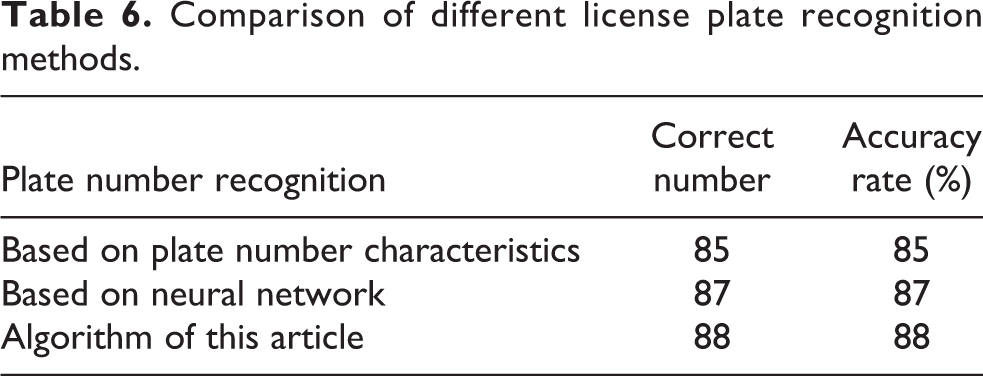
In addition, to reflect the superiority of this algorithm, this article uses several current recognition methods to compare, the comparison results are given in Table 6, and the comparison results are shown in the bar chart as shown in Figure 6.
Comparison of different license plate recognition methods.

Comparison diagrams of several identification methods.
Combined with Figure 6 and Table 6, we can see that the accuracy of the proposed algorithm is the highest, 88%, which shows that the proposed algorithm can recognize the license plate very well.
Conclusions
Nowadays, vehicles have become more and more popular, and they are an indispensable part of transportation. Therefore, the study of urban intelligent transportation system is becoming increasingly important. In this article, the recognition of the unique plate number of each vehicle is studied. On the basis of image recognition, the key technologies of the plate number recognition system are discussed respectively. First, the plate number is preprocessed by gray scale image, deviation correction, and weighted median filter. Then, the plate number image is positioned, character segmentation and character recognition are studied in turn, and the corresponding processing methods are proposed. Through simulation, the accuracy rate of this method is 88%, which is higher than the other two methods. The simulation results show that the proposed plate number location algorithm based on connected region search can accurately locate the plate number according to the characteristics of this article, and the location methods for color and black and white plate numbers are proposed respectively. It is proved that the improved vertical projection-based plate number character segmentation method proposed in this article can accurately segment plate number characters and has strong adaptability. It is proved that the template matching method combined with character features can effectively recognize Chinese characters, letters, and numbers.
Footnotes
Declaration of conflicting interests
The author(s) declared no potential conflicts of interest with respect to the research, authorship, and/or publication of this article.
Funding
The author(s) disclosed receipt of the following financial support for the research, authorship, and/or publication of this article: This research was supported by “Study on the carrying capacity of urban infrastructure in the construction of new type of urbanization” grant of Ministry of Housing and Urban-Rural Development of the People’s Republic of China, NO2016-R2-040.