




Abstract
In recent years, with the rapid development and wide application of the Internet, it has become the main place for the generation and dissemination of public opinion. To grasp the information of network public opinion in a timely and comprehensive way can not only effectively prevent sudden network malignant events but also provide a reference for the scientific and democratic decision-making of government departments. Therefore, in view of the practical application needs, this article studies the emotional characteristics and the evolution of public opinion over time based on the emotional feature words of network public opinion participants. Firstly, the positive and negative emotional lexicon of HowNet emotional dictionary is used, and the commonly used emotional lexicon and expression symbols are added to the lexicon. At the same time, the polarity annotation method of Chinese emotional lexicon ontology is used to construct the emotional lexicon of this article. Secondly, considering other emotional polarity characteristics in the dictionary, an emotional tendency analysis model is proposed. In this article, emotional analysis is applied to the evolution analysis of network public opinion, and the change of network public opinion characteristics with time series is obtained. The simulation results show that the emotional dictionary constructed in this article and the proposed model of emotional orientation analysis can effectively analyze the emotional characteristics of network public opinion participants and apply emotional analysis to the evolution analysis of network public opinion, which can get the change of emotional characteristics of public opinion participants with time series.
Keywords
Introduction
With the continuous development of network media and the increasing number of netizens, the network has become the main position for people to express their opinions. Through the Internet, netizens can discuss major events at home and abroad, participate in politics, pay attention to political style, people’s livelihood, civil rights, and other aspects in a variety of ways, and set off waves of unpredictable waves on the Internet. 1
The network is a virtual world, which has complex and diverse connections with the real world. The network public opinion originates from the real world and can truly reflect public opinion. The Internet records in detail the occurrence and development of real events, social activities, public opinion, and social conditions in all corners of the world and truly reflects the political, economic, military, scientific, and other aspects of the reality of various countries. Increasingly complex social network behavior and increasingly rich network information enable the Internet to timely and accurately show various public opinion trends in real society. Therefore, it is very important to discover, manage, and analyze network public opinion in time. 2
Because of the randomness, virtuality, and concealment of the network itself, more and more people tend to express their real ideas through the network. 3 At present, the Internet has increasingly become the main place where public opinion comes into being and spreads. At the same time, network public opinion also plays an increasingly important role in social development. Network public opinion is an important part of social public opinion, which not only reflects the social and political attitudes of certain social groups or strata but also is an important manifestation of social and public opinion. Therefore, the research and implementation of the network public opinion information monitoring system, a comprehensive, effective, and timely grasp of social conditions and public opinion, will play an important role in the scientific and democratic decision-making of government departments, effective prevention of network emergencies, and maintenance of social harmony and stability.
In contemporary society, more and more people begin to express their opinions through the Internet, including many comments on government work and government departments. Government departments need timely access to these online public opinions, to effectively understand whether the public is satisfied with the current government work so that they can democratically and scientifically adjust the governance plan and improve the efficiency of decision-making; at the same time, through the scientific management of network public opinion, they can also achieve effective supervision of these statements, prevent the spread of malicious speech, and maintain social harmony.
However, the information on the network is complex and numerous websites such as microblogs, bulletin board system (BBS), and forums. It is very difficult to obtain all the information about government work comprehensively, quickly, and effectively by manual means. Not only do we need to browse a large number of websites to identify the information related to government work, but also we need to identify the praise and derogation contained in the information. It takes a lot of manpower and material resources to monitor network public opinion in a traditional way, and the total amount of data obtained is small and the coverage is narrow, which greatly limits the effective development of the work. Therefore, we need an intelligent system, which can timely obtain the network public opinion information related to the work of the government, and deeply excavate the obtained information, analyze the internal relationship among them, and find out the cause of the incident and its development trend.
In addition, with the rapid development of science and technology, artificial intelligence robot has made great progress, can deal with many things that human beings cannot deal with. In the field of big data processing such as network public opinion, compared with human beings, it has better processing effect. Therefore, in the research of network public opinion processing, the robot system is used to process, and the analysis of network public opinion is well realized. In the process of robot dealing with Internet public opinion, it is the most important to study the emotional characteristics of Internet public opinion participants and the evolution of public opinion with time series. The research work of this article is as follows: Using the positive and negative emotional lexicon of HowNet emotional dictionary, and adding the commonly used emotional lexicon and expression symbols on the network, and using the polarity annotation method of Chinese emotional lexicon ontology for reference, this article constructs the emotional lexicon dictionary. Considering other features that can affect the emotional polarity in dictionaries, such as negative words or degree modifying adverbs and sentence patterns, an analysis model of emotional orientation is proposed. Applying emotional analysis to the evolution analysis of network public opinion, we can get the change of network public opinion characteristics with time series.
The content of this article is arranged as follows: the second section introduces the current situation of research on text emotional tendency, the third section gives the methods of text emotional tendency analysis and public opinion evolution, the fourth section provides the evaluation criteria and performance evaluation analysis of this method, and the fifth section includes conclusions.
Related work
Text orientation analysis is to analyze the speaker’s attitude, viewpoint, or emotion toward something, so as to judge whether the speaker has a positive or negative attitude toward the thing. Therefore, it is also called praise and derogation orientation analysis or polarity analysis. 4 The main task of text orientation analysis is to classify the text emotionally. Emotional text classification is similar to traditional topic-based text classification, but it is also different. In topic-based text categorization, feature words are mainly subject-related words. For emotional categorization of text, emotional feature words with emotional orientation play an important role in classification. 5
Text emotional tendency analysis has a broad application prospect, for example, in electronic commerce, companies can analyze product reviews to obtain customer opinions, so as to improve products or provide better services to enhance their competitiveness. The network public opinion can be used to obtain public opinion, in addition, can also be used for bad text information filtering and so on. 6
The study of text emotional orientation is a hot research topic in recent years. This article has certain theoretical significance and practical value in analyzing the emotional tendency of text for network public opinion. In theory, the emotional tendency analysis of network public opinion is still in its initial stage, which involves Chinese natural language processing technology. This article focuses on the emotional tendency analysis model of Chinese commentary texts under the network environment. It can promote the emotional tendency research of network public opinion, the emotional tendency research method of Chinese commentary texts, and the development of Chinese natural language processing technology. In practical value, the emotional tendency analysis of network public opinion can obtain the public’s attitudes toward various social phenomena, national policies, and major events and can play an important role in assisting decision-making for government leaders to obtain public opinion, carry out early warning of network public opinion, and guide the healthy development of network public opinion.
Because the emotional orientation of a text is mainly embodied according to the emotional vocabulary appearing in the text, the emotional dictionary 7,8 has become a very basic work in the study of the emotional orientation of a text and plays a very important role in the process of identifying the emotional orientation of a text. Therefore, building a high-quality, wide-ranging emotional dictionary has become an indispensable task in the process of identifying emotional orientation of online commentary texts.
Some progress has been made in the construction of emotional dictionary and the analysis of text emotional orientation both at home and abroad, but there are still some problems to be further analyzed and discussed.
In the construction of emotional dictionary: Because of the frequent occurrence of emotional words not included in the general emotional dictionary or combined feature words with emotional inclination in short texts of online reviews, this will increase the difficulty of text emotional inclination analysis. In addition, in the process of judging the emotional inclination of words, negative words modifying candidate emotional words and other related factors are also important factors affecting the analysis of emotional inclination of words. If these factors are ignored, it will make the method misjudge the emotional inclination of some words, which will further affect the performance of constructing emotional dictionary.
In the analysis of text emotional tendencies: In the process of researching the emotional orientation of commentary short texts, the distribution of emotional features in training centers and the transfer of emotional polarity in test texts are also important factors affecting the analysis of emotional orientation of texts. If we only consider the influence of emotional features on the emotional tendency of short texts from the training corpus, we ignore the key emotional information of emotional features in the test text. If we only consider the influence of emotional information in the test text on the emotional tendency of short text, we ignore the distribution of emotional characteristics in the training corpus.
Proposed method
Construction of emotional words dictionary
HowNet dictionary 9,10 is essentially a common-sense knowledge base, which describes the concept of vocabulary, including Chinese and English vocabulary. It also reveals the attributes of concepts and the relationship between concepts. All kinds of data involved in natural language processing are included in the data set covered by HowNet. The core parts are knowledge dictionary, Chinese dictionary, English dictionary, attributes information, event table, and antonym and emotion dictionary. Powerful knowledge base provides the necessary environment for natural language processing system, and HowNet is the most commonly used basis for constructing emotional dictionary.
The practice of compiling a common sense dictionary is the research and construction of HowNet. Its emotional dictionary includes negative evaluations of English words and corresponding negative Chinese evaluation words. The positive texts in Chinese texts and the corresponding English texts are positive. Evaluation words, Chinese negative emotional words and corresponding negative emotional words in the English field, English positive emotional words and Chinese positive emotional words are presented in Table 1.
HowNet Chinese emotional words list.
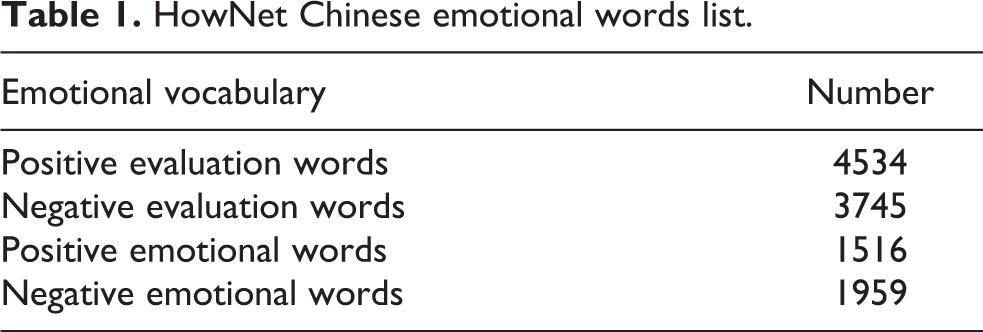
In the construction of emotional dictionary, through the further study of the emotional words, we can see that the words that can express personal feelings in network public opinion are usually used with high-frequency words and constantly updated with time. Many of the emotional words existing in HowNet are seldom involved in the network and lack of new words that appear and are popular in the network. Therefore, although the emotional dictionary in this article is based on the HowNet dictionary, it has been sorted out to some extent, including the abandonment of some uncommon words, and the deletion of words, which are not often seen in the network. In addition, the network vocabulary and other emotional words that have not been mentioned in HowNet are also expanded by referring to other dictionaries.
With the prevalence of computer networks, some network vocabulary is popular among people, especially new people. These words are accompanied by the development of Internet communication forms. They are the emotions expressed by people in some special languages or words in order to save time or embody their personality. They are mainly concise and clear. 11 These new words are widely used in network languages. Because the system of this article is an emotional dictionary constructed for network public opinion, it not only is based on Hownet emotional dictionary but also needs to include special emotional words commonly used by people on the network into the emotional dictionary constructed in this article.
By manually screening the network emotional vocabulary, 931 network sentiment words were obtained and were manually added to the various word sets of the dictionary, as presented in Table 2.
Common network vocabulary.

In addition, statistics show that a large number of network users like to express their emotions intuitively with expressions, so they must categorize the emotional of microblog emoticons. The expression we see is an expression pattern, but the Chinese characters with brackets are stored in short text. This storage method brings convenience to the processing of expression symbols. With the words in brackets as a bridge, we can understand the emotional category, intensity, and polarity of expression symbols. Through this method, 239 expression symbols are expanded by combining with manual correction.
Emotional dictionary is used to distinguish emotional words from ordinary words, but it is still unable to distinguish positive and negative emotions and emotional degree. Therefore, it is necessary to mark the polarity and emotional degree of emotional words.
The Chinese Emotional Vocabulary Ontology Library 12,13 is organized and tagged by the Information Retrieval Research Laboratory of Dalian University of Technology. It describes the emotional types, parts of speech, polarity, and intensity of emotional words in detail. The emotional classification system in this ontology database is based on the further improvement of six categories of emotional classification system of Ekman. 14 –16 Finally, the emotional category “good” was added to the noumenon of vocabulary, and the praise emotion in Chinese was divided into 7 categories (pleasure, good, anger, sadness, fear, disgust, and surprise) and 21 more detailed categories (including praise, boredom, derogation, hatred, etc.). There are seven types of parts of speech in emotional vocabulary ontology: noun, verb, adj, adv, nw, idiom, and prep. Each word corresponds to a polarity under each kind of emotion. Among them, 0 stands for neutrality, 1 for praise, 2 for derogation, and 3 for both sexes. Emotional intensity is divided into five grades: 1, 3, 5, 7, and 9. Grade 9 indicates the greatest intensity, and 1 is the smallest intensity. Because the system is to analyze emotional tendencies, which are divided into three attitudes: approval, opposition, and neutrality, in order to facilitate the distinction and calculation, the polar information in ontology information is changed to zero for neutrality, 1 for positive emotion, and −1 for negative emotion.
Emotional orientation analysis
For the analysis of emotional characteristics of network public opinion participants, the main purpose is to analyze the emotional tendencies of their public opinion texts. 17,18 This article proposes an emotional tendencies analysis model on the basis of considering other emotional polarity characteristics in the text that can affect the dictionary.
At present, emotional analysis based on English theme has been studied by many scholars, but Chinese, which is widely used and has a large number of netizens, has not attracted enough attention in the field of emotional analysis. Compared with English, Chinese has its own linguistic features, which makes it a great challenge to mine the emotions of Chinese themes, and is mainly manifested in the following aspects: (1) there is no space separator between Chinese characters as in English, (2) the extensive use of adverbs in Chinese sentences not only brings ambiguity but also leads to a greater degree of refinement, and (3) Chinese has a greater dependence on word meaning and grammar. Therefore, the existing technology of emotional analysis in English cannot be well applied to Chinese emotional analysis. Determining Chinese emotional polarity is a very arduous task, especially when there are many adverbs and subjective words in the text at the same time. Sometimes, a text containing more than one positive emotional word may express a strong negative emotion, while a text containing more than one negative emotional word may express a strong positive emotion. Therefore, this article proposes an emotional orientation analysis model based on the consideration of other features that can affect the emotional polarity in dictionaries, such as negation or degree modification adverbs and sentence patterns.
In this article, the text is decomposed into sentences and the emotional polarity of each sentence is further analyzed. The emotional polarity of a sentence can be calculated according to the polarity of the emotional words in the sentence. Then, the emotions of all sentences are synthesized to calculate the emotional polarity of the text. The importance of a sentence to the whole text can be expressed by the weight calculated by the comprehensive polarity of the sentence in the text. To describe the problem in the form of formulas: For a given text D, it is composed of a set of sentence S, expressed as


where
In this article, all verbs and adjectives output by institute of computing technology, chinese lexical analysis system (ICTCLAS) Chinese Lexical Analysis System
19
of Chinese Academy of Sciences are used as emotional words. Through the algorithm given below, we can calculate the emotional value

where


where Np
is the number of positive words in the emotional dictionary, Nn
is the number of negative words in the emotional dictionary,
(1) Rules for emotional computation of adding degree adverbs or negative words
In order to make the emotional score more accurate, equation (6) is given to calculate the emotional value of the emotional words with degree adverbs.

where Ne
is a negative coefficient. If a negative word (such as “no”) which can embellish the emotional word wi
is found near the emotional word wi
, the emotion will be reversed and the negative coefficient Ne
will be set to −1.
(2) Emotional computing rules considering sentence patterns
Assuming




Analysis of public opinion evolution
The evolution of public opinion is the process of the change of public opinion information formed by the development and change of public opinion information along the time axis. Therefore, the network activities of netizens are closely related to the evolution of public opinion. 19 –21 Emotional analysis can analyze and deal with the text with emotional color, and netizens’ attitudes and opinions toward the text of public opinion topics are basically expressed. Therefore, the application of emotional analysis in network public opinion can monitor and predict network public opinion and help relevant departments to take appropriate measures and solutions. Before the introduction of the new policy or decision-making, relevant information can be sent on the Internet in advance, and the implementation of the proposal can be decided according to the reaction of the public. By analyzing the response of netizens in advance, we can save a lot of man power, material resources, and financial resources, but also avoid some unnecessary conflicts. When emergencies spread on the network, we can guide the network public opinion correctly through the evolution analysis of public opinion and avoid some unnecessary misunderstandings.
Therefore, this article takes microblog as the research object, aiming at the characteristics of short text data such as microblog, and from the emotional point of view, puts forward an evolutionary analysis of public opinion based on the emotional analysis. This method calculates the emotional inclination of microblog in time series, then divides microblog into segments, and then carries on the evolution analysis of public opinion.
Traditional evolutionary analysis of public opinion seldom considers the influence of emotions on time slices. This article considers that with the evolution of topics and public opinion, emotions will fluctuate accordingly. Therefore, the emotional value of text is used as a feature to time slice the data, and dynamic topic model (DTM) model is used to analyze the topic evolution of the data after slicing. Therefore, the evolution analysis of public opinion in this article mainly includes two steps: (1) documents are divided according to discrete-time intervals and (2) documents after segmentation are analyzed by DTM model. 22,23
Based on time-slicing of sentiment values, consider the emotion value as a feature of the slice. First, calculate the absolute value of the two data sentiment value differences, and sort them in descending order to select the time point that meets the demand. For the data close to the time point, considering the rationality of the time point selection, the current data are merged and the average value is calculated as a time point. Then continue to add new nodes to the sorting time point to continue the calculation, until the conditions are met. The specific process is as follows: Input microblog data, microblog time, and the number of time slices, calculate the emotional value of two adjacent data, take the absolute value, and sort. When n is less than the number of time slices, choose the largest and most time slices which are not selected in the data sorted according to the absolute value of emotional value. The number of microblogs at the current time point—the nearest time point in the existing time point > the threshold value, then the current time point is the most time-sliced time point. If the number of microblogs at the current time point—the nearest time point in the existing time point is less than the threshold value, calculate the average number of microblogs at the nearest two time points, select the corresponding number of microblogs at the time point, and update the existing time point.
DTM model relaxes the assumption of document interchangeability in static topic models such as latent dirichlet allocation (LDA). It considers that the topic distribution
Extraction word distribution
Extracting theme distribution
For each document:
Extracting theme distribution
For each word:
Extracting theme
Extraction word
The function
Experiments and discussion
The commonly used evaluation indicators for evaluating the performance of text emotional classification mainly include precision, recall, and F1 value. 24 –26 The specific calculation formulas are as follows



where a representation correctly judges the number of samples related to emotional categories, b represents the number of samples judged as related emotional categories, and c represents the number of samples that actually have related emotional categories in the test data.
Due to the existence of positive and negative categories in the results of the experimental analysis, it is difficult to measure the classification effect of the method on the whole test set by using the evaluation index value of a single category. Therefore, in the process of experiment, we use the macro-average precision, macro-average recall, and macro-average F1 value 27 –29 as evaluation indicators. The specific calculation formulas are as follows



where
The “Luo Yixiao” incident in November 2016, as one of the top 10 domestic family events in 2016, has good research value in the emotional tendency and evolution analysis of network public opinion. At the same time, this article keeps up with the trend of the era of big data and provides an order of magnitude of network public opinion data for this study under the background of the continuous development of big data theory and technology. Therefore, this article takes “Luo Yixiao” as the search keyword, uses Octopus Data Collector to collect microblog text as the data source, and collects 78,536 microblog information from 00:00 on November 29, 2016 to 24:00 on December 31, 2016. After the preliminary processing of the collected data, that is to say, the data are de-duplicated, de-emptied, and de-advertised. First, delete the same content microblog published by the same user at the same time to avoid repetitive data affecting the validity of the subsequent emotional analysis results; then delete the wrong microblog data, that is, delete the incomplete data or empty data; and then delete a lot of spam information such as advertisements generated by the “Luoyixiao” incident. Finally, we repeatedly clean and check the microblog data, and finally get 74,025 valid microblog data related to the “Luo Yixiao” incident.
Firstly, to verify the performance of the emotional word dictionary designed in this article, we use a simple statistical method 30,31 to analyze the emotional tendencies of the text, use the emotional dictionary to select the emotional features of the text, and compare the extended emotional dictionary with the basic dictionary on the data set. The results are presented in Table 3 and drawn a bar chart in Figure 1.
Performance data before and after the expansion of emotion dictionary.


Performance comparison before and after the expansion of emotion dictionary.
As can be seen from Figure 1, the effect of extended emotional dictionary in text emotional classification is better than that of basic emotional dictionary. The main reason is that the number of emotional words in emotional dictionaries has some influence on the results of emotional orientation analysis. The basic emotional dictionary is mainly composed of commonly used emotional dictionaries, which mainly contains some commonly used emotional words and cannot cover all the emotional words in the corpus. Because of the characteristics of the network text itself, there are network emotional words and expression symbols that are not included in the basic emotional dictionary, which makes the basic emotional dictionary unable to effectively identify the emotional tendency of the text containing these emotional words. The extended emotional dictionary constructed in this article includes the commonly used basic emotional dictionary, network emotional words, and expression symbols. Therefore, the extended emotional dictionary designed in this article can effectively identify network text emotion in text orientation analysis, and the macro-average F1 value of the results of text emotional orientation analysis is also increased by 5.6%.
Secondly, pointwise mutual information (PMI) is used as the baseline to compare this method with other methods. The main purpose of this article is to verify the feasibility of the proposed method for judging the emotional tendency of words. In the course of the experiment, when using two methods to calculate the emotional propensity value of candidate emotional words is 0, there may be more positive emotional words than negative emotional words or more negative emotional words than positive emotional words. It is unreasonable to randomly divide them into positive emotional words or negative emotional words. Therefore, in this group of experiments, when the emotional propensity value of candidate emotional words is calculated by using the above-related methods, they are not divided into positive emotional words or negative emotional words. The results of the two methods are presented in Table 4 and drawn a bar chart in Figure 2.
Performance data of word emotional tendency based on different methods.


Analysis of word emotional tendency using different methods.
As can be seen from Figure 2, the overall effect of this article’s method is better than that of PMI method. The main reason is that PMI method does not take into account the influence of degree adverbs or negatives and sentence patterns on the emotional tendency of candidate emotional words, while this article’s method takes into account the situation that degree adverbs or negatives modify candidate emotional words and sentence patterns in the text, so that to a certain extent, it cannot only accurately identify the emotional tendency of candidate emotional words modified by degree adverbs or negatives. Moreover, it can effectively identify the influence of sentence patterns on text emotional orientation. Compared with PMI,
According to statistics, the heated discussion on “Luo Yixiao” broke out on November 30. On that day, the number of microblog posts increased rapidly to 43,373, and the number of comments forwarded was many and several. Since then, the attention of netizens to time has declined sharply, and the number of single-day microblog posts has been declining. Therefore, this article divides the time slice of November 30 data set based on emotional value.
Firstly, the visualization of high-frequency emotional words is given, as shown in Figure 3. From Figure 3, we can see that the high-frequency emotional words such as “Blessing,” “Heartache,” “Defraud,” “Recovery,” and “Shameless” reflect the dominant emotions of network public opinion events, especially those close to the center, and reflect the emotional tone of network public opinion events and network public opinion participants.
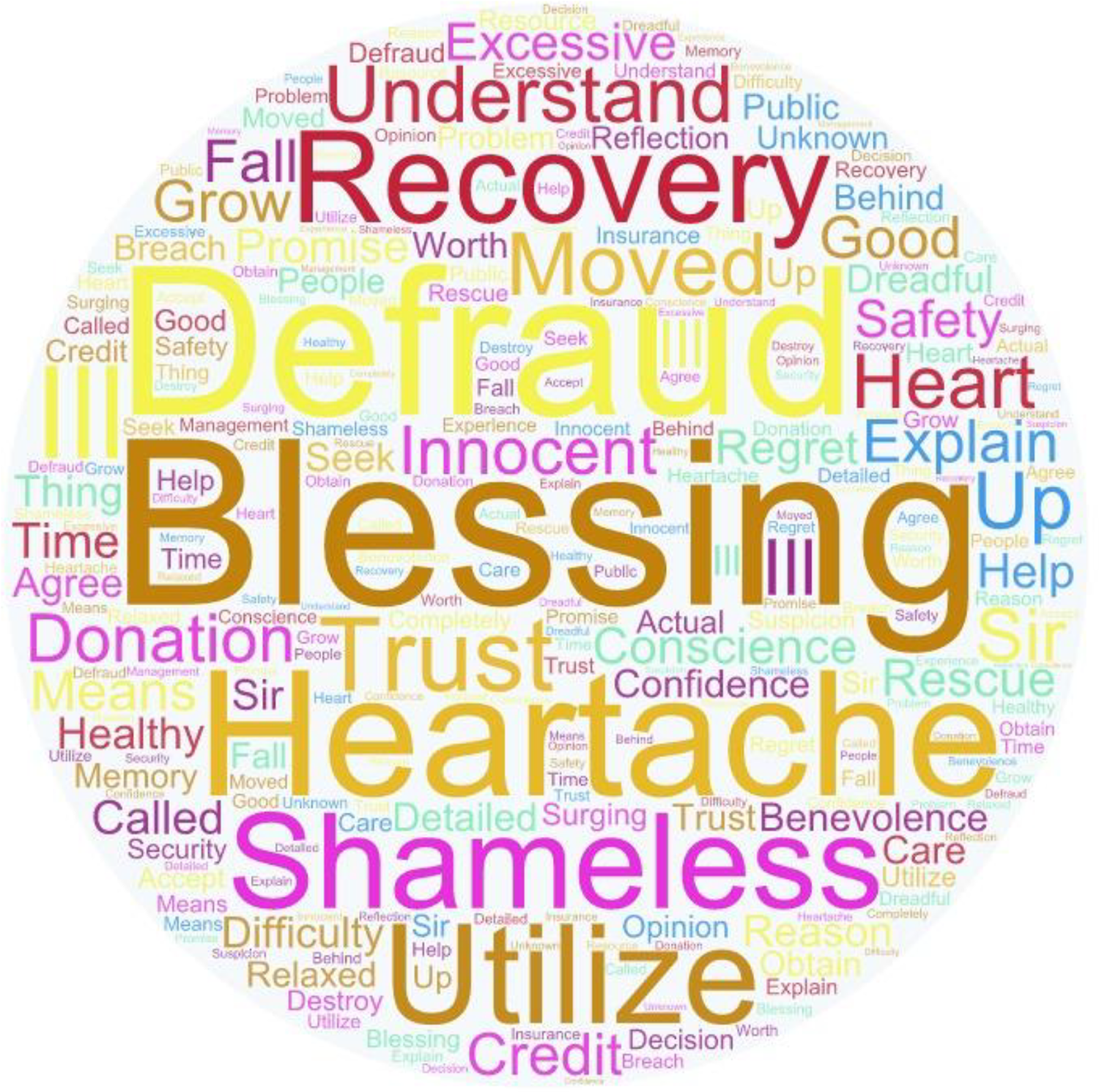
Visualization of high-frequency emotional words.
Secondly, this article presents the time-varying curve of the microblog comment no. 30 of November, as shown in Figure 4. From Figure 4, we can see that (1) the number of comments increases first and then decreases with time, reaching the maximum at 14:00, which is 1129 and (2) during the period from 0:00 to 8:00, the number of microblog comments is too small, totaling 40, which does not have the credibility of analysis, so the emotional inclination of microblog data begins at 9:00.

Time-varying curve of the number of microblogs.
Through the above analysis of the number of microblogs and the time, we can find that because there is too little data before eight o’clock, emotional analysis does not have convincing and credibility, so this article starts from nine o’clock to analyze the emotional polarity intensity of microblog data, and the analysis results are shown in Figure 5. From Figure 5, we can see that the average polarity intensity decreases first and then increases with time. Combining with Figure 4, the number of microblogs increases first and then decreases. It can be found that although the number of microblogs is increasing, the average polarity intensity shows a decreasing trend, indicating that negative emotions are increasing and reaching the lowest point at 16:00. Similarly, from 16:00 to 22:00, the number of microblogs shows a decreasing trend, but the average polarity intensity of microblogs has increased, which shows that the number of positive microblogs has increased significantly in this period.
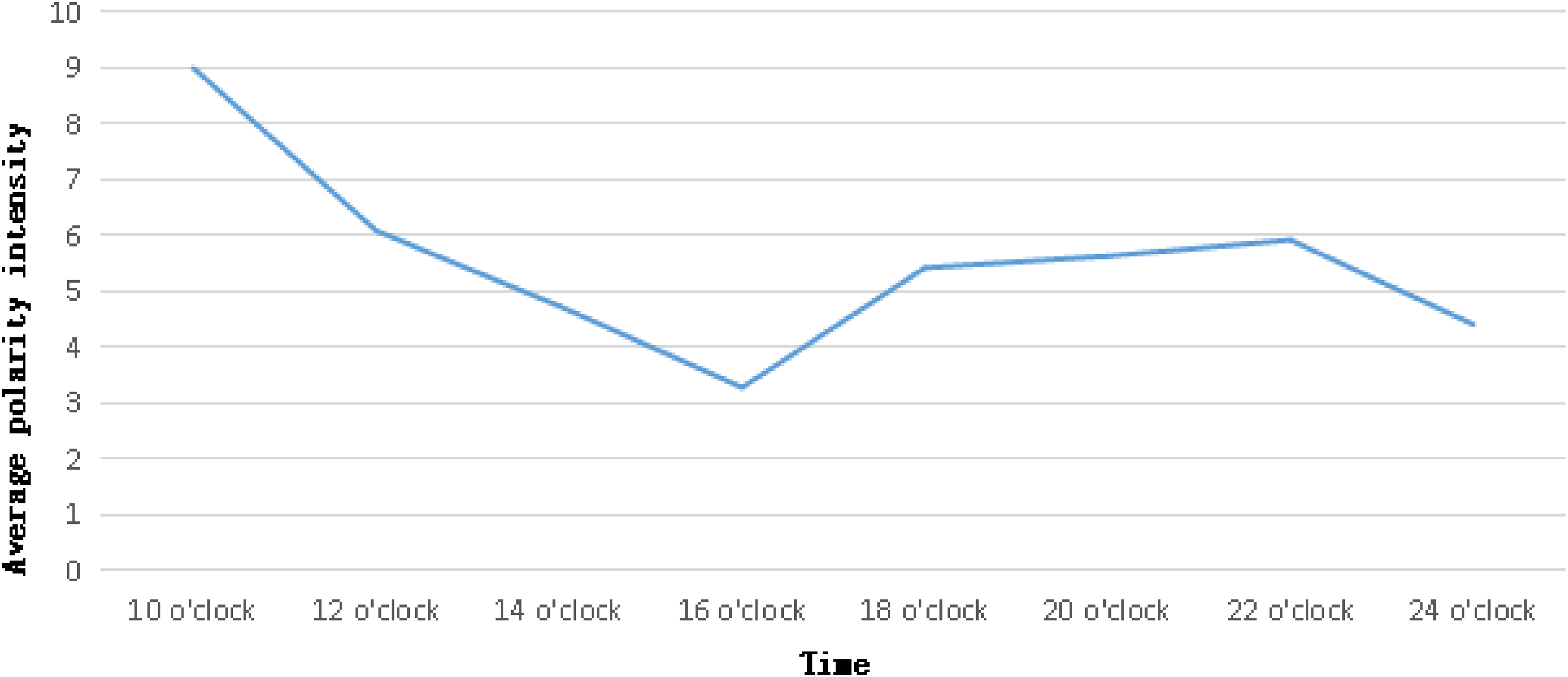
The curve of emotional polarity intensity with time.
Finally, this article divides emotional words into seven categories: pleasure, good, anger, sadness, fear, disgust, and surprise. This article gives the classification of emotional words frequency of microblog comments in the whole event, as shown in Figure 6. From Figure 6, we can see that the main emotions of public opinion participants are “good” and “disgust.” Through the content of microblog text, we can find that most of the netizens express their concern and blessing to Luo Yixiao, but they are angry and disgusted with his father’s behavior.

Classification of emotional word frequency.
Conclusions
In recent years, the network has become the main carrier of public opinion, how to timely and comprehensive grasp of public opinion information has become the main concern of government departments. Aiming at the practical application needs, based on the emotional feature words of network emotional participants, this article studies their emotional characteristics and the evolution of public opinion over time series. Based on the construction of emotional dictionary, an emotional orientation analysis model is proposed, and the emotional analysis is applied to the evolution analysis of network public opinion. The change of emotional characteristics of public opinion participants with time is obtained. The simulation results show that the emotional dictionary constructed in this article has better performance than the basic emotional dictionary. Meanwhile, the emotional orientation analysis method designed in this article has better performance than the PMI method in emotional orientation analysis. In addition, through visualization technology, we constructed a high-frequency emotional word visualization map of specific events, analyzed the number of microblogs and the change of average polarity intensity of microblogs with time, and finally analyzed the classification of emotional word frequency of the whole event.
Footnotes
Declaration of conflicting interests
The author(s) declared no potential conflicts of interest with respect to the research, authorship, and/or publication of this article.
Funding
The author(s) disclosed receipt of the following financial support for the research, authorship, and/or publication of this article: This work was supported by the key project of the National Social Science Fund of China “Research on the shock of artificial intelligence on labor market and the response to the transformation of workers’ knowledge and skills” [Grant No. 19AGL025].
