



Abstract
The ill-posed least squares problems often arise in many engineering applications such as machine learning, intelligent navigation algorithms, surveying and mapping adjustment model, and linear regression model. A new biased estimation (BE) method based on Neumann series is proposed in this article to solve the ill-posed problems more effectively. Using Neumann series expansion, the unbiased estimate can be expressed as the sum of infinite items. When all the high-order items are omitted, the proposed method degenerates into the ridge estimation or generalized ridge estimation method, whereas a series of new biased estimates can be acquired by including some high-order items. Using the comparative analysis, the optimal biased estimate can be found out with less computation. The developed theory establishes the essential relationship between BE and unbiased estimation and can unify the existing unbiased and biased estimate formulas. Moreover, the proposed algorithm suits for not only ill-conditioned equations but also rank-defect equations. Numerical results show that the proposed BE method has improved accuracy over the existing robust estimation methods to a certain extent.
Introduction
Many engineering problems need to solve linear equations. Least squares estimation (LSE) is the most commonly used method to solve linear equations. It is also called unbiased estimation since it satisfies the optimal linear unbiasedness. But when the coefficient matrix of the equation system is ill-conditioned, the calculation results obtained by the LSE often have large errors or even complete distortion. This phenomenon is called the ill-posed least squares problem. As is well known, the ill-posed least squares problems often arise in many engineering applications such as machine learning, intelligent navigation algorithms, surveying and mapping adjustment model, and linear regression model. 1 –5 Without loss of generality, consider a multiple linear regression model

where y is the

Letting

As stated before, it is known that the

where In
is the

in which
BE method based on Neumann series
In this section, a new BE based on Neumann series is proposed to solve the ill-posed least squares problems. Using Neumann series expansion, the unbiased estimate can be expressed as the sum of infinite items. When all the high-order items are omitted, the proposed method degenerates into the RE or GRE method, whereas a series of new biased estimates can be acquired by including some high-order items. Using the comparative analysis, the optimal biased estimate can be found out with less computation. Moreover, the proposed algorithm suits for not only ill-conditioned equations but also rank-defect equations. The main formulas of the proposed method are derived as follows.
Equation (3) can be rewritten as

where the

The selection of the regularization matrix K is the first important issue in the proposed method, which will be discussed in the next section. Using Neumann series, 25 –28 equation (6) can be expanded as

The sufficient condition for convergence of equation (8) is

where
Equation (8) is of great significance. It contains the existing LSE, ridge estimation, and generalized ridge estimation formulas. In other words, it establishes the essential relationship between BE and unbiased estimation and then can unify the unbiased and biased estimate formulas. Based on equation (8), a series of new BE forms can be derived. The details are as follows:

where


There is an optimal biased estimate in the above series of biased estimates as shown in equations (10) to (13). Searching the optimal biased estimate is the second important issue in the proposed method, which will also be discussed in the next section.
Discussion on the special issues
As stated before, there are two important issues in the proposed method that need to be addressed to get the optimal solution more quickly. The first issue is the selection of the regularization matrix K. Technically, the regularization matrix K can be chosen arbitrarily on the premise that equation (7) is satisfied. But it is worth noting that the computation cost in searching the optimal biased estimate will depend on the selected regularization matrix. In this section, a simple formula to obtain the regularization matrix is given as


where
The second issue of searching the optimal biased estimate will be addressed by a comparative analysis. The main steps are as follows. (1) Compute the series solutions of x by equation (13) when i is taken from 1 to g. The value of g can be determined by experience; for example,

where
Numerical examples
An ill-posed surveying adjustment model
Consider the ill-posed surveying adjustment model
29

In the example, the correlation matrix
Now we test the proposed algorithm by using the contaminated observation vector. The contaminated observation vector yc is generated by adding a random number to each element of the exact vector y in equation (17). Without loss of generality, we assume the contaminated observation vector is

Results obtained by LSE (equation (3)), RE (equation (4)), and the proposed BE (equation (13)) are given in Tables 1 and 2 for different values of δ and g. In these tables, the relative error between the estimate and true value is described by

Results of LSE, RE, and BE when

LSE: least squares estimation; RE: ridge estimate; BE: biased estimation.
Results of LSE, RE, and BE when
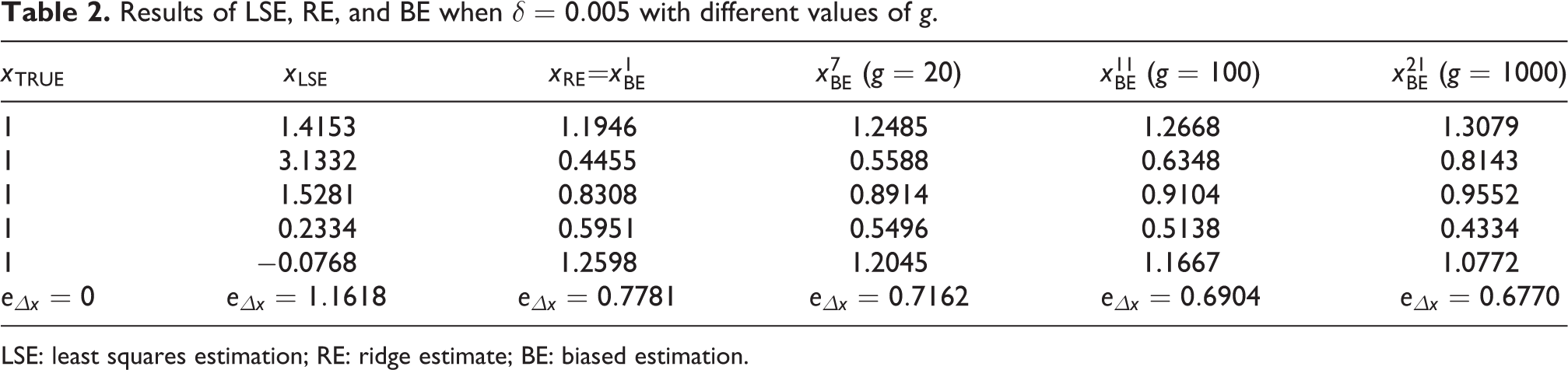
LSE: least squares estimation; RE: ridge estimate; BE: biased estimation.
Table 1 presents the results using
Table 2 presents the results using
From the above results, one can conclude that (1) the proposed BE method has improved accuracy over RE and LSE to a certain extent, (2) more precise optimal solutions can be obtained with the series number g increasing, and (3) there is little difference between the optimal biased estimates if g is large enough. It is important to note that the computation cost of the proposed method will not increase significantly even if g is very large since only simple multiplication and sums of matrices are needed in the computation of series. It is apparent that the computation cost of the proposed method is far less than that of the L-curve method since the latter needs multiple inverse operations of matrices in choosing a suitable value of the ridge parameter.
To further illustrate the superiority of the proposed method, a more serious contaminated model 30 derived from equation (17) is used in the next discussion, whose coefficient matrix and observation vector are both contaminated as

In reference,
30
the authors presented the computation results of this contaminated model obtained by some existing methods such as LSE, RE with L-curve, total least squares estimate (TLS), TLS with L-curve, and virtual observation method. For ease of comparison, Table 3 gives the result obtained by the proposed BE method and the results in reference.
30
Compared with the existing methods, one can see from Table 3 that the proposed method can obtain the solution (
Results obtained by different methods.

TLS: total least squares estimate; LSE: least squares estimation; VOM: virtual observation method; RE: ridge estimate; BE: biased estimation.
Hilbert ill-conditioned matrix
The Hilbert ill-conditioned matrix is often used to test the performance of the various robust estimation methods. The typical Hilbert matrix is defined as 22

With the increase of its order n, the Hilbert matrix becomes more seriously ill-conditioned. In this example, the 20-order Hilbert matrix

where the true value of unknown vector x is
Solutions of the Hilbert ill-conditioned equation.

BE: biased estimation; LSE: least squares estimation.
From Table 4, one can see that the LSE solution is completely distorted even with the use of error-free data. This is due to the equation having a very serious morbidity problem since the condition number of
Conclusions
The ill-posed least squares problems often arise in many engineering applications such as machine learning, intelligent navigation algorithms, surveying and mapping adjustment model, and linear regression model. In this study, a new BE method based on Neumann series is proposed to solve the ill-posed problems more effectively. The developed theory establishes the essential relationship between BE and unbiased estimation and can unify the existing unbiased and biased estimate formulas. Two numerical examples show that the proposed biased estimate has improved accuracy over the existing robust estimates to a certain extent. The proposed method may be very helpful to solve the ill-posed least squares problems in engineering practice.
Footnotes
Acknowledgement
The author thanks the reviewers for a thorough and careful reading of the original article. Their comments are greatly appreciated and have helped to improve the quality of the article. In addition, the author would like to thank Dr Wang W, Master Bai ZC, and Master Li Na for their help in programming and text checking.
Declaration of conflicting interests
The author(s) declared no potential conflicts of interest with respect to the research, authorship, and/or publication of this article.
Funding
The author(s) disclosed receipt of the following financial support for the research, authorship, and/or publication of this article: This study was funded by the National Natural Science Foundation of China (11202138).
