




Abstract
This article investigates the distributed synchronization problem of autonomous underwater vehicles by developing a novel synchronization protocol with memorized controller. More precisely, the memory information for information exchanges of autonomous underwater vehicles is utilized such that the synchronization performance can be improved. By employing the Lyapunov–Krasovskii functional method with model transformation, sufficient criteria are established for guaranteeing the synchronization, and the corresponding distributed synchronization controllers are designed based on matrix techniques. Finally, the effectiveness and benefits of our theoretical method are supported by an illustrative example with simulation results.
Keywords
Introduction
During the past years, there have been thriving research towards the autonomous systems due to their various applications and perspectives in the real world, for example, unmanned aerial vehicles, 1,2 autonomous underwater vehicles (AUVs), 3 –6 automated guided vehicles 7,8 and so on. It is emphasized that the collective behaviours of the coordinated autonomous systems have received tremendous attention, which are more complex but more effective than the single system. As a consequence, various benefits are obtained such as more robustness, more efficiency and relatively low costs. 9,10 As one basic yet fundamental issue, a growing interest is arising into the synchronization problem (also known as the consensus problem), which means that all the single systems in the group can achieve certain agreement upon a common state. 11 –13 Note that distributed framework with local information exchanges according to the communication topology is highlighted compared with the centralized or decentralized cases. Spurred by the pioneering works, remarkable results of distributed synchronization of autonomous systems have been reported in the literature. 14,15
In particular, the AUVs have gained a great deal of researchers’ attention from both theoretical and engineering aspects of view. 16,17 For instance, in Cui et al.’s study, 18 the synchronization control of multiple AUVs is investigated with state and output feedback control strategies. In Xiang et al.’s research, 16 the coordinated formation control problem of AUVs is studied for pipeline inspections, where the leader–follower strategy is used while keeping the desired triangle formation. In Xiang et al.’s study, 17 the synchronized path following control problem of homogeneous underactuated AUVs is investigated, and the two-layer controllers are developed for synchronization task. In Peng et al.’s work, 19 the containment control of networked AUVs guided by multiple dynamic leaders over a directed network is concerned and the corresponding sufficient conditions are given. In Millán et al.’s research, 12 a novel formation strategy of AUVs is proposed to deal with the communication delays by a virtual leader configuration. Note that all the above works are based on the continuous-time underwater communication model, which means that the information exchanges are conducted in continuous time without interruption. It is worth mentioning that for the AUVs, the information exchanges are more complicated and may be unreliable. It is mainly because of the communication limitation in the underwater environment. 20 –22 Subsequently, the underwater communication constraints should be considered in the analysis and synthesis procedure of AUVs. It should be pointed out that the sampled-data control has been recognized as an effective control method in most practical applications. Compared with the traditional continuous-time control schemes, the information transmission is accomplished with discrete-time feature by digital techniques. This brings significant advantages including better control performance and robustness and is more applicable for the underwater communications. 23 As a result, various effective sampled-data control strategies have been adopted for AUVs. 19,24 On another research frontier, some burgeoning efforts have been devoted to the memorized controllers and have achieved encouraging results. By utilizing the past information stored in the memory, the dynamics and the control performance can be potentially improved. 25 By the aforementioned discussions, a natural question arises: Can the sampled-data control scheme together with the memory be adopted to solve the synchronization problem of AUVs by taking into account the underwater communication applications? This motivates us for this study.
With this background, in this article, a novel memorized synchronization protocol with a distributed feature is designed for solving the synchronization of AUVs with undirected topology. Compared with the existing literature, the contributions of our article can be summarized as follows. Firstly, the memorized synchronization mechanism is introduced in the information exchange parts among the AUVs, such that the synchronization performance and design flexibility can be effectively improved. Secondly, the developed synchronization protocol can be considered as a more common case than some existing sampled-data results with or without transmission time delays. Then, the synchronization problem can be transformed into the stabilization problem. By employing the Lyapunov–Krasovskii method, memory-dependent sufficient criteria can be established for ensuring the synchronization control, based on which the desired synchronization gains can be designed.
The outline of the article is given as follows. The preliminaries of the synchronization problem of AUVs are introduced and the distributed synchronization controllers are developed accordingly. Based on the derived results, sufficient synchronization conditions are given in terms of linear matrix inequalities (LMIs). Then, the numerical example is presented with simulation results for demonstrating the effectiveness of our proposed approach. In the end, we draw some conclusions and future direction in this article.
Notation
ℝn represents n-dimensional Euclidean space.
Preliminaries and problem formulation
The AUV model
Consider the multiple AUV system composed of N AUVs with the following dynamics

where
Graph theory
The algebraic graph theory is introduced for subsequent parts. In order to represent the communication topology, denote
Memorized synchronization protocol
By designing

where

In addition, suppose that the synchronization transmissions are in the form of sampled data with a time-driven sampler, where the sampling period is given as

where d is the constant time delay in the memory part storing the information exchanges and
Remark 1
It can be found that the discrete-time signal transmission is more applicable and robust than the continuous-time cases in the underwater communication environments. By applying the memory mechanism, the past information exchanges can be used during the synchronization process.
The aim of this article is to design the desired synchronization input

Thus, it can be verified that if it holds that

then the synchronization can be achieved accordingly.
Before proceeding further, we give the following significant lemmas for deriving the main results of our article.
Lemma 1
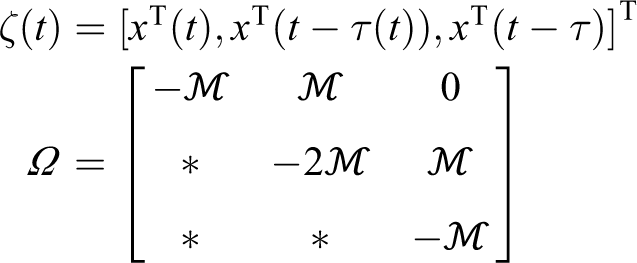
For any matrix

where
Lemma 2
Given constant matrices

or

Main results
In this section, sufficient synchronization conditions for the AUVs are established and then the desired synchronization gains can be obtained with the help of LMIs.
Theorem 1
With the sampling period T, the synchronization of the AUVs (1) can be achieved by the given synchronization gains with connected topology, if there exist positive matrices P,


Proof
By employing the input delay method, for

where
Then, it can be obtained that

which can be further rewritten in a compact form as

with
Since the communication topology is connected, it can be obtained that there exists a nonsingular matrix H, such that the Jordan form with the Laplacian L can be obtained by

where
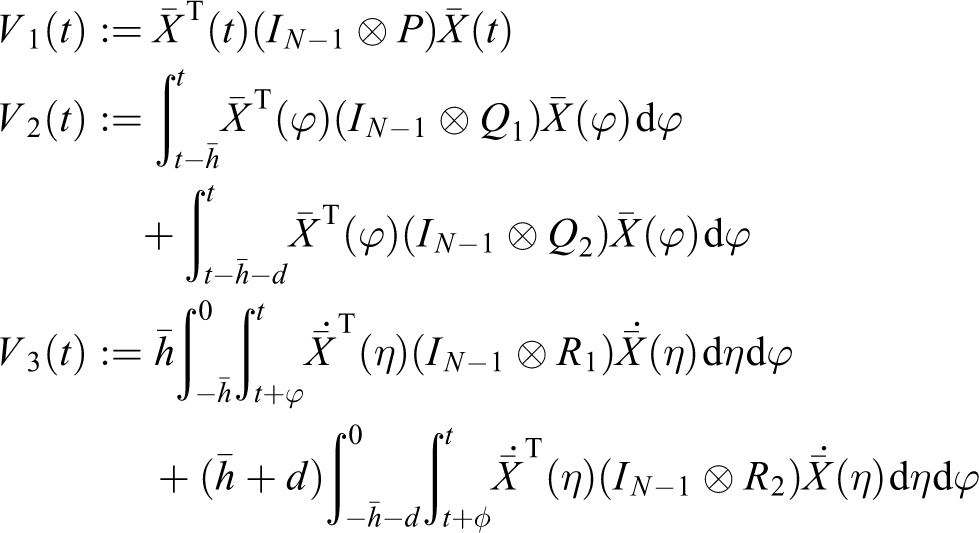
Next, select the following Lyapunov–Krasovskii function

where
By taking the time derivative of

Moreover, it yields from lemma 1 that

and

Then, it can be obtained by lemma 2 that if the LMIs in theorem 1 hold, the desired synchronization can be reached.
Remark 2
It should be pointed out that the LMI conditions in theorem 1 cannot be directly used to derive the synchronization gains, such that the following theorem is provided for solving synchronization gains.
Theorem 2
With the sampling period T, the synchronization of the AUVs (1) can be achieved with connected topology, if there exist positive matrices
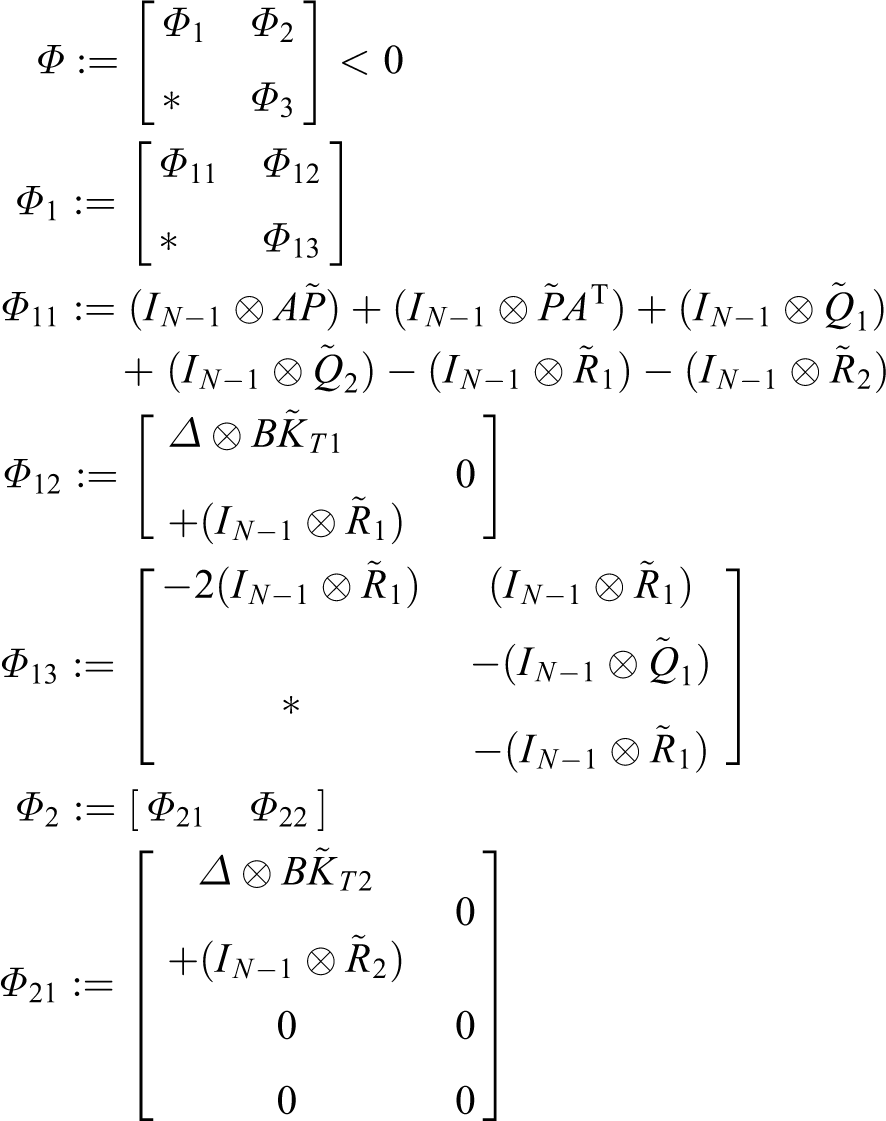

If the above LMIs are satisfied, the desired synchronization gains can be obtained by
Proof
By denoting the following matrices:
Remark 3
On the basis of graph theory, when the communication topology is connected, it follows that the Laplacian L has real number eigenvalues:
Corollary 1
With the sampling period T, the synchronization of the AUVs (1) can be achieved with connected topology, if there exist positive matrices
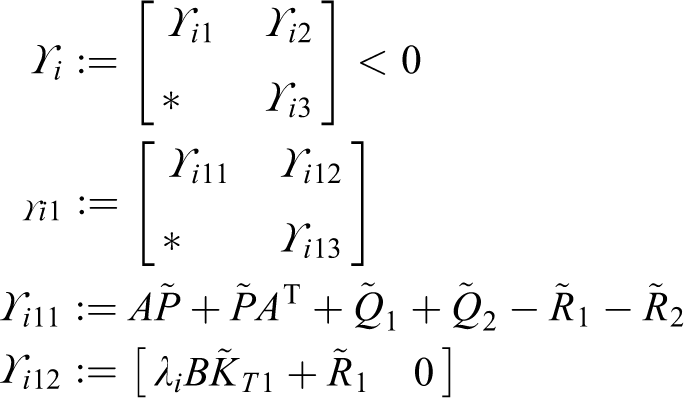

If the above LMIs are satisfied, the desired synchronization gains can be obtained by
Numerical example
In what follows, a numerical simulation example is presented for supporting our proposed method.
Simulation setup
The computer simulation is carried out with MATLAB/SIMULINK software with variable-step configuration, where the computer is with 3.4 GHz Intel Core i7 processor. The numerical parameters of the constructed simulation model are provided as follows.
Consider a group of four AUVs with identical dynamics, where the parameters are given by

Moreover, the communication topology is depicted in Figure 1. It is assumed to be connected with the Laplacian L given by


The communication topology of AUVs. AUV: autonomous underwater vehicle.
such that we can obtain that
The sampling period of the synchronization controller is set as
By solving the synchronization LMI conditions in theorem 2 using MATLAB, the desired

Simulation results
Given random initial conditions of the AUVs within [−2, 2] and the designed synchronization control inputs, the synchronization results of the AUVs are shown in Figures 2 and 3. It can be found in Figure 2 that all the generalized positions of AUVs can converge to the agreement trajectory for the three-dimentional trajectory, while Figure 3 depicts that all the generalized linear velocities of AUVs can remain on a constant value when the synchronization is achieved. From the simulation results, it can be observed that the synchronization can be satisfied with the designed protocol, which demonstrates our theoretical results.

Simulation results of the generalized positions of AUVs. AUV: autonomous underwater vehicle.

Simulation results of the generalized linear velocities of AUVs. AUV: autonomous underwater vehicle.
Figure 4 shows the comparison results of our proposed memorized synchronization strategy, the common sampled-data and the time-delay approaches. It can be seen that the memorized synchronization control has its advantages in time-consuming and control performance. Moreover, it is noted that the synchronization time increases as the sampling period increases since the number of information exchanges decreases.

The comparison results of our memorized synchronization strategy, the common sampled-data and the time-delay approaches.
In addition, Figures 5 and 6 depict the relation between the time delay and the synchronization errors, and the relation between the time delay and the synchronization time when the sampling period is fixed (

The relation between the time delay and the synchronization error.

The relation between the time delay and the synchronization time.
Conclusions
In this article, we have developed a novel memorized synchronization protocol to deal with the synchronization problem of multiple AUVs. Sufficient conditions are derived by applying the Lyapunov–Krasovskii functional method, such that the desired synchronization can be reached and the corresponding synchronization gains can be obtained. Finally, we give an example for illustrating our developed strategy. Our future work would focus on the cases with unreliable links in the AUVs.
Footnotes
Acknowledgement
The authors are grateful to the editor and reviewers for their valuable suggestions which improved this article.
Declaration of conflicting interests
The author(s) declared no potential conflicts of interest with respect to the research, authorship and/or publication of this article.
Funding
The author(s) disclosed receipt of the following financial support for the research, authorship and/or publication of this article: This work was supported by the National Natural Science Foundation of China (grant nos 61703038, 61627808 and 9164820), and the National Key Research and Development Program of China (grant no. SQ2017YFB130092). This work is also supported by the Strategic Priority Research Program of the CAS (grant XDB02080003). This work is also supported by the Fundamental Research Funds for the Central Universities under Grant FRF-TP-18-034A2.
