




Abstract
This article investigates the three-dimensional trajectory tracking control problem for an underactuated autonomous underwater vehicle in the presence of parameter perturbations and external disturbances. An adaptive robust controller is proposed based on the velocity control strategy and adaptive integral sliding mode control algorithm. First, the desired velocities are developed using coordinate transformation and the backstepping method, which is the necessary velocities for autonomous underwater vehicle to track the time-varying desired trajectory. The bioinspired neurodynamics is used to smooth the desired velocities, which effectively avoids the jump problem of the velocity and simplifies the derivative calculation. Then, the dynamic control laws are designed based on the adaptive integral sliding mode control to drive the underactuated autonomous underwater vehicle to sail at the desired velocities. At the same time, the auxiliary control laws and the adaptive laws are introduced to eliminate the influence of parameter perturbations and external disturbances, respectively. The stability of the control system is guaranteed by the Lyapunov theorem, which shows that the system is asymptotically stable and all tracking errors are asymptotically convergent. At the end, numerical simulations are carried out to demonstrate the effectiveness and robustness of the proposed controller.
Keywords
Introduction
The autonomous underwater vehicle (AUV) plays an increasingly important role in the marine engineering and military fields, such as oceanographic mapping, submarine pipeline monitoring, hydrological surveys, and coastal defense. 1 –4 The trajectory tracking control technology is an important prerequisite for the AUV to accomplish a variety of complex tasks. 5 –7 Considering the manufacturing costs, energy consumption, and load capacity, most AUVs are underactuated, which belong to the second-order non-holonomic robot. At the same time, the mathematical model of underactuated AUV is highly nonlinear and coupled, which are also the difficulties of its motion control. 8,9 In addition, in view of the practical application, it is necessary to consider the problem of parameter perturbations and ocean current disturbances which may be caused by the complex marine environment. Therefore, the research on three-dimensional (3-D) trajectory tracking control for underactuated AUV has important theoretical significance and practical values.
The past few years have witnessed many excellent research achievements on motion control of underactuated AUV. With the advancement of intelligent control theory, such as neural network (NN) control, fuzzy control and sliding mode control (SMC) have been successfully applied to the trajectory tracking control of underactuated AUV. 10 –15 In practice, most underactuated AUVs and non-holonomic robots are equipped with asymmetric actuators and their controllable inputs are limited. 16 –18 For this issue, Rezazadegan et al. proposed an auxiliary adaptive controller which can ensure that the control signals are bounded using saturation functions. 19 The adaptive fuzzy control strategy is adopted in the control loop to compensate for the influences of actuator saturation, which guarantees the stability of trajectory tracking system. 20 Two NNs, including a critic NN and an action NN, are integrated by Cui et al. 21 into the tracking control design. The critic NN is used to evaluate the long-time performance of the designed control in the current time step, and the action NN is used to compensate for the unknown dynamics and to eliminate the AUV’s control input nonlinearities. Zheng et al. used a Gaussian error function–based continuous differentiable asymmetric saturation model for backstepping control design, which effectively overcomes the problem of actuator saturation. 22 For the problem of parameter perturbations and ocean current disturbances in trajectory tracking control, some scholars adopted robust adaptive control strategy to design controllers and many achievements have been yielded. Park 23 used the NN to deal with uncertainties in hydrodynamic damping terms of AUV’s model and designed controller based on the dynamic surface control, which can ensure that the trajectory tracking errors are bounded and convergent. Three robust controllers with different advantages are proposed by Qiao et al., 24 named min–max type controller, saturation type controller, and smooth transition type controller, respectively. And it is shown that the tracking errors for the three controllers are all exponentially convergent in the presence of dynamic uncertainties and external disturbances. A novel robust trajectory tracking controller for underwater robots based on the multiple-input and multiple-output extended-state-observer (MIMO-ESO) is innovatively proposed by Cui et al. 25 And the difficulties associated with the unknown disturbances and uncertain hydrodynamics of the robot have been successfully solved by the MIMO-ESO. A direct adaptive fuzzy tracking control strategy for marine vehicles (MVs) is proposed by Wang and Meng. 26 The fully unknown parametric dynamics and uncertainties are encapsulated into a lumped nonlinearity function, which is further identified online by an adaptive fuzzy approximator without requiring any a priori knowledge of the model. An adaptive universe-based fuzzy control scheme with retractable fuzzy partitioning in global universe of discourse is creatively created by Wang et al., 27 which achieved global asymptotic model-free trajectory-independent tracking. This scheme successfully resolved the challenging difficulty in trajectory tracking for the MV with unknown dynamics and unmeasurable disturbances. The principle of bionics is gradually used on the motion control of autonomous robots. 28 –31 The trajectory tracking control strategy for an AUV was proposed by Zhu and Yang 32 based on the bioinspired neurodynamic model, which can ensure the continuous and smooth of the controller outputs. In the work of Sun et al., 33 the bioinspired neurodynamics is combined with SMC to realize the trajectory tracking control for an underactuated AUV and the controller has strong robustness. A composite robust tracking control scheme is proposed by Chen et al., 34 the adaptive fuzzy control algorithm is used to compensate for parameter perturbations, and the sliding mode controller is adopted to eliminate the effects of environmental disturbances and approximation errors. The SMC is a special discontinuous control method, which can dynamically switch its “control structure” according to the current states of the system. It is due to the robustness of SMC that it has been widely used in the control of uncertain systems. 6,8,12,14,33 –35 In the work of Xu et al., 36 a novel adaptive dynamical sliding mode control (DSMC) algorithm is proposed for the trajectory tracking of underactuated AUV, and the output feedback problem is tackled by employing adaptive DSMC to estimate the systematical uncertain states. An adaptive second-order fast nonsingular terminal SMC scheme for the trajectory tracking of AUVs is proposed by Qiao and Zhang, 37 which has a faster convergence rate and does not need to know the upper bound of the system uncertainties. This scheme eliminates the chattering problem and also has strong robustness against uncertain disturbances. A two-layered framework synthesizing the 3-D guidance law and heuristic fuzzy control strategy is proposed by Xiang et al., 38 which can achieve accurate tracking control of underactuated AUVs under uncertain disturbances. Furthermore, the proposed control scheme reduces the design and implementation costs of the complicated dynamics controller. Therefore, it has a good engineering application value, which is also its main contribution. Three tracking controllers are designed by Elmokadem et al. 39 based on the terminal SMC for an underactuated AUV. They not only have excellent trajectory tracking performance, but also have advantages in convergence rate, global stability, and anti-interference ability, respectively. However, the control strategies/scheme proposed in the abovementioned literature has their own advantages and limitations. There are always two sides to everything. The backstepping method is efficient but poor in robustness and involves complex differential calculations for virtual control variables. The advanced control algorithm has a better tracking performance, but it has higher requirements for actual actuators of AUV and poorer in feasibility. More and more scholars pay attention to the practical application of AUVs, and the practical feasibility of the controller is very important. For the trajectory tracking control of underactuated AUV, there are many achievements and are not listed here one by one. From the current point of view, the 3-D trajectory tracking control problem for the underactuated AUV is still a hot spot in the related fields.
Based on the inspiration and analysis of the abovementioned achievements, this article proposes an adaptive robust control strategy for the 3-D trajectory tracking problem of an underactuated AUV. Considering that the commonly used backstepping method has shortcomings such as the complex differential calculations and jump problem of virtual control variables, the bioinspired neurodynamics is introduced to improve it. 9,24,36 The bioinspired neurodynamics is used to filter the virtual velocity control variables, which can greatly reduce the complexity of differential variables. At the same time, the jump problem of velocities is avoided which can ensure the smoothness of the controller outputs. Then, the adaptive integral sliding mode control (AISMC) is adopted to design the dynamic control law, and the auxiliary control law and the adaptive law are derived to compensate the uncertain disturbances. Stability analysis and numerical simulations are performed to verify the effectiveness and robustness of the proposed controller.
The rest of this article is organized as follows. In the second section, the mathematical model of an underactuated AUV and the bioinspired neurodynamics are introduced. At the same time, the 3-D trajectory tracking control problem is briefly formulated. The third section describes the design process of proposed controller in detail and gives the stability analysis of the whole control system. The performance of the controller is verified by numerical simulations and the results are given in the fourth section. In addition, a brief and complete conclusion of this work is made in the fifth section.
Problem formulation
AUV modeling
Taking a standard approach, modeling an AUV can be treated by handling two parts which are kinematics and dynamics. 4 In this study, the roll motion of the AUV and the high-order hydrodynamic damping are neglected 10,24 . Then, the motion of AUV in 3-D space can be described by a five-degree-of-freedom model. 30,39 To intuitively describe the motion of an AUV in 3-D space, the earth-fixed frame ({E}) and the body-fixed frame ({B}) are established and their geometrical relationship is shown in Figure 1.

The coordinate frames of an AUV. AUV: autonomous underwater vehicle.
The kinematic equations of an AUV in 3-D space can be expressed as

where x, y, and z denote the position coordinates of AUV in the frame {E}; u, v, and w are the surge, sway, and heave velocities in the frame {B}; ψ and θ denote the yaw and pitch angular, respectively; and q and r denote the angular velocity correspondingly.
The dynamic equations for an AUV are expressed as

where mn
(n = 1, 2, 3, 5, 6) denote the generalized mass of AUV including the hydrodynamic added mass; dn
denote the hydrodynamic damping terms, the specific expressions are
fn denote the external disturbing torques. The available control inputs are the surge force τu, the pitch torque τq, and the yaw torque τr.
Remark 1
The parameter perturbations of model considered in this study has upper bound, that is,
Bioinspired neurodynamics
A biologically inspired neurodynamic model for describing the behavior of individual neurons is constructed on the basis of extensive experiments by Hodgkin and Huxley. 40 In this model, the voltage characteristic of a cell membrane can be described by the following equation

where Vm
is the voltage of the nerve cell membrane, Cm
is the membrane capacitance; EP,
On the basis of the biologically inspired model, Grossberg proposed a shunting model to explain the individual’s real-time response to emergencies in dynamic environments. 41 At the same time, various models have been derived and widely used in different fields. 28 –34,42
According to equation (3), let

where xi
represents the action potential of the ith neuron membrane, which is limited to the interval [−D, B]; A, B, and D are passive decay rate of the membrane potential and upper and lower nerve excitations, respectively; and
For any excitatory and inhibitory inputs, the output of the neurodynamics varies in the interval [−D, B] and is continuous and smooth. 43 This feature is superior in the tracking control of the robot. Even if the desired trajectory or path has a large jump, it can still ensure that the output of the controller is continuous and smooth.
Problem formulation
In the trajectory tracking control for an AUV, the desired trajectory is directly given by the navigation system. The desired trajectory is described as

In order to facilitate the design of tracking controller, the position error in the frame {E} is transformed to body-fixed frame ({B}) of the AUV by the following coordinate transformation

where the transformation matrix above (
The desired attitude angle of the AUV, that is, ψd and θd can be calculated by the desired trajectory as

Then, the tracking error of attitude angle is defined as

Taking the time derivative of equations (6) and (8) leads to the following error dynamic equations

where
To be brief, considering an AUV described by equations (1) and (2) with the goal of designing a controller to stabilize the trajectory tracking errors, that is, let
That is, the outputs τu, τq, and τr of the controller could drive the AUV to track the desired trajectory in the presence of parameter perturbations and external disturbances.
Controller design
The design of the tracking controller takes the reverse recursive design strategy. First, the velocity is taken as the virtual control variable, and the desired velocities are designed using back-stepping method and bioinspired neurodynamics. Then, the dynamic control laws are developed based on AISMC to drive the AUV achieve the desired velocities and then track the desired trajectory. In addition, Figure 2 is the schematic of the proposed control system.

The schematic of the proposed three-dimensional trajectory tracking control system.
Desired velocity design
The trajectory tracking problem has been transformed into the error-stabilized problem in “Problem formulation” section. Therefore, the Lyapunov function is chosen as

Taking the time derivative of Vk and substituting equation (9) into it, we can obtain

Remark 2
The states of the AUV are measurable and can be used directly in the design of the controller.
The surge velocity, u, yaw angle velocity, r, and pitch angle velocity, q, are chosen as the virtual control variables to ensure that

where
Let the velocity variables u, r, and q of the AUV be equal to their desired values, respectively. And substituting equation (12) into equation (11), we can obtain

Since the cosine function has the nature

Lemma 1
The sway velocity v and the heave velocity w of an AUV both are bounded.
Proof
Choose the Lyapunov function as

Using equation (3), the time derivative of Vv can be expressed as

Since
The desired trajectory is obtained by trajectory planning, and the velocity u of the AUV is constrained by the thruster. Therefore, ud is bounded. Obviously, ye and ze are absolutely bounded. Meanwhile, it has been proved that the v and w are bounded. Therefore, the uncertainties

where
When the curvature of the desired trajectory is large or the trajectory tracking errors are large, the desired velocities designed by equation (12) will have a large jump. In this case, great control torques are required to change the acceleration, which is difficult to achieve in actual situations. Meanwhile, the derivative of the virtual velocity is needed later, and it is obvious that the calculation directly derived from equation (12) is complicated. To this end, the bioinspired neurodynamics is adopted to smooth the virtual velocity control variables and obtaining their derivatives.
Let αu, αr, and αq be the inputs to the neurodynamics described in equation (4), and we can obtain

where
Remark 3
The errors
In summary, the underactuated AUV can track the desired trajectory at velocities
Dynamic control law
In this part, the dynamic control laws are proposed to drive the AUV to sail at the desired velocities. And the velocity tracking errors are defined as

The AISMC method is used to design the dynamic control laws τu, τq, and τr to stabilize the velocity errors.
The control law for surge force τu
In order to stabilize the velocity error ue, the integral sliding surface is introduced as

where
Considering equations (2), (18), and (19) and then taking time derivative of

In order to drive the error ue converge to zero along the sliding surface S1, the equivalent control law is designed as

where the parameters of the AUV’s model used are their nominal values;
Considering the influence of parameter perturbation, the design auxiliary control law is design as

where Γ1 is the gain function associated with the upper bound of parameter perturbation, which is later designed.
According to related literatures and simulations, we know that the function sgn(⋅) could cause the chattering problem which is common in SMC. Therefore, this article uses the hyperbolic tangent function tanh(⋅) to replace sgn(⋅), and their response curves are shown in Figure 3.

The responses of the function sgn(⋅) and tanh(⋅).
The functions tanh(⋅) and sgn(⋅) have the same odd function properties and the same value range, and the interchange of the two functions does not affect the global stability of the system. Obviously, the function tanh(⋅) is relatively smoother which can avoid the chattering problem and thus contribute to the stability of the control system.
Then, the surge control law τu can be rewritten as

In order to guarantee the stability of AUV under parameters perturbation and external disturbances, the auxiliary control law and the adaptive law are designed according to the Lyapunov stability theorem. First, we choose the Lyapunov function as

where
Taking the time derivative of

According to Remark 1, there are always

where
Substituting the equation (27) into (26), and according to the abovementioned inequalities and characteristics of hyperbolic tangent function, the following inequality can be obtained

Remark 4
The AUV usually operate in the deep ocean, and the external current disturbances are generally assumed to be constant or slow time-varying (i.e.
Considering the abovementioned situation, an adaptive law is designed to compensate the influences of slow time-varying disturbances. Equation (28) can be rewritten as

Then, the adaptive law can be designed as

where

Only when ue converges to zero along the sliding surface S1,
Pitch control law τq and yaw control law τr
The design progresses of the pitch and yaw control law are similar to the derivation of the surge control law, so it is briefly deduced in this section.
In order to stabilize the velocity errors qe and re, the integral sliding surfaces are introduced as follows


where
Combining equations (2), (18), and (19), the time derivatives of S2 and S3 can be calculated as follows


Similarly, in order to drive qe and re to converge to zero along the sliding planes S2 and S3, respectively, the equivalent control laws are designed as follows
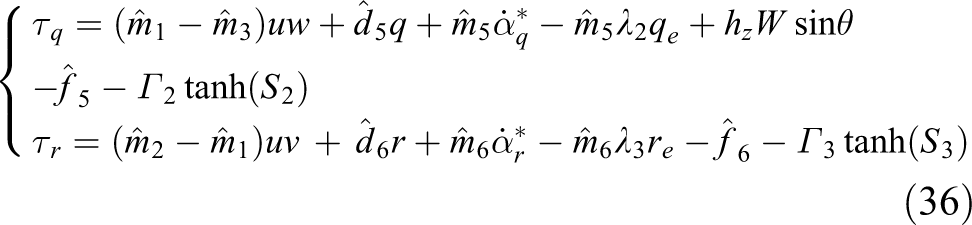
where
For the pitch and yaw dynamics control subsystem, the Lyapunov function is chosen as

where
Taking the time derivative of

In order to guarantee the stability of the control subsystem under parameter perturbations, according to Remark 1 and with reference to the design of Γ1, the gain functions Γ2 and Γ3 are designed as follows

Substituting equations (37) and (39) into equation (38) yields

Similarly, the adaptive laws are designed with reference to equation (27) as follows
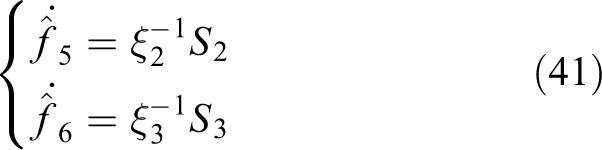
Then, substituting equation (38) into (37) yields

Only when qe and re converge to zero along sliding surfaces S1 and S1,
For the whole dynamic control system of the underactuated AUV, the Lyapunov function is chosen as

Obviously Vd is positive, and combining equations (31) and (42), the following inequality can be obtained

It has been proved by the Lyapunov theorem that the proposed dynamic control laws can stabilize the velocity errors ue, qe, and re and guarantee that the dynamic control system is asymptotically stable.
So far, a preliminary conclusion can be drawn: The proposed controller can drive the underactuated AUV to sail at the desired velocities to track the desired trajectory, and the control system satisfies the stability defined by Lyapunov theorem in the presence of parameter perturbations and external disturbances.
Simulations
In this section, a series of numerical simulations are carried out to verify the effectiveness and robustness of the proposed controller. The simulation takes MATLAB as the experimental platform, and the detailed parameters of the underactuated AUV can be found in the study by Zhou et al. 31 The desired trajectory in the study by Zhou et al. 31 is a combination of a straight line and a spiral, and the desired velocity and curvature of the trajectory are constant. Tracking control for trajectories with constant velocity and constant curvature is simple, and it cannot prove that the controller is generally effective. In order to fully illustrate the superiority of the control algorithm proposed in this article, the cosine trajectory is chosen as the desired trajectory, and the simulation results of the proposed bioinspired AISMC algorithm are compared with the results of the filtered backstepping method. 44
Taking into account the actual length of the AUV and the principles of trajectory planning, and referring to the study by Tami et al., 43 the desired trajectory is given as follows

where the unit of the trajectory is meter (m), and the units of all physical variables in this article use the System International standard.
Then, the initial states of the AUV are set as
The trajectory tracking simulation results and corresponding analysis are as follows.
As vividly shown in Figure 4, both controllers can drive the AUV to quickly eliminate the initial position errors and track the desired trajectory in the presence of parameter perturbations and external disturbances. In order to further compare the tracking precision of the two controllers, the horizontal and vertical projections of the trajectory tracking results are given and the local magnifications are carried out. It can be seen from Figures 5 and 6 that the robust controller based on bioinspired AISMC proposed in this article has higher tracking precision, which not only can quickly eliminate the initial position errors but also can ensure that the steady-state errors are almost zero. However, the filtered backstepping controller has relatively large overshoot and steady-state errors. This fully demonstrates that the tracking controller proposed in this article has high precision and also has strong robustness to the parameter perturbations and external disturbances.

Three-dimensional trajectory tracking results of an AUV under bioinspired AISMC and filtered backstepping controller. AUV: autonomous underwater vehicle; AISMC: adaptive integral sliding mode control.

The vertical projection of three-dimensional trajectory.

The horizontal projection of three-dimensional trajectory.
Figures 7 and 8 show the responses of position errors and velocity errors, respectively. It can be seen intuitively that both controllers can quickly eliminate the initial errors and make the tracking errors asymptotically converge to zero. But the filtered backstepping controller has relatively large steady-state errors, especially the convergences of xe and qe are very poor, and the robust adaptive controller presented in this article has better performance in terms of fastness, precision, and convergence. Figure 9 shows the velocity responses of the AUV. It can be seen that the velocities v and w are obviously bounded and almost equal to zero at steady state, which further verifies the correctness of Lemma 1. But the filtered backstepping controller causes the velocity to oscillate when the curvature of the desired trajectory is large, and the bioinspired AISMC controller completely avoids this phenomenon, which further illustrates the adaptability of the controller proposed in this article. Figure 10 shows the output responses of trajectory tracking controllers, which are also the controllable inputs of the underactuated AUV. It can be seen that the filtered backstepping controller generates a large control torques to eliminate the initial errors and causes chattering phenomena. In particular, the chattering of τq is more serious, which has higher requirements on the actual actuators and is not conducive to the stability of the AUV. In comparison, the outputs of the proposed controller are relatively stable and smooth, which have lower requirements on the actual actuators of AUV and thus have better practical feasibility.

The responses of position errors in trajectory tracking.

The responses of the velocity errors in trajectory tracking.
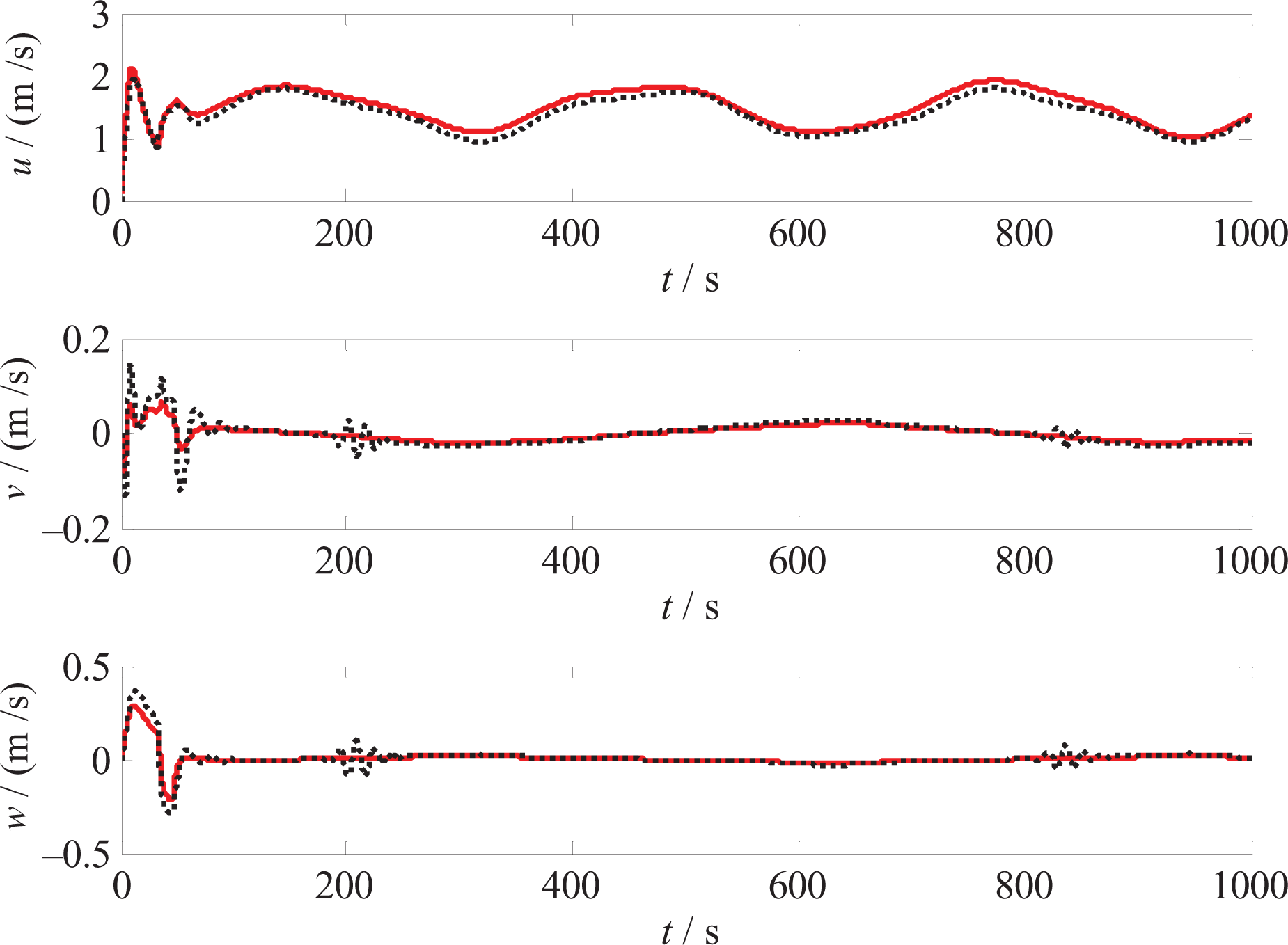
The responses of AUV’s velocities in trajectory tracking. AUV: autonomous underwater vehicle.

The output responses of the two controllers.
Conclusions
In this work, the trajectory tracking controller is designed for an underactuated AUV with full consideration of uncertain disturbances and practical feasibility in the marine environment. The design of the tracking controller combines the bioinspired neurodynamics with the AISMC well. Some problems such as velocity jump and computational complexity in general backstepping are effectively avoided. At the same time, the chattering problem common in the SMC is eliminated, which reduces the burden on the actual actuators of the AUV and increases the practical feasibility. The theoretical stability of the whole control system is guaranteed by Lyapunov theorem. Finally, numerical simulations are carried out to verify the effectiveness of the proposed controller, and it is fully compared with the filtered backstepping controller to further demonstrate the superiority of the proposed controller.
The future work will focus on the accurate trajectory tracking control of underactuated AUV in the case of some states of the AUV are not measurable or the AUV has actuator saturation constraints. Experimental verification and practical application of theoretical results will be an important direction for future work. At the same time, I also hope that in the near future, there will be experimental conditions to carry out practical experiments to verify the research results of this study.
Footnotes
Acknowledgements
The authors would like to thank the National Nature Science Foundation of China and the Fundamental Research Funds for the Central Universities of China.
Declaration of conflicting interests
The author(s) declared no potential conflicts of interest with respect to the research, authorship, and/or publication of this article.
Funding
The author(s) disclosed receipt of the following financial support for the research, authorship, and/or publication of this article: This work was supported by the National Nature Science Foundation of China (nos. 51579024, 61374114, and 51879027) and the Fundamental Research Funds for the Central Universities of China (DMU nos 3132018154 and 3132018128).
