



Abstract
Aimed at determining the ground effect’s influence on the process of ultralow-altitude airdrop, this article studies the corresponding changes in aerodynamic characteristics caused by the ground effect. Through analyzing the longitudinal long- and short-period modes and the lateral mode, this work evaluates the impact that the ground effect has on the level-off and the traction stages during an airdrop mission, with reference to corresponding flight quality standards. Accordingly, these findings provide a reference for the design of flight control regarding airdrop capabilities and support a theory for corresponding ground experiments.
Introduction
Ultralow-altitude airdrop and its main utilization for precise delivery of heavy equipment to desired regions are a focus and a critical difficulty for the airdrop field. 1 When the aircraft is flying near the ground, the lift-drag characteristics change significantly due to the ground effect: The lift increases, its induced resistance decreases, and the lift-drag ratio rises sharply. 2 The ground effect generally increases the aerodynamic efficiency of the aircraft, but it also tends to adversely affect the longitudinal stability. In low-altitude flight, the aerodynamic forces of the aircraft are closely related to its flight elevation, and the factors affecting the longitudinal stability are relatively complex. Modeling shows a clear impact from the ground effect, 3,4 and the effect therefore becomes an important consideration in control design. 5 –9 Both simulation and controls are two essential research areas in this field, which both require full consideration of the ground effect.
To date, international research on the ground effect has mainly concentrated on the theoretical calculation of aerodynamic forces 10 –12 and flight stability analysis near the ground. 13 –15 Ouyang and Liu and Yue et al. studied the lateral flight quality and stability of the aircraft during the ultralow-altitude airdrop process, while considering the ground effect. 16,17 Lee clarifies that the ground effect mainly alters air flow at the wings and the horizontal tail, thereby changing the longitudinal dynamic stability of the carrier. 18 Sun and Dai studied the influence of wing tip sails on the flow fields and aerodynamics of a wing in ground effect. 19 He et al. analyzed the aerodynamic characteristics of the cruise state of a large wing-in-ground-effect (WIG) craft. 20 Chen et al. implemented the ground effect wind tunnel test to analyze the influence of ground effect on the tilt-rotor aircraft. 21 Markedly, the literature does not adequately address the correlation between ultralow-altitude airdrop performance and the ground effect. However, in the level-off and the traction stages, the longitudinal aerodynamic characteristics, the static stability, and the dynamic stability change significantly due to this effect. To ensure the successful completion of an airdrop mission, in-depth analysis of task performance in the presence of the ground effect is essential.
Various aerodynamic configurations experience different levels of the ground effect, with further variation introduced by flight state, control surface settings, and so on. Therefore, the impacts of the ground effect on dissimilar carriers and airdrop missions are not all the same. For the purpose of qualitative ground effect analysis, this article treats a certain type of carrier as example and obtains its long- and short-period modes by using the low-order equivalent principle. Subsequently, the change mechanism of aerodynamic characteristics of airdrop carrier under the influence of ground effect is studied and the flight quality index of height mode is proposed. On this basis, this analysis reveals the ground effect’s impact on task performance during the level-off and traction stages of ultralow-altitude airdrop.
This article is organized as follows. The second section analyzes the ground effect’s impact on aerodynamic characteristics; the third and fourth sections study its influence on the level-off and traction stages, respectively; and the fifth section summarizes the important findings of this work.
Longitudinal aerodynamic-characteristic analysis
During low-altitude flight, the influence of the ground effect on the aircraft’s longitudinal aerodynamic characteristics and moment is mainly composed of three parts: the change in the lift coefficient caused by the free- and bound-vortexes, the lift of the horizontal tail, and the change in downwash angle. 1. Change of the lift coefficient caused by the free vortex
The lift coefficient CL can be expressed as follows, when the ground effect is not considered
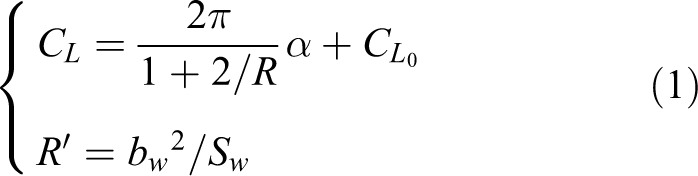
where R is the aspect ratio of the aircraft, bW is the wingspan, SW is the area of the wing, and
Considering the ground effect, the lift coefficient becomes

where σ is the ground effect factor, which reflects the change in aspect ratio. It is a function of the flight height H (the distance between the quarter of the mean aerodynamic chord and the ground) and the wingspan

We can conclude from equation (3) that σ → 0 for flights far from the ground, which means R′ = R.
Equation (2) can be interpreted as the trimming-attack angle, showing a decrease under the ground effect when the lift coefficient and height are fixed. The amount is

2. Change in the lift coefficient from the bound vortex
The variation of the lift coefficient caused by the bound vortex is

where


In the equation, CA is the aerodynamic chord, CM is the moment coefficient for the quarter of the chord length of the wing-body combination,

When flaps and slats are not used, N = N′ = 1. 3. Change of the downwash angle and the horizontal-tail lift
In the free-rotor gyroscope stream, the attack angle of the horizontal-tail is

where ϕT is the incidence angle of the horizontal tail relative to the wing, and ε is the downwash angle in the free-rotor gyroscope stream when the attack angle is fixed. When the ground effect is present and the lift coefficient of the wing-body combination is fixed for flights far from the ground, the above equation changes to

where Δα and Δε represent changes in the attack angle for the wing-body combination and the downwash angle, respectively, and they are determined by the ground effect

where ε1 is the corresponding downwash angle to the attack angle α + Δα in the free-rotor gyroscope stream when the lift coefficient is fixed. beff is the effective wingspan and hT is the height of the quarter of the mean aerodynamic chord for the horizontal tail.
With equations (1) to (12), we can determine the expected variations in lift, attack angle, and the downwash angle induced by the ground effect.
To illustrate an example, we consider a certain type of transport aircraft by Brockhaus. 22 When the flaps stay close, the variation in the longitudinal aerodynamic forces and moment with a change of height is shown in Figure 1.

The variation of aerodynamic coefficients under the ground effect. (a) Lift characteristics and (b) pitch moment characteristics.
As Figure 1 shows, the lift coefficient CL and the pitch moment coefficient |Cm| both increase due to the ground effect. It also shows that with a lower height, there is a bigger change.
To summarize, the change law of the longitudinal aerodynamic derivatives under the ground effect is as follows: With a reduction in height, the lift coefficient CL increases gradually. The increase in wing and horizontal-tail lift, along with a reduction in the downwash angle, lead to an enlargement of the nose-down moment, which equates to enhanced static pitch stability.
Thus, when at low altitude, the aerodynamic derivatives
Influence on the level-off stage
Flying quality is an important indicator of how well a task is performed. The pilot achieves a precise trajectory leveling by using continuous, small-amplitude adjustments. Trajectory leveling is a small attack-angle maneuver, which can be added to the standard military criteria for flight quality during conventional maneuvers. Analyzing the impact of the ground effect on the longitudinal kinetic characteristics (flying quality) is essential to evaluate the influence of the ground effect on task performance in the level-off stage. Accordingly, this section proposes an evaluation method for flight quality in the height mode.
Mode characteristics
The longitudinal equation for small perturbations of the aircraft is

The small-perturbation lateral equation is

where V is the velocity, α is the attack angle, q is the pitch rate, θ is the pitch angle, β is the drift angle, p is the roll rate, r is the yaw rate, ϕ is the roll angle, δe is the elevator deflection, δp is the throttle opening, δa is the aileron deflection, and δr is the rudder deflection. X, Y, and Z are the component force along the body-fixed frame and L, M, and N are the roll moment, pitch moment, and yaw moment, respectively. X*, M*, and Z* are longitudinal aerodynamic derivatives, whereas Y*, L*, and N* are lateral aerodynamic derivatives, which are all obtained by the wind tunnel experiments.


where
In this example, the airspeed V = 80 m/s, and the flap opening rate is 50%. Tables 1 and 2 illustrate the longitudinal and lateral mode characteristic roots, along with the mode characteristics, where ςsp is the damping ratio of the short period, ωsp is the natural frequency of the short period, ςp is the damping ratio of the long period, ωp is the natural frequency of the long period, ςd is the damping ratio of the Dutch roll mode, ωd is the oscillation frequency of the Dutch roll mode, TS is the time constant of the spiral mode, TR is the time constant of the roll mode, and TH is the time required for the initial height to double, which represents the height-mode characteristic.
Mode characteristic roots.

Mode characteristics.

By combining Tables 1 and 2, it is shown that: The ground effect has a large impact on the long-period mode. While at the same height, the convergence properties of the long-period mode are significantly changed by the ground effect. As the height decreases, the dual-conjugate complex roots of the long period move to the right half plane, gradually, while the characteristic roots of the height mode move to the left half plane. There exists a critical height, the neutral stability height at H = 15–20 m. Below this critical height, the long-period model diverges and the height-mode model converges. The ground effect has less impact on the short-period mode. At the same height, the ground effect reduces the short-period damping ratio while increasing the natural frequency; however, the variations are modest. As the height lowers, the damping ratio decreases, and the natural frequency increases. Conversely, when the ground effect is not considered, both the damping ratio and the natural frequency decrease. The ground effect has a smaller impact on the lateral mode. At the same height, the spiral mode converges slowly, and the roll mode observes an enhanced stability. The damping ratio and the oscillation frequency of the Dutch roll mode change slightly, but the variations in all three of these modes are small.
Flight quality analysis
Presently, the height mode does not have a corresponding quality specification. In comparison, it can be seen that the height mode is similar to the lateral-spiral mode by observing the slow change in their motion parameters. Therefore, the height-mode quality requirement is proposed based on the GB-2874 24 requirements for the spiral mode: “It should be guaranteed that the altitude of the aircraft will not diverge rapidly from the current height when the pilot is not vigilant.” The height mode is evaluated by the quality criterion for the spiral-mode time constant. The impact of the ground effect on the flight quality of the type-III plane is shown in Table 3.
Flight quality.
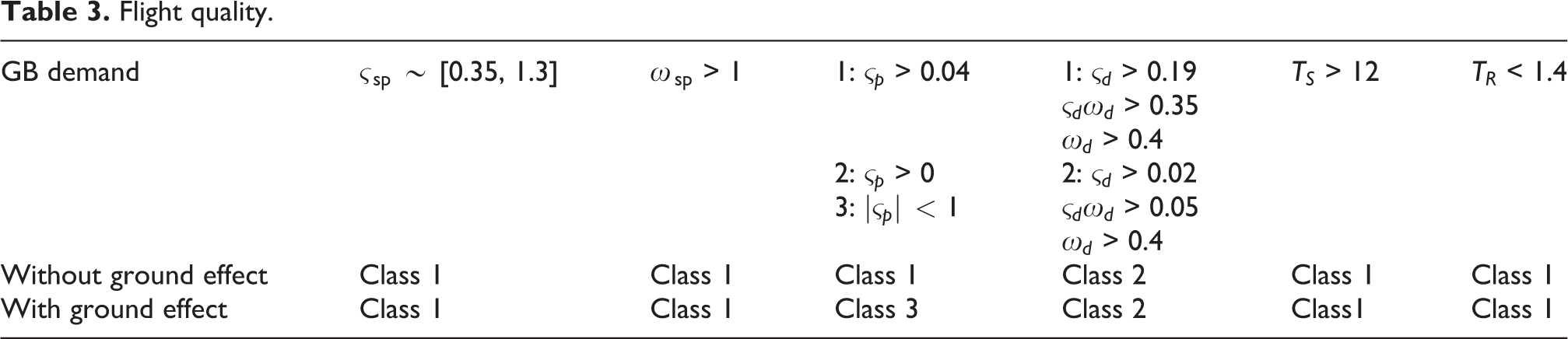
Table 3 shows that the ground effect has little effect on the flight quality of the longitudinal short-period mode, the lateral Dutch-roll mode, the spiral mode, or the roll mode, while the height mode satisfies the proposed first-class flight-quality requirement. However, the longitudinal long-period mode will undergo significant changes, shifting flight quality from the first class to the third class.
As a result, task performance degradation from the ground effect cannot be ignored during the level-off stage. For the carrier to perform the ultralow-altitude airdrop, the general requirement for the long period is to meet the conditions for the first-class or the second-class flight quality (long-period mode damping ratio is bigger than zero); if unmet during the level-off stage, the pilot will assume more operating burden.
Influence on the traction stage
At the traction stage, the operator performs a large lever-and-putter-action to maintain height, so as to ensure that the aircraft assumes an accurate trajectory and stable altitude. There is no corresponding military standard for task performance in the traction stage. Thus, this section starts from the response characteristics of the carrier to analyze the ground effect impact on traction performance during the ultralow-altitude airdrop.
Elevator rudder surface efficiency
The ground effect reduces the downwash of the wing and increases the lift of the horizontal tail, resulting in an efficiency change for the elevator rudder surface. The operator must implement large and rapid rudder control to suppress the upward force moment caused by cargo movement in the cabin and the large downward force moment caused by the cargo’s dropout. Correspondingly, it is necessary to analyze the influence on the efficiency of the elevator rudder surface.
Figure 2 shows the simulations and comparisons of the elevator efficiency at low altitude H = 100 m with V = 100 m/s and at ultralow-altitude H = 10 m with V = 100 m/s. 1° elevator rudder surface signal is added at t = 1 s and is withdrawn at t = 2 s in the simulation.

The efficiency of the elevator rudder surface. (a) Attack-angle response and (b) overload response.
In the figure, the solid and dashed lines represent the state response curves under elevator deflection during low altitude and ultralow-altitude flight, respectively. It can be seen that there is a miniscule difference in elevator efficiency between the ultralow and low altitudes which means that the decline of the elevator rudder efficiency is small. The main reason is that the model used in the simulation was designed with large aspect ratio and the T-type horizontal tail, which drastically reduces the effect of downwash on the elevator efficiency. But for other design of carriers, the ground effect can greatly reduce the elevator rudder efficiency, which is bad for the airdrop mission at the traction stage.
Kinetic characteristics of the carrier at the traction stage
The ground effect changes the initial state of the carrier at the start of the airdrop mission, and it simultaneously changes the longitudinal short-period mode. Therefore, it is necessary to analyze the impact of the ground effect on the kinetic characteristics.
Take the two following state points as an example to verify simulation. Point (1): H = 10 m, V = 80 m/s, and Point (2): H = 5 m, V = 80 m/s, and

The response curves for different traction ratios during the traction stage. (a) The variation of attack angle at point (1); (b) the variation of pitch angle at point (1); (c) the variation of attack angle at point (2); and (d) the variation of pitch angle at point (2).
In the figure, the solid lines show the simulation results of the airdrop process when ground effect compensation is considered. The dashed lines show the simulation results without the ground effect. The solid dots indicate when dropout occurs, and the diamonds indicate the moment that the carrier leaves the ground effect region.
For point (1), when λ = 0.3, the peak error of the attack angle between the two situations, with and without ground effect compensation, is Δα = 0.1146∘ at the moment of dropout. When λ = 0.7, the peak error is Δα = 0.1662∘. For point (2), when λ = 0.3, the peak error is Δα = 0.4760∘, and when λ = 0.7, the peak error is Δα = 0.3266∘.
The simulation results show that ground effect reduces the trimming attack angle while increasing the attack angle and the pitch angle during the airdrop process. And the lower the altitude is, the more obvious the impact is.
Another thing is that if the traction ratio is large, the carrier parachute-opening time will be significant, which will cause large variation in the attack and pitch angles, and the ground effect will intensify this variation further. The simulation shows that the impact on the carrier’s state is bigger with a larger traction ratio, during the traction stage of ultralow-altitude airdrops.
Height reduction caused by the ground effect
Aircraft lift increases under the influence of the ground effect. When the height continues to rise, if the flight speed does not rapidly increase, hindered by a corresponding reduction in the ground effect, the carrier will immediately fall at the pull-up moment, which will adversely affect aircraft safety. 1. The carrier leaves the ground effect region after cargo dropout.
Upon cargo dropout, the weight of the aircraft is reduced. The weight reduction is much bigger than the amount of lift lost through disappearance of the ground effect, so the trajectory of the carrier rapidly rises, and the flight path does not descend.
Figure 3 validates this conclusion. The simulation results show that after the airdrop process completes, whether or not ground effect compensation is introduced, the trajectory of the carrier will keep rising. However, the rising incremental quantity is smaller when there is compensation. Therefore, for this situation, the ground effect will not affect the safety of the carrier. 2. The carrier leaves the ground effect region when the cargo is dragged within the cabin.
At the traction stage, the attack angle increases, and if the engine throttle is not changed, the lift increases. If the carrier leaves the ground effect condition, while the cargo is dragged within the cabin, the lift increment caused by the change in attack angle is much bigger than the amount of lift lost by the disappearing ground effect, so the flight path will not descend. This applies for large transport aircrafts with a conventional layout.
Take the following two state points as an example for simulation verification. Point (1): H = 10 m, V = 80 m/s, and Point (2): H = 15 m, V = 80 m/s, and
At t = 5 s, the cargo starts to move in the cabin, with the results shown in Figure 4.

The response curves for different heights during the traction stage. The response from (a) height variation and (b) pitch angle variation.
In the figure, the solid lines show the simulation results of the airdrop process at point (1), whereas the dashed lines represent point. The solid dots indicate the time of dropout and the diamonds indicate the moment that the carrier leaves the ground effect region. For points (1) and (2), the dropout times are t = 11.73 s and t = 11.29 s, while the off-region times are t = 11.19 s and t = 9.64 s, respectively.
The simulation shows that the carrier has left the ground effect segment before dropout, but the height decline phenomenon does not occur. This means for the model with large aspect ratio and the T-type horizontal tail used in the simulation, the ground effect will not threaten the safety of the carrier.
Conclusion
This article studies the influence of the ground effect on task performance, which is an important component in general airdrop theory. The main contributions of this article are as follows: Based on the flight quality, the influence of ground effect on the level-off stage is studied. Aimed at the peculiar height mode under the ground effect, it is proposed to evaluate it according to the spiral mode quality. The result shows that the ground effect has significant influence on the longitudinal long-period flight quality of the carrier. Therefore, in order to reduce the operating burden of the pilot at the level-off stage, the ultralow-altitude airdrop carrier should have a reasonable aerodynamic configuration to overcome the adverse influence on longitudinal stability. The effect of the ground effect on the traction stage is analyzed from three aspects: the elevator rudder surface efficiency, the state response, and the flight height. The results show that for large-scale transport aircrafts with a large aspect ratio and the T-type horizontal tail, the impact of the ground effect on performance at the traction stage is minimal. However, to ensure airplane safety throughout the airdrop process, the carrier must possess a reasonably well-designed horizontal tail, both in terms of shape and layout, to avoid a reduction in elevator efficiency.
The results of this study have a pronounced engineering significance for aerodynamic configuration design and performance and the safety evaluation of airdrop missions. Additionally, this work forms a solid foundation for the establishment of the task and the manipulation-quality indexes for ultralow-altitude airdrop.
Footnotes
Declaration of conflicting interests
The author declared no potential conflicts of interest with respect to the research, authorship, and/or publication of this article.
Funding
The author disclosed receipt of the following financial support for the research, authorship, and/or publication of this article: This work was co-supported by the National Natural Science Foundation of China (no. 61273141) and the Aviation Science Foundation of China (no. 20141396012).