




Abstract
This article addresses the flight control problem of air-breathing hypersonic vehicles and proposes a novel intelligent algorithm optimized control method. To achieve the climbing, cruising and descending flight control of the air-breathing hypersonic vehicle, an engineering-oriented flight control system based on a Proportional Integral Derivative (PID) method is designed for the hypersonic vehicle, which including the height loop, the pitch angle loop and the velocity loop. Moreover, as a variant of nature-inspired algorithm, modified shuffled frog leaping algorithm is presented to optimize the flight control parameters and is characterized by better exploration and exploitation than the standard shuffled frog leaping algorithm. A nonlinear model of air-breathing hypersonic vehicle is used to verify the dynamic characteristics achieved by the intelligent flight control system. Simulation results demonstrate that the proposed swarm intelligence optimized PID controllers are effective in achieving better flight trajectory and velocity control performance than the traditional controllers.
Introduction
High speed and altitude make the hypersonic vehicles (HSVs) dynamics extremely change in atmospheric conditions. Therefore, the air-breathing hypersonic vehicle (AHV) is characterized by instability, uncertain, nonlinear, coupling, non-minimum phase, actuator saturation constraints and damped flexibility. Control techniques are one of the key technologies for these classes of aircrafts. Several control algorithms have been proposed for AHVs. A tracking controller based on H ∞ control and a nonlinear disturbance observer is designed for an AHV during cruising flight in the study by Sun et al. 1 A fuzzy sliding mode controller for a flexible HSV is presented in the study by Hu et al. 2 in which a Takagi–Sugeno fuzzy model is used to represent the nonlinear dynamic, and the sliding surface reachability is guaranteed by an adaptive sliding mode controller. A tracking control scheme based on nonlinear model predictive control is proposed for the AHV subject to uncertainties and non-vanishing mismatched disturbances. 3 Sridharan et al. 4 considered the design and control of an AHV based on an integrated vehicle-control design process with bilinear matrix inequalities. A high order sliding mode controller and a disturbance observer are integrated for the velocity and altitude control of AHV in the study by Wang et al., 5 where an input–output linearization-based sliding mode controller is designed and a nonlinear disturbance observer is applied to compensate the controller. Shao and Wang 6 proposed a sliding mode integrated trajectory linearization control scheme for the attitude tracking problem of hypersonic reentry vehicle. Jiao et al. 7 presented a type-2 Takagi–Sugeno–Kang fuzzy sliding mode control scheme for hypersonic morphing aircraft. Chen et al. 8 –11 investigated the robust attitude control, anti-disturbance control, guaranteed transient performance-based control and constrained control allocation problems of the near space vehicles.
The merits of the aforementioned control methods are characterized by robustness enhancement for external disturbances and uncertainties and convergence guarantee for tracking reference trajectories. However, these methods have disadvantages as follows. First, most of these controllers are based on the model of AHVs, but in fact an accurate model of AHV is difficult to be obtained, and thus stability and performance cannot be guaranteed. Second, these nonlinear control algorithms are a little complex to be designed and hard to realize. Third, there are few literature that investigate the whole flight envelope, including climbing, cruising and descending.
Nowadays, PID control is still the most applicable engineering method for all kinds of flight vehicles including AHV. 12 It is proved to be reliable in control engineering and has been widely applied in flight control of aircrafts. Liang et al. 13 presented an intelligent optimization-based integral separated PID control method for the AHV attitude control. As an extension of this work, we propose a modified intelligent optimization-based PID control for the trajectory control of the AHV.
Inspired from collective intelligent behaviours of the natural systems, several artificial swarm intelligence algorithms have been put forward, including particle swarm optimization (PSO), ant colony optimization, artificial bee colony algorithm, differential evolution and immune algorithm. Shuffled frog leaping algorithm (SFLA) is another meta-heuristic swarm intelligence algorithm inspired by biotic community, and in particular, by those biological processes with cultural evolution. It was originally proposed by Eusuff and Lansey. 14,15 The SFLA algorithm simulates the frogs swarm leaping on the stones for searching the food and also simulates the memes evolution for the interactive individuals and global information exchange for the population. Zhen et al. presented a memetic algorithm 16 and an improved SFLA. 17 Recently, SFLA has been widely used for parameters optimizations in engineering fields, 18,19 but there are few literature for controller optimization. Bijami et al. 20 formulated a linearized generalized prediction control algorithm as an optimization problem where a new SFLA is employed for optimizing a cost function.
In this article, we apply a control system design methodology to an AHV. The methodology uses PID as the basic control method for designing the height, velocity and attitude control loops of AHV. Moreover, SFLA is used to intelligently optimize the control parameters that are difficult to be determined. To further improve the local and global search ability of SFLA, a modified SLFA (MSFLA) is proposed. The article is organized as follows. The section ‘Modelling and control problem of HSV’ gives the modelling and control problem of AHV. The standard SFLA and a modification of SFLA are, respectively, given in ‘Standard SFLA and its modification’ section. The flight control system based on MSFLA optimized PID method is designed in ‘MSFLA optimized flight control system for HSV’ section. Simulations and comparisons are studied in ‘Simulation and analysis’ section. Finally, the contributions are summarized in ‘Conclusion’ section.
Modelling and control problem of HSV
The following equations define the non-linear longitudinal model that is used for analysis and synthesis of stability and control of an HSV 7




where m is the vehicle mass, V is the forward velocity, γ is the path angle, h is the altitude, α is the angle of attack, q is the pitch rate, T is the thrust, D is the drag, L is the lift, Myy is the pitching moment about the body y-axis and Iyy is the inertia moment. And


where δe is the elevator deflection, s is the wing area, c is the wing mean geometric chord, CL is the lift coefficient, CD is the drag coefficient, CM is the pitch moment coefficient, and CT is the thrust coefficient

Dynamic model of the engine is expressed by a second-order differential equation

where β is the engine throttle regulator variable and βc is the throttle angle.
The objective of the flight control system is to make the AHV track the desired trajectory, velocity and attitude. For the complicated aerodynamic properties of the AHV, it is difficult to obtain the PID control parameters by the traditional linearization strategy. Therefore, an intelligent optimization strategy is adopted to obtain the PID control parameters to improve the control performance, and the linearization of the nonlinear AHV model is not necessary.
Standard SFLA and its modification
Standard SFLA
The SFLA algorithm is based on memetic evolution inspired from a group of frogs when seeking for food. The SFLA algorithm integrates the traits of social intelligence-based PSO algorithm and genetic evolution-based memetic algorithm. In SFLA, a population of frogs means a set of candidate solutions. The frogs group is divided into several memeplexes, and different memeplexes represent different culture. Since the frogs tend to gather around the best frog that may be a local optimum, some members in a memeplex are considered as a submemeplex to avoid convergence to the local optimum. The frog with worst position should be evolved. After certain memetic iterations, memeplexes are shuffled as a population. The local search and shuffling process iterate until the solution satisfies the required index or the evolution generations are finished. The detailed steps of SFLA are as follows.
Step 1 (swarm generation): Let xi denotes i-th frog’s position and fi is its fitness. A frogs population
Step 2 (memeplexes partition): Partition the population into m memeplexes
Step 3 (submemeplexs generation): The selection strategy of a submemplex (including q frogs) in each memplex is that the larger coeffcients are distributed to the frogs with better positions. A selection method is that the frogs with better positions have bigger weights to be assigned to the submemeplex. The weights are assigned with a triangular probability distribution as follows
Step 4 (submemeplexs evolution): Let x
B
denotes the best position and x
W
denotes the worst position in submemeplex. Then, local search is started from the worst frog to leap to the best frog in any memplex. The worst frog in submemeplex leaps towards to the best frog in the memplex, and thus the new position is obtained by a leaping step



where Int(⋅) denotes rounding, Min(⋅) denotes minimize, dmax is the maximum step size, r is a random number and k is an evolution generation. If the new position of the worst frog becomes better, then the worst frog’s position is updated by

Otherwise, the worst frog leaps towards the global best frog and then

where xX is the best position of the swarm. If the worst frog also cannot improve its position, a random position is generated to replace it, that is

where [a,b] is the boundary of frogs’ feasible location. Afterwards, the frogs are sorted in a descending order according to their fitness. Repeat above steps and evolve the submemeplexes with G1 generations.
Step 5 (memeplexs shuffle): After the local search of each memeplex is finished, all memeplexs are shuffled in which the frogs are reorganized in descending order of fitness. Repeatedly divide the population into memeplexs and carry out local search process, until memetic evolution generation G2 is reached.
Modified SFLA
The proposed modification of SFLA is focus on the three segments, given as follows: Similar with the study by Liang et al.,
13
as the control parameters optimization is a continuous optimization problem, the leaping step should be modified to be continuous form. Moreover, the partition strategy in the standard SFLA is replaced by a random strategy, which will improve the diversity and exploitation of frog population, and is benefited for global searching. The evolution of submemeplexes in SFLA is the process of worst frog to adjust its position, which is insufficient for the population evolution, especially for the frogs with better fitness. Therefore, the submemeplexes is cancelled so that all the frogs in memeplexes can take part in the evolution. Furthermore, the learning object in standard SFLA is the best frog in submemeplex or in swarm. This singularity may cause the algorithm get into a local optimum. Therefore, in MSFLA, the frogs learn from a randomly selected frog with a better performance to increase the local exploration ability. The leaping step in SFLA aims to decrease the difference with the best position in the submemeplex or in the swarm. However, it tends to fall into the local optimum and the position states of the better frogs are difficult to be improved. Therefore, in order to enhance the global exploration, the velocity (representing the inertia motion) of the frog is introduced in the leaping step.
According to aforementioned modification, we design an MSFLA as follows.
Step 1 (swarm generation): Same with the step 1 of the standard SFLA.
Step 2 (memeplexes partition): Generate a random numbers sequence, the length of which is the size of the frogs swarm; sort these random numbers, then get the order sequence; in turn select a number of frogs in this order sequence to form a memeplex.
Step 3 (memeplexs evolution): According to aforementioned modification, the i-th frog’s leaping step is modified as

where

In fact, the memeplexes evolution is a process of mutual learning among the members in group. Hence, the performance of the whole frog group is improved after such internal evolution. The difference between the best and worst frogs can be decreased. The memeplexs evolution continues until G1 generations are finished.
Step 4 (memeplexs shuffle): Same with the step 5 in standard SFLA.
Step 5 (lowliest place elimination): The worst frog with lowest fitness in the swarm will be eliminated, and a new frog is randomly generated to fill in the vocation. Repeat step 1 to step 4 until G2 generations are reached.
The implement flow of the MSFLA is shown in Figure 1.

Flowchart of the MSFLA. MSFLA: modified shuffled frog leaping algorithm.
MSFLA optimized flight control system for HSV
The flight control system of HSV is composed of two control channels, one channel is the pitch angle loop, and the other channel is the velocity loop, shown in Figure 2. It aims to control the AHV to achieve the climbing, cruising and descending flight with high stability and precision. The climbing motion is realized by controlling climbing speed of the AHV, the cruising motion here means the height keeping and velocity increasing and the descending motion is realized by controlling descending speed of the AHV. Obviously, the attitude control can also be realized by this system.

Flight control system chart of AHV. AHV: air-breathing hypersonic vehicle.
The control laws of two loops are designed based on the PID control strategy, expressed by


For aforementioned control laws, it should be mentioned that the control parameters vector
Therefore, the proposed MSFLA is used to optimize the parameters vector K. The cost function of MSFLA is
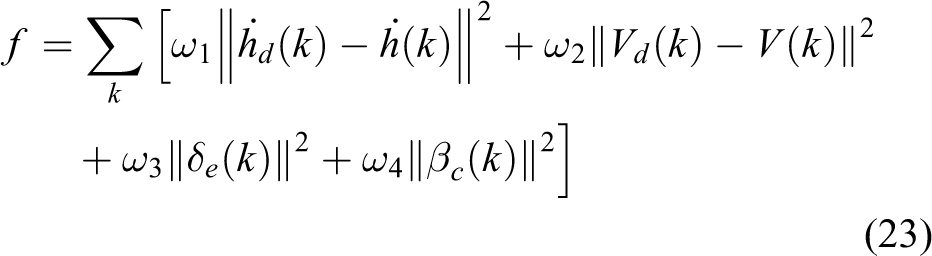
where ω1, ω2, ω3 and ω4 are the weights of the different control objectives. The fitness function of the frog is the reciprocal of the cost function, because it is a minimization problem. The optimization process is based on Figure 1.
Simulation and analysis
Assume that the AHV is trimmed in level flight at 3500 m/s and altitude of 30,500 m. The AHV is controlled to track the following velocity and the climbing rate commands


To verify the effectiveness of the proposed MSFLA optimized PID control method, it is compared against with the traditional PID control method and the standard SFLA optimized PID control method. For the sake of fairness, a set of parameters in the traditional PID controller is considered as one initial candidate frog in SFLA and in MSFLA. For the proposed MSFLA, the population size is set to 10, the number of the memeplexes is 2 with 5 frogs, generations in each memeplex is 4 and shuffling times of population is 2.
Table 1 gives the control parameters obtained for the standard PID, standard SFLA optimized PID and MSFLA optimized PID. Figures 3 and 4, respectively, show the velocity and climbing speed responses under the PID control, SFLA optimized PID control and MSFLA optimized PID control. Figures 5 and 6, respectively, show the responses of the manipulation of elevator and throttle channels.
Control parameters selections.

SFLA: shuffled frog leaping algorithm; MSFLA: modified SFLA.

Comparison of velocity responses.

Comparison of pitch attitude responses.

Comparison of elevator responses.

Comparison of throttle responses.
The simulation results exhibit that the proposed MSFLA optimized PID control is characterized by the fastest dynamic response, remarkably smallest error during the entire maneuver and the highest steady error. Obviously, the improvement of control responses is benefited from optimized control parameters obtained by the swarm intelligence technique.
Conclusion
For orienting the engineering application, the PID-based flight control system of the AHV is designed for longitudinal manoeuvre. The standard SFLA is modified to be the continuous form, randomly partitioning and fast learning. The MSFLA is applied in control parameters optimization in order to obtain near optimal control gains of the PID-based flight control system of the AHV. The simulation results exhibit the advantages of the flight control system optimized by the swarm intelligent algorithms.
The contribution of this article can be summarized as follows: Parameters regulation and optimization problem of flight control system of the AHV are solved, which is an important work on ground and is a preparation for test flight. PID controllers are generally designed based on the transfer functions of the aircraft, thus they are dependent on the precision of the system model, so that they will not be accurate when the system model is not accurate enough. Moreover, a trial and error method is also used in engineering; however, it is a difficult job and will cost much time to obtain a suitable parameters combination. This work intelligently and automatically searches some near optimal parameters for PID controllers. The flight control system optimized by the MSFLA can achieve excellent trajectory, attitude and velocity tracking performance, no matter for the climbing, cruising and descending flight motions.
Footnotes
Declaration of conflicting interests
The author(s) declared no potential conflicts of interest with respect to the research, authorship, and/or publication of this article.
Funding
The author(s) disclosed receipt of the following financial support for the research, authorship and/or publication of this article: This work was supported by the National Natural Science Foundation of China (No. 61304223, No. 61673209, No. 61533008) and the Fundamental Research Funds for the Central Universities (No. NJ20160026).