



Abstract
In this article, the disturbance estimation and rejection problem are discussed for the yaw channel dynamics of small-scale unmanned helicopter subject to mismatched disturbances. Following Takagi–Sugeno fuzzy description for unknown nonlinear disturbances, a composite control input is designed to attenuate the influence of mismatched disturbances in system output channel by combining state feedback control law, disturbance observer, and well-designed disturbance compensator. The satisfactory control performances can be verified using linear inequality optimization algorithm. Simulation results on a yaw channel dynamical system can reflect the feasibility and effectiveness of the proposed disturbance rejection approach.
Keywords
Introduction
Due to the ubiquity of unknown disturbances in many practical processes, anti-disturbance control has been playing an essential role in the field of control theory. 1 Among many disturbance rejection approaches, disturbance observer-based control (DOBC) approach has received extensive attention in the past few decades (see literatures 2 –18 ). Many classic nonlinear dynamical systems with unknown disturbances, such as nonaffine systems, 5 robotic manipulator, 6 Markovian jump systems, 7 non-gaussain stochastic systems, 8,9 permanent magnet synchronous motor systems, 10,11 and flight control systems, 12 –14 can achieve favorable control performance using DOBC approach. It is noted that most of the existed DOBC approaches are based on matched condition. In recent years, DOBC approach for systems subject to mismatched disturbances has lead a new upsurge of research, and many elegant approaches base on DOBC have been respectively proposed for different control systems. In the studies by Yang et al. (2012) and Yang et al. (2011), 19,20 the influences of mismatched disturbances are removed from system output channels by designing disturbance compensation gain. In the study by Yang et al., 21 a DOBC-based sliding mode control method is proposed to attenuate the mismatched disturbance by defining a sliding surface with the estimation of disturbance. In the study by Sun and Guo, 22 a composite controlled input has been designed to attenuate the influences of multiple mismatched disturbances under the framework of back-stepping control.
On the other hand, with great potentiality in application of military and civilian areas, the research of unmanned aerial vehicles (UAVs) have become an focal point in recent years. The small-scale unmanned helicopters have also attracted more interest because of its unique advantages, which includes vertical takeoff and landing capacity, hovering, slowly cruising, and small filed for takeoff and landing (see literatures 23 –25 ). Moreover, when equipping with various sensors, the small-scale unmanned helicopters can more easily to complete some military tasks, such as reconnaissance, surveillance, aerial mapping, rescue, and so on. Among various control objectives, yaw control of small-scale unmanned helicopter is a challenge. The main reason is that the torque in yaw channel is relatively small and is also highly sensitive to manipulation when encountering external disturbances (see the studies by Cai et al. (2008) and Cai et al. (2007) 26,27 for details). As a result, many modeling approaches have been proposed to derive linear or nonlinear models for small-scale unmanned helicopter with specific flight conditions. 28 To predigest the system models, the modeling progress of unmanned helicopter is usually considered only in hovering status or low-speed forward flight. By combining small perturbation theory with linearization method, an approximate incremental linear model can be obtained. Moreover, a linear controller has been designed for the linearized small-scale unmanned helicopter model in specific conditions (see the study by Cai et al. 26 ).
Among the past few decades, fuzzy logic control has made great progress in theory and practice, which can accredit to its strong ability for dealing highly complicated nonlinear systems. 29 –32 As a typical one of the fuzzy approaches, Takagi–Sugeno (T-S) fuzzy model has been intensively investigated since it was firstly introduced. 29 It is noted that T-S fuzzy models, consisting of a series of if-then rules with experience of experts, can describe nonlinear dynamics using a certain number of linear models in different state spaces. Then, by smoothly blending those local linear models together with designed membership functions, the overall T-S models of nonlinear dynamics can be successfully obtained. It has been shown that many physical nonlinear control systems can be modeled and analyzed using T-S fuzzy models, such as networked control systems, 33 chaotic systems, 34 descriptor systems, 35 stochastic systems, 36 time-delay systems, 37 and so on.
Inspired by the above observations, this article aims to investigate the disturbance estimation and rejection problem for yaw channel model of a small-scale UAV helicopter with unknown mismatched disturbances. Supposing that the irregular disturbances can be generated by overall T-S fuzzy models, a T-S-type disturbance observer (DO) is further designed to estimate the mismatched disturbances in small-scale UAVs. Using matrix analytical techniques, the proper control gain and the observer gain as well as the disturbance compensation gain are computed, respectively. A composite controller is finally constructed, which successfully eliminates the influence of mismatched disturbances from the yaw channel output and guarantees the yaw rate in radians per second converge to zero. It is noted that the proposed anti-disturbance control algorithm represents a meaningful expansion compared with those previous control approaches in small-scale unmanned helicopter. 26 –28,38
Notations
Throughout this article, if not stated, matrices are assumed to have compatible dimensions. The identity and zero matrices are expressed by I and 0, respectively. For a symmetric matrix M, the notation M > (≥) 0 is used to denote that M is positive definite (positive semi-definite). The case for M < (≤) 0 follows similarly. The symbol sym is defined as sym(M) = M + MT. For a vector v(t), define
Model description of yaw channel dynamics in small-scale UAVs
The yaw rate dynamics in the body-fixed reference frame derived from Newton–Euler can be expressed as

where Izz and N respectively represent the inertial tensor and moment component. Based on the small perturbation theory, N can be linearized in the neighborhood of the hovering equilibrium state, 28 then we get

where Mω and Mped are respectively the yaw damping coefficient and sensitivity of tail rotor control.
According to literatures, 28,29 using physically decoupled technique from other channels in hover status or near-hover condition, the yaw channel dynamics of small-scale UAVs can be seen as a typical single-input-single-output (SISO) system. Similarly with the study by Cai et al., 26 the identified SISO state-space model can be expressed as

where δped represents the normalized input to the yaw channel, whereas ω is the yaw rate, which can be measured either by a yaw rate gyro or an inertial measurement unit. Ayaw, Byaw, and Cyaw are identified coefficient matrices.
Furthermore, when considering the complex flight environment such as turbulence and wind gust, the above yaw channel dynamics model will be sensitive to those exogenous disturbances. As a result, a general SISO dynamic system with unknown external disturbances is given by

where x ∈ Rn, u ∈ R, and y ∈ R, respectively, represent system state, control input, and measurement output. A, B1, and C are coefficient system matrices and B2 is an identity matrix with In×n. d ∈ Rn can be supposed to be described by an exogenous system in asuumption 1.
Assumption 1
The unknown nonlinear disturbances d can be modeled by the following T-S fuzzy exogenous system with N plant rules18
Plant rule i
If ϑ1 is

where ζ is the state vector of exogenous system. N is the number of if-then rules, whereas m is the number of the premise variables. Wi and Vi are known coefficient matrices of the i th rule. ϑj(j = 1, ⋯ , m) represent the premise variables and are assumed to be measurable.
By fuzzy blending, a global fuzzy disturbance model can be inferred as

where

with ωi being the membership function of the system with respect to plant rule i, and hi(ϑ) satisfies the following properties

Assumption 2
Both the disturbance d and its state variable ζ are bounded.
Assumption 3
The matrix pairs (A, B1) and (Wi, Vi) are controllable and observable, respectively.
Assumption 4
The disturbance state ζ satisfies limt→∞ζ(t) = ζs, and ζS stands for the steady disturbance state vector.
Remark 1
In literature, 26 an accurate model for the yaw channel of an UAV helicopter was obtained, and by applying the composite nonlinear feedback control technique into the design of control law, the satisfactory system performance can be guaranteed. However, the yaw channel dynamics are very sensitive to external disturbances, especially, to those irregular mismatched disturbances. The terrible control performance may appear in yaw channel dynamics when encountering disturbances. Therefore, the disturbance estimation and rejection control problem for the yaw channel subject to mismatched disturbances should be solved urgently.
Remark 2
It is worth noting that the modeled disturbances in most of the existing DOBC methods are usually supposed to be constants or harmonic signals (see the study by Guo and Chen 3 ), which cannot be applied in practical engineering directly for the strong uncertainties of disturbance modeling. Moreover, it is difficult to describe those irregular nonlinear external disturbances using the existing linear exogenous systems. It is well known that the T-S fuzzy model is a powerful solution for approximating complex nonlinear dynamics by a blending of some local linear system models, which is also applicable to the nonlinear disturbance modeling. It turns out that many typical nonlinear disturbances can be described or modelled using T-S fuzzy models.
Design of DOBC-based composite controller
In this section, we expand the DO in the study by Guo and Chen 3 to the case of T-S fuzzy modeling disturbance, which is beneficial for estimating and attenuating more irregular nonlinear disturbances. Combined with the disturbance model (6), the T-S type DO is constructed as

where v is an introduced auxiliary variable, and
Define the disturbance state estimation error

Recall the basic idea of DOBC scheme, a composite controller is designed by the combination of disturbance estimation and conventional control law u = Kx, that is

where K1 and K2 stand for the feedback control gain and the mismatched disturbance compensation gain, respectively.
Theorem 1
Under assumptions 2–3, and consider the system (4) with mismatched disturbances generated by T-S fuzzy model (6), if there exist matrices P1 > 0 and R1 satisfying the following linear matrix inequality (LMI)

Then, the estimation error eζ can be guaranteed to converge to zero asymptotically with observer gain matrix
Proof
A Lyapunov candidate can be selected as

Computing the derivative of (11), yields

It can be verified that equation (10) leads to
Theorem 2
Under assumptions 2–4, if matrices P1 > 0, R and K1 are selected to satisfy LMI (10), and the condition (A + B1K1) is Hurwitz, then the system (4) is bounded-input bounded-output (BIBO) stable under the composite controller (9). The DO gain can be computed by
Proof
Integrating the system (4), disturbance estimation error function (8) with composite controller (9), the following augmented system is obtained

Based on LMI (10) and the precondition (A + B1K1) is Hurwitz, it is plain that

is a Hurwitz matrix. To sum up, once the gains K1 and L are well designed, the augmented system (13) with bounded disturbance d is BIBO stable.□
Theorem 3
Under assumptions 2–4, by designing the gains L and K1 to satisfy LMI (10) and the condition for matrix (14) is Hurwitz, the system (4) under controller (9) eventually reaches a steady state, that is

Proof
Denote the state error ex = x − xs, associated with system (4) and composite controller (9), the augmented error dynamic function can be given by

Obviously, Ξ is a Hurwitz matrix based on the same proof technique as theorem 2. Furthermore, the second term in right side of (15) converges to zero according to assumption 4. As a result, the closed-loop system (15) can be proved as asymptotically stable and limt→∞ex = x − xs = 0, in other words, limt→∞x(t) = xs.□
Assumption 5
The system matrices and the feedback control gain satisfy the rank condition that
Theorem 4
Under assumptions 2–5, if the feedback control gain K1 and the observer gain L are respectively designed to satisfy LMI (10) and the condition that (A + B1K1) is Hurwitz, and the designed disturbance compensation gain K2 satisfies

then the disturbances d can be attenuated from the output channel in steady state for system (4) under the DOB-based composite controller (9).
Proof
Due to assumption 5 is satisfied, the disturbance compensation gain K2 can be derived from (16) on the basis of proper control gain K1. When the composite controller (9) is applied to system (4), the system state and output can be rewritten in the following equations


Considering theorem 3 and assumption 4, it is plain that
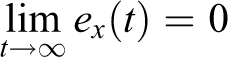


Associating (18) with (19), it is obvious that

□
Remark 3
Since the SISO system matrices satisfy A ∈ Rn × n, B1 ∈ Rn × 1, B2 ∈ R, and C ∈ R1 × n, it can be concluded that the term C(A + B1K1)−1B1 on the left side of equation (16) equals constant. Thus, the disturbance compensation gain K2 can be worked out by multiplying vector
Simulation results
The purpose of this section is to apply the proposed algorithm to practical system model and further illustrate its feasibility and effectiveness.
To facilitate numerical simulation, an identified 4th-order model of SISO yaw channel dynamics [26] is considered, which can be seen as a typical example of equation (4). The system details are given as follows:

and y = ω = C1x with

As for the disturbance
Plant rule
i: If ζ1 is

with member functions

where ζ1 represents the element in first row of vector ζ, whereas ωj, σj(j = 1,2) are designed mean and variance of gaussian function.
Next, we will introduce one typical nonlinear disturbance based on T-S fuzzy disturbance model (21).
First of all, two T-S fuzzy rules are employed with the details of model (21) and member functions (22) respectively given as:

Second, by solving LMI (10) in theorem 1, the observer gain matrix is computed as

Next, by introducing linear quadratic regulator (LQR) approach and selecting penalty matrices Q and R as

then the feedback control gain of LQR can be calculated

Finally, substituting parameters A, B1, B2, C, and K1 into (16), the disturbance compensation gain is obtained

The satisfactory estimation results for disturbances d1, d2, d3, and d4 can be seen from Figures 1
to 4, respectively. Figure 5 shows the trajectory of control input u. Figure 6 demonstrates the comparison between two cases, namely, with and without the disturbance compensation term

Disturbance d1 and its estimation.

Disturbance d2 and its estimation.

Disturbance d3 and its estimation.

Disturbance d4 and its estimation.

The trajectory of composite controller u.

System output with and without disturbance compensation.
Conclusion
In this brief, we have discussed an effective DOB anti-disturbance control algorithm for the yaw channel dynamics of small-scale unmanned helicopter with mismatched disturbances. A T-S fuzzy model together with DO has been applied into depict those modeled disturbances. The state feedback control gain, the DO gain, and the disturbance compensation gain are respectively designed such that the yaw channel dynamics can maintain stability and the yaw rate in radians per second converge to zero. Simulation on the yaw channel dynamical model has verified the effectiveness of the proposed method. In future work, the proposed T-S fuzzy disturbance modeling method will be extended to more complex control systems with mismatched disturbances, such as systems with actuator fault and actuator saturation. In addition, we will continue to explore disturbance modeling approaches for exogenous nonlinear disturbances.
Footnotes
Declaration of conflicting interests
The author(s) declared no potential conflicts of interest with respect to the research, authorship, and/or publication of this article.
Funding
The author(s) disclosed receipt of the following financial support for the research, authorship, and/or publication of this article: This work was supported in part by the Key Project of Chinese National Programs for Fundamental Research and Development (973 program) under grant 2012CB720003 and the National Nature Science Foundation of China under grants 61473249 and 61573307.