




Abstract
Background:
Polymorphisms in miRNA machinery genes have been proved to be related to risk or survival of several kinds of cancers, but the results are controversial and the role of these polymorphisms in gastric cancer remains uncertain. In our study, we investigated the association between five genetic variants in miRNA machinery genes (DICER, RAN, XPO5 [name of the gene]) and clinical outcomes in Chinese gastric cancer patients.
Methods:
A total of 96 patients with stage IB-III gastric cancer treated with radical gastrectomy and adjuvant chemotherapy of oxaliplatin and fluorouracils were analyzed. The MassARRAY MALDI-TOF system was used to determine the genotypes.
Results:
DICER rs3742330 AG+GG genotype was associated with more advanced T stage compared to AA genotype (P=0.009). More patients with XPO5 rs2257082 CC genotype had poorly differentiated tumors compared with CT+TT genotype carriers. After adjustment by age, sex, differentiation, T stage, and lymph node status, XPO5 rs2257082 CC genotype carriers were found to have worse disease-free survival than CT+TT genotype carriers (adjusted HR 3.099; 95% CI 1.270, 7.564; P=0.013), carriers of RAN rs14035 CC genotype had higher three-year OS rate than carriers of CT+TT genotype (adjusted HR 3.174; 95% CI 1.010, 9.973; P=0.048).
Conclusions:
These results indicated that genetic variants in miRNA machinery genes might be associated with the clinicopathological features and prognosis of completely resected gastric cancer patients.
Introduction
Gastric cancer is rampant in many counties and is reported to be the fifth most common cancer worldwide, 1 and its incidence is much higher in East Asia—especially China. In Asia, most cancers arise from the distal part of the stomach.2,3 Early stage gastric cancer patients could be cured by surgical resection with adjuvant chemotherapy. Two randomized, phase III, clinical trials have compared adjuvant chemotherapy with D2 surgery alone in gastric cancer patients. In this adjuvant setting, the ACTS-GC 4 and CLASSIC 5 trials confirmed the efficacy of the TS-1 and XELOX regimens, respectively. Despite the progress in diagnosis and treatment, a large number of gastric cancer patients will develop recurrence or metastasis, which indicates a rather poor prognosis. 6 It is important for us to identify biomarkers that can predict the risk of recurrence or metastasis.
MiRNAs are small, evolutionary conserved, single-stranded, non-coding RNA molecules involved in the post-transcriptional regulation either by mRNA degradation or inhibition of translation efficiency.7,8 Key molecules involved in miRNA biogenesis, such as RNase III enzyme DROSHA, RNase III enzyme DICER, RAN-GTPase (RAN), Exportin (XPO) have been identified as being associated with the development and progression of several cancer types, including gastric cancer, melanoma, ovarian cancer, and T-cell lymphoma.9–12 Polymorphisms in these genes also have been reported to be related to the risk or prognosis of cancers,13–16 but the results are inconsistent and the role of the miRNA processing machinery genes in gastric cancer remains uncertain.
In our study, we enrolled 96 gastric cancer patients who were diagnosed at stage IB-III and who received oxaliplatin plus fluorouracils as adjuvant chemotherapy. We explored the association between polymorphisms in miRNA machinery genes and the clinical characteristics and outcomes of these patients.
Materials and methods
Study population
The Ethics Committee of the Jiangxi Cancer Hospital approved this study, and informed consent was obtained from all patients. Between January 2011 and December 2014, 96 patients treated in our hospital were enrolled. Inclusion criteria were: pathologically diagnosed gastric adenocarcinoma; according to American Joint Committee on Cancer Staging classification (7th ed., 2010), 17 confirmed to be at stage IB-III; received radical surgery; and received adjuvant chemotherapy of oxaliplatin plus fluorouracils. Patients who received palliative surgery, preoperative treatment, or with incomplete pathological data were excluded. Adjuvant chemotherapy regimens as described in previous studies included (a) mFOLFOX6 (71 patients); (b) intravenous oxaliplatin + leucovorin +5-FU (12 patients); (c) XELOX (eight patients); and (d) SOX (five patients). 18 After treatment, a follow-up visit was performed every three to six months for three years, then every six months for two years, then annually. Physical examination and abdominal plus thoracic imaging were performed at each visit.
Single nucleotide polymorphism genotyping
Peripheral blood samples (5 mL) were collected from each subject. Genomic DNA was isolated by standard proteinase K digestion and phenol-chloroform extraction from the blood sample. The SNPs of the miRNA processing genes, including DICER rs13078, DICER rs3742330, RAN rs14035, XPO5 (name of the gene) rs11077, and XPO5 rs2257082, were genotyped. Primers and probes were designed using MassARRAY Typer 4.0 software. Supplementary Table 1 displayed the polymerase chain reaction (PCR) primers. Genotyping was conducted using the MassARRAY MALDI-TOF System (Sequenom Inc., San Diego, CA, USA) 19 at once by the method described in the Sequenom Genotyping Protocol. Duplicate samples and negative controls (without DNA) were included for quality assurance of the genotyping. All duplicate samples showed concordant results for all assays.
Statistical analysis
The disease-free survival (DFS) was defined as time from the date of diagnosis until the date of the first locoregional recurrence, first distant metastasis, or death from any cause (whichever came first). The overall survival (OS) was defined as time from the date of diagnosis to the date of death from any reason or last follow-up. The association between the genotypes and clinicopathological features was analyzed based on chi-square tests. DFS and OS rates were estimated by using Kaplan–Meier method. Comparisons between genotypes were made with the log-rank test. Hazard ratios (HRs) and 95% confidence intervals (CIs) were calculated with the Cox proportional hazards model. The multivariate analysis was adjusted for age (<60 vs. ≥60), sex (male vs. female), differentiation (well to moderate differentiated vs. poorly differentiated/signet-ring cells), T stage (T1-2 vs. T3-4) and lymph node status (with vs. without regional lymph node metastasis). All P values were two-sided, and P < 0.05 was considered to be significant. SPSS version 18.0 (SPSS Inc., Chicago, IL, USA) was used for all statistical analyses.
Results
Patient demographic data
A total of 96 patients were included in this study. The age at the time of diagnosis ranged from 19 to 79 years; there were 67 (69.8%) male and 29 (30.2%) female patients; 26 (27.1%) were diagnosed with well or moderate differentiated gastric cancer; 19 (19.8%) and 77 (80.2%) patients were proved to be at T1-2 and T3-4 stage, respectively; 68 patients (70.8%) had regional lymph node metastasis; and 60 (62. 5%) patients were at stage III.
Association between genotypes and clinicopathological features
As shown in Supplementary Table 2, DICER rs3742330 AG+GG genotype was significantly associated with more advanced T stage compared to AA genotype (P=0.009). XPO5 rs2257082 genotypes were significantly related to differentiation. XPO5 rs2257082 TT+TC genotype carriers were more likely to develop poorly differentiated tumors or tumors with signet-ring cells (P=0.002). We found no significant association between genotypes and metastasis or adjuvant chemotherapy regimens (Supplementary Table 3).
Association between clinicopathological features and survival time
DFS and OS for patients with different clinicopathological features are summarized in Table 1. The two-year DFS rate was 60.5%. The three-year OS rate was 73.2%. T stage and tumor node metastasis (TNM) stage were significantly associated with a two-year DFS rate. Patients with T1-2 tumors had a significantly higher two-year DFS rate than those with T3-4 (88.2% vs. 53.1%; P = 0.022; HR 3.340; 95% CI 1.187, 9.400). Two-year DFS rates for patients in stage IB+ II and III were 75.2% and 50.4% (P=0.044; HR 1.961; 95% CI 1.017, 3.781), respectively.
Clinicopathological features and survival.
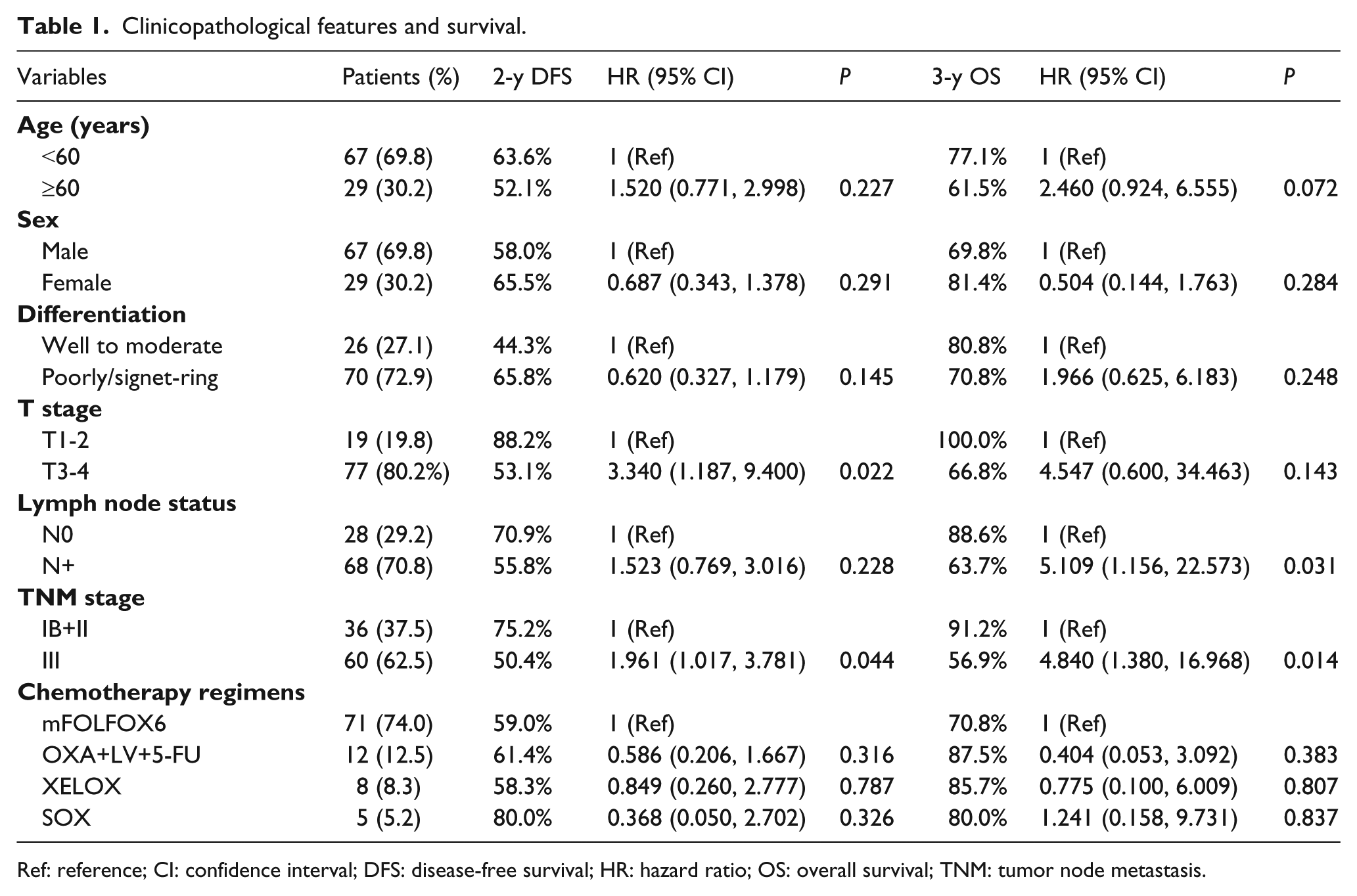
Ref: reference; CI: confidence interval; DFS: disease-free survival; HR: hazard ratio; OS: overall survival; TNM: tumor node metastasis.
We found that lymph node status (P = 0.031, HR 5.109; 95% CI 1.156, 22.573) and TNM stage (P = 0.014; HR 4.840; 95% CI 1.380, 16.968) were significantly related to the three-year OS rate. After multivariate analysis, lymph node status (P = 0.040; HR 5.009; 95% CI 1.075, 23.329) was demonstrated to be an independent prognostic factor.
Association between genotypes and survival time
Among the investigated polymorphisms in our study, XPO5 rs2257082 genotypes were significantly associated with DFS in both univariate and multivariate analysis. XPO5 rs2257082 TT+TC genotype carriers were found to have more favorable DFS than CC genotype carriers (65.2% vs. 31.2%, crude HR 2.215; 95% CI 1.052, 4.666; P = 0.036; adjusted HR 3.099; 95% CI 1.270, 7.564; P = 0.013) (Figure 1).
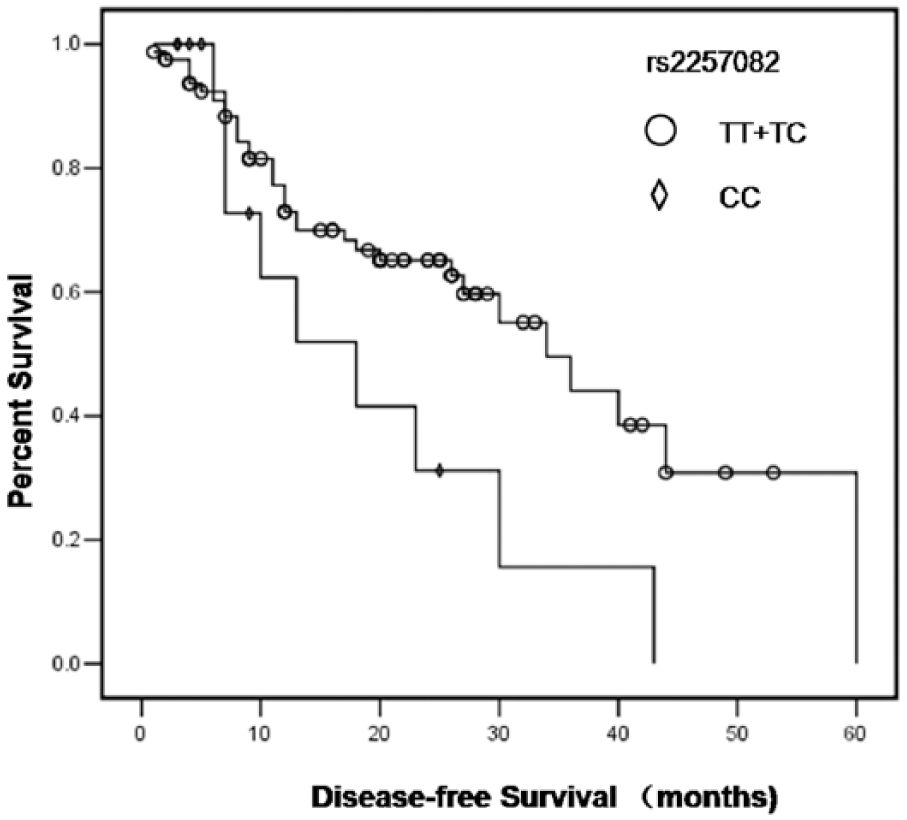
XPO5 rs2257082 genotypes and disease-free survival.
XPO5 rs11077 AA genotype carriers had significantly higher three-year OS rate than AC genotype carriers in a univariate analysis (74.7% vs. 64.8%; crude HR 3.336; 95% CI 1.052, 10.578; P = 0.041). However, after a multivariate analysis, there was no significant association between XPO5 rs11077 genotypes and OS. In a multivariate analysis, carriers of RAN rs14035 CC genotype demonstrated a significantly higher three-year OS rate than the carriers of the CT+TT genotype (73.0% vs. 71.2%; adjusted HR 3.174; 95% CI 1.010, 9.973; P = 0.048) (Figure 2). Data are shown in Table 2 and Table 3.
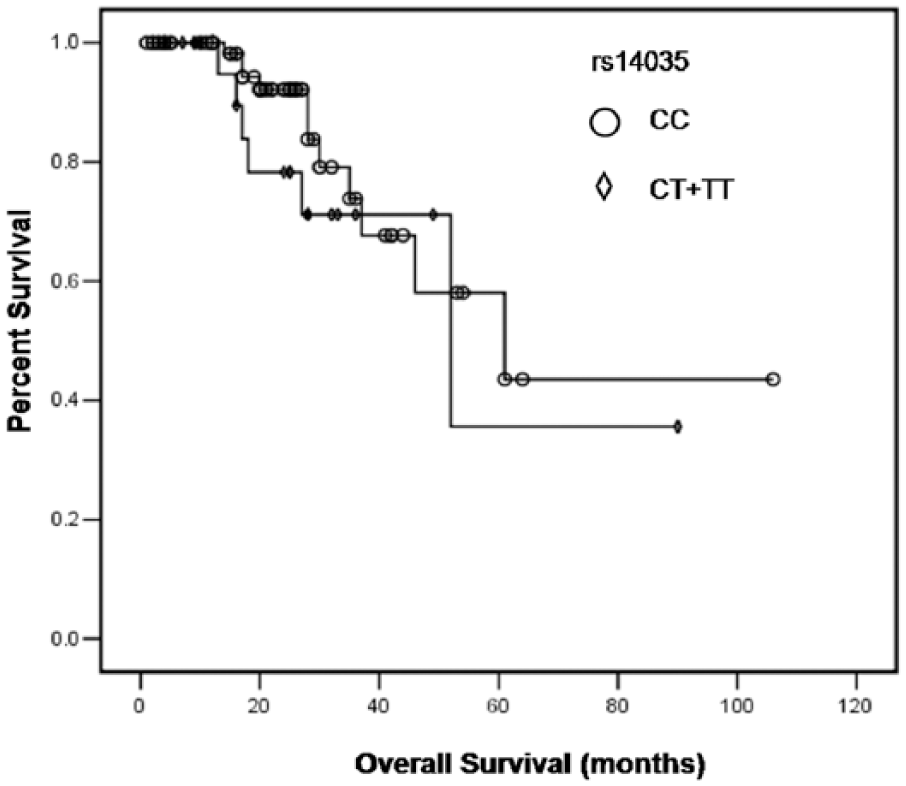
RAN rs14035 genotypes and overall survival.
Relationship between genotypes and disease-free survival.
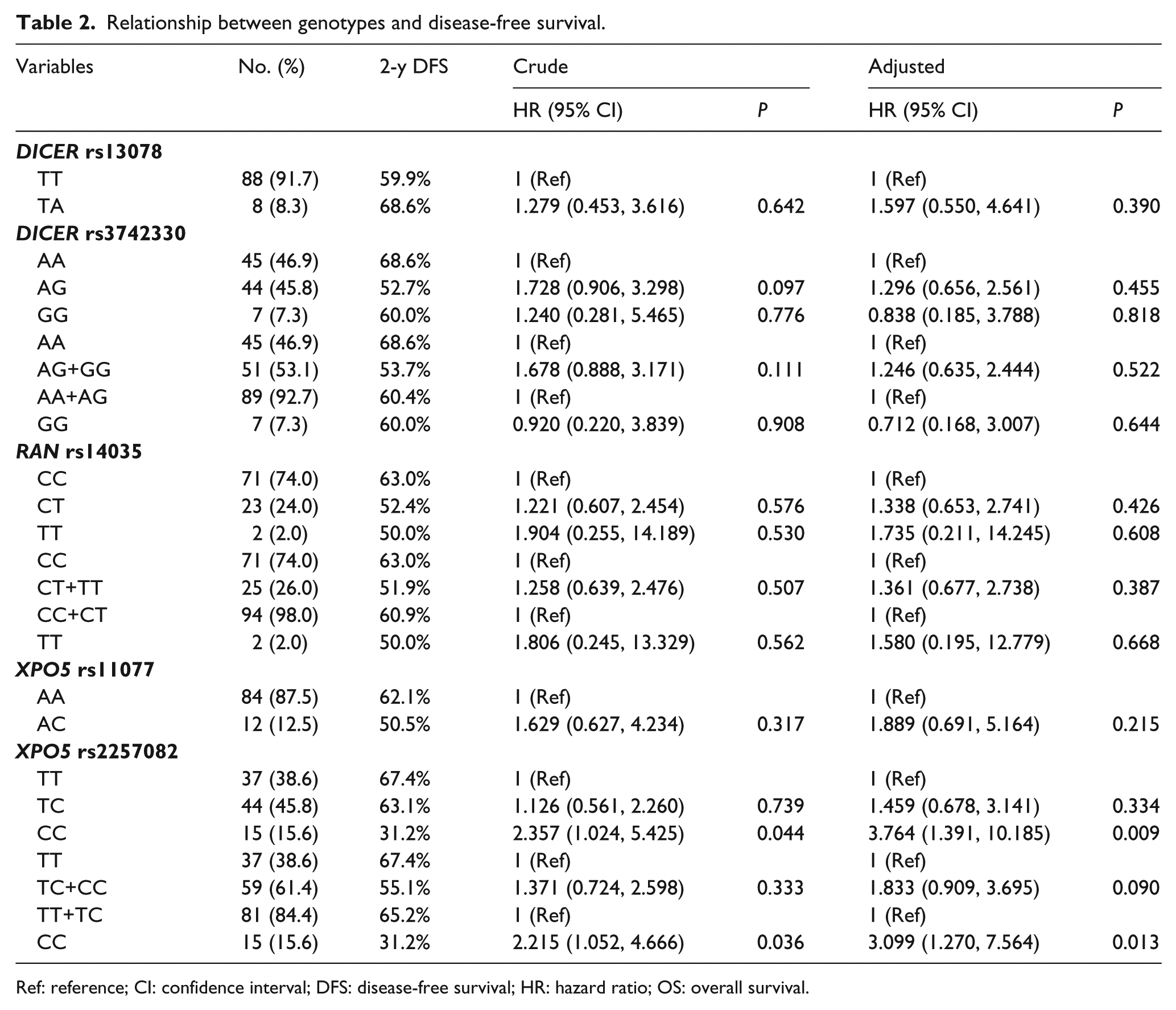
Ref: reference; CI: confidence interval; DFS: disease-free survival; HR: hazard ratio; OS: overall survival.
Relationship between genotypes and overall survival.
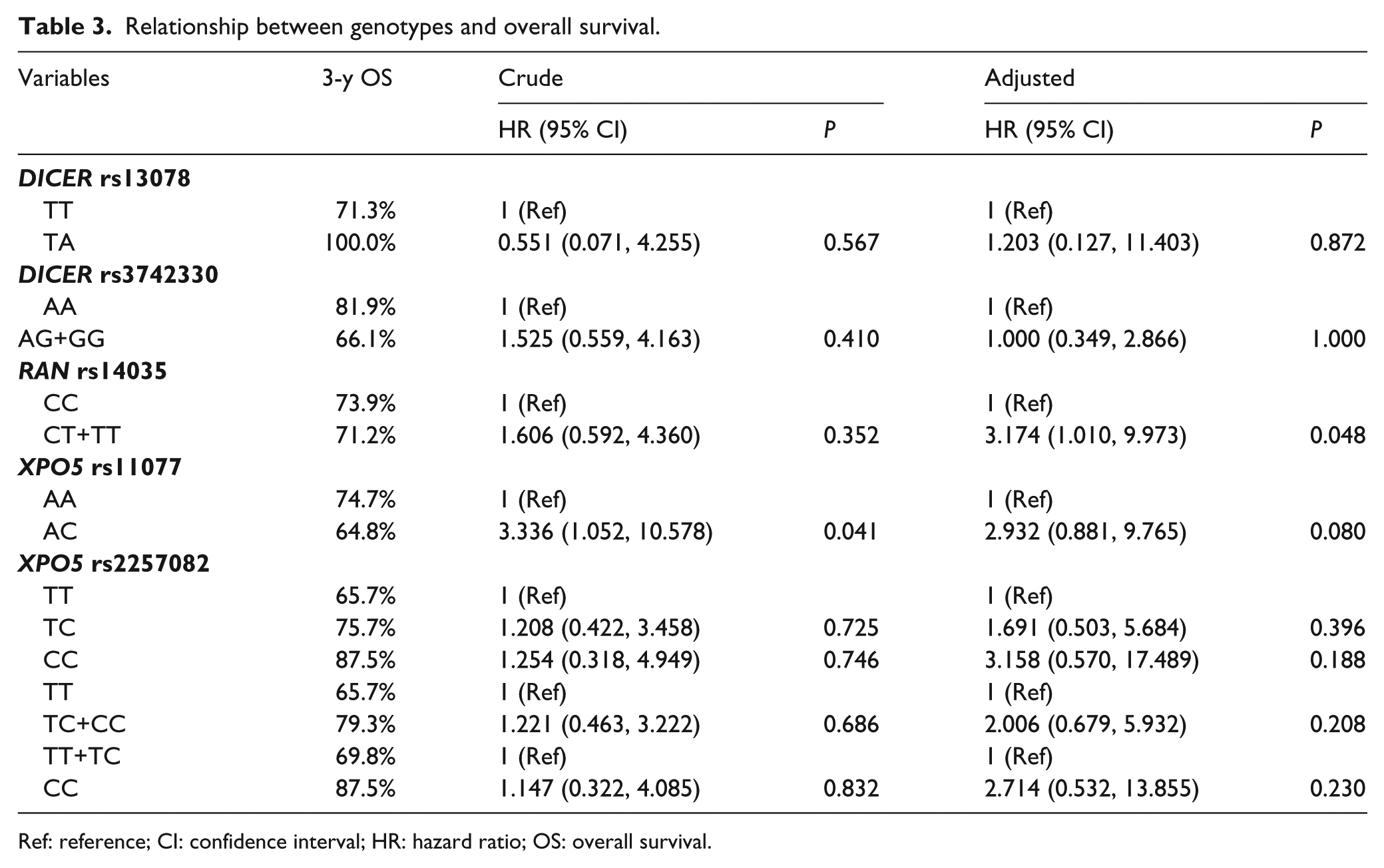
Ref: reference; CI: confidence interval; HR: hazard ratio; OS: overall survival.
Discussion
Human miRNA biogenesis is described as a two-step process. First, the miRNA gene is transcribed to produce a primary miRNA (pri-miRNA). Pri-miRNA is excised by the microprocessor that includes DROSHA and its cofactor DGCR8, producing the 60–70 nucleotide precursor miRNA (pre-mRNA). 20 Second, these precursors are exported to the cytoplasm, are processed by exportin-5 (XPO5 [name of protein which is transcripted from the gene XPO5]) and RAN-GTPase (RAN), and are further diced into ~22 nt miRNA duplexes by the RNase III enzyme DICER. 20 Regulation of miRNA biogenesis might happen at each of these steps and then influence normal cell biology. SNPs in miRNA machinery genes might affect miRNA processing and subsequently impact tumorigenesis. 21 To our knowledge, this is the first study that has investigated the association of these five polymorphisms with the clinicopathologic characteristics and prognosis of gastric cancer patients.
Previous studies have reported that XPO5 rs11077 was related to the prognosis of several kinds of cancers. The AA genotype of rs11077 was identified to be independently associated with worse survival in hepatocellular carcinoma (HCC) patients (HR 0.395; 95% CI 0.167, 0.933; P = 0.034). 22 In Ding’s study, for advanced non-small cell lung cancer (NSCLC) patients, AA genotype exhibited a significantly shorter survival time compared to AC genotype (P = 0.007), and rs11077 was independently associated with OS through multivariate analysis (HR 0.457; 95% CI 0.251, 0.831; P = 0.010). 23 Another research in advanced NSCLC patients also demonstrated that the AA genotype related to a significantly lower five-year survival rate compared with the AC genotype. 24 However, the AA genotype of rs11077 was significantly associated with better survival time (P = 0.023) and was found to be an independent prognostic factor (HR 2.469; 95% CI 1.088, 5.603; P = 0.031) in small cell lung cancer (SCLC) patients. 25 In the Chinese population, less than 1% of cancer patients have the CC genotype.22-25 None of the patients in our study had the CC genotype, which was consistent with the incidence reported in the literature. To our knowledge, this is the first study that has reported that gastric cancer patients who received radical surgery and adjuvant chemotherapy of oxaliplatin plus fluorouracils, rs11077 AA genotype carriers had a significantly higher three-year OS rate than AC genotype carriers, which supports the results from SCLC patients.
XPO5 is located in the nuclear membrane. It is responsible for the export of pre-miRNA and then adjusts miRNA expression. 26 High XPO5 expression was associated with worse clinicopathologic features and poor survival in colorectal cancer patients. 27 The high abundance of XPO5 in melanoma led to enhanced proliferation and metastasis, and thereby supported the aggressiveness of cancer cells. 28 The siRNA knockdown of XPO5 resulted in reduced cellular proliferation, attenuated invasion, the induction of G1-S cell-cycle arrest, and the downregulation of key oncogenic miRNAs. 28 Rs11077 was located in the 3′ untranslated region (3′UTR) of XPO5. 23 The mechanism for rs11077 affecting the survival of cancer patients remains uncertain. One hypothesis was SNPs in miRNA-biogenesis genes might affect the expression of mature miRNAs and consequently miRNA-mediated regulation. 29 But this hypothesis needs to be verified.
There are fewer studies regarding other polymorphisms, which were investigated in our study. Our results suggested that the three-year OS rate for RAN rs14035 CT+TT genotype carriers was significantly lower than in CC genotype carriers in a multivariate analysis. However, in Kim et al’s 30 study, the RAN rs14035 CT genotype was associated with significantly favorable survival compared with the CC genotype (HR 0.587; 95% CI 0.349, 0.987; P = 0.044) in HCC patients. In non-Hodgkin lymphoma patients, 31 rs14035 was not associated with survival. Additionally, we first reported that DICER rs3742330 AG+GG genotype carriers were more likely to have T3-4 tumors. XPO5 rs2257082 CC genotype carriers were more likely to have poorly differentiated tumors than CT+TT genotype carriers. XPO5 rs2257082 was significantly associated with the DFS of these gastric cancer patients.
The results of the relationship between polymorphisms in miRNA machinery genes and the survival of cancer patients were controversial. Some investigators thought it was reasonable to assume that the effects of miRNA-SNP will be modulated in a cell-type-specific manner, given the differential cell of origin for cancers and differential cell type specificity of miRNA transcriptomes. 22 There are some other possible explanations. First, different ethnic populations were investigated in different studies, so data should be extrapolated to other ethnic groups cautiously. Second, most previous studies enrolled patients at a relatively advanced disease stage, while all patients in our study were in stage IB-III, which might be curable. Third, patients in previous studies were treated with different regimens, while all patients in our research received oxaliplatin and fluorouracils, which minimized the influence from different chemotherapy regimens.
In conclusion, for the first time in Chinese gastric cancer patients at stage IB–III who received adjuvant oxaliplatin and fluoropyrimidines, we demonstrated that DICER rs3742330 genotypes were associated with the T stage. XPO5 rs2257082 genotypes were significantly related to differentiation. After adjusting for age, gender, differentiation, T stage, and lymph node status, RAN rs10435 and XPO5 rs2257082 were significantly associated with OS and DFS, respectively. These results indicated that genetic variants in miRNA machinery genes might influence the biologic features and prognosis of these patients. However, since the sample size was relatively small and we did not explore the mechanism, further investigations are needed to verify these results.
Supplemental Material
Supplementary_table – Supplemental material for Genetic variants in miRNA machinery genes associated with clinicopathological characteristics and outcomes of gastric cancer patients
Supplemental material, Supplementary_table for Genetic variants in miRNA machinery genes associated with clinicopathological characteristics and outcomes of gastric cancer patients by Yuqian Liao, Yulu Liao, Jun Li, Liyan Liu, Junyu Li, Yiye Wan and Lixiang Peng in The International Journal of Biological Markers
Footnotes
Author contributions
Yuqian Liao and Yulu Liao contributed equally to this paper.
Declaration of conflicting interest
The author(s) declared no potential conflicts of interest with respect to the research, authorship, and/or publication of this article.
Funding
The author(s) disclosed receipt of the following financial support for the research, authorship, and/or publication of this article: This study was funded by Natural Science Foundation of Jiangxi Province of China (grant number: 20151BAB205043).
Informed consent
Informed consent was obtained from all participants to the study, according to the stipulations of the Ethics Committee of Jiangxi Cancer Hospital.
References
Supplementary Material
Please find the following supplemental material available below.
For Open Access articles published under a Creative Commons License, all supplemental material carries the same license as the article it is associated with.
For non-Open Access articles published, all supplemental material carries a non-exclusive license, and permission requests for re-use of supplemental material or any part of supplemental material shall be sent directly to the copyright owner as specified in the copyright notice associated with the article.
