




Abstract
Introduction
Chronic urticaria (CU) is typically characterized by redness and itching of the skin, which usually resolve within 24 h but may last for 6 weeks or longer, and can have significant effects on patients’ sleep, social life and emotions. Over 80% of CU cases have no obvious cause, which is called chronic spontaneous urticaria (CSU). Its pathogenesis is sometimes unclear, although the main causes are inflammation and auto-immune disorders. 1 one The correlation between CSU and auto-immune thyroid diseases has been studied extensively, but the exact mechanism remains unclear. Studies have shown that metabolic syndrome and hyperlipidemia are common in CSU patients, and CSU has been associated with the incubation period of hepatitis A, B and C. This study retrospectively analysed the correlations between the inflammatory indexes, liver function, blood lipid and BMI, as well as the incidence rates of thyroid function and thyroid nodules in CSU patients, to understand the profile in thyroid function, BMI and inflammatory indexes in patients experiencing CSU.
Materials and methods
Subjects
This is a clinical observation study. The subjects were patients with acute onset of CSU admitted to the Department of Dermatology of the Second People’s Hospital of Hefei from January to December 2020. The inclusion criteria were: (1) urticaria occurring at least twice a week or more and lasting for 6 weeks or longer, without obvious inducement; (2) 18–60 years old; (3) no use of anti-histamines, glucocorticoids or anti-inflammatory drugs in the past week; (4) those who could understand and complete the contents of the questionnaire unassisted. Exclusion criteria were: (1) clear underlying diseases involving abnormal liver and kidney functions; (2) needed to take multiple drugs simultaneously or had a variety of serious complications due to other diseases; (3) suffering from allergic diseases such as eczema or atopic dermatitis; (4) drug or alcohol abuse; (5) pregnant or lactating. All subjects signed written informed consent. This study was approved by the Second People’s Hospital of Hefei (#2020-024).
Fifty CSU patients were included in the study, including 18 males and 32 females of 34.58 ± 10.63 years old. The healthy control group consisted of 50 healthy subjects, including 22 males and 28 females of 34.94 ± 8.90 years old. There were no statistically significant differences in gender, age, marital status, occupation, education level or residence between the two groups (p > 0.05), and all participants provided informed written consent.
Data collection
The subjects’ height and weight were recorded to calculate their BMI. Peripheral blood samples from all participants were collected to detect inflammatory indicators (WBC, NEU and CRP), liver function (ALT), triglyceride (TG) and thyroid function (T3 and TSH). Thyroid colour ultrasonography was performed on all participants.
Disease assessment
The chronic urticaria activity score (UAS-7), which assesses the number of urticaria clusters and the severity of itching every day in the previous week, was used to evaluate urticaria activity according to previous study. 2 Chronic urticaria activity was classified as follows: mild: 0–14 points; moderate: 15–29 points; severe: 30–42 points. Disease severity was summed daily from 0 (minimum) to 6 (maximum) using the UAS-7 score. 3
Statistical analysis
SPSS20.0 software was used for statistical analysis. The t-test was used for measurement data, and the χ2 test was used for enumeration data. The correlations between each study index and disease severity were determined using linear correlation analysis. A p-value of less than 0.05 indicates that the difference between the groups is statistically significant.
Results
Serological test results
The demographic characteristics of the subjects.
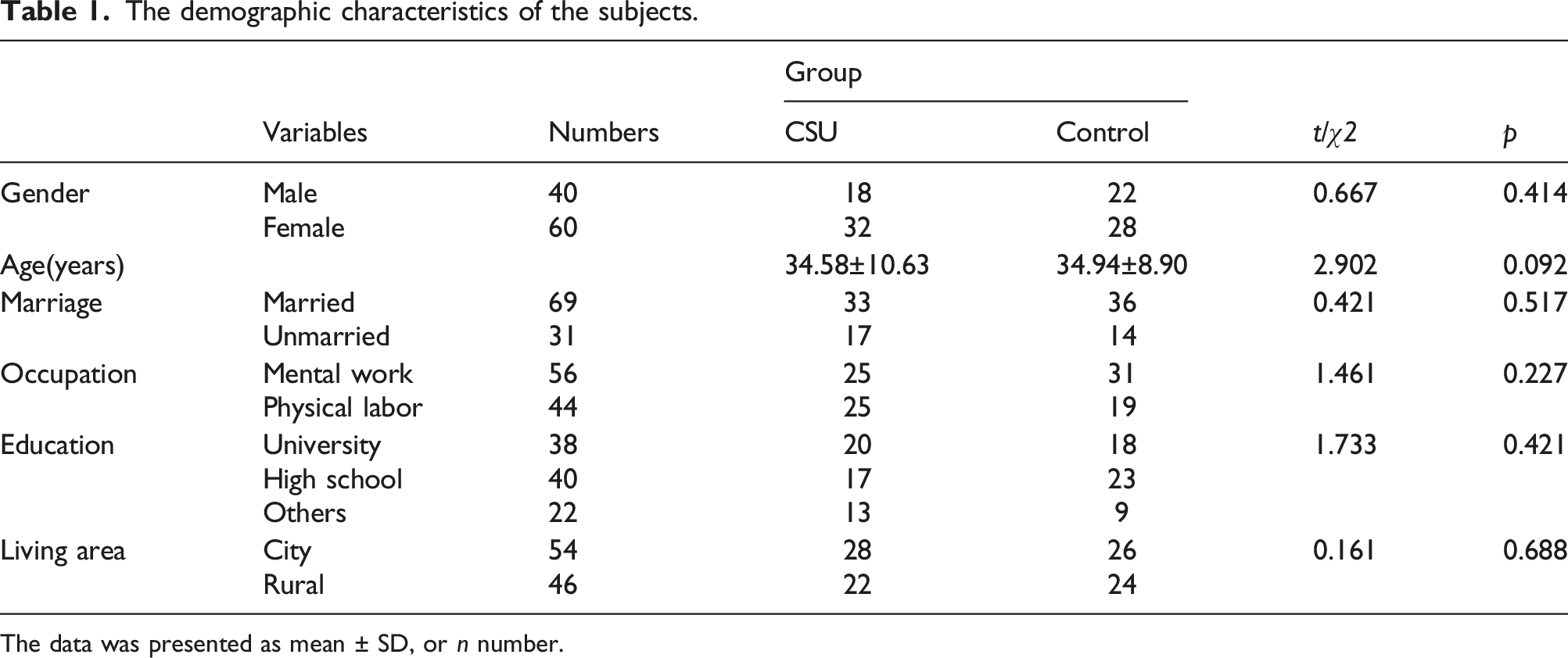
The data was presented as mean ± SD, or n number.
Comparison of laboratory data of CSU patients and control group.

Data were shown as mean ± SD.
Results of thyroid colour ultrasonography
Comparison of results of thyroid colour ultrasonography (n).

Comparison of BMI
The average BMI of the CSU group was 22.07 ± 2.45 and that of the control group was 21.62 ± 2.23. The difference between the two groups was not statistically significant, but the average BMI of the CSU group was higher than that of the healthy group.
Relationship between UAS-7 score and related indexes in the CSU group
The average UAS-7 score of the CSU group was positively correlated with WBC count (r = 0.524, F = 18.18, p < 0.001) and NEU count (r = 0.523, F = 18.08, p < 0.001), but was not significantly correlated with CRP, BMI, ALT, TG, T3 or TSH. In addition, the average UAS-7 score of patients with complications was significantly higher than that of patients without complications (F = 4.19, p = 0.046) (Figure 1). Correlation of UAS7 and variables (WBC and NEU).
Discussion
The WBC and NEU counts of the CSU patients were significantly different from the healthy group and were positively correlated with UAS-7. The exact aetiology of CSU has yet to be clarified. Inflammatory responses of varying degrees are most common in the pathogenesis of CSU. In addition to the increased inflammatory mediators in the skin tissue, the blood circulation of CSU patients also presents increased pro-inflammatory cytokines, 4 and there are more NEU involved, which may be related to improved Th17 function in CSU. 5 In this study, we found that CSU patients showed higher NEU counts than the control group. We also found that inflammation was correlated with disease activity and severity in CSU patients. We observed that the UAS-7 score was positively correlated with WBC and NEU counts. Blood CRP level changes during the acute phase of CSU. We found that the serum CRP level, which reflects the disease activity of CSU, was significantly higher in CSU patients than in the control group. We did not find an association between CRP and UAS-7, but patients with complications showed significantly higher CRP levels than those without complications. Our clinical observation results are similar to those of Ataseven et al. 6 Various immuno-suppressants, anti-inflammatory drugs and immuno-modulators have been used to treat patients with refractory CSU. However, without randomised controlled trials, evidence supporting the efficacy of anti-inflammatory agents, such as leukotriene receptor antagonists, hydroxychloroquine, dapsone, sulfasalazine, methotrexate and colchicine, is quite limited.
Auto-immune mechanisms play important roles in the pathogenesis of 30%–45% of CSU cases, although the link is unclear. Auto-immune thyroid disease in CSU patients has been extensively studied. In this study, most of the hospitalised patients presented with abnormal thyroid function indicators, which mainly manifested as reduced T3 level without obvious hypothyroidism, which is called normal pathological thyroid syndrome, non-thyroid disease syndrome (NTIS) or low T3 syndrome. Previous studies have shown that for various diseases, such as acute cerebrovascular disease, severe kidney disease, heart failure, respiratory failure and children’s central nervous system infection, low T3 syndrome can be used as a reference index for the diagnosis and prognosis of critically ill patients. Although its specific pathogenesis is not clear, it is a protective reaction in critical patients, and there is no correlation between T3 level and UAS-7. Whether thyroxine or its analogues should be administered promptly for the treatment of low T3 in critically ill patients remains controversial. In addition, chronic urticaria patients with positive thyroid auto-antibodies show more severe urticarial condition and are commonly complicated by positive ASST. 7 We performed thyroid colour ultrasonography for all study participants, and found that the incidence rate of thyroid nodules in the CSU subjects was significantly higher than that of the control group, and four CSU subjects aged 36–49 years were diagnosed with papillary thyroid carcinoma. Ozkaya et al. suggested that FNP should be performed when the diameter of the thyroid nodule was ≥10 mm. 8 However, the diameter of the malignant thyroid nodules diagnosed in all patients in this report was 5 mm, suggesting that needle biopsy should be determined by the patients’ clinical manifestations.
In addition, CSU has been suggested to be related, although controversial, to the incubation period of hepatitis A, B and C. We therefore also analysed liver functions, which were significantly higher in the control group, indicating that abnormal liver function can aggravate the severity of CSU. Fat tissue is an active endocrine organ that synthesizes a large number of bioactive proteins called adipokines that can bind to and further activate mast cells, release histamines and promote inflammatory response, thereby causing or aggravating CSU. In addition, obesity may lead to reduced immune tolerance to antigens and increase the risk of allergies and other immunological diseases. 9 Our study showed that BMI was relatively higher in the CSU group than in the control group, and obese patients appeared to have more severe disease (more complications), but there was no correlation with UAS-7 score. Nylec et al. found similar results and concluded that the development of metabolic syndrome was an independent predictor of the uncontrollable course of CSU. Hyperlipidemia is characterised by high blood lipid levels, including cholesterol and triglycerides, which are involved in the inflammatory process. CSU is thought to carry a high risk of hyperlipidemia development, and some researchers have suggested that urticaria symptoms should trigger immediate investigation into hyperlipidemia parameters. 10 This study found that the blood lipid levels of the CSU group were significantly higher than those of the healthy group, but were not correlated with UAS-7. Maged et al. also found that TG, IL-6 and TNF-α were higher in the patient group than in the control group, and that TG was positively correlated with TNF-α, indicating that hyperlipidemia promotes inflammation. 11 In addition, some inflammatory factors such as TNF-α can inhibit insulin receptor tyrosine enzyme activity, interfere with insulin signal transduction and cause insulin resistance, fat mobilisation, the production of large amounts of free fatty acid, increased TG synthesis and insulin resistance in liver cells. They can also increase apolipoprotein C synthesis and inhibit lipoprotein lipase lipolysis of TG, ultimately resulting in higher TG. Symptomatic therapy should therefore be initiated on the basis of modern anti-histamine therapy, and complementary and alternative therapies may be required. In addition, a holistic approach is needed to treat patients and, if feasible, to address obesity, which affects an increasing number of people.
There are several limitations that should be noted. First, we did not conduct power analysis for sample size calculation. In addition, the sample size was relatively low. In future work, a larger number of samples should be enrolled to further verify the current findings.
Conclusions
Our results suggest that inflammation plays an important role in the onset and severity of CSU. CSU patients would have abnormal serum biochemical indexes, including inflammatory factors, as well as thyroid function. The incidence rates of thyroid nodule and thyroid papillary carcinoma are significantly higher than those of healthy subjects. Importantly, our findings suggest that thyroid color ultrasound should be paid attention to at the same time, for early detection of CSU in clinical practice.
Footnotes
Author contributions
Data collection, ideal, writing-original draft preparation, Y. T., S; Writing-review and editing, W.C; All authors have read and agreed to the published version of the manuscript.
Declaration of conflicting interests
The author(s) declared no potential conflicts of interest with respect to the research, authorship, and/or publication of this article.
Funding
The author(s) received no financial support for the research, authorship, and/or publication of this article.
Ethics approval
Ethical approval for this study was obtained from *ethics committee of the Second People’s Hospital of Hefei (#2020-024)*.
Informed consent
ed consent was obtained from all subjects before the study.
