




Abstract
Toll-like receptors (TLRs) play a key role in both innate and adaptive immunity. The role of TLR-4 in various autoimmune disorders has been well documented. Variations in the TLR-4 gene have been linked with susceptibility to rheumatoid arthritis (RA). In the present report, we conducted a hospital-based case-control study to investigate whether common polymorphisms in the TLR-4 gene are associated with susceptibility/resistance to development of RA in a Chinese population. A total of six single nucleotide polymorphisms (Asp299Gly, Thr399Ile, rs10759932, rs41426344, rs11536889, and rs7873784) were genotyped by PCR-RFLP in 250 RA patients and 248 healthy controls. Distribution of genotypes and alleles in RA and controls were compared by Fisher’s exact test. The prevalence of minor allele, heterozygous and homozygous mutants for rs41426344 polymorphism were more frequent in RA patients compared to healthy controls (C: P <0.0001, OR = 5.51 [3.37–8.99]; GC: P <0.0001, OR = 7.38 [4.10–13.29]; CC: P = 0.01, OR = 4.73 [1.28–17.47]). Similarly, the frequencies of CC genotype and C allele of rs7873784 polymorphism were significantly higher in RA than healthy controls ([GC: P = 0.008, OR = 1.77 [1.16–2.70]; C: P = 0.01, OR = 1.61 (1.11–2.34]). However, genotypes and alleles distribution of rs10759932 and rs11536889 were comparable in both clinical categories. Similar to earlier observations, all participants were wild type for TLR-4 codon polymorphisms (Asp299Gly and Thr399Ile). In conclusion, TLR-4 (rs41426344 and rs7873784) variants are associated with susceptibility to development of RA in a Chinese population.
Introduction
Rheumatoid arthritis (RA) is a chronic autoimmune disorder that affects mainly the joints, leading to significant morbidity and decreases the life span of patients. About 0.3–0.6% of the Chinese population are affected by RA and it is more frequent in women compared to men. 1 Although the exact etiology of RA development is not known, the genetic composition of patients has been attributed to one of the major component for RA susceptibility. 2 Human leukocyte antigen variants have been associated with susceptibility to RA and are believed to be one-third of the total genetic susceptibility component. 3 Thus there could be genetic factors other than the HLA gene which are responsible for susceptibility to RA.
Toll-like receptors (TLRs) are transmembrane proteins expressed by a wide range of cells involved in the recognition of pathogens and induction of inflammatory signaling pathways. 4 TLRs also play important roles in the induction of the adaptive immune system. 5 Out of 10 human TLRs reported, TLR4 is most thoroughly investigated which recognizes lipopolysaccharide6,7 as ligand from gram-negative bacteria. Furthermore, TLR-4 is also stimulated by various endogenous ligands such as heat shock proteins (HSPs), 8 fragments of hyaluronic acid, 9 and fibronectin, 10 which are mostly released by cells undergoing damage, or necrotic death. 11 The presence of such endogenous ligands in excessive amounts at synovial joints of RA patients have been reported.12,13 Thus TLR-4 could play an important role in pathogenesis of RA and functional genetic variations at TLR-4 gene may be associated with susceptibility/resistance to RA development.
Several single nucleotide polymorphisms (SNP) have been reported in the TLR-4 gene. Out of these, two functional codon polymorphisms (Asp299Gly and Thr399Ile) have been widely investigated in different population. Mutations at codon 299 and/or 399 are shown to hampered TLR-4 downstream signaling when stimulated by LPS or with other endogenous ligands. 14 Nowadays, SNPs at regulatory regions are of importance in genetic association studies such as 5’untranslated region (UTR), where promoter and transcription factors binding sites are located, or 3’UTR, which influence the expression of mRNA. Recently, the association of SNPs at regulatory regions of TLR-4 (3’UTR: rs41426344, rs11536889, and rs7873784; 5’UTR: rs10759932) have been investigated in a Chinese population and the association of rs41426344 and rs7873784 polymorphisms with susceptibility to RA was reported. 15
In the present study, we analyzed whether variants of regulatory regions (3’UTR: rs41426344, rs11536889, and rs7873784; 5’UTR: rs10759932) and functional codon polymorphisms (Asp299Gly and Thr399Ile) are associated with susceptibility/resistance to RA in a Chinese population.
Materials and methods
Participants
Chinese RA patients who visited and/or were admitted to the Department of Rheumatology and Immunology at the Affiliated Hospital of Jining Medical College during 2013–2014 were included in the study. All patients fulfilled American College of Rheumatology revised criteria 16 and were positive for rheumatoid factor. A total of 250 RA patients were included in the study (45 men, 205 women). Furthermore, sex-matched healthy participants hailing from similar geographical areas with no history of autoimmune disorder were enrolled as healthy controls. Importantly, we enrolled healthy controls with the age range of 35–45 years to maintain uniformity. Two healthy control samples failed to amplify for TLR4 genes and thus were excluded for the present study. About 3 mL of intravenous blood was collected from each participant with anticoagulant and stored at −80°C until isolation of genomic DNA. The study was approved by the institutional human ethical committee of Jining Medical College and written informed consent was obtained from each participant.
TLR-4 polymorphisms genotyping
From the stored whole blood, genomic DNA was isolated by the GenElute™ Blood Genomic DNA Kit (SIGMA-ALDRICH). TLR-4 codon polymorphisms (Ala299Ser and Thr399Ile) were genotyped by polymerase chain reaction followed by restriction fragment length polymorphisms (PCR-RFLP) as described earlier. 17 Other polymorphism at 5’UTR (rs10759932) and 3’UTR (rs41426344, rs11536889, and rs7873784) were also genotyped by PCR-RFLP as described previously. 15 About 10% of samples were randomly selected and sequenced for validation of genotyping technique. The sequencing results were 100% concordant with PCR-RFLP genotyping data.
Statistical analysis
Fisher’s test was used for comparison of genotype and allele frequency distribution among RA patients and healthy controls. Odds ratios (ORs) and 95% confidence intervals (CIs) were calculated by Graphpad prism 5.01. The allele genotypes with higher frequency were selected as reference (OR = 1) and the other ORs were calculated relative to that reference (Fisher’s exact test, 2×2 contingency tables). A P value less than 0.01 was taken as significant (Bonferroni correction for four SNPs 0.05/4 = 0.012). Deviations from the Hardy-Weinberg equilibrium (HWE) were tested using the online tool http://www.oege.org/software/hwe-mr-calc.shtml. Haplotype analysis was performed by SNPStats software. 18
Results
Participant characteristics
Baseline data of all patients and controls are shown in Table 1. Of the RA patients and healthy controls, 82% were women. The mean age of RA patients and healthy controls were 42.3 ± 4.3 and 38.5 ± 3.6, respectively. At the time of enrolment, RA patients had a mean disease duration of 7.7 ± 4.2 years.
Baseline characteristics of healthy controls and RA patients.

HC, healthy control; RA, rheumatoid arthritis; SD, standard deviation.
Prevalence of TLR-4 (Asp299Gly and Thr399Ile) polymorphism
We enrolled a total of 498 Chinese participants in the present investigation. The TLR-4 codon (Asp299Gly and Thr399Ile) polymorphisms were genotyped by PCR-RFLP. In line with earlier observations,15,17,19 all participants were found to be wild type (Asp299Asp and Thr399Thr) for TLR-4 codon polymorphisms.
Distribution of TLR-4 3’UTR and 5’UTR polymorphisms in healthy controls
TLR-4 3’UTR (rs41426344, rs11536889, and rs7873784) and 5’UTR (rs10759932) polymorphisms were genotyped by PCR-RFLP and prevalence of genotypes are shown in Table 2. The prevalence of heterozygous mutant frequency (rs41426344: 6%, rs11536889: 28%, rs7873784: 19%, and rs10759932: 45%) and homozygous mutant (rs41426344: 1%, rs11536889: 12%, rs7873784: 1%, and rs10759932: 11%) were comparable to previous report. 15 Distributions of rs41426344 (P <0.001, χ2 = 16.01) and rs11536889 (P <0.001, χ2 = 18.11) genotypes were deviated from HWE and rs7873784 (P = 0.91, χ2 = 0.01) and rs10759932 (P = 0.89, χ2 = 0.01) were in HWE.
Frequency of TLR-4 genotypes and alleles in healthy controls (HC) and RA patients.

Data are n (%) of participants.
CI, confidence interval; HC, healthy control; OR, odds ratio; RA, rheumatoid arthritis.
Association of TLR-4 3’UTR and 5’UTR polymorphisms with RA
A hospital-based case-control study was performed to examine whether common polymorphism in TLR-4 3’UTR (rs41426344, rs11536889, and rs7873784) and 5’UTR (rs10759932) are associated with RA and results are shown in Table 2. For the TLR-4 3’UTR rs41426344 polymorphism, the frequency of the GC genotype, homozygous mutant (CC), and variant allele C were significantly higher in RA patients compared to healthy controls (GC: P <0.0001, OR = 7.38 [4.10–13.29]; CC: P = 0.01, OR = 4.73 [1.28–17.47]; C: P <0.0001, OR = 5.51 [3.37–8.99]). Similarly, distribution of heterozygous mutant (GC) and minor allele (C) for rs7873784 polymorphism were more frequent in patients than controls (GC: P = 0.008, OR = 1.77 [1.16–2.70]; C: P = 0.01, OR = 1.61 [1.11–2.34]). The genotypes and alleles distribution for rs11536889 and rs10759932 polymorphisms were comparable among RA patients and healthy controls. In addition, haplotype analysis showed T-G-G-G was more frequent in both cases (48%) and controls (50.5%). Prevalence of T-C-C-C haplotype was significantly higher in healthy controls compared to RA (P = 0.012), suggesting protective role of this haplotype against RA pathogenesis (Table 3)
Haplotype analysis of TLR-4 polymorphisms in RA patients and healthy controls.
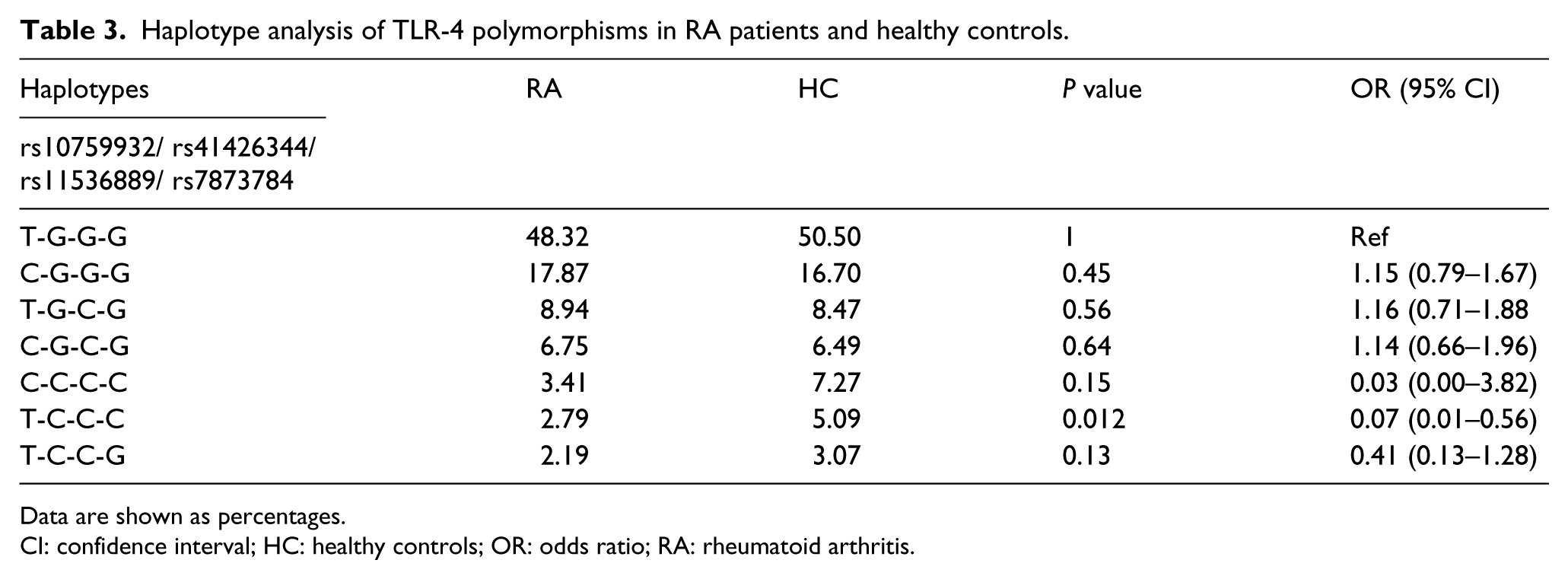
Data are shown as percentages.
CI: confidence interval; HC: healthy controls; OR: odds ratio; RA: rheumatoid arthritis.
Discussion
The present study examined association of common TLR-4 variants in codon and regulatory regions with susceptibility/resistance to development of RA in a Chinese population. Major observations of this study are: (1) codon polymorphisms (Asp299Gly and Thr399Ile) are absent in the studied cohort; and (2) rs41426344 and rs7873784 variants are associated with susceptibility to RA.
In different populations, the role of TLR-4 codon (Asp299Gly and Thr399Ile) polymorphisms has been widely investigated. However, studies in Chinese, Japanese, and Korean populations reported an absence of TLR-4 codon variants.17,19–25 In the present study, we observed complete absence of TLR-4 codon variants and all participants were found to be wild type for TLR-4 Asp299Gly and Thr399Ile polymorphism, corroborating with earlier observations.19,21,24 Distribution of variants in regulatory regions of TLR-4 gene (rs41426344, rs11536889, rs7873784, and rs10759932) was comparable with a previous report in a Chinese population. 15
A major observation of this study was the association of TLR-4 3’UTR rs41426344 and rs7873784 polymorphisms with susceptibility to RA. A previous study by Yang et al. has shown association of similar polymorphisms with susceptibility to RA in a Han Chinese population. 15 Participants with GC genotype and minor allele C of rs41426344 polymorphism had a 7.38-fold and 5.51-fold higher chance of developing RA, respectively. Similarly, heterozygous (GC) and mutant allele (C) for rs7873784 polymorphism were more frequent in RA compared to healthy controls (GC: P = 0.008, OR = 1.77; C: P = 0.01, OR = 1.61). Functional relevance of rs41426344 polymorphism has been shown earlier. TLR-4 rs41426344 variants were associated with decreased mRNA stability and that may lead to lowered expression of TLR4. 26 Duan et al. had shown attenuated LPS signaling in TLR-4 mutant compared to wild type. 27 On the other hand, the functional relevance of rs7873784 is not known. As it is located at 3’UTR, it possibly affects mRNA stability or net expression of TLR-4. TLR-4 rs7873784 polymorphism has been associated with risk of various disease such as type 2 diabetes, 28 prostate cancer, 29 and tuberculosis. 30 Overall, the present study revealed that TLR-4 regulatory variants (rs41426344 and rs7873784) are associated with susceptibility to RA.
The other two SNPs at TLR-4 regulatory region (rs10759932 and rs11536889) were not associated with susceptibility/resistance to development of RA. Furthermore, TLR-4 codon polymorphisms (Asp299Gly and Thr399Ile) were absent in the studied population. These observations cannot exclude the possibility of association between TLR-4 variants (rs10759932, rs11536889, Asp299Gly, and Thr399Ile) with RA. As the genetic polymorphisms vary in ethnic groups, further studies in other populations are needed to obtain a comprehensive result.
Although the present case-control study highlights the association of TLR-4 variants (rs41426344 and rs7873784) with susceptibility to RA, it has several limitations and needs to be addressed. Other confounding factors associated with RA, such as gender, age, smoking, and testosterone levels in men, were not considered for analyses. Furthermore, polymorphisms in other TLRs and associated genes could have potential contributory role in the protection/susceptibility to RA.
In conclusion, the results of our study indicate associations of TLR-4 regulatory (rs41426344 and rs7873784) polymorphisms with susceptibility to development of RA. Furthermore, TLR-4 codon polymorphisms are absent in the Chinese population. These observations validate earlier findings on possible role of TLR-4 in susceptibility to RA. However, independent case-control studies in different populations including a larger sample size are needed to draw a firm inference.
Footnotes
Acknowledgements
The authors thank all patients and participants for their invaluable support.
Declaration of conflicting interests
The authors declared no potential conflicts of interest with respect to the research, authorship, and/or publication of this article.
Funding
This research received no specific grant from any funding agency in the public, commercial, or not-for-profit sectors.