




Abstract

The Indigenous Pharmacy Professionals of Canada (IPPC) is an Indigenous-led association that has been established to connect and support Indigenous pharmacy professionals and help all pharmacists provide better care to Indigenous patients by creating and promoting pharmacy practice models that respect the safety, equality, strengths and teachings of the Indigenous Peoples of Canada. In August 2023, the association held its first “IPPC Members Gathering” at Dakota Dunes Resort, owned and hosted by the Dakota Whitecap First Nation, in Saskatchewan.
The purpose of this gathering was to host a facilitated strategic planning session and to ensure the cultural and professional competencies of the Board of Directors to safely guide the organization. We expanded the purpose to that of a community gathering, welcoming IPPC members who were invited to attend the professional development sessions and evening events, which included fireside music, dancing, entertainment and networking.
A small but dedicated group of members was in attendance. This included 12 board members, who are Indigenous pharmacy professionals from many Nations and professional backgrounds: Dr. Jaris Swidrovich (founder and chair, pharmacist), Dr. Cassandra McLelland (vice chair, pharmacist), Dr. Kalbie Hokanson (secretary, pharmacist), Deborah Emery (treasurer, pharmacist), Amber Ruben (pharmacist), Andrea Brewer (pharmacist), Dr. Kirsten Fox (pharmacist), Kierra Fineday (pharmacist), Dr. Sean Spina (pharmacist), Fanny Fiddler (pharmacy technician), Sasha Merasty (pharmacy student) and Tiara Davy (pharmacy student). We were joined by 2 additional IPPC members, Tyiesha Wright and Calista Fendelet, both Indigenous pharmacy students. IPPC’s 2 staff members were also in attendance, Amy Lamb and Dr. Gezina Baehr, who at the time were operating the organization as interim chief executive officer and chief operating officer, respectively. The event included invitations to Indigenous knowledge keepers, Gilbert Kewistep and Judy Pelly, to open and close our days in a good way with words of wisdom and prayers. We contracted an Indigenous-owned consultant group, Kihew Consulting and Research, to facilitate our sessions. Kihew consists of Indigenous professionals with extensive experience in building and supporting Indigenous-led industries and innovations.
When we arrived at Dakota Dunes Resort, we were welcomed by ever-lit fires and traditionally crafted tipis to view and visit. There was a deep sense of how proud the People of this place are of their heritage, creation and the landscape. The hall from the hotel to the conference space carries exhibitions of Indigenous art and the history of the structural harms to this community, including the lives lost to residential schools. These halls looked like a garden, a space to stop and be reverent to the ancestry and evolution of this place.
Day 1 was a Cultural and Professional Development day and was meant to ensure that this group of pharmacy professionals with Indigenous ancestry have the foundations necessary to effectively guide this organization and its purpose.
The IPPC Board of Directors and staff

IPPC members establishing kinship and community

We began with Indigenous Governance training, provided by Edmund Bellegarde, to help to shape our understanding of how to create an effective, safe and strong organization. We were provided with examples of values, objectives and successes in organizational models such as the Saskatchewan Indian Gaming Authority and All Nations’ Healing Hospital. Edmund provided us with an example of a language and distinctions-based Indigenous values set, including the word Misakâowin, which signifies “The value of finding one’s sense of origin and belonging.” We were reminded of foundational values and the engagement structures of Indigenous communities and Nations who have collaborated from time immemorial. Respect, reciprocity and other intergenerational wisdom must be effectively braided into the structures and policies that will guide IPPC.
As ancestors of systemically disrupted Indigenous communities, this group experiences a diversity of adjacency to traditional culture and upbringing. Cultural development exercises were provided by Kihew’s Bailey Watson. Indigenous ways are often described as “ways of being,” as opposed to the actions we complete in “ways of doing.” As such, this event and this cultural training were designed to immerse those taking part in the experience, to understand the deeper connections that occur behind the experience or exercise. Bailey led us in guided meditation that transported us into the medicine wheel, and we collectively travelled North, South, East and West, visiting the seasons, elements, healing areas and medicines that were found within this circle of holistic health. We were asked to reflect on what our body, our spirit, our mind and our emotions were asking of us in this moment, in this place and for this purpose.
Our second cultural exercise was similar to the “Kairos Blanket Exercise,” an interactive mechanism to better understand the impact of colonization on Indigenous Peoples. We each received cards with scripts to read aloud, each of which representing Indigenous history, with a moment of reflection and recognition on the subject. “I represent the lives lost to residential schools,” a member of our circle read, describing the history and painful truths of this piece of Indigenous cultural genocide in Canada. Each card ended with an honour statement, such as the card that mourned the loss of leadership and safety to feminine leadership and wisdom: “Today, we honour Indigenous feminine knowledge and the critical role that women play in the health of families, communities and societies.” One after another, we were reminded of the deep sense of loss that is felt in all of our bones. The loss of culture, of untouched biodiverse lands, the genocide of a people, a culture and the ecosystems, animals and traditions that sustained thriving life for our ancestors and all living things. These were heavy words from heavy throats that spoke clearly and carefully the statements that were crafted to honour them.
Break-out circles to strategize Indigenous-led pharmacy
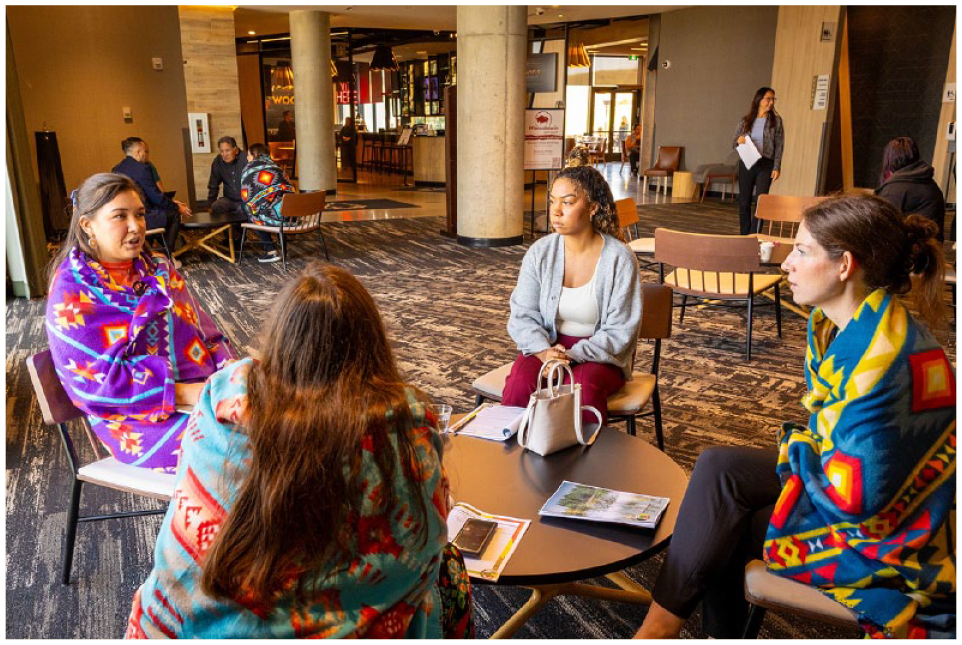
Toward the end of the exercise, the tone of the cards changed. There were words of honour for those successfully protecting and reconstructing Indigenous culture and identity. The next cards reminded us that times are changing and that our communities are finding their culture, their communities and their strength again. The last card was specially written for our founder, Dr. Jaris Swidrovich, to read aloud: “I represent the Indigenous Pharmacy Professionals of Canada” [causing the room to shudder a breath of shared understanding], “an organization that in its infancy, has already created positive change. Before IPPC was created, I often felt alone in carrying the burden of having to explain and educate those who did not understand. Today, I look around the room and I know that I am not alone.”
The members and leaders of IPPC gathered to find purpose, but as Indigenous ancestors, our community, our collective, too is healing. The kind of loss that individuals and communities we represent have experienced is too much for us to handle alone. The fear we face every day creates physiologic processes that affect our holistic health, often reflected in the higher statistics for diseases and disorders, without consideration of the source. When we have space to share our strength, to amplify and reverberate the pride, love, creativity and strength in all of us, we are healed. Day 1, we discovered “why” IPPC existed and it is to build a community that, itself, is the medicine needed to heal the healers.
Evening fireside event with IPPC members

Day 2, we embarked on a strategic planning session, led by John Desjarlais. As a newly founded organization, we at the IPPC asked ourselves: What is this organization’s mission, what are our dreams and aspirations and what is our “20 years from now” vision?
Our mission and vision statements started off wordy and bulky. There is so much work to be led by Indigenous health professionals and so many systemic, structural and practice-related issues that require our urgent attention. We broke into groups to talk about the strengths, weaknesses, opportunities and threats to the organization. We are strong, thanks to our diversity, but we are weak in number. We are deeply needed in a confusing and complex set of systems, with limited resources. We are a community that represents a unique research area, those that see through a Western-trained pharmacy lens and an Indigenous lens. We have the responsibility to carry forward our ancestors’ wisdom. We have a community to build and empower and to lead the changes we need to see in the world.
The group engaged in lengthy discussions about what it means to be Indigenous led and determined, how intergenerational wisdom is translated and how we can honour the past while considering the future. From our vision, mission and values, we will be able to build our objectives, our measurables and our sustainability strategy, and through a defined path we collectively experienced a deeper sense of purpose and hope.
This was the first-ever gathering of Indigenous pharmacy professionals in Canada and a newly formed community with unique and valuable perspectives that are strengthened by our collective. Many of our members describe the fear and sadness associated with the feelings of isolation, being tokenized and the powerlessness of experiencing and witnessing anti-Indigenous prejudices and racism in pharmacy and Canadian health care systems. Gathering together was meant to help us heal and grow so that we can have the strength and strategy to contribute to meaningful practices and systems.
Participating in cultural activities with Dakota Dunes Cultural Team

“Accountability” was among the list of values we defined that day. There is a sense of urgency with contributing to deeply meaningful work, including strengthening our community and reconstructing systems to safe and holistic spaces. Finalizing this governance work will be top priority to keep our focus. We are a movement, composed of members from many Nations, many backgrounds and many values. The load felt a little lighter knowing that we had each other. We have ways of being and doing to guide our path, a defined and unified purpose and collective strength and hope, all of which are incredible medicines.
All those in attendance agreed that gathering meant more than what we “did” and that this experience was an important evolution of the “way of being” that our communities have always been strengthened by. We shared powerful experiences together, including collective grieving, sunrise meditations, fireside laughter and shared epiphanies. We were entertained by local dancers and music, including our own board member Tiara Davy, a talented Métis fiddler. We feasted together and shared our stories and felt the dissolution of fear, isolation and powerlessness. Continued gathering, mentorship and kinship will be a part of this organization’s mission, with a vision of representing and connecting all Indigenous pharmacy professionals from coast to coast to coast.
This experience was unique to me in many ways, including as my first time planning a professional and cultural event. I felt very much like a host, invested in respecting the attendees with intentions such as those of our collective Indigenous ancestors. I was inviting guests from afar into my home, planning meals, sessions and experiences that honoured the people, the place and the purpose of our gathering. All attendees were gifted with a blanket, knowing it would keep them warm by the fire or during morning meditations, a gift that would end up being used to wipe away tears and warm the shaking shoulders of our grieving members. As the staff member tasked with the translation and operationalization of this gathering’s findings, I feel laser focused, truly inspired and deeply motivated.
I feel incredibly humbled to share IPPC’s story, and this story is just beginning. ■
Footnotes
Are you a pharmacist, pharmacy technician or pharmacy assistant with proof of Indigenous ancestry? Contact info@indigenouspharmacy.ca to join IPPC, to receive information and updates related to upcoming gatherings, membership benefits and other opportunities!
Are you an organization, business or individual interested in supporting IPPC’s work? Email info@indigenouspharmacy.ca to set up an introductory call with our team!