



Abstract
Background:
There has been considerable discussion regarding the “leadership crisis” in pharmacy, with concerns that insufficient numbers of pharmacists want to take on leadership roles in their own profession. This exploratory study of leaders and influencers in pharmacy was undertaken to characterize the motivations for and behaviours of titled and untitled leaders, in order to help other pharmacists learn from their experiences.
Methods:
Interviews with 28 individuals who self-identified or were described by others as leaders (with or without formal titles) and influencers in pharmacy were conducted using online platforms (e.g., Zoom, Teams). A semistructured interview guide was used and refined during the interviews. Data were analyzed using a constant comparative method to identify common themes.
Results:
While participants in this study all described different trajectories towards leadership or influencer roles, several common themes emerged, including 1) personal characteristics that enable leadership roles/activities, 2) environmental supports and drivers that propel leadership forward, 3) positive reinforcers that maintain momentum towards leadership aspirations and 4) general predictors of success as a leader/influencer in pharmacy.
Discussion:
To address the “leadership crisis” in pharmacy, it will be necessary to motivate and support individuals in assuming these roles. Findings from this study have highlighted the complex and individual pathways current leaders have undertaken to achieve these roles and have signposted ways in which organizations, managers and mentors can support nascent leadership aspirations in productive ways.
Background
The profession of pharmacy continues to evolve significantly, as new scopes of practice and new entrepreneurial opportunities emerge. Bachynsky and Tindall 1 have highlighted the danger of the decline of pharmacists’ independence during times of rapid change, describing the need for greater “leadership from within.” Shikaze et al. 2 have noted that “a profession without leaders from within that profession is simply not sustainable,” highlighting the importance of self-governance within professional culture and life. More than a decade ago, Tsuyuki and Schindel 3 raised concerns regarding a “leadership challenge” in pharmacy, expressing concern that the profession’s future would end up in the hands of nonpharmacists and the profession’s trajectory would be determined by influencers without lived experience in pharmacy practice. More recently, Tsuyuki 4 has described a “leadership crisis,” explaining “lack of strong leadership causes disengagement of members, making change even more difficult.”
Knowledge into Practice
The profession needs pharmacists to be motivated to assume leadership roles in order to safeguard its future as a profession.
Motivations and behaviours of leaders are complex and nuanced, but common formative experiences exist and can be useful in supporting new leaders in emerging.
Common formative experiences of existing pharmacy leaders include mentorship, finding early success and organizational commitments to insulate new leaders from negative social repercussions of early failures.
Common predictive success factors for leadership in pharmacy include avoiding overreliance on charisma/charm, emphasizing data-driven (rather than instinct-driven) decision-making and a desire to understand others rather than simply control them.
There is no universally accepted definition of terms such as “leader” or “influencer.” 5 General characteristics of leaders and influencers have been described, including the “ability to drag people kicking and screaming into a future they generally resist.” 5 Traditionally, leaders have been viewed as individuals with specific titles or qualifications that impart higher levels of knowledge or skill, thereby supporting the notion they may deserve to direct the work of others. 6 Today, leadership is a more nuanced concept used to describe a constellation of attributes that focus on empowerment, motivation and persuasion of others.6,7 Increasingly, title-less leaders (also called influencers) are playing important roles in shaping the perceptions and thinking of others, 8 and there is recognition that, in the words of Peter Drucker, “Leadership is lifting a person’s vision to high sights, the raising of a person’s performance to a higher standard, the building of a personality beyond its normal limitations.” 9
Recent studies have explored reasons why many pharmacists seem to actively avoid leadership and influencer roles and opportunities, thereby depriving themselves of potential personal growth and their profession the benefits of sustainability. White and Enright 10 have suggested this may be because many choose pharmacy as a profession mainly or solely to help others. Kellar et al. 11 have suggested the professional identity of pharmacists may be at odds with roles such as leader or influencer. Heifetz and Linsky 12 note that those avoiding leadership opportunities often do so because it involves challenging longstanding beliefs, possibly invoking conflict or facing the possibility of heightened emotional discomfort. Shikaze et al. 2 identified barriers to leadership that included lack of formal education/training, time constraints, inadequate incentives and lack of role models/mentors and supports.
Mise En Pratique Des Connaissances
Pour les besoins de la profession, les pharmaciens doivent être motivés à assumer des rôles de leadership afin de préserver l’avenir de la profession.
Les motivations et les comportements des leaders sont complexes et nuancés, mais il existe des expériences formatrices communes qui peuvent être utiles pour soutenir les nouveaux leaders émergents.
Les expériences formatrices communes des leaders pharmaceutiques existants comprennent le mentorat, la découverte du succès précoce et les engagements organisationnels visant à protéger les nouveaux leaders des répercussions sociales négatives des premiers échecs.
Les facteurs prédictifs communs de réussite pour le leadership en pharmacie comprenaient le fait d’éviter une dépendance excessive au charisme/charme, de mettre l’accent sur la prise de décision basée sur les données (plutôt que sur l’instinct) et un désir de comprendre les autres plutôt que de simplement les contrôler.
Overcoming the “leadership crisis” in pharmacy will require the profession to develop new ways of nurturing and inspiring individuals to take on named leadership roles and assume untitled influencer positions. With a somewhat unsuccessful track record of doing this over the past few decades, it will be important to identify and implement different strategies in the future that can help safeguard the sustainability of pharmacy as a profession led from within. Current leaders and influencers in and of the profession have not been well represented in recent research exploring this issue, even though their experiences could be instructive to others contemplating a leadership trajectory.
Research objective
The objective of this research was to characterize the experiences of pharmacists who are leaders and influencers in pharmacy. In particular, this research sought to understand underlying motivations (i.e., why these individuals chose to become leaders/influencers) and what pathways, enablers and supports facilitated their trajectory. Findings from this study could help inform curricular, professional or other programming to enhance opportunities for other pharmacists to similarly assume leadership and influencer roles within the profession.
Methods
This research was exploratory in nature and subjective and reflective in its orientation. As a result, a qualitative research method was used that allowed participants to narrate their own stories while simultaneously analyzing and deconstructing their own experiences to make them more accessible for others. 13 This narrative research method allowed for the exposition of rich data and stories to guide understanding 13 of how leaders and influencers evolved.
Inclusion criteria for participation in this study were completion of an accredited pharmacy degree program, licensure/registration as a pharmacist in any province/territory in Canada, a minimum of 3 years of work experience for a minimum of 20 hours/week in any patient-facing pharmacy setting and the ability to undertake a one-on-one Zoom or Teams-based interview. Convenience and snowball sampling methods were used to recruit participants. A message describing research objectives and inclusion criteria was posted on various pharmacy-related social media groups and forums (e.g., Facebook Pharmacy Communities). Participants were encouraged to self-identify as leaders or influencers and others were invited to nominate individuals meeting inclusion criteria. In addition, personal networks of the research team were leveraged to elicit similar responses. We specifically sought to amplify diversity of respondents based on practice type (e.g., hospital, community, ambulatory), years in practice, positions held, sex and so on. Pharmacists who agreed to participate were then invited to schedule a Zoom, Teams or telephone-based interview, to ensure adherence to COVID-19 research protocols in effect at the time of this project. No financial or other compensation was available for participants in this research. A first round of interviews using the preliminary semistructured protocol was conducted as part of a pilot phase in which the semistructured interview protocol was continuously refined and adapted. The preliminary protocol was based on previously published findings regarding barriers and facilitators to leadership roles in pharmacy, particularly the work of Shikaze et al., 2 Tsuyuki and Schindel 3 and Wright and Enright. 10 The final version of this protocol emerged after the 14th interview and was used for the remainder of the project (Appendix 1). The original interview protocol was adapted iteratively to facilitate greater clarity, to provide opportunities for more in-depth discussion around barriers and facilitators to leadership and further exploration of issues associated with women in leadership roles. Each interview lasted approximately 30 to 50 minutes and was either audio-recorded or recorded using technology embedded in Zoom or Teams.
Verbatim transcripts of interviews were produced, along with extensive interviewer field notes, and a constant-comparative coding system was used in which preliminary coding and identification of themes from early interviews was used to guide subsequent interviewing and analysis.13,14 A minimum of 2 researchers reviewed, independently coded and arrived at consensus of themes using interview transcripts. 14 Interviewing was undertaken beyond the traditional endpoint of saturation of themes to provide a more nuanced understanding of participants’ experiences. 14 NVivo v 11.2 was used to manage data and to support coding and identification of themes. This study was approved by the University of Toronto Ethics Review Board.
Findings and discussion
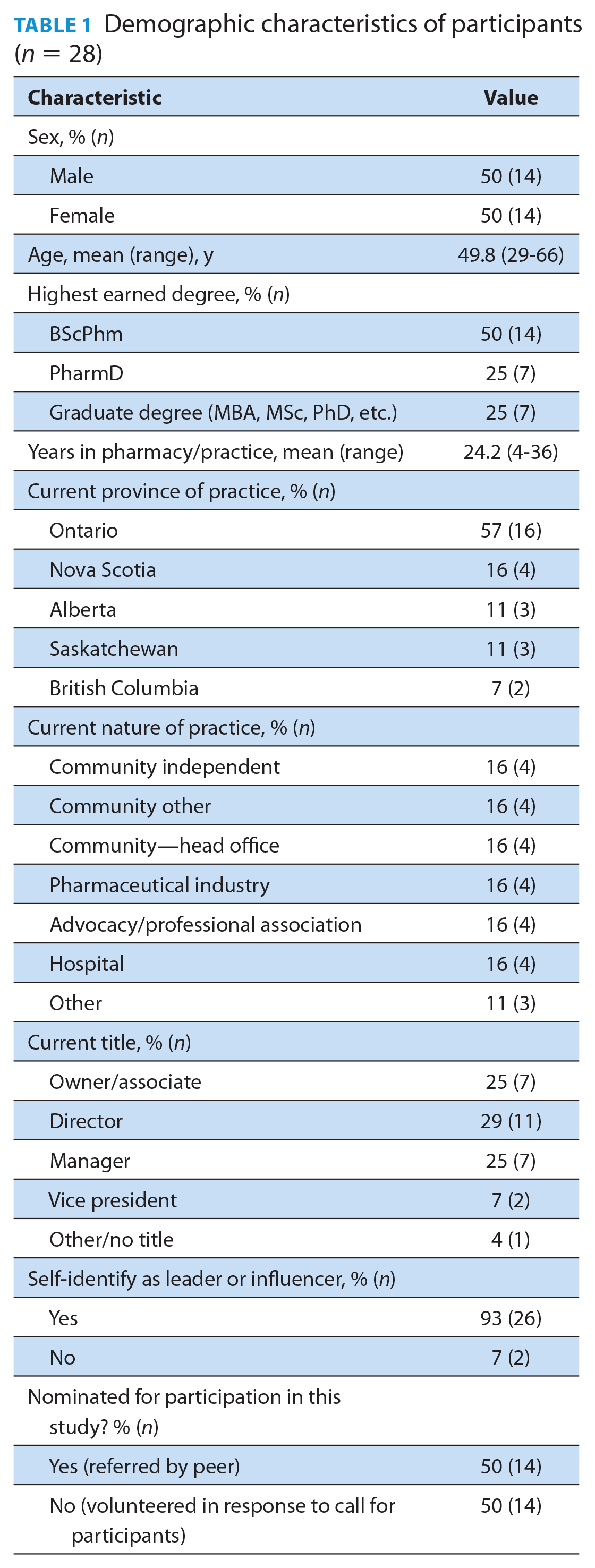
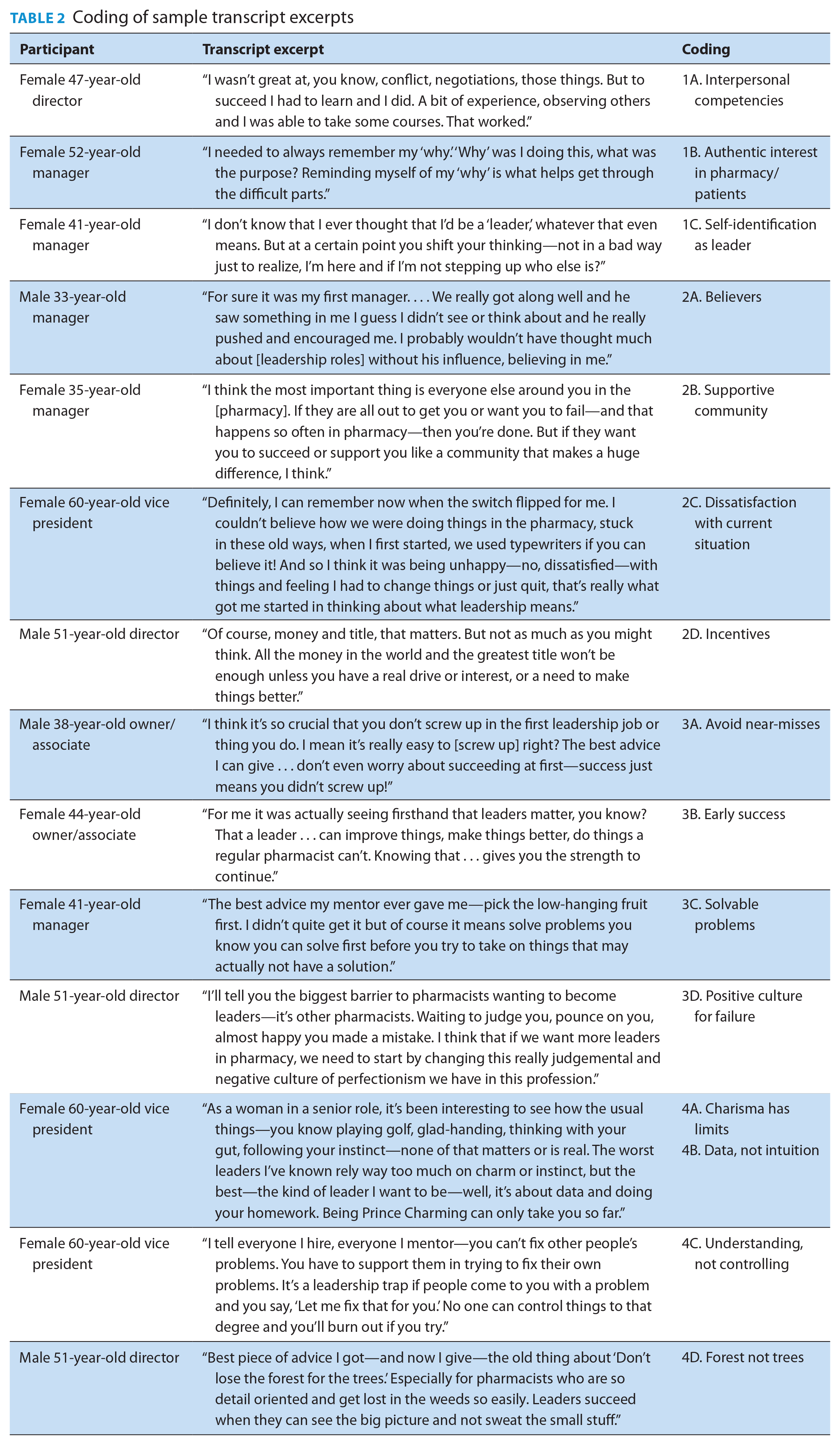
A total of 28 participants from across Canada were interviewed (see Table 1 for demographic characteristics of participants), who self-identified as either leaders and/or influencers. Several key themes emerged from the data. Sample transcript excerpts highlighting coding of these themes and subthemes are provided in Table 2.
Demographic characteristics of participants (n = 28)
Coding of sample transcript excerpts
1. Personal characteristics: It is sometimes claimed leaders are born, not made, suggesting that leadership requires certain characteristics. 5 The importance of certain personal characteristics in facilitating a leadership trajectory emerged in the data and highlighted the importance of foundational elements supportive of leadership, including the following:
A. Interpersonal competencies, including effective communication skills and the ability to manage conflict and negotiate
B. Authentic interest in pharmacy and/or patients
C. Self-identification or a professional identity as an individual with leadership potential
There was general consensus among research participants that, in many cases, these “personal characteristics” could be learned or improved upon through formal education and/or training, and in particular, confident expression of these characteristics was amenable to skill building through experience. Participants endorsed the notion that formal education and training in these essential “soft skills” was lacking in pharmacy and needs to be prioritized as a way of supporting the evolution of leaders from within the profession.
2. Supports and drivers: Participants in this study highlighted the inherently social and interpersonal dimensions of their personal leadership trajectory. This expressed itself as follows:
A. Pivotal role of mentors, teachers or other “believers” in helping them develop both self-awareness of leadership potential and providing a comfort zone to explore leadership roles
B. Being embedded in a supportive community or network of peers who provided encouragement and withheld judgement
C. Dissatisfaction with current practices based on immersion in day-to-day professional activities providing the psychological fuel necessary to consider leadership roles
D. The relatively low importance of traditional incentives (such as title/status, salary/perquisites or enhanced power) and the higher value of nontangible incentives (including personal and professional growth opportunities; access to resources required to make positive changes or the ability to learn from more senior colleagues). A common element of this theme was the notion that becoming a leader was a principled response to environmental circumstances and a way to lessen cognitive dissonance for the leader, rather than a self-interested end goal unto itself.
3. Positive reinforcers: Participants spoke about their early or formative experiences in leadership roles and how these were foundational in shaping future leadership trajectories. This included the following:
A. Mitigating negative emotional responses to “near-misses,” in which early setbacks caused reversion to a more cynical or fatalistic view of the profession or organization
B. Finding early success in accomplishing desired change as a way of positively energizing future leadership
C. Relying upon trusted mentors and believers to focus on identifying and prioritizing solvable, “low-hanging-fruit” problems first, rather than amorphous or seemingly unsolvable issues
D. Organizational and cultural commitment to ensure emerging leaders are not “hung out to dry” or unfairly blamed for early failures, as a way of demonstrating how failures could be managed rather than lead to psychological ruination
4. Predictors of success as a leader: Participants in this study were asked to reflect upon what they had learned through their own experiences that might be useful for new leaders to consider in terms of what constitutes a successful transition into leadership. Several important subthemes emerged, including the following:
A. Avoid overreliance on charisma: Typically, leaders (especially male leaders) have been portrayed as powerful, inspirational, loquacious individuals who command respect and awe and can therefore inspire others to do things differently. Most leaders in this study accepted the value of this stereotyped view of leadership but were equally quick to indicate that charisma alone was insufficient to sustain leadership in the long run. While charisma may have short-term value, they highlighted the ways in which it must be backed up by other competencies and skills. Further, those who self-identified as lacking in general charisma noted how this was not the barrier to leadership some may assume: indeed, in some roles, charisma itself may draw suspicion or contempt. Ultimately, charisma is simply one of many potential tools leaders may have at their disposal, but it is neither necessary nor sufficient for leadership.
B. Be driven by data, not instinct: Traditionally, leaders have been portrayed as having super-human instincts that allow them to read people and situations in ways that facilitate better decision-making and outcomes. The use of intuition, hunches and calculated risks by leaders has been part of contemporary culture. Perhaps counterintuitively, most participants in this study highlighted the work they had to undertake to learn to control these hunches and instead seek out and rely on objective data to be more effective as leaders in a sustainable manner.
C. Be understanding, not controlling: The term leader is often associated with the exertion of power over others.7,8 For most participants in this study, understanding others, rather than trying to control them, represented a more effective and sustainable path towards leadership and one that was more aligned with their general temperament and preferences. A leader’s work in understanding others paves the path towards compromise and win-win situations, while intransigent focus on nonconsensual goals simply breeds subversion and contempt. Most leaders in this study described interest in understanding rather than controlling as a psychological default state, highlighting its value to them in their leadership trajectory.
D. See forests, not trees: The detail-oriented and perfectionist tendencies of many pharmacists have been previously described as a potential barrier to practice change 3 ; participants in this study also highlighted the way in which these tendencies may be barriers to leadership potential.
Findings from this study raise important questions regarding the intersection of personality and opportunity and the environment in which the two mix. Leaders and influencers in this study noted the central importance of self-identification as an individual with leadership potential as important in their trajectory but also noted that such self-identification was not necessarily innate. For some, the support of “believers” and mentors caused them to shift their thinking, while for others, this nascent self-identity already existed and was nurtured through early successes. A key finding, however, was the central role of believers, mentors, coaches and supportive social and professional networks in providing positive reinforcement to help shape and nurture an evolving leadership self-identification. Formalizing such mentorship within the profession and ensuring it is not simply accidental good luck that allows some individuals to find believers may be a profession-wide project of importance in creating a culture of leadership.
This study also highlighted that there is no single or common pathway to leadership; it is the complex interplay of the 4 major themes of this study that produces multiple unique pathways for individuals to shift into leadership thinking and roles. This means that one-size-fits-all proposals for addressing the “leadership crisis” in pharmacy may not be as impactful as hoped; alternatively, this also suggests that multiple pathways exist that open leadership opportunities to a diverse array of individuals with different backgrounds, interests, personality types and supports. In a profession as ethnoculturally diverse and rich as pharmacy, this may be a positive finding insofar as it suggests that leaders from within can come from anywhere or everywhere. There is no required or prescribed starting point in the journey to leadership that precludes anyone from succeeding.
Importantly, the theme focusing on “predictors of success as a leader/influencer” suggested that while multiple trajectories into leadership may exist, once individuals found themselves in such positions of influence, there was a remarkable degree of conformity in terms of behaviour and expectation. While leaders started their journey from different places, with different influences and supports, the actual beliefs and behaviours of leaders were strikingly consistent: recognizing that understanding rather than control was important, or acknowledging the limited role of charisma in sustaining leadership/influence and focusing more on data rather than instinct in decision-making, was perhaps counterintuitive to the stereotype of leadership but consistently described as essential for success. This finding raises intriguing questions about the normalizing effects of leadership. Although individuals may start from different places and could potentially bring these different starting points to their role as leaders and influencers, upon reaching a certain level in the profession, a degree of conformity in thinking, feeling, belief and behaviour emerged. This aligns with cynical observations that leaders eventually are co-opted by the system that allows them to lead to serve the needs of the system itself but equally raises important questions about how new perspectives and outsider experiences can actually become part of the culture.
Finally, important findings regarding the general culture of pharmacy and pharmacists warrant reflection. Virtually all participants spoke about the importance of learning to manage initial failures and difficulties and the need to not be “hung out to dry” when leadership missteps or errors in judgement were made. In part, these comments reflected a prevailing, perfectionist cultural norm in pharmacy that is almost instantaneously unforgiving of both mistakes and risk taking. Others—mentors, believers, bosses, and so on—acted as buffers from the worst impulses of a perfectionist culture that may be quick to judge and consequently deflate interest and ambition to lead. This unstated nature of pharmacy culture may work in opposition to stated professional goals to expand leadership opportunities and encourage greater leadership ambition and needs to be explored further.
It is of course challenging to derive rules that are generalizable to all pharmacists, and this is a limitation of this study. Inclusion criteria for this study specified participants needed a minimum of 20 hours/week of patient contact time, in an effort to ensure participants were actually connected to the reality of work as a pharmacist; a limitation of this inclusion criterion could be exclusion of pharmacists in academia, industry, associations or regulatory bodies in an effort to ensure real-world grounding in practice was part of the participant’s experience. The initial objective of this study was to characterize common experiences among leaders and influencers in pharmacy with the hope that these findings might provide support for others in the profession reflecting upon their own leadership options, but it is not clear if subjectivity or other biases may have interfered with data collection and analysis. Further, most individuals who elected to participate in this study were already named/titled leaders in the field—results may have been different had more unnamed/untitled leaders been recruited (e.g., more focused on structural/systemic barriers), and this may be an opportunity for further research in this area. This study is unique in providing insights into the psychology of leaders and influencers in pharmacy, within the context of a distinct pharmacy culture. The qualitative research method used in this research was appropriate given the exploratory nature of the study but does not purport to be generalizable beyond the study participants.
Conclusions
As concerns about the “leadership crisis” in pharmacy continue to grow, research such as this will be important in helping to identify potential options for motivating the next generation to assume leadership roles and providing them with the support they need to succeed and thrive. Key findings from this study point to the central role of mentors/believers in nurturing leaders, the diverse pathways to leadership experienced by study participants, the counterintuitively marginal role of charisma and intuition in leadership success and the potentially antagonistic role of a perfectionist pharmacy culture that could dissuade promising leaders from this role. A key finding of this study relates to the need for significant upgrading of “soft skills”/interpersonal skills training in pharmacy education and continuing professional development to support individuals on a leadership trajectory. Further research to examine these issues will be needed in order to continue to prioritize leadership as central to the health and sustainability of the profession.
Supplemental Material
sj-pdf-1-cph-10.1177_17151635221136127 – Supplemental material for Understanding motivations and behaviours of our influencers: What can pharmacists learn from their leaders?
Supplemental material, sj-pdf-1-cph-10.1177_17151635221136127 for Understanding motivations and behaviours of our influencers: What can pharmacists learn from their leaders? by Madonna Gaballa, Kristin Kaupp, Paul Gregory and Zubin Austin in Canadian Pharmacists Journal / Revue des Pharmaciens du Canada
Footnotes
Funding:
Funding for this study was provided in part through an unrestricted educational grant from the Ontario College of Pharmacists.
Declaration of Conflicting Interests:
The authors declared no potential conflicts of interest with respect to the research, authorship and/or publication of this article.

References
Supplementary Material
Please find the following supplemental material available below.
For Open Access articles published under a Creative Commons License, all supplemental material carries the same license as the article it is associated with.
For non-Open Access articles published, all supplemental material carries a non-exclusive license, and permission requests for re-use of supplemental material or any part of supplemental material shall be sent directly to the copyright owner as specified in the copyright notice associated with the article.
