



Abstract

Are patients and community members asking complicated questions about naloxone? The goal of this 3-part informational series is to increase pharmacists’ knowledge on the frequently asked questions about naloxone, so that they can fill their own knowledge gaps as well as those of their patients. Pharmacists are key to ensuring all those at risk of an opioid overdose, or who are in a position to help, have naloxone and know how to use it. Beyond the signs and symptoms of opioid toxicity, naloxone administration, and the importance of calling 911, pharmacists can also be a resource for emerging research about naloxone and countering myths about it. In this series, we will be addressing real-world questions from pharmacists, service providers and community members about naloxone.
Access and barriers
Do all Canadians have access to naloxone?
All Canadians have access to naloxone, in theory. Canadian provinces vary with respect to pharmacy naloxone programs. Both intranasal (IN) and intramuscular (IM) naloxone are freely available (paid for by government) in Ontario, Quebec and the Northwest Territories (NWT), while other provinces only provide IM naloxone for free. 1 Even when naloxone is provided to the public for free, access varies. 2 For example, only half of all pharmacies in Ontario dispensed naloxone in 2018, and a third of the kits dispensed were from pharmacies in large urban centers. 3
Even with the expansion of eligible populations for naloxone kits, certain groups, including patients with prescribed opioids, are still less likely to be offered naloxone. 3 Patients taking high-dose opioids or receiving opioid agonist therapy are not routinely offered naloxone. With the rising number of opioid-associated deaths and disparities in access, data suggest that Canadians at risk of an opioid-associated overdose do not have adequate access to naloxone—there is much more room for optimization of naloxone distribution.
What are the barriers to expanding pharmacy-based naloxone distribution?
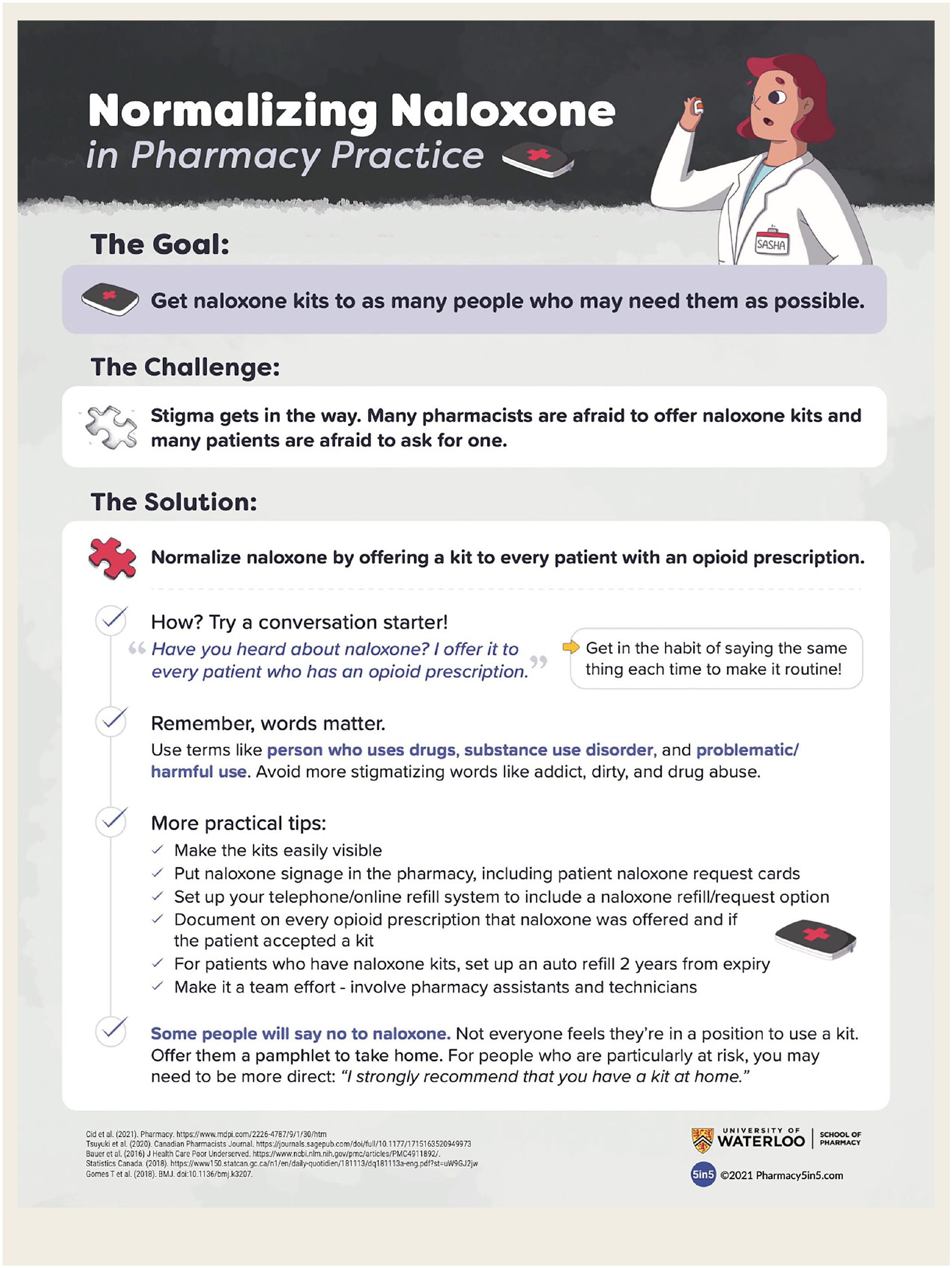
The most common barrier faced by both pharmacists and patients is stigma. 4 In surveys, members of the public report feeling hesitant to ask for a naloxone kit at a pharmacy due to a fear of being labelled an “addict” or being treated negatively by the pharmacy team for having a history of naloxone on their health record. 5 To overcome this barrier, pharmacies can provide nonverbal communication techniques such as a pamphlet that a patient can bring to the counter to signal that they want a naloxone kit. Pharmacies can also proactively offer a naloxone kit to all patients. 4 As well, pharmacists worry about offending patients and struggle to know how to bring up the topic of naloxone.5,6 One way to combat this barrier is through following the national consensus guidelines for pharmacists to offer a naloxone kit to every patient with an opioid prescription. 7 The normalization of dispensing and offering naloxone to all can help to break barriers in pharmacist hesitancy as well as patient stigma. 8
After the overdose
What are the long-term problems that can happen after an opioid poisoning is reversed by naloxone?
The goal of naloxone is to reverse the overdose before there is any permanent brain damage. In many cases, an opioid overdose can be successfully reversed with no harm to the individual. However, we know there is an increased risk of permanent disability and death in the year following even a successfully reversed overdose. 9 In 1 study, the estimation of all-cause mortality was 13 times higher in individuals who had experienced an opioid overdose. 10 Factors including human immunodeficiency virus, hepatitis, respiratory health and circulation health, as well as substance use, contributed to the increased mortality. 9 In a recent Canadian analysis, individuals who visited the emergency department due to an overdose had a mortality hazard 3.5 times higher than those who were at the emergency department for reasons unrelated to overdose. 11 In this same analysis, the mortality hazard was 7.1 times higher if the individual left the emergency department against medical advice. 11
How do people feel after being involved in an opioid overdose situation?
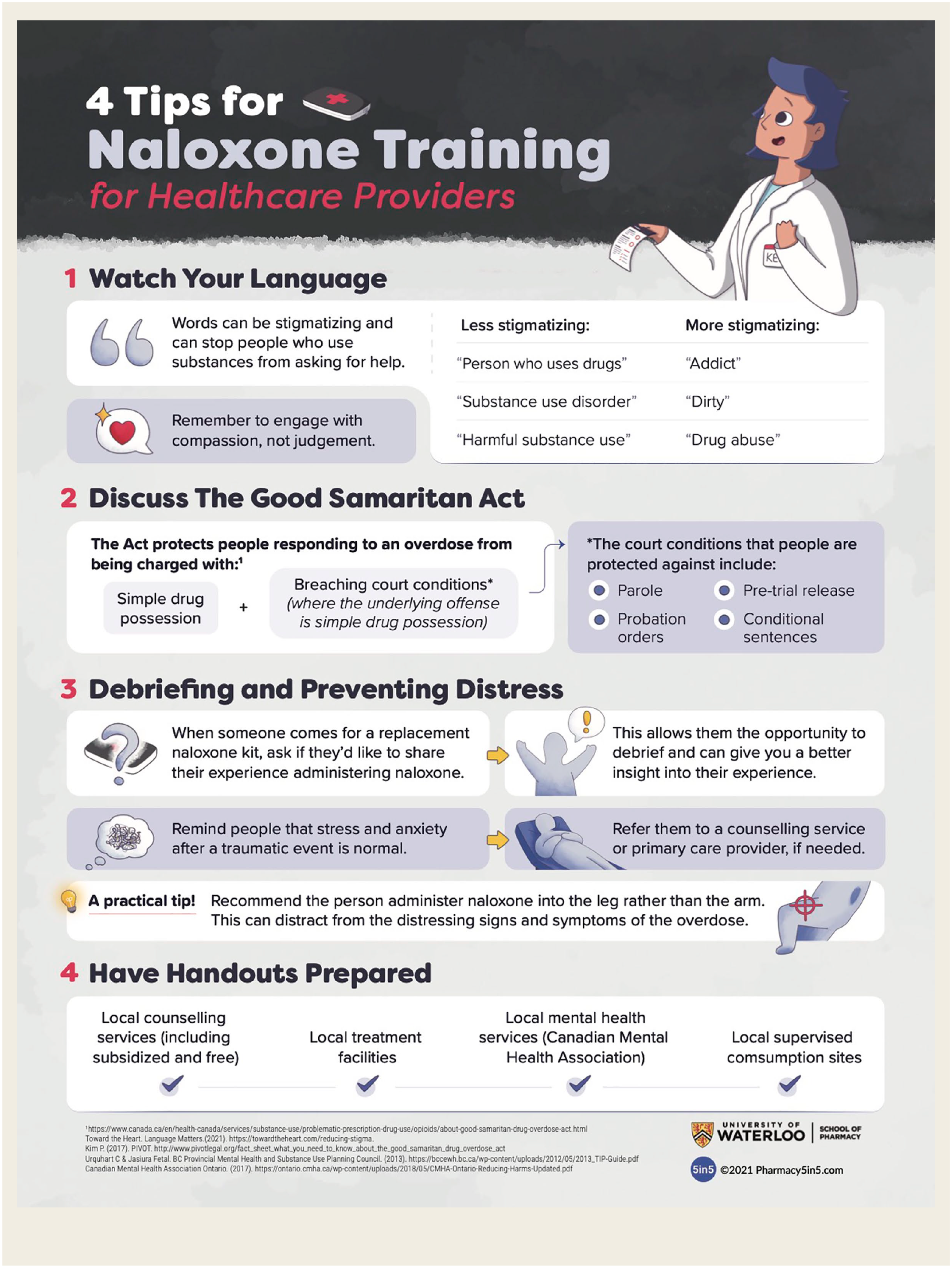
Individuals who work with those who use drugs have described the act of administering naloxone to be associated with anxiety, trauma and stress.12,13 There are reports of both positive and negative experiences after naloxone administration, including relief, confidence, disappointment and verbal/physical abuse from the victim.14,15 First responders and emergency personnel also report an emotional toll, burnout, exhaustion and helplessness associated with opioid overdoses. 16
It is important to discuss trauma and stress during naloxone training to increase awareness. Normalizing the value of debriefing and providing resources like local grief/support groups and counselling can help patients address the emotions caused from an overdose situation. ■
Footnotes
Acknowledgements
The authors thank George Daskalakis, Julianna Gotha, Maggie Yen, Alicia Oesch, Jennifer Curran, Morensa Lam and Heidi Fernandes for their help with this project.
Declaration of Conflicting Interests:
Michael A. Beazely serves on an advisory board for Emergent Biosolutions without financial compensation. The other authors declared no potential conflicts of interest with respect to the research, authorship and/or publication of this article.
Author Contributions:
All authors approved the final version of the article.
Funding:
The authors received no financial support for the research, authorship and/or publication of this article.
