




Abstract

Current health care trends, evidence and policies
Shifting demographics
Multimorbidity/polypharmacy
Decommissioning (deprescribing)
Government policies and strategies: patient centred, integrated health care system, fiscal restraint, evidenceinformed changes
Patient restraint, evidence
Understanding, monitoring and improving health care quality, including safety
Engaging patients in health care planning and policy
Advances in technology
The objectives of this article are to describe recent health care trends, evidence and policies and to identify opportunities for the profession of pharmacy. We pay particular attention to opportunities that use the full scope of pharmacy practice to make a difference in people’s lives.
Current health care trends
The modern pharmacist is largely responsible for helping patients navigate an increasingly complex and costly health care system, particularly with respect to medications. Demographic shifts have led to a situation where older adults now outnumber children under 15 years of age and 1 in 5 Canadians are immigrants, with mixed education and language ability.5,6 Polypharmacy is also commonplace in Canada, with 2 in 3 people over 65 taking more than 5 medications. 7 Drug therapy problems are common, largely preventable and clinically harmful, and they present an increasing burden to our health care system. Approximately 1 in 50 people have had a preventable adverse drug event 8 leading to emergency room visits 9 and increased costs to the health care system. 10 Total drug spending in Canada was estimated to be $39.8 billion in 2017 and made up the second largest share of health care expenditures. 11 The growth in use of health care services, including medications, has led to a general movement to decommissioning of specific health care services, including the reduction or stopping of medications where they may be doing more harm than providing benefit or where evidence for benefit is weak.
Technology is rapidly changing the way health care services are provided. Many pharmacies allow patients to access their own dispensing records. This allows for ease of online ordering of prescriptions and associated home delivery. Drug monitoring, disease monitoring, disease detection and pharmacogenetics are becoming more commonplace in community pharmacies. 12 Most physicians use electronic records,13,14 and almost 20% of Canadian physicians can exchange patient summaries electronically with other physicians. 15 As pharmacies develop improved technology, the integration of health care provider records and the emergence of patient-controlled or viewable health records are important areas of health care transformation. The planned national e-prescribing system will improve patient and provider access to more complete medication records and serve as a platform for many functions beyond medication management, such as e-referrals, patient bookings and interclinician messaging. 15
Government policies and strategies in Ontario,16,17 Alberta, 18 British Columbia 19 and Saskatchewan 20 are driving a patient-centred transformation of health care across Canada. Recent health policies encourage improved integration of the health care system and enhanced patient and community engagement in health policy and practice. Mental health is a dedicated policy focus in Canada.21-23 There is an increasing emphasis on using evidence to inform health policy.24-26 Inclusion of the patient voice in health care planning is becoming more commonplace. Scope of practice has expanded for several frontline health care providers, including prescribing by nurses and pharmacists.
The College of Family Physicians of Canada (CFPC) vision of the Patient’s Medical Home (PMH) 27 is another influential driver of organizational change within health care. The largest demonstrations of the PMH vision in Canada are through Family Health Teams 28 in Ontario, Family Medicine Groups (groupe de médecine de famille [GMFs]) in Quebec 29 and Primary Care Networks (PCNs) in Alberta. 30 A PMH primary care practice offers care that is intended to be seamless and centred on individual patients’ needs, within their community, throughout every stage of life and integrated with other health services. A primary care practice often includes an organized group of family physicians, nurses, pharmacists and other health care providers, who work together in one centre or virtually. Unfortunately, the PMH model places community pharmacy and other health care organizations outside of the primary care PMH (Figure 1) but still part of a patient’s circle of care.
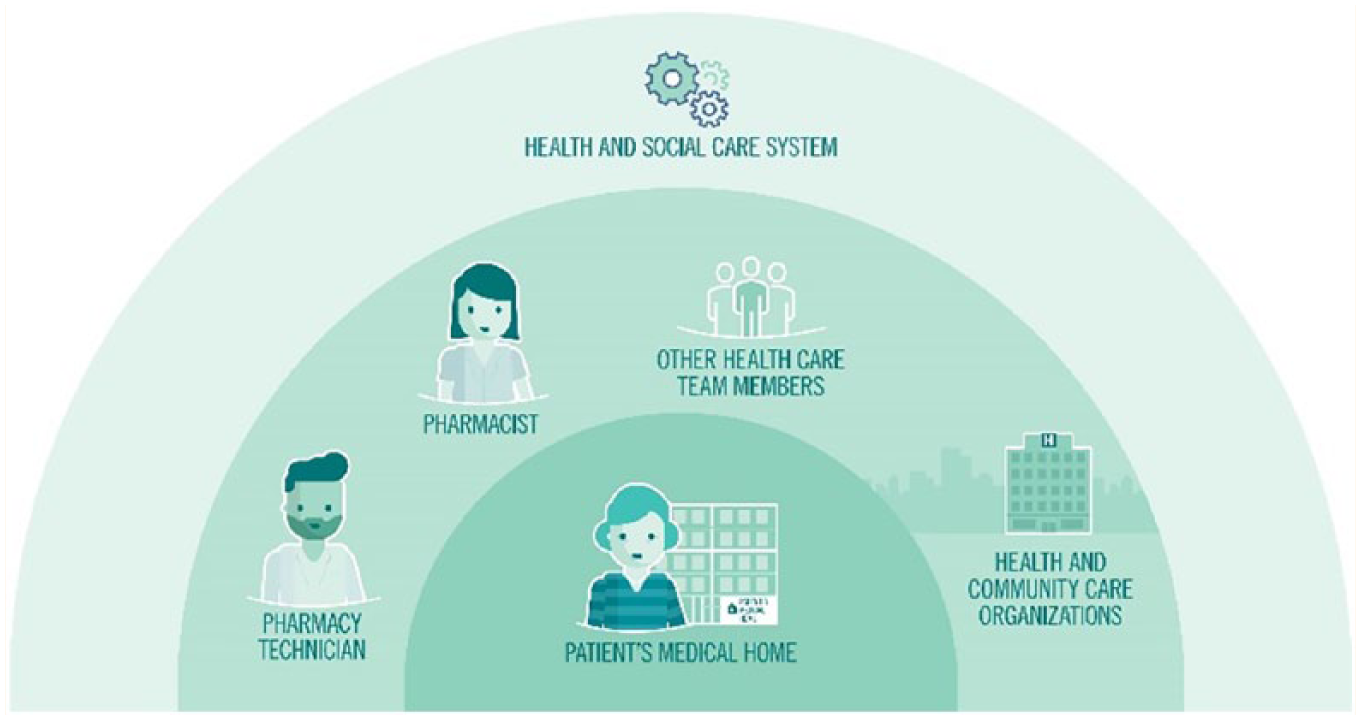
The relationship of the profession of pharmacy to the patient’s medical home within the health care system
There is increased emphasis on
It is revealing that pharmacy as a key health care profession is almost invisible or nonexistent within more recent health policy initiatives. These gaps identify the necessity for pharmacy stakeholders such as the provincial pharmacy advocacy organizations to assume a better advocacy role with respect to the development of pharmacy practice. Pharmacy has an established evidence base that supports the health and cost benefits of pharmacist activities in many settings, including community, primary care team, long-term care and hospital settings.33-42 For example, medication reviews have been shown to be useful in improving the management of diabetes or hypertension, overall appropriateness of medications prescribed and medication discrepancies, but they show mixed effects for other outcomes.43-48 Hospital pharmacist medication review reduces hospital readmission 49 and reduces length of hospital stay. 50 Community pharmacist–based targeted interventions, including those for cardiovascular care, renal disease, dyslipidemia, smoking cessation and diabetes care, improve outcomes for people with chronic diseases.51-54 Highlighting opportunities for the profession of pharmacy to contribute to quality medication management can increase the potential of Canada’s 42,500 pharmacists 55 (the third largest health care profession after nurses and physicians), who remain an incredibly underused health resource. 56
Pharmacy services
Canadians visit their pharmacies often; the average pharmacy dispenses 54,350 prescriptions each year. 57 Pharmacists provide a broad set of patient-focused clinical activities within a variety of health care settings, including comprehensive medication reviews (including diabetes-focused reviews), development of comprehensive care plans, independent prescribing (including renewing and adapting) prescriptions, providing prescribing recommendations, administering vaccines, counselling and prescribing for smoking cessation and providing targeted clinical services (e.g., anticoagulation, antimicrobial stewardship, health coaching). 58
Data from the Ontario Pharmacy Evidence Network (OPEN) research group and others demonstrate that uptake of community pharmacist–delivered medication reviews and vaccinations in Ontario is high.59-62 However, OPEN’s work has also uncovered challenges in community pharmacy service implementation, including delivery of medication review services away from those with more complex health situations towards younger individuals with fewer comorbidities and the lack of documented follow-up after initial assessment.63-65
Organizational-level considerations in pharmacy
Pharmacy is a self-regulated health care profession. Each jurisdiction has an organization in place that is responsible for serving and protecting the public and to hold pharmacists and pharmacy technicians accountable to the established legislation, standards of practice, code of ethics and policies and guidelines relevant to pharmacy practice.
While pharmacy is practised in diverse public and private settings, the for-profit community pharmacy sector employs a large proportion of pharmacists and technicians. 66 As the broader health system reform continues, several key themes continue to emerge for the community pharmacy sector. Beyond the different corporate structures in community pharmacy itself, the primary health care sector within which community pharmacy operates is also extraordinarily complicated. Patchwork funding and governance models among governments, employers, private citizens and third-party payers create tension but also opportunities for innovation and professional evolution. As government and private payers continue to put downward pressure on professional fees and as the number and range of pharmacies (particularly in urban and suburban areas) continue to increase, community pharmacies are working to find efficiencies to support operations and current levels of profitability. The physical structure and workflow systems of most community pharmacies are still oriented towards high-volume transactional dispensing practice. New practice models are evolving to fundamentally shift the nature of community practice by decoupling the compounding and dispensing functions of the profession of pharmacy from the medication management/cognitive services functions. Emerging trends, such as “central fill” and quasi-automated call centres to manage refills, will have an impact on the numbers and types of pharmacists and pharmacy technicians required and on the physical design of community pharmacies.
Approach used to identify opportunities for the profession of pharmacy in the future
A 5-step process was used to identify opportunities for the profession of pharmacy in the future (Figure 2). First, current health care trends, evidence and policies were considered to identify an overarching set of principles the profession of pharmacy should strive to achieve. Second, 10 topics that represent different aspects of professional pharmacy practice were examined to generate topic-specific future opportunity statements for the profession of pharmacy (Appendix 1). Topics and authors were chosen by 3 of the authors (LD, NW and ZA) based on the combination of review of emerging health care trends, major areas of focus of the OPEN and expertise of the author group. Although not all-encompassing, the list service-oriented topics (e.g., medication review, prescribing, immunization/injections), health care trend topics (substance use disorders, deprescribing) and health system organization topics (e.g., quality improvement, e-health) were felt to be broad and diverse enough to draw out directions for the profession of pharmacy when examined as a collection. One author took primary responsibility for generating an overview for a specific topic. This included the current context and topic-specific future opportunity statements that identify existing strengths within the profession of pharmacy and how these strengths can best serve and protect the public when considering health care trends, evidence and policies. The 10 topics were chosen intentionally to encourage future-oriented thinking for the pharmacy profession over the next 5 to 10 years while simultaneously grounding thinking in the present context. It was felt that this approach would provide inspiration for how the profession of pharmacy can evolve from its current state to a better future. Third, the topic-specific future opportunity statements for the profession of pharmacy were combined across the topics to generate an overall set of 50 future opportunity statements for the profession of pharmacy. Fourth, the set of future opportunity statements was mapped onto the overarching set of principles the profession of pharmacy should strive to achieve that was identified after considering current health care trends, evidence and policies. Fifth, deliberation on the set of 50 future opportunity statements generated 2 summary themes that emerged as the key future directives for the profession of pharmacy in the coming 5 to 10 years. The author group exchanged topic summaries and held 10 meetings (participants varied across meetings) to discuss each topic and the overall set of future opportunity statements and summary themes. The majority of participants attended a face-to-face introductory meeting to discuss initial ideas and refine the topics. The rest of the meetings were convened by teleconference to discuss the individual topics based on a 10-minute verbal presentation and accompanying written summary provided by the author (Appendix 1) (earlier in the process) or the summative analysis (later in the process). Formal notes were circulated to all group members.
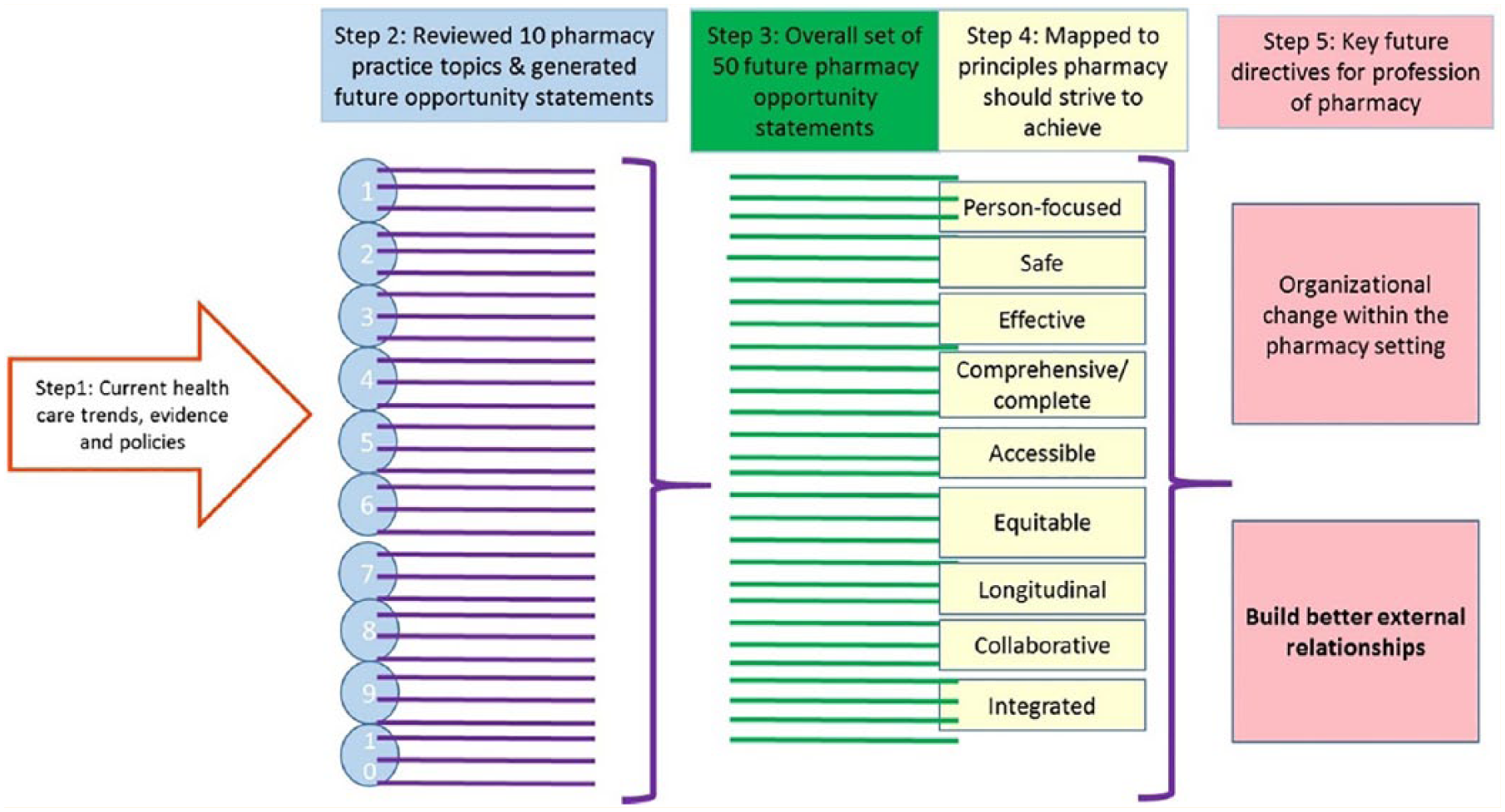
Description of the steps used to generate the future opportunity statements and summary themes
Principles that the profession of pharmacy should strive to achieve
The set of principles that the profession of pharmacy should strive to achieve were identified to be
Future opportunities that support principles the profession of pharmacy should strive to achieve
The 50 future opportunity statements are provided in Appendix 2. These future opportunity statements can be considered by pharmacists working in all practice settings.
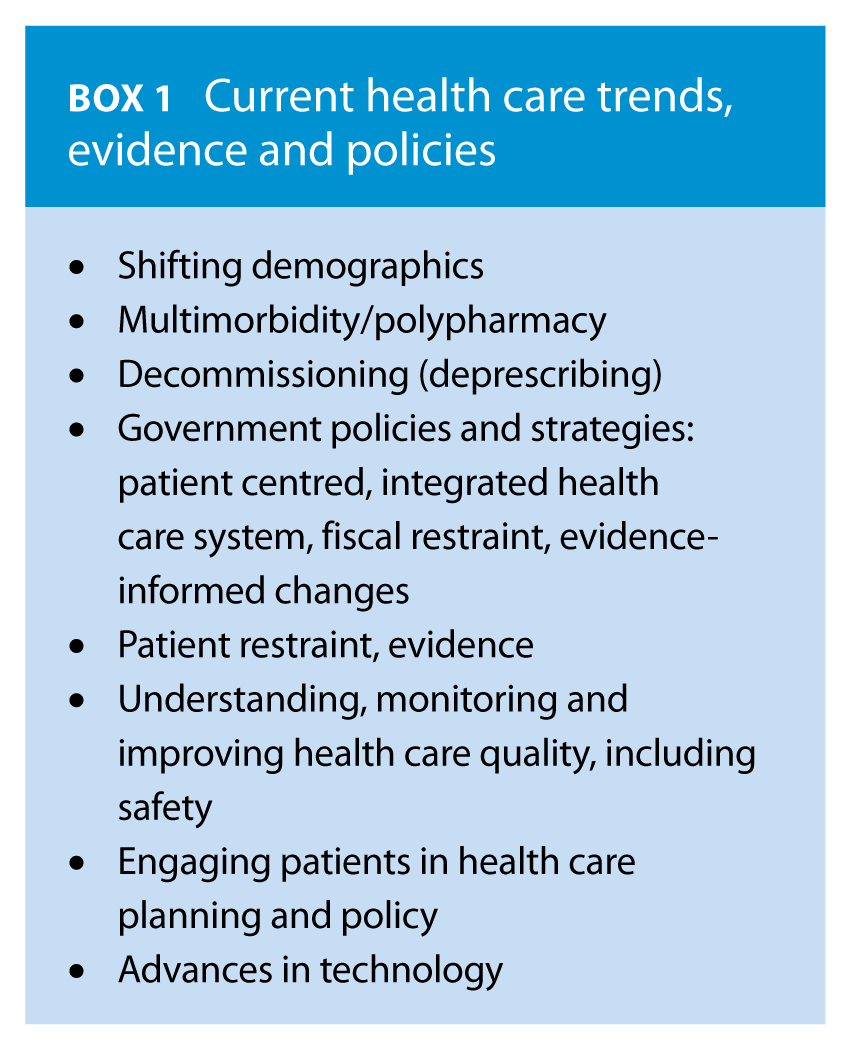
Future directions for the profession of pharmacy
Two summary themes,
Summary theme 1: Organizational change
The profession of pharmacy needs to undertake
The achievement of organizational change transformation is not dependent on first attaining new scopes of practice. Rather, this transformation can be accomplished by leveraging existing opportunities to enhance how the profession of pharmacy applies the current scope of practice, recognizing that these vary across Canada. There is a great need to ensure that each patient can be served with the optimal scope available at this time. Subsequently, each jurisdiction will consider how further enhanced scopes, such as initiation of any prescription, making recommendations for common ailments or widening the set of approved injections given by pharmacists (or pharmacy technicians), will offer additional benefits for patient care.
Summary theme 2: Better external relationships
The profession of pharmacy needs to
Conclusions
Transformational change is needed by the profession of pharmacy in all practice settings to tackle the medication management needs of Canadians for the purpose of improving health outcomes. This is a tall order. If the profession of pharmacy does not make these changes, we risk becoming irrelevant. Substantial cultural, professional, technological, health care system and business shifts are required. Alignment of multiple stakeholders to focus on patient and population health outcomes is needed to stimulate transformation. Determining how patients can benefit from the expertise and services provided by pharmacists as care providers within an integrated care system presents an important and exciting opportunity for the pharmacy profession.
Substantial evidence gaps exist to inform the profession of pharmacy about the most effective ways to meet today’s challenges. Evidence gaps include the need for data on implementation of new medication management approaches from the perspective of patients, pharmacists, other care providers and health-related organizations. Evidence gaps also include the need for data on the health outcomes and health care resource utilization changes due to implementation of new pharmacy-led medication management approaches. New evidence will improve understanding of how a particular activity, service or approach to care can better meet patient and health care system needs or provide associated benefits. In turn, this will help the profession of pharmacy encourage organizational change within the pharmacy setting and in how it connects to patients where they live and with other health care organizations.
Supplemental Material
815717_App_1_online_supp – Supplemental material for Pharmacy in the 21st century: Enhancing the impact of the profession of pharmacy on people’s lives in the context of health care trends, evidence and policies
Supplemental material, 815717_App_1_online_supp for Pharmacy in the 21st century: Enhancing the impact of the profession of pharmacy on people’s lives in the context of health care trends, evidence and policies by Lisa Dolovich, Zubin Austin, Feng Chang, Barbara Farrell, Kelly Grindrod, Sherilyn Houle, Lisa McCarthy, Lori MacCallum and Beth Sproule in Canadian Pharmacists Journal / Revue des Pharmaciens du Canada
Supplemental Material
815717_App_2_online_supp – Supplemental material for Pharmacy in the 21st century: Enhancing the impact of the profession of pharmacy on people’s lives in the context of health care trends, evidence and policies
Supplemental material, 815717_App_2_online_supp for Pharmacy in the 21st century: Enhancing the impact of the profession of pharmacy on people’s lives in the context of health care trends, evidence and policies by Lisa Dolovich, Zubin Austin, Feng Chang, Barbara Farrell, Kelly Grindrod, Sherilyn Houle, Lisa McCarthy, Lori MacCallum and Beth Sproule in Canadian Pharmacists Journal / Revue des Pharmaciens du Canada
Footnotes
Acknowledgements
Thank you to Anita Di Loreto and Natalie Bozinovski for administrative support. Thank you to Annalise Mathers, Manmeet Khaira, and Xioa Li for comments and copy-edits. Thank you to Susan James, Anne Resnick, and Nancy Lum-Wilson for thoughtful discussion, input and edits.
Author Contributions:
All authors approved the final version of the article. Each author generated an overview for one specific topic, participated in group discussion, reviewed the manuscript critically for important intellectual content and approved the final submission.
Declaration of Conflicting Interests:
The authors declared no potential conflicts of interest with respect to the research, authorship and/or publication of this article.
Funding:
Ontario College of Pharmacists and Ontario Pharmacy Evidence Network. This paper is a condensed and adapted version of a White Paper prepared by the Ontario Pharmacy Evidence Network (OPEN) at the request of the Ontario College of Pharmacists (OCP) for the purpose of stimulating a discussion within the profession. The White Paper was presented to OCP Council on June 11, 2018. The authors received no personal financial support for the research, authorship and /or publication of this article.

References
Supplementary Material
Please find the following supplemental material available below.
For Open Access articles published under a Creative Commons License, all supplemental material carries the same license as the article it is associated with.
For non-Open Access articles published, all supplemental material carries a non-exclusive license, and permission requests for re-use of supplemental material or any part of supplemental material shall be sent directly to the copyright owner as specified in the copyright notice associated with the article.
