




Abstract
Capsule Summary
Rubber additives, preservatives/disinfectants (aldehydes), and hydroxyisohexyl 3-cyclohexene carboxaldehyde are important sensitizers in female cleaners with occupational dermatitis. A decreasing time trend in glutaraldehyde sensitization was observed over the study period. These findings emphasize the need for targeted prevention and continuous allergen monitoring in the cleaning industry.
INTRODUCTION
Occupational dermatitis (OD), which mainly consists of hand dermatitis, is a frequent condition in the cleaning industry. Its point prevalence estimates range from 2.2% to 30.1%. 1 A recent study, however, indicates that the point prevalence of hand dermatitis in cleaners may be underestimated if based solely on self-reported data. 2 OD often comes along with adverse consequences as it is associated with reduced quality of life, substantial individual and societal costs, sick leave, and potential job change.3B4 -6
Cleaners perform a high amount of wet work, including repeated hand washing together with prolonged glove use, and are exposed to disinfectants and cleaning agents,1,4,7B8 -10 which results in an increased risk for occupational irritant and/or allergic contact dermatitis.6,11-13
While the association between wet work, cleaning agents, and occupational hand dermatitis is well established, detailed data on sensitization rates, profiles, and time trends in the cleaning industry remain limited. Therefore, this study of the Information Network of Departments of Dermatology (IVDK) analyzes data obtained from cleaners patch tested in the participating centers in Germany, Switzerland, and Austria from 2010 to 2022. This complements the previous study by Liskowsky et al, 14 which analyzed IVDK data of cleaners patch tested from 1996 to 2009. That study reported a 31% prevalence of allergic contact dermatitis among female cleaners with OD and identified major sensitizers such as rubber additives, particularly thiurams (11.6% [95% confidence interval or CI: 9.1–14.1]), zinc diethyldithiocarbamate (3.4% [95% CI: 2.1–4.7]), and mercaptobenzothiazole (MBT, 1.8% [95% CI: 0.7–2.9]), as well as formaldehyde (3.4% [95% CI: 2.0–4.7]). The current study aims at providing an updated overview of the primary sensitizers that may cause allergic contact dermatitis in cleaning staff and assessing influencing factors and trends over time.
MATERIALS AND METHODS
Fifty-eight dermatology departments in Germany, Switzerland, and Austria contributed data to this analysis. The IVDK’s structure and procedures are detailed elsewhere. 15 Briefly, patients’ history, clinical data, and patch test (PT) results are recorded locally, pseudonymized, and transmitted to the IVDK office twice a year. After standardized quality control, data are added to the central IVDK database and analyzed following international standards.16,17
All IVDK members belong to the German Contact Dermatitis Research Group (DKG). PTs were performed according to DKG guidelines.18,19 PT reactions on day 3 (D3) were considered, or on day 4 (D4) in rare exceptions if no D3 reading was performed. Readings coded as +, ++, or +++, that is, positive reactions with erythema, infiltration, papules, and/or (coalescing) vesicles were rated as positive. PT preparations were purchased from Almirall Hermal, Reinbek, Germany (until 2013); SmartPractice Europe (SmP), Greven, Germany (from 2014 on); and in exceptional cases from Chemotechnique Diagnostics, Vellinge, Sweden. PT exposure time was 24 hours in 15.8% and 48 hours in 84.2% of patients. For the majority of patients, Finn Chambers (8 mm inner diameter, SmP) on Scanpor were used. Absolute test numbers varied due to changes in the DKG baseline series and limited commercial availability of test allergens (Supplementary Table S3).
Between 2010 and 2022, 140,973 patients underwent patch testing in 145,913 consultations. Of these, 2372 had been working as cleaners. Among them, 2142 (90.3%) were female. Since sex influences sensitization to common allergens such as fragrances, essential oils, fragrance markers, 20 and metals like nickel, cobalt, and chromium, 21 comparative analyses focused on female patients.
The MOAHLFA Index items hand (H), leg (L), and face (F) dermatitis represent primarily affected sites. 22 Up to 3 “suspected allergen sources” and the main “indication for patch testing” were documented prior to patch testing. With regard to patients’ medical history and alignment of PT results with occupational and nonoccupational exposures, patients were defined as OD cases if their dermatitis was conceivably caused occupationally. Accordingly, female cleaners with OD constituted the study group (n = 860) and female cleaners without OD constituted the comparison group (n = 966) as the possibility for occupational causation was not given. For 316 patients, the etiology remained unclear; these were excluded. If patients were tested multiple times, only the last PT was included.
Percentages of proportions of anamnestic items or reaction frequencies in disjunct groups of patients are presented with 95% CIs using the Wilson score method. For comparison purposes, age-standardized reaction frequencies were calculated (50% females <40 years, 50% females ≥40 years). Significance of group differences was concluded from nonoverlapping 95% CIs. Additionally, P values were calculated using Fisher’s exact test on a 5% level for raw reaction rates (Supplementary Table S3) and anamnestic items, with Benjamini–Hochberg correction applied for multiple testing. The time trend analysis was performed with the exact Cochran–Armitage trend test, P values <0.05 were considered significant. Data were managed and analyzed using the statistical analysis software SAS©, version 9.4 (SAS Institute, Cary, NC, USA). 23
RESULTS
MOAHLFA Index
The demographic profile of both groups, represented by the MOAHLFA index, 24 is documented in Table 1. Hand dermatitis was significantly more frequent among female cleaners with OD, whereas leg and face dermatitis were more common in the comparison group. The age distribution also differed significantly: 690 (80.2%) female cleaners with OD were aged 40 years or older, compared with 830 (85.9%) in the comparison group. A detailed description of the age distribution is given in Supplementary Table S1.
Population Characteristics of Female Cleaners and Controls (MOAHLFA Index)
Significant differences are marked in bold.
Owing to group definition.
95% CI, 95% confidence interval; OD, occupational dermatitis.
Suspected Allergen Sources
Table 2 shows significant differences in suspected allergen sources (up to 3 per patient) 15 between female cleaners with OD and the comparison group. Occupational exposures, especially to cleaning agents, disinfectants, and gloves, were more frequently reported as suspected allergen sources in female cleaners with OD. In contrast, cosmetics and creams (leave-on products) were more prominent in the comparison group.
Suspected Allergen Sources (Up To 3 per Patient) in the Study Group and the Control Group
Only significant differences are depicted and marked in bold.
95% CI, 95% confidence interval; OD, occupational dermatitis.
Final Diagnoses
Among female cleaners with OD, the most common diagnosis was chronic irritant contact dermatitis (32.8%, n = 282), followed by allergic contact dermatitis (25.3%, n = 218). Further diagnoses included atopic dermatitis (12.6%, n = 108), hyperkeratotic eczema (6.2%, n = 53), acute recurrent vesicular eczema (5.3%, n = 46), unspecified eczema/dermatitis (3.8%, n = 33), acute irritant contact dermatitis (3.6%, n = 31), airborne dermatitis (1.3%, n = 11), and nummular eczema (0.5%, n = 4). Other diagnoses accounted for 8.6% (n = 74).
Workplace Cofactors
Workplace cofactors contributing to disease etiology were identified in 710 female cleaners with OD (82.6% [95% CI: 79.9–85.0]), significantly more than in the comparison group (n = 251, 26.0% [95% CI: 23.2–28.9], P < .001). Main cofactors included the occlusive effects of wearing protective gloves (or boots in 6 patients; 49.3%) and wetness (38.7%). Other factors such as heat, mechanical stress, and dryness were uncommon.
PT Results Obtained With the DKG Baseline Series
The DKG baseline series was patch tested in 802 (93.3%) female cleaners with OD and 858 (88.8%) without OD. Age-standardized reaction frequencies and 95% CIs are presented in Table 3; raw data are available in Supplementary Table S3. Significantly increased proportions of positive reactions were observed among female cleaners with OD for various sensitizers, particularly rubber additives (thiuram mix [8.6%, 95% CI: 6.5–10.7], zinc diethyldithiocarbamate [2.0%, 95% CI: 0.9–3.1], mercapto mix [without MBT, 1.3%, 95% CI: 0.4–2.1]), formaldehyde (2.3%, 95% CI: 1.0–3.6), and hydroxyisohexyl 3-cyclohexene carboxaldehyde (HICC; 3.0%, 95% CI: 1.5–4.6).
Age-Standardized Patch Test Results Obtained With the German Contact Dermatitis Research Group Baseline Series Among Female Cleaners With Occupational Dermatitis (n = 860) in Comparison to Female Cleaners Without Occupational Dermatitis (n = 966), Information Network of Departments of Dermatology 2010–2022
Significant differences are marked in bold. Unless otherwise indicated, petrolatum was used as vehicle.
aq, aqua; Std., age-standardized, 95% CI, 95% confidence interval; CBS, N-cyclohexyl-2-benzothiazolesulfenamide; MBTS, 2,2ʹ-dithiobis(benzothiazole); MOR, morpholinylmercaptobenzothiazole; OD, occupational dermatitis.
PT Result Obtained With Special DKG Test Series
The PT results of female cleaners with OD illustrate specific sensitization patterns across 6 special DKG test series (see Supplementary Tables S2 and Table S4–S9). In the DKG “preservatives (in topical preparations)” series, sensitizations to methylisothiazolinone (5.6%, 95% CI: 3.6–7.6) and methyldibromoglutaronitrile (0.3% in petrolatum) (4.5%, 95% CI: 1.5–7.6) were most frequent. In the DKG “ingredients of topical preparations” series, sensitizations to Amerchol L-101 (2.9%, 95% CI: 1.2–4.6) and butylhydroquinone (2.4%, 95% CI: 0.7–4.0) dominated. Sensitizations to povidone iodine (10.9%, 95% CI: 8.0–13.8) and glutaraldehyde (5.5%, 95% CI: 3.2–7.9) were most common in the DKG disinfectants series. Among the rubber series, sensitizations to tetraethylthiuram disulfide (7.9%, 95% CI: 5.7–10.2) and tetramethylthiurammonosulfide (5.6%, 95% CI: 3.6–7.6) showed the highest reaction frequencies. In the DKG “additional fragrances subject to declaration” series, sensitizations to treemoss absolute (2.8%, 95% CI: 0.0–8.2) and stabilized linalool (2.6%, 95% CI: 0.0–7.8) were most frequent. In the “additional fragrances and essential oils” series, ylang-ylang oil (3.6%, 95% CI: 1.6–5.7), clove oil (2.3%, 95% CI: 0.0–4.9), and patchouli oil (2.3%, 95% CI: 0.0–6.7) showed the highest reaction frequencies.
Time Trends in Sensitization to Selected Test Allergens
From 2010 to 2022, only sensitizations to glutaraldehyde (0.3% pet.) showed a significant time trend among female cleaners with OD (exact Cochran–Armitage trend test, P = 0.03; see Fig. 1 and Supplementary Table S10). A stratified 6-year comparison revealed a substantial but nonsignificant decline between 2010–2015 (24 out of 355 positive, 6.8% [95% CI: 4.6–9.9]) and 2016–2021 (7 out of 251 positive, 2.8% [95% CI: 1.4–5.6]).
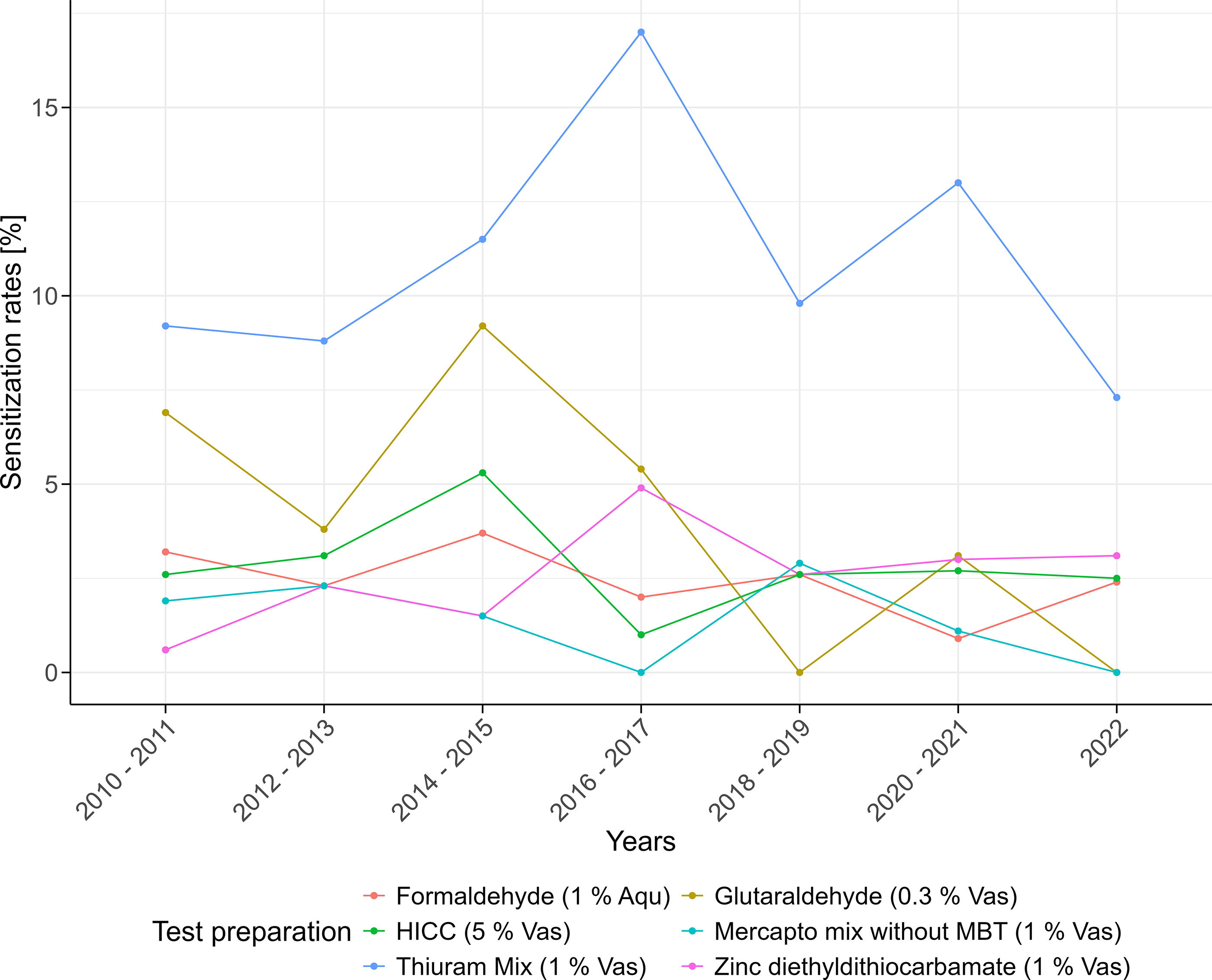
Time trends in sensitization to selected test allergens in female cleaners with occupational dermatitis from 2010 to 2022. The allergens include formaldehyde (1% Aqu), glutaraldehyde (0.3% Vas), HICC (5% Vas), thiuram mix (1% Vas), mercapto mix without MBT (1% Vas), and zinc diethyldithiocarbamate (1% Vas). Data points represent biennial intervals. HICC, hydroxyisohexyl 3-cyclohexene carboxaldehyde; MBT, mercaptobenzothiazole.
DISCUSSION
This study updates and extends the findings of Liskowsky et al 14 on sensitizations in the cleaning industry. PT data of female cleaners with OD confirm that, in addition to HICC, rubber additives and preservatives/disinfectants (aldehydes) remain occupational key sensitizers. Their significantly higher reaction frequencies compared to the comparison group of cleaners without OD underscore their ongoing impact on occupational health in the cleaning sector. Our findings are in line with a recent Danish single center study, 25 where professional cleaners were characterized by a high share of occupational and hand dermatitis, as well as an increased prevalence of sensitization to thiuram mix. Unfortunately, according to different study designs, both publications are not directly comparable. However, among the cleaners from Denmark (about 50% with OD), additionally nickel sulfate was identified as important allergen, while sensitization to preservatives, disinfectants, or HICC was not found to be associated with being a professional cleaner.
Rubber Additives
Our study shows that type IV sensitizations to rubber accelerators remain a major occupational health problem in cleaners. Compared to the control group, female cleaners with OD had significantly higher sensitization rates to thiurams (8.6% vs 2.6%), zinc diethyldithiocarbamate (2.0% vs 0.2%), and mercapto mix (without MBT) (1.3% vs 0.1%). MBT (2% pet.) also showed a marked difference (1.4% [95% CI: 0.4–2.3] vs 0.2% [95% CI: 0.0–0.5]). These findings reflect continued exposure to vulcanization accelerators via protective rubber gloves, a key source of allergic contact dermatitis.26,27 This is consistent with Bauer et al 28 and other studies reporting high rates of sensitization to rubber additives in patients with OD from various occupational groups.29-31 Although the use of thiurams in rubber glove production has vanished, sensitization remains high,32,33 likely due to close chemical relationship and subsequent cross-reactivity with dithiocarbamates, 34 which are now commonly used. Hansen et al 27 highlight ongoing risks from accelerators in rubber gloves and emphasize the need for improved protective measures and stricter regulation. However, selecting accelerator-free protective gloves remains challenging, especially when handling detergents and disinfectants.
Important work-related cofactors in cleaners are occlusion from protective gloves and wetness. Both do not only induce irritant contact dermatitis but also increase the risk of allergic contact dermatitis 27 by enhancing skin permeability and thus skin penetration of allergens from gloves, cleaning agents, and industrial products. 30 As shown by Tiedemann et al, 35 glove occlusion alone has limited effects on the skin barrier but significantly aggravates damage when combined with irritants. This underscores the importance of minimizing allergen contact, especially when the skin barrier is already compromised.
Preservatives
Formaldehyde remains a relevant sensitizer in female cleaners with OD, with a significantly increased reaction frequency (2.3% vs 0.6%). Compared to Liskowsky et al 14 (3.4%), our findings suggest a decrease in sensitization over time. The downward trend was not statistically significant but may still reflect reduced exposures to formaldehyde due to the nowadays widespread use of formaldehyde-free disinfectants, keeping in mind that current PT results may still reflect historical sensitizations.
High proportions of positive reactions to methylisothiazolinone (MI, 5.6%) and methylchloroisothiazolinone/methylisothiazolinone (MCI/MI, 5.9%) were found in female cleaners with OD. These are likely attributable to the widespread use of MI in cosmetics before European Union (EU) restrictions (ban in leave-on, limit to 15 ppm in rinse-off products).36-38 The peak of the MI epidemic (2013/2014) falls within our study period. No significant differences between both analyzed groups suggest that the sensitizations to MI and MCI/MI may reflect nonoccupational rather than occupational sensitization, despite the presence of MI in some cleaning agents. Schnuch et al 39 observed a shift of MI sensitizations from cosmetic to industrial sources after 2013/2014. In line with Marrero-Alemán et al 40 and Silva et al 41 who call for reducing the exposure to MI in cleaners, this emphasizes the ongoing need for stricter regulations of MI in non-cosmetics.
Benzisothiazolinone (BIT) reactions occurred in 2.2% (95% CI: 0.0–5.2) of female cleaners with OD versus 5.5% (95% CI: 0.0–13.2) in the comparison group. Despite its use in cleaning agents, this lack of a significant difference aligns with Geier et al 42 and Søgaard et al, 43 suggesting that BIT is not a major occupational allergen in cleaners, unlike in painters or metalworkers.
Methyldibromoglutaronitrile (0.3% pet.) showed sensitization rates of 4.5% among female cleaners with OD. Its use has been banned in cosmetics in the EU since 2005 for leave-on products, 2008 for rinse-off products, and further restricted for non-cosmetic applications like cleaning agents in 2010. Since 2018, it is only allowed as preserving agents in type 6 products, that is, during storage. 44 Despite these regulations, positive reactions in patch testing persist. This could partially be related to historical sensitizations and false-positive reactions, especially with the 0.3% test preparation. 45
Disinfectants
The high reaction frequency to povidone iodine (10.9%) in female cleaners with OD should be interpreted cautiously, as the 10% test preparation is known to cause a high number of false-positive PT reactions. Forkel et al 46 showed that these reactions are often irritant rather than allergic and that the commercial test concentration is too high. Since iodine-containing disinfectants are not used for cleaning, the observed reactions in our study likely primarily reflect irritant responses.
Glutaraldehyde elicited positive reactions in 5.5% of female cleaners with OD. Its ongoing presence in surface disinfectants stresses the need for improved protective measures and alternative disinfectants to counteract sensitization. Increased prevalence of glutaraldehyde sensitization was also reported among nurses with OD, suggesting a similar exposure risk in health care settings. 47
Our longitudinal analysis using the exact Cochran–Armitage trend test, which is known to overestimate significances, shows a significant decreasing time trend for sensitizations to glutaraldehyde in female cleaners with OD from 2010 to 2022. A more robust analysis on reaction rates comparing the first and the second half of the study period revealed no significance as 95% CIs do overlap. Compared to Liskowsky et al, 14 who reported a reaction frequency of 2.8% (95% CI: 1.3–4.2) to glutaraldehyde among female cleaners with OD patch tested from 1996 to 2009 (also aimed testing), the proportion of positive reactions to glutaraldehyde from 2010 to 2015 was significantly higher (6.8% [95% CI: 4.6–9.9]). This period represents a clear peak, with current reaction rates now returning to earlier lower levels. The observed fluctuations in sensitization highlight the necessity for continuous monitoring.
Fragrances and Essential Oils
Avoiding exposures to fragrances remains a challenge in the cleaning industry as they are contained in many cleaning products. Among all fragrances of the DKG baseline series, only sensitization to HICC was significantly more frequent in female cleaners with OD (3.0%) compared to the comparison group (0.6%). However, to our knowledge, HICC has not been commonly used in cleaning agents and has been banned in cosmetics within the EU since 2021. Thus, past occupational exposure through cosmetics such as emollients or barrier creams is the most likely source.
For essential oils, our data show high sensitization rates for ylang-ylang oil (3.6%), clove oil (2.3%), and patchouli oil (2.3%) in female cleaners with OD. While essential oils are rarely used in cleaning products by large cleaning companies, individual components such as the fragrances linalool and geraniol (found in ylang-ylang oil) and eugenol (found in clove oil) can be present in cleaning products. De Groot and Schmidt 48 provide detailed information on the composition of common essential oils, supporting these findings. Sensitization to these components might occur, particularly with high levels of exposure. However, the sources of sensitization remain elusive.
LIMITATIONS
The analysis is based on clinical data and not the general population (of all cleaners). Changes in the DKG baseline series and limited availability of some allergens may have influenced comparability. Clinical relevance of positive PT reactions and PTs of patients’ own materials were not evaluated. The results cannot be generalized to male cleaners, as analyses focused on females. Time trend analyses of rare allergens are limited by small numbers and potential statistical overestimation of significance. Single positive reactions were possibly missed as PT readings on day 7 were often not performed and therefore not considered.
CONCLUSIONS
Rubber additives and preservatives/disinfectants (aldehydes) remain occupationally relevant sensitizers in female cleaners with OD in addition to HICC, highlighting the need for improved protective measures. These findings are crucial for developing targeted prevention strategies to eliminate exposure to relevant contact allergens in the workplace and improve long-term working conditions.

References
Supplementary Material
Please find the following supplemental material available below.
For Open Access articles published under a Creative Commons License, all supplemental material carries the same license as the article it is associated with.
For non-Open Access articles published, all supplemental material carries a non-exclusive license, and permission requests for re-use of supplemental material or any part of supplemental material shall be sent directly to the copyright owner as specified in the copyright notice associated with the article.
