




Abstract
Non-uniform temperature distributions of concrete box girders are induced by solar radiation depending on the structural shapes and shadows cast on them. Using a real-time shadow-selection algorithm and finite element method, the thermodynamic analysis of concrete box girders is carried out to simulate their time-varying temperature distributions. The theoretical results of the finite element model (FEM) are verified by measured data. Based on this, a series of FEMs of concrete box girders are established considering regional influences, and the temperature gradients of concrete box girders in different climatic zones in China are studied. The most unfavorable temperature gradient of concrete box girders in China is obtained, and it is important for design and not only for health monitoring. Moreover, comparing the temperature gradient modes in the specifications of various countries, the temperature gradient of concrete box girders in the China Highway Bridges Design Code is conservative for structural design. Furthermore, the influences on structural temperature distributions of varying environmental factors induced by regional influences are explored, including atmospheric transparency coefficient (ATC) and solar radiation absorptivity (SRA).
Keywords
Introduction
Concrete box girder bridges are exposed to complex environmental actions including solar radiation, ambient temperature, and windy conditions, causing the non-uniform temperature distributions to vary with time continuously. The nonlinear temperature distributions of the concrete structures depend on the geographical situation, orientation, climatic conditions, and thermal properties of the structures.1,2 There are vast territory and complex terrain in China, forming complex and diverse climate characteristics of monsoon climate. The temperature distributions of concrete box girders caused by solar radiation considering regional influences deserve to be researched furtherly.
Some studies have focused on temperature distributions of concrete structures in various climatic conditions. The effects of different climatological conditions on the performances of concrete structures have been investigated. 3 Different geographical regions have different climate types in China, so non-uniform temperature distributions of concrete box girders are various in different geographical regions under different environmental conditions.4,5 Due to the limited thermal conductivity of concrete material, the temperature variation inside the concrete structures lag behind the surfaces under the action of solar radiation, thus forming temperature differences in the concrete structures. 6 When the deformation induced by temperature differences is restricted by the box girder itself or redundant constraints, thermal stresses can be produced, sometimes even greater than the thermal effect caused by vehicle load.7,8 The non-uniform temperature fields tend to cause nonlinear temperature gradient models. Experimental analysis of temperature distributions and temperature gradients in concrete bridges under the variation of air temperature have been caused for concern. 9 Thus, the regional influences and the main influencing factors of the temperature fields including ATC and SRA of concrete box girders warrant further detailed study, and this provides valuable references for design and not only for health monitoring.
Some studies have focused on the temperature gradients of concrete bridges considering environmental actions. The characteristics of temperature gradients of the concrete box girders induced by solar radiation in Shanghai have been investigated, and the recommended solar temperature gradients are obtained. 10 The FEMs have been established on the concrete box girder bridge located in Guizhou, China, to study the thermal behaviors induced by solar radiation using the vertical temperature gradients. 11 An experimental study has been carried out to obtain the temperature gradients of concrete girders under seasonal environmental conditions in the United States. 12 Equations to predict temperature gradients of concrete box girders have been proposed and the equations have been verified by the experimental results. 13 The temperature gradients of concrete bridge girders under natural environmental conditions have been obtained based on temperature experiments. 14 The temperature gradients of concrete box girders have been studied based on long-term temperature experiments and high moment theory. 15
Moreover, the temperature distributions of concrete box girder bridges induced by cold wave processes differ from those induced by solar radiation or nighttime radiation cooling, proving environmental factors influence the temperature fields of box girder bridges. 16 Previous studies listed above concentrate on certain regions, few studies pay attention to temperature gradients influenced by complex environmental factors of various climatic zones in China. Nowadays, a unified temperature gradient model is used on concrete box girders of various climatic zones in China, the influence of geographical location, and climatic types on temperature gradient models are not taken into account. Although the unified temperature gradient model is convenient to use widely, it is necessary to study its applicability in extensive national and regional lands.
In this study, based on a real-time shadow-selection algorithm and finite element method, a simplified method is developed to obtain the time-varying solar radiation temperature distributions of concrete box girders considering regional influences. Moreover, the trends of temperature variation in concrete box girders are researched furtherly. Based on the geographical distribution characteristics, typical regions are selected to represent various climatic zones in China. Thus, the temperature distributions of each typical zone are obtained, and the temperature gradient models in various climatic zones are researched. Furthermore, the influences on structural temperature distributions of varying environmental factors determined by regional climatic characteristics are explored, including ATC and SRA.
Time-varying solar radiation temperature calculation flow
Thermal environment and solar radiation energy
The concrete structures exchange heat with the outside environment all the time. 17 The thermal environment of the concrete box girders under solar radiation is shown in Figure 1. The heat exchange can be divided into solar radiation, thermal irradiation, and convection. 18 Solar radiation received by the structure is radiant energy emitted by the sun throughout the atmosphere. Thermal irradiation absorbs or radiates heat from the atmosphere and surfaces of the earth. Convection represents the heat transferred between the surfaces of the structures and the surrounding air. 19
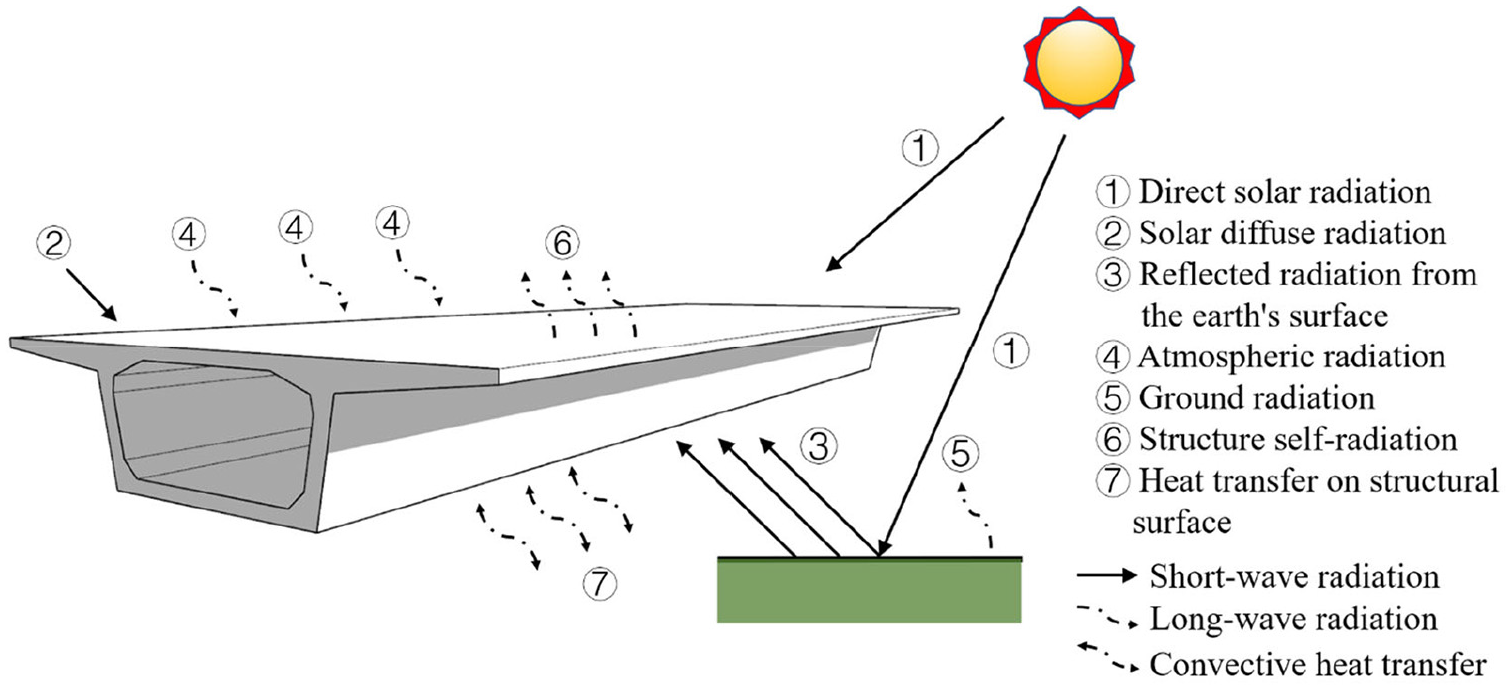
Thermal environment of the concrete structures.
In Figure 2, the surfaces of the box girders can be divided into four types of areas according to the spatial position and the energy gain induced by solar radiation. The area of the bottom flange belongs to Area 2 because the angle between the bottom surfaces of the cantilever flange and the horizontal plane is small. Zones of the surfaces of the box girder from Area 1 to Area 4 can be described as follows:
Area 1 is the area of the top flange and top surface of the cantilever flange,
Area 2 is the area of the bottom surfaces of the bottom flange and cantilever flange with solar reflectance from the ground,
Area 3 is the area of the web without direct solar radiation,
Area 4 is the area of the web with direct solar radiation.

Areas of the surfaces of the box girder.
According to the four types of areas and simulation method of heat transfer mentioned above, the boundary conditions of heat transfer analysis on the surfaces of bridge structures have been established from equations (1) to (5):





Where
Real-time shadow-selection algorithm
The outside surfaces of the structures can be divided into the illuminated area and shadow area based on their structural characteristics, geographical location, and solar orientation. 17 The illuminated and shadowed area of the structures have different heat exchanges with the external environment. 18 The real-time shadow area on structural surfaces can be calculated by a real-time shadow-selection algorithm.
Solar orientation
The solar orientation varies with time, described by the longitude and latitude coordinates


In terms of the expression presented by Lamm,
25

Where
The coefficients of

Based on the spatial position of the sun and the bridge, equation (9) relating


The spatial position of the sun and the bridge.
The azimuth angle


Where
Time-varying solar radiation surfaces
The time-varying solar radiation surfaces of the box girder are selected based on the solar orientation. The real-time shadow surfaces on the box girder side web are obtained based on a real-time shadow-selection algorithm, considering the self-shadow area and mutual shadow area.
29
In Figure 4, the outside surfaces of the right web are self-shadowing area under the action of Light 1, and the sheltered area of the right web is a mutual shadow area under the action of Light 2. The selection of the mutual shadow area can be divided into two steps: Step 1: solve the coordinates of the intersection point
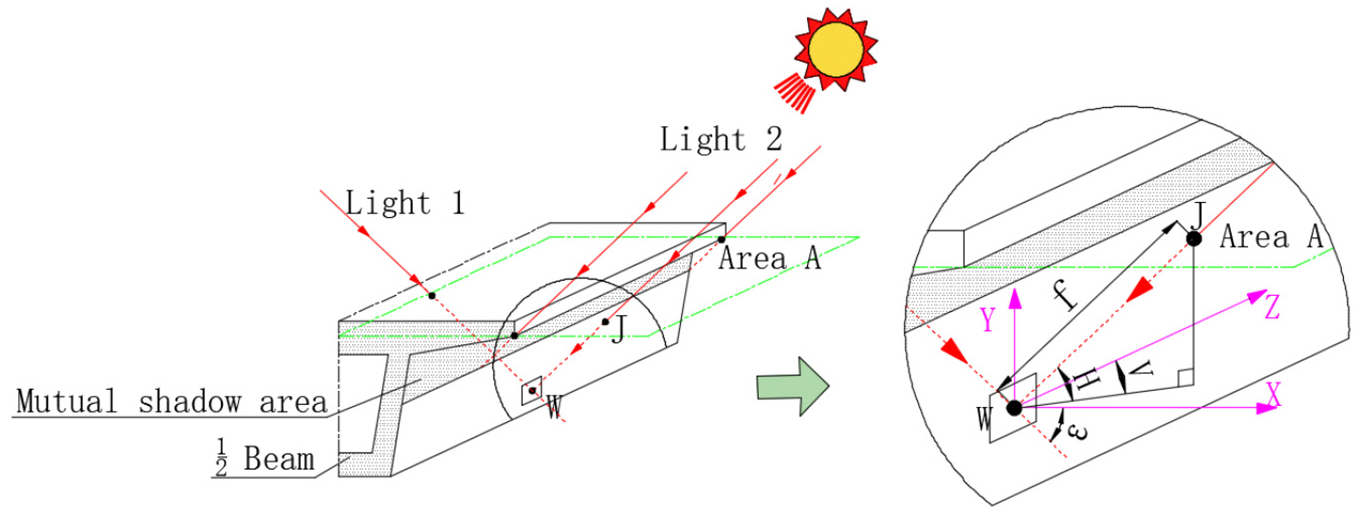
Selection of time-varying solar radiation shadow surfaces of box girder.
The coordinates of the point


After obtaining the coordinates of the point

When the signs of the cross product
Calculation flow
Solar radiation acting on each surface of the concrete box girders differs due to the movement of the sun, and the illuminated and shadowed surfaces of the structure have different convective coefficients, affecting the accuracy of the temperature distributions computations.31,32 Based on this, a method to calculate solar radiation energy was developed based on a real-time shadow-selection algorithm and finite element method. The flow of calculating solar radiation and temperature fields is shown in Figure 5. Firstly, the real-time solar orientation is calculated. Then, the box girder surfaces with sunlight cast on in real-time are selected based on a real-time shadow-selection algorithm. Furthermore, the time-varying temperature distributions induced by solar radiation of the concrete box girders are obtained.

Calculation flow.
FEM and experimental verification
FEM and key parameters
In this study, the FEM (112,574 elements; 160,212 nodes) of a 3 × 30 m simply-supported concrete box girder bridge is established by Solid75 element (Figure 6) using ANSYS 19.0. The heat flux grid can be retrieved by time, element location, and the temperature of the element surfaces, and it is used as the load boundary conditions for the thermodynamic simulation.
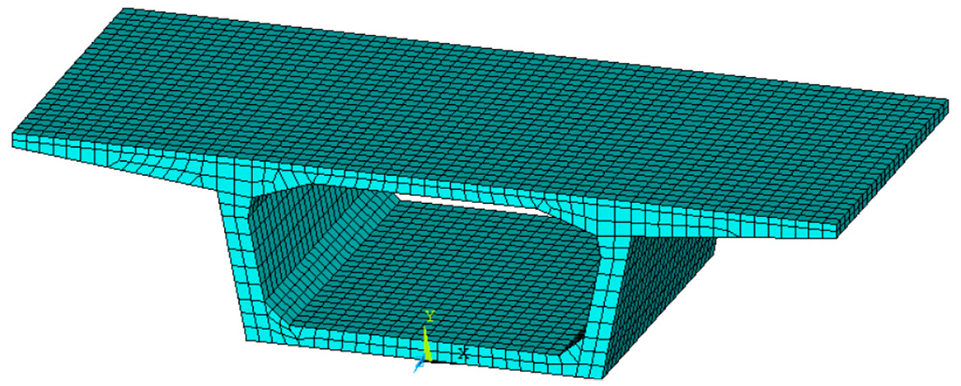
Finite element model.
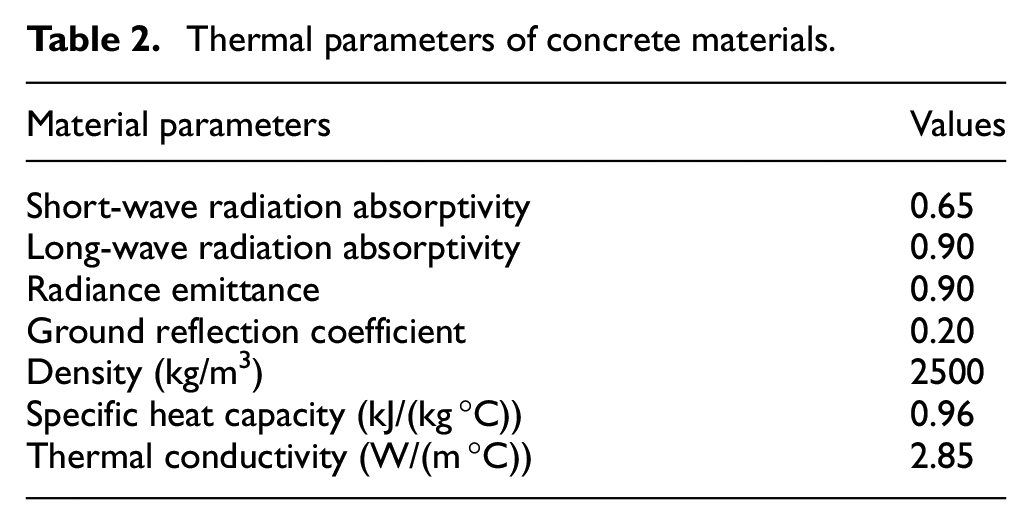
When using heat transfer to calculate the temperature distributions in finite element analysis, many key parameters need to be determined, including solar radiation absorptivity, radiance emittance, ground reflection coefficient, density, specific heat capacity, and thermal conductivity.11,16 The thermal parameters of concrete materials used in this study are provided in detail in Table 2. 33
Thermal parameters of concrete materials.
Experimental verification
To verify the accuracy of the FEMs, the measured data of the concrete box girder located at Yan’an (N36.7°, E109.5°) are compared with the calculation data in this study. The calculation parameters of the FEM located at Yan’an are listed in Table 3.
Calculation parameters used in this study.

It is customary to assume that the minimum air temperature (13.0°C) and maximum air temperature (30.0°C) occur at 3:00 and 15:00, respectively, and the air temperature variation is defined by equation (16) 34 :

When

Measured and calculated values of the FEM in Yan’an: (a) on the top flange and (b) on the bottom flange.
Figure 7 compares the measured temperature variation and the heat transfer analysis results of the top flange and bottom flange of the concrete box girder located at Yan’an. The variation laws of measured and analyzed values are almost the same, and the average relative error between the measured and calculated data is only 8.74%. The differences between the measured and calculated data are due to the different time-varying environmental actions between experimental tests and FEM analysis.21,35 Thence, the FEM analysis following the adopted procedure can accurately predict the time-varying temperature variation considering regional influences.
Temperature distributions considering regional influences
Typical temperature geographical zones in China
There are vast territory and complex terrain in China, forming complex and diverse climate characteristics. Temperature geographical zones are divided based on typical climatic types, so non-uniform temperature distributions of concrete box girder structures are varying in different temperature geographical zone with the change of environmental factors. Temperature distributions and temperature gradient models of concrete box girders considering regional influences deserve to be researched. Typical climatic types in China can be divided into tropical monsoon climate type, subtropical monsoon climate type, temperate monsoon climate type, temperate continental climate type, and alpine climate type of Qinghai Tibet Plateau.
The tropical monsoon climate type is distributed in Hainan and the South China Sea Islands, the subtropical monsoon climate type is distributed in the southern provinces to the north of the Tropic of cancer, the temperate monsoon climate type is distributed in the northeast and northern provinces, the temperate continental climate type is distributed in Xinjiang and Inner Mongolia, and the alpine climate type in the Qinghai Tibet Plateau is distributed in Tibet and Qinghai (Figure 8). 36

Typical temperature geographical zones in China.
The temperature condition, solar radiation duration, and solar radiation intensity of each typical climatic region have obvious differences between them, influencing the temperature distributions of concrete box girders. Therefore, the temperature gradient models of concrete box girders considering regional influences deserve to be studied furtherly.
Temperature gradient model considering regional influences
Based on the FEMs verified above, 34 FEMs of concrete box girders located in various typical climatic zones in China are established. The calculation parameters of FEMs are simplified as follows: the wind speed is 1 m/s, the weather is sunny, and the temperature is determined according to the average maximum temperature and average minimum temperature at the hottest month of the typical zones according to meteorological data from the China Meteorological Administration (http://www.cma.gov.cn/).
In this study, the maximum temperature differences of the concrete box girders are obtained from the surfaces of the top flange. Figure 9 shows the maximum temperature differences of the 34 FEMs of concrete box girders located in different temperature geographical zones in China.
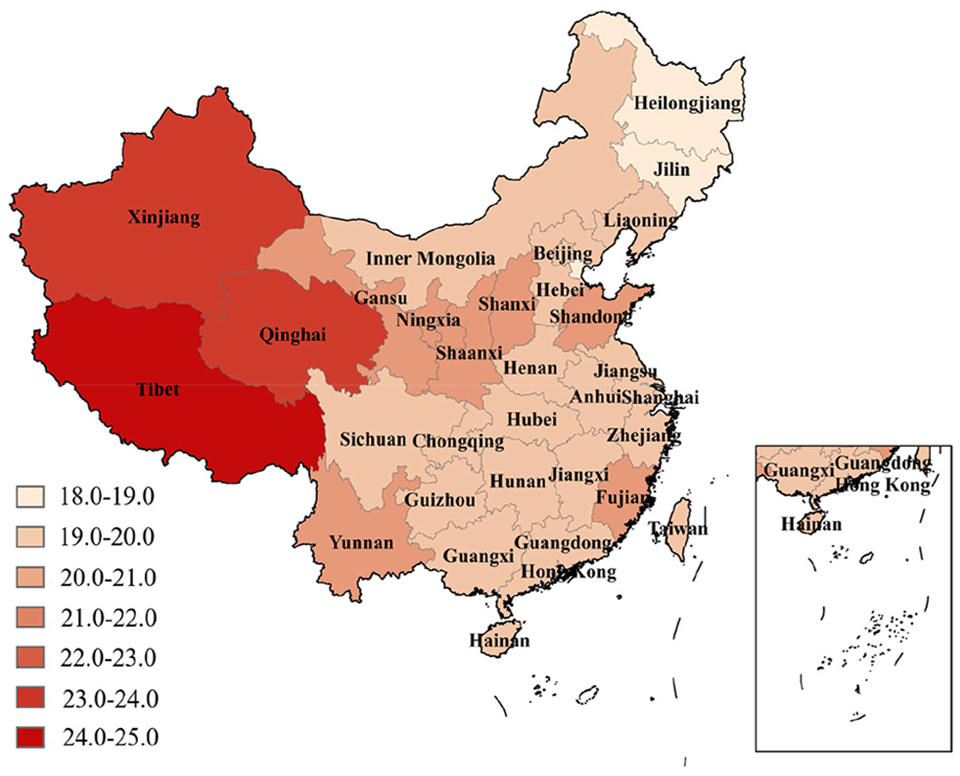
The maximum temperature differences distributions in China (°C).
From Figure 9, the maximum temperature difference of the concrete box girder is from 18.0°C to 25°C in China. The maximum temperature difference distributions are affected by longitude and local climate types. The maximum temperature differences are similar in the tropical monsoon climate type, the subtropical monsoon climate type, and the temperate monsoon climate type. The maximum temperature differences in the temperate continental climate type and the alpine climate type of Qinghai Tibet Plateau are higher than other climate types. Among the maximum temperature difference distributions in China, the most unfavorable temperature difference is in Lhasa. The temperature gradient curve of Lhasa is drawn and compared with the existing specifications in China and abroad in Figure 10.
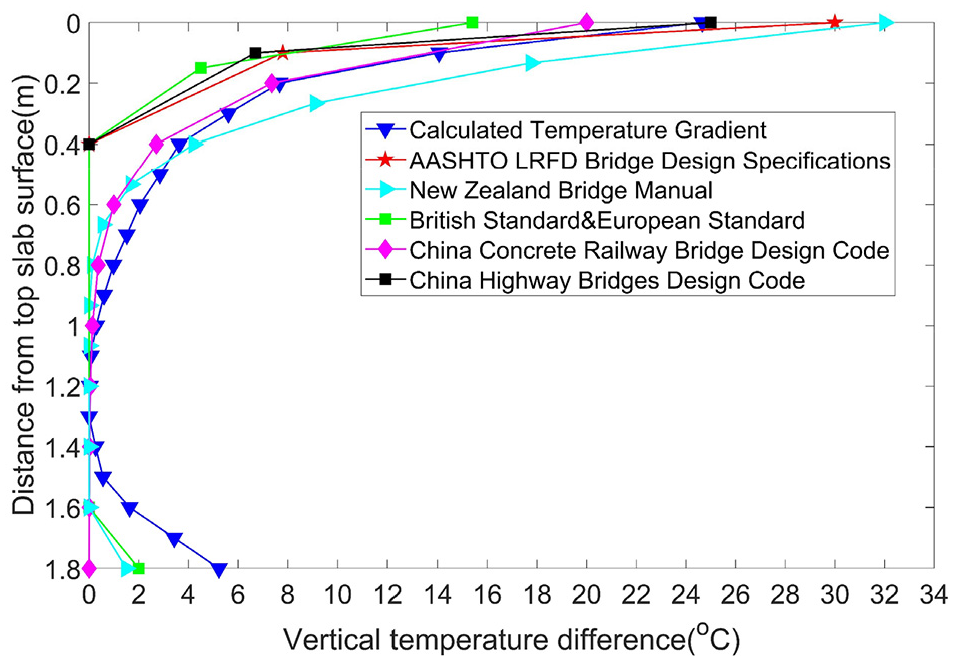
Comparison of calculated temperature gradients with existing specifications.
From Figure 10, the temperature gradient of Lhasa differs from that of Chinese and foreign specifications in numerical values and curve forms. In Lhasa, the maximum temperature difference of the bottom flange is 5.2°C, and it is larger than other specifications. The maximum temperature difference on the top flange is 24.7°C, and it is only smaller than the 25°C, 30°C, and 32°C specified in China Highway Bridges Design Code, AASHTO LRFD Bridge Design Specifications, and New Zealand Bridge Manual, respectively. The temperature difference specified in China Highway Bridges Design Code is concentrated in the range of 0.4 m from the top flange, and the temperature at the bottom flange is not considered. The calculated temperature gradient curve is not only widely distributed in the range of 1.3 m from the top flange but also distributed at the bottom flange. 37
Moreover, the temperature gradient model of the concrete box girder located in Lhasa can be studied furtherly. The temperature gradient model of the concrete box girder follows the exponential function and linear function (Figure 11).

The temperature gradient model of the concrete box girder.
From Figure 11, the exponential function of the temperature gradient model is described by equation (17):

Where

Where
Influences of environmental parameters considering regional influences
The temperature distributions of the structures induced by solar radiation are affected by the natural environment, and thermal parameters of concrete. The temperature gradient models of concrete box girders considering regional influences have been explored. It is found that the calculation parameters differ in different typical temperature geographical zones, including ATC, and SRA. The ATC related to weather conditions including altitude, ozone, water vapor, smoke, and dust, influences the direct solar radiation intensity.21,38 The SRA reflects the absorption degree of solar radiation by the structure, and the type of concrete, the color of the concrete surfaces, and the roughness of concrete surfaces also lead to different SRA in different geographical regions.6,39 Thus, the influence of environmental factors on the temperature distributions of the concrete box girders considering regional influences deserve to be researched.
In Figure 12, points 1 and point 2 are the centers of the top and bottom edges of the top flange, points 3 and 4 are the centers of the top and bottom edge of the bottom flange, and path a and path b are along the center lines of the two webs.

Calculation paths and points of the concrete box girder.
Atmospheric transparency coefficient
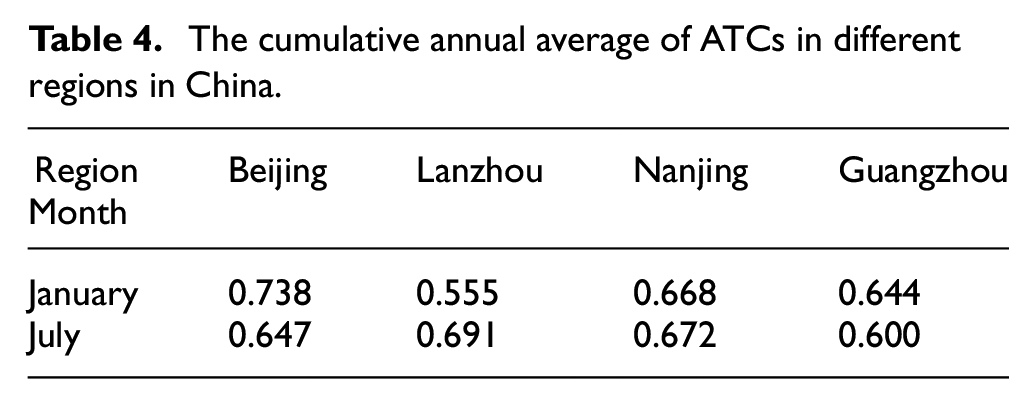
When the atmosphere is affected by the floating layer and sand, the ATC decreases by about 0.1–0.3. When clouds and fog appear, the ATC decreases by about 0.1–0.2. In densely populated and industrially developed areas, large amounts of pollutants are produced, reducing the ATC by about 0.1. Therefore, the influences of the ATC on the temperature distributions of the concrete box girders in different geographical regions are discussed. Table 4 shows the cumulative annual average of ATC in different regions.
The cumulative annual average of ATCs in different regions in China.
In this section, the temperature distribution characteristics of the concrete box girders are compared and analyzed with the ATC varying from 0.3 to 0.9, and the temperature distributions with the variation of ATC are shown in Figure 13. The temperature distributions with the variation of ATC (15:00) on path a and path b are shown in Figure 14.

Temperature distributions with the variation of ATC: (a) point 1, (b) point 2, (c) point 3, and (d) point 4.

The temperature distributions with the variation of ATC: (a) path a and (b) path b.
From Figures 13 and 14, the ATC has a linear effect on the maximum temperature on the top and bottom flanges of the concrete box girder induced by solar radiation. The higher the ATC, the higher temperature of the concrete box girders. When the ATC increases by 0.3, the temperature difference will increase linearly by about 5.4°C, 2.1°C, 0.4°C, and 1.2°C at Point 1, Point 2, Point 3, and Point 4, respectively. Moreover, the ATC has an insignificant effect on the webs due to the mutual shadow occurring at 15:00. Besides, the maximum temperature on the box girder increases linearly with the ATC growing, and the increases of maximum temperature on the top flange are greater than those on the bottom flange.
Solar radiation absorptivity
The type of concrete, the color of the concrete surfaces, and the roughness of concrete surfaces used in bridges tend to be different in different geographical regions leading to different SRA. 20 Table 5 shows the SRAs of different types of concretes and coatings used in civil engineering. Different SRAs lead to different temperature distributions of the concrete box girder. In this section, the trends of temperature variation in the concrete box girders are compared and analyzed when the SRA are 0.25, 0.55, 0.65, and 0.75, respectively.
The SRAs of different types of concretes and coatings.

Figure 15 shows the temperature distributions characteristics of the concrete box girders with different SRA. Figure 16 shows the trends of temperature variation along path a and path b at 15:00 of the concrete box girders with SRA varying from 0.25 to 0.75.

Temperature distributions with the variation of SRA: (a) point 1, (b) point 2, (c) point 3, and (d) point 4.

The temperature changes with the variation of SRA: (a) path a and (b) path b.
From Figures 15 and 16, the effect of SRA on the temperature distributions of the concrete box girders is linear. The greater the SRA, the higher temperature of the concrete box girder. With the SRA increasing by 0.1, the temperature gradients will increase linearly by about 3.24oC and 3.20oC on path a and path b, respectively. Moreover, the increases of maximum temperature on the top flange are greater than those on the bottom flange of the concrete box girder.
When the ATC and SRA increase by 0.1, the temperature gradients of the concrete box girder will increase linearly by about 2.2oC and 3.2oC of path a and path b respectively. From Tables 4 and 5, the ATCs and SRAs range from 0.5 to 0.8, and from 0.2 to 0.75 respectively, and the ATC and SRA are different and limited change in different regions. The most unfavorable temperature gradient is 24.7oC (less than 25oC) in Lhasa, where the ATC is 0.78 and the SRA is 0.65. Thus, it is safe to use the temperature gradient in China Highway Bridges Design Code for concrete box girder design considering the influences of the ATC and SRA in different geographical regions.
Conclusions
The non-uniform temperature distributions of concrete box girders induced by solar radiation are researched by a real-time shadow-selection algorithm and finite element method. The time-varying temperature distributions of the concrete box girder induced by solar radiation are realized, and the real-time temperature fields of the structure effectively are studied. The maximum temperature differences of the concrete box girder in different climatic zones in China are obtained, and the most unfavorable temperature gradient model is developed. The regional influences on the solar radiation temperature distributions are studied considering the variation of the ATCs and SRAs. The main conclusions are listed as follows:
The maximum temperature differences in the temperate continental climate type and the alpine climate type of Qinghai Tibet Plateau are higher than other climate types in China.
The most unfavorable temperature gradient model of concrete box girder in China is listed: The exponential function is adopted for the upper section, namely:
The effects of ATC and SRA on the temperature distributions of the concrete box girder is linear. The higher the ATC and the SRA, the higher temperature of the concrete box girders.
The temperature gradient model of the concrete box girders is conservative in China Highway Bridges Design Code based on the FEMs results in different climatic zones in China. It is safe to use the temperature gradient in China Highway Bridges Design Code for concrete box girder design considering the regional influences.
These conclusions are only applicable to concrete box girders. Any changes in the structural types (
Footnotes
Appendix

| Symbol | Notations | Unit |
|---|---|---|
| Heat received in each area (Area 1 to Area 4) of the box girder | W/m2 | |
| Total solar radiation on a tilted surface | W/m2 | |
| Diffuse radiation on a horizontal surface | W/m2 | |
| Horizontal total solar radiation | W/m2 | |
| Angle between the plane surfaces and the horizontal | ° | |
| Heat flux of solar radiation on the structure surfaces | J/(m2 s) | |
| Heat flux of radiative heat transfer on the structure surfaces | J/(m2 s) | |
| Heat flux of convective heat transfer on the structure surfaces | J/(m2 s) | |
| Solar altitude angle | ° | |
| Solar declination angle | ° | |
| Latitude of a surface | ° | |
| Distance between the point and point | m | |
| Distance from the bottom of the cantilever flange to the bottom flange | m | |
| coordinate of the point | m | |
| coordinate of the point | m | |
| coordinate of the point | m | |
| coordinate of the intersection point | m | |
| coordinate of the intersection point | m | |
| Beijing time | h | |
| Difference between local corrected standard time and local solar time | h | |
| Maximum ambient temperature | °C | |
| Minimum ambient temperature | °C | |
| Time parameter | ||
|
|
Solar radiation absorptivity | |
|
|
Diffuse ground reflection coefficient |
Handling Editor: Chenhui Liang
Declaration of conflicting interests
The author(s) declared no potential conflicts of interest with respect to the research, authorship, and/or publication of this article.
Funding
The author(s) disclosed receipt of the following financial support for the research, authorship, and/or publication of this article: The authors are grateful to project (52078488, 52078501) supported by the National Natural Science Foundation of China and Project (KF2019-018) supported by National Railway Administration of the People’s Republic of China.
