




Abstract
In this research work, the turbulence in fluid flow through a turbulent reactor is investigated. The research was conducted in three steps; modeling, simulations and future forecasting for longer times, where numerical solvers fail to simulate the robust dynamics of turbulence. Advanced finite element solvers are used for the numerical simulations and for the forecasting purpose, artificial neural networks are used. Artificial intelligence is deployed for the transient analysis for longer times, where numerical solvers fail. Results are presented with the aid of tables and video graphic footage.
Introduction
In the fields of electrical and mechanical engineering, the physically motivated simulations are of great interest, specially in the turbulence modeling.
For example, the standard
There are certain limitations of the numerical solvers, for instance, the geometry of the given device, the discritization of the domain, the solver accuracy, and performance speed. The properties of the subject fluids play an important role too, for example, the viscous fluids are not only difficult to handle in the labs but these are also very difficult to deal with numerically. 8
In the recent literature, a novel way to deal with costly simulations is adopted. 9 In this approach, the simulations are extended with the help of the forecasting tools after achieving reasonable experimental/numerical data. Such approaches are not only cost efficient, but are attractive due to their easy to manipulate nature.
Artificial NN have much inspirations from the biological nervous system. The control unit (such as the brain) is divided into different functional and anatomic sub units. Each unit has its own task: hearing, vision, and motor and sensor control. The sensors are connected by nerves in the brain.
In a human brain, there are approximately 86 billion neurons. The neurons work as the basic building bricks for the central nervous system (CNS). The neurons are interconnected at points called synapses. The synapse work as junction and the site to transmit “electric nerve impulses.” Synapse connect neurons or “a neuron and a gland/muscle cell.” The concept of ANN is inspired by the neuron models. The basic structure of neuron is explained below:
A system based on neurons works in two steps, it receives the signal/sense as an input and convey as the output. The system works from the brain to the body and vice versa.
The artificial neural networks (ANN) are the assortment of deep learning technology which comes under the broad spectrum of the artificial intelligence (AI). ANN is also designed as input layers, hidden layers, and also as output layers.
During this research, we have used the artificial neural networks for the data forecasting and understanding of the turbulent regimens.
The manuscript is organized as follows: in the next section, the numerical approach and the basis formulation is described in detail. The results for four fluids, with real life applications and different properties, are discussed in detail. The numerical results are extended with the aid of artificial neural networks and are described, followed by some useful conclusions.
Materials and methods
Materials
Models for four different fluids, including glycerol, air, hydrogen, and water, were simulated with the aid of the numerical solver. The material properties of the fluids are listed in Table 1.
Viscosity’s of different fluids.

Methods
Background of the numerical approach
The k-


and
Here


We assume that the inlet has a constant velocity profile in the

Where,

The boundary condition at the outlet is a convective-flux condition stating that all mass transport over the boundary occurs through convection. All other boundaries are insulated.
Numerical Algorithm
During this research, we have applied the finite element method on the given problem. The method approximated the solution at the mesh points.

where
The Galerkin finite element method
Let us consider the differential equation:

subject to boundary conditions

The solution approximated is given as:

Specifically, a trial function ni(u ) is nonzero only in the interval


The trial functions are simply linear interpolation functions approximate solution as given

Substitution of the assumed solution into the governing equation yields the residual

to which we apply Galerkin’s weighted residual method, using each trial function as a weighting function, to obtain

only two of the trial functions are nonzero. Taking this observation into account, now

Integration of equation 34 yields L + 1 algebraic equations in the L + 1 unknown nodal solution values vj, and these equations can be written in the matrix form

where [K] is the system “stiffness” matrix, v is the vector of nodal “displacements” and F is the vector of nodal “forces.”
Application of the numerical solver
During this research, the system of partial differential equations are solved with the aid of finite element method. The resulting variable values are analyzed with the aid of artificial neural network time series analysis.
For many synthetic polymers the glass transition temperature (Tg) is an important parameter. Polymeric materials are in a soft and rubbery condition above Tg. Polymers are in a glassy state below the Tg. This change leads to a growth, free volume, and strength of macro-molecules. Then adding the plasticizers under isothermal conditions has the same results as growth in temperature on molecular strength. The most common method to make petrochemical origin plastics is extrusion. By reducing the temperature the presence of glycerol has a significant plasticizing effect on gluten. One mole of glycerol has the same effect on the depression of wheat gluten Tg. 10
Dynamical properties in hydrogen are found by doing classical equilibrium molecular dynamics (MD) simulations. MD simulations were performed to find the classical energetic and dynamical properties in pure-hydrogen and mixed hydrates at 30 and 200 K. The lightly-filled mixed H2-THF system, in which there is single H2 occupation of the small cage, its found that the largest contribution to the interaction energy of both types of guest is the van der Waals component with the surrounding water molecules. Gas hydrates are crystalline inclusion compounds with a H2O lattice that makes a periodic array of cages with each cage large enough to contain a gas molecule. 11
Air gauges are used as length measuring devices. They have uses in Mechanical Engineering, like in the process control. The main benefits of air gauges are the chances of non-contact measurement, high accuracy, and high sensitivity to the influence of external conditions with vast variety of different measuring applications. Dynamic variables are time and space-dependent in both their magnitude and frequency content. The time constant of the pneumatic system could be reduced down to many milliseconds. The dynamical properties of the air gauge not only depend on the flow-through geometry and the volume of the measuring chamber. It also depends on the pressurized air feeding system and its length and on the outer diameter of the measuring nozzle. Because of its large impact on the static characteristics as well the last parameter cannot be ignored. 12
ANN time series forecasting tool
The neural network time series helps to forecast the future values with the help of the past values. An approach of tapped delay is used. It is a dynamic approach that works with the aid of tapped delay lines for nonlinear filtering. Data extracted from Comsol Multiphysics was divided into three parts. 70% was used for training, 15% was used for validation and remaining 15% was used for the testing of the model.
Next, to define a nonlinear autoregressive neural network, we have considered 12 hidden layers and two delays. The schematic of the ANN architecture is shown in Figure 7.
Thus with the aid of the time series forecasting, the values for the key variables were depicted in 3D for longer time spans.
Results
Following flow dynamics have been studied during this research:
Concentration
Concentration Gradient(c)
Diffusive Flux
Convective Flux
Total Flux
3D model
The 2D model is extended to three dimension, by taking into account the height (h). The 3D model depicts the resulting integral of the outlet concentration as a function of time, and it shows that the residence time is greater than that in the 2D approximation. At slice and streamline, the velocity field has been taken into account. A maximum time was taken of 500 s was achieved with the aid of the ANN forecasting, which is quite greater then 2D model in which maximum time was 200 s.
In Figure 8, the three dimensional turbulent reactor is presented. The velocity field and the streamlines are presented in Figure 9. These results were obtained with the aid of step-wise application of FEM and ANN. The dynamics varied relative to different fluid properties as shown in Figures 1, 10 and 11.

3D reactor of air at time 500 s.
For all the fluids that is, glycerol, air, water, and hydrogen, we have simulated the flow dynamics. The maximum and minimum were depicted for every fluid at different times with a standard step size. The dynamics revealed that the 3D simulations are more realistic since the flow regimens are better visible. The threshold values can also be understood with the aid of the color bars.
Maximum time in 3D model using numerical solver is 200 s, the results were forecasted using ANN and the maximum time of 500 s was achieved.
The numerical results obtained are documented in detail with the aid of Tables 1 to 6, and Figures 2 to 11. The video graphic footage for each fluid provides the useful conclusions are enumerated below.
Concentration(c) table for glycerol, water, hydrogen, and air.

Concentration gradient(c) table for glycerol, water, hydrogen, and air.

Diffusive flux (

Total flux table for glycerol, water, hydrogen, and air.
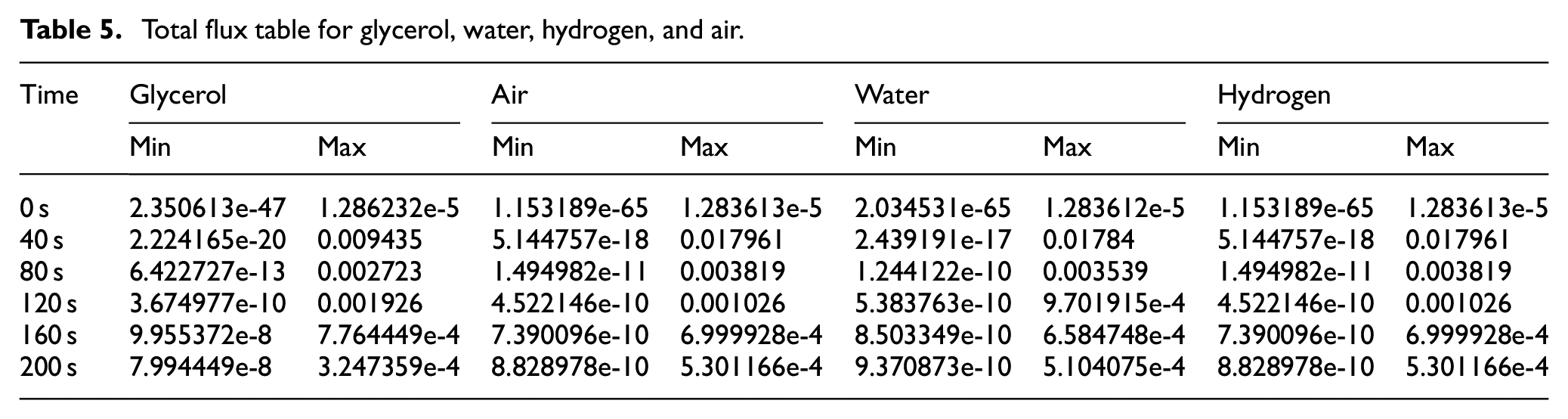
Convective flux table for glycerol, water, hydrogen, and air.


The basic structure of a neuron.
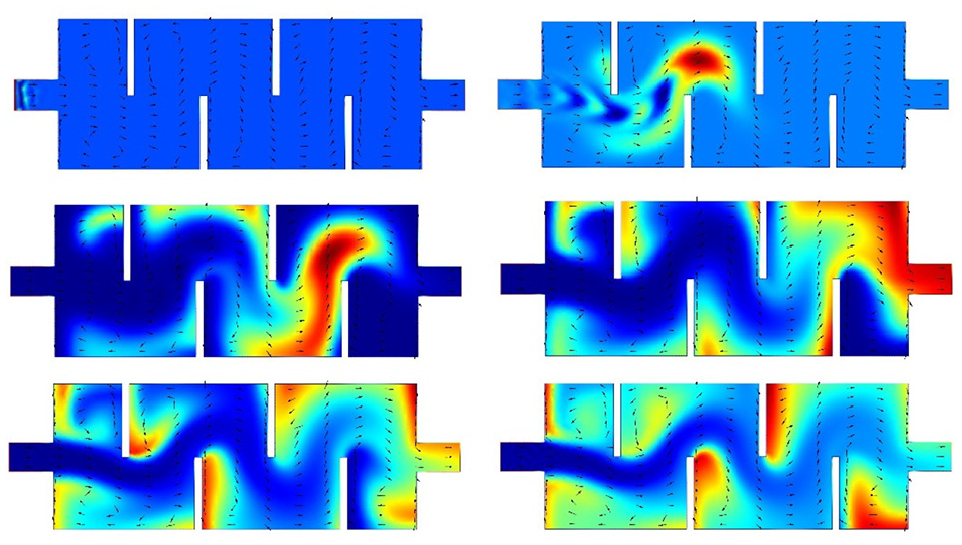
Concentration of glycerol at times t = 0 s,40 s,80 s, 120 s,160 s, and 200 s.

Concentration of water at times t = 0 s,40 s,80 s, 120 s,160 s, and 200 s.
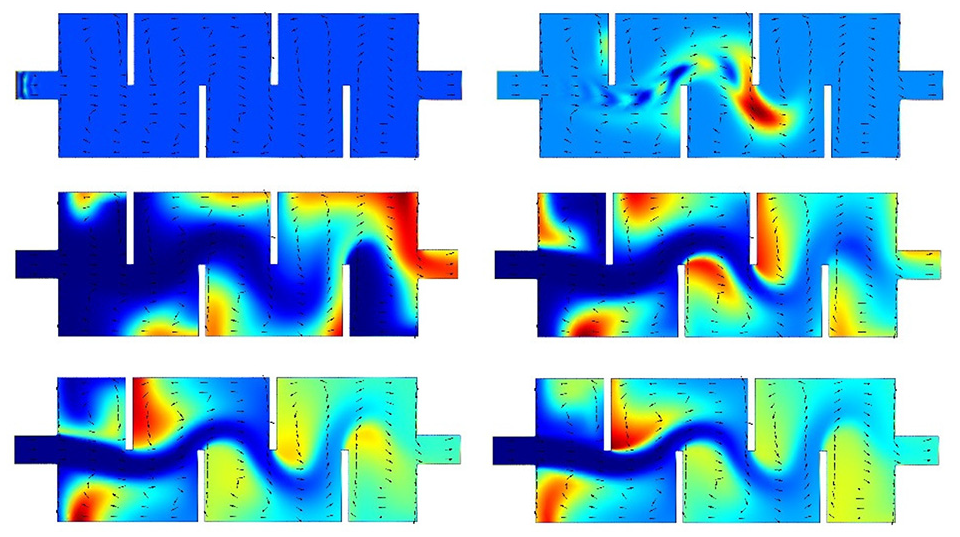
Concentration of hydrogen at times t = 0 s,40 s,80 s, 120 s,160 s, and 200 s.
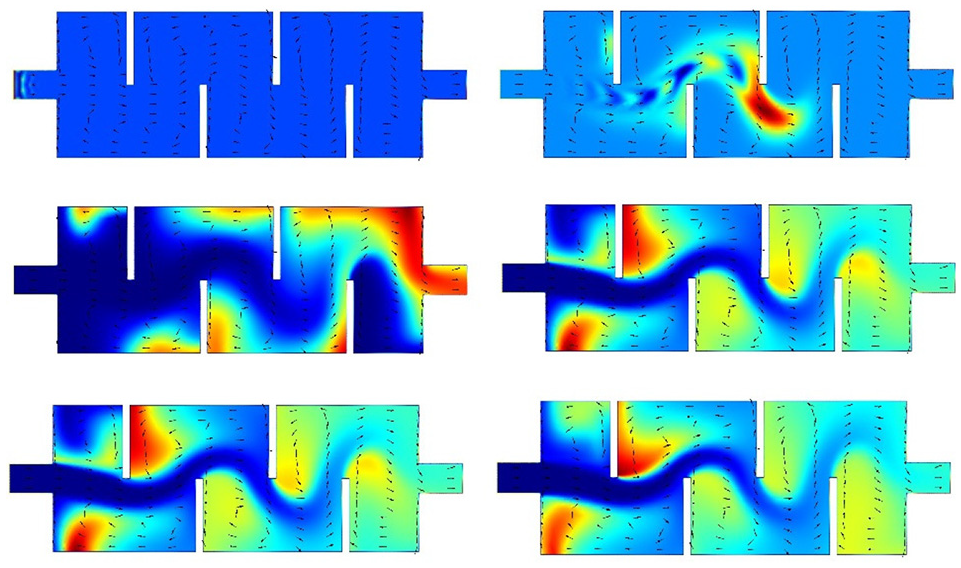
Concentration of air at times t = 0 s,40 s,80 s,120 s, 160 s, and 200 s.
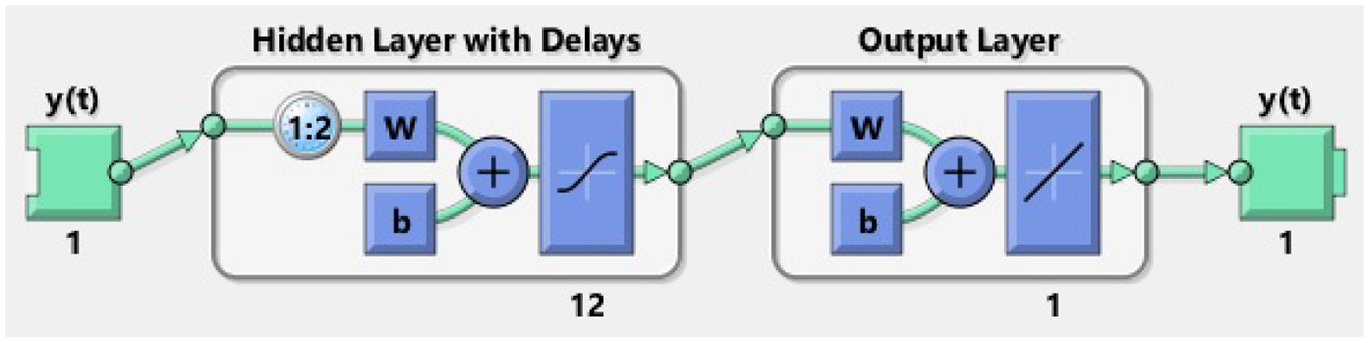
Architecture of ANN for forecasting.

3D reactor geometry.

Velocity field and streamlines in the 3D reactor at tie 500 s.

3D reactor of water at time 500 s.
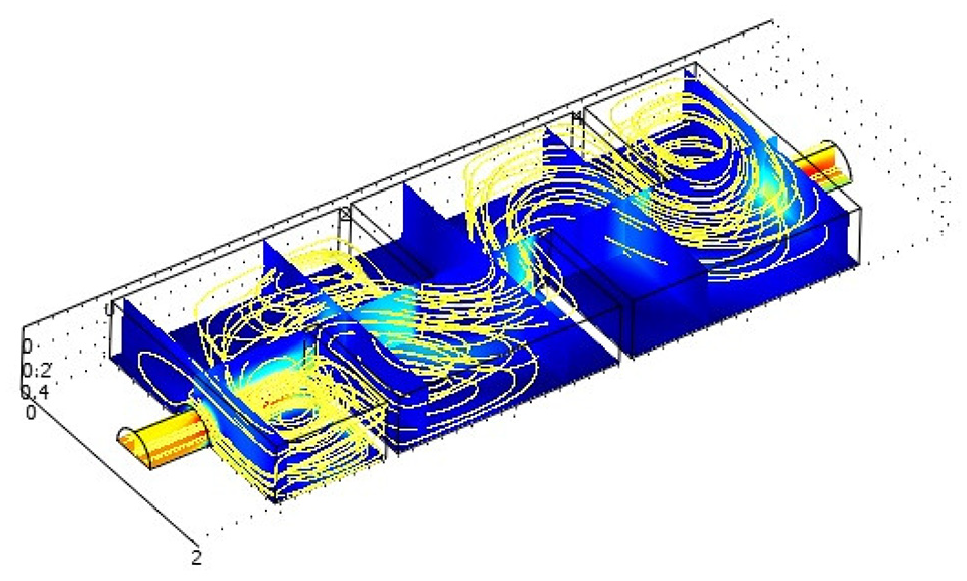
3D reactor of hydrogen at time 500 s.
Discussion
During this research, we conclude that specific deviations can be depicted in the dynamics of turbulent
Initially, to validate the model, we take different fluids including water, hydrogen, glycerol, and air.
We change the dynamics for the water, glycerol, air, and hydrogen model at different times.
Maximum time is 200 s for 2D reactor. It is observed that different changes are shown at different times.
We change the dynamics at sub-domain marker for air, water, glycerol, and hydrogen like concentration gradient, convective flux, and diffusive flux.
Visible changes are observed, when the fluid enters the inlet region at time zero we can see concentration at that starting point.
Furthermore, the transition in time causes dilution throughout the model.
At time 200 s that it is diluted in the model.
We also make 3D models for air, water, and hydrogen, for longer times with the help of ANN.
The work conducted during this research, utilized modern programming tools including the ANN time series forecasting, which can be further extended to formulate better dynamical models at the industrial level for the monitoring of turbulent flows.
Thus glycerol shows the most turbulent dynamics in turbulent reactor.
Conclusion
The proposed model can simulate the viscous fluids efficiently, and it can depict the turbulence to better accuracy. Among all the four fluids, glycerol dynamics were most challenging to depict and higher level of turbulence was observed.
The research strategy documented in this manuscript can prove to be helpful in the field of physics and other engineering and manufacturing fields, where turbulence is the main obstacle in the way of lengthy simulations.
Footnotes
Acknowledgements
This work is supported by the tank engine project: PSF- HIT -085.
Handling Editor: James Baldwin
Declaration of conflicting interests
The author(s) declared no potential conflicts of interest with respect to the research, authorship, and/or publication of this article.
Funding
The author(s) received no financial support for the research, authorship, and/or publication of this article.
