




Abstract
At present, the thermal analysis of oil-air-lubricated angular-contact ball bearings uses empirical heat transfer coefficients to calculate heat transfer. This approach presents problems such as simulating the actual lubrication flow field and ignoring the internal heat conduction in the bearing ring. This paper proposes a CFD steady-state analysis model of oil-air-lubricated angular-contact ball bearings based on fluid-solid conjugate heat transfer to analyze the flow field and temperature field. A temperature rise test of oil-air-lubricated angular-contact ball bearings was carried out to verify the positive determination of the simulation analysis results. Based on a fluid-solid conjugate heat transfer steady-state analysis model, the effects of lubrication parameters, operating conditions, and rolling element materials on the temperature rise characteristics of oil-air-lubricated angular-contact ball bearings were studied. The research results provide a method for analyzing the temperature rise characteristics of oil-lubricated bearings and provide a basis for the analysis of oil-lubricated bearing life.
Keywords
Introduction
Rolling bearings are the key components in mechanical transmission systems that support rotating parts, bear loads, and reduce frictional losses. Rolling bearings are often subjected to severe working conditions such as high speed or heavy load. The generation and accumulation of a large amount of frictional heat can cause the bearing temperature to become too high, which greatly reduces the bearing life. Some features of oil-air lubrication technology, such as precise control of the oil-air parameters, high lubrication and cooling efficiency, and low fuel consumption, give it advantages that significantly reduce the increase in bearing temperature. 1
In recent years, many scholars have carried out experimental and theoretical research on the temperature rise characteristics of oil-lubricated rolling bearings. In terms of experimental research, Aramaki et al. 2 carried out a temperature rise comparison test of silicon nitride balls and steel ball bearings with oil-air lubrication. The results showed that at high speed, the temperature rise of silicon nitride ball bearings is much lower than that of steel ball bearings. Jeng and Gao 3 studied the relationship between oil supply and temperature rise at 0∼1 ml/h through a temperature rise test of oil-lubricated bearings and modified the Palmgren formula. Ramesh et al. 4 studied oil-air lubrication through experiments. The temperature of ultrahigh-speed grinding spindle bearings under lubrication verified that convection heat transfer was the main component of bearing heat transfer. Wu and Kung 5 studied the performance of oil-air-lubricated spindle bearings under different lubrication parameters and preloads showing the influence of tightening force and lubrication parameters on bearing temperature rise and the optimal pipeline length and oil supply. Shunyun and Hebing 6 carried out experimental research on oil-air two-phase flow in high-speed bearings and concluded that test bearings using the same viscosity lubricant showed the lowest temperature rise was almost the same at different speeds, and higher or lower viscosity would increase the temperature rise of the bearing. Li et al. 7 studied the air supply point position, the length of the oil pipeline and other lubrication parameters on bearing temperature rise. Liang et al. 8 carried out temperature rise comparison tests of oil-air lubrication and oil injection lubrication, and their results showed that when the air velocity was 30 m/s, the oil-air lubrication existed in a lean state; the temperature rise was 2°C lower than that of fuel injection lubrication, and the temperature rise of oil-air lubrication was 2°C higher under full oil lubrication. Jiao et al. 9 experimentally considered the amount of fuel supply, speed, and axial preload on the influence of the temperature rise of an oil-lubricated electric spindle bearing unit. Theoretical research approaches have mainly used the thermal network method, finite element simulation method, and computational fluid dynamics (CFD) simulation method. Dexing et al. 10 developed a thermal network model for a pair of front bearings in oil-air-lubricated spindles based on a thermal network method. Pouly et al. 11 proposed a thermal network method to estimate the temperature of various positions in thrust ball bearings considering the influence of the oil-air mixture. Li 12 analyzed the temperature field distribution of an electric spindle bearing when the electric spindle reached thermal stability based on ANSYS software. Chen 13 studied the influencing factors of spindle bearing temperature rise based on the finite element simulation method. Yuefei et al. 14 carried out a comparative analysis of the temperature field of oil-air-lubricated and oil-injection-lubricated bearings based on a computational fluid dynamics simulation method. Li et al. 15 studied the effect of different air flows on the volume distribution and temperature distribution of oil-air-lubricated rolling bearings.
Current research on the thermal analysis of oil-lubricated rolling bearings has been mostly based on experiments, and also many scholars have used theoretical methods to simulate the actual bearing temperature field. In existing theoretical methods, the thermal network method and the finite element method essentially use the same approach. The advantage of the thermal network method is that the boundary conditions are easily addressed. The advantage of the finite element method is that it can simulate complex models, but both can indicate empirical convective heat transfer. For factors such as the inability to simulate the actual lubrication flow field, the CFD method solves the problem of simulating the internal flow field of oil-lubricated bearings, but currently, it is mainly used in research assessing the temperature field of the bearing cavity fluid domain. Most of these approaches ignore the heat conduction inside the bearing ring, and it is difficult to reach convergence in terms of multiphase flow and transient analysis and calculation. There is also the problem of the excessive time and workload required to reach a steady-state temperature rise. Considering the above factors, this paper proposes a CFD steady-state analysis model for oil-air-lubricated angular-contact ball bearings based on fluid-solid conjugate heat transfer. Considering the convective heat transfer of compressed air under the density change with pressure, the temperature rise characteristics of angular-contact ball bearings under oil-air lubrication conditions is studied.
CFD calculation model
Oil-air lubrication systems usually supply oil at 0.1∼1 ml/h and air at 2∼20 m3/h. The ratio of oil to air is extremely disparate. The volume fraction of oil to oil-air mixed fluid is extremely small, so the convection heat transfer of compressed air in oil-gas lubrication is mainly considered. Conjugate heat transfer refers to a coupled heat transfer behavior caused by direct contact between two materials with different thermal properties. This paper presents a CFD steady-state analysis model of oil-air-lubricated angular-contact ball bearings based on fluid-solid conjugate heat transfer. Conjugative heat transfer is achieved by setting coincident coupling surfaces to address fluid heat transfer and solid heat transfer. The calculation method, based on fluid-solid conjugate heat transfer, takes into account the heat conduction inside the bearing ring and can obtain the temperature in the fluid and solid domains of the bearing.
Modeling of the fluid-solid conjugate heat transfer calculation domain
Taking a 7014CE/P4 angular-contact ball bearing as the research object, the main structural parameters are shown in Table 1. This study ignores the cages, fillets, and chamfers that have a small impact on thermal analysis, establishes a simplified geometric model, extracts the fluid domains, and arranges oil and air inlet and outlet pipes, see Figure 1 for Arrangement of bearing oil and air nozzles. The entrance and exit pipes are 3 mm and arranged on different sides of the bearing. Considering that only a steady-state analysis is needed, to simulate the temperature field of the bearing uniformly distributed in the circumferential direction, an entrance and exit are arranged at each rolling element. To improve oil supply and cooling efficiency, the bearings are positioned to receive oil and air from the back, and at the same time, to reduce any obstruction of the lubricating medium by the air flow in the shaft cavity, the oil and air lubrication inlets are placed as close to the inner ring as possible. 16 The calculation domain model of the oil-air-lubricated angular-contact ball bearing is shown in Figure 2(a). The convection-solid calculation domain is meshed at the same time by using a local refinement method. The local radial mesh of the bearing is shown in Figure 2(b).
7014 CE/P4 angular-contact ball bearing main structural parameters.


Arrangement of bearing oil and air nozzles.

Computational domain model and meshing: (a) computational domain model of fluid-solid conjugate heat transfer and (b) local grid in radial plane of bearing.
Setting of conjugate heat transfer boundary conditions
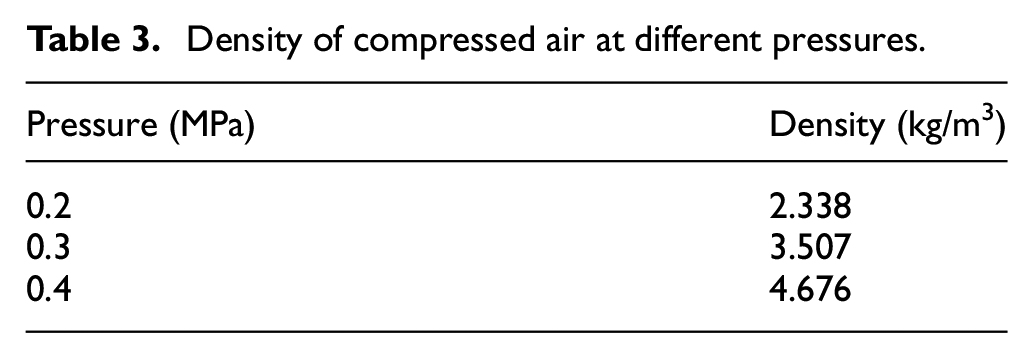
The fluid medium is set as compressed air, and its density increases with increasing pressure, so the simulation should consider the change in the density of compressed air under different pressures. A realizable k-ε turbulence model is selected. The main physical parameters at atmospheric pressure are shown in Table 2. The density at different pressures is shown in Table 3.
Main physical parameters at atmospheric pressure.

Density of compressed air at different pressures.
In the fixed solution, the ambient temperature is 293 K, the initial bearing temperature is 300 K, the operating pressure is atmospheric pressure (101,325 Pa), and the following boundary conditions are set.
Inlet boundary conditions
According to the parameters of the test bench, the air inlet is a velocity inlet, and the parameter selection is shown in Table 4. The outlet is a pressure outlet, which is constant at atmospheric pressure (101,325 Pa).
Air inlet speeds at different pressures.

Speed boundary conditions
The Multi-Reference Frame (MRF) model is used to set corresponding speed boundary conditions for the flow field, the inner and outer raceways, and the rolling elements according to the actual motion of the bearing components, as shown in Table 5.
Wall speed at different bearing speeds.

Boundary heat generation conditions
The frictional heat generation is calculated based on the holistic method of bearing heat generation, considering the influence of oil supply and spin sliding heat generation. The calculation formulas are shown in formulas (1) to (8). The heat generated in the form of heat flux is applied to the contact surfaces of the inner and outer ring raceways and rolling elements. The bearing heat generation and boundary conditions under different operating conditions in this paper are shown in Table 6.








Bearing heat generation and thermal boundary conditions under different operating conditions.

In the formula, H is the heat generated by the bearing; Hl is the heat generated by the friction of the load; Hv is the heat generated by the viscous friction of the lubricant; HSi is the heat generated by the spin and friction of the inner ring; Hchb is the heat generated by the friction between the rolling element and the lubricating oil; ni is the rotation speed of the inner ring; P1 is the calculated load related to the load; f1 is the load correlation coefficient; vo is the kinematic viscosity of the lubricating oil; f0 is the lubrication correlation coefficient; ωm is the rolling angular velocity of the rolling element; ωso is the spin angular velocity of the inner ring; μs is the sliding friction coefficient of the inner ring contact; Qi is the rolling body load at the inner ring contact; ai is the ellipse semi-axis of the inner ring contact; E(e) i is the elliptic integral; Fd is the distance between a single rolling body and the lubricant viscous drag friction; Cv is the viscous friction coefficient of the oil-air lubricant; ρoil, ρair, and ρmix are the density of oil, air, and oil-air mixtures, respectively; X is the oil-air proportionality coefficient; and Woil is the lubricating oil supply flow.
Boundary conditions for heat transfer
The interface of convective solid coincidence (inner raceway, surface of rolling element, and outer raceway) sets a coupled coupling heat transfer relationship.
Analysis of simulation results
The calculation example uses Fr = 600 N, Fa = 600 N, n = 6000 r/min, a compressed air pressure of 0.2 MPa, and an oil supply of 1 ml/h.
Analysis of flow field simulation results
The flow field velocity distribution and flow field streamline distribution in the axial and radial planes of the bearing are shown in Figure 3. Figure 3(a) shows that the maximum velocity of the flow field appears at the exit, and the maximum exit velocity is 62.7 m/s. The air velocity at the inner raceway (max. 55.9 m/s) is greater than the air velocity at the outer raceway (max. 43.9 m/s). Figure 3(b) shows that the maximum velocity of the flow field on the radial plane of the bearing appears at the side of the rolling element and the inner raceway along the rotation direction of the flow field, and the maximum velocity is 55.9 m/s. It can be seen from Figure 3(c) that most of the flow field and flow lines flow along the inlet from the bearing, the outer raceway and the contact point of the rolling elements; thus, the mutual interference between the inlets and outlets can be ignored, indicating that this model simulates the nozzle inlet and outlet. The setting of bearing uniform cooling in the circumferential direction is reasonable.

Flow field simulation results: (a) bearing axial plane flow field velocity distribution, (b) bearing radial plane flow field velocity distribution, and (c) streamline distribution of the flow field in the bearing cavity.
Analysis of temperature field simulation results
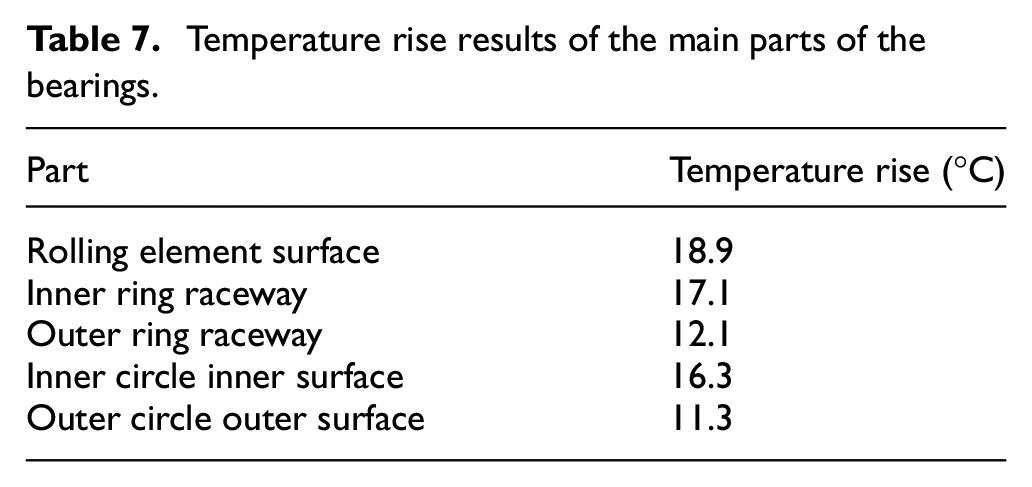
The temperature field simulation results are shown in Figure 4. Figure 4 shows that the highest temperature of the bearing appears on the surface of the rolling element, followed by the inner ring and the lowest temperature of the outer ring. The highest temperature of the inner and outer rings is located on the surface of the contact raceway. For rolling elements, the temperature at the inlet is slightly lower than the temperature at the outlet. The circumferential distribution of the temperature field is basically uniform, which is consistent with the actual situation. Compared with the traditional method of analyzing the temperature field of a bearing cavity fluid field, the advantage of the fluid-solid conjugate heat transfer temperature field is not only that the calculation method is more accurate but also that the calculation result is more comprehensive, and the inner circle of the inner ring of the bearing and the outer ring of the outer ring can be obtained directly. The surface temperature of the round surface is convenient for comparison and verification with the test data. The simulation results of the main parts of the bearing are shown in Table 7.

Temperature field simulation results: (a) temperature field distribution in the calculation domain of conjugate heat transfer, (b) temperature field distribution in rolling elements of bearings, (c) temperature field distribution in the inner ring of the bearing, (d) temperature field distribution in the outer ring of the bearing, (e) overall temperature of bearing solid domain, and (f) X-section temperature of fluid-solid conjugate heat transfer.
Temperature rise results of the main parts of the bearings.
Temperature rise experiment verification of oil-air-lubricated angular-contact ball bearings
Experimental conditions
To verify the reliability of the simulation model, a temperature rise verification experiment was carried out based on a self-constructed oil-air-lubricated mechanical spindle bearing experiment bench independently established in the laboratory. As shown in Figure 5, the experimental rig consists of four parts: a mechanical spindle system, a load loading system, an oil-air lubrication system and a data acquisition system. A thermal resistor is arranged outside the outer ring of the front bearing, as shown in Figure 6.

Oil-air lubricated mechanical spindle bearing experiment bench.

Schematic diagram of the test temperature test point arrangement.
Experimental parameters
Considering the effects of the working load, the speed of the inner ring and the pressure of the compressed air, a comparative test scheme is formulated. The test parameters are shown in Table 8. The test oil-air lubrication oil supply was fixed at 1 ml/h, and the experiment time was fixed at 150 min. To reduce the effect of experimental error, each group of experiments was repeated three times, and the average of three experiments was taken as the final experimental result. The variable load was applied as an axial load. Since a pair of bearings simultaneously bears the unidirectional axial load, the test bearing load should be half of the applied load.
Bearing temperature rise test parameters of oil-air-lubricated angular-contact ball bearings.

Comparison of results
Comparison of experimental and simulated values under different working loads
Figure 7 shows the comparison results between the test and simulation under different working loads. The simulation and test results are similar, with a maximum error of 13.8% and a minimum error of 6.20%. The simulation value is slightly higher than the experimental value, which indicates that the model and boundary condition settings established by the CFD simulation are more accurate.

Test and simulation results under different working loads: (a) comparison of test temperature rise curve and (b) comparison of test and simulation results.
Comparison of experimental and simulated values at different inner ring speeds
Figure 8 shows the comparison results of the test and simulation at different inner ring speeds. The results show that the simulation and test results are relatively close overall. The temperature difference at 2100 r/min is 0.39°C, the temperature difference at 1350 r/min is 0.25°C, and the temperature difference at 600 r/min is 0.47°C. However, the simulation value is lower than the test value when the speed is too low, and the results of both may be inaccurate at low speed. The simulation does not calculate the heat generation accurately at low speeds. Perhaps at low speeds the temperature is more influenced by the environment.

Test and simulation results at different inner ring speeds: (a) comparison of test temperature rise curve and (b) comparison of test and simulation results.
Comparison of the test value and simulation value under different compressed air pressures
Figure 9 shows the experimental and simulation results under different compressed air pressures. The maximum error is 13.8%, and the minimum error is 8.71%. From the comparison results, it can be seen that the simulation and test results are in good agreement with the change trend.

Test and simulation results under different compressed air pressures: (a) comparison of test temperature rise curve and (b) comparison of test and simulation results.
Comparison of test value and simulation value under different oil supply
Figure 10 shows the experimental and simulation results at different fuel supply rates at a speed of 6000 r/min. The maximum error is 8.72%, and the minimum error is 4.04%. The results show that the simulation and test results are in good agreement with the change trend.
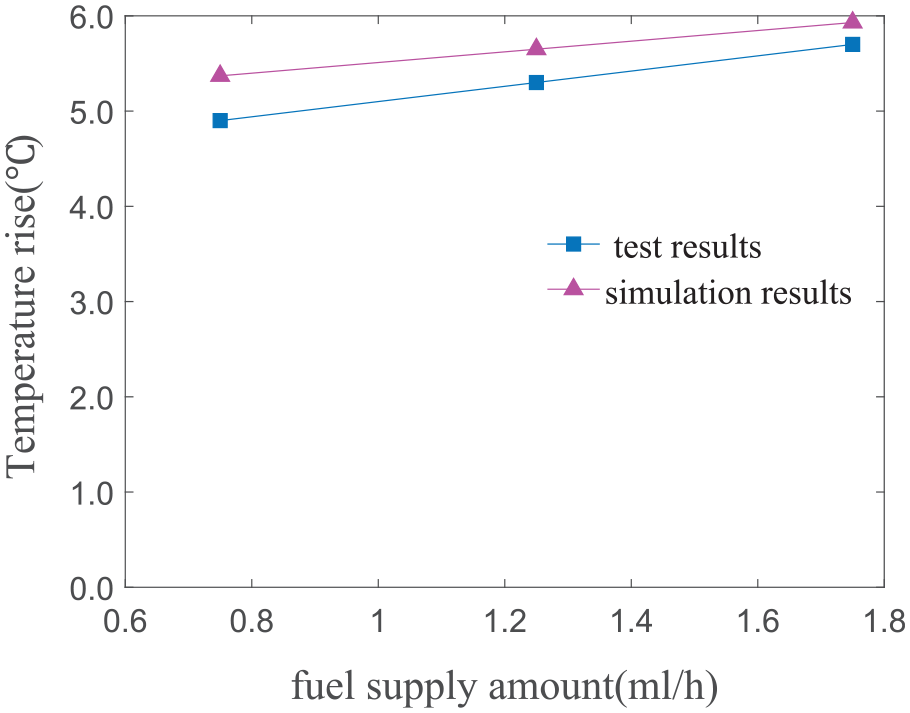
Test and simulation results under different fuel supply amounts.
Analysis of the factors affecting the temperature rise of oil-air-lubricated angular-contact ball bearings
Influence of lubrication parameters on the temperature rise of oil-air-lubricated angular-contact ball bearings
Compressed air pressure
The working load is Fa = 600 N, Fr = 600 N, the inner ring speed is 6000 r/min, the oil supply is 1 ml/h, and the compressed air pressure is 0.2 MPa, 0.3 MPa, and 0.4 MPa. The temperature field distribution is shown in Figure 11.

Effect of compressed air pressure on the temperature rise of various parts of the bearing.
From Figure 11, it can be seen that the temperature of each part of the bearing decreases with the increase in air pressure. When the air pressure increases from 0.2 MPa to 0.4 MPa, the temperature rise of the inner surface of inner ring decreases from 16.3°C to 6.9°C, the temperature rise of the roller surface temperature decreases from 18.9°C to 7.9°C, and the temperature rise of the outer surface of outer ring decreases from 11.3°C to 5.8°C. The decrease in the temperature rise of the inner ring is significantly larger than that of the outer ring. In oil-air lubrication, the oil-air nozzle is generally flush with the end face of the inner ring to avoid direct alignment with the cage, and the temperature of the inner ring contact is high.
Fuel supply
To study the oil-air-lubricated angular-contact ball bearings, the applied load is Fa = 600 N, Fr = 600 N, the inner ring speed is 6000 r/min, the compressed air pressure is 0.2 MPa and the oil supply is 1 ml/h, 5 ml/h, and 10 ml/h. The temperature distribution of the ball bearing is shown in Figure 12.

Effect of oil supply amount on the temperature rise of various parts of the bearing.
Figure 12 shows that when the oil supply is sufficient, the temperature of each part of the bearing increases with increasing oil supply. The main reason is that the heat generated by the lubrication drag between the rolling elements and the lubricating oil varies with increasing oil supply. The changing trend of the rolling elements and the inner and outer rings is basically the same. The influence of the oil supply amount on the temperature rise of the bearing at a higher speed cannot be ignored. When the oil supply amount gradually decreases from the optimal oil supply amount, the bearing temperature increases because the bearing cannot form a complete oil film when the oil supply amount is too low. In this state of boundary lubrication or dry friction, this will greatly increase the contact friction heat generation inside the bearing. Therefore, the oil supply amount of oil-air lubrication should not be too low.
Analysis of the influence of different operating conditions on the temperature rise of oil-air-lubricated angular-contact ball bearings
Speed
To study the temperature field of oil-air-lubricated angular-contact ball bearings, the working load is Fa = 600 N, Fr = 600 N, the compressed air pressure is 0.2 MPa, the oil supply is 1 ml/h, and the inner ring speed is 3000 r/min, 6000 r/min, and 9000 r/min. The results are shown in Figure 13.

Effect of the inner ring speed on the temperature rise of various parts of the bearing.
It can be seen in Figure 13 that the higher the rotation speed of the inner ring is, the higher the temperature of each part of the bearing, and the increase in temperature gradually increases with the increase in rotation speed. When the inner ring speed increases from 3000 r/min to 9000 r/min, the temperature rise of the roller surface increases by 3.88 times, the temperature rise of the inner surface of inner ring increases by 2.97 times, and the temperature rise of the outer surface of outer ring increases by 3.22 times. As the speed of the inner ring increases, the surface temperature of the rolling elements increases the most, followed by the inner ring, and the outer ring has the smallest increase. Therefore, under the condition of higher speed, the overheated area of the bearing should be better cooled with a better combination of oil-air lubrication parameters.
Working load
To study the inner ring speed at 6000 r/min, the compressed air pressure is 0.2 MPa, the fuel supply is 1 ml/h, Fa = 600 N, Fr = 400 N, 600 N, 800 N, and Fa = 400 N, 600 N, 800 N, Fr = 600 N The effect of load on the temperature field distribution of oil-air-lubricated angular-contact ball bearings is shown in Figure 14.

Effect of the working load on the temperature rise of various parts of the bearing: (a) axial load effect and (b) radial load effect.
Figure 14 shows that the temperature of each part of the bearing increases with increasing radial load and increases with increasing axial load. When the axial load increases from 400 N to 800 N, the temperature rise rates of the roller surface, the inner surface of inner ring and the outer surface of outer ring are 29.5%, 45.5%, and 17.92%, respectively. When the radial load increases from 400 N to 800 N, the temperature rise rates of the roller surface, the inner surface of inner ring, and the outer surface of outer ring are 10.49%, 10.19%, and 11.1%, respectively. The heat generation of the spin ring has a greater effect. As the axial load increases, the heat generation of the inner ring is much larger than that of the outer ring.
Effect of rolling element materials on the temperature rise of oil-air-lubricated angular-contact ball bearings
The working load Fa = 600 N, Fr = 600 N, the compressed air pressure is 0.2 MPa, the oil supply is 1 ml/h, and the inner ring speed is 3000 r/min, 6000 r/min, and 9000 r/min; using different rolling body materials, the similarities and differences in the temperature distribution of the oil-air-lubricated angular-contact ball bearings are shown in Figure 15, where the rolling element materials are GCr15 bearing steel and Si3N4 ceramics, and the main properties are shown in Table 9.

Temperature rise of various parts of the bearing under different speeds of different rolling element materials.
Main physical parameters of GCr15 and Si3N4.

It can be seen in Figure 15 that under the same working conditions, the temperature rise of each part of the ceramic ball bearing is significantly lower than that of the steel ball bearing. The main reason is that the ceramic material has a self-lubricating effect and a low coefficient of friction, generating less heat. Compared with steel ball bearings, the temperature rise of the inner ring and rolling body of the ceramic ball bearing is much lower. The main reason is that under the theory of outer raceway control, the spin heat of the inner ring is greatly affected by sliding friction. At the speed of 3000 r/min, the temperature rise of the steel roller is 1.7 times higher than that of the ceramic roller, while at the speed of 9000 r/min, the temperature rise of the steel roller is 4.6 times higher than that of the ceramic roller. Indicating that the higher the speed is, the better the cooling performance of ceramic ball bearings.
Conclusion
This paper presents a fluid-solid CFD calculation model for oil-air-lubricated angular-contact ball bearings based on fluid-solid conjugate heat transfer, which takes into account the heat conduction of bearing rings and the convective heat transfer of compressed air in oil-air lubrication. This research addresses the temperature rise characteristics of ball bearings. The main research conclusions are as follows:
For the effects of oil-air lubrication parameters, as the air pressure increases, the temperature rise of each part of the bearing decreases. The temperature rise of the inner ring is significantly greater than that of the outer ring. When the air pressure increases from 0.2 MPa to 0.4 MPa, the temperature rise of the inner surface of inner ring decreases from 16.3°C to 6.9°C, the temperature rise of the roller surface temperature decreases from 18.9°C to 7.9°C, and the temperature rise of the outer surface of outer ring decreases from 11.3°C to 5.8°C. At this time, the temperature of each part of the bearing increases with the increase in oil supply. In practical applications, an appropriate combination of oil-air lubrication parameters should be selected.
For the effects of different working conditions, as the speed increases, the temperature rise of each bearing section increases. When the inner ring speed increases from 3000 r/min to 9000 r/min, the temperature rise of the roller surface, the inner surface of inner ring, and the outer surface of outer ring increase by 3.88 times, 2.97 times, and 3.22 times, respectively. Compared with the radial load, the axial load has a greater impact on the temperature rise of the bearing. When the axial load increases from 400 N to 800 N, the temperature rise rates of the roller surface, the inner surface of inner ring, and the outer surface of outer ring are 29.5%, 45.5%, 17.92%, respectively. When the radial load increases from 400 N to 800 N, the temperature rise rates of the roller surface, the inner surface of inner ring, and the outer surface of outer ring are 10.49%, 10.19%, 11.1%, respectively.
When the working load Fa = 600 N, Fr = 600 N, the compressed air pressure is 0.2 MPa, the oil supply is 1 ml/h, and the inner ring speed is 3000 r/min, 6000 r/min, and 9000 r/min, the temperature rise of each part of the ceramic ball bearing is significantly smaller than that of the steel ball bearing, and the higher the speed is, the greater the difference between the temperature rise of the two. In the design of bearings operating under severe conditions, consideration should be given to the preferred choice of ceramic rolling elements.
The established steady-state analysis model of fluid-solid conjugate heat transfer is conducive to accurately grasping the temperature rise characteristics of oil-air-lubricated angular-contact ball bearings and provides a basis for the life analysis of angular contact ball bearings under oil-air lubrication conditions, which can more accurately solve flow problems. The solid temperature field saves computing resources and time and improves the calculation efficiency of engineering and technical personnel.
Footnotes
Handling Editor: James Baldwin
Declaration of conflicting interests
The author(s) declared no potential conflicts of interest with respect to the research, authorship, and/or publication of this article.
Funding
The author(s) disclosed receipt of the following financial support for the research, authorship, and/or publication of this article: This research work was supported by the National Natural Science Foundation of China (no. 51775277).
