




Abstract
Aiming at the change law of the flexural and tensile strength of the modified steel slag asphalt mixture during microwave heating, the results of this paper are as follows: the microwave heating process can achieve the recovery of the flexural and tensile properties of the modified steel slag asphalt mixture. The number of point bending failure tests continues to increase, and the recovery rate of bending and tensile properties of beams made of modified steel slag asphalt mixture will slowly decrease until the test piece is completely destroyed. The flexural and tensile strength of beams made by microwave heating asphalt mixture cannot be fully recovered, but different asphalt mixtures have different recovery effects. Compared with the ordinary basalt asphalt mixture, the steel slag asphalt mixture before modification has the same bending and tensile repair effect after microwave heating, while the modified steel slag asphalt mixture has the first bending and tensile repair effect after microwave heating increased by 23%.
Introduction
Asphalt pavements are mostly adopted in my country’s highway pavement at this stage, and the asphalt pavement will be eroded by various natural conditions during use, including: temperature difference between day and night, severe rain and snow weather, long-term fatigue load of automobiles, etc.1,2 The existence of these factors will cause various forms of damage to the asphalt pavement: potholes, ruts, pumping, etc. 3 After the asphalt pavement is damaged, it needs to be repaired in time, otherwise it will cause a certain degree of traffic accidents. 4 The traditional asphalt pavement repair is mainly cold repair, which mainly removes the damaged pavement and adds new asphalt mixture. The biggest disadvantage of this repair method is that the performance of the interface between the new and old asphalt can not meet the ideal requirements, which affects the road performance of the asphalt road.5–7
Microwave heating repair asphalt mixture has been widely used in actual highway asphalt repair, and many scholars have conducted research on microwave heating asphalt mixture.8–10 Hao et al. 11 analyzed the influence of microwave activation on the rheological properties of modified asphalt. Wenju et al. 12 analyzed the effect of different heating methods on the healing properties of asphalt mixtures using a three-point bending test. The results show that microwave heating has a good healing effect on asphalt mixture. Yongxiang et al. 13 analyzed the road performance of asphalt mixture after microwave heating. This paper mainly analyzes the influence of microwave heating mechanism on the road performance of modified steel slag asphalt mixture, and uses three-point bending test to analyze the effect of microwave heating on the bending recovery of modified steel slag asphalt mixture.
Key indicators of microwave heating of asphalt concrete
The main component of microwave heating of asphalt mixture is the magnetron. The magnetron is a vital component in the microwave heating process. Its main performance parameters are as follows14,15:
The magnetron emits electromagnetic waves during operation, and its output power is:

The main mechanism of microwave heating is to emit electrons from the magnetron, propagate through the waveguide, and enter the internal structure of the object to achieve the function of heating the object.16,17 The process of microwave heating of objects is different from the traditional heating method. The microwave frequency used in the process of heating asphalt mixture is 2.5 GHz, and its key indicators are dissipated power, penetration ability and equivalent dielectric constant of the mixture. 18
Power dissipation
Microwave heating is mainly achieved by the energy conversion of the dielectric material during the heating process. The heated object absorbs energy from the energy field of the medium. In the process of calculating the unit volume of the medium, the calculation formula is:

In the above formula:
It can be found from equation (1): In the process of microwave heating of asphalt concrete, when the input microwave power remains unchanged, the medium loss factor directly affects the heating rate of asphalt concrete.
The penetration ability of microwave energy heating
The penetration ability of microwaves is the ability of electromagnetic waves to penetrate concrete when heating asphalt concrete. The expression of microwave penetration characteristics is as follows:

In the above formula:

In the above formula:
Equivalent dielectric constant of mixture
The equivalent dielectric constant of the mixed material is:

In the above formula:

In the above formula:
It can be found from the above formulas 4 and 5 that adjusting the volume ratio of the mixture can effectively change the dielectric constant of the mixture, thereby optimizing the heating effect of the object.
Influence of microwave heating on the performance of modified steel slag asphalt mixture
Traditional asphalt mixtures will produce many irreversible changes under the erosion of natural conditions such as high temperature and ultraviolet rays: asphalt becomes brittle and performance deteriorates.19,20 The aging of asphalt will affect its road performance to a large extent, causing cracks, looseness, grout, and other diseases on asphalt pavement. 21 Microwave heating can greatly improve the performance of modified steel slag asphalt mixture.
Influence of microwave heating on the aging of modified steel slag asphalt concrete
In this paper, ductility and penetration are used as evaluation indicators for asphalt aging to judge the change of modified steel slag asphalt mixture under microwave heating. The performance of the modified asphalt used this time is shown in Table 1 below.
Performance index of modified steel slag asphalt mixture.

In this paper, a microwave oven is used to heat the modified steel slag asphalt mixture, and an infrared thermometer (as shown in Figure 1) is used to measure the temperature of the modified asphalt.

Infrared thermometer.
The temperature change of the modified steel slag asphalt mixture tested by the infrared thermometer is shown in Table 2.
Temperature change of modified steel slag asphalt mixture.

Figure 2 shows the heating and cooling curve of the modified steel slag asphalt mixture. It can be seen from Figure 2 that the heating process of the modified steel slag asphalt mixture is almost linear, and the heating rate remains stable, reaching 3.67°C/min. The cooling rate is related to the surrounding environment. At room temperature, the cooling rate is slower, reaching 1.27°C/min.
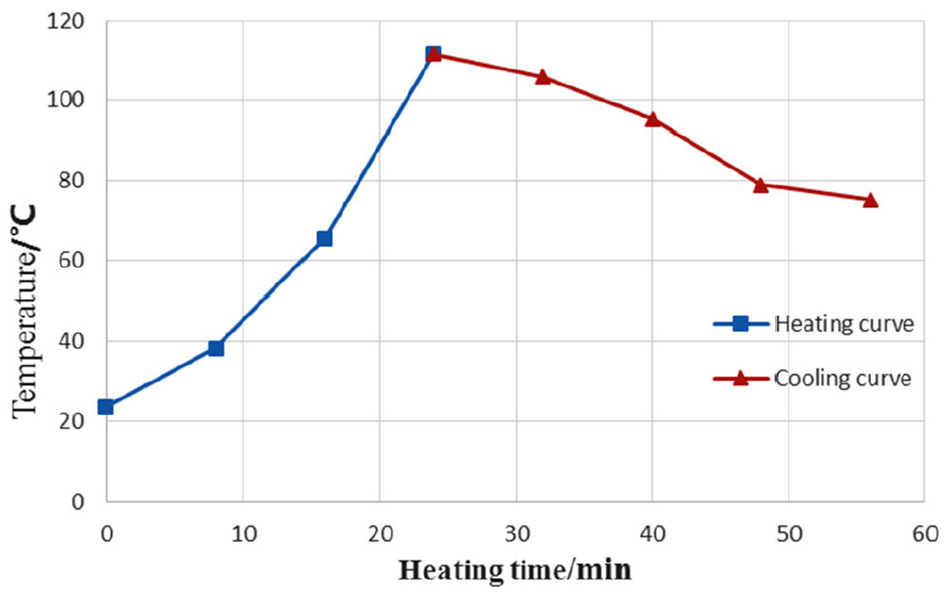
Heating and cooling curve of modified steel slag asphalt mixture.
In this paper, penetration and ductility are used to judge the influence of microwave heating on modified steel slag asphalt mixture. In this paper, the modified steel slag asphalt mixture is heated to 150°C in a microwave oven, and then placed at room temperature to cool. Repeat this process twice, four times, and six times to record the penetration and ductility of the modified steel slag asphalt mixture. The recorded results are shown in Figures 3 and 4.

Change in penetration of modified steel slag asphalt mixture.

Change of ductility of modified steel slag asphalt mixture.
It can be seen from Figures 3 and 4: microwave heating makes the modified steel slag asphalt mixture aging to a certain extent faster. When the microwave was heated twice, four times, and six times, the penetration of the modified steel slag asphalt mixture decreased by 3.4%, 4.2%, and 5.1%, and the ductility decreased by 7.2%, 15.6%, and 21.3%, respectively. With the increase of heating times, the aging performance of modified steel slag asphalt mixture becomes worse and worse.
Influence of microwave heating on road performance of modified steel slag asphalt mixture
In this paper, the rutting test is used to verify the high temperature performance of the modified steel slag asphalt mixture after microwave heating. The sample plate selected for the experiment is a modified steel slag asphalt mixture track plate with a size of 350 mm × 350 mm × 30 mm. The repeated movement of rubber wheels on the rut board simulates the road conditions of modified asphalt. The road performance of the rut board is determined by the dynamic stability coefficient (the number of movements required to form a 1 mm deformation). The test results are shown in Figure 5.

Road performance of modified steel slag asphalt mixture rut board.
It can be seen from Figure 5 that the dynamic stability coefficient of the rut plate of the modified steel slag asphalt mixture after microwave heating increases significantly. The main reason is: microwave heating deepens the aging of the modified asphalt, and the aging of the asphalt makes it harder and more brittle, and the ability to resist rutting deformation increases; secondly, the modified steel slag asphalt after microwave heating is rolled The porosity is lower, the density is higher than the unheated modified asphalt, and the deformation resistance is better.
Repair effect of modified steel slag asphalt concrete in three-point bending failure experiment
Asphalt pavements will be subjected to long-term reciprocating loads during operation, and fatigue damage is the most prone form of damage to asphalt pavements during use. When the reciprocating load on the asphalt pavement reaches a certain number of times, the accumulated stress inside the pavement will exceed the structural resistance of the asphalt pavement, resulting in cracks, slurries and even breaks. In order to be able to simulate the flexural and tensile repair efficiency of asphalt pavement under reciprocating loads of vehicles. This paper uses three-point bending failure experiment to analyze the microwave heating effects of different modified asphalt concretes. The bending failure experiment is mainly to reflect the durability and tensile properties of the modified asphalt mixture, and also to reflect the repairing effect of microwave heating on the modified asphalt mixture.
Test setup
The setting temperature of the test in this paper is 18°C, and the loading rate is 50 mm/min, until the asphalt specimen breaks and stops loading (as shown in Figure 6). In this test, a servo-type multifunctional hydraulic press was used to produce three different modified asphalt mixtures: basalt asphalt mixture (BAM), steel slag asphalt mixture before modification (USAM) and modified steel slag asphalt mixture (MSAM) into the beam shown in Figure 6.

Road performance of modified steel slag asphalt mixture rut board.
The loading test process of the asphalt mixture is as follows: first, each group of different modified asphalt mixtures is subjected to a three-point bending test under the action of 18°C, and the asphalt specimens that are broken after loading are placed in a microwave oven and heated for 5 min. Place it in the air for cooling repair, and then subject the cooled specimen to a bending test until the specimen is damaged. The flexural and tensile strength changes of the modified asphalt mixture specimens were recorded during the test to evaluate the flexural and tensile strength repair effects of the microwave-heated asphalt mixture.
Effect of microwave repair on bending damage of different asphalt mixtures
Different modified asphalt mixtures were repaired under microwave heating and then subjected to bending tests. The deformation process is shown in Figure 7.

Deformation of asphalt mixture test piece.
Figure 8 shows the recovery of flexural and tensile strength of different asphalt mixtures after microwave heating. It can be found from Figure 8: the flexural tensile strength repair rate of the basalt asphalt mixture after the first microwave heating repair reaches 55%; the flexural tensile strength of the steel slag asphalt mixture after the first microwave heating repair before modification The repair rate reached 59%; the repair rate of the modified steel slag asphalt mixture after the first microwave heating repair was 78%. It can be seen that compared with the ordinary basalt asphalt mixture, the steel slag asphalt mixture before the modification has basically the same flexural and tensile repair effect after microwave heating, while the modified steel slag asphalt mixture has the first flexural resistance after microwave heating. The effect of pulling repair has increased by 23%.
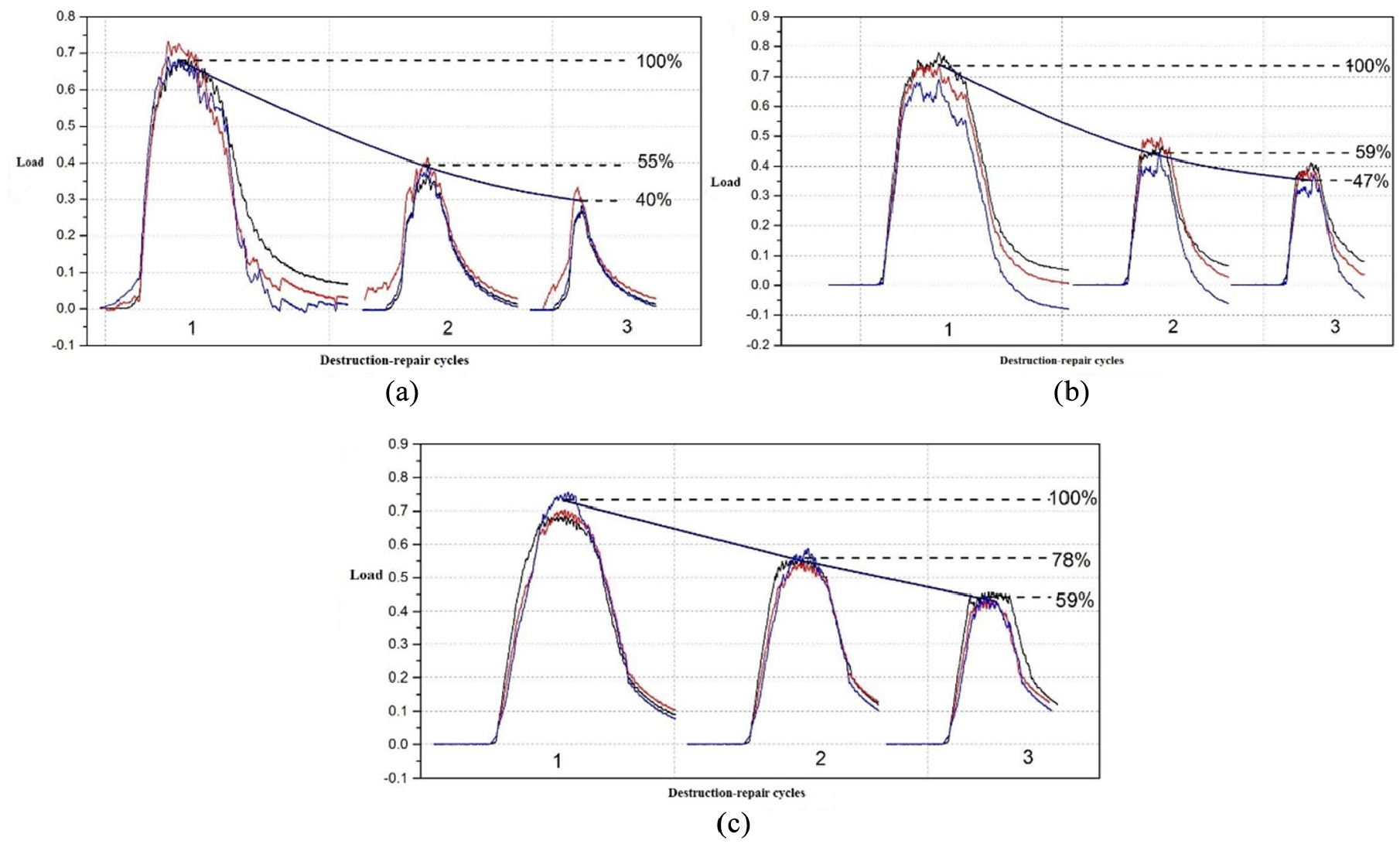
Effect of microwave heating on the recovery ability of asphalt mixture bending failure load: (a) BAM, (b) USAM, and (c) MSAM.
Conclusion
In this paper, the road performance of modified steel slag asphalt mixture by microwave heating is analyzed. The three-point bending failure test is used to analyze the flexural and tensile recovery effects of different asphalt mixtures after microwave heating. The main conclusions are as follows:
The modified steel slag asphalt mixture rut board after microwave heating has good road performance. The increase of its compactness and the decrease of void ratio make its dynamic stability coefficient greatly improved;
The flexural and tensile performance of the asphalt mixture can be restored by microwave heating. At the same time, as the number of failure-bending tests continues to increase, the flexural and tensile performance recovery rate of the asphalt mixture will gradually decrease.
The flexural tensile strength of beams made by microwave heating of asphalt mixture cannot be fully restored, but different asphalt mixtures have different recovery effects. The recovery effect of microwave heating on the flexural strength of the modified asphalt mixture is from strong to weak: modified steel slag asphalt mixture (MSAM), steel slag asphalt mixture before modification (USAM), basalt asphalt mixture (BAM).
Footnotes
Acknowledgements
The author thanks the reviewers for their helpful comments.
Handling Editor: James Baldwin
Author contributions
Experiment design and implementation: Y.Z., R.H.; data analysis: Y.Z.; paper writing: Y.Z.
Declaration of conflicting interests
The author(s) declared no potential conflicts of interest with respect to the research, authorship, and/or publication of this article.
Funding
The author(s) received no financial support for the research, authorship, and/or publication of this article.
