



Abstract
The heat transport in the nanofluids attained much interest of the researchers and engineers due to broad uses in medical sciences, paint industries, aerodynamics, wheel alignment and manufacturing of aircraft parts. Therefore, keeping in mind the paramount significance of the heat transfer, the study of Cu-nanomaterials based nanofluid is conducted. The governing nanofluid model transformed in dimensionless version via similarity transformations. For numerical simulation of the dynamics of Cu-H2O, RK technique with shooting algorithm is employed and presented behavior of the fluid motion, temperature, wall shear stresses and local thermal performance rate via graphical aid. It is noted that the heat transfer augmented promptly by increasing
Introduction
The fundamental fluid mechanics problem in two dimensions due to a stretching slit, firstly explored by Crane.
1
Applications of such type of problems comprised in paper production, plastic films drawing, and polymer extrusion etc. Due to versatile uses, researcher’s community focused to analyze such type of problems under certain conditions. These are mixed convection, mass transfer, convective condition, variable slit temperature, suction and injection etc. The flow characteristics of Newtonian fluid in three dimensions past a bi-laterally stretchable sheet in three dimensions reported by Wang
2
in 1988. In 2014, Sheikholeslami and Ganji
3
reported the variations in the nanofluid characteristics in rotating Cartesian coordinates system. For mathematical investigation of the model, they implemented numerical technique and examined the variations of flow quantities in the flow field. Implementation of two-phase model for nanofluid is also part of his work. In 2010, Rashidi and Keimanesh
4
inspected magnetohydrodynamic flow of laminar liquid film which placed horizontally. The sheet is capable to stretching. They adopted analytical technique for mathematical analysis. The effects of Lorentz force on the nanofluid flow explored in Sheikholeslami et al.
5
MHD flow of
A numerical investigation of thermal transport in the boundary layer flow of the nanofluid over a stretchable surface was conducted by Rana and Bhargava. 7 They used the model comprising the thermophoretic and Brownian motion effects. The results for the flow regimes against the parameters were drawn by implementing variational finite element technique. In 2015, Das 8 presented the analysis of nanofluid dynamics over a permeable surface. To find fascinating results of the study, they incorporated slip effects over the surface and tackled the resultant model numerically. The study was interesting in the context of the topic but, the more novel results could be achieved by ingrained the effects of thermal radiations, Lorentz forces and resistive heating.
The dynamics of non-Newtonian nanofluid under convective flow condition is a paramount research topic in the area of Fluid Dynamics. Keeping in view the significance of such flow, Sandeep et al. 9 analyzed the flow characteristics over a stretching surface with suction/blowing properties of the surface. They observed that thermal performance in Oldroyd-B nanofluid is very effective compared to other fluid like Maxwell and Jeffery nanofluids. In order to make the results more effective, they plugged the magnetic field phenomena in the constitutive model. The heat transfer inspection in radiative and dissipative nanofluid over a stretchable geometry by taking the effects of Lorentz forces into account were found in Pal et al. 10 The influences of suction and injection, Lorentz forces and Grashof number in the dynamics of fluid were core outcomes of the study. Another significant heat transfer investigation in the nanofluid over an inclined stretchable surface is conducted in Thumma et al. 11 The Keller’s box technique is implemented for mathematical analysis and displayed the results against the flow quantities. They validated the study by comparing the results with existing literature.
The effects of Lorentz forces on the dynamics of fluid are significant and broadly applicable in the accomplishment of various industrial products. Due to these applications, a heat transfer investigation in the nanofluid by taking the impacts of Lorentz forces into account over a stretching surface were examined in Ibrahim et al. 12 They found that the imposed magnetic field resists the fluid motion due to which maximum heat transfer at the surface is observed. Further, they validate the study by making a comparative analysis. The investigation of second law analysis in Jeffery nanofluid under the impacts of nonlinear thermal radiation and activation energy is presented in Hayat et al. 13 They observed reverse variations in the temperature and concentration regimes against Deborah number. Further, the escalations in the entropy generation are inspected for stronger Lorentz forces and Bejan number. A 3D heat transport mechanism in Carreau fluid under thermal radiation and heat generation/absorption was determined in Khan et al. 14 They imposed convective condition on the surface and explored the interesting results for the heat transport.
The nonlinear flow model in the presence of various shaped nanoparticles of copper between nonparallel walls was reported in Khan et al. 15 They also discussed the model analytically and explored the velocity and thermal fields graphically. Recently, heat transfer in magneto-nanofluid with natural convection discussed in Sheikholeslami et al. 16 They used Lattice Boltzmann technique for solution purpose. The effects of Ag-nanoparticles on non-Newtonian in the existence of Lorentz forces past a wavering surface studied in Mohd Zin et al. 17 They considered the appropriate geometry of the vertically placed plate.
In 2015, Gul et al. 18 examined the effects of various shaped nanoparticles in porous media. Ahmed et al. 19 examined H2O flow composed by SWCNT bounded between two Riga plates. They discussed the velocity and thermal profiles graphically. The flow of ferro-fluids over a plate positioned vertically described in Gul et al. 20 They also examined the stimulus of convective boundary condition. The characteristics of rotating nanofluid by encountering the influences of magnetic field and radiative heat flux presented in Sheikholeslami et al. 21 Furthermore, they focused on numerical computation of the model. The effects of variable magnetic field and Cu-H2O cavity examined in Sheikholeslami and Vajravelu 22 and Sheikholeslami, 23 respectively. The study comprised in Mohyud-Din et al. 24 confined to H2O flow composed by Cu nanoparticles in stretchable opening/narrowing channel. Further, they examined the impacts of Lorentz force on the flow properties. The flow of magneto-casson fluid past a stretchable sheet by considering of slip parameter discussed in Ullah et al. 25 For numerical and analytical investigation of Newtonian model between two oblique walls described in Adnan et al.26,27 respectively. Rashidi et al. 28 discussed rotating nanofluid model between porous disks. Further, 3D rotating nanofluid squeezed flow discussed in Khan et al. 29 For the flow of nanofluids in various geometries under certain assumptions and boundary conditions, we can study30–36 and references comprised therein.
From the inspection of literature, it is pointed that the heat transfer in the nanofluids under various shape effects over a bidirectional stretchable sheet is not discussed so far. Therefore, the analysis is conducted to fill this research opening. The nanofluid model is formulated via similarity transforms and then handled numerically. At the end, the variations in the velocity and temperature of the nanofluids against various plugged parameters are explored and discussed.
Formulation of the model
Considered the nanofluid flow over a plane stretchable sheet which is capable to stretching in opposite directions. The sheet is placed at

Flow configuration of the nanofluid.
In the light of above imposed restriction, the specific set of PDE’s representing the flow of nanofluid flow over a bi-directionally stretchable surface are 37 :


Equation (1) presenting the continuity equation in three dimensions which gratify identically. The set of equations (2)–(4) described momentum and energy equations, respectively. Furthermore, thermal conductivity is

In the above models,
The dimensional boundary conditions for the specific model are as under 37 :
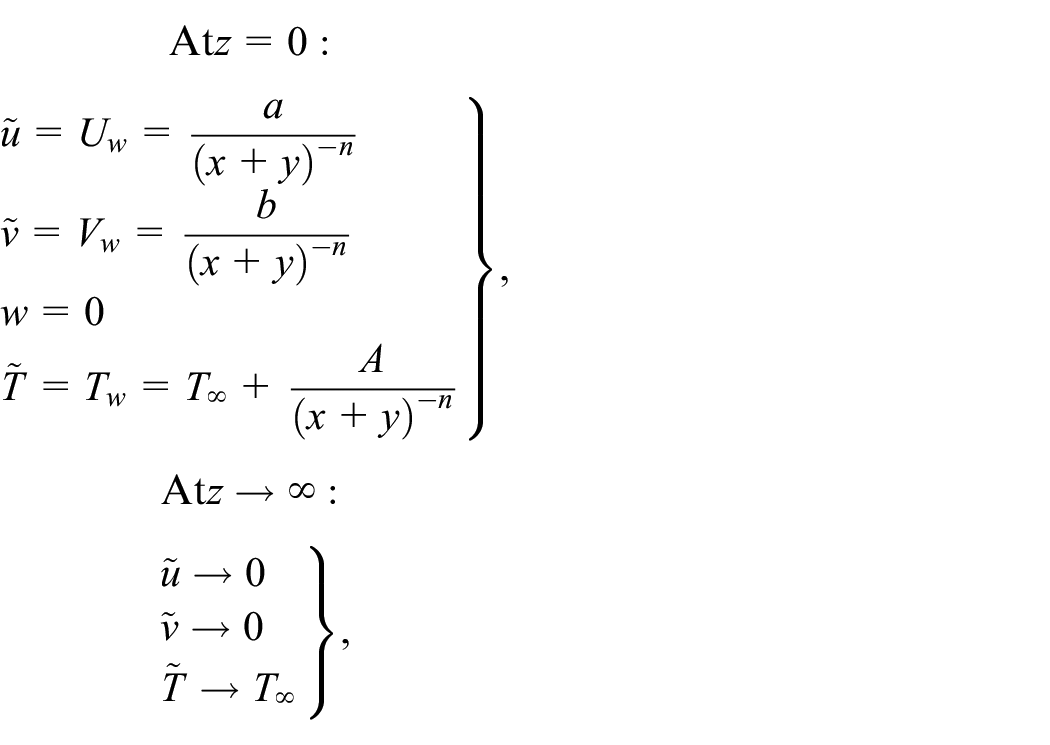
The similarity variables are 37 :

By entreating the suitable partial derivatives and above defined self-similar transformations in equations (1)–(4), the following is attained:


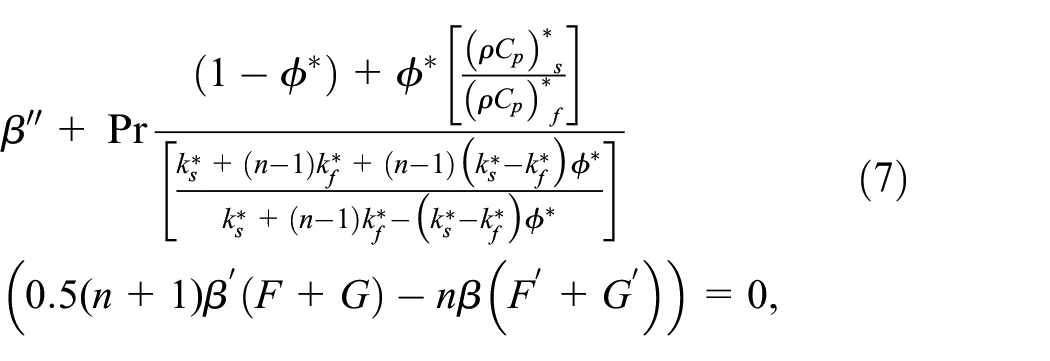
The supporting self-similar boundary conditions are:

Here,
Further, dimensional formulas for shear stresses and local Nusselt number are as follows:

Where,

After simplification, transformed version is given as:

Numerical analysis of the model
It is a paramount fact that the coupled nonlinear mathematical models fail to tackle in the form of closed solution. Therefore, numerical solutions are credible for such nature of the flow models. The formulated model is highly nonlinear and coupled in nature so, closed form solution does not hold. Thus, the model is then treated numerically with RK technique
37
with coupling of shooting technique. In this scheme, firstly the nonlinear mathematical model transformed into a system of first order initial value problem and then solved using the algorithm. Most importantly,

In the light of these substitutions, the nonlinear coupled model transformed into the following version:

The appropriate initial conditions are:

Where,
Results and discussion
This section deals with the graphical results and their comprehensive discussion. The results are presented against various flow parameters over the domain of interest. these results are displayed in Figures 2 to 10. The results are displayed for the velocities, temperature, shear stresses and local thermal performance of the nanofluids against the pertinent flow parameters.

Effects of

Effects of

Effects of
Effects of

Effects of
Effects of

Effects of

Effects of

Effects of
Velocity and thermal distribution
The trends in horizontal velocity component
The vertical fluid motion against
Thermal behavior of the nanofluids for the multiple ranges of the parameter
Trends in shear stresses
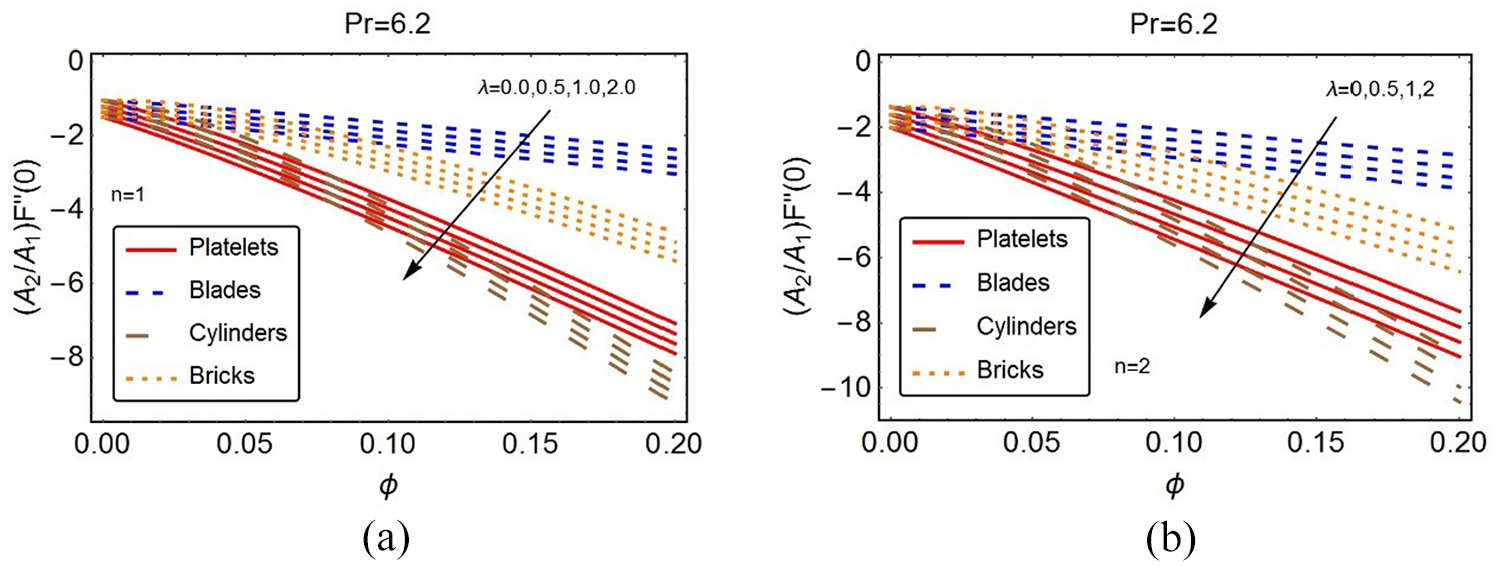
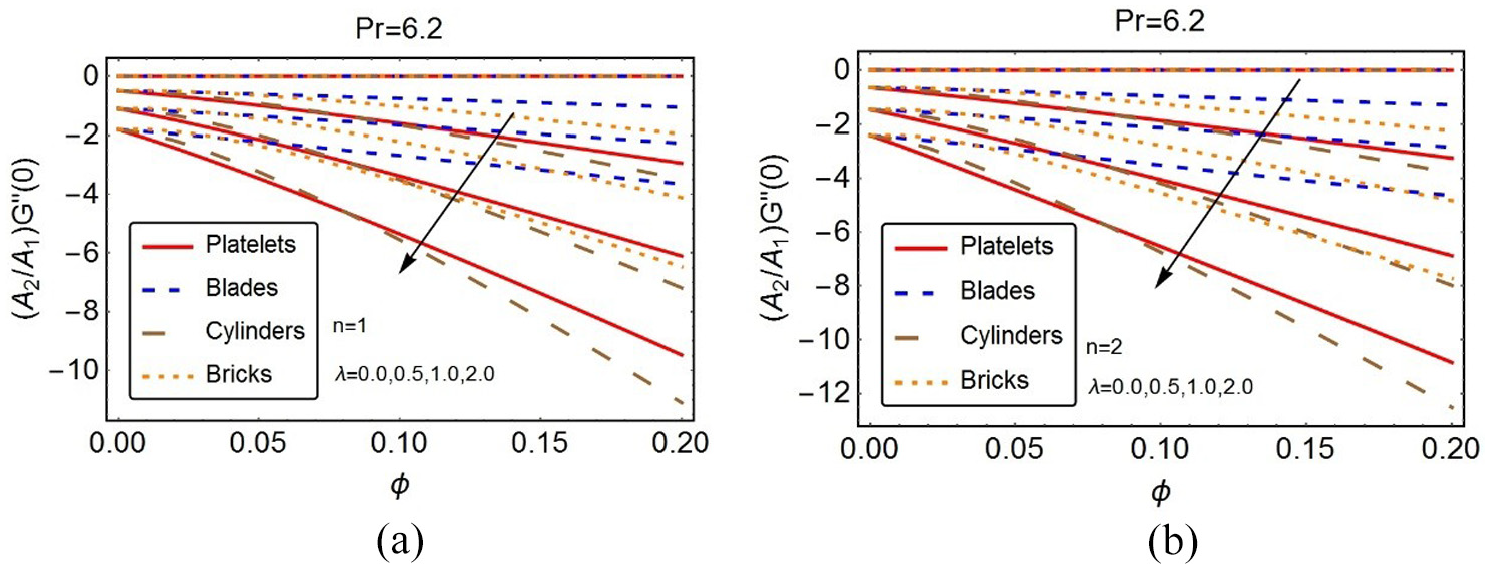
The trends in stresses along horizontal and vertical directions due to varying flow parameters are displayed in Figures 5 to 8, respectively. The stresses along horizontal direction against
Figure 6 portraying the trends in shear stresses against
The behavior of vertical shear stresses by increasing the values of
Trends in local thermal performance
Figures 9 and 10 elucidating the behavior of local thermal performance in the nanofluids under varying
Authentication of the study
The under consideration nanofluid model is modified version of Khan et al.
37
In order to verify the presented results with existing science literature under the same boundary conditions and the same flow parameters, we need to impose some restriction (
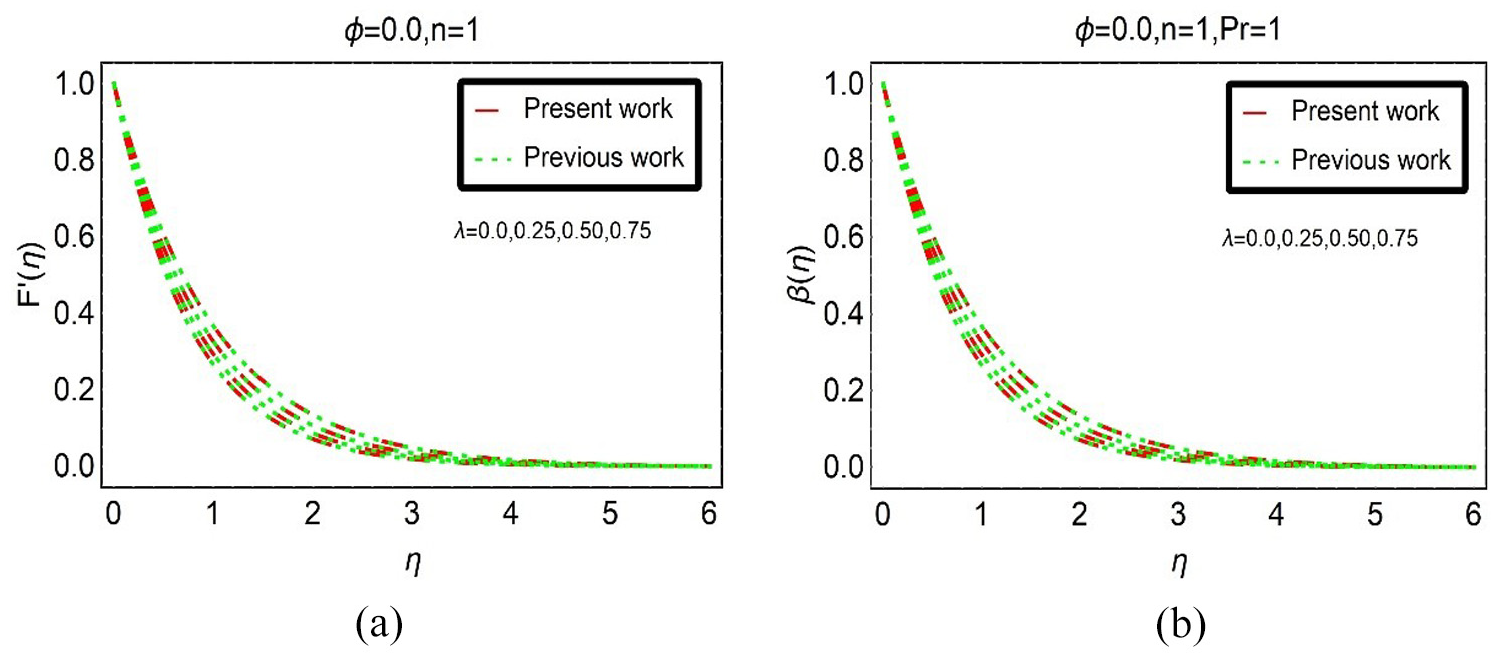
Comparison of present study with previous work Khan et al. 37 for (a) F′(η) and (b) β(η)
Moreover, a comparative analysis for
Authentication of the study for

Conclusions
The thermal transport mechanism is examined under various shaped nanomaterial based nanofluids. The colloidal model is treated numerically and displayed the results against the flow quantities over the feasible region. It is observed that the vertical motion of the nanofluids significantly escalated by increasing
Footnotes
Appendix
Handling Editor: Chenhui Liang
Author Note
Syed Tauseef Mohyud-Din is also affiliated to University of Multan (UoM), Multan, Pakistan.
Declaration of conflicting interests
The author(s) declared no potential conflicts of interest with respect to the research, authorship, and/or publication of this article.
Funding
The author(s) received no financial support for the research, authorship, and/or publication of this article.
