



Abstract
Pre-chamber jet ignition is a promising way to improve fuel consumption of gasoline engine. A small volume passive pre-chamber was tested at a 1.5L turbocharged GDI engine. Combustion and emission characteristics of passive pre-chamber at low-speed WOT and part load were studied. Besides, the combustion stability of the passive pre-chamber at idle operation has also been studied. The results show that at 1500 r/min WOT, compared with the traditional spark ignition, the combustion phase of pre-chamber is advanced by 7.1°CA, the effective fuel consumption is reduced by 24 g/kW h, and the maximum pressure rise rate is increased by 0.09 MPa/°CA. The knock tendency can be relieved by pre-chamber ignition. At part load of 2000 r/min, pre-chamber ignition can enhance the combustion process and improve the combustion stability. The fuel consumption of pre-chamber ignition increases slightly at low load, but decreases significantly at high load. Compared with the traditional spark ignition, the NOx emissions of pre-chamber increase significantly, with a maximum increase of about 15%; the HC emissions decrease, and the highest decrease is about 36%. But there is no significant difference in CO emissions between pre-chamber ignition and spark plug ignition. The intake valve opening timing has a significant influence on the pre-chamber combustion stability at idle operation. With the delay of the pre-chamber intake valve opening timing, the CoV is reduced and can be kept within the CoV limit.
Introduction
With the fuel consumption regulations becoming more stringent, reducing fuel consumption became a high priority. For gasoline engine, enhancing combustion process, reducing friction and heat dissipation loss, suppressing knock are effective ways to improve the thermal efficiency, and common techniques include high-efficiency combustion systems, low friction, advanced thermal management, high EGR (exhaust gas recirculation) or air dilution, in-cylinder water injection, deep Miller, and pre-chamber ignition.1–5 Pre-chamber ignition technology can improve ignition stability and accelerate combustion, it is one of the most promising technologies for ultra-high thermal efficiency engines in the future.
Pre-chamber concept engine with spark plug first began in the first part of the 20th century. 6 Since then, pre-chamber technology has been mainly applied to diesel engines and gas engines. In recent years, due to the high requirements of gasoline engines for thermal efficiency and power performance, research on pre-chamber at gasoline engine has gradually increased.7–9
The pre-chamber spark plug ignites the combustible mixture in a small cavity, and then the high-temperature and high-pressure jets inside the pre-chamber penetrate into the main-chamber, leading to a spatial ignition.10,11 The hot turbulent jet shortens the flame propagation distance. The unburned intermediate products in the pre-chamber enhance the main chamber combustion process.12–15 Besides, the transient reacting turbulent jet increases main chamber turbulent intensity at TDC (Top Dead Center).
Pre-chamber can be divided into two types: active pre-chamber and passive pre-chamber. The active pre-chamber has an injector to provide fuel, while the passive pre-chamber does not.16–20 The passive pre-chamber has a simple structure. Honda has applied a passive pre-chamber to the gasoline engine of the F1 racing car. Since the passive pre-chamber can improve the combustion speed and reduce knocking tendency, the compression ratio of passive pre-chamber engine can be increase, and the combustion phase can be advanced at partial load. Besides, mixture enrichment degree can be reduced at WOT (Wide Open Throttle) operation. Therefore, the passive pre-chamber is benefit for engines with high compression ratio and high load. Although the passive pre-chamber improves the combustion speed, the mixture in passive pre-chamber can’t be enriched, and the lean burn limit of the passive pre-chamber can’t be extended compared with the traditional spark plug ignition.17,21,22 On the other hand, the active pre-chamber has a complicated structure, but it can enrich the mixture inside the pre-chamber, which significantly extends the lean burn limit. 23
Honda 24 studied the pre-chamber at a gasoline single-cylinder engine with a stork-bore ratio of 1.5 and a compression ratio of 16, the results show that the effective thermal efficiency of 47.2% is achieved in the lean burn mode, and the NOx emissions are less than 50 ppm. MAHLE25–27 conducted many researches on the structure, combustion, emission, and fuel consumption of the pre-chamber, and the results show that the lean burn limit is extended to lambda of 2.1, fuel economy is improved by 10%–20%. The research results from Korb et al. 28 show that the tilted nozzle is beneficial to ignition stability, and the engine with pre-chamber has a reduced demand for turbulent kinetic energy compared with traditional spark plug ignition. Biswas and Qiao 29 studied the combustion mechanism of H2 in the pre-chamber at different temperatures, pressures, and equivalence ratios at a constant volume bomb. Shah et al. 30 studied the pre-chamber volume and orifice diameter. And the results show that when the pre-chamber volume ratio is increased from 1.4% to 2.4%, the combustion speed is significantly accelerated. When the orifice diameter is small, the flow resistance is large, and the pressure in the pre-chamber is high, which is beneficial to accelerate combustion of main chamber. Hua et al. 31 studied the knocking of the pre-chamber, the results show that the knocking of the pre-chamber jet ignition has two stages of rapid heat release and pressure oscillation. The first stage is the local rapid combustion caused by the jet injection. The second stage is caused by the auto ignition. Tian et al. 32 studied the impacts of pre-chamber geometric parameters on ignition and combustion processes in a constant volume chamber, the results show that a larger pre-chamber orifice diameter caused earlier ignition timing and lower ignition position, and the flame would quench when the orifice diameter was smaller than a certain value. Tang et al. 33 found that a higher pressure difference between pre-chamber and main chamber produces larger pre-chamber jet penetration speed, over enrichment of the pre-chamber charge reduces the peak pressure difference. The research results from Tanoue et al. 17 show that knocking occurred near the nozzle exit when one hole was used, while it occurred near the center for the two holes scenario. This indicates that the torch flame configuration affects the knocking position. Atis et al. 34 studied the effect of pre-chamber nozzle orifice diameters, large orifice is beneficial to improve combustion stability and reduce partial combustion.
The previous research on the pre-chamber mainly focused on the optimal fuel consumption operation, and there is less research on the low-speed WOT. Moreover, the research results10,35,36 show that the combustion stability of the pre-chamber at low speed and low load is poor, but the optimization research on combustion stability at that operation is limit. In this study, a small volume passive pre-chamber was tested at a 1.5L turbocharged GDI engine. Combustion and emission characteristics of passive pre-chamber at low-speed WOT and part load were studied. Besides, the combustion stability of the passive pre-chamber at idle operation has also been studied.
Experimental apparatus and data processing
Experimental engine and test equipment
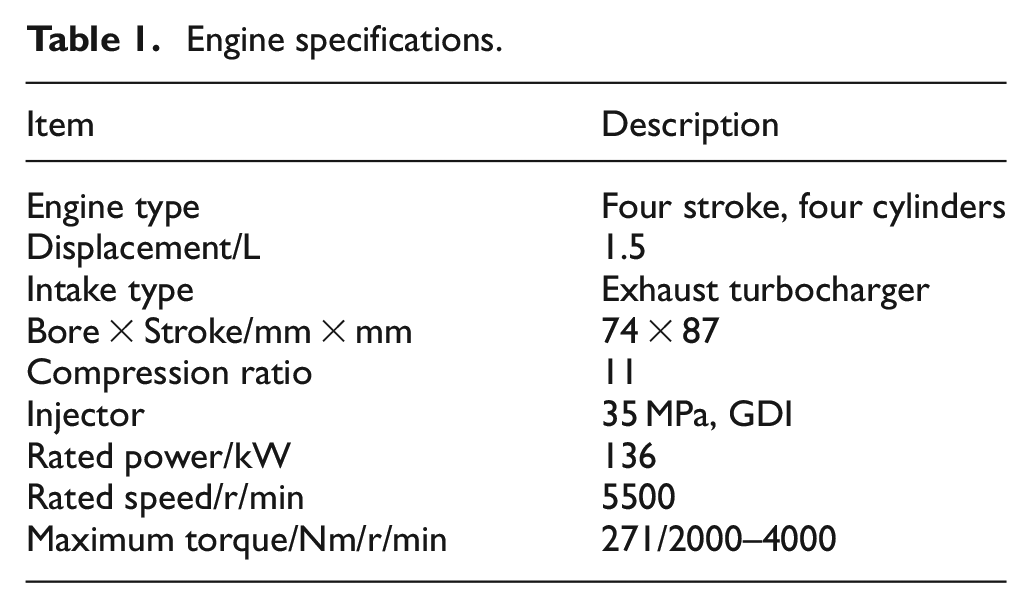
The experiments were carried out on a 1.5L turbocharged GDI (Gasoline Direct Injection) engine (bore/stroke of 74/87 mm). More details about the experimental engine can be found in Table 1. In order to enhance combustion process, improve fuel economy and suppress knock, a passive pre-chamber system was designed, which was mounted at the top of the main chamber.
Engine specifications.
A schematic of the pre-chamber structure is illustrated in Figure 1, in which the drawing of the pre-chamber turbulent jet ignitor is clearly presented. A M8 spark plug was mounted at the top of the pre-chamber shell. The passive pre-chamber volume was about 1.3 mL, which was 3% of the main chamber volume at TDC. The jet orifice diameter was 1.5 mm, the number of orifice was 4, and the jet angle was 140° (the angle between the two outermost orifice).
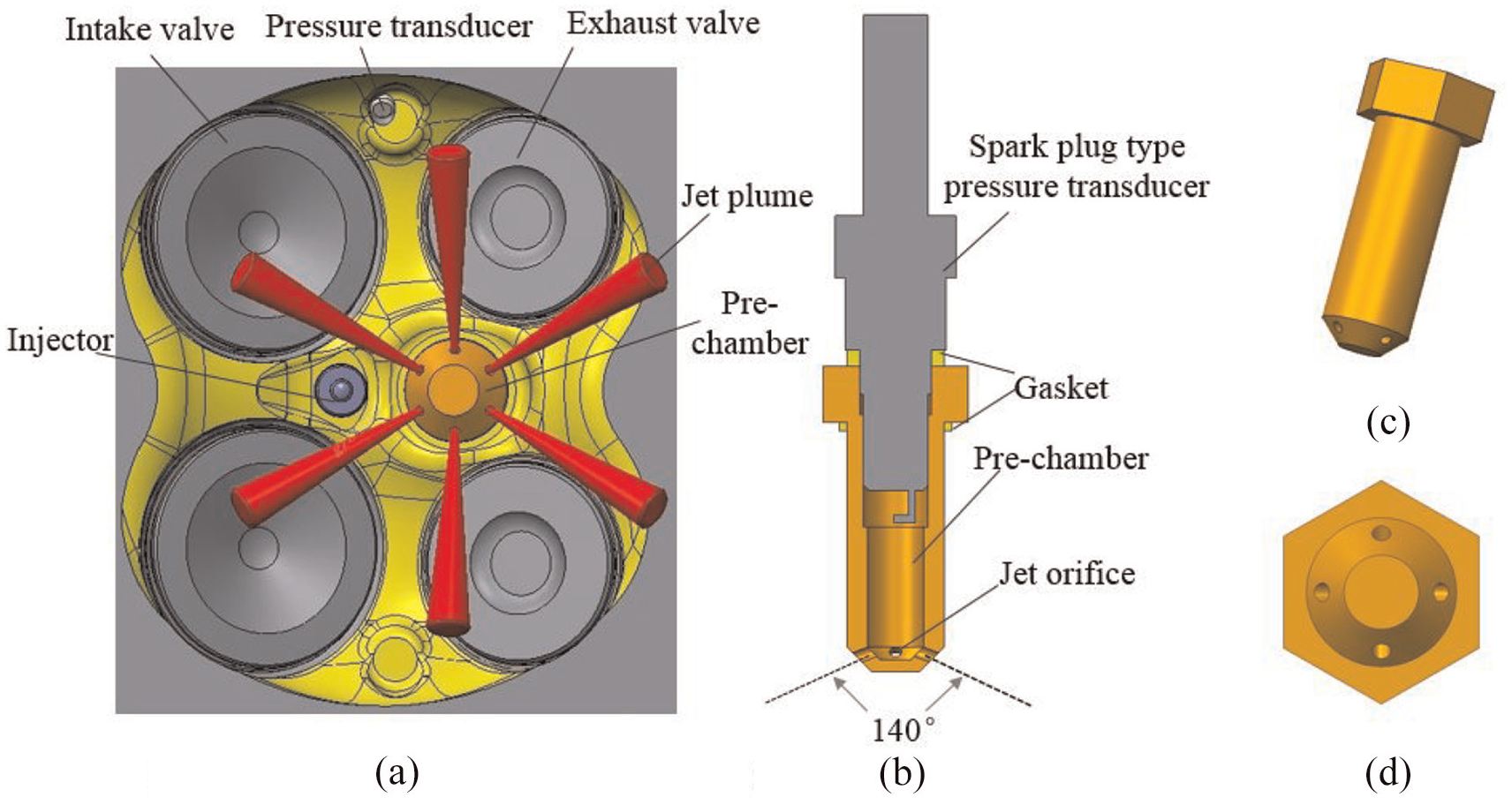
Schematic diagram of pre-chamber: (a) pre-chamber in cylinder block, (b) pre-chamber structure, (c) pre-chamber shell, and (d) pre-chamber orifice.
Maserati found that the thermal conductivity of the passive pre-chamber should be greater than 150 W/(m K) to avoid overheating and damage of the pre-chamber. Maserati Nettuno engine adopts the passive pre-chamber, which is made of CuCrZr alloy with a high level of heat dissipation. 36 Besides, in our study, when the pre-chamber was made of steel with low thermal conductivity, the frequency of early ignition was high, which made the engine easy to damage. When chromium zirconium copper alloy with high thermal conductivity was used in the pre-chamber, the frequency of early ignition was low. Therefore, in order to improve the pre-chamber heat dissipation and reduce the pre-chamber temperature, the pre-chamber made of chromium zirconium copper alloy was used in this study.
The schematic layout of engine bench test system is shown in Figure 2. The engine bench test system mainly consists of a gasoline engine, FEV 250HS transient dynamometer, and FEV TCM control system. Equivalence ratio was measured by a wideband lambda sensor ES630. Fuel mass consumption was measured by a FEV FuelRate. The crank angle was measured by AVL 365C corner marker. AVL indicom combustion analyzer was used to collect cylinder pressure and calculate combustion data. Gas emission was measured by HORIBA MEXA-7100 gas emission analyzer. There were two pressure transducers. Main chamber pressure signals were measured by a Kistler 6115B pressure transducer. Prechamber pressure signals were measured by a Kistler 6113C spark-plug-type pressure transducer. Main chamber pressure signals were used to calculate combustion data.

Layout of engine bench test system.
More details about the experimental equipment specifications can be found in Table 2.
Equipment specifications.

Test conditions and data processing
When the engine operation is at low-speed and high-load, due to the low rotation speed, the combustion speed is slow, and the tendency of knocking and pre-ignition is high. Therefore, the operation of speed = 1500 r/min and BMEP (Brake Mean Effective Pressure) = 2 MPa was selected to study pre-chamber low-speed WOT characteristic. Besides, the effects of pre-chamber on the combustion process, economy and emission of the engine were studied at part load. Further, the combustion stability of the passive pre-chamber at idle operation has also been studied. The calculation of the combustion duration and combustion phase is based on the pressure of main chamber.
The ignition delay(AI10-IGN) is defined as the crank angle from spark plug ignition to 10% heat release. The combustion duration(AI10-90) is defined as the crank angle from 10% heat release to 90% heat release, and AI50 is defined as the crank angle at 50% heat release.
The exhaust lambda was maintained at 1 ± 0.02. The ignition angle was MBT (Minimum Ignition Advance for Best Torque) angle for both traditional spark ignition and pre-chamber, and the combustion phase AI50 was will not be earlier than 8°ATDC (After Top Dead Center ). The ignition timing was optimized to achieve maximum thermal efficiency at different operations. The maximum in-cylinder peak pressure was 100 bar. The maximum main chamber pressure rise rate was within 6 bar/°CA. The intake air temperature after intercooler in the test was 35°C ± 3°C. The cooling water temperature was 88°C ± 2°C. The fuel was commercial gasoline with RON of 92, and which low calorific value was 42.5 MJ/kg. The combustion cycle variation rate CoV was within 3%, the calculation of CoV is described as follows:

Results and discussion
As mentioned above, the aim of this work was to study the effect of operations at low-speed WOT, part load, and idle on the jet ignition and combustion process. First of all, the combustion at low-speed WOT was examined. Subsequently, the effects of pre-chamber on the combustion process, economy, and emission of the engine were studied at part load. Finally, the combustion stability of the passive pre-chamber at idle operation was optimized.
Combustion of pre-chamber at low-speed WOT
In this section, the combustion characteristics of engine installed spark plug and pre-chamber were compared to each other for analysis at 1500 r/min@2 MPa. When the engine is operating in the pre-chamber ignition mode, the pre-chamber pressure and the main combustion chamber pressure were measured at the same time. The heat release rate(HRR) of different ignition methods was obtained by the pressure of the main chamber. Figure 3 shows the variation of pressure and HRR with crank angle at low-speed WOT.

Variation of pressure and HRR with crank angle at low-speed WOT: (a) pressure and (b) HRR.
The ignition timing of the pre-chamber is 3.5°CA ATDC, which is earlier than the traditional spark plug ignition. This is because the main chamber can be ignited by the jet flame only after the mixture in the pre-chamber is ignited, which makes the ignition delay of pre-chamber longer. For spark plug ignition, the combustion phase AI50 is 33.2°CA ATDC, the effective fuel consumption rate is 308 g/kW h, and the maximum pressure rise rate (MPRR) is 0.29 MPa/°CA. But for pre-chamber ignition, the combustion phase is advanced to 26.1°CA ATDC, and the effective fuel consumption rate is reduced to 284 g/kW h, and the pressure rise rate increases to 0.38 MPa/°CA. The maximum HRR of the spark plug ignition and the pre-chamber ignition are 297 kJ/(m3 °CA) and 426 kJ/(m3 °CA), respectively. The pre-chamber ignition can achieve a greater maximum HRR, and an advanced heat release phase.
Due to the slow flame propagation speed and high in-cylinder temperature at low-speed and high-load, the knock tendency of the traditional spark plug ignition is increasing, and the combustion phase is retarded. The ignition timing is around 10°CA ATDC and the peak pressure is at 36°CA ATDC, which makes serious afterburning.
The pre-chamber pressure rises rapidly after spark plug ignition, and the pre-chamber has three pressure peak. The first peak at TDC is caused by the piston compression. The second peak is caused by the combustion of the mixture in the pre-chamber. The hot turbulence jet containing hot combustion products penetrates into the main-chamber, leading to a spatial ignition of the air-fuel mixture. After that, combustion in main chamber starts and the pressure rise leads to the development of inverse jet from the main-chamber to the pre-chamber, which causes the third pressure peak of the pre-chamber. The spatial ignition caused by hot turbulence jet shortens the flame propagation distance, and the flame can quickly propagates to the end of the mixture before auto-ignition. Although the pre-chamber increases the throttling loss and heat loss, the pre-chamber ignition can enhance the combustion process, and improve the combustion phase at high load, which significantly reduce fuel consumption.
Combustion and emission of pre-chamber at part load
Combustion of pre-chamber at part load
In this section, engine speed was maintained at 2000 r/min. The BMEP were 0.5, 0.8, 1.2, and 1.6 MPa. The combustion characteristics and economy of traditional spark ignition and pre-chamber ignition were compared with each other.
Figure 4 shows the BSFC (Brake Specific Fuel Consumption) and BTE (Brake Thermal Efficiency) of spark ignition and pre-chamber ignition at part load. When the BMEP is less than 0.8 MPa, the BSFC of the pre-chamber ignition increases slightly as compared to spark ignition. But when the BMEP is greater than 0.8 MPa, the fuel consumption of the pre-chamber ignition is significantly improved, and the BSFC is improved about 7 g/kW h at most. Besides, the spark ignition achieves the maximum BTE of 36.9% at BMEP of 0.8 MPa, but pre-chamber ignition achieves the maximum BTE of 37.5% at BMEP of 1.2 MPa. This shows that the pre-chamber ignition is beneficial to the improvement of the fuel economy at high load. At low load, the combustion phases of the pre-chamber and spark plug ignition are both at the optimal combustion phase (8°CA ATDC), but the pre-chamber increases the throttling loss and heat transfer loss, which increase the fuel consumption. At high load, the pre-chamber ignition can significantly enhance the combustion process, and improve the combustion phase, which significantly reduce fuel consumption.

BSFC and BTE of spark ignition and pre-chamber ignition.
Figures 5 and 6 shows the AI50 (combustion phase), AI10-90 (combustion duration), Ignition timing, and CoV of spark ignition and pre-chamber ignition at part load. Compared with spark ignition, the pre-chamber ignition effectively improves the combustion cycle variation and combustion speed at all load. The combustion phase of the pre-chamber is not improved at low load, but significantly improved at high load.

AI50, AI10-90, and Ignition timing at part load: (a) AI50 and AI10-90 and (b) ignition timing.

CoV at part load.
The in-cylinder temperature is low at low load, and the knock tendency could be relieved. Therefore, the combustion phase can be maintained at 8°CA ATDC at BMEP of 0.5 and 0.8 MPa, which has the optimal thermal-power conversion. Although the pre-chamber ignition has fast combustion speed, the combustion phase has reached the limit of 8°CA ATDC, and the combustion phase is not improved. The pre-chamber has early ignition timing, but with the load increases, the ignition timing difference between traditional spark ignition and pre-chamber ignition decreases. Due to the multi-point ignition of the pre-chamber, the combustion cycle variation is improved. Besides, the combustion phase is not improved, but the pre-chamber increases the area of the combustion chamber and the heat transfer loss, resulting in increased fuel consumption compared to spark ignition at low load.
At high load (BMEP ≥ 1.2 MPa), the in-cylinder temperature is high, and the engine has a high knock tendency. Pre-chamber ignition improves combustion phase, and the fuel consumption is improved. Besides, the knock tendency of pre-chamber could be relieved, and load of the maximum thermal efficiency is greater than spark ignition.
NOx emissions
As mentioned above, it can be seen that pre-chamber enhances the combustion process, which makes the maximum combustion pressure and temperature increase. Therefore, it is necessary to study the NOx emissions of pre-chamber ignition.
Figure 7 shows the NOx emissions at part load. The NOx emissions of pre-chamber ignition are slightly increased compared to spark ignition at BMEP of 0.5 and 0.8 MPa. But at high load (BMEP ≥ 1.2 MPa), the NOx emissions of pre-chamber increase significantly, with a maximum increase of about 15%. The reason is that the formation of NOx increases exponentially with increasing temperature. At low load, pre-chamber ignition increases the combustion speed, but the combustion phase is not advanced, and the maximum temperature in the cylinder rises slightly. But at high load, pre-combustion improves the combustion speed and combustion phase at the same time, and the maximum temperature in the cylinder rises significantly.

The NOx emissions at part load.
HC emissions
Figure 8 shows the HC emissions at part load. Compared with the spark ignition, the HC emissions of the pre-chamber ignition have decreased, and the highest decrease is about 36%. The reason is that the pre-chamber enhances the combustion process and the peak in-cylinder temperature is higher, which makes the mixture combustion more completely, and reduces the HC emissions.

The HC emissions at part load.
CO emissions
Figure 9 shows the CO emissions at part load. At different loads, there is no significant difference in CO emissions between pre-chamber ignition and spark plug ignition. The reason is that the CO emissions are mainly affected by excess air. The pre-chamber ignition and the spark plug ignition have the same air-fuel equivalence ratio. Besides, CO emissions of pre-chamber ignition are slightly reduced at medium and high loads. The reason may be that the acceleration of the combustion process increases the maximum temperature in the cylinder and promotes the oxidation of CO.

The CO emissions at part load.
Combustion cycle variation at low-speed and low-load
When the engine with pre-chamber ignition operates at low-speed and low-load conditions, due to the small space and low temperature of pre-chamber, the flame in the pre-chamber is easy to extinguish. Besides, the small space of the pre-chamber also makes the turbulence dissipate quickly. The pre-chamber engine suffers from poor combustion stability. Therefore, it is necessary to study the improvement of the pre-chamber combustion stability at low-speed and low-load. In this section, engine operation was maintained at idle condition (Speed = 800 r/min, BMEP = 0.1 MPa).
Figure 10 shows the variation of CoV with ignition timing. Too late or too early ignition timing of pre-chamber is not conducive to combustion stability. Ignition timing of −21°CA achieves the Minimum CoV of 4.1%, which is not within the CoV limit and about 2.3 times that of the spark ignition.

Variation of CoV with ignition timing.
Figure 11 shows the variation of CoV with intake valve opening (IVO) timing. With the delay of the pre-chamber intake valve opening (IVO) timing, the CoV is significantly reduced and CoV can be kept within the CoV limit. The reason is that the experimental engine is a Miller cycle engine. With the delay of the pre-chamber intake valve opening timing (IVO), and the closing time of the intake valve is also delayed, which makes the turbulence dissipation time shorter and the turbulent kinetic energy at TDC becomes stronger. Therefore, stronger in-cylinder flow leads to lower combustion cycle variation. On the other hand, with the delay of the pre-chamber intake valve opening timing (IVO), the valve overlap angle is reduced, which makes the actual compression ratio of the engine larger. More fresh air is pushed in the pre-chamber, which reduces the EGR in the pre-chamber and improves the ignition stability.
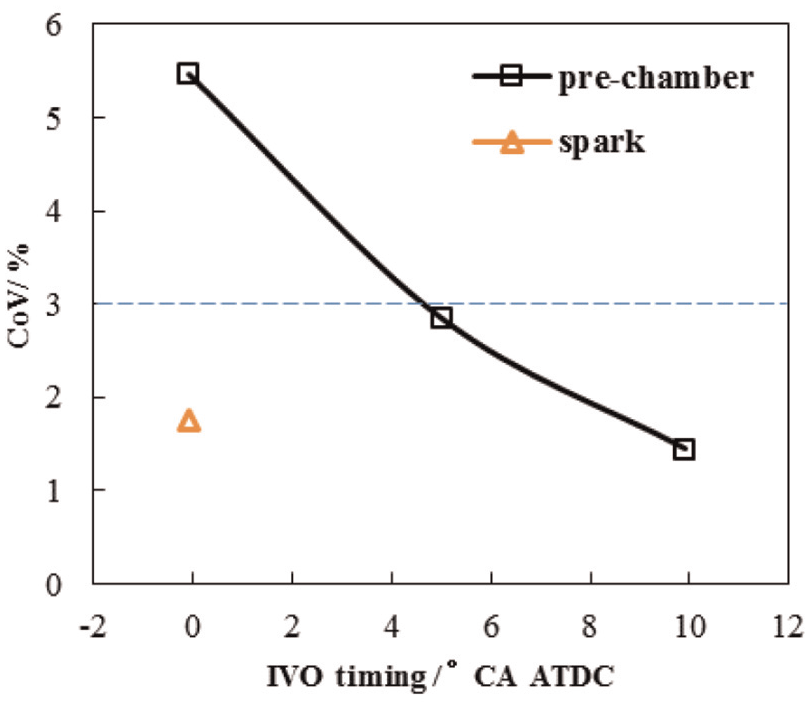
Variation of CoV with IVO timing.
Figure 12 shows the variation of CoV with exhaust valve closing (EVC) timing. Too late or too early ignition timing of pre-chamber is not conducive to combustion stability. EVC timing of −30°CA achieves the minimum CoV of 5.5%, which is not within the CoV limit and about 3.1 times that of the spark ignition.

Variation of CoV with EVC timing.
Conclusions
In this study, the combustion and emission involving in the passive pre-chamber were examined in a 1.5L turbocharged GDI engine. Large amount of data and information are generated and analyzed. The main conclusions are as follows:
At 1500 r/min WOT operating condition, compared with the traditional spark ignition, the combustion phase of pre-chamber is advanced by 7.1°CA, the effective fuel consumption is reduced by 24 g/kW h, and the maximum pressure rise rate is increased by 0.09MPa/°CA. The knock tendency can be relieved by pre-chamber ignition.
At part load of 2000 r/min, pre-chamber ignition enhances the combustion process and improves the combustion stability. The fuel consumption of pre-chamber ignition increases slightly at low load, but decreases significantly at high load.
Compared with the traditional spark ignition, the NOx emissions of pre-chamber increase significantly, with a maximum increase of about 15%; the HC emissions decrease, and the highest decrease is about 36%. But there is no significant difference in CO emissions between pre-chamber ignition and spark plug ignition.
The intake valve opening timing has a significant influence on the pre-chamber combustion stability at idle operation. With the delay of the pre-chamber intake valve opening timing, the CoV is reduced and can be kept within the CoV limit.
Footnotes
Handling Editor: Chenhui Liang
Declaration of conflicting interests
The author(s) declared no potential conflicts of interest with respect to the research, authorship, and/or publication of this article.
Funding
The author(s) disclosed receipt of the following financial support for the research, authorship, and/or publication of this article: Key Project of Natural Science Research in Colleges and Universities of Anhui Province (Project Number: KJ2019A1009, KJ2020A0837) and Open Fund Projects of Maanshan Engineering Technology Research Center of Advanced Design for Automotive Stamping Dies (Project Number: QMSG202102, QMSG202103).
