



Abstract
The aim of this paper is to ensure proper thermal management in order to remove and dissipate the heat produced by a square Light Emitting Diode (LED), as well as to ensure stable and safe operation by reducing the junction temperature. For this, we developed a three-dimensional code, time-dependent that solves the systems of equations for the mass, momentum, and energy using Comsol Multiphysics. After validation of this numerical 3D code, the thermal performance of a LED cooling system with three nanofluids such as MWCNT-Water, MWCNT-Ethylene Glycol, and MWCNT-Engine oil is studied numerically into account of aggregation effect. Several parameters such as: the power of the LED lamp, the inlet temperature and velocity of nanofluid, the length of the heat sink, and the length of the microchannel have been varied in order to find an optimal condition allowing a good heat dissipation from the LED chip to the heat sink. It was concluded that the use of MWCNT-Water in the microchannel is the best nanofluid that can cool the heat sink. In addition, the increase of velocity inlet of the coolant in the microchannel, the length of the heat sink, and the microchannel length while the decrease of the inlet temperature of nanofluid in the microchannel are an important factors allowing the decrease of the junction temperature of the square LED lamp.
Keywords
Introduction
Nowadays, the electronic devices such as Light Emitting Diodes (LEDs) are becoming the most used in the application of street lamps, automotive and household illumination, advertising displays, traffic lights, industrial application, aerospace and avionics, telecommunication and consumer market like mobile phones due to the excellent properties for long lifetime, low power consumption, and low cost. Especially in the field of lighting, LED lamps have taken the place of discharge lamps such as mercury discharge lamps1–7 and metal halide lamp8–10 due to better energy efficiency, small size, environmental friendliness, low UV radiation, easy control, and low maintenance. Even though high-power LEDs have a high-energy efficiency of around 15%–25% from power to light under the current level of technology contrasted with 10% in traditional lighting, there is still more than around 80% of the electric power consumed by LED devices as heat dissipation, which will result in high chip junction temperature. The increase of junction temperature resulting from increased input power will affect many LED parameters such as light output, forward voltage, and wavelength. Therefore, the temperature of the chip’s junction should be kept at an appropriate range to ensure its performance and service life.11,12 So, the adequate thermal management of LED package is unavoidable to remove and dissipate the heat produced by the LED and to guarantee reliable and safe operation.
One of the solutions for cooling performance/heat dissipation in LED lamps is the best design of heat sink leading to the optimization of various design parameters such as pin spacing, diameter, height, and orientation, which were studied by several researchers.13–21 To improve the heat dissipation performance of heat sink by enhancing thermal radiation emission, Kim et al. 22 was applied a composite coating composed of cupric oxide (CuO) and silicon-based resin to an aluminum-alloy heat sink for a LED module.
Changing substrate materials is a solution for other researchers such as Yin et al., 23 Yang et al., 24 and Heo et al. 25
The ionic wind focuses on improving heat transfer. A numerical and experimental study was performed to analyze the thermal flow around the heat sink with the ionic wind. 26 The cooling performance by Shin et al. 27 was enhanced by 148% in maximum by the ionic wind compared with that of the original heat sink for 0.6 W of the applied power.
The cooling performance enhancement of LED packages with carbon nanogrease has been investigated by Nam et al. 28 who found that the measured thermal conductivities of the grease with MWCNT, silver, copper (II) oxide, and aluminum oxide enhance up to 82.8%, 26%, 58.8%, and 40% at 1.0 wt%, respectively, compared with that of the pure grease.
Kim and Kang 29 studied the cooling performances of the LED package with applied CNT (carbon nanotube) and graphene to the thermal grease that enhanced the heat dissipation by reducing the LED chip temperature 7.5°C and 5.5°C at 0.75 wt% of nanoparticles, respectively.
The implementation of an adequate phase change material (PCM) inside the heat sink and electronic devices in order to store the energy dissipated from the LED lamp and to release it outside in the event of PCM discharge has been among solutions found by a few researchers such as: Ben Salah and Ben Hamida, 30 Wu et al., 31 and Maranda et al. 32
These last years, microchannel and thermoelectric cooling system33,34 have become an important approach for the heat dissipation of LED lamps. These solutions interest many researchers considering their low cost and at the same time its effectiveness in reducing the junction temperature of the lamp. The nanofluid passing through the microchannel to cool the heat sink being varied such as: air, 35 nitrogen air-gas, 36 a permeable membrane. 37
Due to their highly efficient conductivity, the use of nanofluids to control heat transfer and/or cooling system in various applications is considered among the effective solutions for several researchers such as: Massaoudi et al.,38–41 Ben hamida et al.,42–45 and Ben Jaballah et al.46,47 Recent work asserts that MWCNT is among the best to use to improve heat transfer.48–50
Therefore, the three-dimensional analysis of the thermal management of cooling electronic devices is a promising area of research. Thus, in this work, the most basic fluids of nanofluids used in industrial applications which are MWCNT-Water, MWCNT-Ethylene Glycol, and MWCNT-Engine oil into account of aggregation effect. These last are the coolants of the heat sink of the square LED lamp and circulating in a rectangular microchannel are investigated with a focus on the effect parameters: the power of the LED lamp, the inlet temperature and velocity of nanofluid, length of the heat sink, and the length of the microchannel.
Physical problem
Geometry of the problem
Figure 1 shows our studied 19 structure of LED package that is the same studied by Ha and Graham 51 and the dimensions of the heat sink.

(a) Structure of the LED package. (b) Dimensions of heat sink.
The dimensions of the structure of the LED package and its materials are summarized in Table 1.
Structural dimensions and materials of LED package.

In this study, the thermal conductivity of the materials 52 used in the LED package is considered dependent on temperature as shown in Figure 2.

Thermal conductivity of materials of LED package function of temperature.
Description and boundary conditions of the problem
The 3-D model of a LED package, which is cooling by a nanofluid in the microchannel designed in this paper including its physical diagram, is shown in Figure 3.
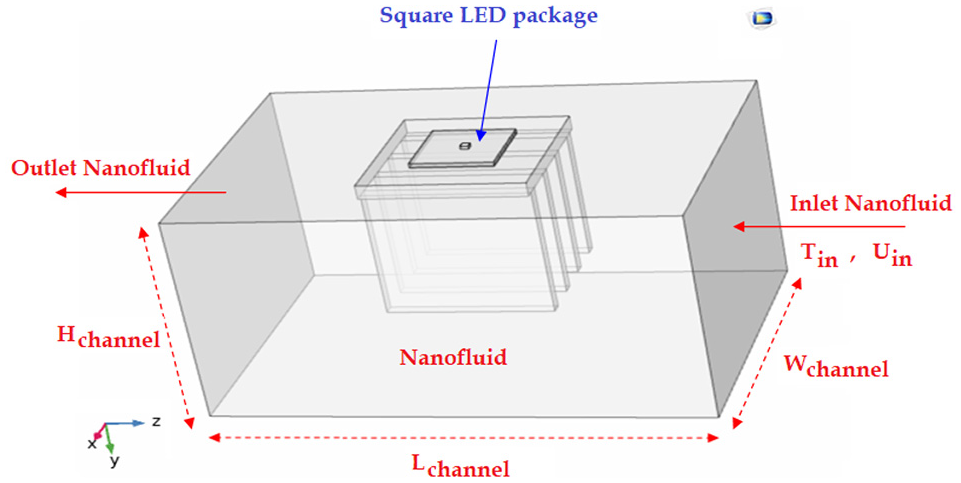
Physical model.
The system contains the LED package and the microchannel. In order to cool the heat sink of the LED lamp, a cubic microchannel that has dimensions: length (Lchannel), width (Wchannel), and height (Hchannel) is designed just on the upper surface of the heat sink while the LED lamp is in the open air (outside the heat sink). Inside the canal, we introduce the most used nanofluids in the field of nanotechnologies; which are MWCNT-Water, MWCNT-Ethylene Glycol, and MWCNT-Engine oil at a uniform temperature (Tin) with a uniform velocity (Uin) that must be varied for a better decrease in junction temperature of the LED lamp.
The applied boundary conditions are given as follows:
On top of the die, there is a uniform heat flux and other surfaces are adiabatic.
The inlet boundary condition of the microchannel is set to be the uniform temperature Tin with a uniform velocity Uin.
Pressure outlet boundary condition with zero gradients at a microchannel outlet.
No-slip condition is imposed on the surface of the microchannel walls.
All the outer walls of the microchannel are insulated.
Simplifying assumptions and governing equations
In order to analyze the thermal and flow characteristics of this three-dimensional model and at unsteady-state, several assumptions are made regarding the operating conditions of a heat sink with nanofluid in the microchannel:
The Navier-Stokes and energy equations can be used to analyze the physical processes;
The nanofluid flow is single-phase, incompressible, and laminar flow prevails across a microchannel;
The body forces and the effect of viscous heating are neglected;
The effect of radiation is neglected and the surface of the microchannel is well insulated.
Based on the above assumptions, the unsteady-state governing equations for mass, momentum, and energy conservation are expressed:

Where


In these equations, p is the pressure, g is the gravity, and η is the dynamic viscosity.

Where, T is the temperature, C is the specific heat capacity, and λ is the thermal conductivity.
Thermophysical properties
The expressions of the thermophysical properties used for the three fluids: water, ethylene glycol, and oil are the following:
For water


T in K and dynamic viscosity in Pa s

T in K and thermal capacity in J/(kg K)
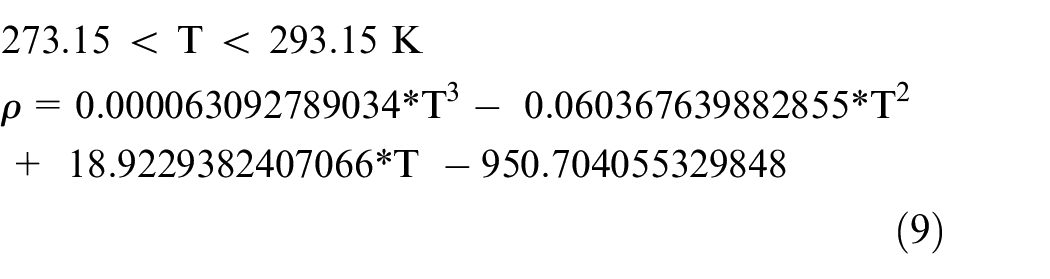

T in K and mass density in kg/m3

T in K and thermal conductivity in W/(m K)
For engine oil

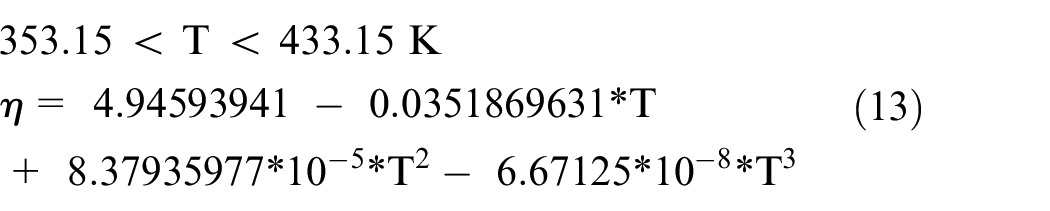
T in K and dynamic viscosity in Pa s

T in K and Thermal capacity in J/(kg K)

T in K and mass density in kg/m3

T in K and thermal conductivity in W/(m K)
For ethylene glycol


T in K and dynamic viscosity in Pa s

T in K and thermal capacity in J/(kg K)

T in K and mass density in kg/m3
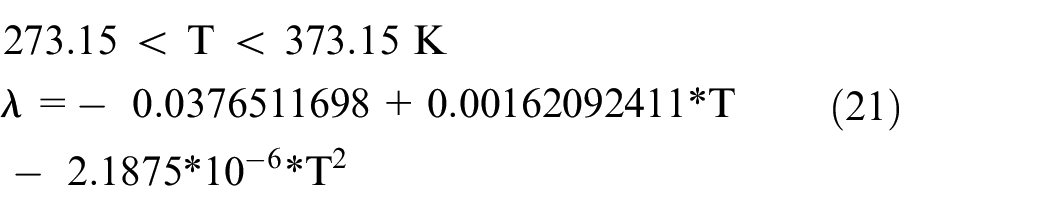
T in K and thermal conductivity in W/(m K)
For Multiwalled Carbon Nanotube MWCNT
The density


With
Considering the aggregation effect, nanoparticle volume fraction

The effective viscosity

With D = 2.1;
The effective thermal conductivity

With


Numerical method and validation
The numerical study is performed in this study by using the commercial software Comsol Multiphysics 5.4. Both solid and nanofluid phases were simultaneously solved as a single domain. In order to reach a plausible mesh grid, we examined several meshes (from extremely coarse to finer mesh) applied to this 3D model illustrated in Table 2. From this table, the fine mesh used and adequate to satisfy the accuracy of the results contain 45,255 domain elements, 27,722 boundary elements, and 2087 edge elements as shown in Figure 4. This mesh is already used by Ben Salah and Ben Hamida.19,30
Mesh sensitivity.


(a) Mesh configuration to simulate the flow in the heat sink. (b) Mesh configuration of LED.
To compare our 3D code to Ha and Graham’s 51 model, we simulated the temperature distribution of the LED package under the same conditions as Ha and Graham, 51 as shown in Figure 5.

Temperature distribution of the LED package: (a) our 3D code and (b) Ha and Graham 51 code.
The commercial software “Ansys” was used to simulate the 3D model of Ha and Graham 51 under the following conditions: the LED lamp has a power of 1 W, heat transfer coefficient is 10 W/m2/K, and the ambient temperature is 25°C. From Figure 5, we see that the minimum and maximum temperatures of the LED package are 53.32°C and 60.30°C respectively, for the model of Ha and Graham. 51 Compared with those found by our 3D model, these temperatures are 53.22°C and 60.37°C respectively. The difference in temperature between the two models is less than 0.001%.
Figure 6 shows the vertical temperature profile along the LED package’s centerline. From this graph, we can see also that our 3D model simulated with Comsol Multiphysics and Ha and Graham’s 51 3D model simulated with Ansys are in good agreement.

Vertical temperature profile along the center (z axis) line (c).
Results and discussion
After the validation of our 3D model, it is used to vary several parameters influencing the junction temperature of the LED lamp in order to decrease it. In this paper, the studied and varied parameters are: the power of the LED lamp, the length of heat sink, the inlet temperature and velocity of MWCNT nanofluid, and the length of the microchannel. The initial parameters of the LED lamp and the microchannel are illustrated in Table 3.
Initial parameters of the LED lamp and the microchannel.

Under the same conditions of Table 3, Figure 7 shows the temperature distribution of square LED at time = 2000 s using three cooling nanofluid (MWCNT-Engine Oil, MWCNT-Ethylene Glycol, and MWCNT-Water) in the microchannel. In addition, Figure 8 shows the junction temperature of the square LED using three cooling nanofluids in the microchannel according to time. We see from this that the junction temperature of the square LED is the highest for MWCNT-Engine Oil and the lowest for MWCNT-Water as a cooling nanofluid.

Temperature distribution of square LED at time = 2000 s using microchannel cooling with: (a) MWCNT-engine oil, (b) MWCNT-ethylene glycol, and (c) MWCNT-water.

Junction temperature of square LED according to time using microchannel cooling with: MWCNT-engine oil, MWCNT-ethylene glycol and MWCNT-water.
Effect of the coolant inlet temperature
In this section, we will deal with the influence of the inlet temperature of the cooling nanofluid in the microchannel on the thermal behavior of the square LED package while keeping all illustrated parameters in Table 3. For this, we vary only the inlet temperature of the three cooling nanofluid (MWCNT-Engine Oil + MWCNT-Ethylene Glycol + MWCNT-Water) from 5°C to 25°C.
Figure 9 shows the junction temperature of the square LED using three cooling nanofluids in the microchannel (MWCNT-Engine Oil + MWCNT-Ethylene Glycol + MWCNT-Water) subjected to three different inlet temperatures (Tin = 5°C, 15°C, and 25°C) according to time.

Junction temperature of square LED using three cooling nanofluids in a microchannel under Tin = 5°C, 15°C, and 25°C according to time.
We see from this figure that: for each cooling nanofluid, when the inlet temperature increases, the junction temperature of square LED increases. In addition, for the same inlet temperature of cooling nanofluid; the junction temperature of the square LED is the lowest for MWCNT-Water and the highest for MWCNT-Engine Oil as cooling nanofluid. Indeed, the junction temperature of the MWCNT-Water-cooled LED is reduced by approximately 1.5°C compared to the use of MWCNT-Ethylene Glycol as a coolant and by approximately 3°C compared to the MWCNT-Engine Oil for each coolant inlet temperature. We also note that the junction temperature of the LED lamp decreases by 20.1°C if the MWCNT-Water inlet temperature is 5°C instead of 25°C, that is a decrease of 75.5%. This decrease in temperature is also for the case of MWCNT-Ethylene Glycol and MWCNT-Engine Oil.
Therefore, we can conclude that the decrease of the inlet temperature of the coolant in the microchannel promotes the decrease of the junction temperature as well as the MWCNT-Water is the best coolant compared to both MWCNT-Ethylene Glycol and MWCNT-Engine Oil.
Effect of the coolant inlet velocity
In this section, we will deal with the influence of the inlet velocity of the cooling nanofluid in the microchannel on the thermal behavior of square LED while keeping all illustrated parameters in Table 3. For this, we vary only the inlet velocity of the three cooling nanofluid (MWCNT-Engine Oil + MWCNT-Ethylene Glycol + MWCNT-Water) from 1 to 10 mm/s.
Figure 10 shows the average temperature of square LED using three cooling nanofluids in the microchannel MWCNT-Water, MWCNT-Ethylene Glycol, and MWCNT-Engine Oil, subjected to three different inlet velocities (Uin = 1, 5, and 10 mm/s) according to time. From this figure, we see that: when the inlet velocity increases the average temperature of square LED decreases for each cooling nanofluid. It is noted also that MWCNT-Engine Oil can decrease the average temperature of the LED lamp more than MWCNT-Ethylene Glycol and MWCNT-Water when the nanofluid velocity increases from 1 to 10 mm/s. In fact, the average temperature of the square LED lamp decreases by 3.2°C, 2.1°C, and 1.3°C for MWCNT-Engine Oil, MWCNT-Ethylene Glycol, and MWCNT-Water coolants respectively, when the nanofluid velocity increases from 1 to 10 mm/s.

Average temperature of square LED for three inlet velocity of (a) MWCNT-water, (b) MWCNT-ethylene glycol, (c) MWCNT-engine oil in the microchannel (Uin = 1, 5 and 10 mm/s) according to time.
Consequently, we can conclude that the increase of the velocity inlet of the coolant in the microchannel promotes the decrease in the average temperature of the lamp as well as its junction temperature.
The junction temperature of the square LED lamp for the three coolants (MWCNT-Engine Oil, MWCNT-Ethylene Glycol, and MWCNT-Water) entering the microchannel at a velocity of 10 mm/s and a temperature of 25°C according to time is plotted in Figure 11. From this figure, we note that the junction temperature of the square LED is the lowest for MWCNT-Water and the highest for MWCNT-Engine Oil as a cooling nanofluid. This difference in temperature does not exceed 1°C.

Junction temperature of square LED 1 W using three cooling nanofluids in the microchannel for an inlet velocity of Uin = 0.01 m/s according to time.
Effect of the power of square LED
In this section, we will deal with the influence of the power of square Light Edding Diode with keeping all illustrated parameters in Table 3. For this, we vary only the supply power of the LED from 1 to 3 W with the three cooling nanofluids (MWCNT-Engine Oil +MWCNT-Ethylene Glycol + MWCNT-Water).
Figure 12 shows the junction temperature of the square LED using three cooling nanofluids in the microchannel (MWCNT-Engine Oil + MWCNT-Ethylene Glycol + MWCNT-Water) subjected to three different powers of LED (P = 1, 2, and 3 W) according to time.

Junction temperature of square LED supplied by three different power values (P = 1, 2, and 3 W) using three nanofluids in the microchannel according to time.
We see from this figure that: for each cooling nanofluid, when the power of LED increases, the junction temperatures of square LED increases. In addition, for the same power of LED; the junction temperature of the square LED is the lowest for MWCNT-Water and the highest for MWCNT-Engine Oil as a cooling nanofluid.
Indeed, the junction temperature of the MWCNT-Water-cooled LED is reduced by 3.9°C compared to the use of MWCNT-Ethylene Glycol as a coolant and by 7°C compared to the MWCNT-Engine Oil when the power of LED is 3 W. So, the MWCNT-Water promotes a reduction of the junction temperature of the LED lamp by 8.3% compared to MWCNT-Ethylene Glycol and by 14.9% compared to MWCNT-Engine Oil.
In the case where the LED lamp has a power of 2 W, MWCNT-Water can reduce the junction temperature by 5% compared to MWCNT-Ethylene Glycol and by 12% compared to MWCNT-Engine Oil.
In the case of a LED power of 1 W, it also reduces the junction temperature by 4.3% compared to MWCNT-Ethylene Glycol and by 7.7% compared to MWCNT-Engine Oil.
Therefore, we can conclude that MWCNT-Water is the best junction temperature reducer compared to both MWCNT-Ethylene Glycol and MWCNT-Engine Oil.
Effect of the microchannel length
In this section, we will deal with the influence of the microchannel length on the thermal behavior of square LED while keeping all illustrated parameters in Table 3. For this, we vary only the length of the microchannel from 60 to 100 mm.
Figure 13 shows the temperature distribution of square LED 1 W at time = 100 s using three different length microchannel cooling (60, 80, and 10 mm) with three cooling nanofluids (MWCNT-Engine Oil, MWCNT-Ethylene Glycol, and MWCNT-Water).

Temperature distribution of square LED 1 W at time = 100 s using three different length microchannels with three nanofluids (MWCNT-engine oil, MWCNT-ethylene glycol, and MWCNT-water).
Figure 14 shows the junction temperature of the square LED using three cooling nanofluid (MWCNT-Engine Oil + MWCNT-Ethylene Glycol + MWCNT-Water) in the microchannel using three different lengths of the microchannel (60, 80, and 10 mm) according to time.

Junction temperature of square LED 1 W using three nanofluids in the microchannel with three different lengths according to time.
From this figure, we see that for each cooling nanofluid, the junction temperature of square LED decreases when the length of the microchannel increases. In addition, for each length of microchannel; the junction temperature of the square LED is the lowest for MWCNT-Water and the highest for MWCNT-Engine Oil as a cooling nanofluid.
For more details, we plotted the average temperature of square LED only in the case where the cooling nanofluid is the MWCNT-Water circulating in the microchannel for three different lengths which are shown in Figure 15. From this figure, we see that the average temperature of the square LED decreases with the increase of the microchannel length just before 270 s. This difference in temperature does not exceed 1°C for each difference of 20 mm. Beyond 270 s, the average temperature is uniform whatever the length of the microchannel. Therefore, it can be concluded that the microchannel length is not an influencing factor on the decrease of the temperature junction of the square LED lamp.

Average temperature of square LED 1 W using MWCNT-water in the microchannel with three different lengths according to time.
Effect of the length of the heat sink
In this section, we will deal with the length of the heat sink on the thermal behavior of square LED crossed by the three cooling nanofluids in the microchannel while keeping all illustrated parameters in Table 3. For this, we vary only the length of the heat sink from 10 to 18 mm.
Figure 16 shows the junction temperature for three different lengths of the heat sink of square LED (10, 14, and 18 mm) using three cooling nanofluid (MWCNT-Engine Oil + MWCNT-Ethylene Glycol + MWCNT-Water) in the microchannel according to time.

Junction temperature of square LED 1 W using three different lengths of the heat sink for three nanofluids in the microchannel according to time.
From this figure, we see that for each cooling nanofluid, the junction temperature of the square LED decreases when the length of the heat sink increases. More the heat sink is larger; more the heat will be distributed and dissipated from the junction of the lamp to the heat sink. Hence, the decrease in the junction temperature of the square LED. Besides, for each length of the heat sink, the junction temperature of the square LED is the lowest for MWCNT-Water and the highest for MWCNT-Engine Oil as a cooling nanofluid.
For more details, we plotted the junction temperature for three different lengths of the heat sink of square LED (10, 14, and 18 mm) only in the case where the cooling nanofluid is the MWCNT-Water circulating in the microchannel which is shown in Figure 17. From these two figures, we see that the junction temperature of the square LED decreases with the increase of the length of the heat sink. Therefore, it can be concluded that the length of the heat sink is a determining factor on the decrease of the temperature junction of the square LED lamp.

Junction temperature of square LED 1 W using three different lengths of the heat sink for MWCNT-water in the microchannel according to time.
Conclusion
In this paper, a numerical study was performed to analyze the thermal management around the heat sink of the LED package with the three nanofluids which are MWCNT-Water, MWCNT-Ethylene Glycol, and MWCNT-Engine Oil. The 3-D model was used to numerically model the heat dissipation of the LED chip toward the nanofluid-cooling microchannel. In order to decrease the temperature junction of the LED lamp, several parameters such as the power of the LED lamp, length of the heat sink, inlet temperature and velocity of nanofluid, and the length of the microchannel, have been varied to deduce the optimal condition. By keeping all the parameters of the lamp and the microchannel the same for all nanofluids, the main results found are:
MWCNT-Water is the best cooler of the heat sink and the junction temperature of the LED lamp.
When the inlet temperature of nanofluid in the microchannel decreases the junction temperature of the square LED lamp decreases.
The increase of the velocity inlet of the coolant in the microchannel promotes the decrease of the junction temperature of the lamp.
When the power of LED is 3 W, the MWCNT-Water promotes a reduction of the junction temperature of the LED lamp by 8.3% compared to MWCNT-Ethylene Glycol and by 14.9% compared to MWCNT-Engine Oil.
The junction temperature of the square LED decreases with the increase of the microchannel length.
The junction temperature of the square LED decreases when the length of the heat sink increases.
Footnotes
Appendix
Handling Editor: Chenhui Liang
Declaration of conflicting interests
The author(s) declared no potential conflicts of interest with respect to the research, authorship, and/or publication of this article.
Funding
The author(s) disclosed receipt of the following financial support for the research, authorship, and/or publication of this article: This research was supported by the Deanship of Scientific Research, Imam Mohammad Ibn Saud Islamic University, Saudi Arabia, Grant No. 20-13-14-005.
