



Abstract
In this study, a single cylinder of 1.16 L, naturally aspirated engine was converted to a spark ignition engine, which was a diesel engine operating with natural gas as fuel. By placing electronic throttle, electronic ignition module, gas fuel injectors and proximity sensors on the test engine, the engine has been turned into a positive ignition engine that can work with natural gas as fuel, thanks to the electronic control unit developed by our project team. Then, in the study performed, different cycle skipping strategies were experimentally investigated at a constant engine speed of 1565 rpm, in accordance with the generator operating conditions. Engine performance, emissions (CO, HC, and NOx), and combustion characteristics (cylinder pressure, rate of heat release, etc.) of cycle skipping strategies were experimentally investigated with natural gas as fuel in Normal, 3N1S, 2N1S, and 1N1S engine operating modes. According to the results obtained, specific fuel consumption, CO and HC values improved in all cycle skipping operating conditions, except for NOx, but the best results were obtained in 2N1S operating conditions; it was concluded that the specific fuel consumption, CO and HC values improved by 11.19%, 61.89%, and 65.60%, respectively.
Introduction
Natural gas is an important alternative fuel in the heavy duty purposed generators when environmental effects and operating costs are considered as parameter. Installed power in the buildings in both industrial and domestic usage is calculated according to rated power on the energy consuming devices. Generator powers are determined in diversity factor for each system because of the low probability of pulling of rated power of the these consuming devices. Generator power output is a limited source and energy consumption is referred to as continuous, prime, standby by gradually. Generally, generator power is chosen by over real consumption values with the protective approach because generator output power cannot exceed the standby power; consequently generator is running in partial load in general.
Natural gas engine used in experiments is one cylindired, 1.16 L, liquid cooled and four stroke engine. High inertia volan is subsumed to achieve torque disorder and running stability at low cycle. In order to prevent the pumping losses that are mentioned above and benefit from the inertia of flywheel, cycle skipping methods have been applied by cutting fuel and ignition without turn down of gas throttle in the partial load conditions, thus reduction conditions of fuel consumption and CO2 emission at low loads compared to normal conditions have been investigated.
Some researchers have experimentally investigated cycle skipping methods in a single cylinder engine. Yüksek et al. 1 carried out a study that; they worked on cycle skipping methods with positive ignited engine and they observed that specific fuel consumption reduced approximately to 4.3%, CO emissions reduced as 39%, and HC emission decreased as 12%.
In the studies carried out in the literature, it has been observed that some researchers work on cylinder deactivation strategies in multi-cylinder engines as given below. Chien et al. 2 carried out a study that; in the applied study with general engine that has eight cylinders, 6.2 L volume, firstly 1D model has been created by using current test values then, cycle skipping model has been set up with Simulink to model cylinder deactivation. They applied dynamic cycle skipping methodology depending on the torque demand. The most notable result is that 32% improvement of net specific fuel consumption compared to V8 engine in the applied experimental and theoretical study of cycle skipping. In another study, Buitkamp et al. 3 carried out a study that; as it is well known, half of the cylinders are deactivated. Also, they changed ignition order at the same time and they made ignition in accordance to three cylindered form. They found according to obtained numerical results that deactivation of only one cylinder with three cylinders working condition improves the fuel economy significantly. Yar et al. 4 performed a study that they investigated the effect of cylinder deactivation method which ensures the improvement of fuel economy on noise, vibration, and hardness. They analyzed one and two cylinders of four cylinders inline gasoline engine by the developed model and they investigated NVH results. In another study, Allen et al. 5 carried out a study that they worked on cylinder deactivation method which is an important for fuel efficiency and aftertreatment thermal management. Despite to cylinder deactivation can developed by a lot of different methods, they investigated freshly inducted charge and trap combusted gases methods and they obtained similar results in both two methods and they concluded that there is no difference in results between these two methods. In another study, Abas et al. 6 investigated experimentally the effects of cycle skipping strategies on fuel economy and emissions. According to obtained results, CO2 emissions decreased to 5.7%, HC emissions decreased to 6.8%.
In some studies, the cycle skipping methodology was examined with the help of a mathematical model. Van Ess et al. 7 carried out a study that; in the applied study with gasoline engine that has four cylindrical and 1.8 L volume, they worked cycle skipping methods by valve and cylinder deactivation. They did 1D model of engine by using GT-SUITE program and they found cycle skipping made an improvement to specific fuel consumption near to 1.1%, CO emissions reduced as 46%, and CO2 emission increased as 1.9%. Hu et al. 8 performed a study that; they tried four new valve strategies with coil electromagnetic valve train then, these studies were analyzed on GT Power. According to their obtained results, they come to a conclusion that the best skip firing strategy was provided by keeping the exhaust valve open and an improvement of 10%–23% were achieved in fuel economy.
Some researchers have experimentally investigated when dynamic cycle skipping and lean burn operating mode and the simultaneous application of both modes in the engine. Ortiz-Soto et al. 9 carried out a study that they tried lean burn and dynamic cycle skipping methods in the homogeneous charged engine and they examined their effects on fuel combustion exhaust emission in Audi EA888 Gen. 3B 2.01 engine. They determined that CO2 emission release were compared to lean burn mixture and DSF but when dynamic cycle skipping and lean burn were used at the same time recovery could increase as 9.7%.
In some studies, the cycle skipping strategy was studied by changing the valve timing and minimizing the pumping losses. Dogru et al. 10 performed a numerical study that they focused on reducing emissions and they examined the cycle skipping methods with changeable tappet timing. They indicated that NOx emissions improved by approximately 40% at the end of the study. In another study, Kurtlar et al. 11 carried out a study that they worked on cycle skipping methods with positive ignited engine and spark ignited engine. In another study, Baykara et al. 12 carried out an experimental study that they worked on cycle skipping methods on one cylindered, positive ignited engine by valve control mechanism which they developed. They indicated that specific fuel consumption reduced as 14% at low partial loads and as 26% at higher partial loads, HC emissions increased in seriously. In another study, Dogru et al. 10 carried out a study that they carried out cycle skipping with variable timing strategy as numerically. They achieved a significant change in emissions and especially they achieved a change in NOx emissions to a value of 39.4%.
Some researchers have studied variable valve timing and cycle skipping methods together. Zhao et al. 13 carried out a study that they applied cylinder deactivation and variable valve timing strategies on four cylinder SI engine, pumping loss decreased, fuel economy improved, and also they come to conclusion that this method is proper at low speeds and urban driving conditions.
In some studies, control methods for cycle skipping have been studied. Ritzmann et al. 14 carried out a study that; they investigated cylinder deactivation process and cylinder reactivation process by a control-oriented discrete-event model. They come to a conclusion that, fuel consuming can increase transiently with cylinder deactivation process and cylinder reactivation process compared to normal working conditions, but fuel consumption increases at a few seconds or longer time working period with fuel-efficient deactivated cylinder mode.
In some studies, dynamic cycle skipping methods were studied. Scassa et al. 15 carried out a study that; they worked on the decision to fire or skip prior to each firing opportunity using the dynamic skip fire method, which is an advanced cylinder deactivation technology. They did simulations by FEV Complete Powertrain Simulation Platform and they achieved 5% improvement in fuel consumption and 40% decrease in NOx emissions.
In this performed study which differs from literature studies, compression and positive ignition diesel engine with electronical control converted to natural gassed engine. Electronical control unit has been developed by our project team. Thus, cycle skipping methods have been analyzed with the controlling of throttle opening, pulverized fuel, and ignition advance depends on circuit. In the conducted study, different cycle skipping strategies were investigated in a single-cylinder natural gas powered SI engine. By choosing 1565 rpm as engine operating speed (ISO 8178-6 and ISO 3046-1 standards), the effects of different cycle skipping techniques on engine performance, emissions, and combustion efficiency in natural gas generator engines were investigated. Especially at part load conditions, the effect of cycle skipping techniques on engine performance and emissions have been examined and it has been investigated whether this operating condition will contribute to fuel economy and emission reduction or not.
Materials and method
Material
In the performed study, one cylinder, mechanical fuel system and one compression ignition engine have been converted into electronical controlled positive ignition engine by design and R&D doings and natural gas engine has been used in tests. Testing room is as shown in Figure 1. The properties of test engine was given in Table 1. Although the compression ratio of the engine was 14.6 during the studies, the actual compression ratio was reduced by adjusting the valve advances, and thus no engine combustion problems such as knock, backfire, or pre-ignition were observed during the experiments. A schematic view of the test system is given in Figure 2. APICOM FR 50 Eddy-Current type dynamometer and APICOM MP2030 controller has been used to load engine. Dynamometer can load engine as torque control, speed control, and load control. Engine data which are power, torque, cycle, coolant temperature, exhaust temperature, oil pressure have been recorded by National Instrumental Data Gathering System and LabVIEW Program and they have been evaluated. New Flow Mass Flowmeter has been used for fuel consumption measurement; Kistler 6052C Pressure Sensor and Kistler Charge Amplifier has been used for in-cylinder pressure measurement; Teledyne T3DSO1104 4-Channel Oscilloscope has been used to measure top dead center signal, pressure signal, and ignition advance; Bosch BEA 060 5 gas analyzer have been used to measure exhaust gas analyses; ISO 3046-1 has been used to measure environmental moisture, pressure, and temperature data. Also, Figure 3 shows the picture of electronic control unit of the engine.

Picture of experimental setup.
Engine technical properties used in tests.


Figural representation of the test room.

Electronic control unit.
Method
Tests have been applied in accordance with ISO 8178-6 and ISO 3046-1 standards because engines have been produced according to generator applications as mentioned before. Engine speed has been chosen as 1500 rpm/minute. Firstly, torque in 100% conditions has been determined and partial load condition has been adjusted according to this condition. It has been observed that engine can ensure 70 Nm torque in 1560 rpm/minute. Arrangements have been done according to 35 Nm torque and 1560 rpm/minute for the 50% partial load. Current software, electronic control unit, and current design of engine have been changed thus the current system has been made ready to experimental analysis then pre-experiments have been done before the start of tests and results have been evaluated. As mentioned above, Normal cycle in electronic controlled engine has been applied in 3 Normal 1 Skipping (3N1S), 2 Normal 1 Skipping (2N1S), and 1 Normal 1 Skipping (1N1S) conditions. Engine speed and torque with the cycle skipping reduced, for this reason fuel amount has been changed and cycle and torque have been remained stable. Throttle position controlled with ECU using PID control and engine speed kept constant during experiments. In the study carried out, the most suitable ignition advance values were selected according to the maximum brake torque principle and these advances were kept constant during the studies. Ignition advance was kept constant as 19°CA, 18°CA, 17°CA, and 15°CA under normal, 3N1S, 2N1S, and 1N1S operating conditions, respectively. A summary of test conditions is given in Table 2. The engine has been expected to reach regime conditions with each new method, and all data have been taken according to regime operating conditions. Pressure, Top Dead Center, Injector, and Ignition Signals have been processed by oscilloscope then finalized.
Design of experiment.

Results and discussion
All cycle skipping modes have been tried and mapping studies have been done for each mode separately. During these studies, it has been determined that 1N2S mode at 50% partial load condition cannot achieve the adjusted load independent of fuel amount so this mode has been left out of assessment. In 1N1S (1 normal cycle 1 skip cycle) operating condition, the engine could be loaded at 4.9 kW. Since the reduction in engine power cannot be avoided, all emissions and fuel consumption are given as specific emissions and specific fuel consumption.
Exhaust gas temperature
Exhaust gas temperatures are measured by PT100 sensor it is average temperature of exhaust gas. When the cycle skipping amount for the 50% partial load increase, exhaust gas temperature decreases significantly as mentioned in Figure 4. The reason is that even if the temperature of exhaust stroke that occurs in each normal cycle increases, the time between exhaust strokes is long enough to reduce the total temperature.
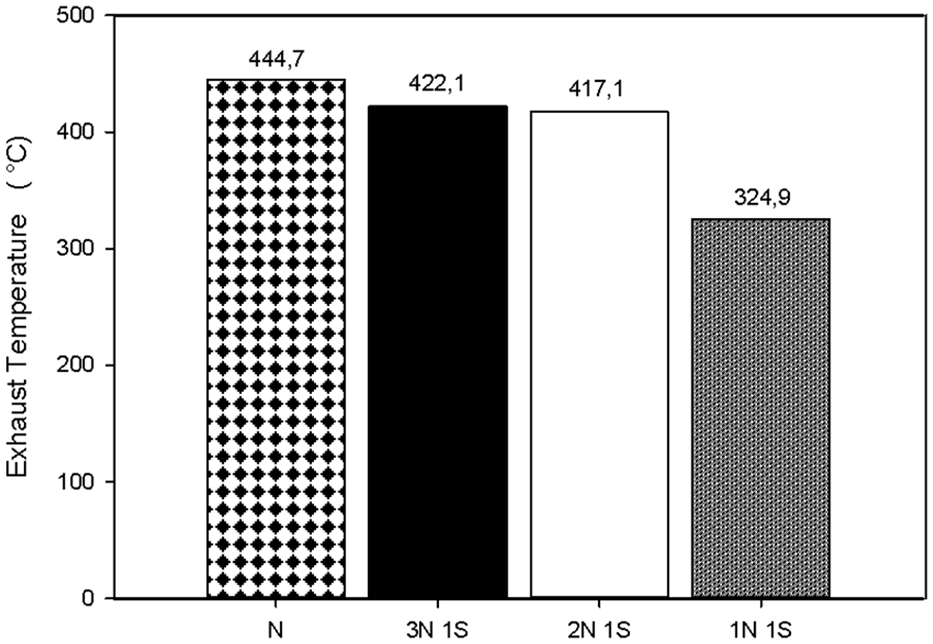
The comparison of exhaust gas temperature.
Specific fuel consumption
As mentioned in the above section, mapping studies have been carried out by adjusting the spraying amount of the injectors so that the same torque can be taken at the same speed depending on the cycle skipping mode, then mapping studies have done. Hereunder, required fuel injection times to maintain the rpm and power are 4.3 ms in Normal mode, 6 ms in 3N1S mode, 7 ms in 2N1S mode, and 16 ms in 1N1S mode. With the increasing cycle skipping frequency, fuel injection increases per cycle and fuel amount has been increased two times to reach the same power in the 1N1S mode. The reason of decreasing fuel consuming amount in 3N1S and 2N1S is that cycle skipping and decreasing amount residual gaseous in cylinder and increasing volumetric yield in the normal cycles. But volumetric yield increase in 1N1S mode cannot be reached to much fuel increase and there were some increase in specific fuel consumption. The emission and pressure data also confirm these results and will be explained in detail below. The specific fuel consumption changement data at 50% partial load that depends on cycle skipping mode can be seen in Figure 5. Specific fuel consumption in 3N1S mode decreased as 7.86% compared to normal cycle, in 2N1S mode increased as 11.19% compared to normal cycle. Specific fuel consumption in 1N1S mode decreased as 9.17% compared to normal cycle, in 2N1S mode increased as 2.27% compared to 1N1S mode.

The comparison of specific fuel consumption.
CO emission
Specific CO emission at 50% partial load that depends on cycle skipping mode, can be seen in Figure 6. We have seen that CO emissions with the increasing specific fuel consumption, dropped in parallel, and there is some increase in 1N1S mode. CO emissions in 3N1S mode decreased as 57.3% compared to normal cycle, in 2N1S mode decreased as 61.89% compared to normal cycle. CO emissions in 1N1S mode decreased as 55,48% compared to normal cycle, in 2N1S mode increased as 16.8% compared to 1N1S mode. CO formation that occurs in ignition deficiency,16,17 decrease with cycle skipping. The reason of this situation can be explained that the reduction of residual gaseous that remained in cylinder with the cycle skipping and, higher cylinder pressure due to the combustion of fresh air-fuel mixture taken in cycles with combustion, and, thus improvement of combustion with the formation of temperature. The partial increase in the 1N1S mode can be interpreted as the incomplete combustion of the relatively rich mixture even if the in-cylinder pressures increase due to the increased amount of fuel.
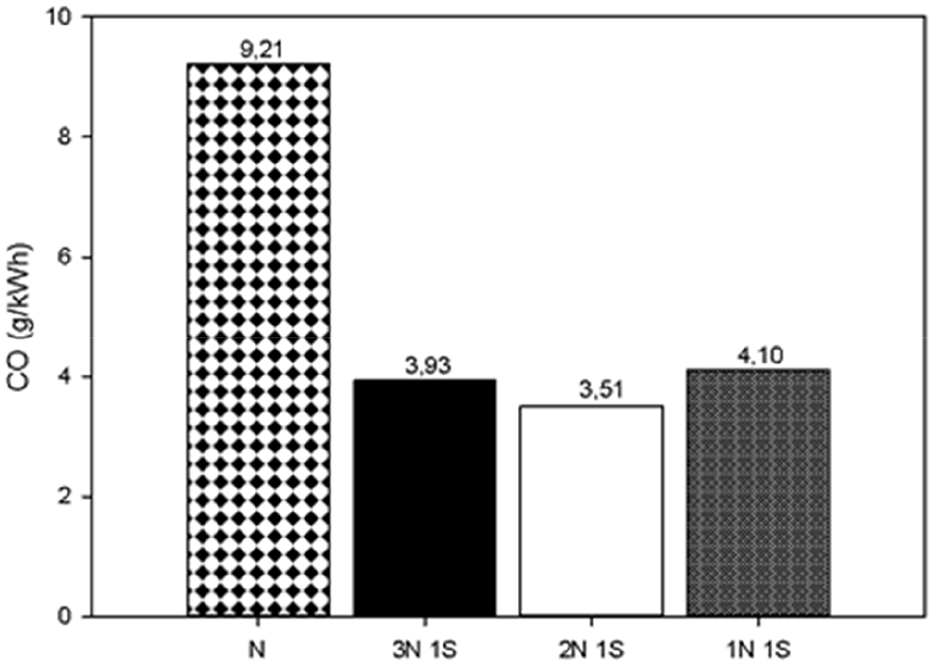
The comparison of CO emission values.
HC emissions
As seen in Figure 7, specific hydrocarbon emission at 50% partial load with the increasing of cycle skipping frequently, has increased until 2N1S mode and increased significantly in 1N1S mode. Hereunder, the value which was 1.25 g/kWh in normal cycle decreased as 60.8% to 0.49 g/kWh in 3N1S mode. The value in 2N1S mode decreased as 60.8% to 0.43 g/kWh compared to normal cycle mode. It is known that quenching mechanisms are the main reason of formation of hydrocarbon emissions. The extinguishing of the flame, trying to penetrate the crevices, removes more heat from the flame than what is released in the flame thickness as a result of the combustion due to the large surface to volume ratios. Unburned fuel then flows through the crevices toward the cylinder at the end of the expansion stroke. Most of it oxidizes in the cylinder, the rest ends up partially as residual HC, which remains in the cylinder, and the rest enters the exhaust system. The increase in cycle peak pressures after the idle cycle and increase of nitrogen oxides in parallel to this trend, confirm this situation. HC emissions in 1N1S mode increased as 122.4% to 2.78 g/kWh compared to normal cycle. Here, the excessive increase of fuel increased also the flame extinction and caused an increase in HC emission.

The comparison of HC emission values.
NOx emission
As seen in Figure 8, specific NOx emission at 50% partial load with the increasing of cycle skipping frequently, has increased and decreased significantly in 1N1S mode. Hereunder, the value in normal cycle was 0.19 g/kWh; increased as 117 times to 22.29 g/kWh in 3N1S mode. The value in 2N1S mode increased as 243 times to 46.18 g/kWh compared to normal cycle mode. With the consideration of formation mechanism of NOx in the positive ignition engine; cycle skipping increased while decreasing residual gases and increasing temperature. It has been determined that, NOx emission decreased as 40.73% to 27.37 g/kWh in 1N1S mode compared to 2N1S mode. Due to the cycle skipping operating condition, the exhaust temperatures get colder in the cycles without combustion and the exhaust temperatures generally decrease. However, due to the fact that more fuel is sent into the cylinder in order to obtain the same power in the combustion cycles, the in-cylinder pressure, and thus the in-cylinder temperature increases. In the results obtained, it was concluded that there was a significant increase in NOx emissions with cycle skipping.

The comparison of NOx emission values.
Pressure and heat release rate
Pressure formations in-cylinder of normal mode, 3N1S mode, 2N1S mode, and 1N1S mode are as shown in Figures 9 to 12. Average pressure graphs comparison for all modes are indicated in Figure 13. As seen in graphs, in-cylinder pressure values increase with cycle skipping amount. In-cylinder pressure value in normal cycle is 28 bar averagely, it increases to 75 bar in 1N1S mode. As shown in Figure 14, maximum heat release rate value increases with increasing amount of cycle skipping. In the obtained in-cylinder pressure data, some pressure increase was observed during intake and compression strokes under the operating condition of 1N1S (1 normal cycle 1 skip cycle). The reason for this situation is that the engine operates with a more variable characteristic in 1N1S operation condition and the in-cylinder pressure sensor is placed perpendicular to the cylinder head. Due to the fact that the engine operates in a more variable structure in 1N1S operation condition and the in-cylinder pressure sensor is placed vertically on the cylinder head, cyclical differences occur due to pressure fluctuations in low pressure conditions compared to combustion and maximum pressure. For this reason, pressure data during intake and compression stroke in 1N1S engine operating condition are higher than other operating characteristics.

Normal cycle pressure graph.

3N1S cycle pressure graph.

2N1S cycle pressure graph.

1N1S cycle pressure graph.

In-Cylinder pressure comparison.

Heat release rate comparison.
Combustion characteristics
Combustion characteristics are examined in Table 3 as given below. As an expected result, as the cycle skipping rate increased, the amount of fuel sent to the combustion chamber in each cycle increased. As can be seen from the SFC (specific fuel consumption) values, the thermal efficiency reached its highest value under 2N1S engine operating conditions. Although the thermal efficiency is higher in 1N1S engine operating condition than N (normal) engine operating condition, it has been determined that it decreases somewhat compared to 2N1S value. Additionally, the combustion efficiency is calculated using the emission values as given in the equation (1) below. 15

where,
Combustion characteristics of the experiments.

In addition, it was concluded that the maximum heat release rate and maximum cylinder pressure values increased as the cycle skipping rate increased. In addition, CA10 values increased as the cycle skipping amount increased. As the cycle skipping amount increased, the CA90 value decreased as a result of the increase in combustion efficiency and thermal efficiency. This is because of increase on in-cylinder pressure values during cycle skipping, by sending more fuel per unit cycle, and removing residual gases.
Conclusion
Nowadays, with the decrease of fossil fuels and negative consequences of global warming, researchers have shifted their studies to this subject. It is obvious that fuel consumption and average waste exhaust gas amount are important factors for market competition and environmental concerns. In the performed study, it has been observed that, with using 2 normal 1 cycle skipping mode (2N1S) in a one cylinder engine designed for generator applications, specific fuel consumptions decreased as 11.19%, CO emission decreased as 61.89%, HC emission decreased as 65.60%, and NOx emission increased dramatically.
Footnotes
Appendix
Handling Editor: James Baldwin
Declaration of conflicting interests
The author(s) declared no potential conflicts of interest with respect to the research, authorship, and/or publication of this article.
Funding
The author(s) disclosed receipt of the following financial support for the research, authorship, and/or publication of this article: This research was supported by Tubitak (Scientific and Technological Research Council of Turkey) with 1511 project. Project Number: 1209017. The author is also indebted to Erin Motor A.Ş for laboratory use and all other support.
