This communication models the flow of viscous nanofluid between two heated parallel plates with radiation and uniform suction at one boundary. Two types of carbon nanotubes (CNTs) namely the single (SWCNT) and multiple (MWCNT) walls are accounted. Heat generation, radiation, and dissipation in heat expression are utilized. Entropy generation and Bejan number are examined. Formulation and analysis in rotating frame are considered. Convergent solutions for velocity and temperature are constructed and interpreted. Coefficient of skin-friction and Nusselt number are tabulated and analyzed for comparative study of SWCNT and MWCNT. Correlation for skin-friction and Nusselt number are also evaluated. An enhancement in velocity profile is seen through suction variable. A reduction occurs in axial velocity for higher Reynolds number. An opposite trend is hold for thermal field through Eckert and Prandtl numbers. An intensification in temperature is noted for radiation. An amplification in entropy rate is observed through Brinkman number. Higher Reynolds number corresponds to improve Bejan number. An improvement in radiation variable lead to rises heat transfer rate for both carbon nanotubes.
Recently, the nanomaterial is quite prominent in the engineering, technology, and bioengineering processes. A nanofluid is a mixture of various nanoparticles and into base liquids like oils, water, ethylene-glycol, tri-ethylene-glycol, etc. It is noticed that the base liquids have low thermal conductivity and do not meet the requirement of many materials in industry, technology, and medicine. Therefore, Choi and Eastman1 proposed the basic concept of suspension of small solid particles into ordinary materials. They examined that the small solid particles suspension significantly rises the thermal efficacy of ordinary energy transportation materials. Further the carbon nanotubes with superficial thermal conductivities are found to have specific thermal properties. There are various models available for evaluating the efficient thermal conductivities of nanotubes. In this regard, Xue2 suggested the theoretical approach based on Maxwell’s theory to examine the thermal conductivities. He involved the rotational elliptical nanotubes having larger axial ratio which accounted for space distribution effects on Mechanical alloy and cold spray phenomena for the development of composite surfaces coating for heat transportation is implemented by Pialago et al.3 Study of melting heat transportation in fluid flow by variable thicked stretching sheet is explored by Hayat et al.4 In another study, Hayat et al.5 analyzed the features of in thermally radiative nanofluid flow induced due to movement of cylinder. Hayat et al.6 examined the thixotropic nanomaterial flow subject to radiation, magnetic field, and Joule heating. Mushtaq et al.7 described the features of non-linear radiated nanofluid flow with respect to solar energy. The convected flow of peristaltic water-based nanofluids in presence of heat sink/source is illustrated by Shehzad et al.8 Sheikholeslami et al.9 reported thermally radiative water based nanoliquid flow and energy transport in uniformly heated channel. Some other activities concerning nano-fluid flows can be seen in Refs.10–24
Optimization of entropy is attractive field of research during the past few decades. The thermodynamic irreversibility in any liquid flow procedure can be measured through entropy investigation. The second law of thermodynamics expresses that every genuine procedure is irreversible. Second law of thermodynamics has broad applications in issues including heat move and fluid flow. Entropy generation is related with thermodynamic irreversibility, which is available in all heat transfer and fluid flow forms. Bejan25 explored entropy generation for convective heat transport due to temperature inclination and consistency impacts in a liquid. Bejan26 additionally introduced different explanations behind entropy generation in applied heat designing where generation of entropy obliterates accessible work (e.g. exergy) of a framework. Hayat et al.27 explored radiative flow between two rotating disks with viscous dissipation, Joule heating and irreversibility. Qayyum et al.28 considered entropy generation in MHD flow of Walter-B nanofluid. Here heat generation and dissipation effects are present. Some studies about this topic are mentioned in Refs.29–38
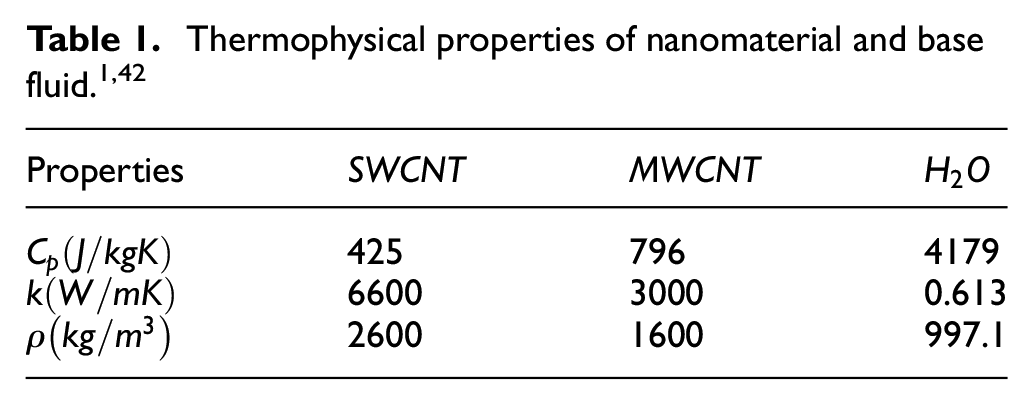
The above studies examines that no effort has been made to discuss the irreversibility analysis in water-based carbon nanotubes between two rotating heated plates. Currently there are various scientists and researchers that scrutinize the entropy generation in water based CNTs between two heated plates. Our main interest here to examine rotating flow of viscous nanofluid between two heated plates. Single (SWCNT) and multiple (MWCNT) walled carbon nanotubes are considered. Here water is used as base as base fluid. Heat generation, radiation, and dissipation are present. Upper plate is subject to suction. Entropy generation and Bejan number are examined. Convergent series solutions by homotopic procedure39–41 are computed. Analysis for physical quantities of interest is arranged through graphs and tabulated values. Thermophysical characteristics of nanomaterial are given in Table 1. Comparative study with previous publish studies are presented in Table 2. Computational results of physical quantities are discussed in Tables 3 and 4. Correlation outcomes for skin friction and heat transfer rate are established in Tables 5 and 6.
Thermophysical properties of nanomaterial and base fluid.1,42
Properties
425
796
4179
6600
3000
0.613
2600
1600
997.1
Comparison results of heat transfer rate with Olanrewaju et al. and Sithole et al.
We consider steady rotating flow of water-based between two parallel plates. The plates have temperature and Lower plate at y = 0 is stretched while the upper plate at y = h being the porous with suction. Viscous dissipation, heat absorption, and radiation are accounted. Cartesian coordinates taken in such a way that sheet is in direction and to normal direction. Fluid rotation is through angular velocity along y-axis. Flow sketch is highlighted in Figure 1.
Here denotes rotational parameter, Prandtl number, radiation parameter, Eckert number, Reynolds number and suction parameter. The quantities , and are
Thermophysical characteristics of nanofluid are expressed as
Physical quantities
Skin friction coefficient and Nusselt number are defined as
in which wall shear stress and heat flux at wall satisfy
One can found
Entropy optimization
Relevant expression in presence of radiation and dissipation satisfies
we get
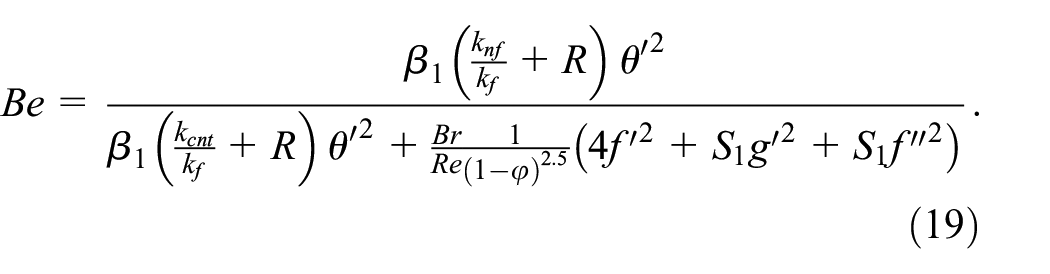
Bejan number gives
Series solutions
Initial guesses and linear operators satisfy:
Above operators have properties
Convergence analysis
Convergence and approximation rate for series solution are depend on auxiliary parameter , and . Therefore the are plotted for 10th order approximations for and . Admirable ranges of curves are , and for case (see Figure 2). Convergence ranges for are , and (see Figure 3).
curves for cases.
curves for cases.
From above table we noted that the results have an excellent agreement.
Discussion
The results of the formulated problem are developed by homotopic scheme. The behavior of involved influential parameters on fluid velocities, skin-friction, temperature, Nusselt number, irreversibility, and Bejan number are picturized and tabulated. Analysis is organized for two kinds of nanotubes known as and .
Velocity
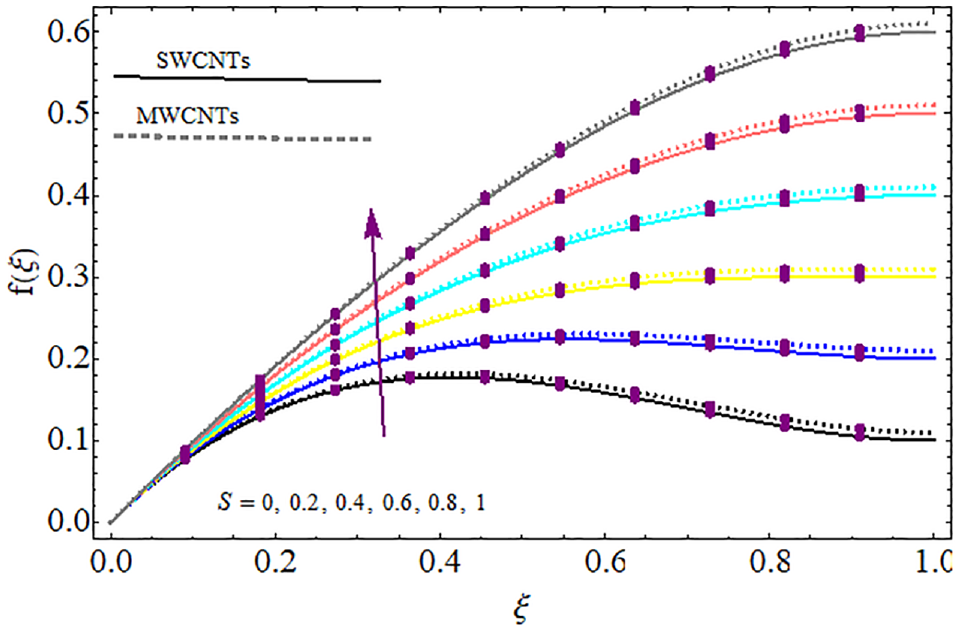
Figures 4−9 describe the importance of various parameters including suction and Reynolds number on radial , axial , and tangential velocities. Influence of suction variable on velocity components (, , and ) is revealed in Figures 4−6. An intensification in velocity components is seen with variation in suction variable. Physical description of velocity against Reynolds number is illuminated in Figures 7−9. Clearly radial velocity has dual behavior through Reynolds number. An amplification in Reynolds number corresponds to augment axial and tangential velocities components ( and ). An increment in Reynolds number reduces viscous force and thus velocity boosted.
against .
against .
against .
against .
against .
against .
Temperature
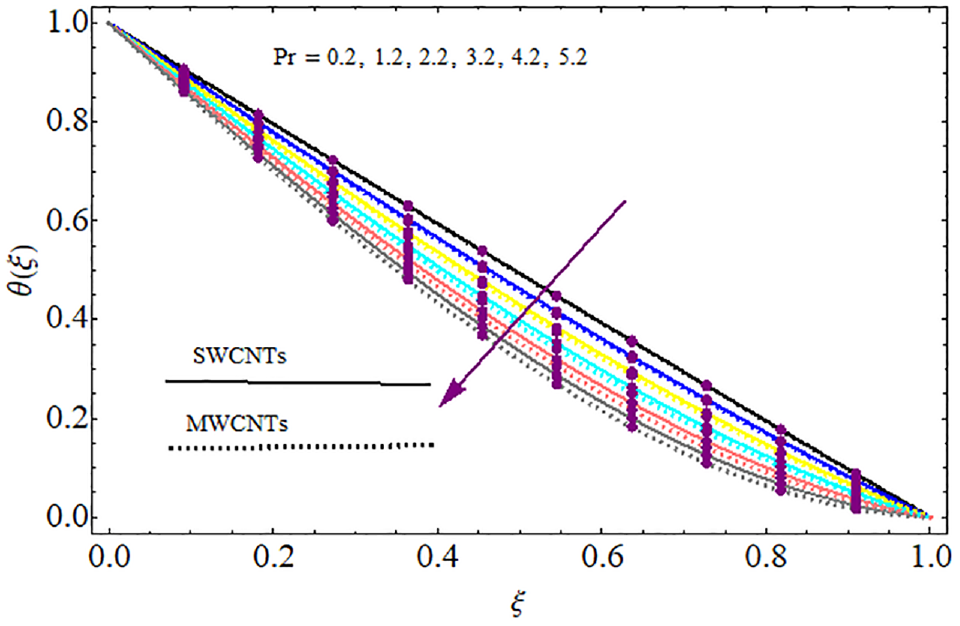
Influence of temperature with variation in Prandtl number is illuminated in Figure 10. An increment in Prandtl number reduces thermal conductivity which decays temperature for both CNTs. A reduction in thermal field is seen through heat absorption variable for both carbon nanotubes (see Figure 11). Physical description of temperature versus radiation is portrayed in Figure 12. Higher approximation of radiation decays mean absorption coefficient, which improve heat flux. Therefore thermal field boosted for both CNTs. It is apparent that by increasing nano-volume fraction constraint the temperature enhances (see Figure 13). Figure 14 sketch to shows influence of thermal field versus Eckert number. An enhancement in kinetic energy against Eckert number occurs, which improves temperature for both carbon nanotubes.
against .
against .
against .
against .
against .
Entropy generation and Bejan number
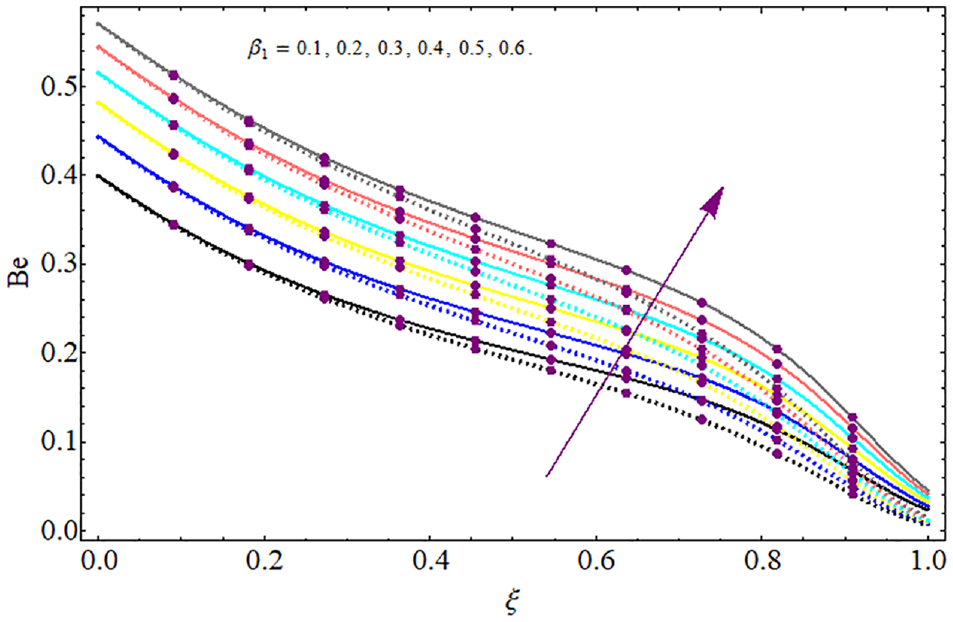
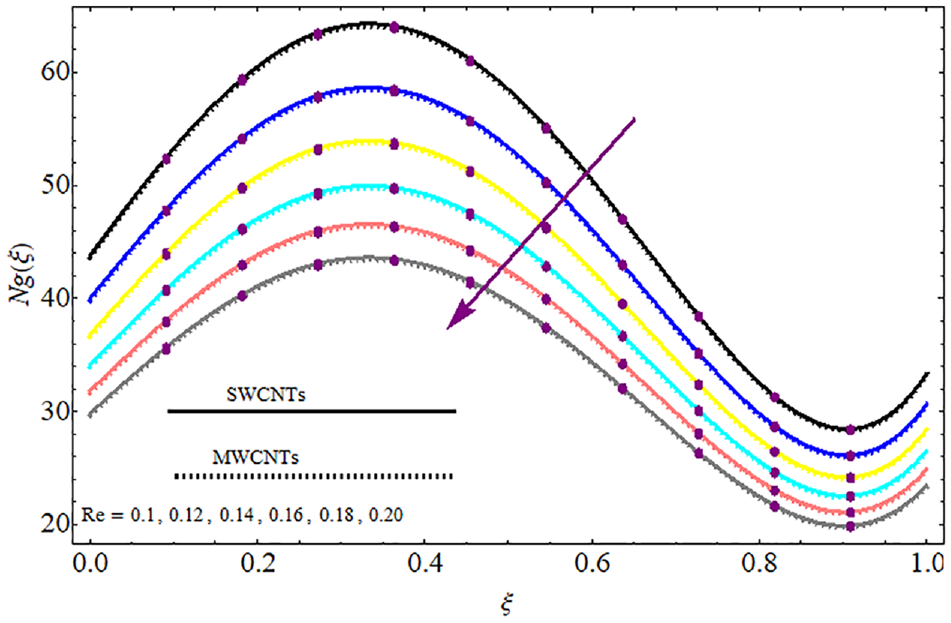
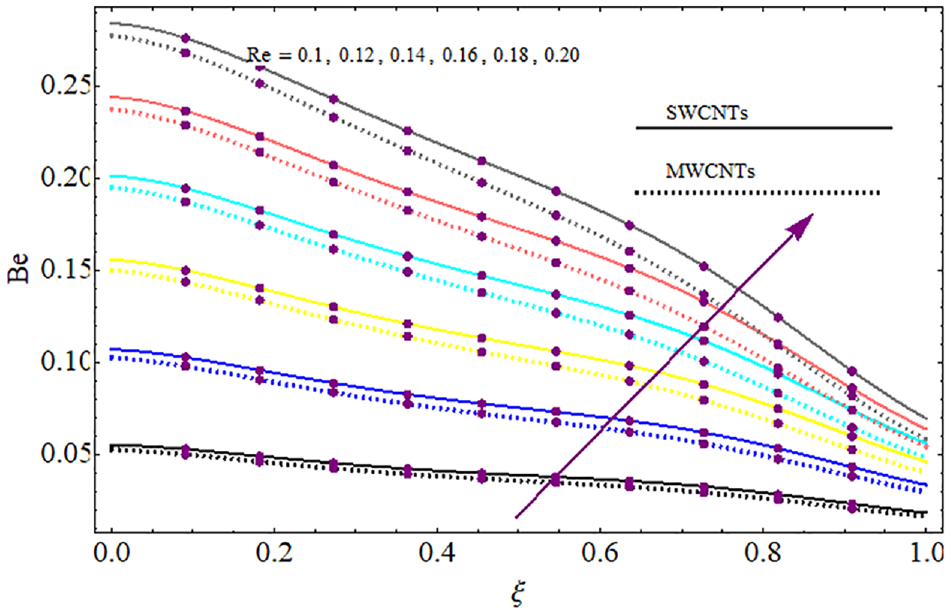
Aspects of temperature difference parameter , Brinkman number , Reynold number and nano volume fraction parameter are displayed in the Figures 15−22 for irreversibility and Bejan number . Both and cases are considered. Figures 15 and 16 demonstrate the behavior of temperature difference parameter for and . For higher values of the entropy generation and Bejan number are increasing for both cases. Impact of on and are portrayed in Figures 17 and 18. Irreversibility is increasing for higher while it decays the Bejan number. Physically an increment in Brinkman number rises the viscous force which improves collision amongst the liquid particles and thus irreversibility boosted. Figures 19 and 20 describe behavior of Reynold number for both entropy and . Same behaviors of entropy generation and Bejan number are noticed for Reynolds number. Effect of volume fraction parameter versus entropy and Bejan number are studied in Figures 21 and 22. Irreversibility and Bejan number are increasing function of higher .
against .
against .
against .
against .
against .
against .
against .
against .
Physical quantities
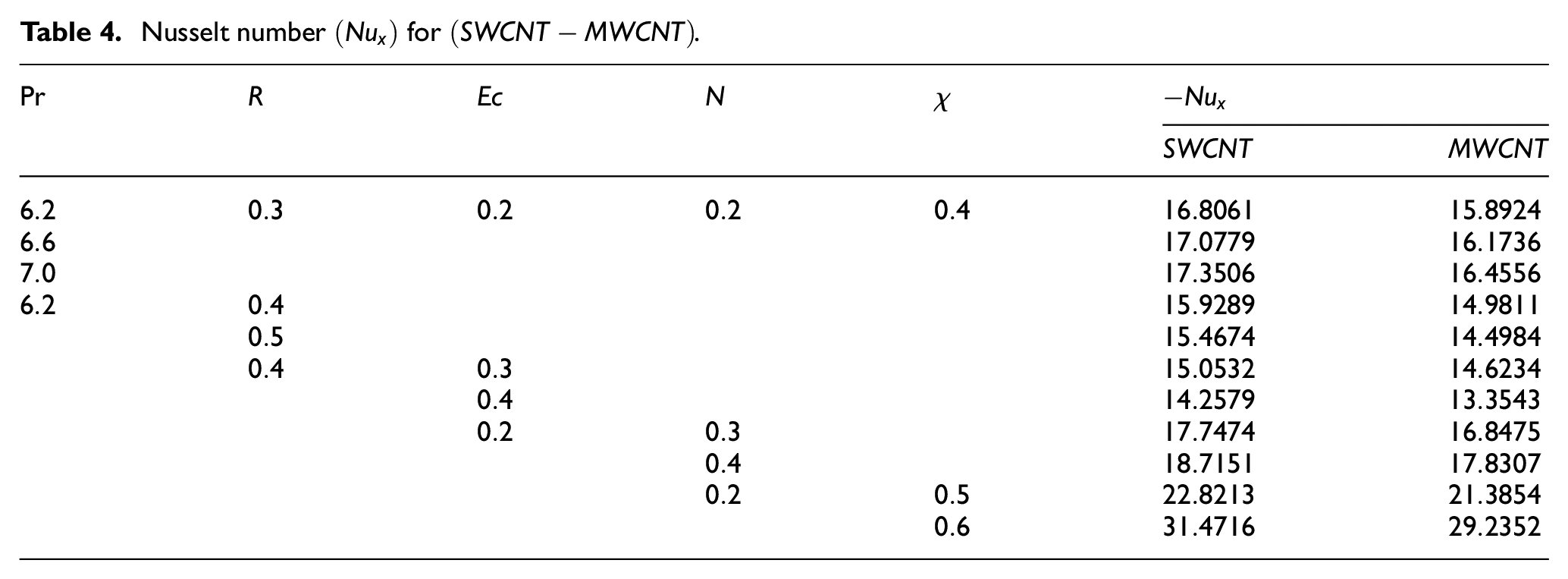
Tables 3 and 4 are developed for skin friction and Nusselt number . Here behavior of pertinent constraints can be seen through Tables 3 and 4 for and cases. Table 2 depicts that is an increasing function of , and . Table 4 declared that Nusselt number enhances for higher Prandtl number , heat absorption parameter , and volume fraction while it decreases against radiation parameter and Eckert number .
Correlation for skin friction and Nusselt number
In Tables 3 and 4 we examined the and variations for both plates in presence of . The skin friction coefficient and Nusselt number with respect to parameters in Tables 3 and 4 are higher for than . Tables 5 and 6 are established for correlation coefficient of skin-friction and Nusselt number . It is for to evaluate the inter-dependence of constraints on drag force and rate of heat transportation. Tables 5 and 6 report the correlation coefficient . The values of coefficient of correlation are noticed between to .
Conclusions
Main observations of this study are:
Impacts of suction parameter and Reynolds number on axial, radial, and tangential velocities are opposite.
Temperature enhancement occurs for Eckert number and radiation parameter.
Temperature is an increasing function of nanoparticle volume fraction.
Entropy production boosts up for higher Brinkman number and temperature difference parameter.
Bejan number is higher for higher nano volume fraction, Reynolds number and temperature difference parameter while declines for Brinkman number.
Skin-friction is higher in case of when compared with .
The considered investigation has significance in polymer industry, fabrication of medicines, plastic surface stretching, architecture, and metallurgical processes. The diverse application of CNTs (carbon nanotubes) including in solar cells, cooling of nuclear reactor, heat exchangers gas storage, medical instruments, ultra-capacitors, and many others. Radiations are quite prevalent in cancer therapy, drug delivery, plasma, metallurgy, etc.
Footnotes
Handling Editor: James Baldwin
Declaration of conflicting interests
The author(s) declared no potential conflicts of interest with respect to the research, authorship, and/or publication of this article.
Funding
The author(s) received no financial support for the research, authorship, and/or publication of this article.
ORCID iD
Sohail A. Khan
References
1.
ChoiSUSEastmanJA. Enhancing thermal conductivity of fluids with nanoparticles. ASME, United States Publications-Fed, 1995. Vol. 231, pp.99–106.
2.
XueQZ. Model for thermal conductivity of carbon nanotube-based composites. Physica B Condens Matter2005; 368: 302–307.
HayatTMuhammadKFarooqM, et al. Melting heat transfer in stagnation point flow of carbon nanotubes towards variable thickness surface. AIP Adv2016; 6: 015214.
5.
HayatTKhanMIWaqasM, et al. Numerical simulation for melting heat transfer and radiation effects in stagnation point flow of carbon–water nanofluid. Comput Methods Appl Mech Eng2017; 315: 1011–1024.
6.
HayatTWaqasMShehzadSA, et al. A model of solar radiation and Joule heating in magnetohydrodynamic (MHD) convective flow of thixotropic nanofluid. J Mol Liq2016; 215: 704–710.
7.
MushtaqAMustafaMHayatT, et al. Nonlinear radiative heat transfer in the flow of nanofluid due to solar energy: a numerical study. J Taiwan Inst Chem Eng2014; 45: 1176–1183.
8.
ShehzadSAAbbasiFMHayatT, et al. Model and comparative study for peristaltic transport of water based nanofluids. J Mol Liq2015; 209: 723–728.
9.
SheikholeslamiMHayatTAlsaediA. MHD free convection of Al2O3–water nanofluid considering thermal radiation: a numerical study. Int J Heat Mass Transf2016; 96: 513–524.
10.
HsiaoKL. To promote radiation electrical MHD activation energy thermal extrusion manufacturing system efficiency by using Carreau-Nanofluid with parameters control method. Energy2017; 130: 486–499.
11.
HsiaoKL. Micropolar nanofluid flow with MHD and viscous dissipation effects towards a stretching sheet with multimedia feature. Int J Heat Mass Transf2017; 112: 983–990.
12.
TurkyilmazogluM. Buongiorno model in a nanofluid filled asymmetric channel fulfilling zero net particle flux at the walls. Int J Heat Mass Transf2018; 126: 974–979.
13.
TurkyilmazogluM. Fully developed slip flow in a concentric annuli via single and dual phase nanofluids models. Comput Methods Programs Biomed2019; 179: 104997.
14.
LiuCPanMZhengL, et al. Effects of heterogeneous catalysis in porous media on nanofluid-based reactions. Int Commun Heat Mass Transf2020; 110: 104434.
15.
SheikholeslamiMAshorynejadHRGanjiDD, et al. Investigation of rotating MHD viscous flow and heat transfer between stretching and porous surfaces using analytical method. Math Probl Eng2011; 2011: 1–17.
16.
BégOAZuecoJTakharHS. Unsteady magnetohydrodynamic Hartmann–Couette flow and heat transfer in a Darcian channel with Hall current, ionslip, viscous and Joule heating effects: network numerical solutions. Commun Nonlinear Sci Numer Simul2009; 14: 1082–1097.
17.
SheikholeslamiMGanjiDD. Heat transfer of Cu-water nanofluid flow between parallel plates. Powder Technol2013; 235: 873–879.
18.
HayatTKhanMIWaqasM, et al. Viscous dissipation effect in flow of magnetonanofluid with variable properties. J Mol Liq2016; 222: 47–54.
19.
HsiaoKL. Combined electrical MHD heat transfer thermal extrusion system using Maxwell fluid with radiative and viscous dissipation effects. Appl Therm Eng2017; 112: 1281–1288.
20.
HayatTKhanMKhanMI, et al. Electro-magneto squeezing rotational flow of carbon (C)-water (H2O) kerosene oil nanofluid past a Riga plate: a numerical study. PLoS One2017; 12: e0180976.
21.
RashidiMMHayatTErfaniE, et al. Simultaneous effects of partial slip and thermal-diffusion and diffusion-thermo on steady MHD convective flow due to a rotating disk. Commun Nonlinear Sci Numer Simul2011; 16: 4303–4317.
22.
SheikholeslamiMHayatTAlsaediA, et al. Numerical analysis of EHD nanofluid force convective heat transfer considering electric field dependent viscosity. Int J Heat Mass Transf2017; 108: 2558–2565.
23.
TurkyilmazogluM. Analytical solutions to mixed convection MHD fluid flow induced by a nonlinearly deforming permeable surface. Commun Nonlinear Sci Numer Simul2018; 63: 373–379.
24.
LiuCZhengLPanM, et al. Effects of fractional mass transfer and chemical reaction on MHD flow in a heterogeneous porous medium. Comput Math Appl2019; 78: 2618–2631.
25.
BejanA. A study of entropy generation in fundamental convective heat transfer. J Heat Transf1979; 101: 718–725.
26.
BejanA. Fundamentals of exergy analysis, entropy generation minimization, and the generation of flow architecture. Int J Energy Res2002; 26.
27.
HayatTQayyumSKhanMI, et al. Entropy generation in magnetohydrodynamic radiative flow due to rotating disk in presence of viscous dissipation and Joule heating. Phys Fluids2018; 30: 017101.
28.
QayyumSHayatTJabeenS, et al. Entropy generation in nanofluid flow of Walters-B fluid with homogeneous-heterogeneous reactions. Math Methods Appl Sci2020; 43: 5657–5672.
29.
KhanSAHayatTAlsaediA, et al. Melting heat transportation in radiative flow of nanomaterials with irreversibility analysis. Renew Sustain Energ Rev2021; 140: 110739.
30.
WangJMuhammadRKhanMI, et al. Entropy optimized MHD nanomaterial flow subject to variable thicked surface. Comput Methods Programs Biomed2020; 189: 105311.
31.
PalDMandalG. Heat and mass transfer of a Non-Newtonian Jeffrey nanofluid over an extrusion stretching sheet with thermal radiation and nonuniform heat source/sink. Comput Therm Sci2020; 12: 163–178.
32.
GuptaSKumarDSinghJ. Analytical study for MHD flow of Williamson nanofluid with the effects of variable thickness, nonlinear thermal radiation and improved Fourier’s and Fick’s laws. SN Appl Sci2020; 2: 1–12.
33.
SrinivasuluTGoudBS. Effect of inclined magnetic field on flow, heat and mass transfer of Williamson nanofluid over a stretching sheet. Case Stud Therm Eng2021; 23: 100819.
34.
RasoolGShafiqABaleanuD. Consequences of Soret–Dufour effects, thermal radiation, and binary chemical reaction on Darcy Forchheimer flow of nanofluids. Symmetry2020; 12: 1421.
35.
AkbarYAbbasiFM. Impact of variable viscosity on peristaltic motion with entropy generation. Int Commun Heat Mass Transf2020; 118: 104826.
36.
AfridiMIQasimMMakindeOD. Entropy generation due to heat and mass transfer in a flow of dissipative elastic fluid through a porous medium. J Heat Transf2019; 141: 022002.
37.
SaklyABen NejmaF. Heat and mass transfer of combined forced convection and thermal radiation within a channel: entropy generation analysis. Appl Therm Eng2020; 171: 114903.
38.
KhanMIAlzahraniFHobinyA, et al. Fully developed second order velocity slip Darcy-Forchheimer flow by a variable thicked surface of disk with entropy generation. Int Commun Heat Mass Transf2020; 117: 104778.
39.
LiaoS. Beyond perturbation: introduction to the homotopy analysis method. Taylor & Francis eBooks, 2003.
40.
AbbasbandySHayatT. Solution of the MHD Falkner-Skan flow by homotopy analysis method. Commun Nonlinear Sci Numer Simul2009; 14: 3591–3598.
41.
WaqasMDogonchiASShehzadSA, et al. Nonlinear convection and joule heating impacts in magneto-thixotropic nanofluid stratified flow by convectively heated variable thicked surface. J Mol Liq2020; 300: 111945.
42.
KhalidAKhanIKhanA, et al. Case study of MHD blood flow in a porous medium with CNTS and thermal analysis. Case Stud Therm Eng2018; 12: 374–380.
43.
OlanrewajuMAGbadeyanJAIdowuAS. Flow and heat transfer analysis of a second grade fluid with Newtonian heating in the presence of elastic deformation in a porous medium. Pacific J Sci Technol2016; 17.
44.
SitholeHMondalHSibandaP. Entropy generation in a second grade magnetohydrodynamic nanofluid flow over a convectively heated stretching sheet with nonlinear thermal radiation and viscous dissipation. Results Phys2018; 9: 1077–1085.
45.
KumarASinghRTripathiR. Heat transfer analysis of CNT-Nanofluid between two rotating plates in the presence of viscous dissipation effect. Math. Mod. Sci. Computi. Appl.. Vol. 308. Singapore: Springer, 2020.
46.
Sudarsana ReddyPSreedeviP. Effect of thermal radiation and volume fraction on carbon nanotubes based nanofluid flow inside a square chamber. Alex Eng J2021; 60: 1807–1817.
47.
HayatTKhanSAAlsaediA, et al. Computational analysis of heat transfer in mixed convective flow of CNTs with entropy optimization by a curved stretching sheet. Int Commun Heat Mass Transf2020; 118: 104881.
48.
ShafiqAKhanIRasoolG, et al. Influence of single- and multi-wall carbon nanotubes on magnetohydrodynamic stagnation point nanofluid flow over variable thicker surface with concave and convex effects. Mathematics2020; 8: 104.