



Abstract
This article addresses the hemodynamic flow of biological fluid through a symmetric channel. Methachronal waves induced by the ciliary motion of motile structures are the main source of Couple stress nanofluid flow. Darcy’s law is incorporated in Navier-Stokes equations to highlight the influence of the porous medium. Thermal transport by the microscopic collision of particles is governed by Fourier’s law while a separate expression is obtained for net diffusion of nanoparticles by using Fick’s law. A closed-form solution is achieved of nonlinear differential equations subject to Newton’s boundary conditions. Moreover, the current findings are compared with previous outcomes for the limiting case and found a complete coherence. Parametric study reveals that nanoflow is resisted by employing Newton’s boundary conditions. Thermal profile enhancement is contributed by the viscous dissipation parameter. Finally, one infers that hemodynamic flow of non-Newtonian fluid is an effective mode of heat and mass transfer especially, in medical sciences for the rapid transport of medicines in drug therapy.
Introduction
The hemodynamic flow of non-Newtonian fluids is of great importance. Generally speaking, it is referred to the flow of blood to different of the human body. Hemodynamic flows are usually governed by the process of peristaltic or ciliated walls of the different organs, arteries, and tissues. Unlike pre-existing reports on nanofluids, the main emphasis of Ellahi et al. 1 is to further enhance the heat transfer rate of nano species. In this connection, the simultaneous contribution of activation energy and chemical reaction are taken into account which improves the thermal properties of gold particles. They devised the medical use of gold particles, owing to the best metallic thermal conductivity. In Akbar et al.2 magnetohydrodynamic (MHD) flow of viscoelastic fluid with heat is presented. Since, Casson fluid model is the robust non-Newtonian fluid model which is the most appropriate one, to predict viscoplastic behavior of fluid that is transported due to cilia beating on the inner walls of the channel. Their findings include that large values of the Casson fluid parameter is consequently, elevates the quantity and size of the trapped boluses. Whereas, the short length of the cilia structure has an opposite effect on the pressure rise, in the pumping region. On the contrary, Mann et al. 3 does not merely, consider the metachronal wave which generates the motion of the fluid in any geometry. But, they have elaborated the impacts of two separate types of propagation of waves namely; symplectic wave and antiepileptic wave on the motion of Burgers fluid. Since it was difficult to analyze the nonlinear flow phenomenon, therefore, the fractional Adomian decomposition method is employed to evaluate the pressure gradient. Nazeer et al.4,5 are relevant to the bio-magnetic fluid bounded by ciliated walls. Two-dimensional cilia-driven non-Newtonian fluid has been discussed under the influence of transverse magnetic fields. Closed-form solutions are obtained to elaborate the altering behaviors of field variables. Some other note able findings of Couple stress fluid can be seen.6–8
Flows through a porous medium and bounded by slippery walls of the channel are reported, to highlight the significant role in mechanical and industries.9–15 In El-Dabe et al.16,17 explore the magnetohydrodynamics of respectively Power-law fluid and Williamson fluid, respectively. For an effective role of porous medium separately, non-Darcy law and simply Darcy law are employed. Zaman et al. 18 prefer a numerical solution rather than an analytic solution for Numerical simulation of the pulsatile flow of blood in a porous-saturated overlapping stenosed artery. However, in Machireddy and Kattamreddy 19 an analytic solution for an MHD peristaltic flow is achieved by applying partial boundary conditions on a porous channel. Ellahi et al. 20 used “Separation of variables” for a two-dimensional Jeffrey fluid. Gradual decline in the momentum of non-Newtonian fluid is reported against the porous media, which is quite unlike the previous cases. In Ellahi et al. 21 authors had to opt numerical scheme since, it was difficult to predict the characteristics of the flow, due to the pertinent variables. The two-phase flow of Couple stress fluid is simulated with the help of the Range-Kutta method with the shooting technique, which highlights the resistive contribution of lubricated walls of the channel.
Heat and mass transfer through fluids is not a casual routine in mechanical and chemical engineering.22–26 Awais et al. 27 simulated the effects of heat and mass transfer on the flow of Casson fluid. A permeable duct of uniform shape is chosen for dual expressions for the profiles of velocity, temperature, and mass fraction have been computed numerically by exploitation of explicit Runge-Kutta procedure. Analytic solution by Krishna and Chamkha 28 interprets the simultaneous impacts of electric fields and magnetic fields. Viscoelastic fluid revolves due to the rotation of opposite plates bounding the fluid. Two different hemodynamics is given in Srinivas et al.29 and Hayat et al.30 deal with the transport of heat under influence of lubrication governed by the flow mechanism of peristalsis. An exact solution of a complex non-Newtonian fluid model is presented by Chu et al. 31 The study deals with the properties of thermal radiation, heat generation, and the effect of convective boundary conditions through a duct with the Rabinowitsch fluid. In another attempt, Chu et al. 32 have focused on minimizing the entropy production on Rabinowitsch fluid through a tilted channel. To achieve this goal, two different cases have been assumed. In the first case, the viscosity and thermal conductivity of the fluid are treated as a constant. While in lateral case both viscosity and thermal conductivity vary.
In view of the above, a brief and compact study of existing literature indicates that heat and mass transfer utilizing the hemodynamic flow of a biological fluid is not reported, yet. Moreover, a comparative analysis of two separate locomotion of nanofluids subject to Newton’s boundary conditions is a new idea. Finally, the main objective of the current study is to decide whether the Newtonian fluid highlights hemodynamic flow or not.
Problem formulation
Consider a two-dimensional and unsteady flow of a biological fluid with heat and mass transfer through an asymmetric channel as shown in Figure 1. Biological flow is caused by the ciliary motion of tiny motile structures, which propagate metachronal waves on the opposite walls having a constant speed

Configuration of the biological fluid flow.
The back and forth motion of tiny hair cilia4,5 may be pretended from the following equation

The elliptical movement of cilia verified by Sleigh in his experimental study. 33 Therefore, the vertical position of the cilia tips can be expressed as

Fluid velocities are assembled by cilia tips without slip conditions are given as Nazeer et al.4,5


Longitudinal and transverse velocities are easily illustrated in view of equations (1) to (4) respectively


To mathematically model the ciliary motion of biological fluid, stress tensor of Couple stress fluid is brought under consideration. Therefore, the governing equations relevant to the heat and mass transfer of Couple stress fluid are listed as:


Transport of heat and mass through a non-Newtonian fluid is studied by employing Newton’s boundary conditions:18,34,35


The most appropriate approach to investigating cilia-driven flow is to first introduce the following transformations in the above set of governing equations (7) to (11).

And, subsequently using the dimensionless quantities defined in (15) in the transformed form of the differential equations
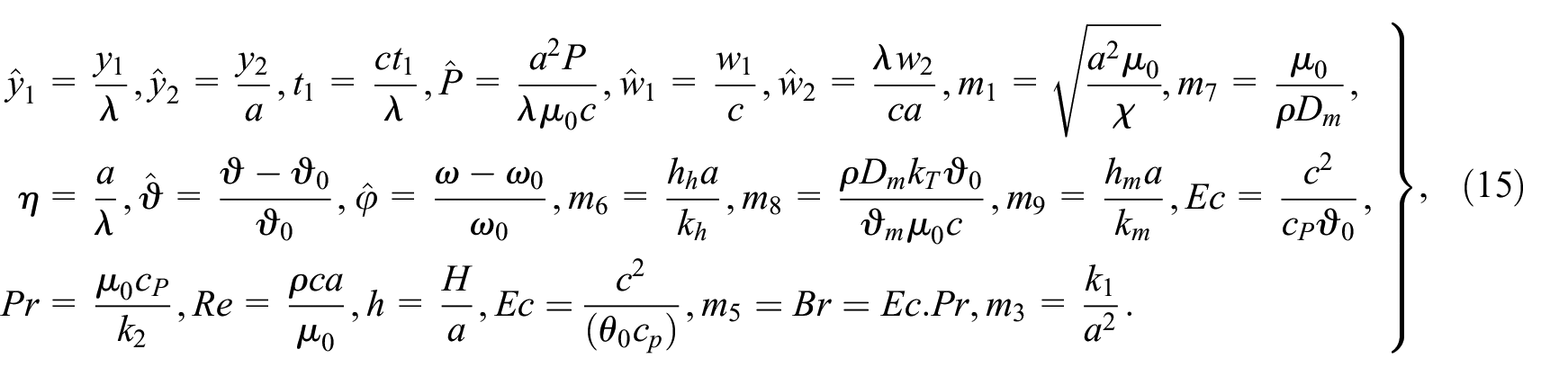
Finally, one an easily yield the dimensionless form of differential equations are expressed as:


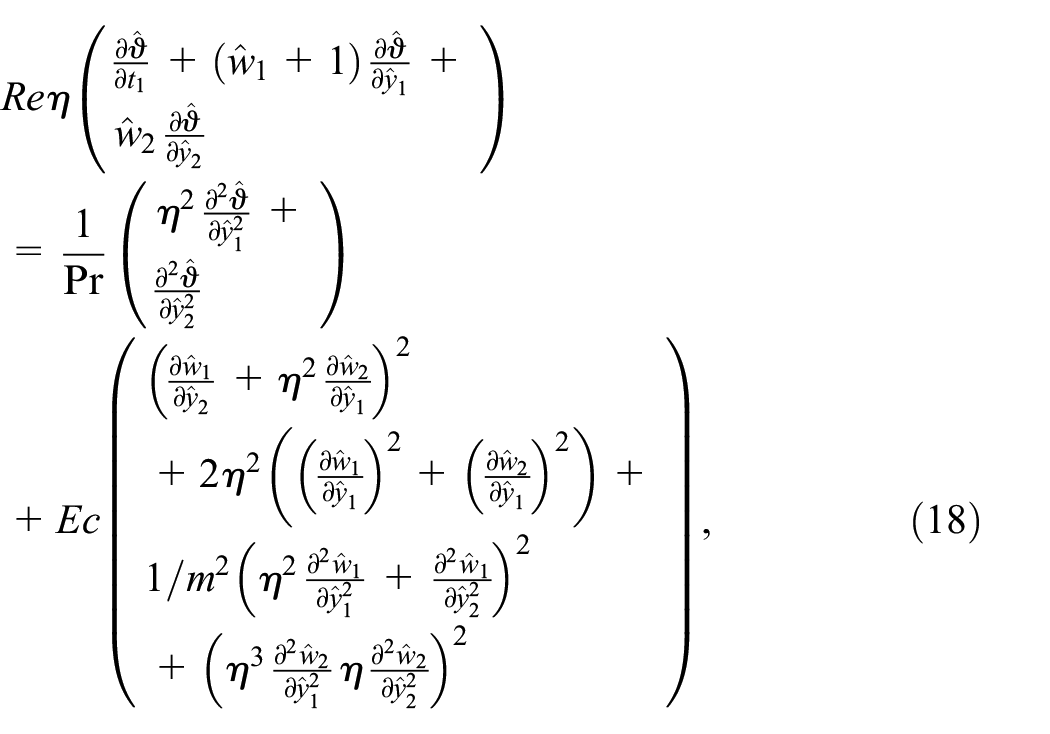

In view of low Reynolds number approximation and, by using the assumption of lubrication theory such that (




Similarly, the set of dimensionless momentum, thermal, and mass flux boundary conditions are:


Solution of the problem
Since, the thermal differential equation is of nonlinear form and coupled with momentum equation which is solved exactly, along with concentration, subject to the boundary condition (24) and (25). The closed-form solutions for the ciliary motion of Couple stress fluid is achieved as

A mathematical equation that describes the thermal transport of the biological fluid is given as

Similarly, the mass diffusion through Couple stress fluid can be achieved as

The value of w0, a10, a20, b10, b20, b30, b40, b50, b60 and c10 are given in Appendix.
Results and discussion
This segment of the article is furnished to carry out a comprehensive parametric study of heat and mass transfer of Couple stress fluid. The pertinent parameters which are taken into account are the porosity parameter
Variations in the momentum of the Couple stress nanofluid against the pertinent parameters are shown in Figures 2 to 5. The effective role of the porous medium is displayed in Figure 2. It is seen that by increasing the permeability of the medium, the flow of Couples stress fluid gradually increases its velocity. This phenomenon is apprehended as the resistive force is dampened by increasing the value of

Effects of porosity parameter

Effects of wave number
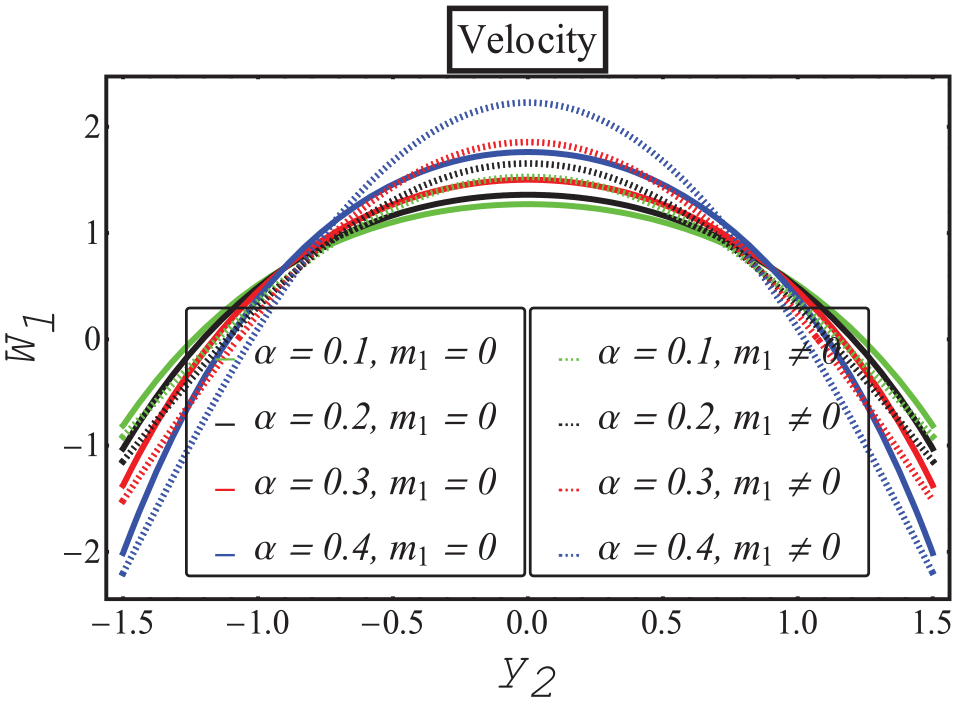
Effects of eccentricity parameter
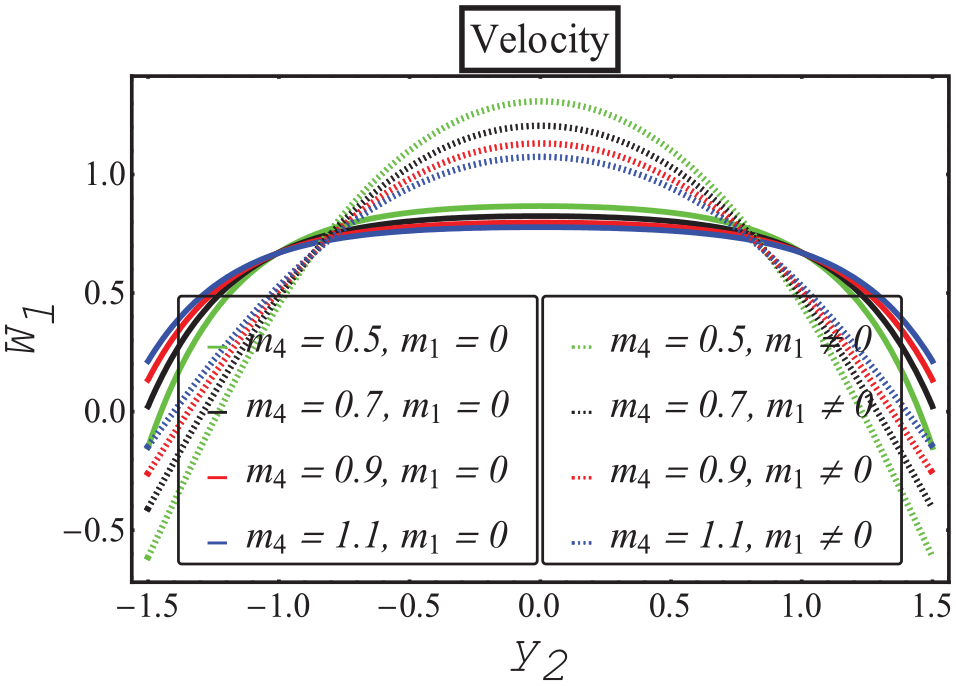
Effects of velocity slip parameter

Effects of viscous heating parameter

Effects of velocity slip parameter

Effects of heat transfer Biot number

Impact of porous medium parameter on stream function for

Impact of porous medium parameter on stream function for

Impact of slip medium parameter on stream function for

Impact of slip medium parameter on stream function for
Numerical findings
Since the present study is a comparative investigation of two different types of biological flows. Couple stress fluid is considered as the biological which is the main source of heat transfer and mass transfer utilizing metachronal waves. In this regard, some significantly important dimensionless quantities, due to their implementations in science and engineering have emerged during the process. Two of such significance are defined as:


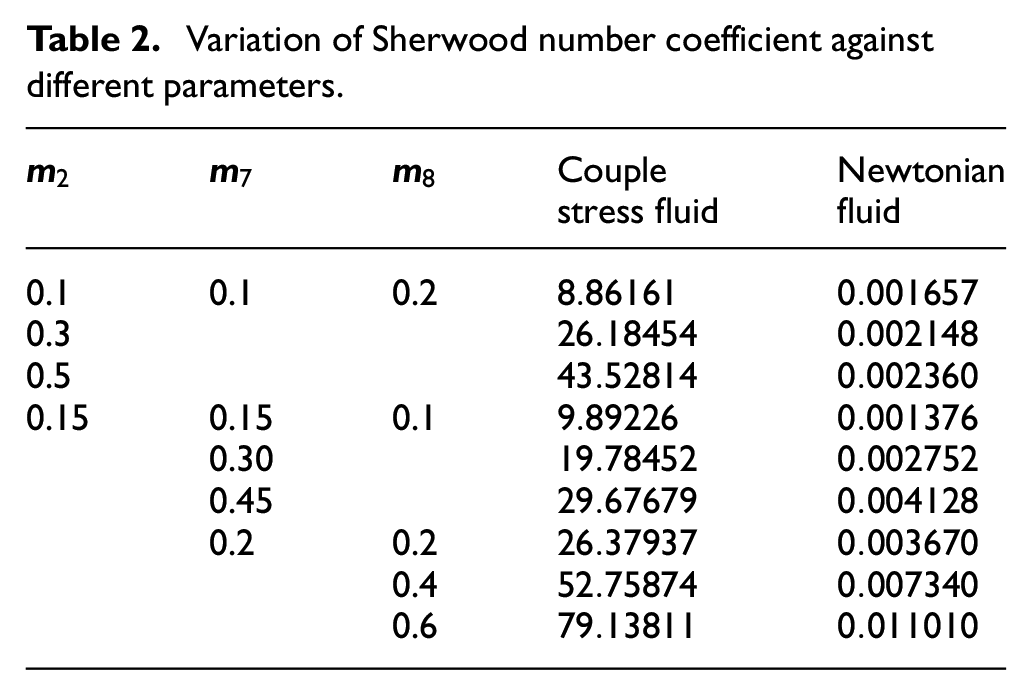
Numerical data showing the variation in Nusselt number and Sherwood number against different parameters have been computed in Tables 1 and 2, respectively. Table 1 is constructed to numerically analyze the contribution of porous medium parameters
Variation in Nusselt number coefficient against different parameters.

Variation of Sherwood number coefficient against different parameters.
Comparative analysis
The obtained solution is further compared with the existing literature. Ramesh
36
pertains to the effects of slip and convective conditions on the peristaltic flow of Couple stress fluid through a porous medium. Since the previous study merely discusses the transport of non-Newtonian fluid due to the flexibility of the opposite walls devoid of cilia structure. Therefore, the comparison is carried out for the limiting case cilia length parameter
Current findings vs previous findings.

Conclusions
Heat and mass transfer of a biological fluid is investigated. Methachronal waves induced by the ciliary motion of motile structure are the main source of Couple stress nanofluid flow. To dampen the skin friction of opposite walls of the symmetric channel lubrication effects are incorporated. An exact solution is achieved for the set of nonlinear differential equations. Some significant findings of the investigation are listed below:
The velocity of nanofluid is resisted by employing Newton’s boundary conditions.
Porous medium contributes to rising the momentum of the flow.
Thermal energy rises due to the viscous dissipation parameter.
Couple stress fluid is more suitable for hemodynamic flow than Newtonian fluid.
Heat transfer rate is inversely affected by the excessive lubrication effects.
Wall resistance is more prominent on the nanoflow of Couple stress fluid.
The computed results of the current investigation are in full agreement with the previous findings subject to the applied constraints.
Footnotes
Appendix
Handling Editor: James Baldwin
Declaration of conflicting interests
The author(s) declared no potential conflicts of interest with respect to the research, authorship, and/or publication of this article.
Funding
The author(s) received no financial support for the research, authorship, and/or publication of this article.
