



Abstract
EGR and excess-air dilution have been investigated in a 1.5 L four cylinders gasoline direct injection (GDI) turbocharged engine equipped with prechamber. The influences of the two different dilution technologies on the engine performance are explored. The results show that at 2400 rpm and 12 bar, EGR dilution can adopt more aggressive ignition advanced angle to achieve optimal combustion phasing. However, excess-air dilution has greater fuel economy than that of EGR dilution owing to larger in-cylinder polytropic exponent. As for prechamber, when dilution ratio is greater than 37.1%, the combustion phase is advanced, resulting in fuel economy improving. Meanwhile, only when the dilution ratio is under 36.2%, the HC emissions of excess-air dilution are lower than the original engine. With the increase of dilution ratio, the CO emissions decrease continuously. The NOX emissions of both dilution technologies are 11% of those of the original engine. Excess-air dilution has better fuel economy and very low CO emissions. EGR dilution can effectively reduce NOX emissions, but increase HC emissions. Compared with spark plug ignition, the pre chamber ignition has lower HC, CO emissions, and higher NO emissions. At part load, the pre-chamber ignition reduces NOX emissions to 49 ppm.
Introduction
With the increasingly severe energy shortage, air pollution and other issues, the state has formulated CHINA VI which is more strict standards and emissions regulations. The policy is aimed to improve the energy conservation and environmental protection level of internal combustion engine. Achieving the persistent use of energy and the sustainable development of the environment are the final purpose. 1 A large number of advanced technologies, such as turbocharging, 2 variable intake manifold, 3 variable compression ratio, 4 and so on, have further reduced the fuel consumption and emissions of gasoline engine. But these technologies mainly aim at the stoichiometric air-fuel ratio to optimize the combustion performance of gasoline engine. 5 Lean combustion means that the engine can apply larger air-fuel ratio than stoichiometry. 6 With this technology, the engine can achieve better thermal efficiency and emission characteristics. There are two kinds of lean combustion technologies commonly used at present: EGR dilution and excess-air dilution. 7 On the basis of excess-air ratio of 1, EGR dilution is to introduce exhaust gas to slow down combustion, optimize combustion phasing and decrease pumping losses.8,9 While excess-air dilution is to increase the air proportion of mixture, thus improving the in-cylinder polytropic exponent and engine economy. 10
Many universities and enterprises at home and abroad have made profound research on these two dilution combustion technologies. Lee et al. 11 from Seoul National University made a study on combustion control and operating range expansion of gasoline HCCI. They extended the operating range of gasoline HCCI combustion and develop control logic.12,13 EGR, fuel stratification and valve timing swing were applied to extending the high load operation range. 14 Because of the characteristic of gasoline HCCI combustion, it could operate without the throttle valve and decreased pumping losses. The high load boundary of the low speed region was improved more than those of the high speed region. 15 Compared to conventional gasoline or diesel engine, it was difficult to control gasoline HCCI combustion by chemical kinetics. 16 As was revealed in this study, the problem of combustion instability remained while increasing the load. Kai et al. 17 studied Spark Controlled Compression Ignition. Theoretical air-fuel ratio SPCCI employed EGR heavily to decrease the use of fuel and oxygen. 18 In the concrete, we adjusted the flow of EGR with load. 19 The low the load was, the more the flow of EGR were applied. The high air-fuel ratio leaded to the insufficient combustion efficiency after igniting the mixture, even the spark plug couldn’t ignite the mixture. 20 SPCCI engine adopted compression ignition technology, 21 through expanding the flame kernel and cooperating with the piston to compress the mixture upward. Compression ignition technology could stably generate the spontaneous combustion state in order to make up the lack of spark plug in lean combustion. 22 The inert gas introduced by EGR reduced the combustion temperature and caused the inhibition of NOX emissions. 23
However, the research of lean combustion with excess-air dilution found that the load of gasoline engine could be regulated without throttle by increasing the air-fuel ratio. 24 The new control mode without throttle could reduce pumping losses, enhance polytropic exponent, and improve the thermal efficiency greatly. In addition, it had better effect on emissions performance. 25
High air dilution can slow down the combustion rate, increase combustion cycle variation, which limits the further improvement of gasoline engine thermal efficiency of gasoline engine. But prechamber jet ignition can overcome the disadvantage of high air dilution. According to the acceleration mechanism of flame passing through obstacles proposed by Bychkov et al., 26 the flame speed will be increased by 5–8 times after passing through obstacles. The prechamber ignition technology first ignites the combustible mixture in a small space, and the high-temperature and high-pressure mixture in the pre-chamber is sprayed into the main combustion chamber through small holes, thereby igniting the main combustion chamber mixture. There are three reasons why the pre-chamber achieves fast and stable combustion: the sprayed high-temperature, high-pressure mixture increases the ignition area; the flame sprayed through the small holes is extinguished, producing active combustion intermediate products, and increasing the combustion speed; the turbulent kinetic energy of the main combustion chamber is increased by high-speed sprayed mixture.
The prechamber ignition combustion process can be divided into three stages: (i) cold fuel jet, which consists prechamber mixture ignited, pre-chamber gas expansion; (ii) turbulent hot product jet, during which a hot jet penetrates into the main-chamber, leading to a spatial ignition of the air-fuel mixture; (iii) reverse fuel-air/product jet, combustion in main chamber starts and the pressure rise leads to the development of inverse jet from the main-chamber to the prechamber. 27 The prechamber can be divided into active prechamber and passive prechamber. The active prechamber can be fueled from the injector, while the passive prechamber cannot. Attard et al.28–30 studied the effects of different fuels such as gasoline and propane injected into the active prechamber. The results show that propane can accelerate the combustion rate, expand the lean burn limit and reduce emissions. Korb et al. 31 studied the influence of nozzle structure parameters on the prechamber. The straight hole can improve the turbulent kinetic energy, and the inclined hole can improve the oil-gas mixing. Tanoue et al. 32 studied the knocking mechanism of the prechamber ignition, the torch flame configuration affects the knocking position. Yasuhiro KT 33 has studied the influence of intake ports with different tumble levels on the prechamber jet ignition. Jet ignition reduces the need for tumble level, and the effective thermal efficiency of the low tumble intakeport is 47.2%.
Nevertheless, previous research studies were only focus on the excess-air dilution or just on EGR dilution, meaning that the best dilution strategy of the two technologies was merely studied together at the same operating point. It can be seen from the previous research that EGR dilution combustion and excess-air dilution combustion have similar effect on thermal efficiency and emissions performance, but the principle is not the same. The previous paper only analyzed the cumulative heat release rate of combustion process. The research on the improvement of fuel economy and combustion phase of dilution air by prechamber needs to be further explored.
In order to precisely compare and analyze the differences in principle, this paper focuses on the essence of combustion. Referring to the theoretical cycle and cycle thermal efficiency, the influence of working substance on the actual cycle is considered, not just the combustion process. This contributes to energy conversion and energy efficiency. For lean combustion, the previous paper did not pay much attention to influence of mixture concentration and prechamber on combustion process. Determining formation mechanism and influencing factors of pollutants are very helpful to reduce emissions and enhance the cleanliness of energy conversion. As was revealed in previous study, the problem of combustion instability and ignition difficulties weren’t resolved well while increasing the load and dilution ratio. On the basis of previous research, this study solve the problems in two step. At the same operating point, the optimal dilution ratio of each dilution combustion technology and ignition methods is first of all selected by comparing and analyzing the engine performance changes. Next, at the optimal dilution ratio, the influence of different dilution combustion technologies and ignition methods on the engine performance is explored with the change of load. The instability of the engine working conditions near the maximum COV is one of the difficulties in this experiment. The study is investigating the optimal dilution strategy in the different operating points so as to provide technical and engineering reference for engine energy saving and emissions reduction.
Experimental setup
Experimental facilities
The experimental object is a 1.5 L GDI engine, and its detailed parameters are shown in Table 1. The main measurement and control devices include AVL PUMA bench control and test system, INCA software system for engine bench calibration, AVL 602 combustion analysis system, AVL 735 s fuel consumption meter, AVL 753 c oil-water temperature controller, AVL eddy current dynamometer, Horiba exhaust gas component detector, etc. Figure 1 shows the composition of engine bench test system and experiment environment of test is outlined in Table 2.
Main structure and technical parameters of engine.


The composition of engine bench test system.
Experiment environment.

The operation process of the system is as follows. When using EGR dilution, the exhaust gas flows through the turbine, three-way catalyst, EGR intercooler, and then into the intake system. The exhaust gas is thoroughly mixed with fresh air before entering the cylinder. EGR valve is used to control the dilution ratio. After the three-way catalyst, the mixture is relatively clean. EGR intercooler and intake intercooler are not easy to be corroded, and the reliability of the system is higher. Excess-air dilution is achieved by increasing the throttle valve and reducing the injection quantity.
Experimental environment
In the process of engine bench test, first different dilution technologies and dilution ratio are applied to keeping the engine running at the same operating points. Then performance comparison test is carried out by maintaining engine speed and changing the load. The emissions test shall be conducted in accordance with GB 17691–2005 Limits and Measurement Methods for Exhaust Pollutants from Ignition Engines of Vehicles.
Experimental procedures and methods
A comparative study of engine economy and emission characteristics is carried out. In this study, the engine is operated at a specific operating point using different dilution rates and in different operating points using the optimal dilution rate. EGR and excess-air dilution combustion technology are applied respectively.
The injection of inert gas by EGR and the change of in-cylinder the polytropic exponent by excess air will cause great changes in the thermal process. The fuel injection pulse width, intake manifold pressure and ignition advance angle are adjusted in the optimal state to obtain the best engine performance. The economy and emission characteristics of the engine is recorded and analyzed.
The prechamber is installed at the top of combustion chamber. The prechamber contains fuel injectors and spark plugs. The schematic diagram of the prechamber is shown in Figure 2. The volume of prechamber is 1.2 mL, accounting for 3.6% of the volume of main combustion chamber. The diameter of prechamber nozzle is 1.25 mm, the number of holes is six, and the jet flame nozzle angle is 90°.




Schematic diagram of prechamber.
Dilution ratio can be calculated by equations (1)–(3).
In the study, the same operating point is 2400 rpm@12 bar (engine speed is 2400 rpm, mean effective pressure is 12 bar). Because the engine has greater tolerance for dilution combustion at medium speed and medium load, it is favorable to carry out comparative test and select the optimal dilution ratio of different technologies in this operating point. The specific parameters are shown in Table 3.
Experimental conditions and dilution parameters.

“–” Indicates those the engine can’t adopt higher EGR dilution ratio.
Different dilution ratios of the two technologies have been studied at the same operating point. In order to study the change rule of engine performance at the optimal dilution ratio, the load characteristics of 5, 8, 11, 14, and 17 bar (full load) at 2000 rpm are tested respectively for comparative analysis. The specific parameters are shown in Table 4.
Experimental conditions and dilution parameters.
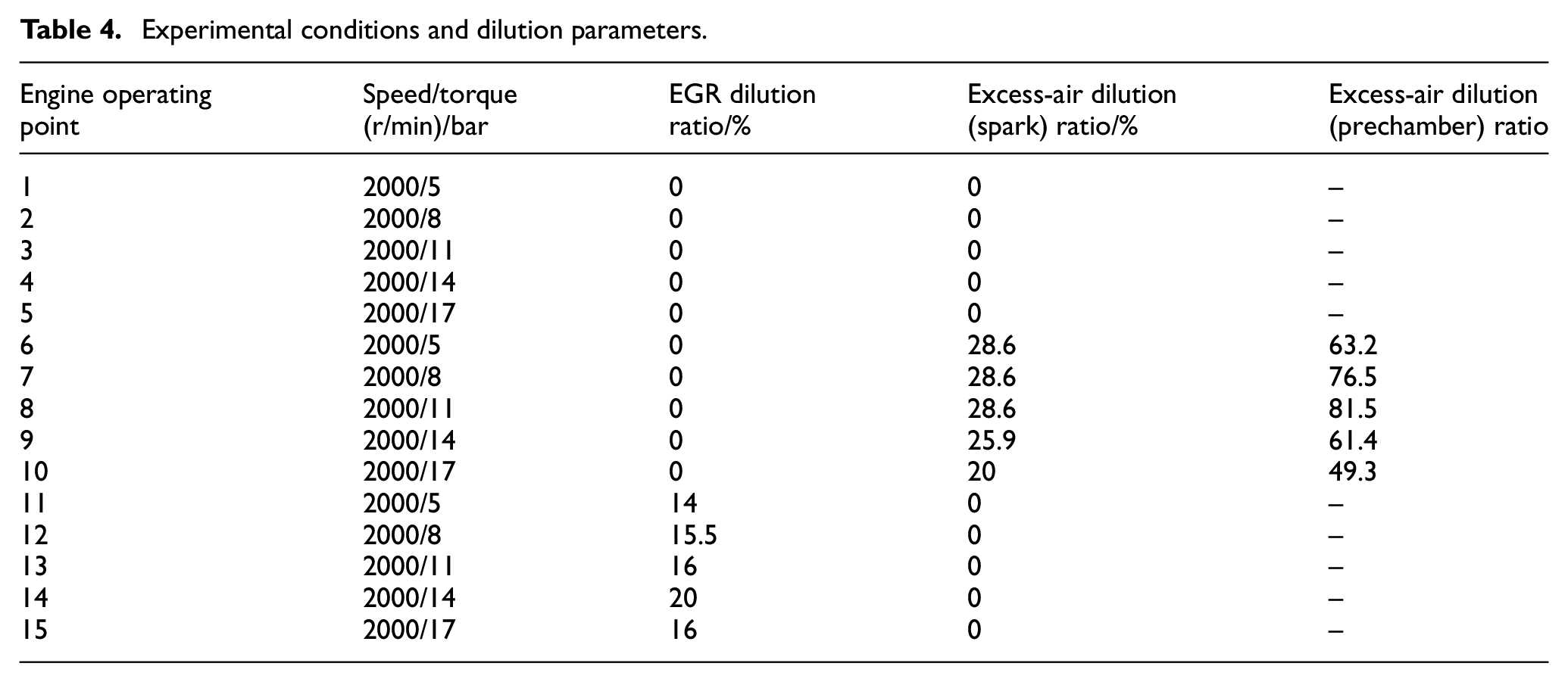
The original engine adopts stoichiometric combustion mode, keeping the EGR and air dilution ratio at 0 for comparative analysis. In order to obtain stable performance, the COV of maximum EGR ratio and excess-air ratio at various operating points is within 3%, the calculation of COV is described as follows:

The ignition angle was MBT (Minimum Spark Advance for Best Torque) angle, and the combustion phase MFB50 was will not be earlier than 8°ATDC. The maximum main chamber pressure rise rate was within 6 bar/°CA. The prechamber has the different air/fuel ratio to that of main chamber. The prechamber has an injector to provide fuel and uses rich mixture for ignition. The fuel mass injected in the prechamber was optimized to achieve maximum thermal efficiency at different operations. The main chamber injection timing and prechamber injection timing were kept constant at −300°ATDC and −150°ATDC, respectively.
In addition, in order to compare and analyze the influence of different dilution technologies on engine performance, crank angles are defined in advance. MFB10 is defined as the crank angle of 10% heat release of the total in cylinder, that is, combustion lagging period. MFB50 is the crank angle corresponding to 50% heat release of the total in cylinder, that is, combustion phasing. MFB90 is the crank angle corresponding to 90% heat release of the total in cylinder. MFB10-90 represents the crank angle range corresponding to 10% to 90% heat release of the total in cylinder, that is, combustion duration, which can be expressed as equation (5).

Experiment results and analysis
Comparative study on engine economy with different dilution technologies
When the engine operating point is set as 2400 rpm@12 bar, the engine economy tests under different dilution ratios are carried out with EGR and excess-air dilution respectively. The change trend of brake specific fuel consumption(BSFC) and COV with different technologies can be seen from Figure 3. Compared with the original engine, lean combustion displays great fuel economy. When the dilution ratio is 33.1%, excess-air dilution for spark shows the lowest BSFC. It is about 6.7% lower than that of the original engine. When the dilution ratio is 80%, excess-air dilution of prechamber shows the lowest BSFC, which is 15.9% and 9.9% lower than that of the original engine and excess-air dilution of spark, respectively. But when dilution ratio is less than 37.1%, since the delay of the combustion phase and the energy loss of the prechamber, the BSFC is larger when prechamber is applied compared to spark. When the dilution rate is greater than 37.1%, the air dilution improves the combustion phase of the pre-chamber, BSFC is improved. The prechamber can significantly improve the combustion stability, and the combustion cycle variation is less than 3% at the dilution rate of 100%. The economy of EGR is also greatly improved. When the EGR dilution ratio is 20.5%, BSFC is about 4% lower. At the same dilution ratio, excess-air dilution has better BSFC improvement effect than the EGR dilution. And excess air dilution with spark has higher dilution limit than EGR.
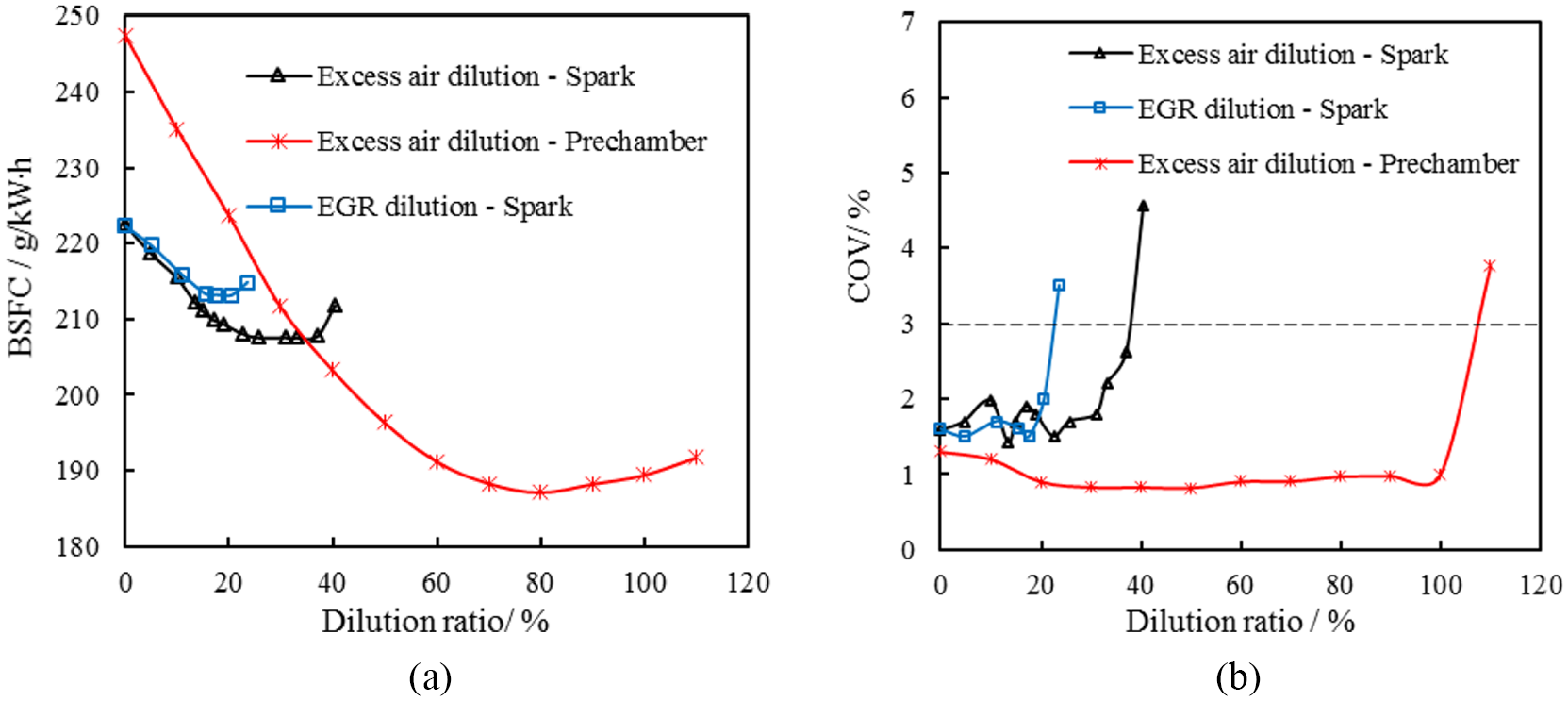
The comparison of BSFC (a) and COV (b) with different dilution technologies.
Figure 4 shows the comparison of cylinder pressure, HRR and cylinder temperature with different dilution technologies at dilution ratio of 20%. Since EGR dilution can effectively suppress the knock tendency, EGR has an advanced combustion phase and maximum peak cylinder pressure. For excess air dilution, the retarded ignition time of prechamber makes a retarded heat release time. But prechamber enhances the combustion process, which makes a significantly higher peak cylinder pressure and heat release rate as compared to excess air dilution of spark. Besides, the prechamber has the highest cylinder peak temperature. And there is no significant difference in the maximum cylinder peak temperature between EGR and excess air dilution for spark ignition.

The comparison of cylinder pressure, HRR (a) and cylinder temperature (b) with different dilution technologies at dilution ratio of 20%.
Figures 5 to 8 show the change trend of in-cylinder thermal process parameters such as MFB10, MFB50 and MFB10-90. These parameters can provide a reference for comprehensive analysis of the cause of BSFC change. Compared with the original engine, owing to the increase of the cylinder charge, the temperature of mixture decreases at the end of engine compression. Therefore the engine can adopt a great ignition advance angle to achieve better combustion phase. It can be seen from Figure 5 that EGR dilution adopts the most radical ignition advanced angel, causing most advanced MFB10 and MFB50. However, it is not only the combustion phase that determines the engine economy, but also the polytropic exponent of the in-cylinder thermal process is an important factor. The polytropic exponent of EGR almost remains, but that of excess-air dilution increases sharply. The economy improvement brought by the increase of polytropic exponent exceeds the benefit of combustion phasing advance. So excess-air dilution presents best economy. The prechamber ignition greatly shortens the combustion duration. But when dilution ratio is less than 37.1%, since combustion speed of the prechamber ignition is too fast, different fire beams cause cylinder pressure fluctuations, which causes the ignition angle to retreat and fuel economy declines.

Ignition advance angel of different dilution technologies.

MFB10 of different dilution technologies.

MFB50 of different dilution technologies.
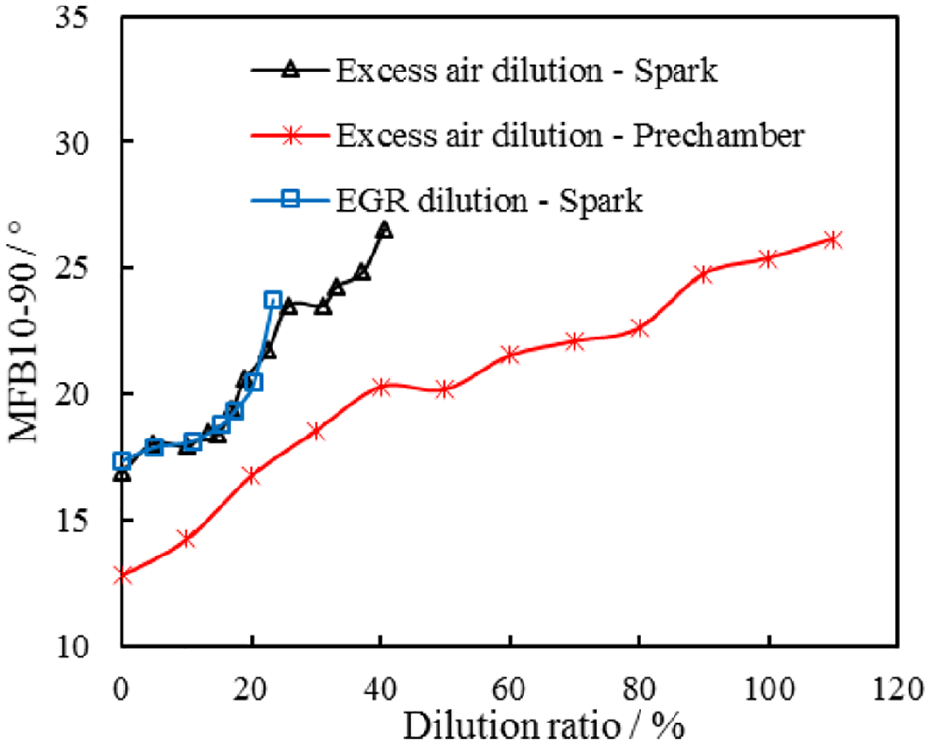
MFB10-90 of different dilution technologies.
When the dilution ratio is greater than 37.1%, air dilution reduces the pressure fluctuations of the prechamber ignition, and the combustion phase is advanced, and the fuel economy is improved. At the same time, although the ignition advance angle, MFB10 and MFB50 of the dilution combustion are better than those of the original engine, MFB10-90 is longer. Longer duration of MFB10-90 shows slower combustion flame speed. In a word, MFB10-90 doesn’t play an important role on the engine economy.
In addition, when the EGR dilution ratio increases from 20.5% to 23.5%, the BSFC shows an upward trend. This is because the COV is close to the limit, 3%. At the COV limit, combustion is unstable and the combustion phasing is poor. This shows that the tolerance limit of the combustion system with EGR dilution in this operating point is about 20.5%. When the excess-air dilution ratio is up to 37.1%, the test engine with spark ignition can still maintain good economy and combustion stability. The combustion duration of the pre-chamber ignition at different dilutions is greatly shortened, even when the dilution rate is 110%, the combustion duration is less than 30°CA. The combustion system has more tolerance for excess-air dilution than EGR dilution. This is mainly due to the fact that the in-cylinder flame propagation speed with excess-air dilution is faster than that with EGR dilution. According to Figures 5 to 8, the ignition advance angle of EGR dilution is larger than that of excess-air dilution at the same dilution ratio. But it does not lead to the same advance degree of MFB50 and shorter MFB10-90. The results show that the inert component of EGR dilution slows down the reaction rate.
Comparative study on engine emissions with different dilution technologies
The emission characteristics of HC, CO, and NOX with different dilution technologies, different dilution ratios and different ignition method are tested at the same operating point. The test results are shown in Figures 9 to 11.
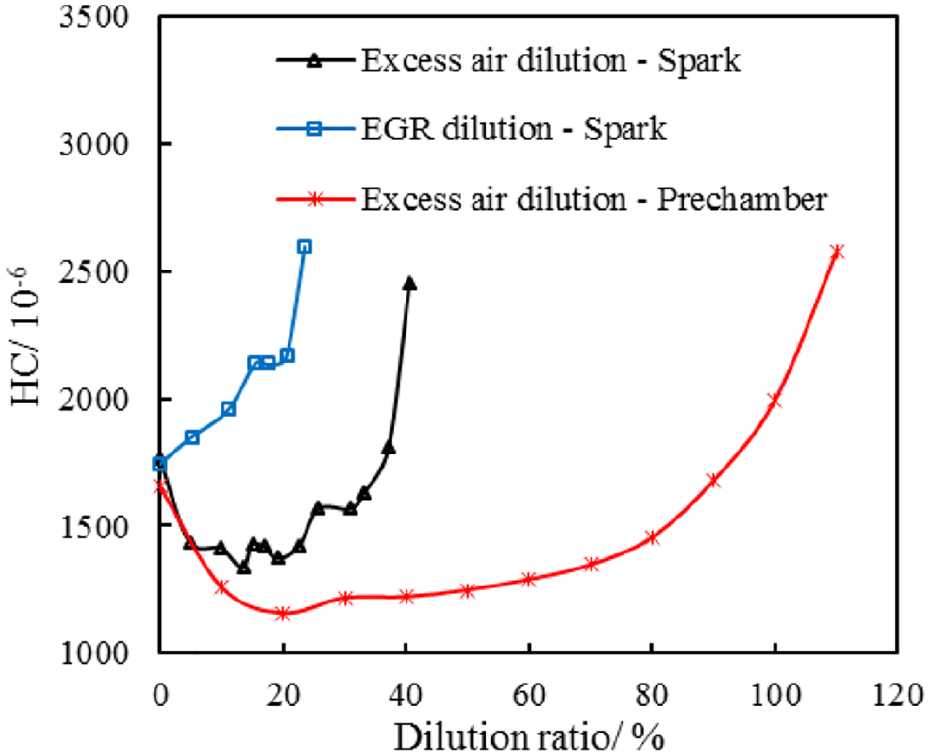
HC emissions of different dilution technologies.
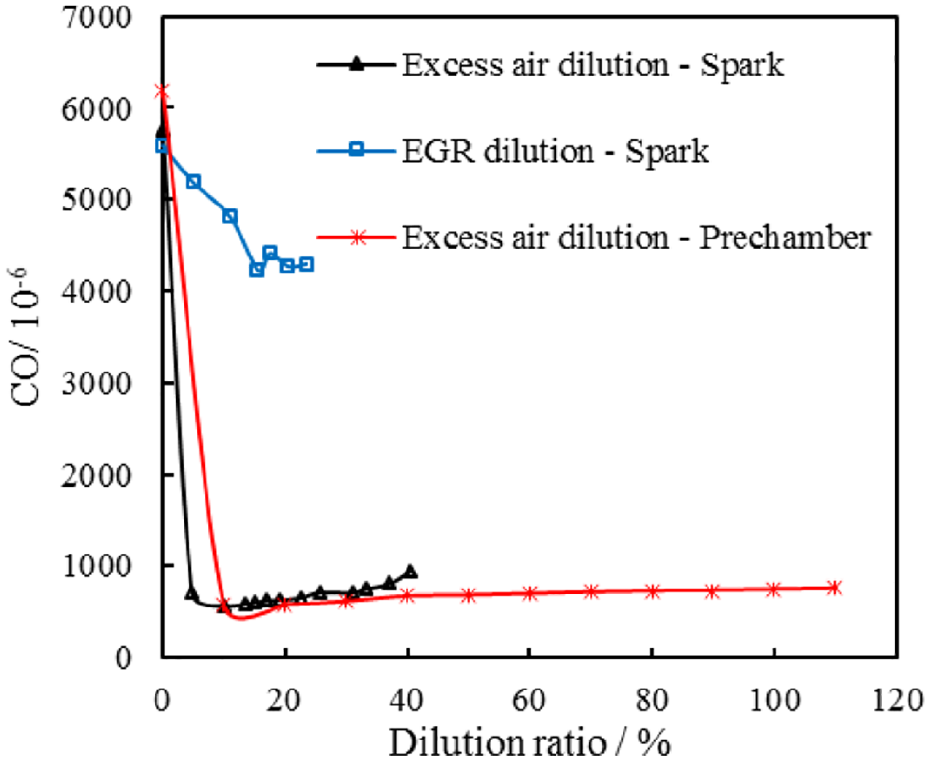
CO emissions of different dilution technologies.
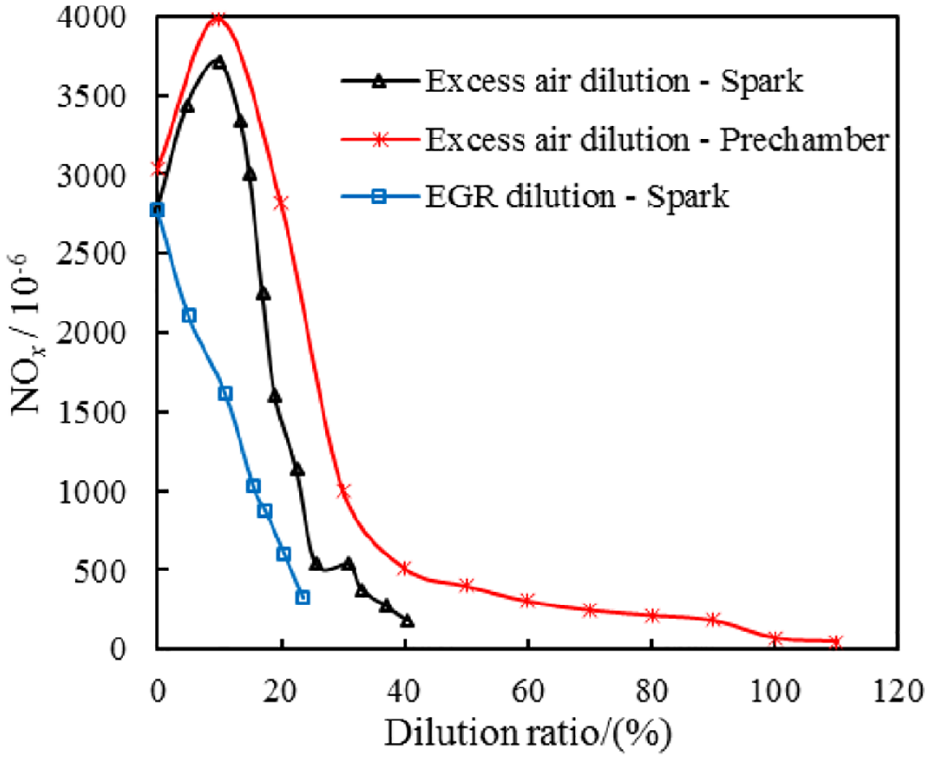
NOX emissions of different dilution technologies.
It can be seen from Figure 9 that at the same dilution ratio, the HC emissions with EGR are higher than those with excess air. Compared with the original engine, EGR dilution shows an upward trend of HC emissions. While the HC emissions with excess-air dilution first fall and then rise, only when the dilution ratio is over 40.5%, the emissions exceed the original engine. The HC emissions with excess-air dilution of prechamber first fall and then rise, and the prechamber has lower HC emission.
Through analysis, three main factors determine the formation of HC emissions. They are gap effect, combustion losses and the re-oxidation of HC in the later stage. When EGR is adopted, the flame propagation speed slows down. Therefore, the combustion duration extends (Figure 8) and the maximum combustion temperature decreases. Meanwhile, the inertia gas of EGR aggravates the incomplete combustion, which leads to the increase of combustion losses. These factors affect the oxidation process of HC, so HC emissions increase with the raising of EGR dilution ratio. When adopting the excess-air dilution, the flame propagation speed is slow and the combustion temperature also reduces. However, oxygen-enriched chemical atmosphere greatly promotes the later re-oxidation process of HC, so the HC emissions shows a downward trend compared with the original engine. Nevertheless, when the excess-air dilution ratio reaches 36.2%, the in-cylinder chemical atmosphere is extreme lean. In-cylinder flame propagation speed and combustion temperature are unacceptable. The incomplete combustion on combustion chamber wall aggregates. As a result, the HC emissions increases. At the same dilution ratio, the HC emission of pre chamber ignition is smaller. When prechamber ignition is applied compared to spark ignition, the heat release is faster, the heat release in cylinder is more concentrated, and the combustion temperature in cylinder is higher, which accelerated the oxidation rate of HC. On the other hand, the improved ignition stability of prechamber ignition can also reduce HC emission.
Figure 10 shows the change trend of CO emissions. It can be known that the CO emissions of excess-air dilution are much lower than those of EGR. This is mainly because the excess-air ratio is the decisive factor for the generation of CO in gasoline engines. In the oxygen-enriched chemical atmosphere, the emissions of CO will be greatly reduced. However, compared with the original engine, the CO emissions of EGR are slightly decreased. EGR dilution and the original engine combustion operate at stoichiometric air-fuel ratio, so the CO emissions of both of them hold at the same level. The advance of combustion phasing promotes the CO oxidation ratio. This is the reason for the slight decrease of CO emissions with EGR dilution. With the increase of dilution ratio, the CO emission of prechamber ignition is the same as that of spark plug ignition. Since prechamber can improve the combustion stability, when the dilution ratio is greater than 10%, the prechamber has smaller CO emission.
High temperature, oxygen enrichment, and high temperature duration are the decisive factors for the NOX generation of gasoline engine. Any change of factors will directly affect the generation of NOX emissions.
NOX emissions of excess-air dilution first increase and then decrease with the increase of dilution ratio in Figure 11. The ignition advance angle and combustion phasing are both advanced. Excess-air dilution increases the oxygen-enriched atmosphere. The combined effect of these factors leads to the peak of NOX emissions when the dilution rate is 9.9%. It can be seen from Figure 8, the combustion duration prolongs. The reduction of combustion temperature in the cylinder plays a leading role, so NOX emissions show a downward trend. When the dilution ratio is higher than 17.0%, the NOX emission level is lower than that of the original engine. NOX emission stay at a low level, and will slowly decrease when the dilution ratio reaches 34.5%. At the same dilution ratio, the NOX emission of prechamber ignition is higher. The heat release of prechamber is more concentrated, which leads to higher combustion temperature and higher NOX emission. On the other hand, the high temperature environment in the prechamber also produces NOX emissions. With the increase of dilution ratio, NOX emission of prechamber ignition first increases and then decreases. At a dilution rate of 110%, the pre-chamber ignition reduces NOX emissions to 49ppm.
While compared with the original engine, the NOX emissions of EGR dilution shows a sharp decline with the increase of dilution ratio. The inert gas in the exhaust gas effectively increases the in-cylinder heat capacity and reduces the in-cylinder temperature. These are the unfavorable conditions of NOX generation. When the dilution ratio increases, the combustion temperature will further decrease, so the NOX emissions will continue to decrease.
Comparative study on engine economy at optimal dilution ratio
The economy and emissions characteristics with three different combustion are investigated. 5, 8, 11, 14, and 17 bar (full load) at 2000 rpm are set as the working points. By comprehensive analysis, the best dilution ratio is selected.
At the same working point, the change rule of engine economy are shown in Figure 12. At optimal dilution ratio, the BSFC of engine decreases first and then increases with the increase of load. It shows the engine has great economy at medium load. At all test operating points, the excess-air dilution combustion with prechamber shows the best economy, the best BSFC is 191.36 g/kW·h. The BFSC of EGR dilution also shows a significant reduction compared with the original engine.

BSFC of different dilution technologies.
Comparative study on engine emissions at optimal dilution ratio
The emissions characteristics of HC, CO, and NOX are tested are shown in Figures 13 to 15.

HC of different dilution technologies.

CO of different dilution technologies.
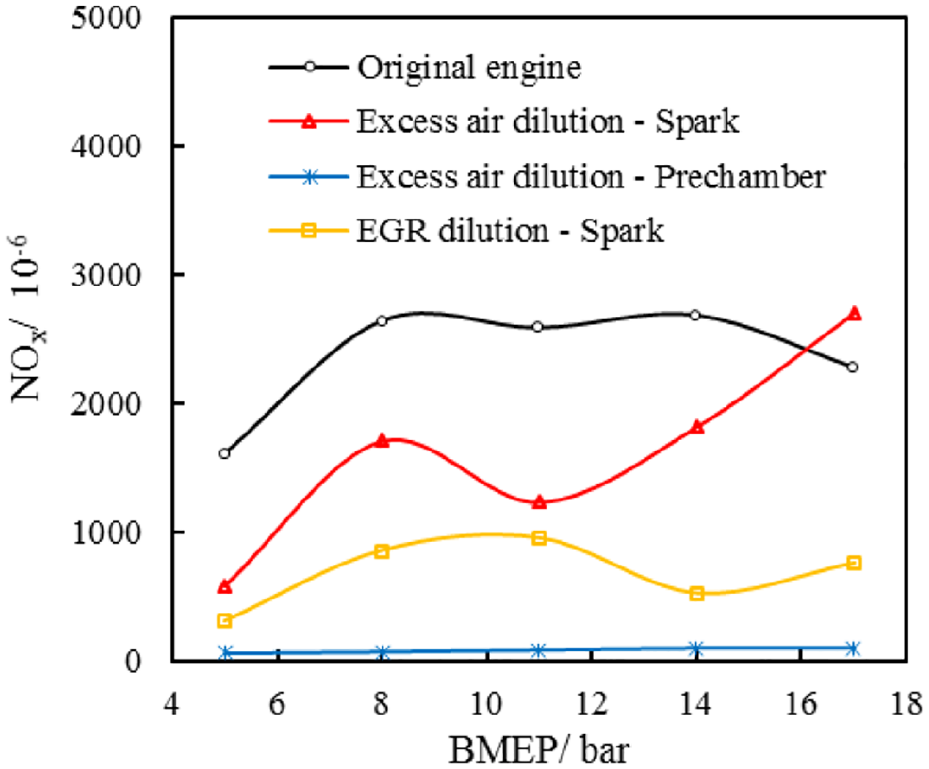
NOX of different dilution technologies.
It can be seen from Figure 13 that the HC emissions of EGR dilution are higher than those of the original engine and excess-air dilution at all operating points. The prechamber ignition has lower HC emissions compared with spark ignition under different loads, due to its high dilution ratio and combustion stability. The HC emissions of excess-air dilution are more than those of the original engine when the engine is running at small and medium load. While the HC emissions decrease with the increase of load, and are fewer than those of the original engine. At the small and medium load, the in-cylinder combustion temperature is generally not high. Meanwhile, the lean mixture increases the HC emissions of incomplete combustion. With the increase of load, the amount of circulating fuel increases, and the later oxidation process of HC is greatly improved. The oxygen content in the excess air combustion mode is abundant, which greatly promotes the oxidation process of HC, resulting in the fewer emissions of HC than those of the original engine at heavy load. In addition, the in-cylinder heat load increases with the increase of engine load, which improves the later oxidation process of HC. This is the reason why HC emissions of three different combustion technologies all decrease with the increase of load.
Figure 14 shows the trend of CO emissions change with three different combustion models. Due to the strong correlation between the CO emissions of gasoline engine and the excess-air ratio, in the condition of oxygen-enriched environment, the CO emissions of excess air dilution are much fewer than those of the original engine and EGR dilution. While for the EGR dilution and the original engine combustion, the CO emission doesn’t show obvious change law. The CO emissions of pre-chamber ignition and spark ignition are both at a lower level, and there is no significant difference.
It can be seen from Figure 15 that, except for the full load (17 bar), when the original combustion, excess air dilution and EGR dilution are adopted respectively, the NOX emission shows a downward trend in turn. Compared with the original engine, the in-cylinder combustion temperature of EGR dilution and excess air dilution is decreased, so the NOX emissions are more than those of the original engine. While compared with EGR dilution, the oxidation atmosphere of excess air dilution is stronger, resulting in higher NOX emission level. In addition, at the operating point of 2000 rpm@17 bar, the in-cylinder heat load is very high, and the oxygen-enriched atmosphere of excess air combustion causes its NOX emission level higher than that of the original engine. The dilution rate of the pre-chamber ignition under different loads is higher, and the combustion temperature is lower, so the NOx emissions is maintained at a low level under different loads.
Conclusions
This study experimentally investigates the economy and emission characteristics of different combustion technologies. Data and theoretical reference are provided for choosing the optimal dilution ratio and dilution technology. The following conclusions are offered:
When the engine is running at 2400 rpm@12 bar with same dilution ratio, excess air dilution has better economy than EGR dilution. Compared with combustion phasing, the increase of the polytropic exponent plays a decisive role in the improvement of economy. While combustion duration has less influence on the economy of the engine. The flame propagation speed of air dilution is faster than those of EGR, and the engine combustion system is more tolerant to excess air dilution ratio.
Only when the excess-air dilution ratio is less than 33.1%, the HC emissions are fewer than those of original engine. The CO emissions of excess air dilution are much fewer than those of EGR dilution, and both of them are fewer than those of the original engine. When the excess air dilution ratio is 9.9%, the NOX emissions reach the peak value, and then decrease continuously with the increase of dilution ratio. The NOX emissions of the EGR dilution are significantly fewer than those of original engine, and significantly decrease with the increase of dilution ratio. At the same dilution ratio, compared with spark plug ignition, the pre chamber ignition has lower HC, CO emissions, and higher NO emissions. At part load, the pre-chamber ignition reduces NOx emissions to 49 ppm.
When dilution ratio is less than 37.1%, since combustion speed of the prechamber ignition is too fast, different fire beams cause cylinder pressure fluctuations, which causes the ignition angle to retreat and fuel economy declines. When the dilution ratio is greater than 37.1%, air dilution reduces the pressure fluctuations of the prechamber ignition, and the combustion phase is advanced, and the fuel economy is improved.
At the same operating point, EGR and excess air both have great economy with respective optimal dilution ratio. The economy of excess air dilution is the best. Pre-chamber ignition can maintain combustion stability to 110% dilution rate, significantly improve fuel economy.
The HC emissions of EGR dilution are more than those of excess air dilution and original engine. The HC emissions of excess air dilution are more than those of original engine at medium and small load and less than those of original combustion at heavy load. The CO emission level of excess air dilution is much lower than that of the original combustion and EGR dilution.
In addition to 2000 rpm@17 bar (full load), NOX emissions decrease in turn when the original combustion, excess air dilution with spark and EGR dilution, excess air dilution with prechamber are used respectively.
Footnotes
Appendix
Handling Editor: James Baldwin
Declaration of conflicting interests
The author(s) declared no potential conflicts of interest with respect to the research, authorship, and/or publication of this article.
Funding
The author(s) disclosed receipt of the following financial support for the research, authorship, and/or publication of this article: Thanks for the funding of projects of Open Fund Project of Maanshan Engineering Technology Research Center of Advanced Design for Automotive Stamping Dies (Grant number: QMSG202004, QMSG202005, QMSG 202101, QMSG202102), Academic support project for top talents of subjects (majors) in Colleges and Universities and Key project of Natural Science Research of Anhui Provincial Department of Education (Grant number:KJ2020A0837).
