



Abstract
This paper presents the results of an experimental investigation on the relationship between strength and ultrasonic pulse velocity (UPV) of concrete exposed to high temperature, especially for a decision of building remodeling of concrete structures. The experiments were conducted at three different initial compressive strength levels for temperature up to 800°C. UPV, Compressive, and splitting tensile tests and UPV measurements were performed for unheated and heated concrete specimens. The measured UPV values in the present work were correlated with compressive and tensile strengths to estimate the strength of concrete. Based on the results, two linear equations for predicting compressive and tensile strength of concrete at elevated temperatures using UPV have been proposed. It is found that the difference of initial compressive strength of concrete does not have a significant effect on the strength reduction ratio after exposed to high temperatures. In addition, the reduction factors of compressive and tensile strengths in the present work do not well comply with the values of suggested by EN 1992-1-2.
Introduction
The strength variation of concrete subjected to elevated temperatures widely depends on many factors which includes degree of exposed temperature, time of duration, initial compressive strength, mixing proportions of concrete and so on. It is well known that concrete at elevated temperature brings a significant loss of mechanical properties such as compressive strength, tensile strength, and elastic modulus.1,2 The strength assessment of concrete for fire-damaged concrete structures is important for a decision of remodeling, repairing, strengthening, or demolishing of concrete structures. Therefore, a reasonable strength assessment of concrete after subjected to fire is very important work for structural sustainability of the fire-damaged concrete structures. In the strength assessment of concrete, the primary test usually has been carried out by concrete core samples taken from the damaged concrete. Actually, the strength test on core samples (destructive test) is well known a typical method and the most reliable method for assessing the strength variation of concrete subjected to high temperatures. However, taking core samples from damaged concrete occasionally has an apprehensive problem that makes weak points within the structural member for safety or with the performance of concrete structures. Therefore, several reliable non-destructive tests have been developed to increase the safety of the fire-damaged concrete or structures. As a non-destructive test, UPV method has been used to obtain the strength and other properties of concrete since the mid 1940’s. This method provides immediate strength and properties of concrete, and can be used to improve the concern of coring in concrete from the fire-damaged concrete structures.2–5
Lin et al. 6 investigated the residual compressive strength and ultrasonic pulse velocity (UPV) of concrete that water-cured after exposure to high temperatures. The relationship between the residual strength ratio and the residual UPV ratio was examined. Cylindrical specimens (100 mm in diameter and 200 mm in height) were made of concrete with water-cement ratios of 0.58 and 0.68 and, after 90 days, the specimens were heated in an electric furnace to temperatures ranging from 100 to 1000°C. The concrete specimens exposed to elevated temperatures were cured in a water tank for 72 h and tested after 2, 27, 87, and 177 days. The UPV values and compressive strength of each post-fire-curing specimens were obtained. Test results show that water curing of the concrete specimens after exposure to high temperatures has a noticeable effects on the residual strength and UPV recovery. The mixture proportion of concrete does not have a significant effect on the relationship between the residual strength and UPV ratios of the post-fire-curing concrete. Authors proposed linear equations for relationship between the residual strength and UPV ratios of post-fire-curing concrete with water-curing and non-curing, respectively. Al-Numan et al. 7 reported on the relationship between UPV and compressive strength of concrete. The concrete specimens were made with varied cube and compressive strength from 18 to 55 MPa. Based on the results, the authors proposed a reasonable exponential equation for UPV and compressive strength of concrete to improve the application of the UPV method as a non-destructive method. Kumar et al. 8 investigated the residual compressive strength of concrete exposed to elevated temperatures using non-destructive testing techniques. Compressive strengths of concrete specimens before and after exposed to between 718°C and 1029°C for five different exposal times were investigated using 60 cube specimens (150 mm × 150 mm × 150 mm). Compressive strength of the unheated and heated specimens were found using digital compression testing machine of capacity 1000 kN and UPV test. Test results indicated that compressive strength of concrete by the both tests decreased steadily with the increase of temperature, and it can be concluded that UPV test is reliable to investigated the quick assessment of compressive strength on fire affected concrete with relatively less exposure time. Azreen et al. 9 investigated UPV values with a total of 70 cube concrete samples (150 mm × 150 mm × 150 mm) and seven beam samples (750 mm × 150 mm × 150 mm) by direct and indirect paths. Direct UPV Tests were performed between the top and the bottom surfaces of the concrete specimen and indirect tests were conducted along the surface. UPV values were compared using direct and indirect methods and developed a relationships from this comparison. Test results show that the direct UPV showed higher value than indirect UPV value as much as 16.5% due to position of transducers. The obtained compressive strength in this study showed a good relationship with the direct UPV measurement than the indirect UPV measurement. Hager and Carré 10 presented the results of a study on the impact of high temperature on compressive strength and UPV value in ordinary and high performance concrete. Tests were conducted on concrete cube specimens of 150 mm × 150 mm × 150 mm with 200°C, 400°C, 600°C, and 800°C, respectively. Test results show that the high temperature clearly affected the UPV value and compressive strength of concrete up to 800°C, and UPV value was definitely differ between the ordinary and high performance concrete. Authors also suggested that UPV value may an effective method of assessing the quality of concrete affected by high temperature by the comparison of decay factors of compressive strength and UPV value.
In summary, it has been observed that a number of studies were reported on relationship between UPV value and strength of concrete. The use of UPV test, as a non-destructive test, has been used to investigate the strength of concrete because UPV value was affected by various conditions and types of concrete. However, the use of UPV test for evaluation of strength of concrete subjected to high temperature has not been studied well. The purpose of this work is to investigate compressive and splitting tensile strengths of concrete using direct destructive tests and UPV tests with four different exposure temperatures and three different compressive strength levels, then compared to each other for determining relationship of both values. In addition, this paper tries to contribute a better use of UPV test for evaluation of compressive and splitting tensile strengths of concrete structures after exposure to high temperatures such as fire.
Experimental program
Materials
The cement used for making concrete specimens was Portland cement (type I) with a specific gravity 3.15. Slag cement and fly ash were used as a replacement of cement with a specific gravity of 3.01 and 2.23, respectively. The superplasticizer (polycarboxylic acid) with a specific gravity of 1.2 was used for each targeted slump. The coarse aggregate was crushed stone of 25 mm maximum size with a specific gravity of 2.65. As a fine aggregate, river and crushed sands with a specific gravity of 2.57 and 2.64 were used, respectively. The fineness modulus of river and crushed sands were 2.72 and 3.62, respectively. A total of 90 cylinder specimens were made for ultrasonic pulse velocity, compression, and splitting tensile tests.
Concrete specimens
Table 1 shows the mix proportions of concrete used in the present work. Three different intended mix design strength at 28 days of 24, 27, and 35 MPa were considered to make specimens. The selected concrete strengths are the most common used concrete strength of building structures in Korea. All the specimens were cast in cylinder mold of 100 mm in diameter and 200 mm in height. The specimens were kept in a cylinder mold, and demolded after approximately 24 h, then moved into a water tank with a temperature of 20°C ± 1.5°C for 27 days. A total of 28 days of concrete specimens were heated in an electric furnace up to 200°C, 400°C, 600°C, and 800°C. The selected temperatures were considered for the effects of thermal expansion, cement paste breaking, and disintegrating of concretes shown by many investigations.10,11 Each specimen was heated up to a target temperature with a rate of 1°C/min, and then maintained for 2 h. After heating, all specimens were cooled in room temperature approximately 24 h before test.
Mix proportions.
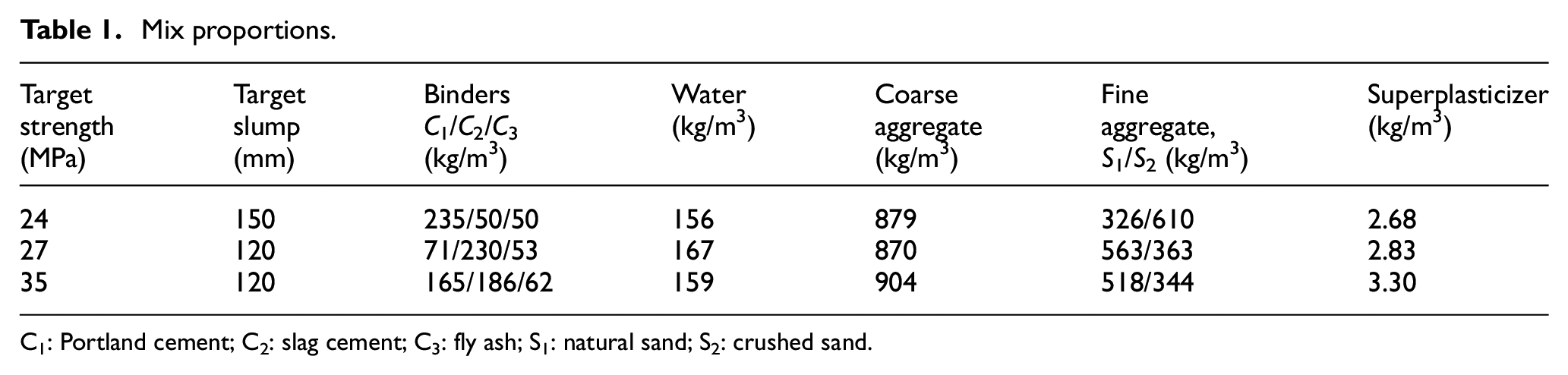
C1: Portland cement; C2: slag cement; C3: fly ash; S1: natural sand; S2: crushed sand.
Experimental tests
Compression tests were conducted on a total of 45 cylindrical specimens in accordance with the Korean standards KSF 2405 (2009) using universal testing machine (UTM) and an acquisition system. 12 The load was applied at a rate of 0.02 mm/s with a preload of about 200 N. Generally, a splitting tensile test is relatively simple and seems to provide reliable test results to calculate the tensile strength of concrete under uniform stresses at the top and bottom across the diameter of the tested cylindrical specimens. Therefore, in this work the splitting tensile test was used for investigation of tensile strength. The splitting tensile test was carried out according to the Korean standards KSF 2423 (2009) for a total of 45 specimens. 13 The load was applied at a rate of 0.01 mm/s with a preload of about 50 N. As a non-destructive test, UPV test was conducted for cylindrical specimens to measure the velocity of wave transmission in the specimen. In general, ultrasonic pulse velocity (UPV) tests are performed by direct measurement (opposite faces) or indirect measurement (along the surfaces). 14 According to the Azreen et al., 9 direct measurement method shows a good correlation for estimating the compressive strength of concrete using cylinder core specimen. Therefore, direct measurements were carried out using a cylindrical specimen with the dimension of 100 mm in diameter and 200 mm in height in this study. The transmitter and receiver were placed at the top and bottom of a cylinder specimen, respectively. UPV tests were conducted before they were tested in compressive and splitting tensile tests. A Digital Indicator Tester (PUNDIT) consists of two transducers, that is, one receiver head of 54 kHz ± 5 kHz with bandwidth <10 kHz and one transmitter, and were used in the present work. 10 Figures 1 and 2 show a typical compressive strength and ultrasonic pulse velocity test in this work, respectively.

Compressive strength test.

Ultrasonic pulse velocity test.
Results and discussion
Compressive strength
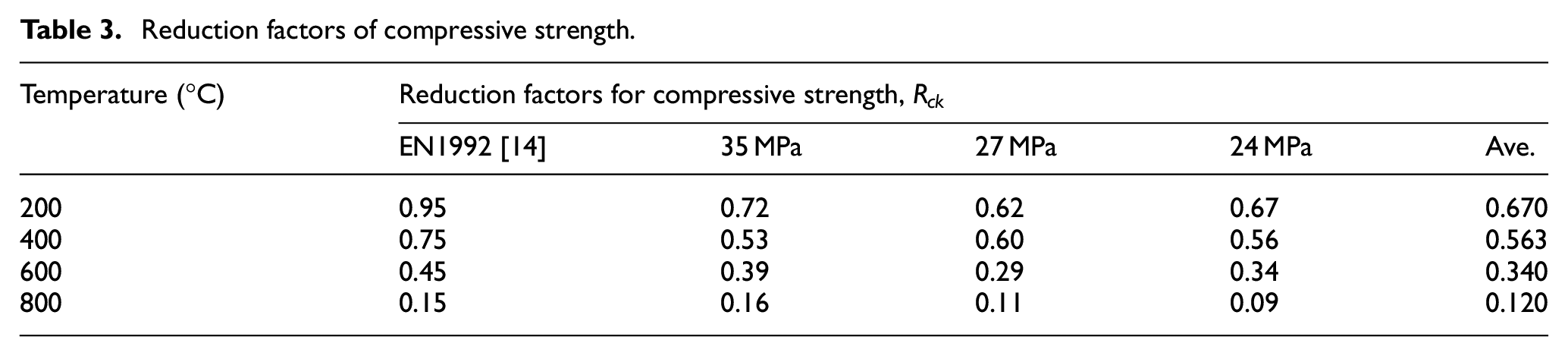
The results of the compressive strength tests with room temperatures, 200°C, 400°C, 600°C, and 800°C are given in Table 2. Each value in Table 2 are obtained an average of three concrete specimens. In Table 2, it is clear that the compressive strength of the heated concrete decreases with an increasing temperature. The observed average residual compressive strengths compare to room temperature ranging from 62% to 72% for 200°C, from 53% to 60% for 400°C, from 29% to 39% for 600°C, and from 9% to 16% for 800°C, respectively.
Compressive strengths of concrete subjected to high temperatures.

Figure 3 shows the variation of compressive strength determined in the present work up to 800°C. It is observed that compressive strengths decrease as the temperature increases, that is, the compressive strength affected primary by exposure temperature. The compressive strength found in the present work compared to room temperature was approximately 28%–38% for 200°C, 10%–46% for 400°C, 61%–71% for 600°C, and 84%–91% for 800°C, respectively. As a result, the effect of initial mix design strength of concrete is not significant in decreasing rate of concrete strength after exposure to high temperature. Since the present study conducts with relatively small different initial mix design strength, additional tests are needed to verify such a trend. In the Figure 3, it is shown that the highest decreasing percentage of compressive strength at high temperature is not proportional to the initial mix design compressive strength. Also it is found that the highest compressive strength decreasing percentage occurred a temperature between 600°C and 800°C as much as 22.23%.

Variation of compressive strength in terms of temperature.
To investigate the results of this work, the strength reduction factor suggested by EN1992-1-2 15 as a function of the exposure temperature was adopted as follows:

where
Reduction factors of compressive strength.
Splitting tensile strength
The average splitting tensile strengths of concrete at 28 days with room temperatures, 200°C, 400°C, 600°C, and 800°C are given in Table 4. In Table 4, it is found that the splitting tensile strengths of the heated concrete also decreases as temperature increases. The obtained tensile strength compare to compressive strength ranging from 7.48% to 9.66% for room temperature, from 8.44% to 11.11% for 200°C, from 7.26% to 11.25% for 400°C, from 7.00% to 8.57% for 600°C, and from 6.31% to 11.48% for 800°C, respectively. It is observed that the reduction trend in tensile strength due to high temperature is similar to that in compressive strength. The reduction in the tensile strength of heated concrete is also significantly affected by the exposure temperature.
Splitting tensile strengths of concrete subjected to high temperatures.

Figure 4 shows the graphical variation of tensile strength of concrete at elevated temperature in this work. In Figure 4, it is shown that the tensile strength of heated concrete continuously decreases with an increasing temperature, and there is a noticeable reduction after the concrete subjected to 800°C. It is found that the tensile strengths of 24 MPa shows the highest reduction at 200°C, 400°C, and 800°C with an average of 34.777%, 58.37%, and 89.27% compared to room temperature, respectively. In addition, the highest reduction of tensile strength for 600°C occurred for 27 MPa with an average of 77.82%. Based on the test results, it can be said that the initial mix design strength of concrete does not have an apparent effect on the residual tensile strength of heated concrete. It is shown that the highest reduction of tensile strength observed at a temperature between 400°C and 600°C as much as 25.33%. This result may be due to the density damage or loss of integration between binder and aggregate of concrete due to higher temperature.
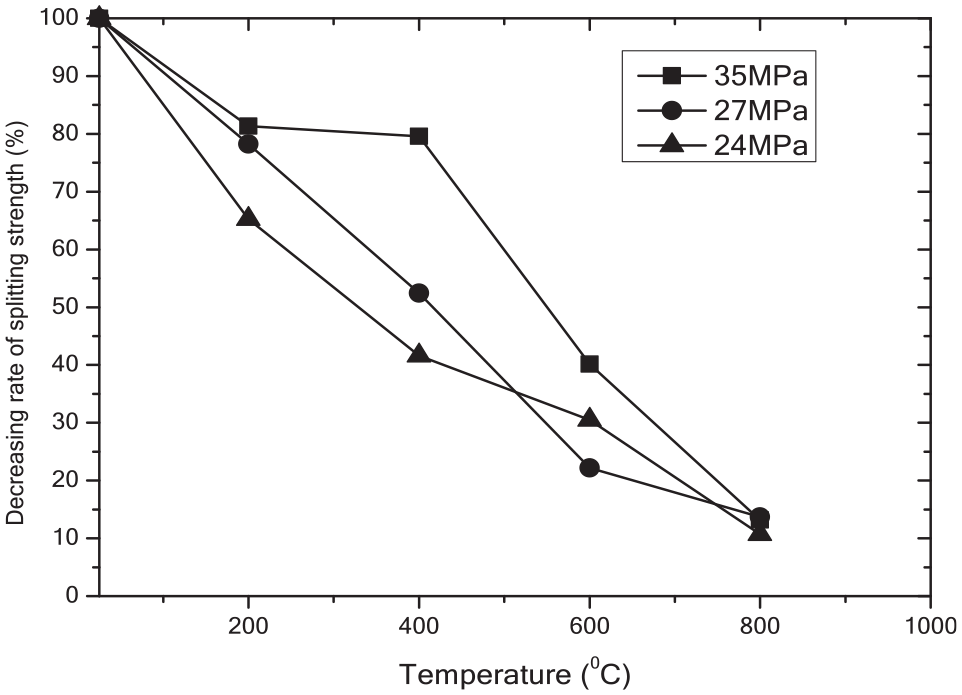
Variation of tensile strength in terms of temperature.
In general, the tensile strength of concrete should normally be ignored for structural design. However, tensile strength of concrete can be considered important because of the spalling and crack propagation of concrete at elevated temperature.16,17 The strength reduction factor of tensile strength of concrete in the present work from the same concept of equation (1) are given in Table 5.
Reduction factors of splitting tensile strength.
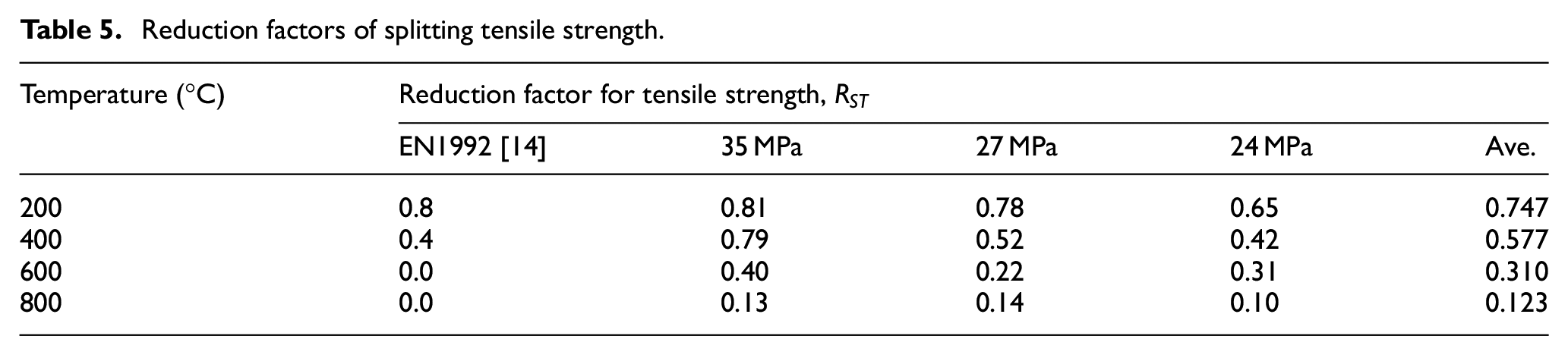
The obtained reduction factor of tensile strength ranged from 0.65 to 0.81 at 200°C, from 0.42 to 0.79 at 400°C, from 0.22 to 0.40 at 600°C, and from 0.10 to 0.14 at 800°C, respectively. In Table 5, it is clear that the reduction factors of tensile strength decreases as the increase of an exposure temperature, and decreases as the initial mix design strength of concrete decreases up to 400°C. However, it is found that the reduction factor of tensile strength is not proportional to the initial mix design strength over 600°C. This results may be come from the density of concrete changed steadily due to temperature up to 600°C while the loss of concrete density may not be constant by initial mix design strength up to 800°C. Compare to the EN 1992-1-2, 15 the reduction factors for tensile strength in this work at 200°C were slightly smaller than those of given by EN 1992-1-2 15 while reduction factors at 400°C were relatively higher than those given by EN 1992-1-2. 15 In addition, it is found that the reduction factors at both 600°C and 800°C are 0.31 and 0.12, respectively while the EN1992 considers zero strength reduction factor over 600°C. This is a very meaningful observation that can provide a clear result of concrete subjected to high temperature.
Ultrasonic pulse velocity of concrete specimen
The quality of concrete can be estimated in terms of the UPV of concrete. The UPV values found in this work may be compared with quality guidelines by the Indian Standard (IS 13311 part I) 14 which is shown in Table 6.
Velocity criterion for concrete quality grading.
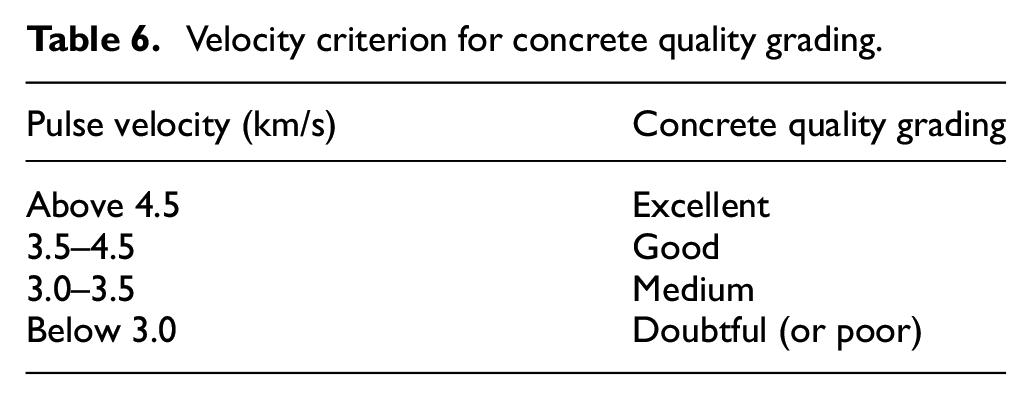
Table 7 shows a summary of the UPV values in this study. In Table 7, the UPV value is an average value of at least six time measurements for each concrete specimen. From the results, the loss of UPV compared to room temperature took place for approximately 7.4%7–9.32% at 200°C, 24.25%–43.81% at 400°C, 45.56%–63.82% at 600°C, and 76.99%–90.27% at 800°C, respectively. Compare by the Indian Standard (IS 13311 part I), 14 it is found that the quality of concrete will reaches approximately poor quality when concrete exposed temperature between 400°C and 600°C, and concrete having relatively higher initial mix design indicated somewhat lower reduction ratio of UPV at elevated temperature. It is also observed that the lower grades of concrete strength could be reached poor quality at the relatively lower exposure temperature. This result may be differed from many concrete factors such as water/cement ratio, mix proportions, types of aggregate, etc. It is need to more tests and studying for verifying such a difference.
UPV values of concrete subjected to high temperatures.

The strength reduction factor of UPV values for concrete was adopted in the present work as follows:

Where,
Reduction factors of UPV values.

Strength estimation model and evaluation
To derive a level of suitable relationship between strength and UPV of concretes subjected to high temperatures, a linear regression model was used. This model was known as an adequate modeling approach for deriving the relationship between UPV and concrete strength through many investigations with aggregate type, W/C ratio, curing time, specimen size, and various testing methods.3,6,10 Therefore, it is assumed that the strength of concrete strength would be developed by UPV. The considered form of the linear regression equation may be written as:

Where,


where

Relationship between UPV and compressive strength.

Relationship between UPV and tensile strength.
In general, the coefficient of determination (R2) of 0.7 or higher value indicates a good regression because that it accounts for how much experimental data are closely related with the obtained regression equation. 10 The linear formulation proved relatively good for modeling the concrete strength using the UPV of concrete subjected to high temperatures. Therefore, the proposed equations on compressive and tensile strengths are quite adequate for estimating of concrete strength using the UPV.
Conclusions
In the present work, the effect of different initial mix design strength on the relationship between UPV and strength of concrete subjected to high temperature was investigated. Based on the experimental and analytical results, the following conclusions are drawn:
The UPV value, compressive and tensile strengths of concrete decrease when the exposure temperature increases up to 800°C, and the difference of compressive strength does not significant change the reduction ratios of residual compressive, tensile, and UPV of concrete at elevated temperatures.
The reduction factor ratios of compressive, tensile strength, and UPV of concrete at high temperature seem not to significantly depend on the initial compressive strength, and the obtained reduction factor of strength in the present work do not comply well with the those of suggested by EN 1992-1-2. 15
It is found that the reduction factor by UPV is relatively higher than that of compressive and tensile strengths, and could be successfully used to estimate the strength of concrete subjected to high temperature.
The proposed linear formula in this study may be successfully used to estimate the strength of concrete subjected to high temperature using UPV.
Footnotes
Handling Editor: James Baldwin
Declaration of conflicting interests
The author(s) declared no potential conflicts of interest with respect to the research, authorship, and/or publication of this article.
Funding
The author(s) disclosed receipt of the following financial support for the research, authorship, and/or publication of this article: This research was supported by National Research Foundation of Korea Grant (2019R1A4A1028116), funded by the Ministry of Education, Korea, and also by research fund from Chosun University (2020), Korea
