



Abstract
Based on the frictional mechanism of a wet clutch, frictional models of wet clutch engagement were established using the modified Reynolds equation and the elastic contact model between frictional pairs. Then, the heat flux models for the viscous shear and asperity friction were built, and the two-dimensional transient thermal models for the separator plate, friction disk, and ATF heat convection model were deduced based on the heat transfer theory and conservation law of energy. Finally, the Runge–Kutta numerical method was used to solve the frictional and thermal models. The average temperature of the separator plate, friction disk, and ATF were calculated. The effects of operating and material parameters, such as applied pressure, initial angular velocity, friction lining permeability, surface combined roughness RMS, equivalent elastic modulus, and ATF flow, on the thermal characteristics of friction pairs and ATF during engagement, were studied. The simulation results show that the temperature characteristics of the separator plate, friction disk, and ATF depend mainly on the viscous shear and asperity friction heat flux, and that the operating and material parameters of the wet clutch also have significant impacts on the overall variation trend of the thermal characteristics of the separator plate, friction disk, and ATF.
Keywords
Introduction
Wet clutches, as a key part in AT/DCT, play an important role in power transmission. The wet clutch in AT/DCT consists of separator plate, core disk, and wet friction linings that bond to both sides of the core disk, 1 as shown in Figure 1. The friction pairs of the wet clutch are submerged in an automatic transmission fluid (ATF), which acts as a cooling lubricant during operation. A large amount of heat is generated from the sliding friction between the separator plates and the friction disk during starting and shifting. The generated heat causes the temperature of the separator plate, friction disc, and cooling lubricating oil to rise sharply, resulting in thermal stress, causing local ablation of the separator plate and friction disc surface and changes in the physical properties of the lubricating oil, and even producing serious thermal failure forms such as crack, fin bending, and deterioration of the sintered oil.2–6 Therefore, numerical simulation of the temperature characteristics of a wet clutch may provide the required insight for studying the temperature distribution of friction pairs in an inexpensive way.

Simplified model of the wet clutch.
Although many studies on temperature field of wet clutches have been carried out, they focus more on temperature and thermal stress distributions using the finite element method. For example, Sun 7 analyzed the transient thermal–structural coupling phenomenon and thermoelastic instability of friction discs using the finite element method, and revealed the distribution formation of hot spots in circular direction and on the surface of the separator plate. Zhang et al. used Abaqus to calculate the temperature field and stress field during the shifting of the wet clutch, and analyzed the effects of different speed differences, the thickness of separator plate, and the working oil pressure on the temperature field and stress field. 8 Yu et al. 9 used simulation software Abaqus to construct a three-dimensional model of the friction clutch, and used finite element theory to analyze the influence of clamping spring constraint on the variation of non-uniform temperature field. He and Su 10 proposed a new friction disk with a skew T-junction oil groove structure and analyzed the heat transfer characteristics and temperature distribution of a wet clutch. Wu studied the sliding friction temperature field optimization model during the stable period of sliding friction to analyze the influence of speed, oil pressure, and lubrication flow on the characteristics of sliding friction temperature rise. 11 Wang et al. 12 analyzed the change process of the temperature field of the separator plate bonding surface during the bonding process, the hot spot and the change law of contact stress, and discussed the influence of the working oil pressure and the relative speed on the temperature field change process. Zhou 13 used the wet clutch thermal-structure coupling analysis model to analyze the influence of wet clutch sliding friction conditions, engagement pressure, friction plate material, and other factors on the temperature field during the wet clutch engagement. Yang et al. 14 built a three-dimensional finite element model of a wet clutch. The author studied the temperature field and stress field distributions of a steel disc and analyzed the effects of engaging time and radius on temperature and stress fields. Jang et al. 15 developed a thermal model, which included viscous heat dissipation in the fluid and heat transfer into friction pairs. Further, the author also studied the effects of grooves, roughness, centrifugal force, deformability, and permeability on temperature field.
However, previous studies on the temperature characteristics of wet clutches have focused on temperature distribution characteristics and heat transfer of friction pairs, and most of them are based on finite element theory, and the application of other numerical methods is relatively few. This study focused on the temperature characteristics of a wet clutch based on the frictional heat mechanism of a wet clutch. This paper presents the viscous shear and asperity friction heat flux models in engagement, the two-dimensional transient thermal models of friction pairs, and the ATF in a wet clutch. A numerical method was used to analyze the effects of the working parameters and the material of the wet clutch on temperature characteristics.
Model description
According to the frictional mechanism of a wet clutch, the heat generated between the separator plate and the friction disc is composed of the heat generated by the contact friction of the asperities on the surface of the friction pairs and the heat generated by the shearing of the lubricating oil film between the friction pairs. 6 Thus, models of viscous shear and asperity friction heat fluxes were developed based on their frictional power mechanism. Two-dimensional transient temperature models in the radial and axial directions for the separator plate, friction lining, and ATF were built. As the heat flux distribution coefficient is dependent on the friction material parameters of the separator plate, the friction lining was taken into account.
Modified Reynolds model
The simplified model of the wet clutch is shown in Figure 1. Under disengagement, the friction pairs of the separator plate and friction disk are immerged in the ATF, which plays an important role in lubrication and cooling. For modeling purpose, some assumptions were made in the following studies. For instance, the surfaces of friction pairs are assumed to be isotropic asperities, and the surface asperity height for friction pairs is assumed to be a Gaussian distribution. The relationship between the average gap

Owing to the axisymmetric structure of the wet clutch, a one-dimensional modified Reynolds equation based on the average flow model17,18 was used to model the ATF in wet clutch engagement.

Real contact model
The real contact area

To simplify, the contact pressure of asperity

Force and torque balance model
Wet clutch engagement was assumed to be a quasi-static process, and the inertia of the friction pairs was neglected in engagement. As a result, the applied force

The oil film force


During engagement of the wet clutch, the transmitted torque of the wet clutch, which drives the friction disk, is balanced by the viscous shear torque

where, I is the equivalent moment of inertia of the friction disk. The viscous shear and asperity friction torques are, respectively, given by


where, fc is the asperity friction coefficient between the friction pairs. The friction coefficient used here is a curve fit of the test data obtained using the friction testing machine.

Thermal models
The thermal model for the wet clutch is shown in Figure 2. The friction heat generated between the friction pairs during the engagement of the wet clutch is dissipated on the separator plate, friction disc, and lubricating oil, respectively, which causes the temperature of the separator plate, friction disc surface and cooling lubricating oil to increase. For the convenience of analysis and calculation, only the radial heat transfer of the temperature on the separator plate and the friction plate, the heat transfer between friction pairs and forced convective heat transfer between friction surfaces are considered. The friction plate is composed of a friction lining and a core plate, ignoring the temperature gradient between the friction lining and core plate, and the rigid chip and the friction lining are considered as a whole for discussion and research. The heat transfer theory was used to develop the transient heat conduction equations for the separator plate, friction lining, and ATF.

Thermal model for the wet clutch.
The heat conduction equation for separator plate A is described as

The heat conduction equation for friction lining B is

where,

The heat convection between ATF and friction surfaces can be described as

where,

The heat generation of the wet clutch q during engagement can be estimated using the viscous shear heat flux qh and the asperity friction heat flux qc.



Based on the heat generation of the wet clutch, the overall power between friction pairs

Numerical simulation and model verification
Numerical simulation
The governing equations were solved by integration using the Runge–Kutta method to obtain the thermal characteristics of the wet clutch. The time step was set to 0.001 s. The iteration was stopped when the relative angular velocity reached 0.001 rad/s. At this moment, the engagement of the wet clutch was completed. The parameters used in the calculations are shown in Table 1.
Initial data in calculation.

Model test verification
Bench principle
In order to verify the accuracy of the wet clutch friction pair model and ATF temperature model, the experimental verification was carried out based on the wet clutch comprehensive performance test bench.
The test bench is composed of five parts: driving system, loading system, mechanical system, sensor system, measurement, and control system. The principle and the actual test bench are shown in Figure 3. Both the driving system and loading system are composed of a frequency conversion motor and a frequency converter. The mechanical system is mainly a clutch test box, a hydraulic actuator, etc. The sensor system includes speed, torque, and temperature sensors. The measurement and control system consists of an industrial control computer, a frequency conversion controller, and measurement and control software. Adjust the speed of frequency conversion motor of the driving and the loading system to the set value. The wet clutch friction pair is controlled by the industrial control computer to perform sliding friction. The acquisition card records the temperature of the separator plate, friction plate, and ATF in real time with a sampling frequency of 100 Hz.

Wet clutch test bench.
Comparison of test and simulation
In order to ensure the consistency between the simulation and the test, the test conditions were set according to the simulation conditions. However, due to the limitation of the test conditions, only the temperature of the separator plate and ATF with the control oil pressure of 0.7 MPa were extracted and compared with the simulation results, as the Figure 4 shows.

Test and simulation results.
It can be seen from Figure 4 that the simulation results of the separator plate and ATF are in good agreement with the measured temperature of the test. The measured temperature of the separator plate and ATF are lower than the simulation. This is because the thermal radiation of the separator plate and the friction plate is ignored in the simulation. And the heat exchange between the inner and outer cylinders of the separator plate and the friction disc is also ignored. The temperature is only absorbed by the separator plate, friction disc and ATF, so the simulation temperature is higher than the test temperature. The highest temperature points of the separator plate and ATF are delayed. This is because there is a gap in the test process to be eliminated, so the time is lagging.
Effects of operating and material parameters on the thermal characteristics of a wet clutch
Effect of applied pressure
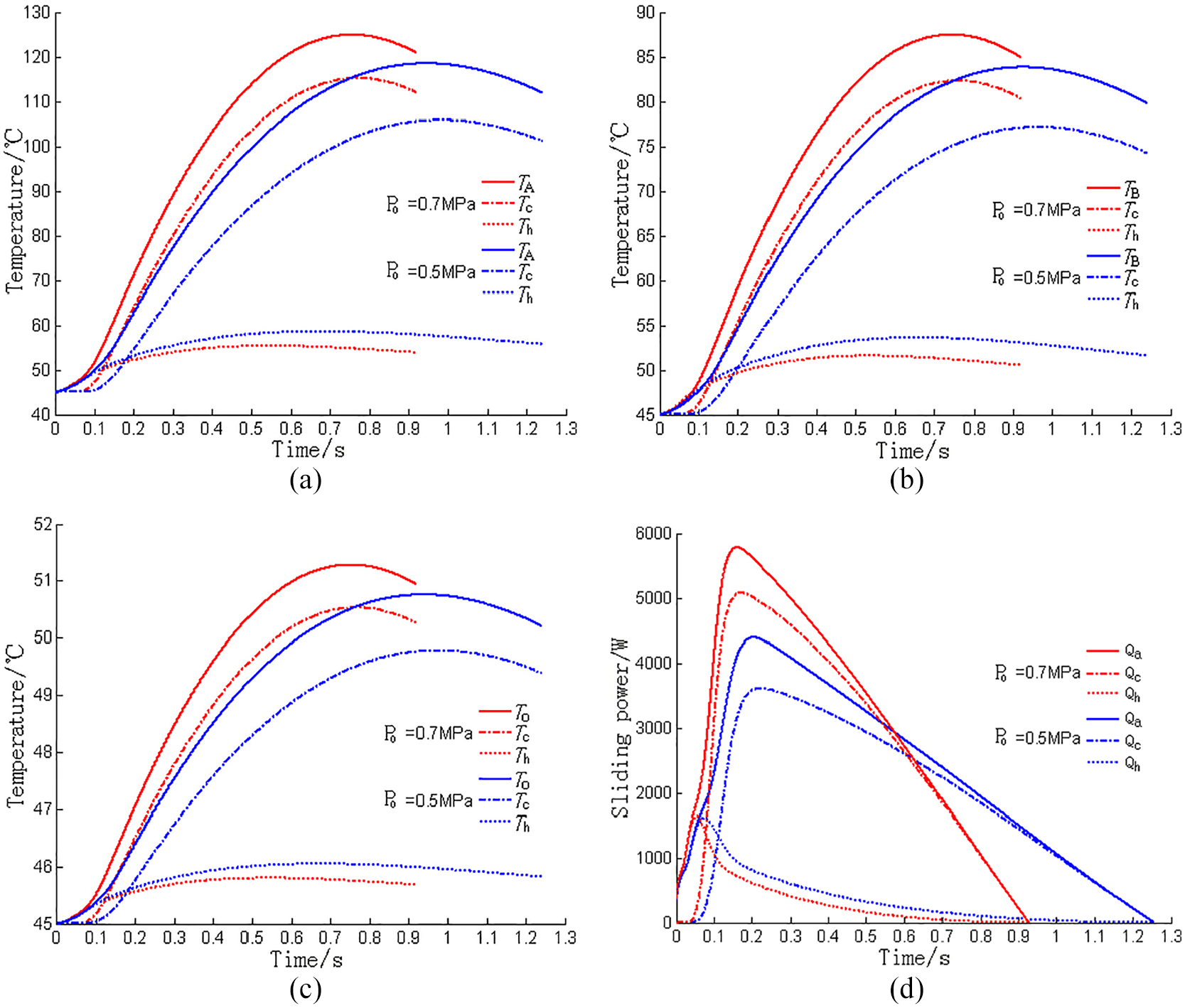
As shown in Figure 5, the change in applied pressure had a significant influence on the temperature rise characteristics of the friction pairs and ATF. With an increase in the applied pressure, the engagement time became shorter, the contribution of the viscous shear heat flux to the temperature rise characteristics of the friction pairs and ATF was reduced, while the contribution of the asperity friction heat flux was significantly increased and the response is faster, and the temperature rise rate and maximum temperature of the friction pairs and ATF were increased significantly. The heat flux of viscous shear and asperity friction during the engagement contributes to the increase in temperature, which increases the temperature rise rate and maximum temperature of the friction pair and the lubricating oil.
Effect of applied pressure on temperature.
These happened because the applied pressure of the wet clutch was increased to accelerate the squeezing speed of the oil film between the friction pairs, the engagement entered the asperity friction stage earlier, and the relative angular velocity of the friction pairs reduced rapidly, the total sliding friction power quickly reaches the maximum value. Hence, the heat flux of the viscous shear substantially reduced, and the heat flux of the asperity friction and the sliding friction power are significantly increased.
In addition, the shortening of the engagement time caused a reduction in the ATF flow into the friction pairs, the heat at the surface of the friction pairs could not be conducted axially in time. As a result, the maximum temperature of the friction pair and the ATF and the maximum value of the total sliding friction power are significantly improved.
Effect of initial angular velocity
Figure 6 shows the influence of the change in initial angular velocity on the temperature rise characteristics of the friction pairs and ATF in engagement. The higher the initial angular velocity, the longer the engagement time. The contributions to the heat flux of the viscous shear and asperity friction significantly increased, as well as the temperature rise rate and maximum temperature of the friction pairs and ATF.

Effect of initial angular velocity on temperature.
It can be seen from the thermal model that the increase of the initial angular velocity and the increase of the relative angular velocity of the wet clutch will lead to the increase of the viscous shear heat flux and the rough friction heat flux, and the corresponding sliding power will increase. Although the extension of the engagement time causes the flow of cooling lubricating oil between the friction pairs increases, but the excessive heat generated between the friction pairs cannot be taken away in a short time, resulting in a significant increase in the temperature of the friction pairs and the lubricating oil and the total sliding friction power.
Effect of friction lining permeability
As shown in Figure 7, the permeability of the friction lining has an important influence on the temperature rise characteristics of the friction pair and the lubricating oil in the squeeze-fluid and boundary lubrication stages of the engagement. With the increase in the friction lining permeability, the engagement time was slightly shortened, the contribution of the viscous shear to the heat flux was significantly reduced, and the contribution of the asperity friction to the heat flux was increased to a certain extent and the response is faster. However, the change of friction lining permeability has little effect on the maximum temperature of the friction pair and ATF.

Effect of lining permeability on temperature.
This is because the higher the permeability of the friction lining, the easier the ATF can be permeated into the porous structure of the friction lining during the engagement, the increase in the rate of reduction of relative angular velocity results in a decrease in viscous torque, and a decrease in viscous shear heat flux and sliding power generated by viscous shear. However, the earlier the friction pair enters the boundary lubrication stage, the earlier the asperity friction torque is generated, which leads to an advance and a significantly increase of the maximum value of the total sliding friction power.
Effect of surfaces roughness RMS
It can be seen in Figure 8 that the change in the surface roughness RMS of the friction pairs had an influence on the temperature characteristics of the friction pairs and ATF in the wet clutch engagement. With the increase in the surfaces combined roughness RMS of the friction pairs, the engagement time slightly increased, the temperature rise rate and maximum temperature of the friction pairs and ATF slightly decreased, the contribution of the viscous shear heat flux substantially reduced, and the contribution of the asperity friction heat flux increased to a certain extent.

Effect of surfaces roughness RMS on temperature.
This is because the higher the surface roughness RMS of the friction pairs, the rougher the surface of the friction pairs, with the increase of lubricating oil film gap between the friction pairs, the viscous shear torque of the cooling lubricating oil is greatly reduced, so the viscous shear heat flux and the generated sliding power are greatly reduced. And at the same time, due to the earlier contact of the individual asperity, the contact of the friction pair asperity and the generation of friction torque are both advanced, the temperature contributed by the asperity friction heat flux increases, and the prolonged engagement time causes the lubricating oil to take more heat away from the friction surface, so that the temperature of the friction pair and the lubricating oil is reduced. And as the viscous shear torque is greatly reduced, the sliding friction power generated during the engagement is also reduced.
Effect of equivalent elastic modulus
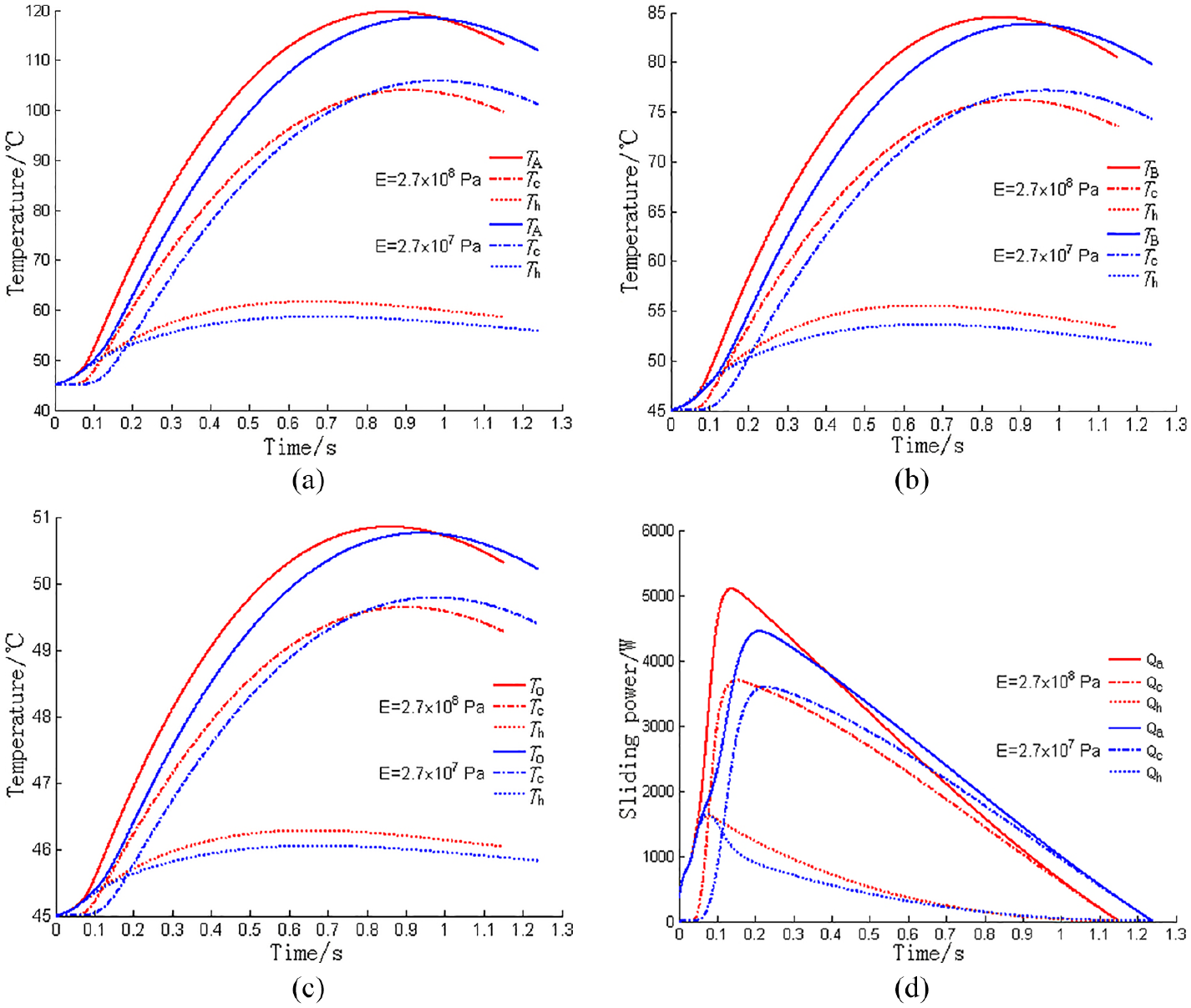
It can be seen from the simulation results in Figure 9, with an increase in the equivalent elastic modulus, the engagement time was slightly shortened. The temperature rise rate and maximum temperature of the friction pairs and ATF slightly increased, the contribution of the viscous shear heat flux increased, and the contribution of the asperity friction heat flux decreased and the response is faster.
Effect of equivalent elastic modulus on temperature.
This is because as the equivalent elastic modulus of the friction pair increases, the viscous torque and the viscous shear heat flux increase as well, which causes an increase of the sliding friction power during the wet clutch engagement, and leads to an increase of the maximum total power . At the same time, as the engagement time is shortened, the cooling time of the lubricating oil is shortened, which causes the maximum temperature of the separator plate, friction plate and lubricating oil to increase.
Effect of ATF flow
As shown in Figure 10, the change in ATF flow had a significant effect on the maximum temperature of the friction pairs and ATF in the engagement. The increase in ATF flow had a slight influence on the engagement time as well as the contribution of the heat flux of viscous shear and asperity friction to the temperature of the friction pairs. However, the increase in ATF flow resulted in a substantial decrease in the maximum temperature of the friction pairs and ATF and the decrease in the maximum temperature of the ATF is most significant.

Effect of ATF flow on temperature.
This is because with the increase in ATF flow, the surface convection heat of friction pairs and heat capacity of ATF in unit time increased significantly, resulting in an obvious decrease in the maximum temperature of the friction pairs and ATF.
Conclusions
A numerical simulation of the dynamic thermal characteristics of a wet clutch was conducted. The effects of various parameters, such as applied pressure, initial angular velocity, friction lining permeability, surface combined roughness RMS, equivalent elastic modulus, and ATF flow on the temperature rise mechanism in wet clutch engagement were studied. The numerical results led to the following conclusions.
The change in applied pressure had a significant influence on the temperature rise rate and maximum temperature of the friction pairs and ATF. With the increase in applied pressure, the contribution of viscous shear heat flux was reduced, while the contribution of the asperity friction heat flux was increased, and the temperature rise rate and maximum temperature of the friction pairs and ATF significantly increased.
The change in the initial angular velocity mainly influenced the overall temperature rise characteristics of the friction pairs and ATF. With an increase in the initial angular velocity, the contribution of the viscous shear and asperity friction heat fluxes significantly increased, and the temperature rise rate and maximum temperature of the friction pairs and ATF also increased.
The change in the friction lining permeability mainly influenced the heat generation and heat dissipation rates of the wet clutch. With the increase in the friction lining permeability, the contribution of the viscous shear heat flux was significantly reduced, the contribution of the asperity friction heat flux was increased. The influence was most significant, on the temperature rise rate of friction pairs and ATF in the squeezing fluid and boundary lubrication stage, however, minimal only on the maximum temperature of friction pairs and ATF. In addition, the temperature drop rate of the friction pairs and ATF in the asperity friction stage increased accordingly.
The change in the surface roughness RMS of friction pairs had an influence on the temperature rise rate and maximum temperature of the friction pairs and ATF. With the increase in the surface combined roughness RMS of friction pairs, the contribution of the viscous shear heat flux was substantially reduced, while that of the asperity friction heat flux slightly increased. Thus, the temperature rise rate and maximum temperature of the friction pairs and ATF, as well as the temperature of the engagement end, slightly decreased.
The change in the equivalent elastic modulus of the friction pairs had an influence on the temperature rise characteristics of the friction pairs and ATF in the boundary lubrication and asperity friction stages. With the increase in the equivalent elastic modulus of the friction pairs, the temperature rise rate and the maximum temperature of the friction pairs and ATF, as well as the temperature of the engagement end, slightly increased. The contribution of the viscous shear heat flux increased, while that of the asperity friction heat flux initially increased then decreased.
The change in ATF flow had a significant influence on the maximum temperature of the friction pairs and ATF. With the increase in ATF flow, the contribution of the viscous shear heat flux to the temperature of friction pairs remained constant; however, the maximum temperature of friction pairs and ATF substantially decreased, particularly that of the ATF, which was significant.
Footnotes
Appendix
Handling editor: James Baldwin
Declaration of conflicting interests
The author(s) declared no potential conflicts of interest with respect to the research, authorship, and/or publication of this article.
Funding
The author(s) disclosed receipt of the following financial support for the research, authorship, and/or publication of this article: Project Supported by Chongqing Research Program of Basic Research and Frontier Technology (No.cstc2017jcyjAX0143), China Postdoctoral Science Foundation (No.2020M681808) and the Postdoctoral Research Preferred Fund Project of Zhejiang Province (No.ZJ2020080).
