



Abstract
Fillers can improve the tensile performance of ductile tubes. Mechanical analyses of tensile tubes with filler have generally focused on experimental and numerical studies on concrete-filled steel tube (CFST) components, while mechanical performance of tensile tubes with flexible supporting fillers has rarely been investigated. In the current research, we have proposed a “steel tube+pre-stressed flexible internal support” structure. Meanwhile, strengthening of tensile thin-walled tubes with internal supports was studied in terms of stress and deformation. The trends of yield strength and ultimate strength of tensile tubes were determined and calculation equations of yield strength and normal ultimate strength of tensile tubes with internal support were derived. Strengthening coefficient variations as functions of radius-thickness ratios of steel tubes and elastic moduli of internal supports as well the optimized internal support p corresponding to maximum increment of tensile performance of tubes were also determined. It was experimentally verified that the initial supporting pre-stress of internal support on steel tubes could be achieved by cold shrink fitting technique. Experimental results revealed that the developed composite structure significantly enhanced the mechanical performance, fracture toughness, and energy consumption characteristics of tensile tubes. Hence, the proposed structure was confirmed to have promising applications.
Keywords
Introduction
Due to their excellent mechanical performance and good workability, thin-walled tubes with internal support (e.g. concrete-filled steel tube (CFST)) have been extensively employed in the constructions of residential buildings, long span bridges, and power transmission facilities. In practical engineering, some parts of steel tube components or component sections such as lower chord of truss bridges and the tensile sides of power transmission towers under strong wind loads may be tensile. Mechanical analyses of tensile tubes with fillers have focused on tensile tests and numerical simulations of CFST components.
International design specifications have been proposed for CFST. CFST design specifications of Japan, America, and Europe (AIJ2008; 1 AISC2005; 2 CEN2004 3 ) neglect concrete effect and equate tensile CFST components with tensile hollow steel tubes, leading to relatively conservative designs. However, experimental and theoretical studies have indicated that when steel tubes were under tensile stress, radial contraction was limited by core concrete, resulting in the generation of confining force at the interface of two materials and making steel tubes in the two-dimensional tensile condition, which improved CFST tensile bearing capacity by 10%. 4 Based on GB 50936-2014 Technical Code for Concrete Filled Steel Tubular Structures, tensile strengths of CFST components are 10% higher than those of hollow steel tubes. 5
Experimental and theoretical investigations on tensile CFST components have been performed by researchers around the world. Han et al. 6 and Li et al. 7 studied CFST component stress states under tension along axial direction and found that the presence of concrete fillers improved the tensile strength of CFST components by 11% and 14%, respectively. Also, the simplified calculation equations of tensile strength were derived. Han et al. 8 explored the time-dependent behaviors of CFST tensile members subjected to coupled long-term loading and chloride corrosion. Their findings revealed that the filling of core concrete increased ultimate tensile strength by an average of 12.3%. Chen et al.9,10 investigated the mechanical performance of CFST specimens with reinforcing bars or angles under axial central and eccentric tensile and derived calculation equations for tensile strengths of this type of CFST components. It was experimentally found that the tensile strength of CFST components was improved by 14.6% on average compared to corresponding hollow tubes. Ye et al. 11 performed experimental studies on the mechanical behaviors of tensile concrete-filled stainless-steel tube (CFSST) components and found that the effective combination of concrete filler and stainless-steel tube could increase the tensile strength of CFSST components by 5%–10% compared to corresponding hollow stainless-steel tubes. Regarding the ultimate tensile strength of concrete-filled double skin steel tube (CFDST) members, Li et al.12,13 and Tao and Yu 14 considered that the tensile strength was contributed from both outer and inner tubes, and the coefficient of the strength enhancement of outer tube was considered to be 1.1. Han et al. 15 and Xu et al. 16 conducted axial tension tests on concrete-encased CFST (CECFST) and angle-encased CFST (AECFST) components, analyzed the load transfer mechanisms of these components, and derived corresponding simplified calculation equations for tensile strength. Wang et al. 17 performed comprehensive research works on the behaviors of CFRP externally-reinforced circular CFST members under combined tension and bending, and investigated CFRP enhancement effect. Zhou et al.18,19 conducted experimental studies on the confining-strengthening, confining-stiffening, and tension-stiffening effects of axially tensile circular concrete-filled steel tube (CCFST) and squared concrete-filled steel tube (SCFST) components. They concluded that the tensile strengths of CCFST and SCFST were 10.2% and 5.2% higher than corresponding hollow tubes, respectively. Xu et al. 20 developed an analysis model for the strength and stiffness enhancement of CCFST under axial tensile loads. Their model considered the surface performance of steel tube and concrete, offered simplified design equations for strength coefficient, and revealed that tensile strength was 15.6% higher than corresponding hollow tubes.
Few studies have been reported on the tensile performance of steel tubes with flexible supporting fillers. Zhu 21 conducted axial compression experiments and tensile numerical simulations on PU-filled steel tube (PFST) components and investigated confinement effect of steel tubes on polyurethane (PU), which revealed the in-depth working mechanism of PFST composite tubes under axial loads. Hang 22 evaluated the deformation and destruction properties of PU-filled double skin steel tubes (PFDST) under axial compression, carried out numerical simulation of the PFDST member under axial tension using finite element software, and adopted finite element regression method to derive calculation equations for ultimate tensile bearing capacity of PFDST components. Gao et al. 23 performed tensile fracturing tests on 304 stainless steel thin-walled circular tube components under flexible supporting operating condition and obtained the change rules of ultimate tensile strength, elongation, and fracturing energy versus loading rate and internal support elastic modulus.
Research on CFST revealed that the tensile strengths of CFST members were higher than those of reference hollow steel tubes due to the “composite action” between outer steel tube and infilled concrete. They also derived corresponding calculation equations. Research on the calculation of tensile strength of steel tubes with fillers has focused on CFST field. Domestic and international CFST design standards stipulate the tensile strength of steel tubes.1–3,5 Some researchers4,6–20 have performed experimental, numerical, and theoretical studies on the tensile strengths of different CFSTs. There are few reports on the calculation equations of tensile strengths of steel tubes with flexible supporting materials. Using numerical method, the tensile properties of PFST and PFDST have been studied and the strengthening coefficients of ultimate tensile bearing capacity of corresponding components have been obtained using finite element regression. 21 In Zhu and Hang,21,22 the enhancement of tensile strength of steel tubes was mainly due to the bonding effect between steel tubes and PU filler. Most of these calculation equations are empirical equations derived from tensile experiments or numerical simulations of specific components, most of which rely on different deformation versions of enhancement factor 1.1 and superposition equations of the strength of different components, lacking deep study in theoretical level. Table A1 in the Appendix 2 summarizes the calculation equations of the tensile strengths of different steel tubes with fillers.
In the current research, stress states of steel tubes and internal supports were theoretically studied. The stress and deformation increments of thin-walled tensile tubes with internal support were coupled and the changing trajectory of yield strength and ultimate strength of tensile tubes was given. The calculation equation of yield and normal ultimate strengths of composite structures was derived, and the changing rule of strengthening coefficient with radius-thickness ratio of steel tubes and elastic modulus of internal support was summarized. The optimized internal support p corresponding to maximum increment of tensile performance was obtained, and applicability of cold shrink fitting technique to realize initial supporting pre-stress of internal support on steel tubes was further evaluated and its feasibility was experimentally verified. Experiments demonstrated that the developed composite structure considerably improved the mechanical performance, fracture toughness, and energy consumption properties of tensile tubes. Therefore, the developed structure was considered to have promising applications.
Stress analysis of tube wall
Basic hypotheses
This article follows the following basic hypotheses in the derivation process:
The yield condition of the steel tube meets the Mises yield criterion.
There was no bonding between the outer surface of the internal support and the inner wall of the thin-walled tube, so the friction shear stress between the internal support and the thin-walled tube was not considered.
The thin-walled tube material satisfied the isotropic linear hardening theory and the single curve hypothesis.
During the stretching process, the thin-walled tube undergone elastoplastic deformation, while the internal support material only undergone elastic deformation.
Mises yield criterion
When a material is under certain stress conditions, it yields and this condition is called yield condition, which is generally represented by yield function. Mises yield condition is one of the most commonly applied yield conditions and its physical significance is that when the distortion energy corresponded to the stress condition of a certain point within an object reaches a certain value C, the material yields at this spot. At yield state, second invariant of deviatoric stress of tensile hollow tube

Mises yield condition can be applied to describe the yield behaviors of metallic materials with good ductility. When material constant is standardized according to uniaxial elongation experiments of thin-walled circular tubes, one would have:

In principal stress space, Mises yield surface is expressed as a cylindrical surface along the direction of hydrostatic compressive axis (as shown in Figure 1(a)). The intersecting line of this yield surface and


Mises yield surface (a) and its intersection line with
From Figure 1(b): When the tube wall material in the bidirectional tension state reaches the initial yield, with the increase of
Stress analysis of tube wall at yield state
Under the action of axial tension, the steel tube would shrink laterally. Due to the supporting effect of the concrete, the lateral necking of the steel tube was restricted. The steel tube wall was in a three-way stress state, namely: longitudinal tension, circumferential tension, and radial compression. The Poisson effect of tensile thin-walled structures with filler (e.g. CFST) results in the generation of inward contraction, and fillers can provide thin-walled structures with different support levels. Figure 2 shows the typical stress state of tensile thin-walled structures with fillers.

Typical stress state of tensile thin-walled structures with filler. 18
Outer surface of tube wall
The outer surface of tube wall is under plane stress with zero radial stress; that is,
Since walls are relatively thin, wall thickness t is a small value compared to internal radius r of circular tubes. By neglecting the gradient of

which is the same as that calculated with the Laplace equation for thin-walled tubes under pressure.

Equilibrium state of the force in the cross section of steel tube.
By substituting axial stress

Defining radius-thickness ratio as

Using

The yield trajectory of outer surface of tube walls.
Inner surface of tube wall
The inner surface of tube wall is under stress state along three directions. The three principal stresses include axial stress
With inner surface of tube walls at yield state:

Equation (7) can be rearranged as:

Using

The yield trajectory of inner surface of tube walls.
Figure 6 shows the comparison and analysis of inner and outer surfaces of tube wall. At constant value of

The comparison of the yield trajectories of inner and outer surfaces of tube walls.
Stress analysis of tube wall at extreme state
According to the isotropic hardening theory,
24
the shape and center position of loading surface remain constant and only the size is changed, indicating the expansion with similar shapes in the stress space. Isotropic hardening under complex stress states is shown in Figure 7. Isotropic characteristics are maintained after material hardening and the anisotropy induced by plastic deformation is neglected. Based on isotropic hardening theory, it could be concluded that the expression of
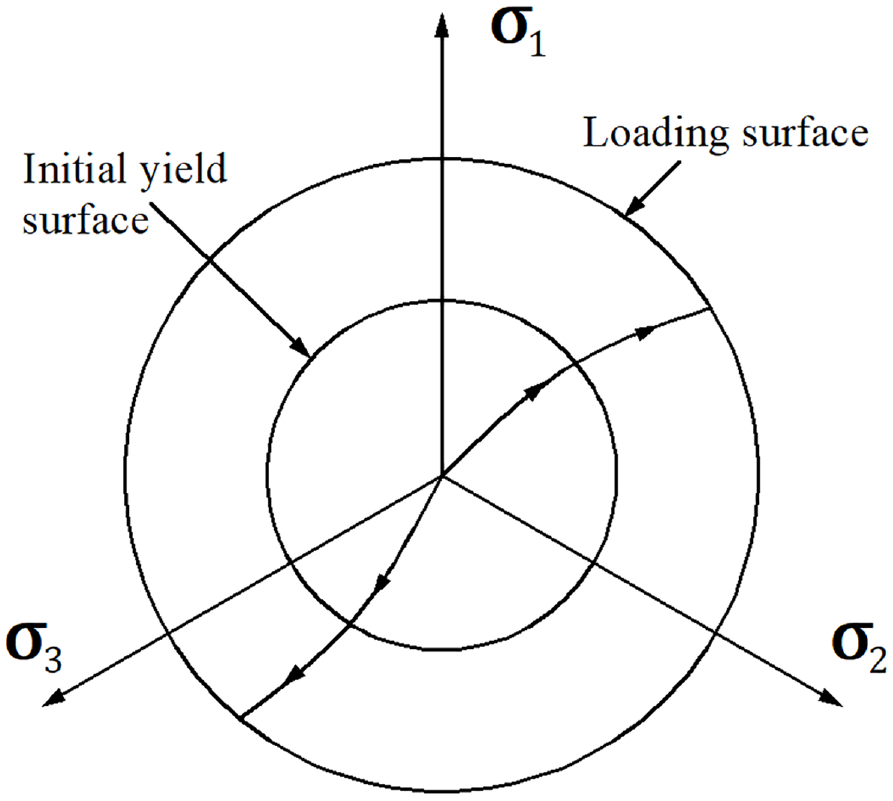
Isotropic hardening under complex stress state.
Based on isotropic hardening theory and single curve assumption,
24
the corresponding

Equation (9) could be rearranged as:

The case of biaxial tension (first quadrant) and the independent stresses along two directions were considered. Derivation of equation (10) is taken on
The stress state analyses of inner and outer surfaces of tube walls under extreme state are similar to corresponding analyses under yield state, which is not further elaborated.
Deformations analysis of tube wall
Cross-section area of tensile hollow tube wall at elastic stage
According to the generalized Hooke law, the strain state of thin-walled circular tubes at elastic stage under axial tensile loads could be stated as:

When hollow tube is uniaxially stretched, axial tensile stress is
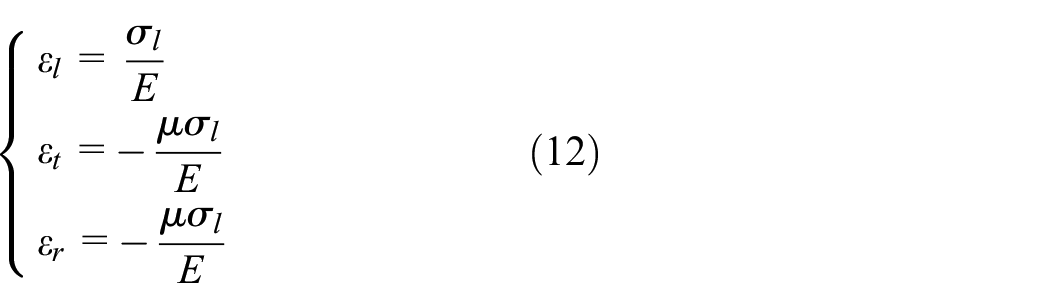
For tensile hollow tubes, the ratio of the cross-section area of tube wall

Cross-section area of tube walls with internal supports at elastic stage
Regarding steel tubes with internal supports, the stress states of inner and outer surfaces are different such that outer surface is under biaxial tensile stress (
Deformations of outer surface of tube walls
Substitution of
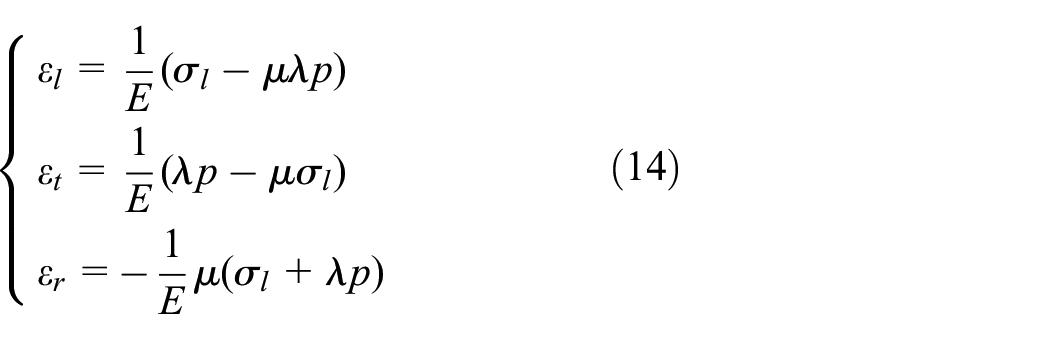
At elastic stage, the ratio of the cross-section area of tube wall with internal support (
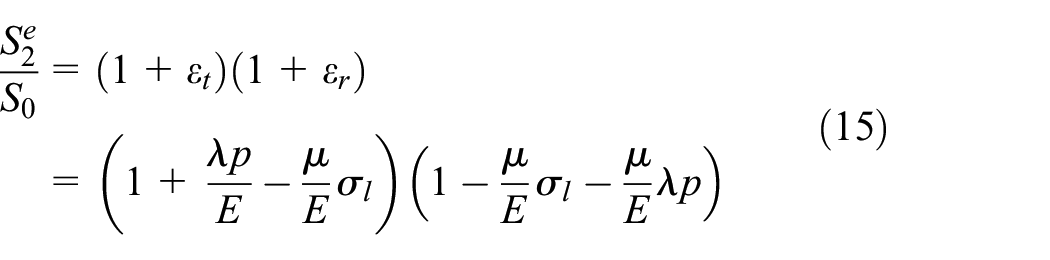
According to equations (13) and (15),

At elastic stage, the Poisson’s ratio of steel tubes

When the outer surface of tube wall reaches yield state,

As can be seen in Table A2 in the Appendix 2,

Increment of cross-section areas of inner and outer surfaces of tube walls with internal support at elastic stage: (a)
Deformations of inner surface of tube walls
Substitution of

At elastic stage, the ratio of cross-section area of tube wall with internal support

Based on equations (13) and (20),

At elastic stage, Poisson’s ratio of steel tube
Substitution of

When the inner surface of tube walls reach yield state,

Different materials have various
As given in Table A3 in the Appendix 2,
Cross-section areas of tube walls with internal supports at strengthening stage
When Mises material reaches strengthening stage, its strain is divided into elastic and plastic strains. For elastic strain part, Poisson’s ratio of tube

When Mises material enter strengthening deformation stage, for which the stress-strain curves conform to “bilinear isotropic hardening” model (Figure 9), the following relationship is obtained for


and

Based on equations (24)–(26), the ratio of the cross-section area of outer surface of tube wall to that of tensile hollow tube wall at extreme state is obtained as:

Based on equations (24), (25) and (27), the ratio of the cross-section area of inner surface of tube wall to that of tensile hollow tube wall at extreme state is obtained as:


Bilinear isotropic hardening model.
Coupling of stress and deformation analyses
As discussed in Section 3.2, the change of stress state significantly improves the carrying capacity of steel tubes.
As discussed in Section 3.3, the relative increase of cross-section area can decrease real stress. For commonly applied steel types, elastic strain part is about millesimal order. As can be seen from Figure 8, for elastic strain parts with millesimal order, the increment of tube wall cross-section area is only 0.07%. Since
When coupling effect of stress and deformation analyses is considered, relative increment of cross-section area can be neglected and only the stress improvement brought by stress state change is taken into account. Based on equations (6) and (8) and Figure 6, under yield and extreme states, optimized support p and maximum stress increment of tube walls with different radius-thickness ratios are summarized in Table 1.
Optimized support p and maximum stress increment of tube wall at yield and extreme states.

Calculation equations of the strengths of steel tubes with flexible internal supports
Calculation equations of yield strength
With flexible supporting materials, the typical stress states of the inner surfaces of tensile steel tubes and internal supports are shown in Figure 10. The friction shear stresses of the inner surfaces of tube walls
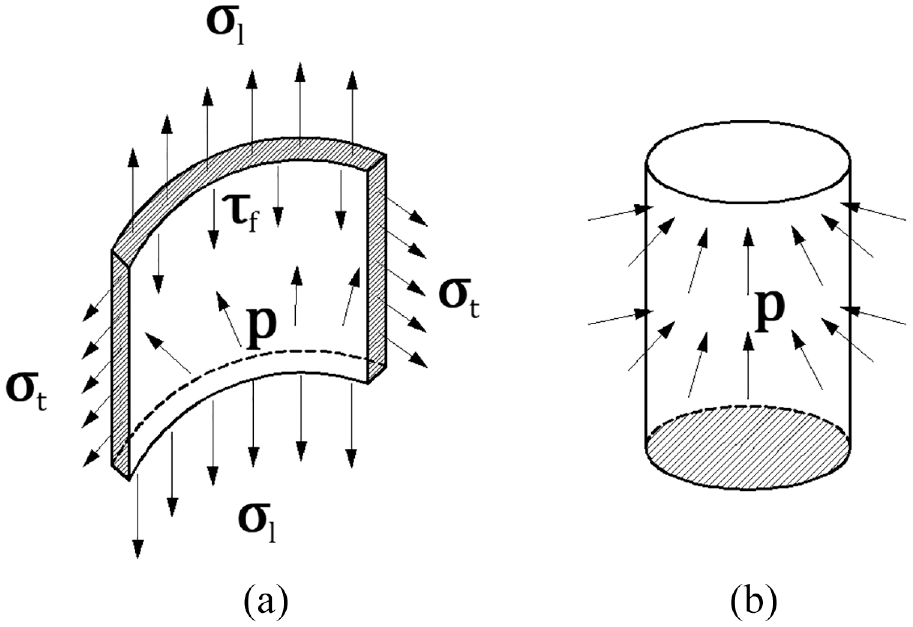
(a) Stress state of steel tubes and (b) stress state of internal support.
According to the generalized Hooke law,


Since steel tubes and internal supports satisfy the force balance and compatibility of deformation, one can consider that:

For steel tubes,

and for internal support,

Substitution of equations (30) and (31) into equation (32) gives:

Considering equations (33) and (34), p in equation (35) is eliminated to give:

Define

Substitution of

Yield strength of steel tubes with fillers can be calculated by substituting equations (36) and (37) into equation (38):

Taking

Changing trajectories of strengthening coefficient with
Calculation equations of normal ultimate strength
At strengthening stage, the Poisson’s ratio of steel
Assume that during steel tube tensile, radius-thickness ratio (

The deviators of stress are:

According to equation (41), the second invariant of deviatoric stress

By defining plastic scale factor as

and from Chen, 24

Substitution of equation (44) into equation (43) gives:

and substitution of equations (40)–(42) into equation (45):

Assuming that inner flexible supporting materials are always at elastic stage, one could conclude
Similar to the process of obtaining the

Based on deformation compatibility relation between inner surfaces of tube wall and outer surface of internal support, equations (46) and (47) are combined to give:

Equation (48) gives the relationship between
Based on the above three assumptions, tensile stress corresponding to the longitudinal tensile strain of the steel tube reaching 5000
When the longitudinal tensile strain of steel tubes reaches 5000

Define

Substitution of

The normal ultimate strength of steel tubes with fillers can be obtained by substituting equations (49) and (50) into equation (51) as:

Discussion
Optimization of p
Based on equation (36), the relation of internal support pressure at elastic stage (p) and elastic modulus of internal support (

Steel tubes are stretched to initial yield point. Steel tubes gain higher internal support pressure p at higher values of elastic modulus of internal support

where the Poisson’s ratio of steel tubes
As can be seen from Table 1, optimized p of steel tube at yield state

Function

If
It is worth noting by the researchers that how to realize the optimized p to reach the largest enhancement of yield strength. Herein, we have proposed two solutions (micro-expansion concrete and cold shrink fitting technique) to achieve optimized pre-stress of internal supports.
Adding micro-expansion concrete into steel tubes is extensively applied in engineering.27–29 Lots of experimental studies have been conducted on the deformation ability of micro-expansion concrete and the bonding properties of steel-concrete interface.30–33 However, micro-expansion concrete needs long maintenance times. Therefore, we used cold shrink fitting technique as an example to realize pre-stressed internal support of steel tubes.
Experiments demonstrated that low-temperature cooling could lead to the contraction of polymers, including nylon, polytetrafluoroethylene (PTFE), polyurethane (PU), and acrylonitrile butadiene styrene (ABS) plastic. Then, the cooled internal support material is inserted into the steel tube. When the internal support material returns to room temperature, initial supporting prestress is produced on steel tubes by internal support.
According to generalized Hooke law,

At yield state, the supporting pressure generated by internal supporting material on steel tube is optimized support

According to Table 1,

The optimized elastic modulus of internal support

where
Exploratory experiment
Figure 12(a) shows the dimensions of the 304 stainless steel thin-walled circular tube standard components prepared according to ISO6892-1 Metallic materials-Tensile testing and Figure 12(b) shows hollow tube component. Also, the component with PTFE filler is presented in Figure 12(c). The measured parameters of 304 stainless steel thin-walled circular tubes are: original gauge length

(a) Size of 304 stainless steel thin-walled circular tube standard components, (b) tensile hollow tube components, and (c) tensile components with PTFE filler.
Loading equipment was Shenzhen Wance 100-ton HUT106D microcomputer-controlled electrohydraulic servo universal testing machine (located at the Army Engineering University of PLA in Nanjing, China) with axial tensile speed of 15 mm/min. 23 Under each working condition, four effective components were stretched and the macroscopic features of components after break are presented in Figure 13. Also, tensile load-displacement curve of components under different working conditions are shown in Figure 14. Specimen datas under different working conditions are compared in Table 2.

Macroscopic feature of components after break.

Tensile load-displacement curve of components under different working conditions.
Comparison and analysis of components under different conditions.

AVG: average; STD: standard deviation; INC: increment.
As given in Table 2, the supporting effect of pre-stressed flexible filler retards the transverse necking of tensile circular tubes toward symmetry axis, significantly enhancing the mechanical performance, fracture toughness, and energy consumption of measured tensile components. The average increments of yield force, ultimate bearing capacity, elongation at break, and fracturing energy of steel tubes are 10.81%, 15.35%, 19.33%, and 47.38%, respectively. Great increase of mechanical performance of tensile tubes confirms the effectiveness and feasibility of the proposed cold shrink fitting technique.
Applications and prospects
Research on tubes with internal support has generally focused on the mechanical performance of tensile CFST, while the effects of flexible supporting materials on the mechanical performances of tubes have rarely been studied. In the current research, we have proposed the “steel tubes+pre-stressed flexible internal support” structure with high toughness, convenience, light weight, and low price which significantly improved the mechanical performance and fracture toughness of tensile tubes, making it very suitable for the fabrication of steel tube composite structures.
Pre-stressed flexible internal supports and thin-walled tensile tubes can form highly efficient composite structures and the elastic modulus of internal support is applicable to a wide range. Compared with bulky CFSTs, lightweight flexible internal supports have evident advantages of lower weight and higher convenience in construction. This study provides new technological path for improving the comprehensive mechanical performance of steel tube composite structures, which is of vital importance in improving structure design security.
As previously mentioned, improvement of the mechanical performance of tensile steel tubes by flexible internal supports is illustrated from theoretical and experimental points of view. However, the following issues need further attention by researchers:
In real scale engineering components, by finding cheap internal support materials with suitable elastic modulus, the manufacturing cost and structure weight can be further decreased to realize the structural industrialization, which is the noteworthy direction.
This study suggests that the prestress of flexible internal supports on steel tubes can be realized by cold shrink fitting technique. Quantitative relationship between the cold contraction and temperature of different internal supports needs to be further defined.
In our experiments, only one specification of 304 stainless steel tube was experimentally studied and the effects of material properties of tubes and length-to-radius ratio of components on internal supports were not taken into account. Further studies are required on components with different materials, section forms, and sizes.
This study has focused on the influence of internal support on the tensile mechanical performance of tubes, while the improvement of mechanical performance of tubes under compression, bending, torsion, local buckling, and more complex stress conditions needs to be further investigated.
Conclusions
In the current research, the following conclusions were drawn:
Strengthening of tensile tube relies on the coupling of stress and deformation. In fact, change of stress state is the main factor in the improvement of yield and ultimate tensile strengths, while the enhancement due to deformation is negligible. The theoretical yield strength of the tube with internal support is 15.5% higher than that of hollow tube.
The calculation equations of yield and normal ultimate strengths of tensile tubes with internal supports were theoretically deduced. The trends of strengthening coefficient as a function of
Yield and extreme states are distinguished and optimized internal support p values corresponding to the tensile performance of tubes at yield and extreme states were deduced. This study proves the application of flexible internal supports with cold shrink fitting technique to realize the initial supporting pre-stress of internal supports on steel tubes, and experimentally verifies the effectiveness and feasibility of this method.
A “steel tubes+pre-stressed flexible internal support” structure is proposed. This structure significantly improves the mechanical performance, fracture toughness, and energy consumption properties of tensile tubes. In addition, it is easy to assemble and its weight and cost are low, which is very suitable for the fabricated steel tube composite structures with the characteristics of high toughness, convenience, light weight, and economy, making it a great candidate for many applications.
Footnotes
Appendix 1
Appendix 2

|
|
Expression of |
|
|
|---|---|---|---|
| 0.001 | , | 1.0007 | |
| 0.002 | , | 1.0014 | |
| 0.005 | , | 1.0035 | |
| 0.01 | , | 1.007 |
Handling editor: James Baldwin
Author contributions
Conceptualization, YG and FS; methodology, YG and FS; software, QX and PF; validation, QX and PF; formal analysis, LG and LB; investigation, LG and LB; resources, XY and HZ; data curation, YG and FS; writing – original draft preparation, YG and FS; writing – review and editing, YG and FS; visualization, QX and PF; supervision, LG and LB; project administration, XY and HZ; funding acquisition, YG and FS. All authors have read and agreed to the published version of the manuscript.
Data availability
The data presented in this study are available on request from the corresponding author.
Declaration of conflicting interests
The author(s) declared no potential conflicts of interest with respect to the research, authorship, and/or publication of this article.
Funding
The author(s) disclosed receipt of the following financial support for the research, authorship, and/or publication of this article: This research was funded by the National Natural Science Foundation of China, 51979280. Thanks for the MJEditor( ) for its linguistic assistance during the preparation of this manuscript.