



Abstract
To improve the accuracy of fault diagnosis of bearing, the improved particle swarm optimization variational mode decomposition (VMD) and support vector machine (SVM) models are proposed. Aiming at the convergence effect of particle swarm optimization (PSO), dynamic inertia weight, and gradient information are introduced to improve PSO (IPSO). IPSO is used to optimize the optimal number of VMD modal components and the penalty factor, which is applied to the vibration signal decomposition. The fault sample set is constructed by calculating the multi-scale information entropy of each component signal obtained from the bearing vibration signals. At the same time, IPSO is used to optimize the support vector machine (IPSO-SVM), which is used to bearing fault diagnosis. The time-domain feature data set is used as the comparison data set, and the classical PSO, genetic algorithm, and cross-validation method are used as the comparison algorithm to verify the effectiveness of the method in this paper. The research results show that the optimized VMD can effectively decompose the vibration signal and can effectively highlight the fault characteristics. IPSO can increase the accuracy by 2% without adding additional costs. And the accuracy, volatility, and convergence error of IPSO are better than comparison algorithms.
Introduction
The rotor system in large rotating machinery such as aero-engine is the power source of the entire machinery, and its supporting points are very prone to failure when working under alternating load conditions all year round. Especially for thermal rotating machinery such as aero-engine, the supporting point bearings have become the focus of research by many scholars at home and abroad due to the working conditions, installation positions, and the large dispersion of their own life. 1
The performance state of the bearing determines whether the rotor system can operate stably, and the traditional oil analysis method as one of the means of detecting the performance state of the industrial bearing, its technical means have gradually matured. 2 However, because the results of the oil analysis method are affected by the bearing failure status, inspectors, etc., and cannot detect early bearing failures, Mingfu et al. 3 conducted research based on rotor dynamics and found that the vibration characteristics of the machinery can reflect the performance of the machinery status. Subsequently, vibration signal analysis is gradually applied to the field of bearing fault diagnosis. Many scholars collect vibration signals from the laboratory simulation platform, and combine them with spectrum analysis, 4 wavelet transformation, 5 time-frequency domain characteristics, 6 machine learning,6,7 and other algorithms to study fault vibration signals, and achieved rich results. However, due to the location of the bearings of rotating machinery such as aero-engine, the vibration sensor cannot be directly installed on the bearing seat. Therefore, the vibration signal collected by the sensor installed on the casing has obvious coupling, especially in the early failure of the bearing is more likely to be overwhelmed by noise.
For the above situation, algorithms such as empirical mode decomposition (EMD),8,9 blind source decomposition, 10 local mean value (LMV) 11 have been applied to the analysis of bearing fault vibration signals, and have achieved fruitful results with the efforts of many scholars.8–11 EMD has problems such as lack of strict mathematical theory foundation, end effect, modal aliasing, over-envelope, etc. 12 LMV cannot avoid the problem of the false component signal. 13 Because of the problems existing in the above algorithm, Dragomiretskiy and Zosso 14 proposed a non-recursive Variational Mode Decomposition (VMD) method with strict mathematical proof in 2014. This method can accurately decompose signals, and has the advantages of low modal aliasing and high computational efficiency, so it has been widely used. Because the decomposition accuracy of VMD is affected by the number of component signal and penalty parameters, many scholars have proposed to use some optimization algorithm to optimize VMD, such as genetic algorithm, 15 wolf pack algorithm, 16 grasshopper optimization algorithm, 17 and so on. However, these optimization algorithms also have their shortcomings. For example, genetic algorithms have a large number of calculations and are easy to block local extreme values. 2 And, after the analysis of vibration signals by the optimized VMD, it is necessary to perform spectrum analysis on the component signal to identify the fault category, which is particularly cumbersome. 18
Based on the above reasons, this paper proposes an improved particle swarm optimization algorithm to optimize the diagnosis model of VMD and SVM. Considering that the particle swarm optimization algorithm is easy to fall into the local extreme value, which leads to the phenomenon of convergence effect, 19 the dynamic inertia weight, and gradient information are introduced to improve the particle swarm optimization algorithm. Due to component failure occurs, its vibration signal has a shock vibration characteristic, which leads to a sparse characteristic of the vibration signal, and its information entropy can reflect this characteristic. Therefore, information entropy of VMD component signal as the fitness function, and improved particle swarm optimization algorithm is used to optimize the number of modal component signal and penalty parameter of VMD. The vibration signal is decomposed by optimized VMD, and the multi-scale entropy of each component is calculated to construct the fault sample data set. And the fault sample is diagnosed by the improved particle swarm optimized SVM.
In the model proposed in this paper, the improved particle swarm optimization algorithm is fully used to optimize VMD and SVM, which can effectively improve the accuracy of VMD’s decomposition of vibration signals and the classification accuracy of the SVM model for fault samples. At the same time, the multi-scale entropy, which can highlight the characteristics of vibration faults more than the time-frequency domain characteristic parameters, is used to construct the input data set of the IPSO-SVM model, which further increase the identification of the fault from the data source itself. Therefore, the method proposed in this paper can achieve more than 98% accuracy. The IPSO can obtain a better optimization effect than the PSO without adding additional time-consuming.
The rest of this paper is organized as follows: Section II introduces the theory of VMD and optimized VMD, and optimized VMD verification test. Section III introduces the theory of SVM. Section IV introduces the theory of improved particle swarm optimization algorithm and optimized support vector machine. Section V contains the bearing fault diagnosis process, bearing experiment, and diagnosis analysis results. Section VI concludes the proposed diagnosis method in this paper.
Optimized VMD
When rotating machinery is running, the signals collected by vibration sensors are mostly coupling signals due to the influence of other components. And the vibration characteristics of early weak faults of rotating machinery are more likely to be submerged in noise signals so that it is difficult to analyze mechanical fault characteristics through vibration signals. The variational modal algorithm proposed by Dragomiretskiy and Zosso 14 in 2014 year can effectively decompose multi-coupled signals, which helps identify vibration characteristics of weak faults.
What is a VMD?
The goal of VMD is to decompose a real-valued input signal x(t) into a discrete number of sub-signals (modes) uk, essentially based on the three concepts of Wiener Filtering, Hilbert Transform and Analytic Signal, Frequency Mixing and Heterodyne Demodulation. 14 Since VMD has carried out a detailed analysis and description in Literature, 14 this paper will not repeat it, but only describes the implementation process of VMD.
The goal of VMD is to decompose a real-valued input signal x(t) into a discrete number of sub-signals (modes) uk, essentially based on the three concepts of Wiener Filtering, Hilbert Transform and Analytic Signal, Frequency Mixing and Heterodyne Demodulation. 14 Since VMD has carried out a detailed analysis and description in Literature, 14 this paper will not repeat it, but only describes the implementation process of VMD. And the alternate direction method of multipliers (ADMM) is used to alternately update the modal component uk, the center frequency ωk, and the Lagrangian multipliers λ(t) to calculate the saddle point of the Lagrangian function. The process is described as follows:


Optimized VMD
Since the number k of modal components signal uk and the value of the quadratic penalty factor è have a greater impact on the result of VMD decomposition, PSO is used to optimize VMD. Considering that the particle swarm optimization algorithm is easy to fall into the local extreme value, which leads to the phenomenon of convergence effect, 19 the dynamic inertia weight and gradient information are introduced to improve the particle swarm optimization algorithm. This section describes optimized VMD by Improved PSO, while the improved PSO is described in section IV in this paper.
When the bearing is faulty, there will be periodic shock waves in the vibration signal, which makes the signal show strong sparse characteristics. When the vibration signal contains more noise signals, the periodic shock characteristics in the vibration signal are not obvious, which makes the vibration signal less sparse. When the sparsity of the vibration signal is strong, the envelope entropy value is small. When the sparsity of the vibration signal is weak, the envelope entropy value is larger. 15 The envelope entropy value of each component uk obtained by VMD is used as the fitness function (equation (4)) of IPSO optimized VMD.

Where a(j) represents the envelope signal of x(j) after Hilbert Transform. 20
The optimized VMD by IPSO is briefly described as follows: the individual with the smallest envelope entropy in the population found in the first iteration, as well as the modal component uk, the number of components k, and the quadratic penalty factor è corresponding to the individual are regarded as the optimal global optimal solution. In each subsequent iteration, the minimum envelope entropy value obtained this time is compared with the global minimum envelope entropy value. If the current envelope entropy value is smaller than the global envelope entropy value, the individual with the smallest envelope entropy in the population found in this time, as well as the modal component uk, the number of components k, and the quadratic penalty factor è are regarded as the optimal global optimal solution. Otherwise, the next iteration is executed until the algorithm termination condition is met. When the algorithm satisfies the termination condition, the global optimal solution is used as the optimal parameters of VMD, to realize the optimization of VMD.
Algorithm verification
The simulation signal is used to verify the effect of optimized VMD by the IPSO. In the simulation process, the sampling frequency of the vibration signal is 1024 Hz, and the sampling time lasts 1 s. The simulation signal is obtained by the following formula:

The simulation signal x(t) and the components of signal x(t) are shown in Figure 1. The optimized VMD by IPSO is used to decompose the signal x(t), and the minimum envelope entropy value of decomposed signal changes with the number of iteration steps as shown in Figure 2. The global minimum envelope entropy value is 0.14218, (k, è) = (3, 1782), so that the number k of modal components uk in VMD is set to 3, and the quadratic penalty factor è is set to 1782, the vibration signal decomposition result is shown in Figure 3. By comparing Figures 1 and 3, it is found that the VMD decomposition signals are consistent with the components that constitute the x(t) signal, but the component signals obtained by the VMD decomposition have a slight phase shift phenomenon. The result of spectrum analysis of VMD decomposition component signals is shown in Figure 4. It can be seen from Figure 4 that the VMD decomposition components can more accurately find the characteristic frequency multiplication of each component in the signal x(t).
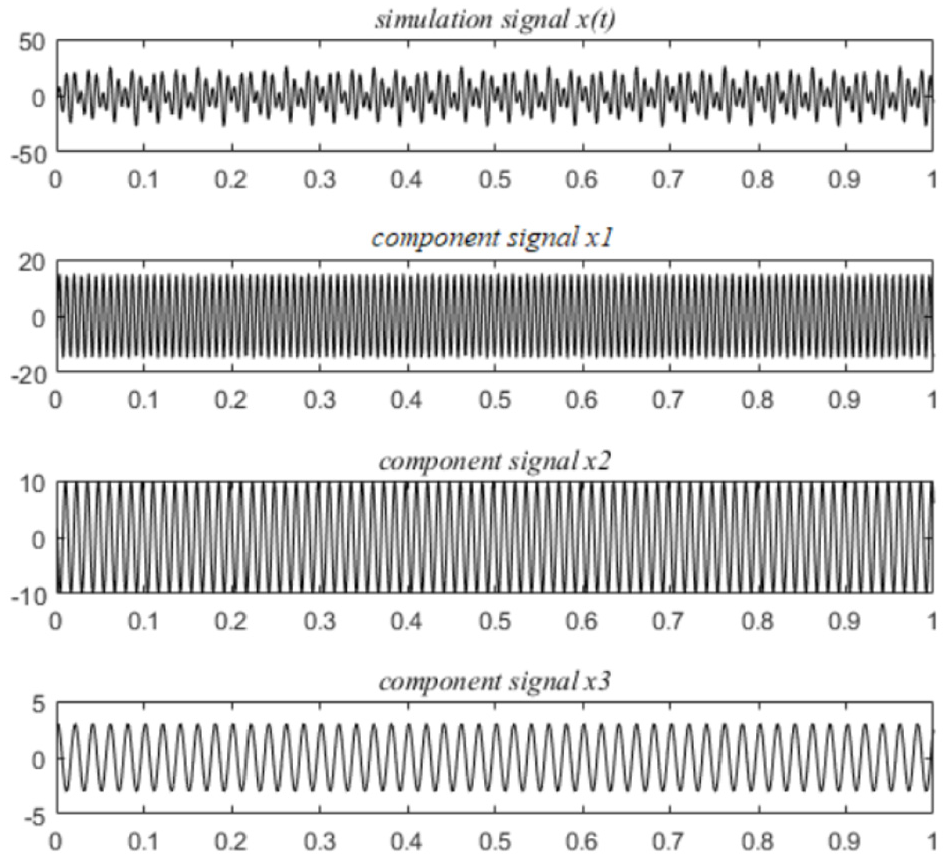
Simulation signal x(t) and its component signals.

Minimum envelope entropy value change curve.

VMD decomposition results of signal x(t).
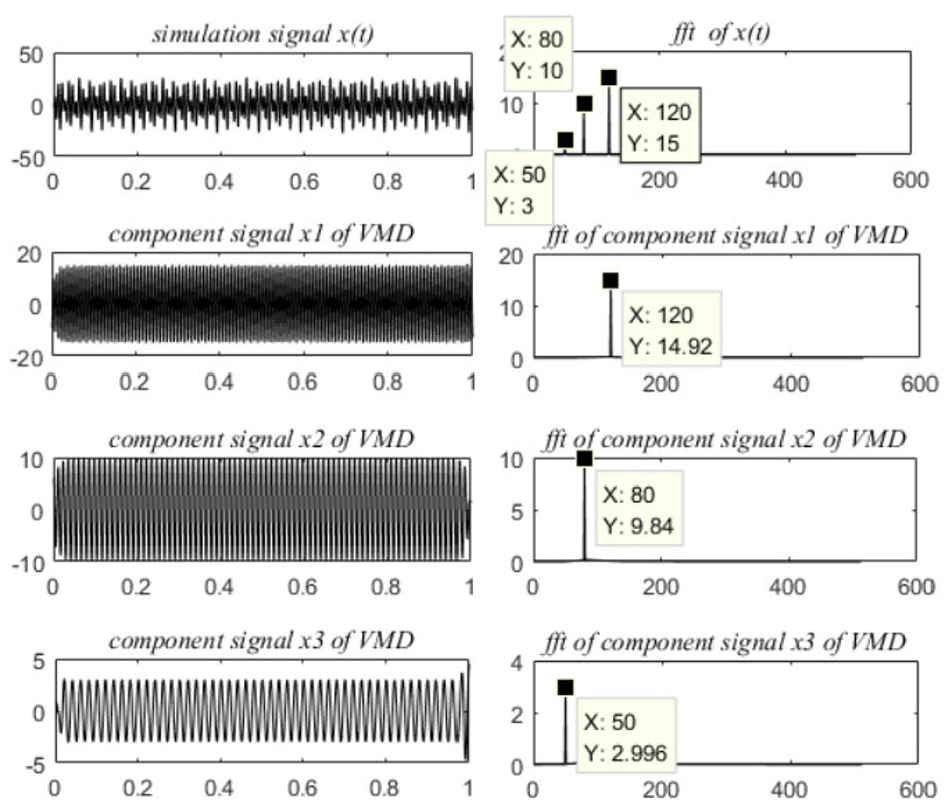
Spectrum analysis of VMD component signals.
Support vector machine
To accurately identify the bearing fault from the coupled signal requires not only the effective separation of vibration sources of vibration signals but also a recognition algorithm that can capture fault characteristic information. Support Vector Machine (SVM) can transform low-dimensional linearly inseparable problems into linearly separable problems by mapping them to higher-dimensional Spaces. 21 In addition, SVM is widely used in all kinds of fault diagnosis because of its simplicity and high efficiency. 22 Since SVM is relatively mature and has been described in detail in the literature, 21 it will not be discussed in this paper.
The penalty parameter c and the kernel parameter g of SVM are the key issues that determine whether the SVM can effectively classify the fault samples. The common solution to this problem is to use random generation, cross-validation, or optimization algorithm to optimize parameters c and g. Literature 21 shows that these methods have their shortcomings. Therefore, in this paper, the improved particle swarm algorithm optimization is used to optimize SVM, and the optimized SVM is used for bearing fault diagnosis.
Optimized SVM by IPSO
Particle Swarm Optimization (PSO) is an intelligent optimization algorithm obtained by studying the predation behavior of birds. The basic theory of PSO has been described in detail in the literature, 23 so the basic principle is not introduced in this paper. The PSO is easy to fall into the local extreme value, which leads to the phenomenon of convergence effect. 19 And its inertial behavior easily affects the search movement state, which easily reducing its search accuracy. So, Improved Particle Swarm Optimization (IPSO) is proposed in this paper.
What is an IPSO?
When the number of iterations is small, the global search capability should be improved. When the number of iterations is large, the local search capability should be improved. For this reason, we introduce the dynamic inertia weight ω, which dynamically changes the spatial searching ability of particles. Its calculation method is shown in equation (6).

Where ωmax, ωmin represent the maximum and minimum inertia weights respectively, step represents the current iteration number of the particle, maxStep represents the maximum number of iterations of the particle.
To accelerate the movement of the particles toward the optimal target, we introduce gradient information 24 to solve this problem.
Firstly, the fitness function fitness(

Where f(
Secondly, it is assumed that all partial derivatives of fitness(

When the variables in the target are linear, equation (8) can be expressed as equation (9).

Suppose the individual vector of the population P is expressed as


Where x(k|t+1), x(k|t) respectively represent the position of the k-th variable in the individual at time t + 1 and time t, v(t) represents the velocity of the particle at time t.
In this way, the particle can search along with the optimal target.
Optimized SVM by IPSO
The flow chart of Optimized SVM by IPSO is shown on the right of Figure 5, which consists of the IPSO optimization part and the SVM network part. The error of SVM network diagnostic validation set samples is taken as the fitness function (equation (7)) of IPSO optimization of SVM. And the penalty parameter c and kernel parameter g that minimize the validation set error are found through continuous iteration of IPSO, to realize the optimization of SVM. The steps of the IPSO-SVM network algorithm are described as follows:

Bearing fault diagnosis process based on IPSO optimized VMD and SVM models.
Bearing fault diagnosis base on optimized VMD and SVM
Bearing fault diagnosis process
The bearing fault diagnosis process based on IPSO optimized VMD and SVM models are shown in Figure 5. The process is mainly composed of three parts, including IPSO (middle), optimized VMD by IPSO (left), and optimized SVM by IPSO (right).
The process is briefly described as follows: Firstly, the vibration signals of bearing faults under different working conditions are collected through the laboratory bearing fault simulation platform. Secondly, IPSO is used to optimize the modal number and penalty parameters of VMD. Thirdly the optimized VMD is used to decompose the vibration signal under different working conditions, and the multi-scale entropy of each component is calculated to construct the fault characteristic sample data. IPSO is used to optimize SVM, and the optimized SVM is used for bearing fault diagnosis.
Bearing experiment
The bearing experimental platform is shown in Figure 6. The bearing vibration signal data under different working conditions are collected from the platform to verify the effectiveness of the optimized VMD and SVM models based on IPSO.

Bearing experiment platform.
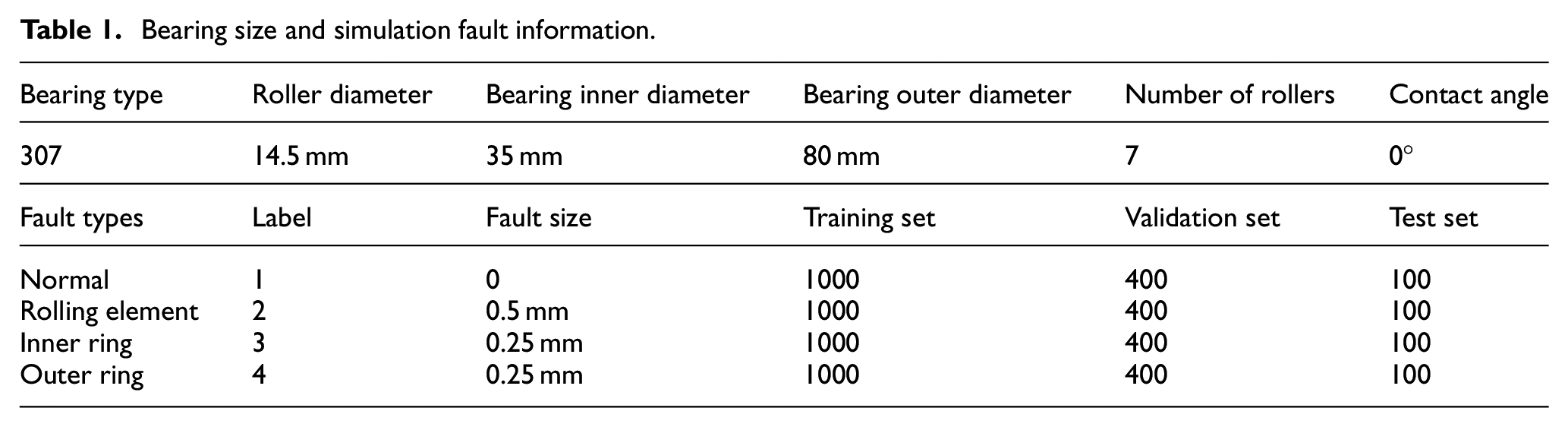
In the experiment, the rotor speed is 988 rpm; and each cycle sensor samples 1024 points; and each experiment collects 16 cycles. In the experiment, four types of bearing faults vibration signal are simulated, including normal, inner ring fault, outer ring fault, and rolling element fault. The bearing size and simulation fault information used in the experiment are shown in Table 1. And the time domain signals of the four-fault types are shown in Figure 7.
Bearing size and simulation fault information.

Time domain signal under different working conditions.
Data set preparation
The VMD method optimized by IPSO is used to decompose the vibration signal. The vibration signal components of VMD and its spectrum diagrams under different working conditions are shown in Figure 8. As can be seen from Figure 8, the modal spectrum diagrams of each component under each working condition do not overlap obviously, and each component has different central frequency bands, which shows that the VMD optimized by IPSO can effectively decompose the vibration signal of the different working condition.

Vibration signal decomposition results based on optimized VMD method.
Although the optimized VMD can effectively decompose the vibration signal, for identifying the bearing fault characteristic frequency, it is necessary to calculate its inherent characteristic frequency according to the size of the bearing, and then identify the bearing fault through the frequency spectrum. 1 The above method is not universal because the bearing fault characteristic frequency changes due to changes in bearing size. Therefore, the characteristic data set is constructed by calculating the multi-scale entropy (MSE) of each component. Based on the research conclusion in literature, 25 when calculating MSE in this paper, the embedding dimension is 6 and the value of a multi-scale factor is 12, so the characteristic matrix of 4× (12 × 6) can be obtained. In the data set, the normal condition label is 1, the outer ring fault label is 2, the rolling element fault label is 3, and the inner ring fault label is 4. The ratio of training set samples, validation set samples, and test set samples are 3:1:2.
To avoid errors caused by order of magnitude and dimension problems between characteristic parameters to diagnosis results, the samples are normalized according to equation (11).

Where xmax, xmin respectively represent the maximum and minimum values of a certain characteristic parameter. xi represents the i-th value of a certain type of characteristic parameter. x represents the normalized value.
The time-domain characteristic parameters 2 set is used as the comparison data set of VMD multi-scale entropy, and the classical particle swarm optimization algorithm (PSO), genetic algorithm (GA), and cross-validation algorithm are used as the comparison optimization algorithm to optimize SVM. The effectiveness of this method is verified from two aspects of the data set and optimization algorithm.
The cross-validation SVM algorithm is denoted as GridSearchSVM, and its cross-validation samples are validation sets. The optimized SVM by PSO is denoted as PSO-SVM. The parameters setting of PSO are the same as IPSO, including c1 = c2 = 1.5, the number of iteration maximum step is 100, the size of particle swarm is 30, the maximum weight is 0.9, and the minimum weight is 0.4, the maximum search speed of particles is 10, the minimum search speed is −10, and the optimization parameter is 2. The optimized SVM by the genetic algorithm is denoted as GA-SVM. And its maximum iteration step is 100, the population size is 30, the crossover probability is 0.6, the mutation probability is 0.05, and the optimization parameter is 2. The kernel function used in SVM is the radial basis function.
Diagnosis accuracy analysis
The bearing fault samples are diagnosed by several algorithms mentioned in the previous section. And its diagnostic results of several algorithms are shown in Table 2. Note: To avoid the difference in the diagnosis result caused by the inconsistency of the population initialization in the algorithm, so based on the same data set and algorithm, the average value of the repeated diagnosis 30 times is used as the result evaluation standard. As shown in Table 2, the optimal results of each item in the algorithm have been marked in bold, and its visualization is shown in Figure 9. From Table 2 and Figure 9, it can be found that under the VMD multi-scale entropy or time-domain characteristics data set, the diagnostic method proposed in this paper has the best effect. And its diagnostic accuracy for different fault types has reached more than 98%, while other diagnostic methods are relatively poor. Compared with PSO, the accuracy of the IPSO is improved by about 2%, and there is no obvious difference in time consumption. The diagnostic accuracy of GA is second only to the IPSO. And its diagnostic results are consistent with the conclusions of the literature. 21 But the GA is relatively time-consuming. The diagnosis effect of SVM optimized by cross-validation method is relatively poor. However, because the cross-validation method avoids the iterative process in the optimization algorithm, its calculation speed is faster than other algorithms. For fault diagnosis, it is acceptable to get effective recognition results by spending acceptable consumption, so the algorithm proposed in this paper has more advantages in bearing fault diagnosis.
Diagnosis results of different algorithms.
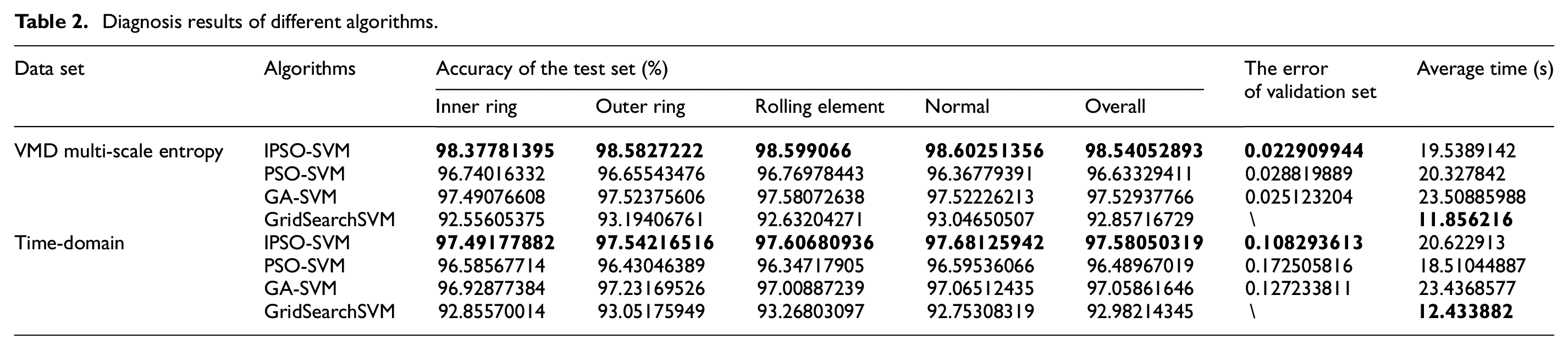

Diagnosis results of different algorithms.
As shown in Table 2, under two different data sets, the diagnostic results of IPSO-SVM and GA-SVM models are not significantly different, which the IPSO-SVM model does not show obvious advantages. The reasons for this phenomenon are as follows. Firstly, from the perspective of the data itself, multi-scale entropy can highlight the fault characteristics of vibration signals more than time-domain characteristics. Secondly, the essence of IPSO-SVM and GA-SVM models is the SVM model. Therefore, there is no essential difference in the structure of the SVM model except for the penalty parameter and the kernel parameter of the SVM model. Under the same data source, if the penalty parameters and kernel parameters of the two SVM models are set the same, the SVM model will get the same result. Thirdly, compared with the particle swarm optimization algorithm, the genetic algorithm makes its population types more diverse due to the existence of mutation and crossover mode. So, it is easier to search for extreme value. Based on the above reasons, the diagnostic results of IPSO-SVM and GA-SVM models are not much different. However, the particle swarm optimization algorithm is simpler and faster than the genetic algorithm. Therefore, this is also the main purpose of this paper to choose the optimization algorithm.
In addition, in terms of diagnostic results. Under the validation data set, the average convergence error of the IPSO-SVM model is the smallest and reaches 0.022909944. The diagnosis time of the IPSO-SVM model is also reduced by 1–2 s compared with the PSO-SVM model. At the same time, the diagnostic accuracy of the IPSO-SVM model for different faults reaches more than 98%, while the best diagnosis effect of other algorithms can only reach 97%. This shows the effectiveness of the IPSO-SVM model.
Analysis of algorithm stability
Because of the randomness of the initial population of the intelligent optimization algorithm, the results of each diagnosis are different. So, the fluctuation of the intelligent optimization algorithm is analyzed. The diagnosis results of IPSO, PSO, and GA 30 times are shown in Figure 10. It can be seen from Figure 10 that the fluctuation of diagnosis results is within 3% no matter what kind of data set. Under VMD multi-scale entropy data set, the fluctuation of the diagnosis algorithm is smaller than that under the time-domain characteristics set, which may be because vibration signal is composed of multiple vibration sources. It is impossible to express various fault characteristics accurately by extracting the time domain statistical characteristics directly from the original vibration signal, which makes the characteristics data set have some common linearity. So, the diagnosis algorithm cannot accurately capture the characteristic details, which leads to larger fluctuation. On the contrary, after the vibration signal is decomposed by VMD, the differences between the characteristics are obvious. And the diagnosis algorithm can accurately capture the characteristics, thus making the difference of diagnosis result of different algorithms smaller.
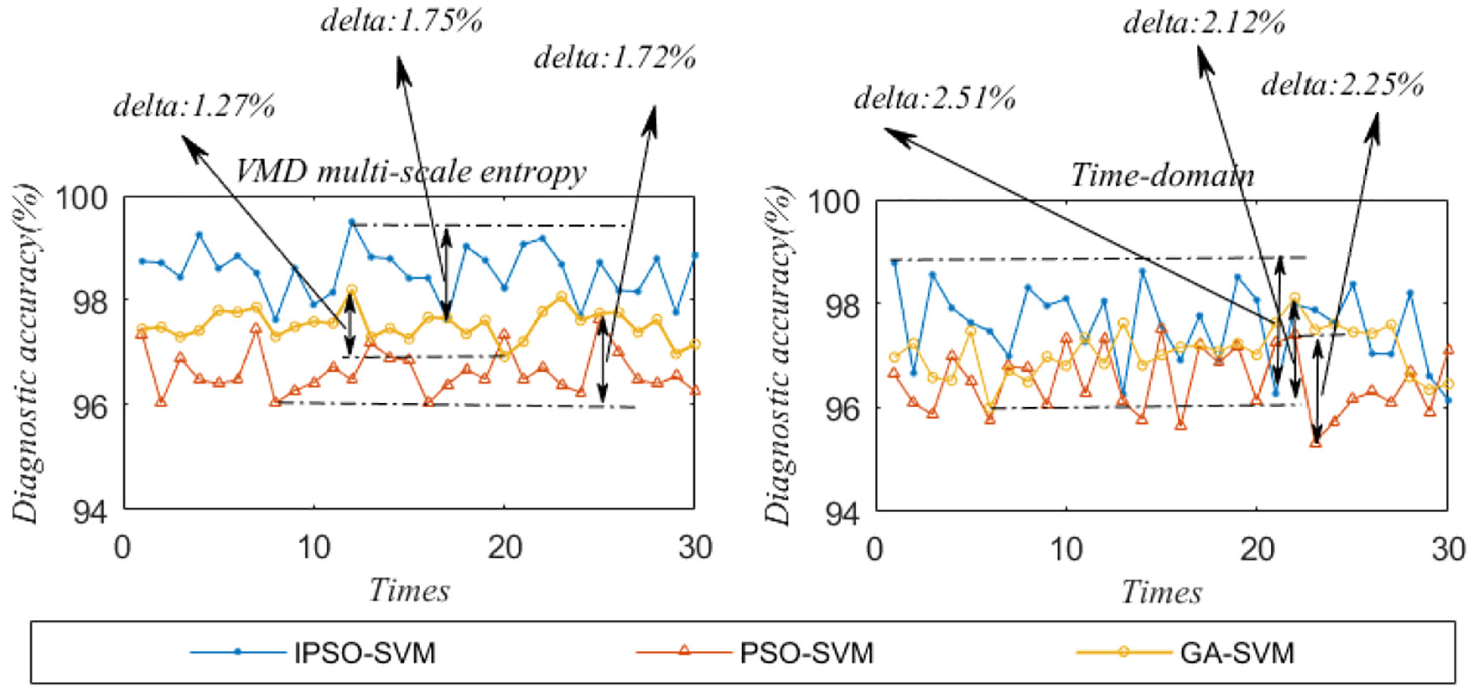
The diagnosis results of IPSO, PSO, and GA for 30 times.
Algorithm diagnosis error analysis
Based on VMD multi-scale entropy data set, the average convergence error trend of several algorithms is shown in Figure 11. It can be seen from error trend Figure 11 that IPSO, PSO, and GA can converge to smaller error values. However, the IPSO has a faster convergence speed, and it can be seen from Table 2 that the convergence error value of the IPSO is smaller. Therefore, through diagnosis accuracy analysis, stability analysis, and error analysis, it can be found that the method proposed in this paper can better diagnose bearing faults.

The average convergence error trend of algorithms.
Conclusion
Aiming at the reasons for weak signal, multi-coupling, and difficulty in bearing fault diagnosis, an improved particle swarm optimization algorithm is proposed to optimize the diagnosis model of VMD and SVM in this paper.
Considering that particle swarm optimization is easy to fall into local extremum and lead to convergence effect, dynamic inertia weight is introduced to change particle searching ability and gradient information is introduced to strengthen particle searching toward the optimal solution. When a mechanical component fails, its vibration signals show shock characteristics, which leads to sparse characteristics of the vibration signal. And information entropy of the vibration signal can reflect this phenomenon. Therefore, based on this point, the adaptability function of IPSO to optimized VMD is constructed. To improve the accuracy of bearing fault diagnosis, the multi-scale entropy of components signal obtained from vibration signals decomposed by VMD is calculated. Based on the multi-scale entropy, the fault characteristic data set is constructed. The optimized SVM by IPSO is used to realize the diagnosis of bearing fault samples.
The research results show that the method proposed in this paper can effectively identify bearing faults, and its diagnostic accuracy is over 98%. The data set constructed with VMD components is more effective than the time-frequency domain feature data set. It is easier to highlight the fault characteristics of the vibration signal and is more conducive to fault diagnosis and recognition. The IPSO can obtain a better optimization effect than the PSO without adding additional time-consuming.
Footnotes
Handling editor: Carmen Bujoreanu
Declaration of conflicting interests
The author(s) declared no potential conflicts of interest with respect to the research, authorship, and/or publication of this article.
Funding
The author(s) received no financial support for the research, authorship, and/or publication of this article.
