



Abstract
The question of which turbulence model is better for a given class of applications is always confusing for the CFD researchers and users. Comparative assessments of scale-adaptive simulation (SAS), improved delay detached-eddy simulation (IDDES) and other hybrid RANS/LES models based on eddy-viscosity models (EVMs) are thoroughly investigated. But how well they perform based on a second-moment closure needs to be answered. In this paper, a widely acclaimed Reynolds-stress model (RSM) in aeronautical engineering, SSG/LRR-
Introduction
For computational fluid dynamics (CFD), the predicted result of arbitrary flow simulation depends on the appropriation of the underlying representation of flow physics and the accuracy of the numerical method solving the corresponding equations. 1 To accurately predict the flow physics occupied by turbulence. The most perfect way is to directly resolve all turbulent fluctuations ranging from integral scale to Kolmogorov one (i.e. Direct Numerical Simulation, DNS), and the ideology of resolving large scale and modelling small scale can also be an alternative way (i.e. Large-eddy Simulation, LES). However, at a realistic flight Reynolds number, the turbulence scale in attached boundary layer is usually very small, which leads the computational cost too large to be afforded in current situation. Therefore, turbulence models based on the Reynolds-averaged Navier-Stokes (RANS) equation are still the backbone of industrial applied CFD methods. 2
Hybrid RANS/LES approaches, which aim to combine the superior accuracy of LES in the detached region with the efficiency of RANS in attached boundary layers, have drawn much attention, especially in separated flow in the past two decades. 3 Various hybrid methods have emerged, such as detached eddy simulation (DES),4,5 scale adaptive simulation (SAS), 6 hybrid filtering method,7,8 and others.
DES is the most popular one of Hybrid RANS/LES methods, which was proposed by Spalart 4 based on the one-equation SA model and then was extended to the two-equation SST model by Strelets. 9 Due to its simplicity and good predictions in massively separated flows, DES has gained a wide attention. However, as the application went deep, researchers found that the DES limiter can be falsely activated by grid refinement inside attached boundary layers, which is called Grid-Induced Separation (GIS). 5 In order to avoid this, the DES concept was extended to Delayed-DES (DDES), 10 following the proposal of Menter et al. 11 to “shield” the boundary layer from the DES limiter. However like the DES, DDES approach is still only suitable for computing of massively separated turbulent flows. Shur et al. 12 proposed a novel DES model, called Improved-DDES or IDDES. It has two branches, DDES and WMLES, including a set of empirical functions of subgrid length-scales designed to achieve good performance from these branches themselves and their coupling. By switching the activation of RANS and LES in different flow regions, IDDES significantly expands the scope of application of DDES with a well-balanced and powerful numerical approach to complex turbulent flows at high Reynolds number. 13
SAS is proposed by implanting the second derivative of velocity into turbulence scale equation. The first version is based on the one-equation KE1E model 14 with von Karman length scale to adapt to the underlying turbulent structures. It is a great attempt to achieve Hybrid RANS/LES performance without explicit grid dependency. Afterwards, a two-equation SAS model was proposed by Menter and Egorov 6 through reformulating Rotta’s equation and then transferred to SST model. One of the features of SAS model is that the limiter does not affect RANS behavior of the model. In other words, even the grid scale is close to Kolmogorov scale, the result cannot converge to DNS solution. That is the reason why some researchers classified SAS model as an advanced URANS method. 15
The hybrid filtering approach is regarded as one of the most rigorous hybrid methods. 16 The theoretical framework is based on the similarity of mathematical formation between Reynolds-average and filtered Navier-Stokes equations, 17 and then revised for compressible flow. 7 The hybrid filtering method includes two critical factors: turbulence model (including RANS model and LES model) and blending function. Currently, more and more advanced RANS models are used in hybrid way,11,18–20 with a large number of blending functions proposed and applied.21–23 Thus the hybrid filtering approach may also be a suitable choice for industrial application.
Above hybrid RANS/LES methods have their certain advantages, but from an engineering standpoint, the question of which model is better for a given class of applications is always confusing for the CFD users. In the EVM framework, comparative assessments are quite enough.
24
But how well they perform based on a second-moment closure needs to be answered. As pointed out in NASA’s CFD Vision 2030 Study Report
25
: the prediction of any separation that is initiated in the boundary layer will still require improvements in RANS-based methods. Among the RANS turbulence models, Reynolds-stress models are perceived as the most advanced ones and in principle will be potential in capturing the flow separation for a wider range of flows. For instance, Chaouat
26
combined a subgrid-scale stress model with a partial integral transport model (PITM). Probst et al.
27
introduced the idea of DES into the
Besides physical model, numerical scheme is also an important aspect when considering turbulent structures accurately resolved.
32
Although the numerical error can be mitigated by refining computational grid scale in principle when using low-order numerical scheme, it will certainly make the computation unaffordable.
33
Therefore, we consider high-order scheme, which has more potential in delivering higher accuracy with less computational costs,
34
and could be recommended to LES or Hybrid RANS/LES.
35
Meanwhile, the coupling of turbulence model and numerical scheme is of great significance and deserve profound discussion. In present study, a seventh-order weighed compact nonlinear scheme (WCNS)36,37 is applied to the comparative assessment of IDDES, SAS and hybrid filtering method based on the SSG/LRR-
The framework of this paper is organized as follows. In Section 2, we present a brief description of the turbulence models, including SSG/LRR-
Turbulence model
Original SSG/LRR-
model
The reference for the standard implementation of the SSG/LRR-


The Reynolds stresses are solved directly by

The dissipation term is modeled by

where
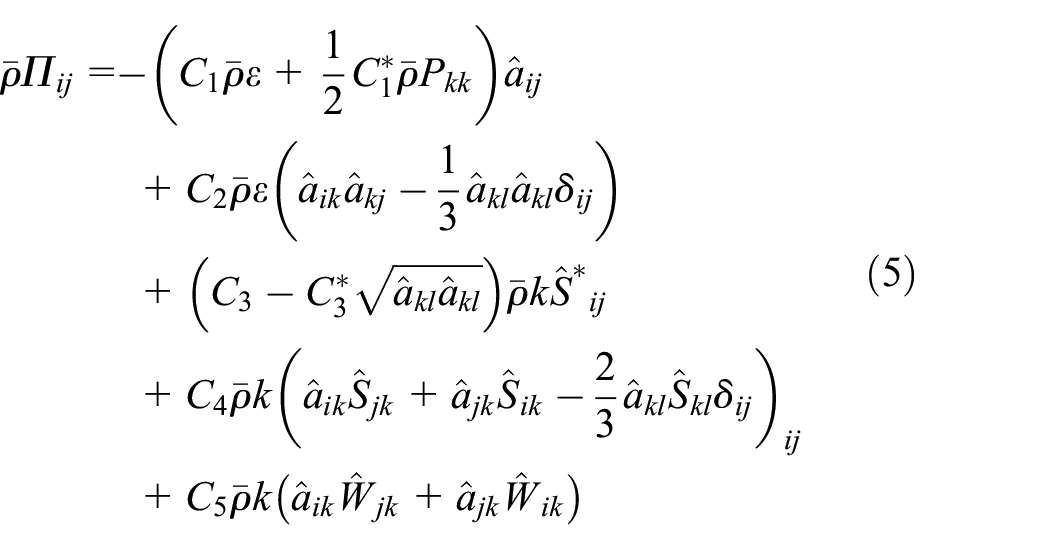
where pressure dilatation is neglected, and the anisotropy tensor is

The diffusion term is modeled via:

where
This model follows Menter’s
42
approach, combining the SSG-

The bounding values of the
Bounding values of

Bounding values of the Reynolds-stress equation coefficients,

SSG/LRR-IDDES method
Detached eddy simulation was first constructed on one-equation SA model.
4
According to the grid resolution, it can switch between RANS and LES mode. Afterwards, a similar formulation is applied to two-equation SST model,
9
which based on a criterion between local grid scale
The original DES model acquires widespread acceptance in industrial applications, but there are still some deficiencies have been found, such as model stress depletion (MSD) 10 problem and grid induced separation (GIS) phenomenon. 5 In order to solve these problems, many advanced revisions were proposed, such as Delayed-DES(DDES) model 10 and Improved-DDES (IDDES) model. 12 The IDDES model is constructed by coupling wall-modeled LES (WMLES) and DDES to eliminate the log layer mismatch (LLM) problem, and maintain the compatibility of general DES model. The major improvement of IDDES model mainly reflects in the near-wall modification of LES filter, and more rapid transition between RANS and LES than original DES model.
Referring Shur et al.’s
12
work, the detailed IDDES formulation for the SSG/LRR-

Noted that the

where the blending function

The

where


with

Elevating function

where the function

and the function

where the quantities
In addition, a modified grid size length scale was adopted by Shur et al., 12 which is used here:

Where,
SSG/LRR-SAS method
Scale adaptive simulation is proposed by implementing second derivative of velocity into turbulence scale equation. The derivation is based on the theory of Rotta,
44
and then introduced to two-equation SST model.
6
Unlike the hybrid framework of DES model, SAS model bases on a criterion between von Karman length scale
Considering the similarity of scale-eqution between SSG/LRR-
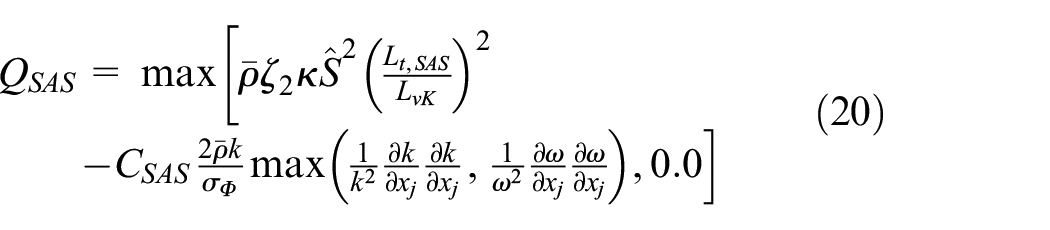
where
In addition, high wave number is damped to avoid accumulating energy of small scales. It can be realized by imposing a lower limit of the von Karman length scale 6 :

where
Hybrid Reynolds-stresses and subgrid-stresses method
The proposed hybrid filter is a linear combination of URANS and LES operators:

where
Seven partial different equations for the Reynolds stresses

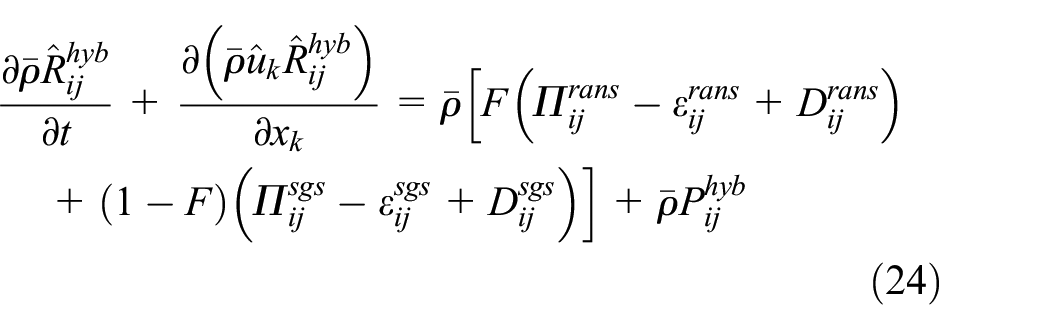
Applying the hybrid filtering approach to the turbulence models, new transport equations can be derived for the hybrid turbulence-stress
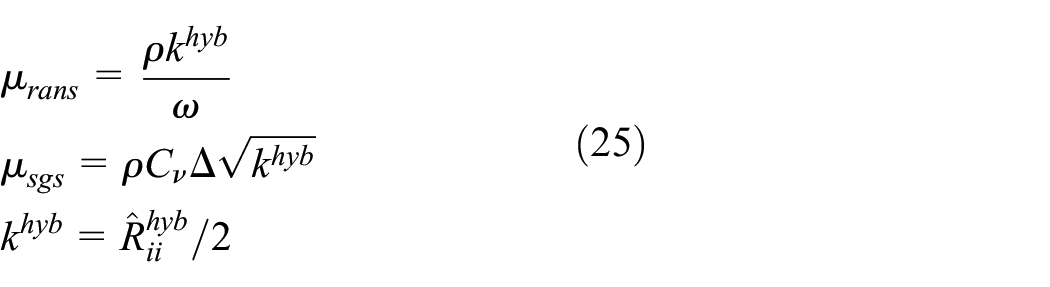
The URANS and SGS eddy viscosities are formulated as:
The modeling of the dissipation-rate in SGS model is not given by its transport equation as in RANS models but it is then explicitly computed by means of the grid size

where

The diffusion term is modeled by analogy with the RANS modeling as

Finally, a proper blending function

Numerical methods
Coordinate transformation and symmetrical conservative metric method
In Cartesian coordinate, the three-dimensional RANS equations are

where the supscript “*” represents the non-dimensional variable, which yields
As the transformation from Cartesian coordinates to curvilinear coordinates is applied, that is,

equation (26) becomes
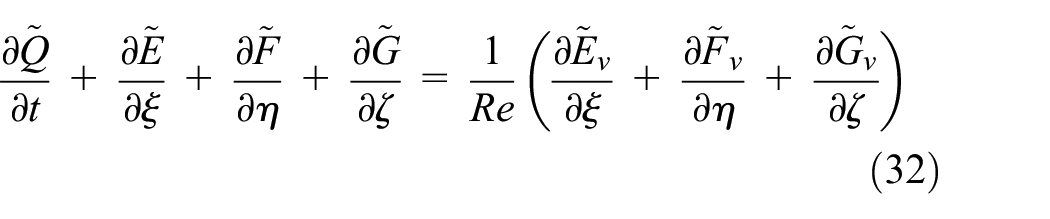
where

High-order weighted compact nonlinear scheme
After the weighted compact nonlinear scheme (WCNS)
49
was proposed, a series of WCNS were developed and applied to a wide range of applications.38,50–52 The WCNS scheme consists of three components: (i) cell-edge to cell-node central flux difference; (ii) flux evaluation at the cell-edge, and (iii) cell-node to cell-edge weighted nonlinear interpolation of flow variables. In this paper, a 7th-order tri-diagonal compact one WCNS-E8T736,37 is adopted for the comparative assessment of IDDES, SAS and hybrid iltering models based on the SSG/LRR-
Considering the WCNS-E8T7, the inviscid term in equation (28) is discretizated by an explicit eighth-order central flux differencing:

where

Only the discretization in
For the Step (iii), a seventh-order weighted compact nonlinear interpolation is adopted as

The weights

where

The
Comparative results
NACA0012 airfoil stalled flows
Flow configuration
NACA0012 airfoil is one of the benchmark cases in aeronautical separated flows. There are plenty of experimental studies,54,55 covering data from
Simulations of the NACA0012 airfoil at four different angle of attack of

Computational grid in the X-Y plane and wall, NACA0012 airfoil.
All of the turbulence models described above (SSG/LRR-IDDES, SSG/LRR-SAS and Hybrid SSG/LRR models) are employed here and compared with the traditional SST-IDDES approach. The seventh-order compact scheme WCNS-E8T7 is carried out to reduce the effect of numerical dissipation. Time iterative is performed using the dual-time stepping technique with 0.01 times the non-dimensional time steps (
Instantaneous flow field at
angle of attack
At

Iso-surface of the Q-criterion at 100T, colored by Mach number.
Figure 3 displays the instantaneous vorticity contours of 50% span at non-dimensional time 100T. Whether for SST or SSG/LRR-

Vorticity contours of 50% span at 100T.
Time-averaged result
The averaged lift and drag coefficients obtained by different scale-resolving approaches are listed in Figure 4. At the AoA of

Time-averaged lift and drag coefficients of all NACA0012 computations and comparison with experimental data.
At the AoA of
At the AoA of

Time-averaged pressure coefficient distribution over NACA0012 airfoil at the AoA of
Taken all cases together, the degree of coincidence among RSM-based approaches is SSG/LRR-IDDES > Hybrid SSG/LRR > SSG/LRR-SAS > SSG/LRR-URANS, compared with the experimental data. On the other hand, the results based on SSG/LRR-IDDES are slightly better than the SST-IDDES. It shows that the RSM has a good potential as the basic turbulence model in the hybrid RANS/LES framework.
Flow over a turret
Flow configuration
The turret is a common type of protrusion outside the aircraft. For example, the camera pod of the UAV (unmanned aerial vehicle), which always affects the aerodynamic characteristics of the belly of UAV. In present study, the turret geometry and flow conditions are selected to model an experiment performed at the U.S. Air Force Academy,
57
see Figure 6. The turret consists of a half-foot radius hemisphere on top of a circular cylinder attached to the wind-tunnel wall. The flow conditions for the computation and experiment are a Reynolds number based on the turret diameter of

Computational wind-tunnel cross section. 57
The numerical domain extended over
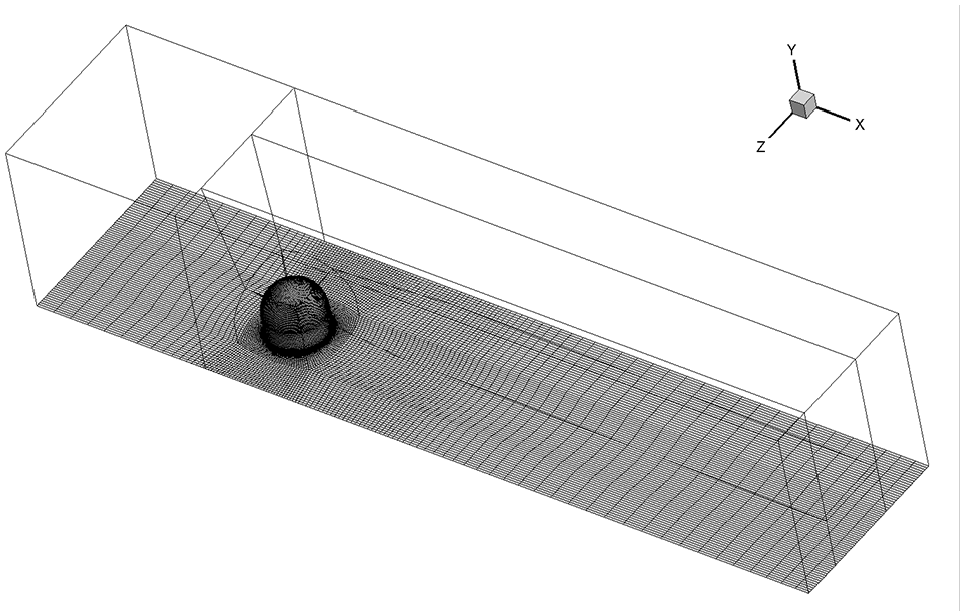
The numerical domain and surface mesh for turret and wind tunnel.
The SSG/LRR-IDDES, SSG/LRR-SAS and hybrid SSG/LRR models are employed here and compared with the SSG/LRR-URANS approach. At the same time, SST-URANS and SST-IDDES are carried out as references. The seventh-order scheme WCNS-E8T7 is adopted to reduce the effect of numerical dissipation. Time iterative is performed using the dual time stepping technique with the non-dimensional time steps
Referring to Morgan and Visbal’s setting, the inflow profile was generated from an individual flat-plate simulation. Figure 8 shows the time-mean velocity profile. This ensures that all methods are coincident at inlet.

Time-mean streamwise inflow velocity profile.
Instantaneous flow field
A 3D view of the whole flow region is given in Figure 9. This figure compares the instantaneous flow features at 40T predicted by the six approaches. It is predictable that the SST-URANS solutions are absent of multiple levels of fine scale structures. The SSG/LRR-URANS gives a relatively obvious improvement, but the retained flow details are still not enough. Based on SSG/LRR-

Iso-surface of the Q-criterion at 40T, colored by Mach number.
Time-averaged result
Next, we focus on the time-averaged solutions. Figure 10 compares the surface streamlines predicted by the six approaches to experimental oil-surface-flow visualizations (Figure 11; The copyrights of Figure 11 belong to the AIAA Journal and the relevant authors). In this view, we are looking from a perspective above and downstream of the turret. The surface-flow visualization from the experiment was enhanced by the original authors with schematic streamlines to highlight flow patterns. The flow on the wind tunnel floor is very similar to that seen in the experiment. All solutions display very similar features in the region ahead of the turret influenced by the necklace vortex. However in the turret wake, especially in the backside surface of turret, the difference appears. The SSG/LRR-SAS and hybrid SSG/LRR models both predict a pair of strong vortices in the shape of the ears. This flow structure is similar with that obtained by SSG/LRR-URANS. The SSG/LRR-IDDES predict a vortex structure formed from the shoulders of the cylinder, which agrees better with the experimental oil-surface-flow visualizations (bold arrow in Figure 11) than that of SSG/LRR-URANS. It is consistent with the trend of the instantaneous solutions. Similar differences also exist in SST-IDDES and SST-URANS, which indicates that the type of scale correction has a major influence on the wake region.
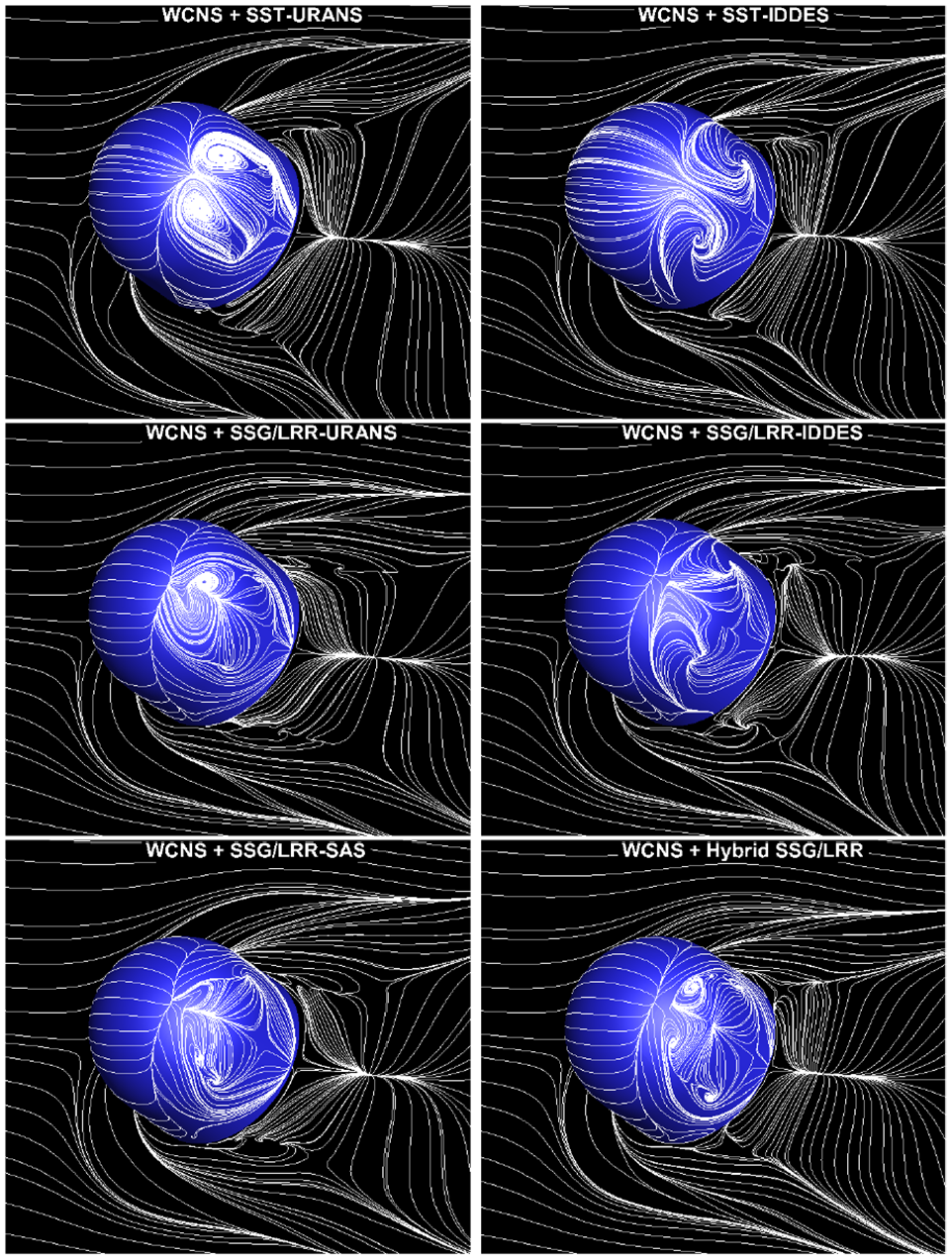
Comparison of time mean near surface flow topology.

The oil-surface-flow visualization from the experiment. 57
A comparison of the numerical and experimental mean-surface pressure coefficient is shown in Figure 12. All RSM-based solutions exhibit the same pressure drop as the flow accelerates over the front portion of the turret dome. However in the separated flow region, all solutions are slightly deviated from the experimental data. Morgan and Visbal 58 implemented the gird convergence analysis on this case using hybrid RANS/ILES method and indicted that the simulation accuracy can be improved by reducing the grid size in this region. As far as this grid is concerned, the RSM-based solutions are better than SST-based solutions.
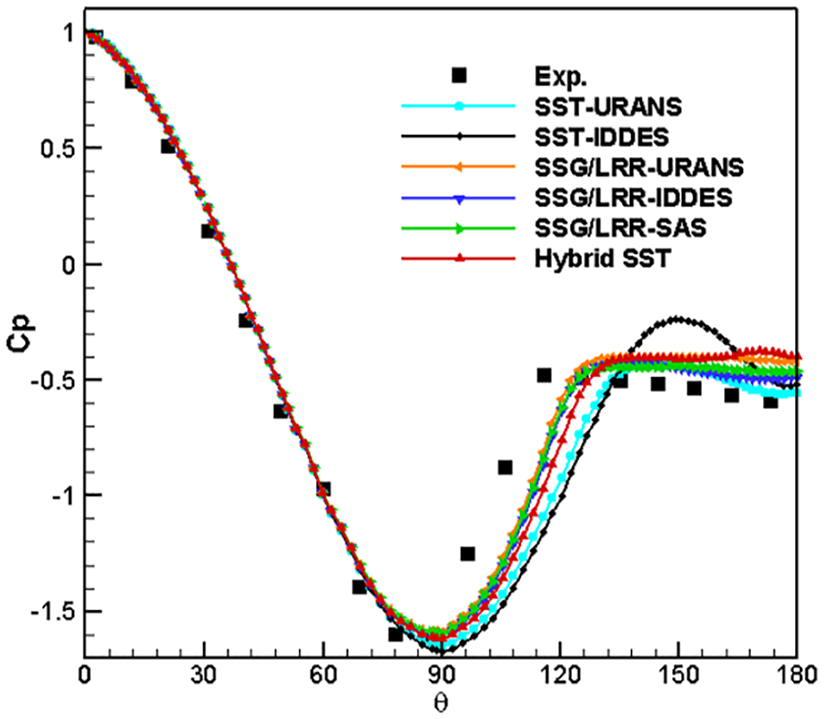
Time-mean surface-pressure coefficient comparison for turret dome.
A comparison of mean u-velocity profiles at four locations in the wake flow are shown in Figure 13. The location of the profiles is given in Figure 14. Velocity profiles 2 and 4 are located at the

Comparison of time-mean u-velocity profile.

u-velocity profile locations.
Conclusions
Based on the high-moment turbulence model SSG/LRR-
A comparative assessment of SSG/LRR-SAS, SSG/LRR-IDDES and hybrid SSG/LRR models is made with the high-order WCNS-E8T7 scheme. At the same time, the traditional SST-IDDES is also used as a reference. The relevant cases include NACA0012 airfoil stalled flows and flow over a turret. The former is a benchmark case for hybrid RANS/LES models, while the latter is a small challenge to the turbulence models and discretization methods. In above cases, all of the three new methods show a good ability to simulate unsteady turbulence, while the original SSG/LRR-URANS method is insufficient. Among the hybrid RANS/LES methods, the calculation results obtained by SSG/LRR-IDDES are generally the best. The hybrid SSG/LRR model shows more physical viscosity than SSG/LRR-IDDES. It is due to the fact that Deardorff’s pressure-strain correlation gives an insufficient dissipation in the separated region. The SAS modification can also cause the physical viscosity to be reduced in the separation regions. But unlike the IDDES or hybrid framework, it is based on the use of a von Karman length scale, which always relies on the accuracy of the calculated velocity gradient.
This paper preliminarily shows the potential of hybrid RANS/LES methods base on a Reynolds-stress model by comparing with the SST-IDDES. Like other hybrid methods based on the EVM, there may still be some defects in above methods. Therefore, future work needs to consider more test cases.
Footnotes
Handling editor: James Baldwin
Declaration of conflicting interests
The author(s) declared no potential conflicts of interest with respect to the research, authorship, and/or publication of this article.
Funding
The author(s) disclosed receipt of the following financial support for the research, authorship, and/or publication of this article: This work was supported by the Natural Science Foundation of Hunan Province in China (No. 2020 JJ5648), the Scientific Research Project of National University of Defence Technology (No. ZK20-43) and the National Key Project (No.GJXM92579). The authors thank Associate Professor Huaibao Zhang of Sun Yat-sen University for his valuable suggestions.
