



Abstract
Spare parts are treated as the basis to guarantee the safe and economic operation of civil aircraft, its scientific prediction and reasonable configuration play an important role in perfecting integrated logistics support (ILS) and achieving win-win situation of stakeholders (e.g. manufacturers, operators, maintenance providers). This paper studies the existing spare parts prediction and configuration methods of civil aircraft, and discusses future development trend of spare parts from the perspective of prediction and configuration, respectively. The current development status of civil aircraft spare parts prediction techniques are firstly introduced, according to demand characteristics of spare parts; the present research status of civil aircraft spare parts configuration methods are then elaborated, based on the traditional methods and machine learning methods; the development trend of civil aircraft spare parts prediction and configuration methods is finally analyzed, combined with the advantages and disadvantages of the existing methods of civil aircraft spare parts management methods. The efforts of this work provide a reference for the comprehensive management of civil aircraft spare parts and improve the perfection degree for the ILS of civil aircraft.
Keywords
Introduction
Spare parts are one of the material foundations for integrated logistics support (ILS), the scientific prediction and reasonable configuration of spare parts is essential for guaranteeing the safe and economic operation of civil aircraft. The complexity of spare parts management has greatly increased the proportion of procurement and storage costs in airline costs.1–3 According to the TeamSAI’s statistics, the global civil aviation industry currently stores approximately $50 billion in spare parts, accounting for approximately 75% of airlines inventory funds and 25% of working capital. However, the utilization rate and turnover rate of most civil aircraft spare parts are extremely depressed, only 25% are used, and there is a problem of excessive backlog.4,5 And if the prediction and configuration strategy is unreasonable, it will lead to lack and untimely support, and cause flight delays or aircraft on ground (AOG). To solve the existing problems and ensure a win-win situation for stakeholders, it is currently the focus and hotspot of the integrated management of civil aircraft spare parts.
In the 1960s, the aviation industry had already realized the economic loss and reduced operating capacity caused by the shortage or the accumulation of spare parts. Researchers were aware of the importance of conducting research on integrated management of spare parts, and have carried out a huge number of studies and practical applications over the years. Research on the comprehensive management of civil aircraft spare parts mainly includes two aspects: one is the prediction of spare parts based on the law of consumption, historical data, relevant influence parameters, and demand distribution, which avoids the deviation from actual demand; the other is spare parts configuration management, the research is contributed to configure the spare parts combined with distribution characteristics of the spare parts support network sites, so as to ensure the availability based on the current operational scale and needs of the fleet. On the premise of ensuring the availability of the fleet, the above works can optimize the inventory of spare parts and reduce the total costs of operation support. Many airlines and OEM have carried out engineering applications based on the research of spare parts applications of demand prediction and configuration techniques to provide customers with thoughtful and efficient spare parts support services. For example, Boeing launched the Global Airline Inventory Network (GAIN), 6 Airbus established a ISO9000-certified China-Europe Aviation Support Center, 7 Commercial Aircraft Corporation of China Ltd (COMAC) launched spare parts support center management system 8 and Xi’an Aircraft Manufacturing Company established a SPEC2000-based central spare parts warehouse and satellite warehouse.
The aim of this paper is to investigate spare parts prediction and configuration methods, analyze the advantages and disadvantages of existing theories and methods in the comprehensive management of spare parts and summarize its development trends, with a view to provide support for the improvement of the competitiveness of civil aviation industry.
In what follows, the research status of civil aircraft spare parts prediction techniques is introduced in section 2. Section 3 performs the analysis and summary of civil aircraft spare parts configuration techniques. The development prospect of civil aircraft spare parts management is predicted through analysis in section 4. Some conclusions are summarized in section 5.
Research status of civil aircraft spare parts prediction techniques
This section elaborates the techniques of civil aircraft spare parts, which includes time series, failure observation methods, regression model and machine learning.
Time series methods of spare parts prediction
A time series is the well-defined method that predicts development trend based on the characteristics of time, which include trend, seasonality, periodicity, and irregularity. 9 In the field of civil aircraft spare parts prediction, the trend characteristics of spare parts demand can be divided into slow moving demand, strictly intermittent demand, erratic demand, lumpy demand.10,11 The moving average (MA) method and its extension methods are usually used for predicting slow moving demand, such as the weighted moving average (WMA) method, autoregressive moving average (ARMA) method, exponentially weighted moving average models (EWMAM). Certain data is corrected by these methods to eliminate irregular disturbances that affect the accuracy of spare parts prediction. Willemain et al. 12 used MA method to predict the consumption of spare parts on the premise of analyzing the distribution of spare parts’ life characteristics. Regattieri et al. 10 used the methods of WMA, EWMAM, and Croston to predict subsequent spare parts demand based on historical data of Alitalia. Johnson and Boylan 13 used EWMAM to predict the consumption of spare parts, and compared the analysis errors through the mean square error, which verified the effectiveness of the method.
The prediction of spare parts using the exponential smoothing method is developed by the support of the theory of MA. Combining the previous data and predicted value, the later predicted value of the target is obtained after weighting, to eliminate irregular and random disturbance in the process of spare parts prediction. The method is not only used in slow moving demand but also is extended to discrete data by Brown, then developed methods for trends and seasonality.14,15 Holt also developed a similar method of exponential smoothing for additive trends.16,17 Poul et al. 18 analyzed the effect of using different exponential smoothing models in inventory prediction based on predicting the cost of spare parts and concluded that the optimal method needs to select the correct smoothing factor. Dong et al. 19 proposed a prediction method of subsequent spare parts based on the exponential smoothing and rough set theory to address the problems of large error of the prediction method in predicting the spare parts requirements. Liu et al. 20 combined the exponential smoothing method with a gray model to establish a combined model. Segura et al. 21 used spreadsheets to model as Holt-Winters exponential smoothing model to determine the best predictive value and formulated a nonlinear programming problem related to the proposed predictive model. Zhang et al. 22 used Holt-Winters exponential smoothing method to predict aircraft spare parts consumption law, the test result showed the square root of the sum of squared residuals is relatively small, and the calculation is simple and operability. Ruiz-Aguilar et al. 23 proposed a hybridization methodology combined with autoregressive integrated moving averages (SARIMA) model in the artificial neural network model (ANN). Although the MA method and other methods perform well in smooth and linear demand prediction, these methods lack accuracy for other demands.
There are many scholars found the above techniques cannot solve the realistic questions with increasing erratic, lumpy and intermittent demands.24–26 The data of spare parts demand is collected form Dassault Aviation, which show the proportion of the above demand in total demand, as showed in Figure 1. To deal with the above problems, Croston et al. analyzed the spare parts demand of airlines and determined the source of bulk demand. As Croston analyzed, the demands with the above characteristics accounts for most of the demands for civil aircraft spare parts, these demands are often random in time and quantity, and zero-value demand and positive-value demand are interspersed with each other.12,27,28 Therefore, Croston comprehensively considered the impact of demand time interval and consumption history based on EMM, divided the time series into non-zero demand value time series and non-zero demand value time, and combined the two time series in order to achieve spare parts prediction. 28 Based on the Croston framework, Liu et al. 29 used a deep learning network to establish a deep Croston method to predict the demand for aero engines. Ghobbar et al. explored the application of Croston and seasonal regression methods in spare parts prediction and verified these methods through the component maintenance workshop of one of the largest airlines in the UK.30,31 Although the Croston method is effective in predicting intermittent demand, there is room for perfection in its theory.

Proportion of spare parts demand.
Many scholars have improved the basic Croston method. Rao 32 corrected the algebraic error in the Croston method. Johnton and Johnson and Boylan 13 expressed concern about the uncertain factors in the Croston method. Syntetos and Boylan 33 found an error in Croston’s mathematical derivation of expected demand estimation, which corrected the prediction bias in Croston’s method. There are many related improvement methods, but the most noteworthy is the Syntetos-Boylan approximation (SBA) method proposed by Syntetos and Boylan based on the Croston method. This method introduced a new bias that is applied to the original estimate of the average demand of Croston, 34 which can also be combined with distributions such as Poisson distribution. Eaves and Kingsman 35 used spare parts data from Royal Air Force to test the effects of SBA, simple exponential smoothing and the original Croston method, and concluded that SBA is superior to other methods. Gutierrez et al. 36 also verified that the SBA method is superior to Croston’s and exponential smoothing methods in lumpy demand prediction. The above methods must satisfy the assumptions of the Croston method.
Since in a real spare parts prediction scenario, the demand for spare parts may not meet any standard distribution. At this time, non-parametric prediction methods that do not rely on any distribution assumptions can be used for prediction. Efron proposed the Bootstrap method, which can randomly sample observations from historical demand data to construct a histogram of demand distribution.37–39 Teunter and Duncan 40 used the Bootstrap method to predict spare parts demand. Many scholars have conducted further research on the Bootstrap method.12,25,41,42 But the notable one is the new Bootstrapping method (WSS method) proposed by Willemin et al, which transformed the probability integral to deal with non-parametric intermittent requirements. From this, the WSS method was established to predict the cumulative distribution of demand within a fixed delivery time, and the effectiveness of this method was proved through spare parts testing. 43 Syntetos et al. 26 tested the WSS method.
Although the above-mentioned research works (are shown in Figure 2) can provide support for the prediction of civil aircraft spare parts, there is a large deviation between the estimated value of spare parts based on the time series method and the actual demand of the project when the historical consumption data of spare parts fluctuates greatly, which makes it impossible to spare parts order and subsequent supply.
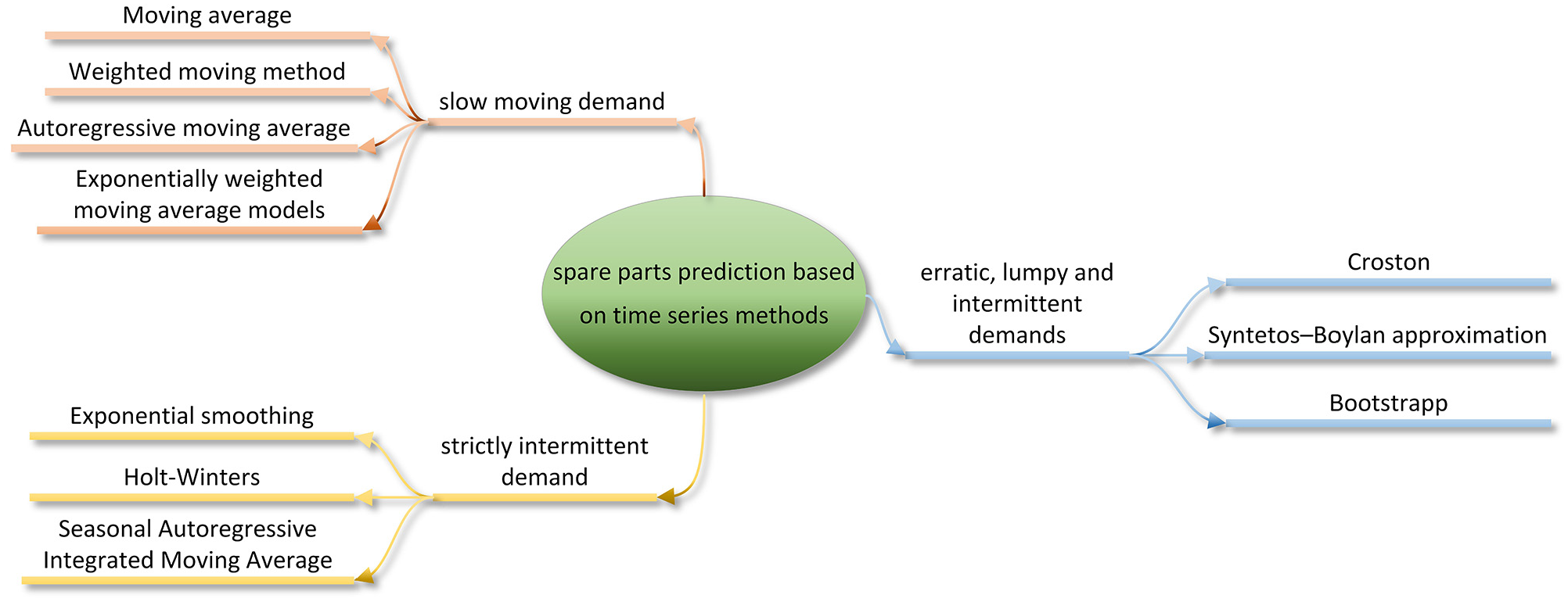
Spare parts prediction based on time series methods.
Regression models of spare parts prediction
The predicted value of civil aircraft spare parts demand will be affected by single factor or multiple factors. Generally, regression analysis is used to establish the relationship between input and output variables of the target to determine the relationship equation between spare parts consumption and influencing variables, which is used as the prediction model.44,45 The model realizes the demand prediction of spare parts based on the changes of input variables. 46 Yang et al. proposed a linear method for the problem in the consumption of aviation spare parts, the measurement standard are the indicators of related analysis, such as significance analysis. The analysis results showed that the linear regression model is feasible for the prediction of aviation spare parts. 47 Later on, the scholar developed a multiple linear regression prediction model of aircraft spare parts by collecting 15 years of testing data of aircraft tire consumption, and the research results proved the reliability of the method. 48 Guo et al. proposed a regression analysis combination method based on turnover data to realize the demand prediction of spare parts. 49 These studies can prove that the regression model can solve the prediction problem affected by multivariate factors to a certain extent.
Regarding the application of regression analysis method in spare parts prediction, the main problem is: when too many influencing factors are involved, the accuracy of the regression analysis method predictive analysis will be reduced, and the spare parts demand prediction cannot be realized. In addition, when the variable parameter dimension is high, enough sample support is needed to realize the establishment of the regression analysis model.
Failure observation methods of spare parts prediction
Airline order spare parts mostly in accordance with annual or monthly as a cycle.50,51 For instance, Boeing determines the time point to order spare parts based on mean time between failures. However, the strategy is not suitable for new aircrafts due to the characteristic of the kind of spare parts is little field data or maintenance record. To solve this problem, many scholars applied failure observation methods to predict spare parts consumption.
Sun et al. developed a two-sample prediction methods based on Bayesian and classical method respectively, the results showed the ordering time and ordering number. 52 The scholar then employed a Weibull process to establish a prediction model for LRUs in the airline, downtime was predicted through the point estimation and prediction limits under different confidence levels. 53 Zhang et al. 54 aimed at the management problem of spare parts whose life is subjected to Weibull distribution, proposed an optimization model based on residual life prediction. Lowas et al. performed a Monte Carlo simulation of notional aircraft components that subjected to Weibull distribution, which provided a simulated spare parts demand characteristics. 55 Weibull process in the prediction of spare parts can analyze the failure trend of components as a whole.
Niu et al. 56 applied Poisson distribution to predict spare parts, and introduced Bayesian method when certain historical fault information was existed. Boutselis and McNaught 57 simulated different logistic support organizations to create a test dataset, used Bayesian network to forecast spare parts demand. Later on, many scholars developed different methods to solve the problem of prediction based on failure observation.58–67
Prediction methods based on failure detection can solve the problems that introduce new aircrafts. It should be noted that the status information and historical information of spare parts should be taken in consideration after the aircraft is in service in order to improve the accuracy of demand.
Machine learning of spare parts prediction
Under the background of information technology leading spare parts prediction, the methods of machine learning and data-driven are valued by scholars because of their self-learning ability and rapid ability to find the best. SVM and ANN are typical methods of machine learning models, which are not only suitable for studying the relationship between the predicted value of civil aircraft spare parts and influencing parameters, but also for the realization of spare parts prediction through historical consumption data.68–70 The advantage of SVM in spare parts prediction is that its optimal hyper plane can separate the projections according to different categories, thereby avoiding the risk of local prediction minimums. Li et al. 71 applied SVM to predict spare parts demand, the input of SVM are the main factors that influenced spare parts consumption. Cao 72 used SVM to predict the non-zero demand of parts, proposed a hybrid mechanism that combined the SVM prediction results with the relationship of spare parts demand with variables, the training on the data set showed that the method can more accurately predict the demand for spare parts. Bao et al. 73 proposed an intermittent demand prediction method for spare parts based on SVM regression, and compared the calculation results of this method with the Croston method, which proved the effectiveness of the method. Li et al. 74 analyzed the factors of spare parts demand and constructed an index system of influencing factors, thereby establishing a quantitative analysis of influencing factors and a prediction method of ε-support vector regression. Xing and Shi 75 used BP-SVM method to predict the demand interval and demand quantity of the intermittent demand separately. Xiong et al. proposed a method predict damage-oriented spare parts demand based on ε-Support Vector Regression. 74 Van der Auweraer et al. 76 combined with spare parts consumption information to explore the application of ANN model in spare parts demand prediction. Boylan and Syntetos 77 summarized the methods and techniques of spare parts demand prediction in recent years, most of which focus on SVM and ANN. Babajanivalashed et al. 78 proposed a methodology to select the best prediction method based on binary classifier machine learning, the results indicated that neural network is the best method for 98% of demand compared with the performance of random forest. The above methods have self-learning and fast optimization capabilities in prediction, but there is still room for improvement in error control.
Some scholars use the idea of establishing back propagation based on neural networks to predict spare parts. The principle of back propagation based on neural networks as shown in Figure 3. The reason is that this idea can compare the input with the qualified output and calculate the mean square error. 79 The mean square error is propagated backward through the network, and the loop is repeated to reduce the prediction error value below the set predetermined threshold to control the optimal spare parts prediction solution. 80 Cheng et al. 81 used simulated data of spare parts demand to train back propagation neural network (BPNN) as a demand prediction tool. Mao et al. 82 established a three BPNN model to predict spare parts demand. In order to provide reference for spare parts inventory control, Chen et al. 83 proposed moving back propagation neural network (MBPN) and moving fuzzy neuron network (MFNN) to predict the demand for critical spare parts, the prediction result shows that the proposed method is effective by compared with gray prediction methods, BPNN and fuzzy neuron network. Guo et al. 84 proposed the maintenance equipment support demand prediction steps based on I’SO-BPNN. Chen et al. 85 considered the noise in consumption series, proposed a prediction method combining fuzzy C-means clustering algorithm and fractional order model, the result showed that the relative error and average relative error of the proposed method are less than EWT-BPNN.

Principle of back propagation based on neural networks.
Although machine learning theory has shown a comparative advantage in spare parts prediction compared with traditional methods, the development of related theories is still in the research stage, and the feasibility of practical engineering application needs further verification. In addition, the spare parts prediction techniques of machine learning are based on a large amount of effective data, so it is still necessary to further explore its feasibility in combination with actual engineering data.
Each of the above four types of spare parts prediction methods has its own characteristics. In the engineering application of spare parts demand prediction, a reasonable method should be analyzed and selected according to the characteristics of the spare parts itself and the actual situation of the problem. The comparative analysis of the four methods of civil aircraft spare parts prediction methods is listed in Table 1.
Comparison of existing methods for civil aircraft spare parts prediction.

Research status of civil aircraft spare parts configuration techniques
Spare parts configuration is another focus of the civil aircraft spare parts management. A large number of researches have been conducted on civil aircraft spare parts configuration methods, mainly including two aspects of analytical methods and optimization algorithms.
Analytical methods of spare parts management
Civil aircraft spare parts inventory management originated from the Multi-Echelon Technique for Recoverable Item Control (METRIC) theory developed by the US RAND Corporation for the US Air Force, 51 which is actually a multi-project two-level (base-level and grass-roots) maintenance support system evaluation and optimization model based on some basic assumptions (as shown in Figure 4). The assumptions are:
The demand for spare parts follows an even Poisson distribution.
The two-level repair shop has unlimited repair capabilities (that is, it is not affected by maintenance resources and fleet operation requirements), and the faulty parts will enter the repair state immediately after arrival without waiting.
The failure rate of failed parts has nothing to do with the number of work parts.

Multi-echelon inventory structure of METRIC.
METRIC theory is widely used in the management of spare parts configuration of complex equipment. For example, the European navy and air force widely have used OPUS commercial software for spare parts configuration, and the software generally used the METRIC model.
The spare parts inventory management methods used in the current engineering field are all developed based on the METRIC theory, and have received extensive attention from academia, and have carried out a lot of research. On the basis of the static Palm theorem, Sherbrooke calculated and analyzed the corresponding expected out-of-stock value of all possible permutations and combinations of inventory quantities, and looked for the METRIC model that maximizes the use efficiency of spare parts under the constraint of the total costs.86,87 Based on the METRIC theory and system analysis method, Ruan et al. 88 established a dynamic configuration model of spare parts based on multiple constraints by introducing Lagrangian factors to solve the problem of spare parts configuration affected by the cost, quantity, quality and scale of spare parts. The METRIC theory established spare parts inventory management system, which has brought a lot of inspiration to scholars who follow-up research in this area.
On the basis of in-depth study of METRIC theory, METRIC extension models such as DYNA-METRIC model, VARI-METRIC model and MOD-METRIC model were evolved. Muckstadt 89 extended the single-level spare parts level of METRIC theory to two-level spare parts level, namely Line Replaceable Unit (LRU) and Shop Replaceable Unit (SRU), established the MOD-METRIC model. Burns and Sivazlian 90 studied the dynamic response of the multi-level supply chain to the various needs of customers including the demand for spare parts. Then, Hillestad established the DYNA-METRIC model, which considers multi-level inventory and takes system availability as the goal. In a dynamic wartime environment, the logistics support process affects the performance of spare parts, the model uses an unsteady composite Poisson distribution process to obtain the actual dynamic characteristics of the initial spare parts supply environment. There is few restriction conditions required in the model, which solves many practical engineering problems to a certain extent, thus establishing the position of the METRIC model family in the field of spare parts prediction. 91 Slay established a VARI-METRIC model to make the average number of items to be repaired equal to the variance, which is a negative binomial distribution. 92 Similarly, Graves analyzed the error of the expected out-of-stock value in the METRIC model, and used negative binomial analysis to replace the Poisson distribution in the METRIC hypothesis. 93 Later, Sherbrooke has expanded VARI-METRIC to a two-level spare parts level. 94 Sleptchenko and van der Heijden 95 defined Performance Based Contract (PBC) specifications as modeling variables and parameters, and proposed a PBC-METRIC model, which can minimize the cost of spare parts supply according to airline availability requirements and PBC specifications. The effectiveness of this method was verified through the case of a European airline. Costantino et al. 96 proposed the ZIP-METRIC model, which used the zero-inflated Poisson analysis to enhance the traditional METRIC formula, and verified the proposed method through 1745 projects of a European airline, indicating that it has a comparative strong advantage in intermittent and lumpy demand patterns. It should be noted that the above method is limited by the assumptions of METRIC theory.
Because the inventory configuration of real civil aircraft cannot fully meet all the assumptions of the METRIC model family, many scholars have considered the constraints and restrictions in the real configuration situation and proposed an inventory configuration method based on the METRIC model family. Liu et al. 97 proposed a research method of lateral transshipments and multi-level distribution of civil aircraft spare parts inventory with degree of importance to study the influence of degree of importance on the distribution of spare parts inventory, the optimal configuration quantity, total cost and fleet availability of the inventory are obtained by the testing that the spare parts of civil aircraft door were took as the research object. Feng et al.98–100 proposed a multi-echelon inventory configuration technique with maintenance ratio for civil aircraft spare parts, and introduced later transshipments in follow-up research to configure inventory.
Li et al. 101 proposed a joint configuration method based on queuing theory and VARI-METRIC model for the problem of multi-level inventory configuration with limited civil aircraft maintenance capabilities. Lau et al. 102 considered the limited number of maintenance systems and proposed a new analysis method based on METRIC to calculate the expected backorder and fleet availability over time. Basten et al. 103 considered the maintenance analysis level of spare parts and performed spare parts configuration management based on the METRIC model, and concluded that the cost was reduced by more than 43%. Kutanoglu and Mahajan 104 proposed a METRIC model that considers spare parts sharing, the calculation results show that the proposed inventory sharing strategy can significantly reduce costs and meet the requirements of spare parts configuration. Ruan et al. 105 considered the factor of time to relax the assumption of spare parts steady demand in METRIC theory, the research result conforms to the actual status. Wong et al. 106 established a multi-item, continuous review model of two-location inventory systems for spare parts, which can minimize the total costs for inventory storage, lateral transshipments and emergency shipments. The above-mentioned methods are based on METRIC theory, which are emphasis on the multi-echelon idea. But the reliability of spare parts itself and the application of the redundant system need to be considered in inventory management techniques.
In the civil aircraft spare parts inventory configuration, the operational status of the aircraft system or component failure depends on the inventory status of the spare parts. 107 In other words, when there are available replaceable spare parts in the inventory, the fault can be repaired through the replaceable spare parts. When spare parts are out of stock in the designated spare parts warehouse, the supply of spare parts will be carried out through other procedures (such as the transfer of goods from other spare parts warehouses), but at this time it will consume more cost and longer time. In response to the problem of inventory configuration of this type of spare parts warehouse, Öner et al. 108 proposed the Erlang loss model, which minimizes system cost and basic inventory level by coordinating component reliability. Sang-Hyun et al. 109 combined the classic spare parts inventory management model and the multi-task principal-agent model to establish an analysis model that include the reliability of spare parts, and weigh the inventory level of spare parts. Jin and Tian 110 hoped to improve the operational availability of the system through reliability design and proposed a dynamic inventory strategy that can adaptively replenish inventory to meet the demand for spare parts that changes over time. Selçuk and Ağralı 111 jointly considered the reliability of spare parts and the configuration of inventory to minimize the cost of storage and economic transportation. Given the difference of spare parts inventory between daily support case and wartime support case, Geng proposed a support method to reduce the requirement and the annual average storage cost of spare parts considering sharing. 112 These researches conducted to integrate reliability improvement and inventory decisions for spare parts, which solved the problem that the reliability of spare parts affects the inventory level.
Redundant systems are commonly used in aviation, aerospace and industrial fields as a reliability system that improves availability.113–115 In order to enable civil aircraft to have a higher dispatch rate and availability, and to avoid AOG incidents, it is necessary to consider the impact of the redundancy level of equipment on the inventory configuration of spare parts. If there are too many redundant components, it will lead to increased costs and waste of resources. On the contrary, there are too few redundant components, and more resources are needed to store redundant spare parts. For the k-out-of-N system with the same repairable components, a mathematical model was proposed by Smidt-Destombes et al. 116 to analyze the spare parts inventory level, maintenance strategy and repair capability. Then, them presented two approximate methods to analyze the relation between the system availability and some control variables that include the spare parts inventory level, the repair capacity, and repair job priority setting. 117 Zhao et al. 118 established a joint optimization model for the configuration of redundant components, inventory and maintenance personnel of the backup system to maximize system availability. Moghaddass and Zuo 119 designed a repairable k-out-of-n:G system model to weigh the relationship between the system’s inventory configuration and maintenance strategy, and optimize the model to minimize the overall cost related to operation and maintenance. Xie et al. 120 considered both redundant configuration and spare parts supply issues, aiming at the availability properties of a single repairable k-out-of-n:G system, they developed a continuous-time Markov chain model and extended it to multiple series system composed of repaired k-out-of-n:G systems. van Jaarsveld and Dekker 121 developed an approximative, analytic method in case of redundancy and multiple systems to determine minimum stock quantities. Vujošević et al. 122 developed a mathematical model to optimize the spare parts inventory for a redundant system subject to a phased mission. Sung and Lee 123 analyzed spare parts allocation model for the availability of redundant system, which included an efficient branch-and bound of a bounding procedure. Öner et al. 124 constructed a method that determine different combinations of the redundancy decision, the timing of applications and how much spare parts inventory to order. Redundancy configuration and spare parts provisioning simultaneously were considered in the above methods, which can maximize operational availability of the whole system.
Spare parts management must be operated in a supply chain system that known as the spare parts supply chain, as shown in Figure 5. The system aim at providing the needed spare parts at the right moments, the right quantities, the right places and the right transportation, while costs are minimized and service levels are fulfilled. 125 For the direction of spare parts management, Miranda et al. 126 proposed a simulation-based modeling methodology to support the order process related to the spare parts supply chain, which optimized the decision of policies and strategies related to spare parts inventories. Li et al. 127 considered the specificity, randomness and uncertainties in production and storage, proposed an improving stochastic model for the supply chain planning of spare parts to ensure its availability. Rubino et al. 128 defined a multi-attribute model that redesign the spare parts inventory of the local warehouse when environment conditions change that including market, production and suppliers. Gallego-García et al. 129 analyzed the impact of the distribution network design for spare parts management and presented a conceptual model to improve spare parts support effectiveness. Karim and Nakade 130 developed a location-inventory model for a spare parts supply chain facing disruption risk by applied queuing theory. Although the prediction methods based on spare parts supply chain dealt with some problems, the future work can model user’s benefits as another optimization objective.

Supply chain system.
The above works provide theoretical support for the management of civil aircraft spare parts are shown as Figure 6, and can provide references for practical engineering applications. However, when a large number of research projects are involved in the process of configuration, the analytical methods are relatively cumbersome in the solution process, which lead to a long calculation time or even failure to solve the problem.
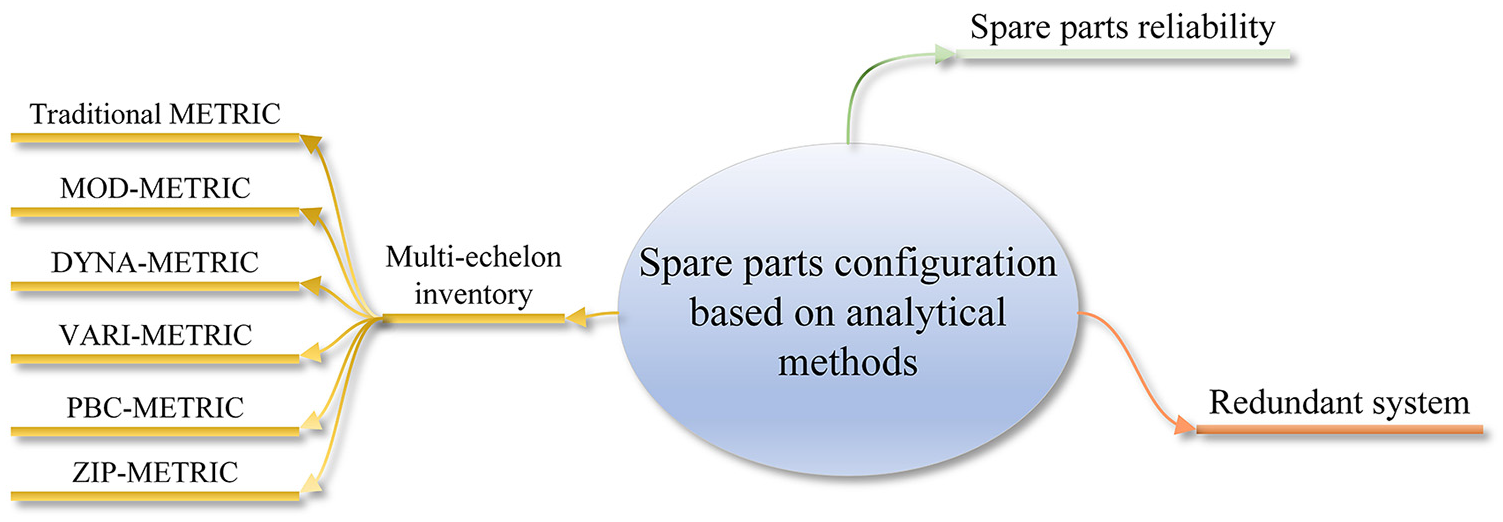
Spare parts configuration based on analytical methods.
Optimization algorithms of spare parts configuration
With the rapid development of computer technology, a large number of optimization algorithms have also emerged and been applied in various fields. For civil aircraft spare parts configuration, this type of method is also applicable. Good deals of researches have been carried out, which was used for the optimization algorithm of spare parts configuration, and phased results have been obtained.
In order to reduce the cost of delay caused by unexpected failures, Batchoun et al. 131 used genetic algorithms to determine the best configuration plan of spare parts. Marseguerra et al. 132 used genetic algorithms to optimize the number of spare parts required for a multi-component system, so as to optimize multiple goals such as system revenue and total inventory. Khorshidi et al. 133 used genetic algorithms to model for the redundancy system to determine the best redundancy configuration and inventory configuration. Patriarca et al. 134 optimized the inventory level of repairable spare parts in a complex network through genetic algorithm. Cai et al. 135 developed a combined method of genetic algorithm and Monte Carlo to get the optimal inventory level, safety level and potential failure threshold, and proposed an appointment policy of spare parts based on the prediction of residual life. Wu et al. 136 proposed an approach based on genetic algorithms to reduce the total operational cost of spare parts logistic system by appropriately designing the bill of material configuration. Durán et al. 137 used genetic algorithm to develop an optimization model for spare parts management during the life cycle based on the principles of Activity Based Costing. The above researches were considered from the different perspective of inventory configuration by genetic algorithms.
In addition to genetic algorithms, there are many applications of typical heuristic optimization algorithms in spare parts configuration, such as Mohammaditabar et al. 138 proposed an inventory strategy, and used simulated annealing algorithm to model and solve it, in order to achieve the purpose of inventory classification and obtain the optimal inventory. Levner et al. 139 analyzed the multi-level spare parts inventory of civil aircraft with out-of-stock orders and interval demand based on the ANN model. Qin et al. 140 proposed a dynamic basic inventory strategy for a two-level repairable spare parts network, which is implemented by a greedy algorithm based on marginal analysis. Rahimi-Ghahroodi et al. 141 presented a greedy heuristic method to jointly optimize the stoke levels and the number of service engineers to minimize the total service costs. Sheikh-Zadeh et al. 142 defined a greedy heuristic optimization spare parts storing model for the purpose of segementate multi-echelon inventory.
Luis and Orlando 143 combined the particle swarm optimization algorithm with local search to solve the multi-level inventory configuration optimization problem of spare parts. Ali et al. 144 realized the multi-level spare parts inventory optimization configuration of complex equipment machinery through antlion algorithm. Sheng and Prescott 145 used a variety of colored Petri nets (CPN) models to represent maintenance activities, maintenance management and other factors affecting maintenance of the fleet. The scholar also proposed a novel hierarchical colored Petri net (HCPN) model of the fleet spare parts inventory system, which can solve the problem of fleet deployment and task-oriented spare parts configuration. 146 Lee et al. 147 developed a solution framework that integrates the multi-objective evolutionary algorithm and the multi-objective computing budget configuration method to solve the problem of aircraft spare parts configuration with huge search space, multiple goals, and high variability.
Furthermore, some scholars developed unique heuristic algorithms for specific problems in spare parts inventory management. In order to achieve a good level of civil aircraft spare parts inventory, Ni et al. 148 proposed a heuristic algorithm model for optimizing the average waiting time of aircraft, the optimization results showed that the reasonable degree of the distribution of spare parts inventory can be improved, thereby enhancing the aircraft utilization rate. van Jaarsveld et al. 149 proposed an inventory control algorithm for an assemble-to-order system to find the basic inventory level to minimize inventory costs and out-of-stock costs.
Optimization algorithms of spare parts configuration management have certain advantages in computational efficiency and are not sensitive to problems with higher dimensions. However, due to the randomness of the initial value selection in the solution process, the analysis results have a certain degree of discreteness. In addition, the research on the optimization algorithm of spare parts configuration is still in theoretical research, and the engineering factors considered are not yet comprehensive. The above two types of spare parts configuration techniques have their own characteristics. In the engineering application of spare parts configuration techniques, a reasonable method should be analyzed and selected according to the characteristics and data basis of the spare parts configuration problem. Table 2 shows the comparative analysis of the two methods of civil aircraft spare parts configuration.
Comparison of existing methods for civil aircraft spare parts configuration.

Further research of civil aircraft spare parts management
With the development of the global civil aviation industry, the scale of the civil aircraft fleet continues to expand. Civil aircraft spare parts prediction and configuration techniques have become an important focus of comprehensive logistics support. In order to realize the accurate prediction and reasonable configuration of civil aircraft spare parts based on the preliminary research and tracking of relevant documents, the development trends of civil aircraft spare parts prediction and configuration techniques are sorted out, as shown in Figure 7.
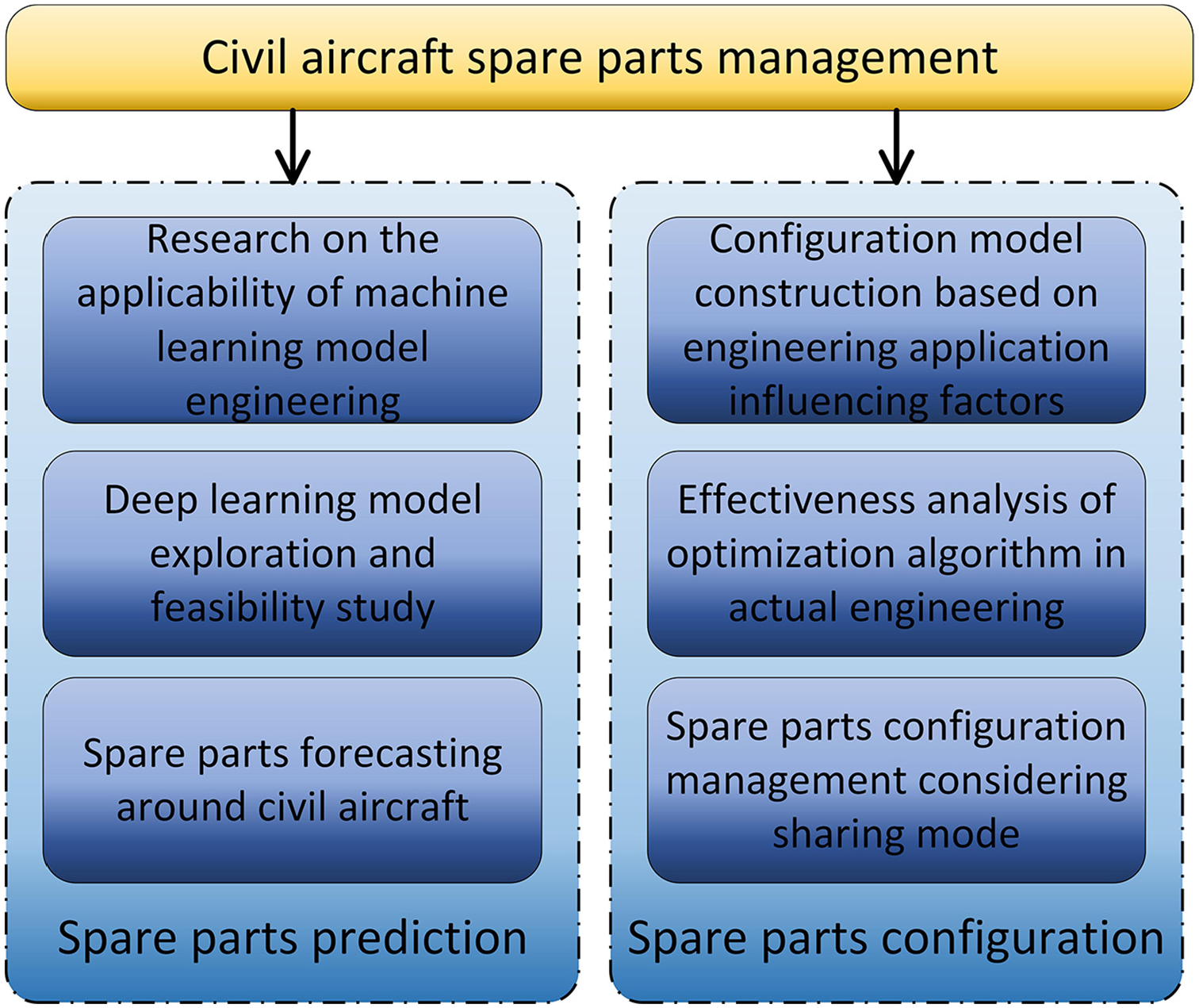
Development trends of spare parts management.
The works of the civil aircraft spare parts support system mainly include the prediction and configuration techniques. The development trends of related techniques can be described as below.
Spare parts prediction techniques
With the actual growth of civil aircraft operations and the accumulation of related historical spare parts consumption data, although machine learning models show certain advantages in spare parts prediction, the applicability of spare parts prediction of machine learning models combined with actual data is still the focus of the next research. With the rapid development of big data theory in recent years, the application of deep learning models to spare parts prediction and its feasibility study is expected to become a feasible way to achieve scientific spare parts prediction in the next step. Currently a lot of civil aircrafts have been put into operation one after another, the following research can learn from the prediction work experience of those mature models and big data theory to realize accurate prediction of spare parts, which will be an important direction for actual prediction of spare parts in the civil aviation industry.
Spare parts configuration techniques
Although a large number of researches have been carried out on the configuration of civil aircraft spare parts, most of the researches are only analyzed from a theoretical perspective. Therefore, in order to guide the actual project, the next step is to carry out research on spare parts configuration methods from the perspective of actual requirements, such as considering maintenance engineers, ground support equipment (GSE) and spare parts integration configuration techniques. These efforts will help avoid shortage and waste of spare parts, improve maintenance efficiency and reduce operating support costs in a certain extent when the configuration of spare parts meets the demand for continuous airworthiness. For the existing optimization algorithm needs to further explore the engineering applicability in the above direction. At present, major manufacturers and operators are tending to integrate maintenance resources. Therefore, the research on spare parts configuration methods that considers the sharing mode will become a research hotspot in the next stage.
Conclusions
Spare parts prediction and configuration methods have always been an important research direction in the comprehensive management of civil aircraft spare parts. The reasonable prediction of spare parts demand and efficient configuration of spare parts have greatly affected stakeholders operating capabilities and market competitiveness. In this paper, the development status of civil aircraft spare parts prediction and configuration techniques are studied one by one, the advantages and disadvantages of methods are sorted out, which provide references for the engineering application of civil aircraft spare parts management. On this basis, the development trends of civil aircraft spare parts prediction and configuration techniques are analyzed. Some conclusions are given as below.
Spare parts prediction techniques are divided into four categories: time series method, regression analysis method, failure observation methods and machine learning model. And the applicable scenarios of different methods are analyzed and summarized: time series methods based on historical spare parts consumption data are suitable for predicting little change demand, regression models have good performances in some systems that are affected by multiple factors; the prediction based on failure observation methods can solve the demand of a fleet established by introducing new aircraft; machine learning techniques have strong self-learning ability, which can rapidly find the optimal solution in nonlinear system.
Spare parts configuration techniques are divided into two categories based on analytical methods and based on optimization algorithms. And the applicable scenarios of different methods are analyzed and summarized: the analytical methods can conduct the spare parts inventory management from the perspective of multi-echelon inventory, spare parts reliability, redundant system and supply chain; multi-objective optimal problems can fast be solved by optimization algorithms based on requirements and supply data of spare parts.
Combined with the development potential of deep learning theory and sharing mode in this field, the engineering feasibility of civil aircraft spare parts management methods and techniques based on intelligent optimization algorithms should be further researched.
Footnotes
Handling editor: James Baldwin
Declaration of conflicting interests
The author(s) declared no potential conflicts of interest with respect to the research, authorship, and/or publication of this article.
Funding
The author(s) disclosed receipt of the following financial support for the research, authorship, and/or publication of this article: This paper is supported by the National Natural Science Foundation of China (Grant No. 51875465). The authors would like to thank them.
