This paper investigates the enhanced viscous behavior and heat transfer phenomenon of an unsteady two di-mensional, incompressible ionic-nano-liquid squeezing flow between two infinite parallel concentric cylinders. To analyze heat transfer ability, three different type nanoparticles such as Copper, Aluminum , and Titanium oxide of volume fraction ranging from 0.1 to 0.7 nm, are added to the ionic liquid in turns. The Brinkman model of viscosity and Maxwell-Garnets model of thermal conductivity for nano particles are adopted. Further, Heat source , is applied between the concentric cylinders. The physical phenomenon is transformed into a system of partial differential equations by modified Navier-Stokes equation, Poisson equation, Nernst-Plank equation, and energy equation. The system of nonlinear partial differential equations, is converted to a system of coupled ordinary differential equations by opting suitable transformations. Solution of the system of coupled ordinary differential equations is carried out by parametric continuation (PC) and BVP4c matlab based numerical methods. Effects of squeeze number (S), volume fraction , Prandtle number (Pr), Schmidt number , and heat source on nano-ionicliquid flow, ions concentration distribution, heat transfer rate and other physical quantities of interest are tabulated, graphed, and discussed. It is found that and Cu as nanosolid, show almost the same enhancement in heat transfer rate for Pr = 0.2, 0.4, 0.6.
Electrokinetic effects can be experienced and observed, when an ionic liquid comes into contact to the charged wall of a liquid flow channel. The charged wall attracts counter-ions present in nano-ionic liquid and thus an electric double layer (EDL), forms on a charged wall of a liquid flow channel. Development of a double layer structure causes shortage of concentration of counter ions in a bulk. In pressure-driven flow, the downstream flow of these counter-ions develop a current that creates an electric potential field within a flow channel. An electric potential field, in turn, creates an electric force at each point in the flow channel and thus develops resistance to flow, thereby increasing flow resistance and apparent viscosity of an ionic liquid. Nekoubin,1 studied an electroosmotic flow of non-Newtonian fluids through a curved rectangular microchannels by solving the system with SIMPLE finite method. They found that increasing the aspect ratio leads to an increase in the circulation strength of shear thinning fluid flow. At the same year, Banerjee et al.,2 performed a numerical study with variation of channel height when more ionic species with channel patterned with heterogeneity has been considered. They compared analytical results for transport characteristics of an electroosmotic flow obtained with a direct numerical simulation of Nevier-Stokes equation, Nernst-Plank equation, and Poisson equation, simultaneously. The study has shown that heterogeneous potential could generate complex flow structures and an increment of species layer at different levels significantly improve the mixing rate. Bag and Battacharya,3 worked out a numerical study of an electroosmotic flow of a non-Newtonian fluid near a surface potential homogeneity. The limitations of the linear slip-model and the nonlinear Poisson-Boltzmann model at various flow conditions have been highlighted.
The unsteady flow of viscous fluid between squeezing parallel plates, moving normal to their surfaces, is of much interest in a hydrodynamical machine. It is practically worked out in a polymer processing, compression, and injection modeling. Stefan,4 reported work on squeezing flow under lubrication approximation mechanism. Domairry and Aziz,5 has investigated effects and characteristics of a squeezing flow of a viscous fluid under a magnetic field, between parallel disks. Whereas effects of the hydro-magnetic squeezing flow of a viscous fluid between parallel plates have been discussed by Siddiqui et al.6 In both these investigations, solutions of the models have been carried out by a homotopy perturbation method (HPM). Similarly, Rashidi et al.,7 analyzed the hydrodynamic squeezing flow of a viscous fluid by homotopy analysis method (HAM). Nayak8 investigated the steady/unsteady electroosmotic flow in an infinitely extended cylindrical channel with diameters ranging from 10 to 100 nm. They considered a mixture of for numerical calculation of the mass, potential, velocity, and mixing efficiency. Results are obtained for the channel diameters are small, equal, or greater than the electric double layer (EDL) both for steady and unsteady cases. Similarly, the unsteady flow of nanofluid between two squeezing parallel plates have been investigate by Shekholeslami et al.9 They solved the problem by (ADM) and found that the Nusselt number increases with increase of volume fraction and Eckert number while it decreases with growth of Squeeze number.
A specific heat capacity of a material is the most noticeable characteristic for an evaluation of thermal conductivity of a material.10–14 Unfortunately, Literature has limited experimental evaluations, been carried out, to determine specific heat capacity of so much material existed. Moreover, pure liquids like oil, water, and ethylene glycol mixture are poor heat transfer mediums in engineering and technical systems, due to their poor thermal conductivity. In contrast, solid material has high value of the thermal conductivity than that of liquids. For example, the thermal conductivity of a copper (Cu) is 3000 times higher than that of an engine oil and 700 times more than that of water. The word nano-fluid was first time mentioned by Choi and Eastman,10 to recognize an engineered colloids composed of nano-particles, suspended in a base fluid. Further, the data available at present are mostly computed by using a theoritical model developed by Pak and Cho.15 However, according to Vajjha and Das,16 a theoritical model is not always suitable to precisely determine the specific heat capacity. Hence, the experimental evaluation is required to provide accurate specific heat capacity value, thermal characteristics, and performance of a nano-fluid. As such, Zhou and Ni,17 used the differential scanning calorimetry (DSC) to determine the , water-based nano-fluid’s specific heat capacity, and reported an inverse relation with volume concentration. In addition, O’Hanley et al.,18 used heat flux type DSC to evaluate the specific heat capacity for CuO, SiO, and based nano-fluid at a temperature up to and at a maximum concentration of and observed comparable findings. The matching result was also reported by Zhou et al.,19 using CuO-ethylene glycol based nano-fluid. Nano-fluids are a homogenous mixture of a base fluid and nano-particles. Metallic or non-metallic nano-particles are mixed with a base fluids include water, organic liquids, engine oils, lubricants, bio-fluids, polymeric solution, and other common liquids, to enhance transport properties and heat conduction ability of a common base fluids. Nano-particle is a distributive part of any material, having a diameter is about less than 100 nm. Experiments has shown the fact that the heat transfer ability enhancement is dependant on amount of the dispersed nano-particles, nature of a material, and a shape of nano-particle, suspended in the base fluid. Numerical investigation of heat transfer enhancement behavior of a fluid by adding nano-particles, in a differentially heated enclosure was first worked out by Khanafer et al.20 They found that the suspended nanoparticles in a base fluid enhances heat transfer speed significantly, at any given Grashof number. Sheikholeslami et al.,21 investigated effects of a magnetic field on a natural convection flow of nano-fluid (cu-water) in an inclined half-annulus enclosure, by Finite Element Method. Moreover, Akbari et al.,22 studied laminar forced convection heat transfer of water- nanofluids through horizontal rib-microchanneland simulation for Reynolds numbers 10–100 and nanoparticle volume fraction of 0.00–0.04 inside a two dimensional rectangular microchannel were performed. Esfe et al.,23 examined thermal behavior of nanofluids, thermal conductivity of -EG nanofluids by KD2-Pro thermal analyzer. They performed experiments at temperature ranging from to while volume fraction . Similarly, Jiang et al.,24 experimentally examined a mixture of /deionized water nanofluid thermal conductivity at various temperature and mass fractions, they developed a new prediction approach of fuzzy lookup table method (FLTM). Thermal conductivity of /deionized water nanofluid has been measured by several experiments; and then the statistical/numerical approach of fuzzy lookup table method has been presented. It is seen that thermal conductivity is function of temperature and nanoparticles concentration. Recently, Peng et al.,25 investigated the thermal conductivity of -Cu/EG with an equal volume by an Artificial neural network (ANN). They added a mixture of and Cu nanoparticles in to EG at various concentration of 0.125–2.0 at T = 25 to T = 50. Further, the feedforward multilayer perception of NN was examined to simulate the thermal conduction coefficient of -Cu nanofluids. In brief, Researchers recently investigated various kind of fluids with or without suspension of nanosolid, through different flow geometries,26–30 and presented the results in detail.
Review of the above articles shows that various effective parameters were studied in different works. This paper investigates effect of different parameters on heat transfer behavior, flow velocity, and ions concentration distribution of an unsteady nano-ionicliquid flow through squeezing parallel cylinders. To analyze heat transfer ability, three different type nanoparticles such as copper, Aluminum , and Titanium oxide of volume fraction ranging from 0.1 to 0.7 nm, are added to the ionicliquid in turns. The Brinkman model of viscosity and Maxwell-Garnets model of thermal conductivity for nanoparticles are adopted. Further, Heat source , is applied between the concentric cylinders. For this model, the unsteady two dimensional, incompressible nano-particle based ionic liquid flow between concentric cylinder shown in Figure 1 is assumed. The physical model is formulated into partial differential equations system by the general continuity equation, the modified momentum equation, the Poisson equation, the Nernst-Plank equation, and the energy equation. By similarity transformation, the PED’s are converted to equivalent ODE’s system. The solution of the model is carried out by the parametric continuation (PCM) and BVP4c matlab based methods. The solution comparison of the two methods and effects of parameters on a velocity field, heat transfer, and other physical variables are tabulated and graphed. According to our literature survey there is no work available on this problem.
Schematic view of electrolyte based nanofluid.
Model description
In this talk, an unsteady, two-dimensional, laminar, boundary layer flow, and heat transfer of nanoparticles based ionic-liquid between concentric cylinders under an influence of an induced electric field is investigated. It is assumed that an ionic-liquid composed of nanoparticles is infinite in the positive z-direction. The polar coordinate system (r, , z), is considered on the center of the inner cylinder so that velocity components u, v, and w are along r-axis, -axis, and z-axis respectively, as shown in Figure 1. It is assumed that diameters of both the concentric cylinders are functions of time, with unsteady radii and of the inner and outer cylinders respectively, where is a constant of the expansion/contraction strength, t denotes time, and denotes radius of the inner cylinder at t = 0. The fluid is taken to be symmetric nanoparticles ionic-liquid of a constant viscosity , and density . Thus anions and cations (specified by + and − respectively), are assumed to have equal valencies z = 1, and equal diffusivities D. A net electrostatic surface charge density , is assumed on the inner cylinder wall. A bulk concentration of each ion species, and the mean inflow velocity are represented by and respectively. Also heat source , is applied between the concentric cylinders. Thermo-physical properties of water and a few specific nano-particles are given in Table 1.
Thermal physical properties of water and nano-particles.
Pure water
997.1
4179
0.613
Copper (Cu)
8933
385
401
Silver (Ag)
10.500
235
429
Aluminum
3970
765
40
Titanium-Oxide
4250
686.2
8.9538
The governing equations equations are
Continuity equation:
Momentum equation with electro-kinetic effect:
The Poisson equation:
The Nernst–Plank equations:
The energy equation:
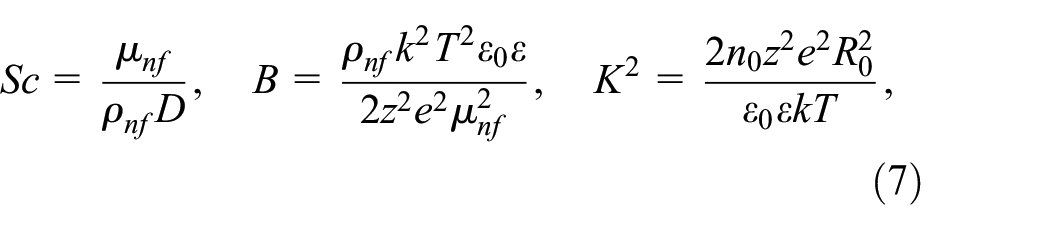
with the associated dimesionless paramers, Schmidt (Sc), Inverse Debye length (K), B is fixed for a given liquid at a specified temperature, defined as
where is the velocity vector of nano-particles based ionic-liquid and p indicates pressure. Moreover, , , , and are the effective density, the effective dynamic viscosity, the effective heat capacity, and the effective thermal conductivity of the nano-particle based ionic-liquid respectively, defined as
Boundary conditions.
Associated boundary conditions of the model are
To analyze the model, we introduce these transformation parameters
where , , , , , , and are the similarity variable, dimensionless radial velocity, dimensionless axial velocity, dimensionless induced potential, dimensionless temperature, dimensionless cations and anions concentration distribution functions, respectively.
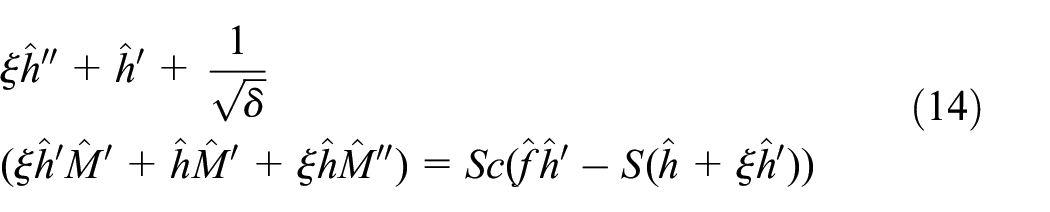
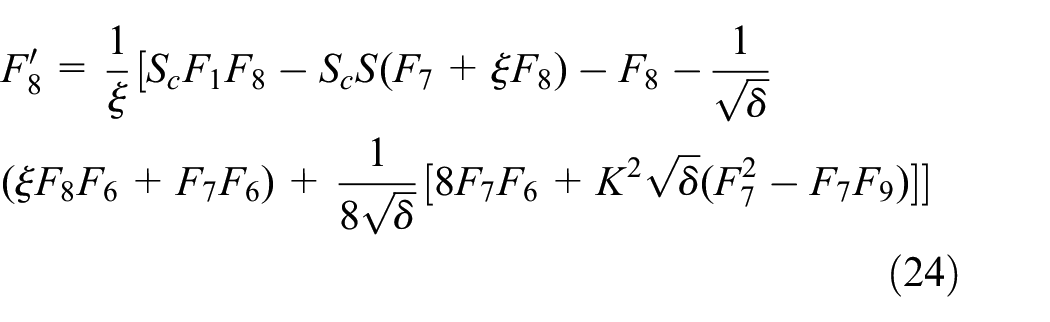
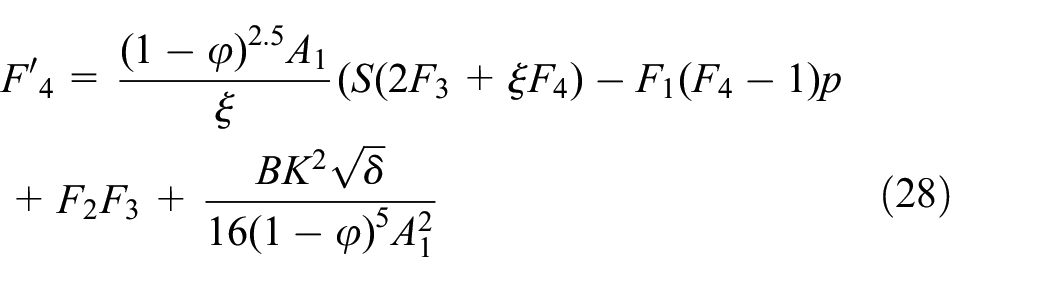
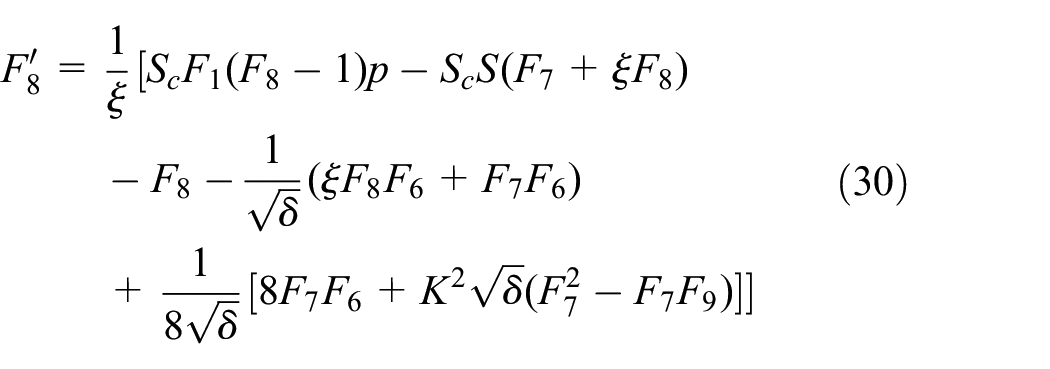
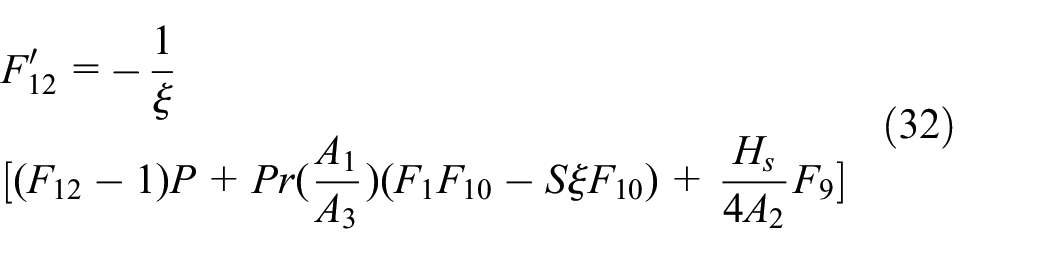
Equations from (1) to (6), are converted to the following coupled system by using the proposed transformations defined in (10).
Where , , and are dimensionless constants, given by
whereas the squeeze parameter (S), the prandtl number (Pr), and heat source parameter , appeared in the model are defined as:
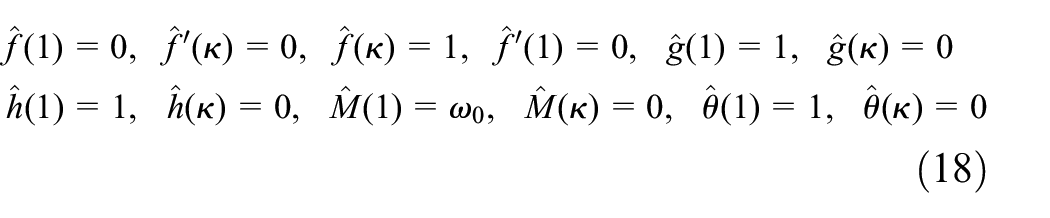
and boundary conditions given in (9), are converted to
where
The physical quantities of interest are the skin friction coefficient and the Nusselt number, defined as:
Analytic solution by parametric continuation method
Application of the parametric continuation method to the system of nonlinear equations , with boundary conditions , and optimal choice of continuation parameter, is made in this section. The following procedural algorithm is a sequence of steps to be followed for an application of the method through matlab.
Canonical form of a BVP as a first order ODE
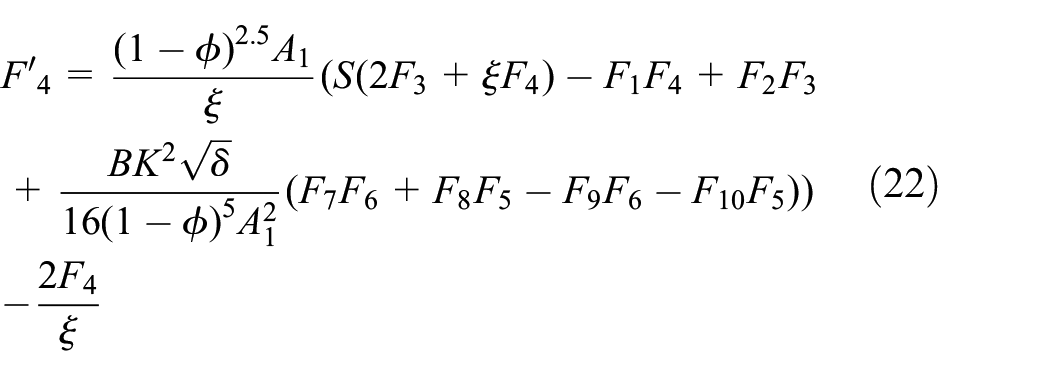
To convert equations (11−15), into first order ODE, we suppose the following
where is a coefficient matrix, is a remainder, and , .
Application of the supposition principle and specify Cauchy problem for each component
Here denote unknown vector functions. Solving the following two Cauchy problems for each component, we then satisfy the original ODE automatically
and leave the boundary conditions.
Numerical solution of Cauchy problem
To solve the problem, we use an implicit scheme, defined as below.
Selection of corresponding blend coefficient
Since, boundary conditions are applied only for , where . Solving ODE for sensitivities, we need to apply , which in matrix form looks as
where
Result and discussion
In recent analysis work, an ionic water is the base liquid, containing different kinds of nano-particles such as copper, aluminum or titanium oxide, flowing between parallel concentric cylinders. The system of nonlinear ordinary differential equations (11−15), subject to boundary conditions (18), are solved by numerical techniques the PCM and BVP4C method. In order to analyze effects of an involved parameter on physical quantities of interest of the nano-ionic liquid flow between parallel concentric cylinders. A number graphs and analysis data tables are presented.
Figure 2 is drawn to discuss the velocity behavior of different types of nano-liquid flow between parallel cylinders. Figure 2(a) shows that the velocity is higher for the -water and -water than Cu-water nano-liquid flow, which confirms the realty that density of the nano-liquid that is Cu-water is more than that of the -water and -water. Thus nano-particle of greater density tends to decrease velocity of a nano-liquid flow. Figure 2(b) to (d) presents effects of particle volume fraction on the velocity profile in case of different nano-liquid format. From figures, it is obvious that the velocity is an increasing function of a volume fraction in all the three types nano-particle water combination. But the velocity shows significant increase in magnitude for increasing values of the particle volume fraction in case of Cu-water liquid format.
Profile of for different nano particles (a) and different values of ϕ (b, c, d) for fixed values of , , , , , , .
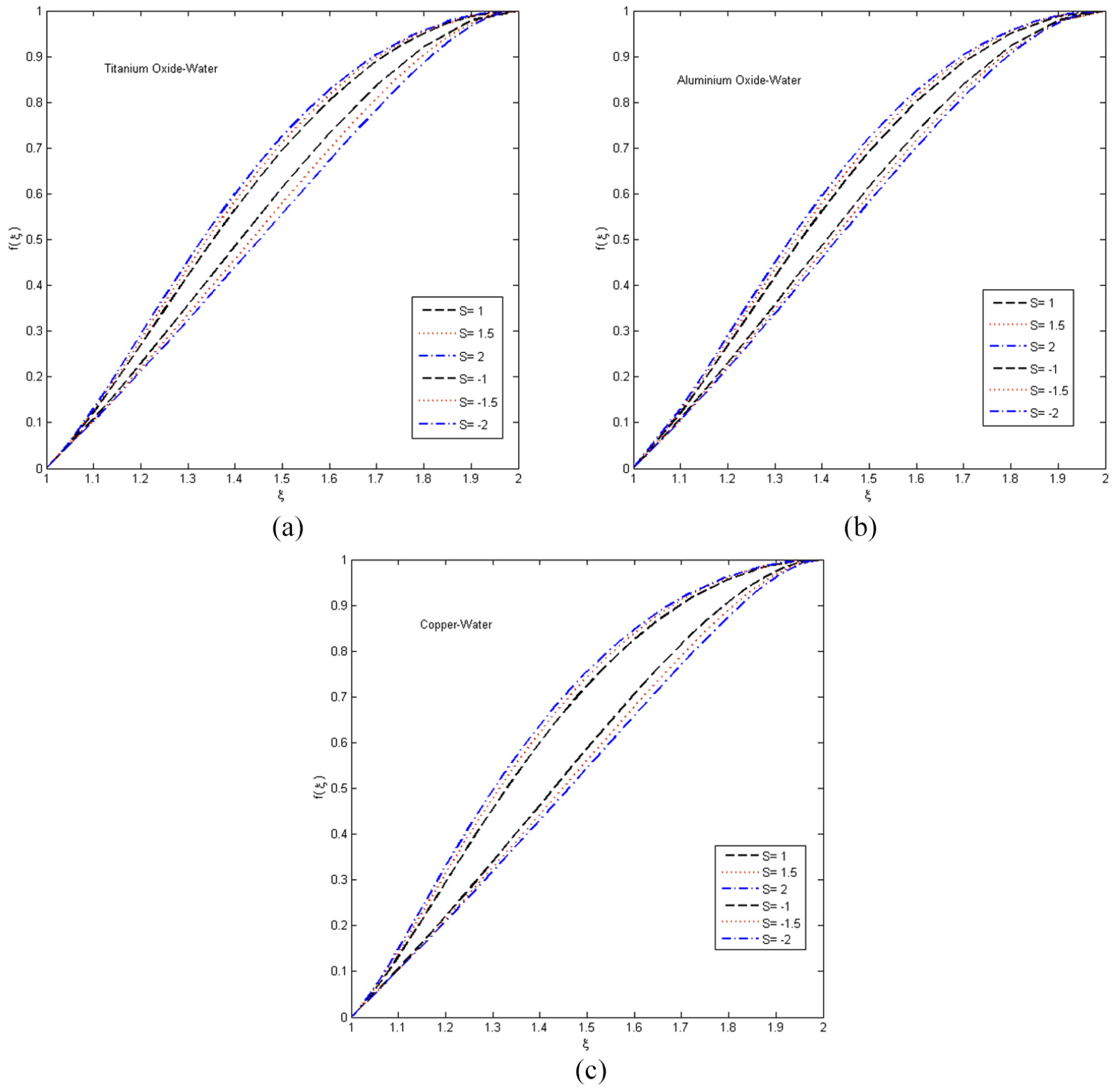
Figure 3 expresses effect of squeeze number (S), on a horizontal velocity of flow of nano-ionic liquid, for different nano-particle. Here, it is worth to note that positive squeeze number means widening a flow channel and negative squeeze number refers to narrowing the flow channel. All three graphs in Figure 3, indicates that the velocity decreases with increases values of and increases with increases absolute values of . Moreover, As Figure 3 displays graphs of velocity profile for all the three nano-particle liquid format, so it can be noted that variation in magnitude of velocity profile due to squeeze number (S), is significant in case of Cu-water than that of -water and -water format.
Profile of for the effect of Titanium Oxide-Water (a), Aluminium Oxide-Water (b) and Copper-Water (c) for fixed values of , , , , , , .
Figure 4 presents vertical velocity of the flow for different type nano-particle liquid format, particle volume fraction , and squeeze number (S). Figure 4(a) shows that magnitude of is higher for -water and -water format than in case of Cu-water format in the flow region and the behavior absolutely reverses for flow region . Figure 4(b) portray dependance of vertical velocity of Cu-water flow on particle volume fraction . It is observed that velocity is an increasing function of a larger particle volume fraction in the flow region and display totally reverse behavior for the flow region . Figure 4(c) and (d) informs that widening of the flow channel between parallel cylinders tends to decrease the vertical velocity for the flow region and increase in the flow region , whereas narrowing the flow channel tends to increase the vertical velocity for the flow region and decreases onwards.
Profile of for for the effect of (a) dufferent nano particles, (b) volume fraction and (c,d) S for fixed values of , , , , , , .
Effects of heat source (Hs), Prandtl number (Pr), and squeeze number (S), on heat transfer rate for different type of particle water mixture are displayed in Figures 5 to 7. Figure 5(a) display comparative ability of heat transfer for Aluminum Oxide, Copper, and Titanium Oxide nano-particle water format. It can be noticed from graphs that heat transfer ability of Copper and Aluminum Oxide is better than that of Titanium Oxide. Figure 5(b) and (c) present responses of heat transfer behavior of Aluminum Oxide, Copper, or Titanium Oxide particle water mixture for an increasing value of heat source (Hs). From graphs, it is evident that heat transfer ability enhances for an increasing value of the heat source parameter (Hs), for every type of nano-particle. But in case of Copper as nano-particle, heat transfer rate is the best. Figure 6 display effects of a prandtl number on heat transfer rate for different type nano-particle. It is also observed that ability of heat transfer rate enhances independent of nature of a nano-particle, by an increasing the Prandtl number (Pr). The comparative analysis of the Figure 6(a) to (c) helps to draw the conclusion that the Copper and Aluminum oxide are better choices for the heat transfer with larger values of the prandtle number (Pr). The last Figure 7, display effects of a squeeze number (S) on heat transfer nature of the different nano-particle liquid format. Figure 7(a) shows that heat transfer ability of the Titanium Oxide as nano-particle decreases by an increasing a squeeze number S in the flow region , and increases in the region . Figure 7(b), indicates that the heat transfer behavior of a copper as nano-particle depreciates very significantly. Thus, it can be concluded that to transfer heat efficiently, copper as nano-particle is the best choice.
Profile of for the effect of (a) dufferent nano particles and (b,c) different values of Hs.
Profile of (a,b,c) for the effect Pr.
Profile of (a,b) for different values of S.
Table 2 is developed to investigate behavior of Nusselt number as response to variation in values of squeeze number (S), Prandtl number (Pr), and heat source parameter (Hs), in case of Cu-water, -water, and -water mixture. It is observed that Nusselt number decreases with increases of Prandtl number(Pr) in cases of all three nano-particle water mixture. But Nusselt number is larger in case of the Cu-water mixture than in case of the -water and -water, which implies that convective heat transfer behavior is depreciating by an increasing Prandtl number. Similarly, the same table presents a relation between squeeze number (S) and Nusselt number for all the three particle-water mixture. The data in the table reveals that an increasing squeeze number , tends to decrease Nusselt number, whereas increasing an absolute squeeze number , tends to increase Nusselt number. The table further shows that Nusselt number is an increasing function of heat source parameter (Hs), This implies that thermal boundary layer is developing by increasing a value of heat source parameter. Table 3, is specified to discuss effects of a particle volume fraction , and a squeeze number (S) on the skin friction coefficient , for all three nano-particle water format. The table data indicates that the skin friction coefficient is increasing function of a particle volume fraction , which means that boundary layer velocity increases by increasing the volume fraction . The numerical data further shows that the boundary layer velocity change is prominent in Cu-water mixture than that in -water and -water combination. Table 3 also presents dependance of the skin friction coefficient on a squeeze number (S). From table data, it can be noticed that an increasing squeeze numbe r tends to decrease skin friction coefficient, which implies that widening the flow channel slows down the boundary layer velocity. whereas increasing an absolute squeeze number , causes skin friction coefficient to increase, which indicates that boundary layer velocity increases by narrowing the flow channel.
Local Nusselt number attitude in Cu-Water, -water, and -water mixture, for different values of Pr, S, and Hs. When B = 0.5, K = 0.5, , Sc = 0.2, .
The Nusselt number
Prandtl number
Squeeze number
Heat source parameter
Copper
1
1
0.5
0.3045
0.3666
0.0365
1.4
0.2172
0.2556
0.0259
1.7
0.1787
0.2086
0.0213
2
0.1518
0.1763
0.0180
1
1
0.3045
0.3666
0.0365
1.5
0.2025
0.2351
0.0240
2
0.1517
0.1742
0.0180
−1
271.5367
25.3509
53.0235
−1.5
406.2264
37.0427
78.2850
−2
541.0307
48.8194
103.6860
1
0.5
0.3045
0.3666
0.0365
1
0.6097
0.7470
0.0731
1.5
0.9156
1.1431
0.1097
2
1.2222
1.5573
0.1463
The skin friction coefficient attitude in Cu-Water, -water, and -water mixture, for different values of and S. When B = 0.5, K = 0.5, , Sc = 0.2.
Skin friction coefficient
Volume fraction
Squeeze number
Copper
0.1
1
0.9869
1.6604
1.6044
0.3
1.5087
2.1133
2.0707
0.5
2.1316
2.5036
2.4804
0.7
2.6304
2.7564
2.7491
0.1
1
0.9869
1.6604
1.6044
1.5
0.5670
1.1736
1.1133
2
0.3768
0.8569
0.8031
−1
11.1161
6.2774
6.5465
−1.5
15.5544
8.0660
8.4843
−2
20.2838
10.0108
10.5875
Table 4 is the only table, which characterizes to display the matching results of the flow model by two numerical methods, parametric continuation (PC) and BVP4C matlab packages. Both the methods are employed to solve the coupled nonlinear ordinary equation system (11–15) with boundary conditions (18), for fixed physical parameters, S = 1, B = 0.5, K = 0.5, , Sc = 0.2, Pr = 2, = 0.5, Hs = 0.5, in all the three particle-water mixture. The obtained data table reveals that solution of the modal is in a good agreement for both the numerical methods in all the three formats. Thus the recent research work gives confidence to researchers that they may use both or any of the two numerical methods for their modal solution.
Comparison of PCM results with that of BVP4C, for physical parameters, S = 1, B = 0.5, K = 0.5, , Sc = 0.2, Pr = 2, , Hs = 0.5.
PCM
BVP4C
1
0
2.0000
1.0000
1.0000
1.0000
0.0000
2.0000
1.0000
1.0000
1.0000
1.1000
0.0644
1.7281
0.9078
0.9215
0.9364
0.0621
1.7617
0.9080
0.9280
0.9321
1.2000
0.1736
1.4789
0.8249
0.8424
0.8651
0.1714
1.4586
0.8250
0.8450
0.8691
1.3000
0.3105
1.2489
0.7464
0.7607
0.7857
0.3184
1.2897
0.7417
0.7617
0.7804
1.4000
0.4605
1.0354
0.6680
0.6749
0.6978
0.4652
1.0536
0.6685
0.6785
0.6959
1.5000
0.6107
0.8360
0.5857
0.5834
0.6016
0.6187
0.8378
0.5878
0.5800
0.6000
1.6000
0.7495
0.6491
0.4961
0.4849
0.4973
0.7476
0.6411
0.4911
0.4810
0.4900
1.7000
0.8667
0.4732
0.3957
0.3784
0.3850
0.8600
0.4710
0.3949
0.3749
0.3843
1.8000
0.9530
0.3070
0.2815
0.2626
0.2648
0.9589
0.4004
0.2804
0.2603
0.2632
1.9000
1.0000
0.1496
0.1505
0.1368
0.1367
0.9971
0.1401
0.1501
0.1310
0.1333
2.0000
1.0000
−0.0000
−0.0000
0.0000
0.0000
1.0000
0.0000
0.0000
0.0000
0.0000
Conclusion
In this paper, parametric continuation method (PCM) and BVP4C have been applied to analyze an unsteady nano-ionicliquid flow and heat transfer ability of different nanoparticles, between squeezing concentric cylinders. In order to investigate heat transfer ability, three different type nanoparticles such as copper, Aluminum , and Titanium oxide of volume fraction ranging from 0.1 to 0.7 nm, are added to the ionicliquid in turns. The Brinkman model of viscosity and Maxwell-Garnets model of thermal conductivity for nanoparticles have been adopted. The squeezing flow channel is assumed, with as coefficient of expansiona/contraction. The unsteady two dimensional flow of nano-ionicliquid through squeezing flow channel is modeled into PDE’s by momentum equation with electric force, Poisson equation, Nernst-Plank equation, and energy equation. The PED’s are converted to ODE’s by suitable similarity transformations. Solution of the system is worked out by two numerical methods PCM and BVP4c .It is observed that results of PCM is in a very good agreement with that of BVP4C method, so it is concluded that any of the two methods can be used for finding numerical solution of a system of coupled differential equations, confidently. The effects of a squeeze number (S), volume fraction , heat source(Hs), and a Prandtl number (Pr) on a velocity profile, skin friction coefficient, and Nusselt number, are numerically investigated. Some worthy conclusions are drawn, noted below.
The Skin friction coefficient analysis reveals that boundary layer velocity increases by increasing a value of volume fraction . In addition, this behavior of the boundary velocity is very distinct in the Cu-ionicliquid flow between concentric cylinders.
The Skin friction coefficient analysis against the Squeeze number (S) explores the fact that boundary layer velocity decreases with widening of a flow channel and increases with narrowing of a flow channel.
The analysis of a Nusselt number for Cu-water, -water, or -water in response to a Prandtl number (Pr), a squeeze number (S), and heat source(Hs), concludes that copper is the best choice for the heat transfer rate enhancement through the contracting flow channel with the increasing heat transfer parameter (Hs).
Footnotes
Acknowledgements
The authors would like to thank the Department of Basic Sciences and Islamiat (BSI), University of Engineering and Technology (UET), for providing the necessary computing facilities required for this work. Also, the authors are very thankful for the valuable comments of the reviewers.
Handling Editor: James Baldwin
Declaration of conflicting interests
The author(s) declared no potential conflicts of interest with respect to the research, authorship, and/or publication of this article.
Funding
The author(s) received no financial support for the research, authorship, and/or publication of this article.
ORCID iDs
Rehan Ali Shah
Muhammad Sohail Khan
Aamir Khan
References
1.
NekoubinN. Electroosmotic flow of power-law fluids in curved rectangular microchannel with high zeta potentials. J Nonnewton Fluid Mech2018; 260: 54–68.
2.
BanerjeeANayakAKHaqueA, et al. Induced mixing electrokinetics in a charged corrugated nano-channel: towards a controlled ionic transport. Microfluid Nanofluidics2018; 22: 1–21.
3.
BagNBhattacharyyaS. Electroosmotic flow of a non-Newtonian fluid in a microchannel with heterogeneous surface potential. J Nonnewton Fluid Mech2018; 259: 48–60.
4.
StefanJ. Versuche ber die scheinbare Adhsion. Ann Phys1875; 230: 316–318.
5.
DomairryGAzizA. Approximate analysis of MHD squeeze flow between two parallel disks with suction or injection by homotopy perturbation method. Math Probl Eng2009; 2009: 603916.
6.
SiddiquiAMIrumSAnsariAR. Unsteady squeezing flow of a viscous MHD fluid between parallel plates, a solution using the homotopy perturbation method. Math Model Anal2008; 13: 565–576.
7.
RashidiMMShahmohamadiHDinarvandS. Analytic approximate solutions for unsteady two-dimensional and axisymmetric squeezing flows between parallel plates. Math Probl Eng2008; 2008: 935095.
8.
NayakAK. An analysis of steady/unsteady electroosmotic flows through charged cylindrical nano-channels. Theor Comput Fluid Dyn2013; 27: 885–902.
9.
SheikholeslamiMGanjiDDAshorynejadHR. Investigation of squeezing unsteady nanofluid flow using ADM. Powder Technol2013; 239: 259–265.
10.
ChoiSUEastmanJA. Enhancing thermal conductivity of fluids with nanoparticles. Report no. ANL/MSD/CP-84938; CONF-951135-29, Argonne National Lab., IL, 1995.
11.
SwainKMahantheshB. Thermal enhancement of radiating magneto-nanoliquid with nanoparticles aggregation and joule heating: a three-dimensional flow. Arab J Sci Eng2021; 46: 5865–5873.
12.
HamiltonRLCrosserOK. Thermal conductivity of heterogeneous two-component systems. Ind Eng Chem Fundamen1962; 1: 187–191.
13.
SafaeiMRHajizadehAAfrandM, et al. Evaluating the effect of temperature and concentration on the thermal conductivity of hybrid nanofluid using artificial neural network and curve fitting on experimental data. Physica A2019; 519: 209–216.
14.
MahantheshBShashikumarNSLorenziniG. Heat transfer enhancement due to nanoparticles, magnetic field, thermal and exponential space-dependent heat source aspects in nanoliquid flow past a stretchable spinning disk. J Therm Anal Calorim. Epub ahead of print 27June2020. DOI: 10.1007/s10973-020-09927-x.
15.
PakBCChoYI. Hydrodynamic and heat transfer study of dispersed fluids with submicron metallic oxide particles. Exp Heat Transf1998; 11: 151–170.
16.
VajjhaRSDasDK. Measurements of specific heat and density of nanofluid. AIP Conf Proc2008; 1063: 361–370.
17.
ZhouSQNiR. Measurement of the specific heat capacity of water-based nanofluid. Appl Phys Lett2008; 92: 093123.
18.
O’HanleyHBuongiornoJMcKrellT, et al. Measurement and model validation of nanofluid specific heat capacity with differential scanning calorimetry. Adv Mech Eng2012; 4: 181079.
19.
ZhouLPWangBXPengXF, et al. On the specific heat capacity of CuO nanofluid. Adv Mech Eng2010; 2: 172085.
20.
KhanaferKVafaiKLightstoneM. Buoyancy-driven heat transfer enhancement in a two-dimensional enclosure utilizing nanofluids. Int J Heat Mass Transf2003; 46: 3639–3653.
21.
SheikholeslamiMGorji-BandpyMGanjiDD, et al. Effect of a magnetic field on natural convection in an inclined half-annulus enclosure filled with Cu–water nanofluid using CVFEM. Adv Powder Technol2013; 24: 980–991.
22.
AkbariOAToghraieDKarimipourA, et al. Investigation of rib’s height effect on heat transfer and flow parameters of laminar water- nanofluid in a rib-microchannel. Appl Math Comput2016; 290: 135–153.
23.
EsfeMHKarimipourAYanWM, et al. Experimental study on thermal conductivity of ethylene glycol based nanofluids containing nanoparticles. Int J Heat Mass Transf2015; 88: 728–734.
24.
JiangYBahramiMBagherzadehSA, et al. Propose a new approach of fuzzy lookup table method to predict /deionized water nanofluid thermal conductivity based on achieved empirical data. Physica A2019; 527: 121177.
25.
PengYParsianAKhodadadiH, et al. Develop optimal network topology of artificial neural network (AONN) to predict the hybrid nanofluids thermal conductivity according to the empirical data of nanoparticles dispersed in ethylene glycol. Physica A2020; 549: 124015.
26.
NascimentoDROliveiraBRSaideVGP, et al. Effects of particle-size distribution and solid additives in the apparent viscosity of drilling fluids. J Pet Sci Eng2019; 182: 106275.
27.
WangHSuYWangW, et al. Enhanced water flow and apparent viscosity model considering wettability and shape effects. Fuel2019; 253: 1351–1360.
28.
SomanDPKarthikaSKalaichelviP, et al. Impact of viscosity of nanofluid and ionic liquid on heat transfer. J Mol Liq2019; 291: 111349.
29.
BanerjeeANayakAKWeigandB. Enhanced mixing and flow reversal in a modulated microchannel. Int J Mech Sci2019; 155: 430–439.
30.
MalekiHAlsarrafJMoghanizadehA, et al. Heat transfer and nanofluid flow over a porous plate with radiation and slip boundary conditions. J Cent South Univ2019; 26: 1099–1115.