



Abstract
In this paper, numerical and experimental analysis were carried out to study the characters of the detonated rupture disks used in rarefaction wave gun for test. The pressure bearing capacity and cutting blasting ability of the disks were studied in detail. The research results showed that the designed detonated rupture disks could withstand the maximum pressure of 140 MPa or more during launch process. The central detonating spoke had an annular cutting depth of about 1.3 mm. It was not the shearing deformation at the supporting edge but the excessive tensile deformation at the middle position that led to the failure. The disk was cut and destroyed as a whole satisfyingly, so the rationality and feasibility of the detonated rupture disks used in rarefaction wave gun for test were verified, which could provide a reference for the development of rarefaction wave artillery and similar low recoil weapons.
Keywords
Introduction
The rarefaction wave gun for test using the principle of rarefaction wave can better meet the requirements such as large diameter, heavy load, high initial velocity, and low recoil for modern dynamic simulation test equipment, so as to complete the target vulnerability analysis of the new weapon, the target damage effectiveness evaluation and the protection engineering protection ability evaluation. The key to the rarefaction wave gun for test is the opening timing and speed of the rear spray device. The opening methods that meet the opening requirements mainly include detonated rupture disks and inertial gun breech drive. Compared with the inertial gun breech rear spray device, the detonated rupture disks rear spray device opens quickly, so the gas has the strongest ability to spray, but at the same time, the ablation effect on the expansion nozzle during the rear spray process and the range of the rear spray dangerous area are also the biggest. There are many researches on inertial gun breech drive opening devices. The propulsion concept was explained, a methodology for the design of a reasonable apparatus for experimental validation was developed, and the experimental results were presented by Kathe.1–4 A one-dimensional model of the RAVEN was presented by Coffee.5,6 Physical and classical interior ballistics models of inertial breech RAVEN was emphatically set up, and the numerical simulation was implemented by Zhi et al. 7 The influence of loading conditions on launching performance of raven was analyzed by Zhang et al. 8 The launch property of the rarefaction wave gun and some influences of different factors on the launch property were studied by Wang et al.9–11 However, there are few researches on detonated rupture disks. This paper carried out the numerical and experimental researches on the pressure resistance and detonated cutting damage of detonated rupture disks, in order to provide support for the development of detonated rupture disks used in rarefaction wave gun for test.
The detonated rupture disks (see Figure 1) used in rarefaction wave gun for test is an opening device that relies on the mechanical properties of detonated disks to achieve delayed gas post injection. It consists of the disk, cutting rope, detonator, holder, and initiator, as shown below.
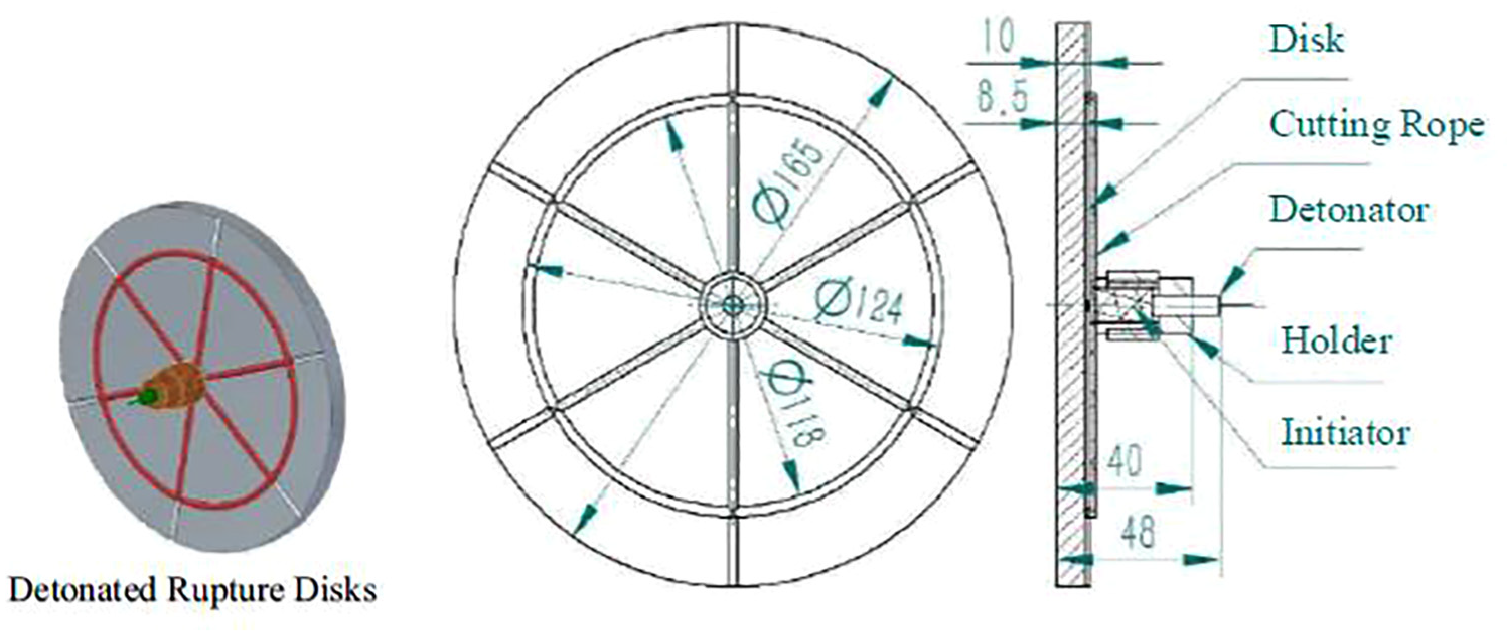
The structure of the detonated rupture disks.
The rear spray opening device of the detonated rupture disks was realized by installing detonated disks with a certain mechanical strength at the connection between the medicine chamber and the expansion nozzle. When the gas pressure on the disks exceeds the destruction limit during the launch process, the disks will rupture quickly, connecting the medicine chamber with the expansion nozzle, and the gas in the chamber will start to back inject under the pressure gradient. With an external trigger to detonate, the detonated disks can both withstand the maximum chamber pressure and be broken within a predetermined time. The two advantages are essential for the application of detonated rupture disks in the rear spray device of rarefaction wave gun for test.
Pressure bearing capacity analysis
Since detonated rupture disks need to withstand hundreds of megapascals of gunpowder gas in the working process,12–15 the key to its functionality is the pressure bearing capacity. This paper used the finite element method to complete the analysis and calculation.
Table 1 shows parameters of disk material. The constitutive of steel material adopted the ideal elastic-plastic model during finite element calculation. Axisymmetric 2D Model and 3D model were applied respectively. The load, constraint settings and numerical calculation results are shown in Figure 2.
Parameters of disk material.


Finite element material constitutive and load constraints.
After the finite element calculation, the maximum bearing pressure of disks without grooves was 155 MPa, and the maximum pressure after adding grooves was 150 MPa. In the 3D case, the maximum pressure was reduced to 144 MPa due to the influence of the radial grooves. The typical results are shown in Figures 3 and 4.

Cloud diagram of 2D axisymmetric finite element calculation of equivalent stress, tensile stress and shear stress: (a) disks without grooves and (b) disks with circular grooves.

Cloud Diagram of 3D finite element calculation of equivalent stress, tensile stress, and shear stress of disks with spoke ring groove.
It can be seen from the finite element calculation results that the designed disks with grooves can withstand the maximum pressure of 140 MPa during launch. The damage of the disks was not the shearing failure of the supporting edge, but the excessive tensile deformation at the middle position.
Cutting blasting ability analysis
For detonated rupture disks, the penetration and cutting depth of the cutting rope to the slotted disks could directly affect the destruction of the disks and the opening timing of the rear spray device, thereby affecting the launch performance of the rarefaction wave gun for test. The calculation of the cutting ability of the cutting rope adopted the explicit dynamic finite element method, and used the two mesh models of ALE and Euler to complete the analysis of its penetration process. All the calculations are obtained by the commercial software LS-DYNA.
According to the structure of detonated rupture disks, the cm-g-μs unit system was applied. The established finite element calculation model included the cover, medicine, disks and air, etc., as shown in the Figure 5. In order to reduce the calculation time, the 2D model simplified the disks to axisymmetric structure, and the 3D model only took the 1/4 structure.

A 2D and 3D finite element analysis models using ALE/Euler grids.
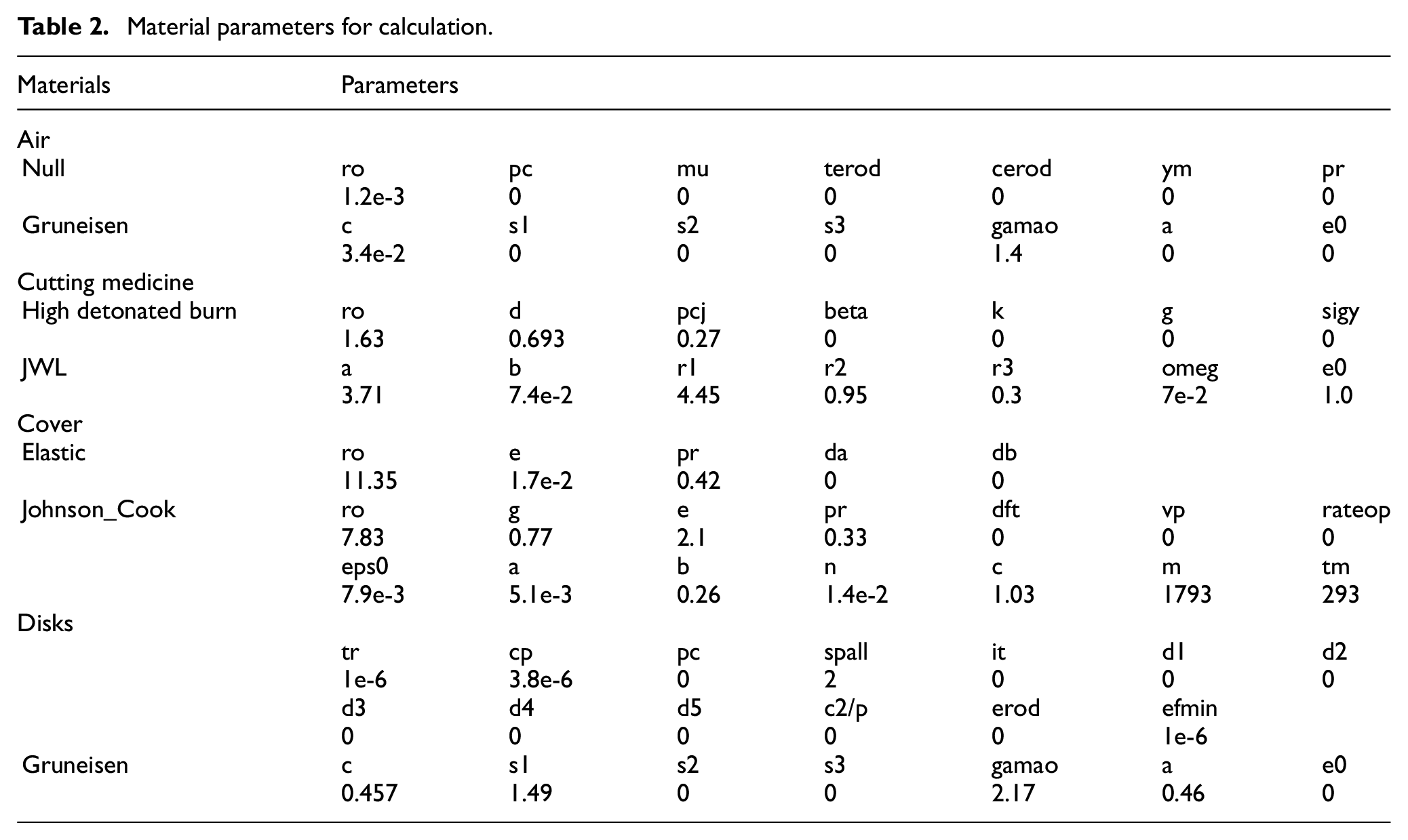
Cut a cylinder with a diameter of 10 mm at the center of the disks far away from the cutting rope to ensure that the finite element model was completely divided as the structure meshes. The blue area was the air region, the red area was the medicine cover, the light blue area was the medicine, and the cyan area was the disks. The material constitutive model and state equation used in the calculation are shown in the Table 2. In the model, the contact between the detonated gas and the cover, the contact between the cover and the disks was set as surface contact, and the self-contact of the cover was set as single-sided contact. The initial bombing point coordinates were set. The non-reflective boundary condition was set in 2D. The reflective boundary condition on the upper surface of the air region in 3D was set to simulate the constraints of the cutting rope cover. The calculation time was 20 μs.
Material parameters for calculation.
Using the ALE 2D model, the obtained cutting rope cutting calculation results are shown in the following figures.
Figure 6 shows the forming and penetration cutting process using ALE 2D jet. The jet penetration thickness was about 0.7 mm. For the jet forming process, the formed jet was relatively short and the penetration and cutting effect was only average in performance due to the limitation of the blast height.

The forming and penetration cutting process using ALE 2D jet.
Figure 7 shows density cloud map of Euler 2D jet penetration process. Under the effect of detonated gas, the lead cover was formed and the final penetration depth was about 0.9 mm.

Density cloud map of Euler 2D jet penetration process.
Figure 8 shows density cloud map of Euler jet penetration process. The penetration depth remained basically unchanged after the jetting process for 8 μs, and the penetration depth was 1.4 mm at this time.

Density cloud map of Euler jet penetration process.
Verification of cutting experiment
First, two shot for center detonation ring cutting test were carried out. The outer diameter of the detonated rupture disks is 165 mm, and the thickness of the detonated rupture disks is 8.5 mm. The diameter of the cutting rope is 118 mm, and the thickness of the cutting rope is 6 mm. The cutting results are shown in the Figure 9.
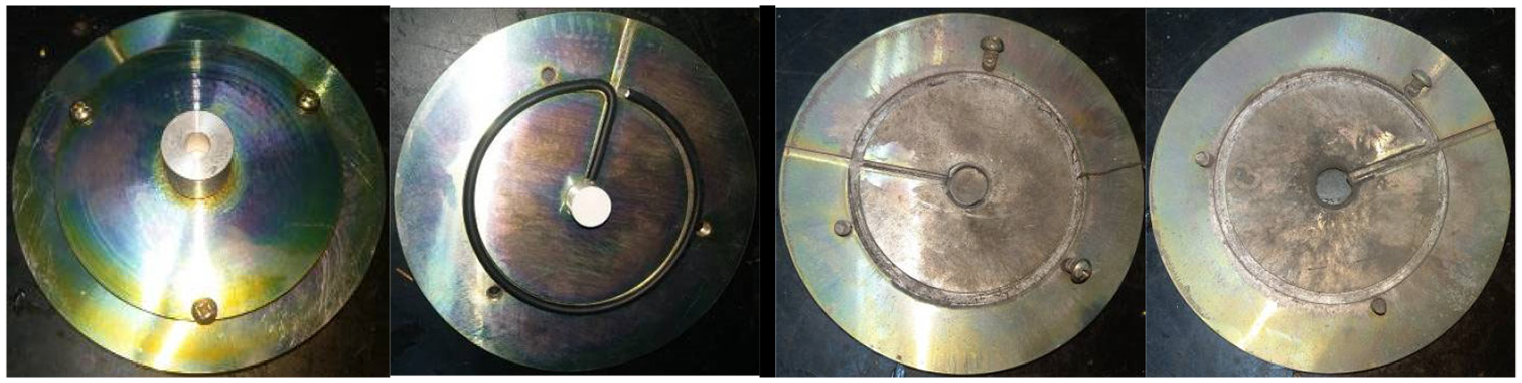
Ring cutting damage results.
It can be seen from the cutting situation of the above figure that the central detonating ring cutting was affected by the detonator and the power of the cutting rope. The cutting depth was about 0.8 mm, which was basically consistent with the simulation results in section 3. The disks as a whole failed to achieve cutting and destruction. The cutting effect was poor. For the insufficient cutting damage ability of the central detonating environment cutting strategy, a modification was carried out according to the central detonating spoke circular cutting strategy designed in section 3. Another two shot for central detonating spoke circular cutting test were carried out. The results are shown in the Figure 10.

Radial ring cutting damage results.
It can be seen from the cutting situation of the above figure that the central detonating spoke circular cutting detonator and cutting rope were more powerful, and the cutting depth was about 1.3 mm, which was basically consistent with the numerical analysis results. The disks were cut and destroyed as a whole, and the cutting effect was good. The rationality of the designed calculation scheme was verified, and it can be used for the subsequent combination shooting test of rarefaction wave gun for test and detonated rupture disks.
Conclusion
Numerical and experimental analysis were carried out to study the characters of the detonated rupture disks used in rarefaction wave gun for test. The pressure bearing capacity and cutting blasting ability of the disks were studied in detail. The research results showed that the designed detonated rupture disks could withstand the maximum pressure of 140 MPa or more during launch process. The central detonating spoke had an annular cutting depth of about 1.3 mm. It was not the shearing deformation at the supporting edge but the excessive tensile deformation at the middle position that led to the failure. The disk was cut and destroyed as a whole satisfyingly, so the rationality and feasibility of the detonated rupture disks used in rarefaction wave gun for test were verified, which could provide a reference for the development of rarefaction wave artillery and similar low recoil weapons.
Footnotes
Handling Editor: Pietro Scandura
Declaration of conflicting interests
The author(s) declared no potential conflicts of interest with respect to the research, authorship, and/or publication of this article.
Funding
The author(s) disclosed receipt of the following financial support for the research, authorship, and/or publication of this article: This work was supported by the China Postdoctoral Science Foundation (2017m623387).
