



Abstract
Due to superior robustness characteristic of sliding-mode control techniques, this study proposes a multiple sliding-mode control (MSMC) strategy based on the stator flux oriented vector scheme for speed control of three-phase AC induction motor (IM) drives in the presence of an external disturbance and uncertainties. At first, the dynamic model of a three-phase IM drive is transformed into two-axe orthogonal model (i.e. d and q axes) in the synchronously rotating frame so that vector control can be applied. Then, based on the stator flux oriented scheme (i.e. zero stator flux at q-axis and constant at d-axis), the proposed MSMC causes mechanical angular speed and stator current at q-axis reach toward predefined sliding surfaces. Moreover, stator flux and current at d-axis are respectively indirect and direct controlled such that tracking errors approach toward designed sliding surfaces. The closed-loop stability of the proposed MSMC is proved to possess uniformly ultimately bounded (UUB) performance by Lyapunov stability criteria. Furthermore, the simulation results reveal that the proposed MSMC strategy has a high level of robustness despite addition of an external load and random uncertainties on system parameters. In the meantime, the simulations for comparing the baseline controller (i.e. conventional PI control) are also conducted to verify the superiority of the proposed control scheme.
Keywords
Introduction
IM drives have widely been applied to numerous kinds of fields such as industries, traffic transportation and medical equipment etc. Many researchers and engineers have been devoting to control of AC IM drives in order to improve control performance and reduce cost. Over past two decades, vector control has become a popular technique to effectively manipulate AC motor drives in terms of control performance.1,2 However, as ones know, control of motor drives with excellent performance is a challenging problem as operated at low-speed in the presence of system uncertainties. Moreover, an external load, that is, disturbance, to motor drives is another big challenge in fast response and precise tracking. Based on these concerns, developing a speed controller with a high-level of robustness and a superior performance for AC motor drives is strongly in need.
There have been some research findings in the published literatures about the control of IM drives and some representative studies are reviewed here. Field-oriented control (FOC) and direct torque control (DTC) schemes are two most popular approaches to control of AC motor drives. Like in Wu et al., 3 the FOC and DTC approaches are both applied to a five-phase permanent magnet motor. The results reveal that FOC scheme has low torque ripples and DTC scheme has fast dynamic response. Awan et al. 4 presented an exact input-output feedback linearization structure based on stator-flux-oriented control method for the performance improvement of permanent-magnet synchronous motors and reluctance motors. In addition, Lin et al. 5 proposed an advanced deadbeat direct torque and flux control (DB-DTFC) in permanent magnet synchronous motor (PMSM). The algorithm model based on stator flux oriented coordinate system is deduced and a general solution method is presented to solve the reference stator voltage. The results show that the performance in the aspects of electromagnetic torque and stator current ripples reduction, dynamic response, computation burden, and robustness to motor parameters variation are all improved. With regard to control of induction motors, a model predictive control (MPC) based filed-weakening algorithm was proposed in Su et al. 6 for a traction electric vehicle using a low-voltage induction motor. The augmented prediction state relationship between stator voltage and flux-producing current is established for motor current control. The system eigenvalues are adjusted in real time for various speed regions and the controller performance is evaluated with the amplitude of the eigenvalues. The simulation and experimental results are provided to verify its feasibility and effectiveness. Konstantopoulos et al. 7 has developed a new nonlinear controller for speed regulation of voltage source inverter (VSI)-driven induction motors. The proposed controller directly provides the duty-ratio input of the VSI in the permitted range to ensure linear modulation and is fully independent to the system parameters and suitably regulates the motor speed and the stator flux to the desired values. The simulation and experimental results show that the system responses have fast convergence to the equilibriums after limited transients. Furthermore, a neural network (NN) vector control was proposed by Fu and Li 8 for a three-phase induction motor. The role of the NN controller is to substitute the two decoupled current-loop PI controllers in conventional vector control techniques. The experimental results demonstrated that the NN vector control can succeed in driving the induction motor without audible noise using relatively lower switching frequency or lower sampling rate.
One of well-known robust controllers, that is, sliding-mode control, has been proven to the most effective and feasible technique for any kinds of control systems. Here, some typical works with regards to induction motors are surveyed and reviewed. An adaptive sliding-mode control based model predictive torque control 9 was proposed to enhance the robustness and improve the performance by adjusting the switching gain adaptively. In Chen and Yu 10 presented a backstepping sliding mode control combining with a disturbance observer to regulate the speed of an induction motor. Experimental results verify its effectiveness and practicability. Furthermore, a speed observer design based on backstepping and sliding-mode strategies is used to perform speed operation, especially, at low-speed operation. From experimental tests, the control system is indeed robust on machine parameters and under load torque injection even operating at low-speed. 11 Obviously, it reveals that the sliding-mode control strategy may be a suitable solution for control of induction motor drives.
Based on the aforementioned literatures review, FOC and DTC based approaches are usually used to tackle three-phase AC motor drives. To the best of our knowledge, a multiple sliding-mode control (MSMC) strategy12,13 based on the stator flux oriented vector scheme is firstly proposed for control of IM drives and can effectively deal with the IM drives in spite of suffering an external load and random uncertainties. The contributions of this study can be summarized as follows: (1) A viable solution that is, the proposed MSMC, is presented for the speed control of three-phase AC IM drives (2) The proposed MSMC scheme which is hierarchically designed based on stator flux oriented vector strategy can become a standard design procedure applied to three-phase AC IM drives (3) The proposed control demonstrates the superior performance to a conventional PI control and possesses a high level of robustness despite addition of an external load and random uncertainties on system parameters.
The rest of the paper is organized as follows: In section 2, the dynamic modeling of the IM drive, decoupled d-q axes transformation and the problem formulation are given. The stator flux oriented multiple sliding-mode control design are described in section 3. The simulation results and discussions are presented in section 4. Finally, in section 5 the conclusions are made.
Dynamic model of an IM drive, decoupled d-q axes transformation and problem formulation
Dynamic model of the IM drive
First, an AC IM drive is three-phase balanced, hence, its dynamic model of the stator, rotor electrical circuits and electromechanical part in space vector form can be expressed as follows:



where
Decoupled d-q axes transformation
Consider a coordinate transformation from an original three-phase coordinate system to an orthogonal coordinate frame rotating with an angular speed of power source


where

Through the coordinate transformation, equations (2) can be rewritten as



where complex vectors
Problem formulation
After the above coordinate transformation, the two-axe dynamic model with orthogonal features along with the electro-mechanical model is obtained in the equations (4) so that the individual axis can be controlled via a feedback decoupled approach. To achieve the stator flux oriented vector control, the stator flux must be controlled to zero at q-axis, that is, all stator flux is located at d-axis. In the meantime, the stator flux at d-axis must be maintained as a constant value. In this way, the electromagnetic torque

Overall control block diagram of the IM drive system.
Stator flux oriented multiple sliding-mode control design
As the foregoing, the stator current needs to be controlled where the reference stator current is generated via the desired stator flux and its dynamics. In addition, the desired torque is obtained based on the dynamics of the mechanical angular speed error. Consequently, MSMC is proposed to control the stator current


In the beginning, the first sliding surface is defined as

where


where

where

where
Before discussing the result of the proposed controller, the following property about “uniformly ultimately bounded (UUB)” is given.
Definition 1: Wu and Karkoub
16
The solutions of a dynamic system are said to be UUB if there exist positive constants

where

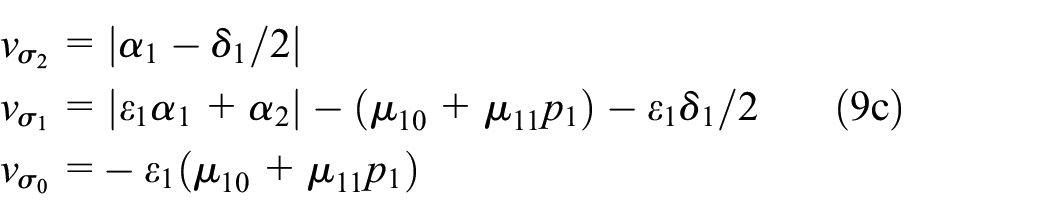
Then,
Proof: See Appendix A.
Moreover, as the mechanical angular speed is equal or less than rated speed, the stator flux is a constant value under constant power operation. Hence, based on the result of stator flux oriented control, the reference

To achieve the tracking of the reference

where


where

Remark: In equation (12a),
Since the stator flux

where the selected gains,


where
Then, the fourth sliding surface is defined as

where


where

Finally, the proposed MSMC in equations (12) and (17) generate three-phase voltage commands via coordinate transformation fed into a inverter to achieve the speed control. The proof is analogous to the proof of
Simulations and discussions
To evaluate the performance and validate feasibility of the proposed control, two cases of simulations are performed for the tracking of reference speeds that are respectively constant and sinusoidal speeds. The chosen system and control parameters in the simulation are shown in Table B1 of Appendix B. First, the simulations of the IM drive operated with the constant speed 2000

Responses of the IM drive with a constant angular speed under addition of disturbance after 1 s. and a maximum of 10% error of random variance on the system parameters: (a) tracking of real and reference mechanical angular speeds with addition of disturbance after 1 s, (b) stator flux at d-axis,

Responses of the IM drive operated with a sinusoidal angular speed under addition of disturbance after 1 s. and a maximum of 10% error of random variance on the system parameters: (a) low-speed operating, (b) stator flux at d-axis,

Tracking of the sinusoidal mechanical angular speed using conventional PI controllers under the same conditions with Figure 3.
Conclusions
The dynamic model of a three-phase IM is decoupled and represented via the d-q axes transformation such that the corresponding controller can be designed with ease. Then, the speed control of an IM drive based on the stator flux oriented MSMC strategy was proposed to resolve the typical and potential problems for example, low-speed tracking performance and a high-level of robustness. The proposed MSMC not only had outstanding tracking performance but also possessed a high level of robustness in the presence of an external load and random uncertainties on system parameters. The overall system stability with the UUB performance is assured via Lyapunov stability criteria. Finally, the simulation results also validate the effectiveness and feasibility of the proposed MSMC scheme. Additionally, the comparative simulations with a baseline controller (i.e. conventional PI) exhibit the superior performance of the proposed MSMC under different operating conditions. Due to the necessity of feedback states measured by sensors for the proposed controller, it will cause the increase of cost. Thus, the direction of next research will be sensorless speed control of IM drives without sensors using our proposed control scheme.
Footnotes
Appendices
Handling Editor: James Baldwin
Declaration of conflicting interests
The author(s) declared no potential conflicts of interest with respect to the research, authorship, and/or publication of this article.
Funding
The author(s) disclosed receipt of the following financial support for the research, authorship, and/or publication of this article: The corresponding author would like to thank the financial support from Ministry of Science and Technology of Taiwan, R. O. C. with Grant No. MOST 109-2221-E-027-118.
