




Abstract
This article addresses MHD nanofluid flow induced by stretched surface. Heat transport features are elaborated by implementing double diffusive stratification. Chemically reactive species is implemented in order to explore the properties of nanofluid through Brownian motion and thermophoresis. Activation energy concept is utilized for nano liquid. Further zero mass flux is assumed at the sheet’s surface for better and high accuracy of the out-turn. Trasnformations are used to reconstruct the partial differential equations into ordinary differential equations. Homotopy analysis method is utilized to obtain the solution. Physical features like flow, heat and mass are elaborated through graphs. Thermal stratified parameter reduces the temperature as well as concentration profile. Also decay in concentration field is noticed for larger reaction rate parameter. Both temperature and concentration grows for Thermophoresis parameter. To check the heat transfer rate, graphical exposition of Nusselt number are also discussed and interpret. It is noticed that amount of heat transfer decreases with the increment in Hartmann number. Numerical results shows that drag force increased for enlarged Hartmann number.
Introduction
Having amazing heat transfer characteristics in contrast with usual heat transit-fluids, nanofluids with astonishing heat transit characteristics is the most discoursed topic of present time. Nanofluids contain nanoparticles with size under 100 nm. Over traditional heat transit fluids, nanofluids offer special influence. Sensational development in the thermal effects of host fluids is produced when a very slight quantity of nano-particles suspended thoroughly and dissipates constantly in the base fluids. To generate steady and highly conducted nano-fluids one step and two step methods are applied but creating nanoparticles with both methods experience cluster of nanoparticles. This is the pivotal issue in industrial science including nano-powder. Nanofluid was introduces by Choi and Eastman. 1 After that different researchers analysed many properties of nanofluids. Evans et al. 2 discussed the Brownian motion effect on nanofluid thermal conductivity. He investigated that thermal conductivity can be increased. Yacob et al. 3 presented nanofluid flow along with convective boundary condition passing through a stretching surface. Nanofluid flow accompanied by a nonlinear stretchable surface was elaborated by Nadeem and Lee. 4 Influence of viscous dissipatation of Copper-water nanofluid along with side by side plates was discussed by Sheikholeslami and Ganji. 5 Hatami and Ganji. 6 examined the MHD nanofluid flow with suction between parallel disks. Hayat et al.7,8 discussed the thermal radiation effect of Powell-Eyring nanofluid and squeezing flow of carbon nanotubes. Ramana Reddy et al. 9 studied the inclined MHD unsteady flow of a nanofluid with Hall current and soret effects. They observed that enhanced soret number strengthens the momentum boundary layer thickness. Ayub et al. 10 inspected the nanofluid flow with MHD, slip effects and Riga plate. Impact of Brownian motion on MHD nanofluid over variable stretching sheet was discussed by Jayachandra Babu and Sandeep. 11 It is found that velocity slip parameter diminishes the velocity field. Ramana Reddy et al. 12 considered the thermophoresis and slip effects on MHD nanofluid. They used R.K. Fehlberg method for solving this problem and found that unsteadiness parameter decays the concentration profile. Anantha Kumar et al. 13 investigates about slip effects on bioconvective flow of nanofluids passing through a stretching sheet. Surface thickness parameter minimizes the temperature as well as concentration profile. Shah et al. 14 considered the Cattaneo-Christov heat flux model for second grade nanofluid having carbon nanotubes. He investigated that how entropy plays a role in our daily life. Impact of nonlinear radiation on MHD Casson fluid flow was studied by Ramudu et al. 15 They used numerical technique for solving differential equations. It is concluded that brownian motion and thermophoresis parameters strengthens the temperature profile. Consequences of Joule heating on copper and silver nanofluid flow with porous medium was discussed by Shah et al. 16 HAM and shooting methods are compared with the aid of numerical tables.
The process of stratification is illustrated as the formation of assorted layers possessing different densities. Stratification process occurs because of temperature changes, diversity of fluids and differences in concentration. Stratification is the interesting process in the mechanics of convective transportation because it has wide applications in the domains of industrial, natural and engineering processes. These applications include manufacturing processes, in atmosphere involving heterogeneous mixture, industrial food and salinity and thermal stratification mechanisms in oceans, rivers, reservoirs and reservoirs of ground water. Moreover, thermal stratification impedes penetration of oxygen between upper and lower layers of water and thus water be nominated as anoxic by the involvement of biological process and hence, this is illustrated as the disadvantage of it. RamReddy et al. 17 described the impact of non-Darcy porous mediumon nanofluid flow with thermal stratification. Hayat et al. 18 scrutinized the flow of an Oldroyd-B fluid with thermal stratification and stagnation point. Sheremet et al. 19 looked into the consequences of nanofluid filled in a square porous cavity under thermal stratification. Abbasi et al. 20 reported the upshot of double stratification and radiation effects on Jeffrey nanofluid. Muhammad et al. 21 elaborated the features of thermal stratification in ferromagnetic fluid with stagnation point. Rehman et al. 22 flashes the characteristics of flat and cylindrical surfaces on tangent hyperbolic fluid with thermal radiations. Impact of thermal stratification and Joule heating on MHD nanofluid flow was considered by Daniel et al. 23 Rehman et al. 24 investigated the double stratification phenomenon on tangent hyperbolic fluid. Hayat et al. 25 studied the characteristics of heat absorption in Oldroyd-B fluid with convective boundary conditions.
The process of mass transfer along with chemical reaction energy has been observed by many researchers due to its consequences in chemical engineering, geothermal reserviors, cooling of nuclear reactor and in oil recovery. Activation energy is the most important factor in chemical reaction. It is the fewer amount of energy for atoms or molecules due to which they experience a chemical reactionca. Bestman 26 initially investigated the mass transfer of boundary layer flow in a porous medium with suction. Mass transfer flow of MHD thermally radiative fluid with activation energy was discussed by Maleque. 27 Shafique et al. 28 declared the behaviour of activation energy on Maxwell fluid. Influence of thermal reaction on Casson fluid with stagnation point was studied by Abbas et al. 29 Zulfiqar et al. 30 analysed the soret, dufour effects on MHD fluid flow with uniform suction/injection. Mustafa et al. 31 explored the features of chemical reaction on the MHD nanofluid flow passing through a vertical surface. Outcomes of chemical reaction on Cassonfluid flow over a rotating cone with Halll effect was inspected by Deebani et al. 32 He concluded that enhanced Brinkman number decays the Bejan number. Dawar et al. 33 considered the Williamson nanofluid with activation energy. It is noted that Williamson parameter decays the drag force.
Magnetohydrodynamic nanofluid flows are very useful in engineering as well as in biomedicines. They have wide applications in nuclear power plant, nanofluid as a coolant, in fuels like Copper-oxide brake nanofluid (CBN), AOBN etc, magnetic nanoparticles for cancer therapy and many more. Aforeknown literature surveys designates that researchers highlighted the characteristics of Magnetohydrodynamic nanofluid flows. Although peculiarity of thermally stratified flows because of stretching sheet with chemical reaction have not been explored until now. Therefore our main objective is to investigate the behaviour of chemical reaction on MHD nanofluid flow over a stretching sheet. Thermal stratification is also contemplated. We considered variable temperature both at the surface and away from the wall. The emerging dominating equations are figure out by homotopic technique.31,34–42 The consequences of demanding parameters are inspected through graphs. Additionally, drag force and heat transfer rate has been elaborated graphically.
Formulation
Two dimensional and steady state flow of MHD nanofluid passing through a stretching sheet is taken with thermal stratification. Energy and concentration equations are used to discuss the temperature and concentration profiles. Velocity is contemplated at the surface of the plate. Variable temperature is considered at wall that is,


Physical model of the problem.
exposed boundary conditions are


Here velocity components are denoted by
Using

law of conservation of mass (1) is fulfilled consonantly. Therefore equations (2)–(6) becomes:





In the above equations Hartmann number is represented by

Mathematical expression of skin friction coefficient is disclosed as follows:

Undimensioned mode is given as

Here,
Nusselt number for the present analysis is given as

Homotopic solutions
Liao 34 was the first who presented Homotopy analysis method in 1992. We get series solution of highly nonlinear problems with this method. This gave us great opportunity to choose initial guesses and linear operators. They are declared as given below:




With



here
The final solutions



Convergence analysis
Convergence of series solution can be secured by HAM. It depends over an auxiliary parameters


Discussion
This section contains graphical results of various opposite parameters for velocity, temperature and concentration distributions. Influence of Hartmann number

Description of

Description of

Description of
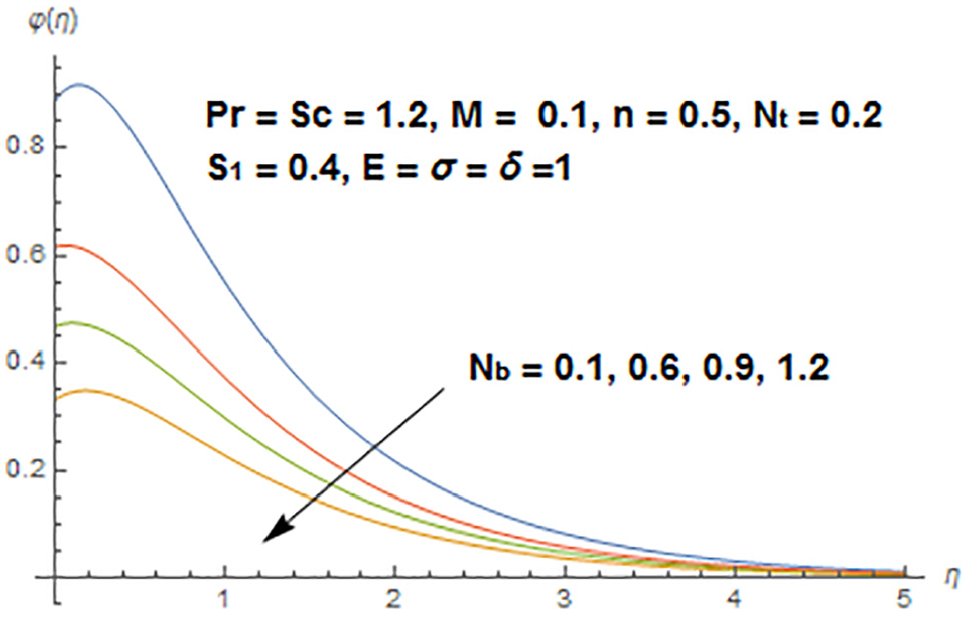
Description of

Description of
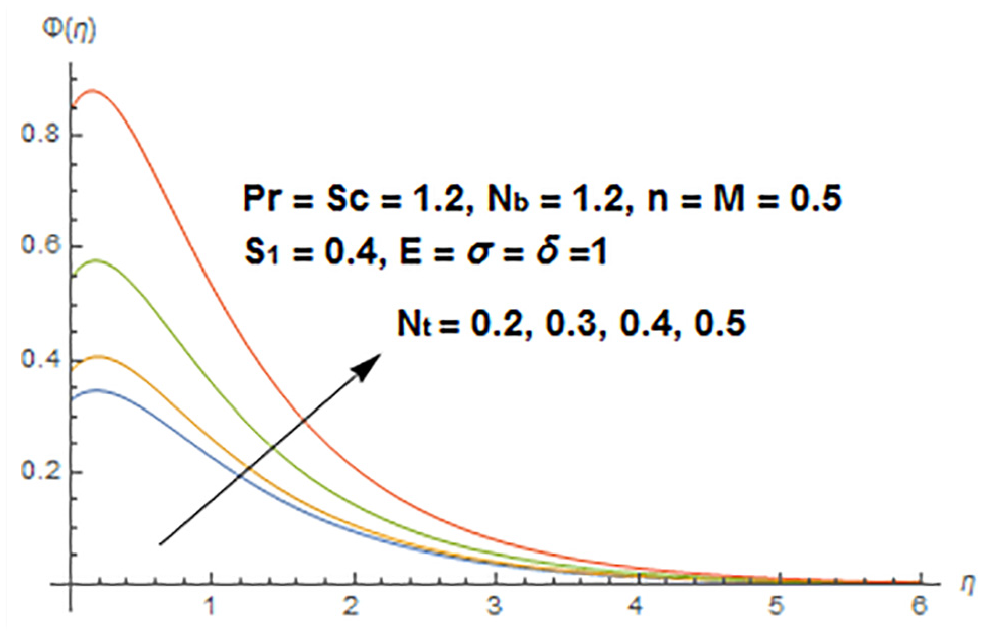
Description of

Description of
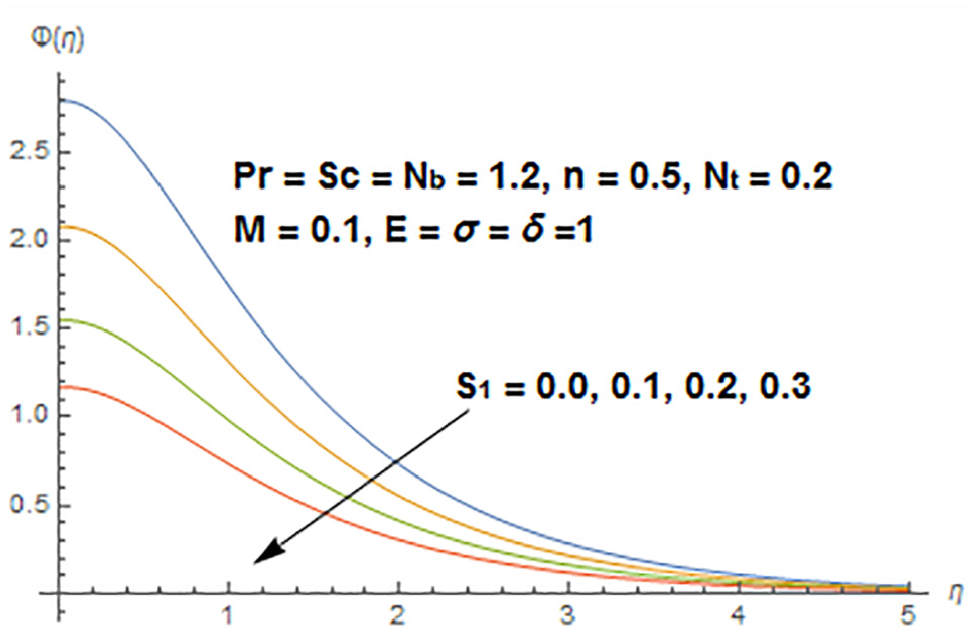
Description of
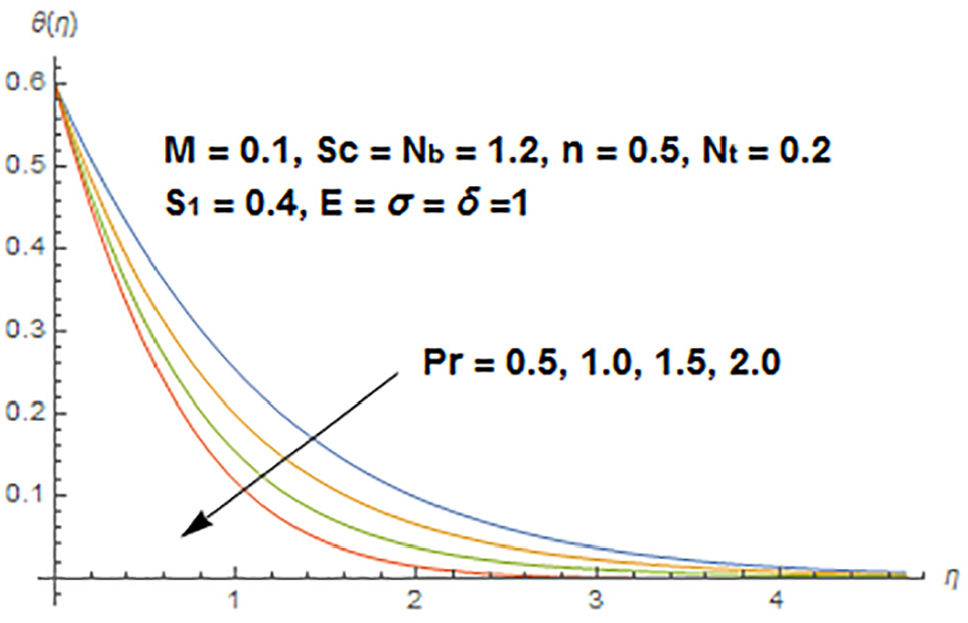
Description of
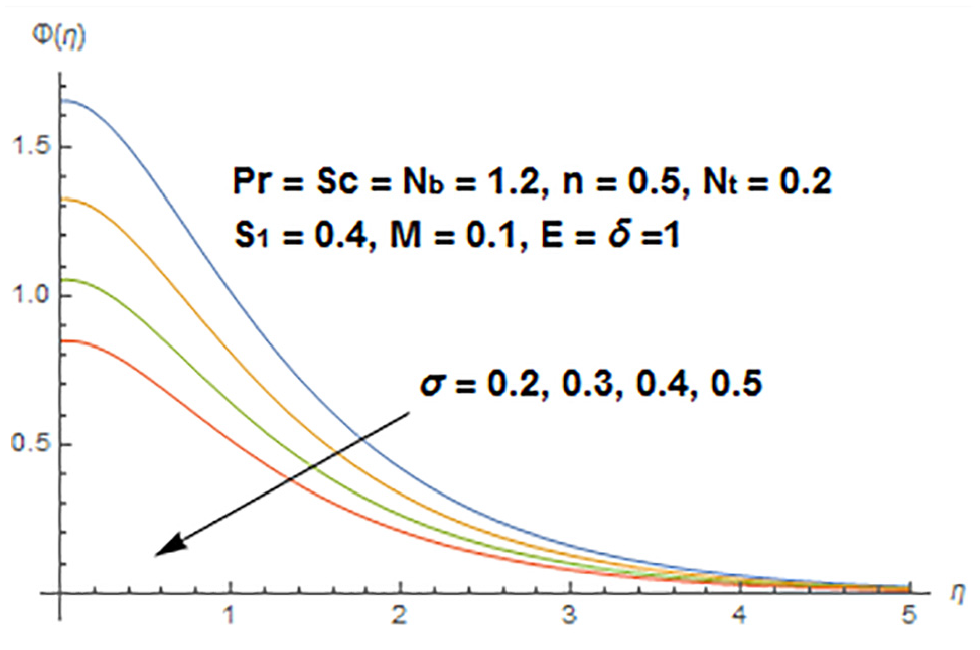
Description of

Description of

Description of

Description of

Description of
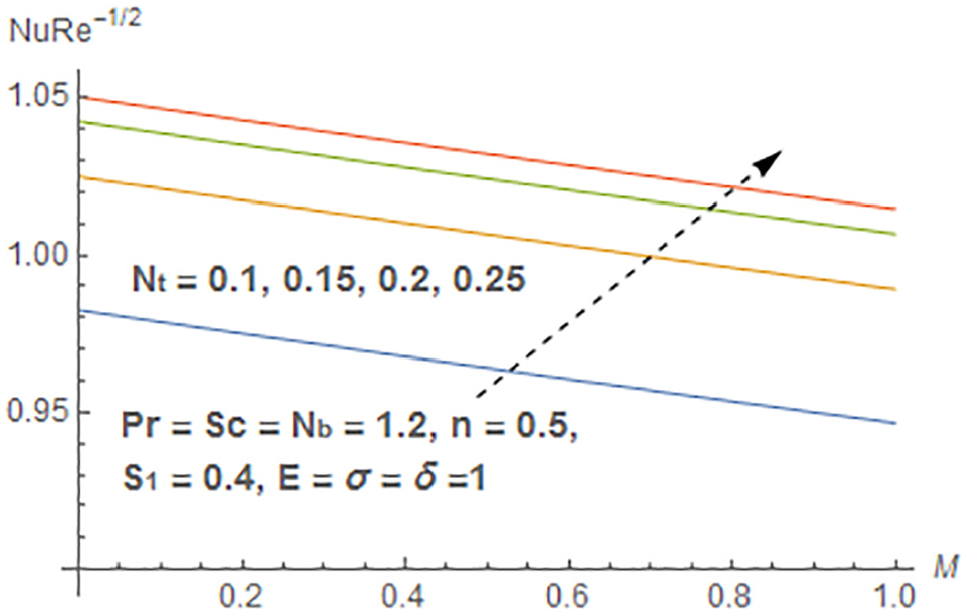
Impact of

Impact of
Table 1 is constructed for the inspection of skin friction
Comparison of drag force for distinct values of Hartman number

Concluding remarks
In this article we analyse the characteristics of chemical reaction of MHD nanofluid with thermal stratification. The main outcomes are summarized as:
Increasing Hartmann number
Dominant Brownian motion
Higher Prandtl number
Thermal stratified parameter
Concentration field decays for growing reaction rate parameter
Temperature difference parameter
Enlarged Hartmann number
It is hoped that the present study subsidized as a motivation for representing supplementary Magnetohydrodynamic nanofluid flows mainly in nuclear reactors, accelerators, flow metres, MHD generators, designing of cooling systems and biomedicines. This article may be used in nano drug delivery, cancer therapy, cell separation, automotive industry and solar energy harvesting.
Footnotes
Acknowledgements
The author M.Y.Malik extend their appreciation to the Deanship of Scientific Research at King Khalid University, Abha 61413, Saudi Arabia for funding this work through research groups program under grant number RGP 2-13-42.
Handling Editor: James Baldwin
Declaration of conflicting interests
The author(s) declared no potential conflicts of interest with respect to the research, authorship, and/or publication of this article.
Funding
The author(s) received no financial support for the research, authorship, and/or publication of this article.
