Nano-fluid flow is maintained over a non-uniform porous plate of variable thickness with non-uniform stretching (shrinking) velocity. In real engineering systems, the conduction resistance of sheets is necessarily important, whereas, in typical analysis very thin walls are undertaken. The surface thickness is ignored in the classical studies of flow, heat, and mass transfer problems. However, it the compulsory component in many physical problems, therefore, we thoroughly examined the perceptiveness of the wall thickness on the field variables and the transport of heat and nano-particle between solid surfaces and fluids. The phenomenon of variable wall thickness is extensively investigated with the combination of other boundary inputs. The variable stretching and shrinking velocities of the plate may have linear and non-linear forms and the sheet is uniformly heated whereas the nanoparticles are uniformly distributed over its surface. The diffusion of heat and nanoparticles in the fluid are governed using the boundary layer PDE’s, which satisfy certain BC’s. A set of unseen transformations is generated for solving the system of boundary value PDE’s. In view of these new variables, we obtained a system of boundary value ODE’s and it contains several dimensionless numbers (parameters). It is worthy noticeable that the problem describes and enhances the behavior of all field quantities in view of the governing parameters. All the field quantities, rates of heat and mass transfer are evaluated and effects all the parameters are seen on them and they are significantly changed with the variation of these dimensionless quantities. New results are presented in different graphs and tables and thoroughly examined. The Thermophoresis force enhances both the temperature and concentration profiles, however, the concentration distribution of nanoparticles is abruptly changed with a small variation in this force. The concentration profiles are bell-shaped on the right and behaves like a normal distribution. On the other hand, the addition of more nanoparticles into the base fluids increased (decreased) the temperature (concentration) profiles. Moreover, the two different attitudes of wall thickness are also examined on filed variables. The significant features and diversity of modeled equations are scrutinized and we recovered the previous problems of mass and heat transfer in Nano-fluid from a uniformly heated sheet of variable (uniform) thickness with variable (uniform) stretching/shrinking and injection/suction velocities. Moreover, two different numerical solutions of the modeled equations are found. These solutions are compared in a table and exactly matched with each other.
The thermal diffusion and mass transfer in the flow within the boundary layer are thoroughly investigated in the presence of stretching, shrinking, injection and suction velocities by scientists, engineers and mathematicians. The modeled problems have numerous and tremendous uses in industry and machines, therefore, the researchers show great interest in this area and strictly emphasized on it and published many research articles. There are many engineering processes which are directly associated with these types of flow problems, however, the making of sheeting material in factories and formation of metallic sheets, making and cooling of large metallic and polymer plates, glass designing and melting and continuous casting. Instead of all these achievements and realities, transporting of hot materials between turning handles, a feed roll or the formation of metals by extrusion process, formation of string and wire, paper production, glass fiber manufacturing and spinning of laments etc. are also the well known applications of such flows and have a big pact of research in fluid dynamics. The detailed discussions of these applications in different fields of science are available in Altan et al.1 On the other hand, very thin walls are undertaken in the typical analysis of flow, heat and mass transfer problems over sheets, moreover, no importance is given to the surfaces thickness while pursuing studies on that specific subject. Conduction of sheet could not be neglected in many processes of engineering systems and significantly changed the fluid velocity, temperature and concentration distributions. The conjugate heat transfer is important in problems of perspiration cooling systems and heterogeneous chemical reaction processes, however, the analysis cannot be proceed further without the information of interface temperature and concentration. The differences between the interfaces and ambient regions of these two variables cause the diffusion of these quantities, however, they need to be determined within the boundary layer by employing a proper set of governing equations and significant changes in their behavior is of the fundamental interest.
The asymptotic velocity distribution of flow problems along a flat plate (Blasius) with uniform and asymptotic suction (Iglisch), suction and blowing (Falkner-Skan) are increasing functions and these results show a closed resemblance with the universal distribution law for smooth pipes. However, the experimental data gives the real profiles for the velocity, which are bell-shaped curves with the asymptotic nature on the right of the semi-infinite domain. Moreover, the conjugate heat transfer problem of Perleman and the respective velocity profiles over a flat plate exhibit the behavior of experimental work. The non-similar solutions of these problems have been studied and examined. Later on, similar solutions are obtained by employing an alternate technique such that the non-similar terms in the transformed equations are expanded in terms of the power series for the non-similar space variable, by equating like powers of the independent variable (the axial space variable), a set of non-linear coupled ODE’s with similar cases have obtained which were solved numerically and asymptotically. Moreover, a uniform thickness of the boundary has been undertaken in most of these problems. However, to the best of the author’s knowledge no investigations have been made yet to construct a set of generalized similarity transformations without using the stream function formulation which gives a unified process model to elaborate the modeled problems of nano-fluid flows, which are maintained over a variable/uniform porous plate of non-uniform thickness with variable/uniform stretching/shrinking velocity. The stretching flow model of Sakiadis2,3 is very famous and highly cited in literature, however, the theoretical investigation in Sakiadis2,3 are experimentally checked and verified in Tsou et al.4 Crane5 found exact and closed form analytical solutions of stretching flow problems and these solutions are given in term of exponential functions, moreover, many researchers6–11 have been further extended and refined the Crane’s solutions. In Refs.,6–11 problems of linear/non-linear stretching flows are studied and embedded in different physical boundary conditions on flow properties at the surface of a sheet. Effects of variable and uniform surface heat flux are examined over the field quantities and the properties of flow and heat transfer are thoroughly investigated under these circumstances. All the above mentioned works strictly demonstrate the behavior of heat diffusion in Newtonian and non-Newtonian fluid flow over a stretching sheet. Besides that many research articles have been published in this area and researchers have paid considerable attention to the solutions of flow models of shrinking sheet. In this regard, Miklavčič and Wang12 published the first paper on flow maintained over shrinking sheet. Moreover, combined effects of shrinking and suction are investigated altogether on flow properties.
Nowadays, nanotechnology has many uses due to the extraordinary characteristics of nano-sized materials and is therefore a developing research field. The term “nano-fluid” was first introduced by Choi and Eastman13 and he combined engineered colloids with the particles of nanometer size, which are dissolved in a base fluid. For instant cooling of any kind of devices with high energy, effective cooling and heating techniques are desired for such kind of devices. Certain techniques are developed and widely used for the variation of diffusion of heat in nano-fluid, therefore, the variation in thermal diffusion occurred due to the geometry of a surface, boundary conditions and changes in the thermal conductivity of fluids. Buongiorno14 explored all the significant and governing sources and agents, whereas, they are combined with the slip mechanism, however, he claimed that the more effective and important slip mechanisms in nano-fluid are the Brownian diffusion and Thermophoresis force. Later on, Kuznetsov and Nield15 introduced the natural/free convection flow model of nano-fluids and they examined the diffusion of heat into the flow from vertically heated wall, although, it is the extension of the idea established and implemented for nano-fluid in Buongiorno.14 However, these concepts and investigations are extended for saturated porous medium see Cheng and Minkowycz.16 The analogies of Buongiorno14 and Cheng and Minkowycz16 are combined altogether and a new version of nano-fluid flow problem has been appeared in Nield and Kuznetsov.17 The consolidated version of Blasius, Falkner-Skane, Iglish and Sakiadis models are generalized for nano-fluid flow by Khan and Pop.18 Moreover, the problem in Khan and Pop18 is solved with Homotopy analysis Method see Hassani et al.19 Rana and Bhargava20 extended and modified the idea of Khan and Pop18 and studied the flow of nano-fluid over a variably stretching surface with non-linear motion. The work of Rana and Bhargava20 is modified in Kalidas21 for steady boundary layer flow and heat transfer in nano-fluid in the presence of partial slip conditions. Ghosh and Mukhopadhyay22 discussed the flow of a nano-fluid over an exponentially stretching surface in the presence of heat and mass fluxes. For both stretching and shrinking sheet, the problem of nano-fluid flow and heat transfer is addressed in Zaimi et al.23 Madaki et al.24 included the effects of thermal radiation and chemical reaction in the model of nano-fluid flow and diffusion of heat over a non-linear stretching sheet. MHD flows of nano-fluid have been discussed extensively in Refs.25–27 Note that the flows maintained over a shrinking sheet behave differently as compared to flows generated over stretching sheet. However, both stretching and shrinking sheet problem have been discussed widely in literature and the researchers investigated their physical behavior and characteristics, but engineers, scientists and physicists showed more interest in analyzing shrinking sheet flow and heat transfer problems of nano-fluids see Refs.28–30 Nadeem et al.31 investigated the flow of two-dimensional Maxwell viscoelasticity based micropolar nano-fluid over a horizontal stretching sheet. The flow of MHD Maxwell nano-fluid over a vertically moving flat porous sheet is also discussed in Nadeem et al.32 Awan et al.33 studied the MHD impacts of Jeffrey fluid over an oscillatory and stretching sheet. Later on, Rehman et al.34 analyzed the vital characteristic of flow in both nano-fluid and hybrid nano-fluid over a stretching surface in the presence of Coriolis force. Most recently few researchers have been discussed the boundary layer flow of nano and micropolar fluids under various assumptions see Nadeem et al.35,36 Many research articles appeared in the literature to address other features and characteristics of nano-fluid flow models and their solutions are found for any combination of normal (injection and suction) and axial (stretching and shrinking) velocities such that these combinations emulsify the geometry of a sheet which allows different similarity transformation with stream function formulations and as a result different governing equations in the form of ODEs have been met.
The objective of the present study is to formulate a unified modeled problem which presents the diffusion of heat and nanoparticles in flow when it is maintained over a porous and stretching (shrinking) plate of variable thickness. Note that the porous and shrinking (stretching) velocities are non-uniform, whereas, the sheet of variable thickness is heated with constants temperature and species concentration. Boundary layer form of the governing PDE’s is used, however, the classical stream function approximations are not utilized. We found a set of unseen transformation for similarity variable, velocity components, temperature and mass diffusion variables. These transformations are used to simplify the four boundary value PDE’s of continuity, momentum, energy, concentration and provide four boundary value ODE’s. The system of ODE’s and BC’s demonstrates a set of problems of mass and heat transfer in nano-fluid from porous (both uniform/variable injection/suction may occur) sheet of variable (uniform) thickness, with linear/non-linear stretching (shrinking) velocity. In the final problem of ODE’s, there are ten parameters in which the two are specifically associated with the variable thickness of the sheet in the transformed equations of continuity and momentum, however, a single parameter, that is, is seen in the energy and concentration equation. On the other hand, the second parameter is contributing into energy and concentration equation through the coupling effects of continuity and momentum equation. Moreover, these two parameters are effectively changed both the surface velocities, therefore, their theoretical and experimental impacts on the flow behavior and diffusion characteristics could not be denied. Abrupt changes in the field variables are noted due to the significant role of Thermophoresis force and increasing ratio of the concentration of nanoparticles in the base fluid. In addition, the two different attitudes of wall thickness are also examined on filed variables and the quantities of physical interests. It is worth noticeable that the present modeled problem works for incompressible nano-fluid flows, heat and mass transfer in a rectangular coordinate system. The modeled equations and their solutions can be converted into a set of classical problems and their well-established solutions given in references. In addition, the final ODE’s are solved numerically for all possible cases of stretching, shrinking, injection and suction. Moreover, new results are demonstrated in figures and tables and their detail discussion is provided in the next section. Correctness of the modeled problem is claimed and we compared it with the open literatures, moreover, the bench marks solutions are recovered when we manipulate the parameters of current problem accordingly. Many experiments have been performed on different flows with the help of standard technique of particle image velocimetry (PIV), however, accurate results of the different flow models have been produced by implementing this technique, similarly a nano-fluid flow over a flat plate is investigated with PIV technique in Laein et al.37 This method provides detailed, qualitative and quantitative information of velocity of the fluid.
Basic equations
Flow of nano-fluid is maintained on heated plate of variable thickness and it is located along -axis, whereas, its surface geometry is presented with a function . Initially, it is an arbitrary (generalized) function and it is determined (fixed) when we got the exact similarity of the governing PDE’s in later stage. Moreover, the sheet is porous and injection/suction can take place thorough its porous surface and it is assumed non-uniform. All the thermal properties, temperature and concentration of ambient-fluid (is at rest) are uniform, whereas, the sheet is variably porous and the stretching (shrinking) velocity is non-uniform. The diffusion of heat and nanoparticles in fluid flow from such a sheet is investigated in this paper. It is assumed that the two dimensional flow in the boundary layer region is steady and incompressible. The continuity, momentum, energy and concentration equations in view of all these assumptions and approximations are given bellow.
The equation of continuity comes from the conservation of mass law, whereas, for incompressible and two dimensional flows it has the following form:
The following momentum equation comes from the Newton’s second law of motion, however, it is the steady, two dimensional and boundary layer form of the Navier Stokes equation and valid for laminar flow of fluid, which has uniform viscosity:
The energy equation comes from the first law of thermodynamics and the boundary layer form of this equation is presented bellow and it is valid for the fluids of uninform thermal properties without the viscous dissipation term:
The concentration equation comes from the conservation of species law, whereas, for incompressible and two dimensional flows it has the following form:
where the unknown functions are use for axial and normal components of velocity, temperature and species concentration variable and subscripts are representing the partial derivatives. The represents thermal diffusivity, denotes the ratio of heat capacity of nanoparticle to the fluid, and are the density of particles and fluid, respectively, denotes the volumetric expansion coefficient, and represent thermophoretic diffusion and Brownian diffusion coefficients, respectively.
It is customary to define no slip condition at fluid-solid interface. Therefore, the axial and normal components of velocity, the temperature function and concentration of nanoparticles at the surface of stretching/shrinking and porous plate of variable thickness are defined bellow:
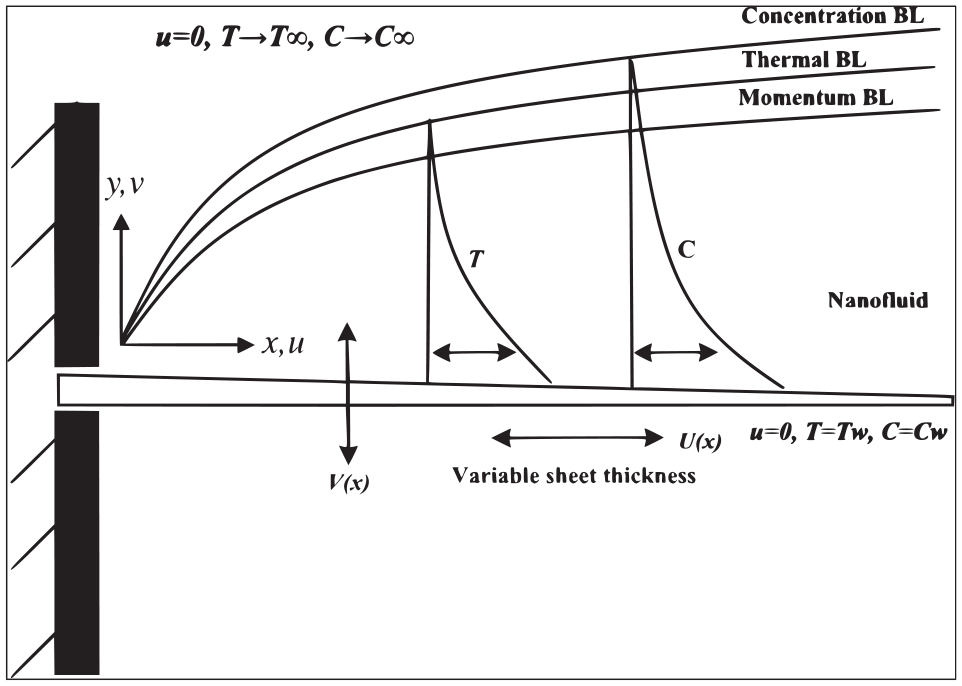
where represents the variable stretching (shrinking if ) velocity and is the injection (suction if ) velocity of the fluid flow at the surface of the sheet. Note that is an arbitrary shape of the surface and is the characteristic velocity. The characteristic length is defined by where and . The sheet is heated uniformly and it has constant concentration of nanoparticle. The constant values of temperature and concentration are denoted by and , whereas their ambient values are represented by and , respectively. It is further assumed that the wall temperature (concentration) is higher than the ambient temperature (concentration) as shown in Figure 1. A set of following transformations is formed for the velocity components , temperature , concentration variable and similarity variable as:
where the unknown functions are representing the axial and normal velocity components, represents temperature function and is the concentration distribution of nanoparticle. The new variables in equation (7) are substituted into the governing PDEs (1)–(4), and we get the following system of ODEs:
Physical geometry of the problem.
The boundary conditions in equations (5) and (6) are reduced as
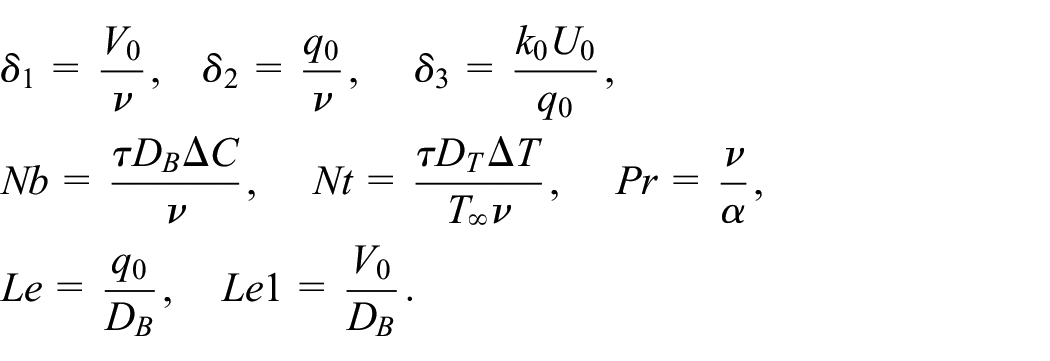
where prime is used for the derivative of unknown functions w.r.t. the similarity variable and
Here , , denotes the Prandtl number, and are the Thermophoresis force and Brownian motion parameters, respectively, is the Lewis number, and are the injection (suction) and the stretching (shrinking) parameters, respectively, is the non-linear sheet thickness parameter, is the surface thickness parameter, is the modified injection (suction) parameter and represents the modified Lewis number.
More terms of practical use are also calculated from the solutions of equations (8)–(11) in which the skin friction coefficient (dimensionless shear stress at the surface of plate), the Nusselt number (dimensionless heat flux at the surface of plate) and the Sherwood number (dimensionless mass flux at the surface of plate) are defined as:
where shear stress (), heat and mass fluxes ( and ) are defined at the surface of the plate. Using the similarity transformations in equation (7), we obtain
where . In the present study, and are reduced/modified Nusselt and Sherwood numbers, respectively.
Comparison and graphs discussion of numerical solutions
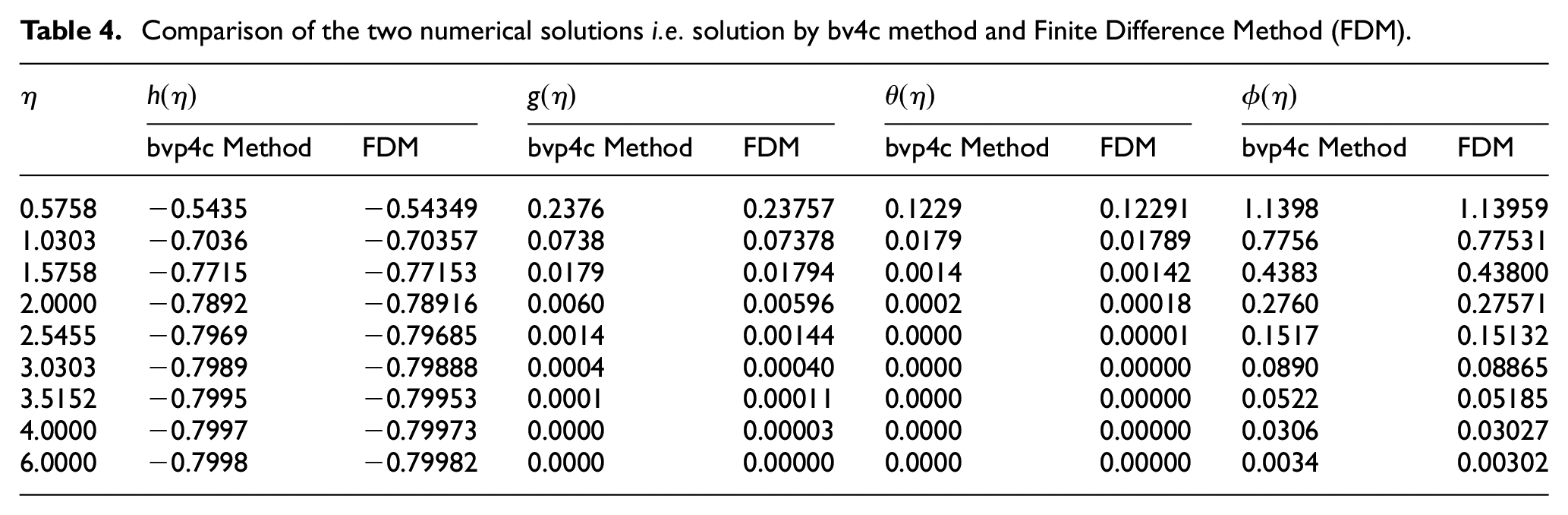
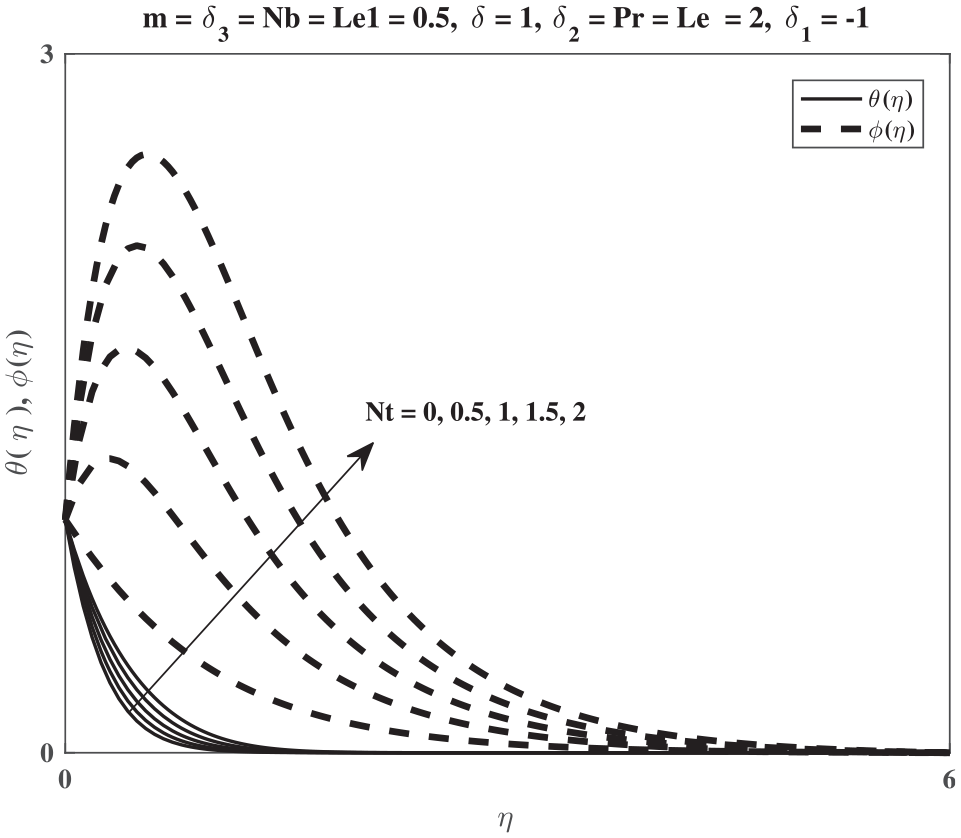
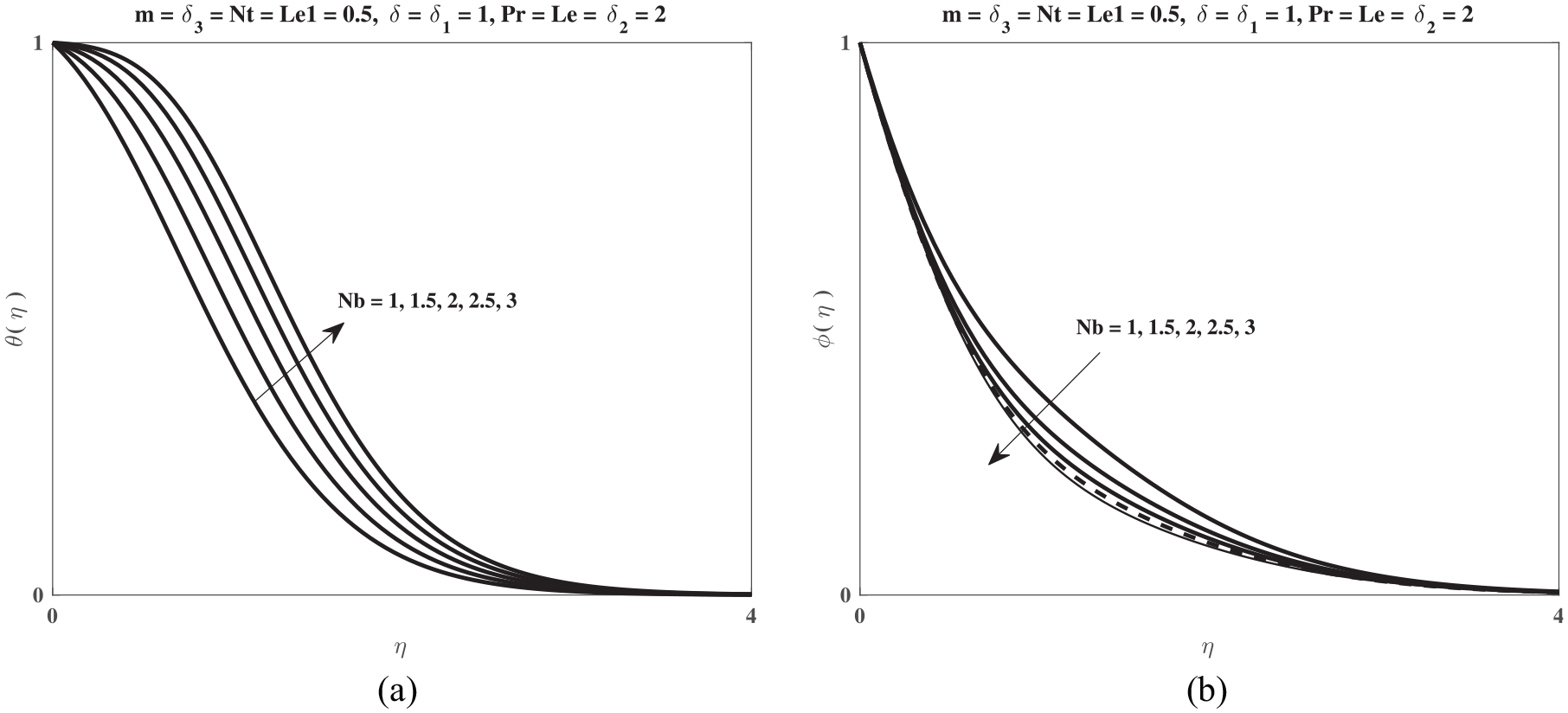
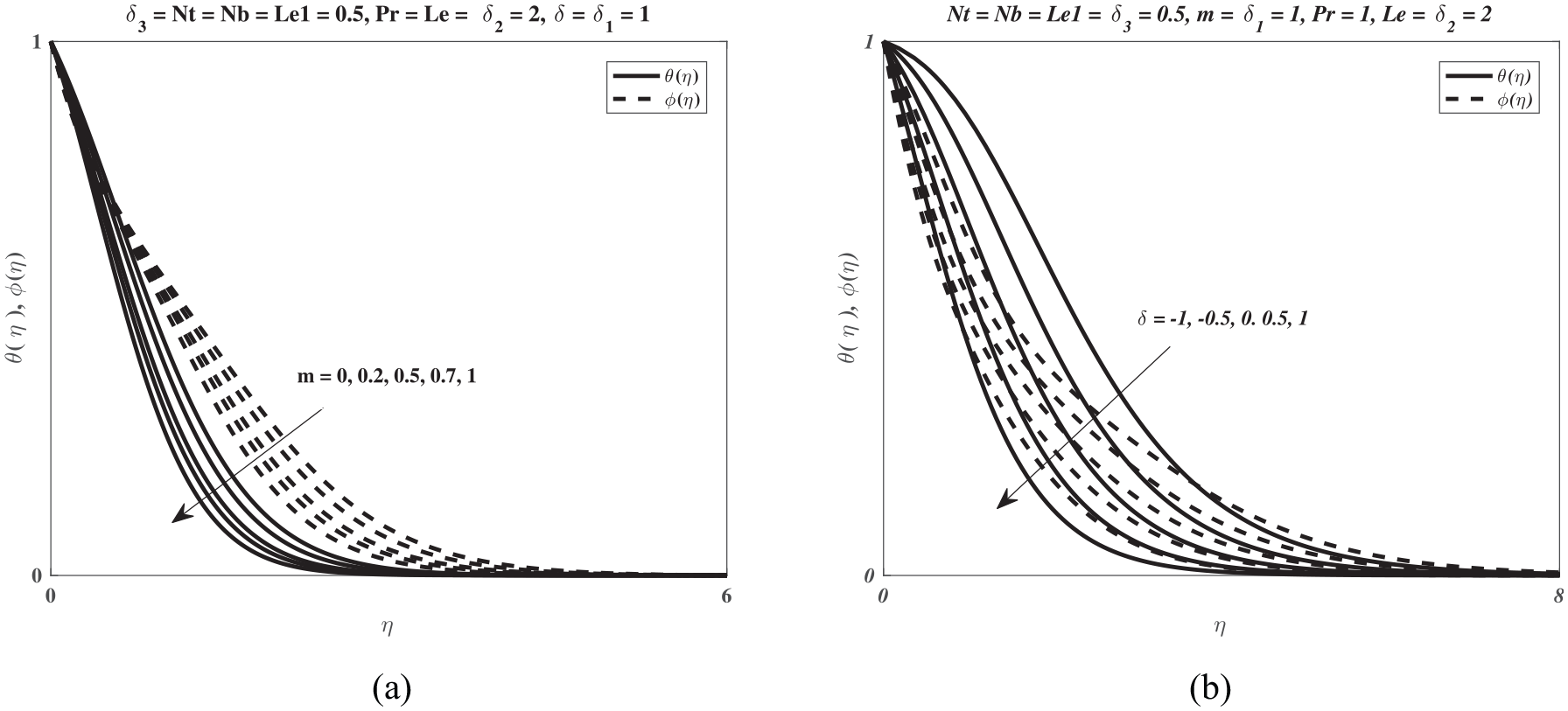
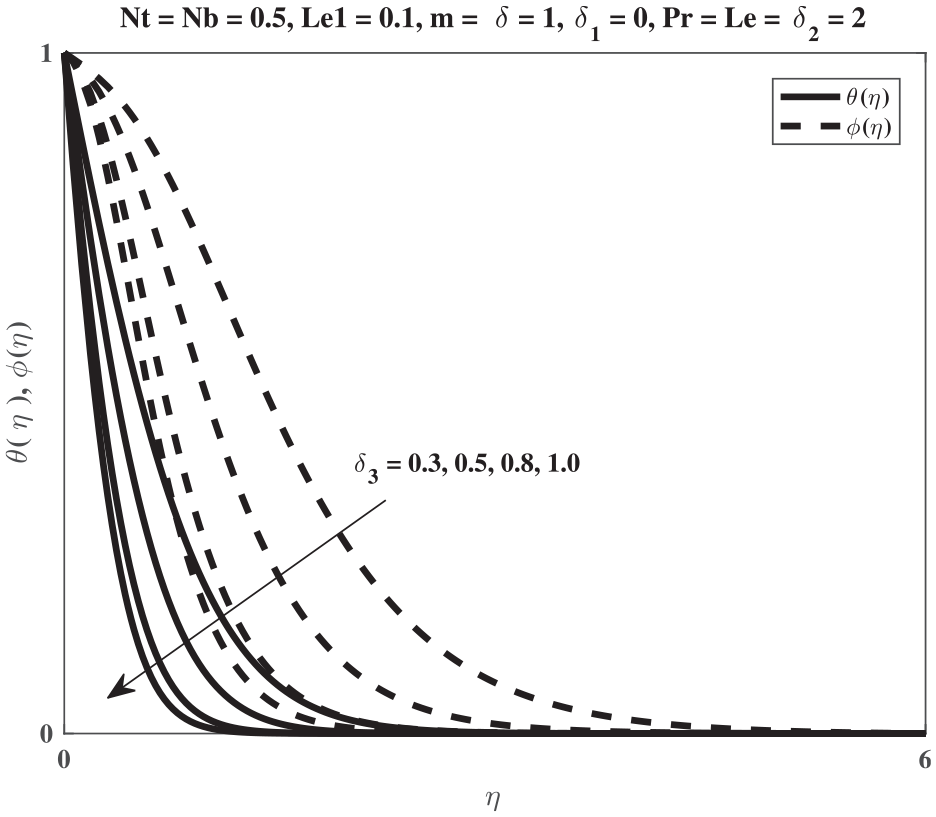
The system of boundary value ODE’s contains a first order linear and three second-order non-linear coupled ODE’s (8–11) satisfy the BC’s in equation (12) and its numerical solution is presented here. Results of equations (8)–(11) are confirmed and they have been retrieved from the solutions of classical modeled problems in some cases, however, the problems present the diffusion of heat and nanoparticles in flows, which is induced with the variable stretching/shrinking and porous velocities of the plate of non-uniform thickness. We found a variety of published work, which has a strong resemblance with this special type of flow problem such that the current solutions are compared with its solutions. The benchmark solutions of classical problems are retrieved when we fixed the parameters in equations (8)–(11). The numerical solutions are precisely matched with the published results for a fixed numerical value of the parameters, which determine the velocities at the surface of a sheet. All the classical solutions are recovered in such special situations. The comparisons ensured the validity, correctness and effectiveness of the current modeled problem and its solutions. For all stretching/shrinking and injection/suction situations, the numerical solutions are precisely matched with the published results. The previous (published) results are recovered from the solutions of equations (8)–(11) for a fixed numerical value of the governing parameters in them. The unknown variables and the representatives of normal velocity , axial velocity , temperature distribution and species concentration of nanoparticles and the quantities of physical interests , are calculated and their qualitative comparison is established. The discussion elaborates the consequential analysis of all physical phenomena on flow, diffusion of heat and mass of nanoparticles in such flows for which the current model is formulated. Comparative analysis of the problem in hand is established with the previously published classical models and their solutions, which are exactly matched with each other, however, some restrictions are imposed on parameters of the present modeled problem. Results of Refs.11,18–21,23,38–41 are recovered for when and results of Khan and Pop18 are retrieved for for various values of and . These analysis are presented in Tables 1 to 3. One of the proper and specialized demonstration of the current model is presented in which we recovered the previously published bench mark solutions of the traditional flow problems. It is clear from both Tables 1 and 2 that by increasing the dimensionless number , the rate of heat transfer at the plate, that is, is a decreasing function. We also noticed from Table 1 that, by increasing of dimensionless parameter , is an increasing function. On the other hand, the rate of mass transfer from the surface of plate is increased with the increasing of as shown in Table 3. We got the best accuracy between the results of current model and Refs.11,18–21,23,38–41 for the quantities and . In Table 4, two different numerical solutions of the system of the boundary values ODE in Eqs. (8-11) are found. The numerical data for the unknown functions are taken at certain mesh points. In most cases, the two solutions are exactly matched up to four decimal places. The first and main numerical solution is obtained with bvp4c package of MATLAB, whereas, the second solution is obtained with the Mathematica function NDSolve. Another comparison is established with the results of Rana and Bhargava20 which is presented in Figure 2 and demonstrated with good agreement. We recovered the standard results of classical problem Rana and Bhargava20 in term of axial velocity . Figure 2 illustrates the effect of stretching parameter through the boundary layer region on the axial velocity for different while fixed values are taken for other parameters. Both the axial velocity and skin friction are increased with the increasing of , the stretching parameter. The pioneering work of Khan and Pop18 regarding the diffusion of heat and nanoparticles in the flow due to a linearly stretching plate is a remarkable contribution in this area of research, later on, this modified work is further extended for non-linear stretching plate by Rana and Bhargava.20 Finally, we recovered the models and results of both Khan and Pop18 and Rana and Bhargava.20 Therefore, it is claimed that the modeled problem equally describes flows, diffusion of heat and nanoparticles in flows on both linear and nonlinear stretching sheet. It is concluded from Figure 3 that both the diffusion functions (temperature and nanoparticle concentration) are increased with the increasing of for and . This means that any small change (increase) in the Thermophoresis force increased the temperature profiles effectively and increased the concentration profiles abruptly. Both of these profiles are asymptotic in nature, however, for all values of Thermophoresis force, the temperature profiles are decreasing function of Thermophpresis and the concentration profiles have peak, moreover, the peaks are increased with the increasing of Thermophoresis force, whereas, the thickness of concentration boundary layer is greater than the thermal boundary layer for this set of parameters value. On the other hand, the addition of more nanoparticles in the base fluid changed the behavior of temperature and concentration profiles, therefore, the diffusion functions are plotted in Figure 4 for different and the temperature (concentration) distribution is increased (decreased) within the boundary layer with the increasing of as shown in Figure 4a (4b). The Brownian motion of nanoparticles enhances the heat energy within the thermal boundary layer which continuously pushes the nanoparticle away from the main flow region into the sheet and this causes reduction in species concentration. The Brownian motion of nanoparticles plays a noteworthy role in increasing the conduction of the heat by two means (a) direct transport of thermal energy carry nanoparticles that transport heat energy either by conduction or convection (b) an indirect transport of micro-convection in neighbor of individual nanoparticles. It is noted that for small nanoparticles the Brownian motion is fast, whereas, large values of the parameters are needed, for large nanoparticles the converse will occur and obviously both the concentration and temperature profiles are enhanced by the Brownian motion. In the current simulation, there are two different parameters, that is, out of 10 which are primarily associated with the variable thickness of the sheet and their effects are investigated on the two diffusion variables. The two different wall thickness parameters are changed the temperature and concentration distributions in different manners, so in Figure 5, their effects are investigated on the diffusion variables. In addition, the temperature and concentration profiles are varied with and and they are plotted in the respective Figures 5 and 6. Note that the stretching parameter and non-linear sheet thickness parameter are strongly related to each other, as a result any small change in the value of these two parameters affected the temperature and concentration profiles and they are decreased with the increasing of and . In both these two figures the thickness of concentration boundary layer is greater than the thermal boundary layer and the profiles are decreasing functions and asymptotic in nature.
Results of are compared with the published data for and for different and .
Comparison of the two numerical solutions solution by bv4c method and Finite Difference Method (FDM).
bvp4c Method
FDM
bvp4c Method
FDM
bvp4c Method
FDM
bvp4c Method
FDM
0.5758
−0.5435
−0.54349
0.2376
0.23757
0.1229
0.12291
1.1398
1.13959
1.0303
−0.7036
−0.70357
0.0738
0.07378
0.0179
0.01789
0.7756
0.77531
1.5758
−0.7715
−0.77153
0.0179
0.01794
0.0014
0.00142
0.4383
0.43800
2.0000
−0.7892
−0.78916
0.0060
0.00596
0.0002
0.00018
0.2760
0.27571
2.5455
−0.7969
−0.79685
0.0014
0.00144
0.0000
0.00001
0.1517
0.15132
3.0303
−0.7989
−0.79888
0.0004
0.00040
0.0000
0.00000
0.0890
0.08865
3.5152
−0.7995
−0.79953
0.0001
0.00011
0.0000
0.00000
0.0522
0.05185
4.0000
−0.7997
−0.79973
0.0000
0.00003
0.0000
0.00000
0.0306
0.03027
6.0000
−0.7998
−0.79982
0.0000
0.00000
0.0000
0.00000
0.0034
0.00302
Effects of stretching parameter and non-linear sheet thickness parameter are seen on velocity distribution which exactly matched with Rana and Bhargava.20
Effects of (Thermophoresis number) number are seen on the temperature (solid lines) and concentration (dashed lines) distributions.
Effects of (Brownian motion number) are seen on (a) temperature distribution (b) concentration profiles.
Effects of (a) (non-linear sheet thickness parameter) (b) (surface thickness parameter) are seen on temperature (solid lines) and concentration (dashed lines) distributions.
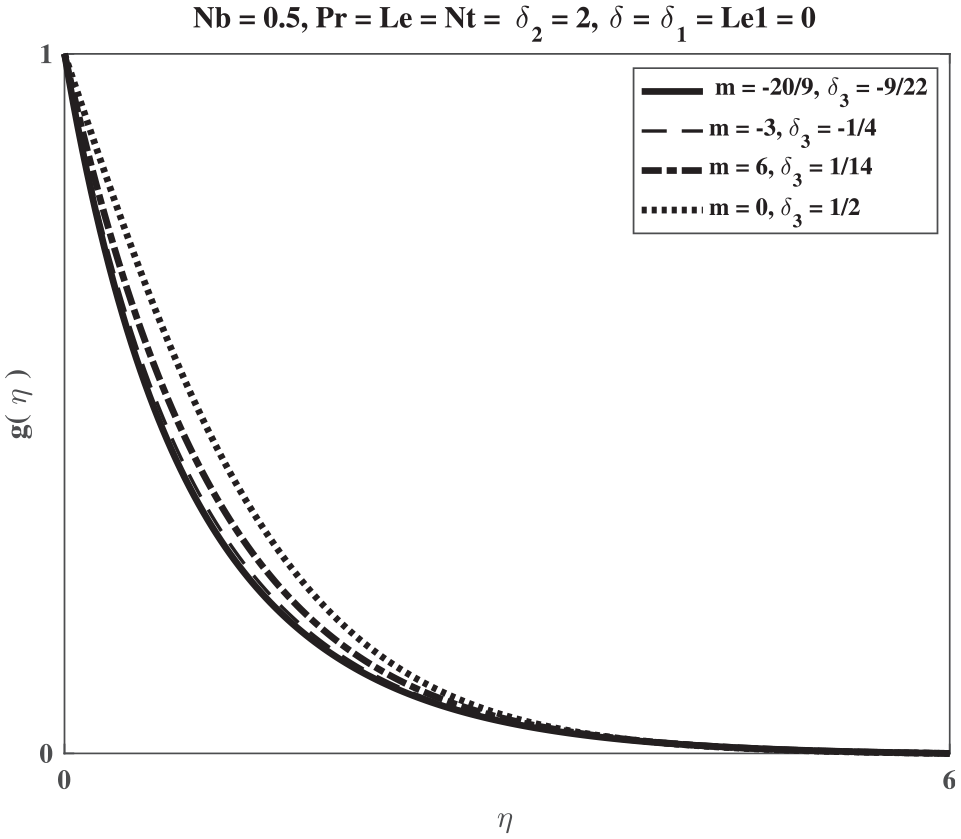
Effects of stretching parameter are seen on temperature (solid lines) and concentration (dashed lines) distributions.
To the authors’ knowledge, the present modeled problem is precisely describe the diffusion of heat and nanoparticles in flows maintained over a shrinking, porous and heated sheet of variable thickness. A base fluid of higher viscosity is assumed and a small concentration of nanoparticle is taken into account so that, the diffusion of temperature and solid volume fractions of nanoparticles is examined, therefore, effects of large Lewis number is investigated on these two profiles. The shrinking/impermeable status of modeled problem is presented in Figure 7. It is observed from this figure that both the diffusion variables are decreased with the increasing of . It is also confirmed that the shrinking flow problem has solutions for certain ranges of suction parameter and the solutions are missing for large values of this parameter. Thermophoresis force rises the temperature of the flow regime within the boundary layer for small and .
Effects of (Lewis number) are seen on (a) temperature distribution (b) concentration function.
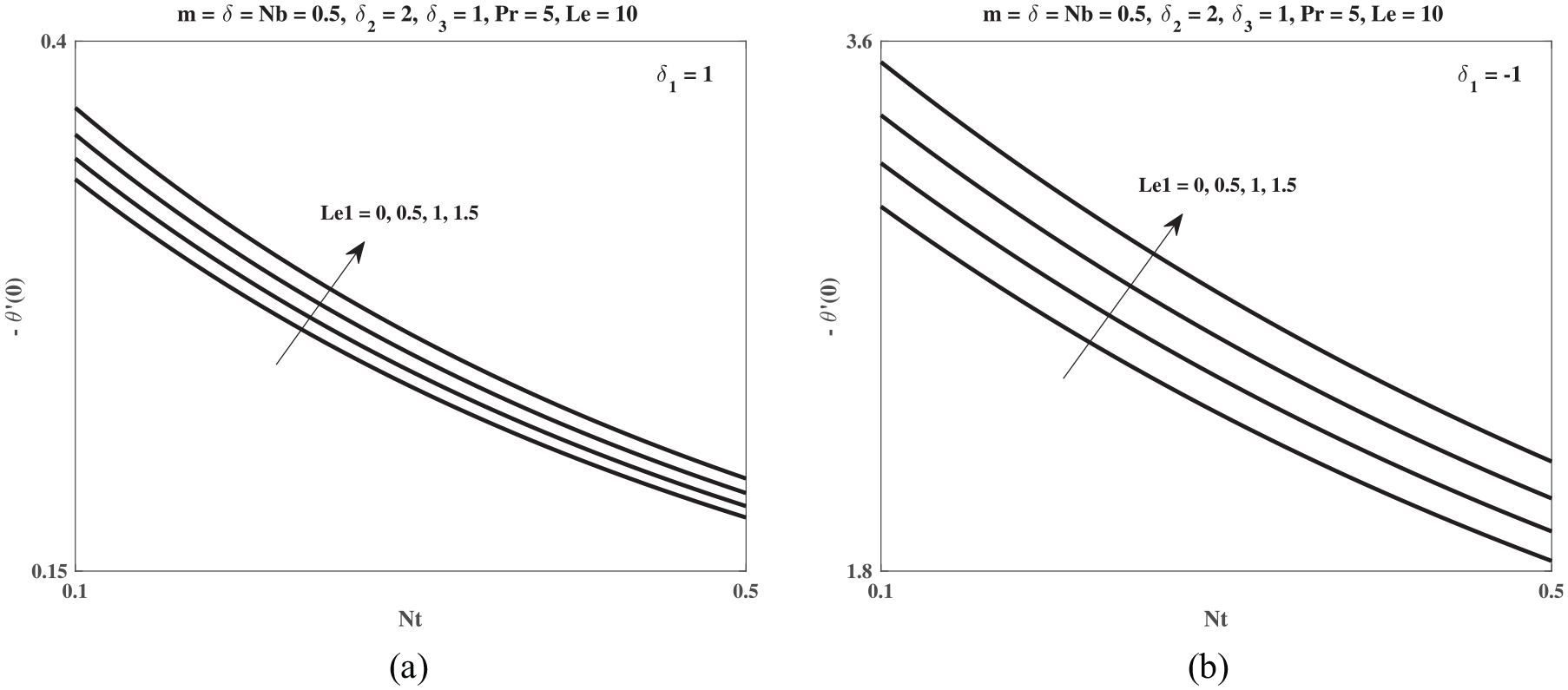
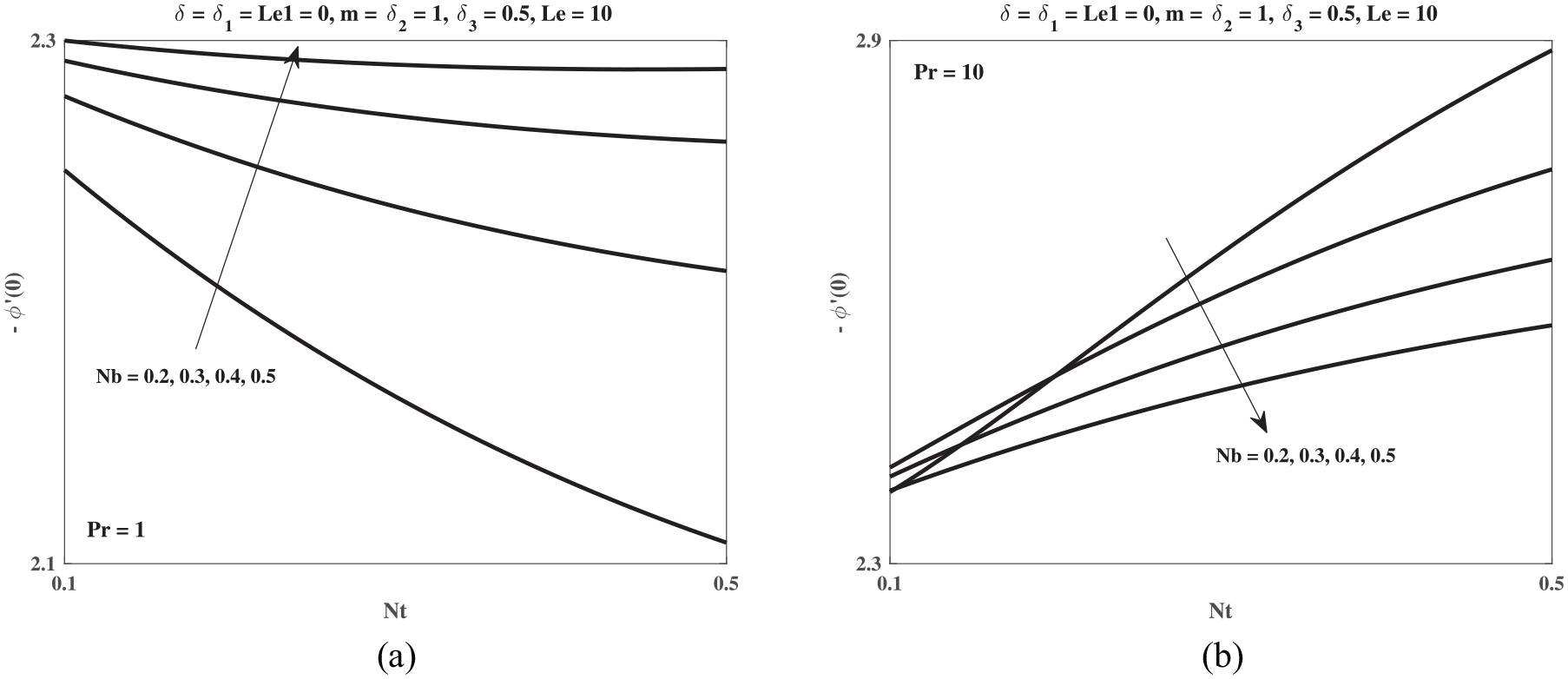
In the next figures the rates of heat and mass transfer at the surface of sheet of variable thickness is evaluated against the increasing Thermophoresis force and different values of other parameters. The rate of heat transfer is graphed against increasing Thermophoresis force, that is, in Figure 8 for different (different concentration of nano-particles is taken). The effect of Prandtl is also observed in Figure 8(a) and (b) for small (base fluid of low thermal conductivity) and bit large (base fluid of high thermal conductivity) values of Prandtl number, respectively. In both these two figures, the rate of heat transfer at the surface is decreased with the increasing of Thermophoresis force for all cases of small and high concentration of nanoparticles in the base fluid and by considering the fluid of high and low conductivities. Figure 8(a) demonstrates that the behavior of heat transfer against is linear for the base fluids of low thermal conductivity and each small concentration of nanoparticles, however, its behavior is linear in two profiles and non-linear in one for large value of as shown in Figure 8(b). Moreover, it is also observed from Figure 8(b) that high conducting base fluids and other parameters value reduces heat transfer rate. In Figure 9, there are two graphs and the heat transfer rate is plotted against Nt in each graph for different values of (the base fluid of higher viscosity fluid is taken with small diffusivity of nano-particles into it), whereas, the Figure 9(a) and (b) are specifically plotted for small (low conducting base fluid) and bit large (high conducting base fluid) values of Prandtl number, respectively. The profiles in each graph of this figure are uniformly changed with change in . From Figure 9(b) it can be noted that large Prandtl enhances the heat transfer rate. Moreover, the behavior of heat transfer rate against is linear for small Pr and each small and large values of , however, its variation against is non-linear for large . Figure 10, defects the variation in heat transfer rate against for different values of (fluid of high viscosity is taken, i.e. with small input of secondary viscosity i.e. small ), whereas, Figure 10(a) and (b) are specially graphed for (injection) and (suction), respectively. The profiles in each graph are changed uniformly with . Note that the behavior of heat transfer rate is non-linear in this case for both (injection) and (suction) and small value of .
Effects of and numbers are seen on heat transfer rates (impermeable sheet).
Effects of and numbers are seen on heat transfer rates (permeable sheet (injection case)).
Effects of and numbers are seen on heat transfer rates (permeable sheet both injection and suction).
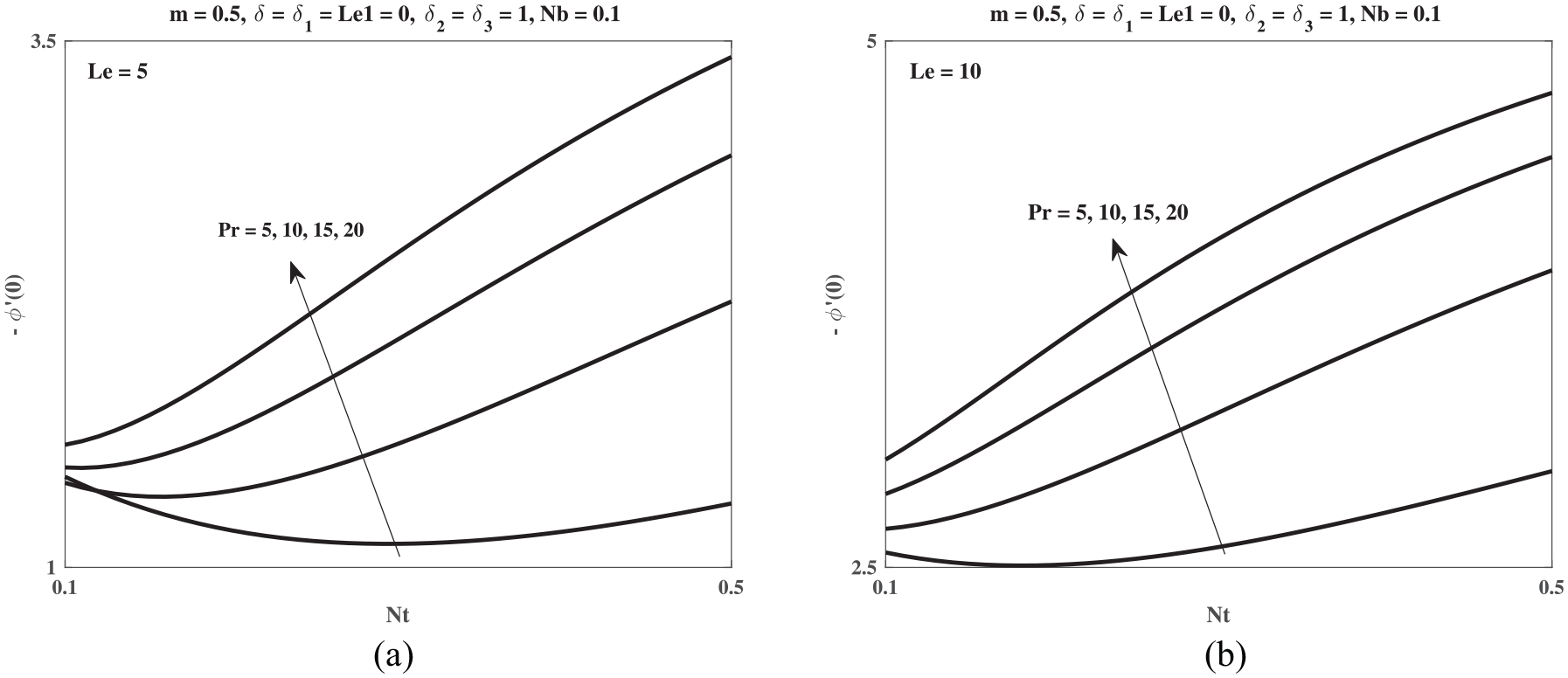
Two more cases of impermeable sheet are examined in Figures 11 and 12 for the mass flux of nanoparticles behavior. The variation in dimensionless concentration rate is presented against (Thermophoresis force) for different (different concentration of nanoparticles) in Figure 11. The effect of Prandtl number is also observed on it in Figure 11(a) and (b) for small and bit large values of Prandtl number, respectively. Note that small (low conducting base fluid) Prandtl enhances the mass transfer rate as shown in Figure 11(a). Moreover, the behavior of concentration rate is non-linear against for both small and large (low and high conducting base fluid) and each small (small concentration of nanoparticle in base fluid) value of . The numerical data in Table 3 is authenticated and the profiles of Sherwood number are plotted against with variation of see Figure 11(b). The behavior of in Figure 11(b) is reliable with the results given in Table 3. In Figure 12, the dimensionless concentration rate is plotted against for different values of (high conducting base fluid is taken), whereas, Figure 12(a) and (b) are plotted for and (Base fluid of higher viscosity), respectively. It can be seen from Figure 12(a) that the small value of (Base fluid of intermediate viscosity) increases mass transfer rate. Furthermore, the behavior of concentration rate is non-linear for both and and each small and large value of . Note that spontaneous changes in the profile of mass flux against are observed at the surface of a sheet for different and these variations are more prominent for large values of .
Effects of and numbers are seen on dimensionless concentration rates (impermeable sheet).
Effects of and numbers are seen on dimensionless concentration rates (impermeable sheet).
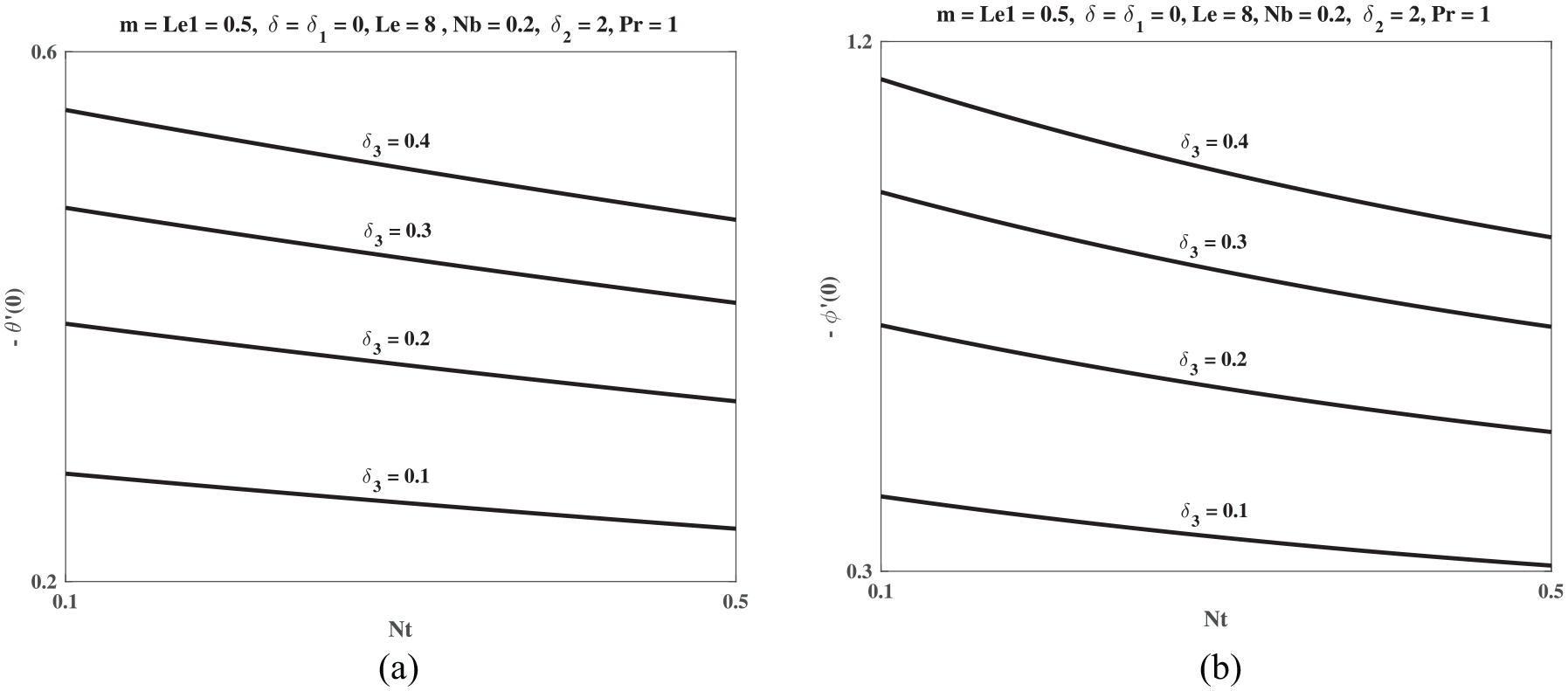
Unknown quantities and are obtained from the solution of equations (10) and (11) and equation (10), which contains the parameters , , , , , , and , whereas, equation (11) is equipped with . So the effects of are seen on the rates of heat and mass transfer in Figures 13 to 15, respectively. In Figures 13(a), 14(a) and 15(a), the rate of heat transfer is decreased with the increasing of , however, it is increased with the increasing of in Figure 13(a) whereas decreased with the increasing of and in Figures 14(a) and 15(a), respectively. The variation in heat transfer rate against is linear with a negative slope and small changes are noted in it for small values of . In Figure 13(a), heat flux is a constant function against for greater than 1 while for small values of this parameter, it is changed linearly. Moreover, the rate of heat transfer is changed rapidly in the variation of , as shown in Figures 14(a) and 15(a). In Figure 14(b), the variation in mass transfer rate against is non-linear and it is decreased with the increasing of both and . However, the rate of mass transfer is increased for increasing in Figure 13(b), in addition, it is decreased (increased) against for less than or equal to 1 (greater than 1).
Effects of are seen on (a) dimensionless heat transfer rates (b) dimensionless concentration rates.
Effects of are seen on (a) dimensionless heat transfer rates (b) dimensionless concentration rates.
Effects of are seen on (a) dimensionless heat transfer rates (b) dimensionless concentration rates.
Conclusion
The modeled problem under consideration demonstrates the diffusion of heat and nanoparticles in fluid flow on uniformly heated and variably porous plate of non-uniform radius, with non-linear stretching/shrinking velocity. Both the shrinking/stretching and suction/injection velocities are variable and they may be varied both linearly and non-linearly. Unseen similarity transformations are utilized to simplify the governing PDE’s. Using the bvp4c package of Matlab, the modeled problem of non-linear coupled ODE’s is solved numerically. The well-established results of classical problems11,18–21,23,38–41 of thermal diffusion and transport of nanoparticles in fluid flow maintained over stretching (shrinking) and porous sheets discussed so for are recovered from the present modeled problem by fixing its parameters accordingly. The classical results are recovered in terms of and . These results are exactly matched with each other which shows the accuracy and validity of the current modeled problem. Effects of all dimensionless quantities (i.e. the parameters representing the velocity components at boundary/plate) are determined on fluid velocity, heat and mass diffusion and discussed graphically. In different tables, the numerical results for and are displayed and matched with the classical results. The modeled equations for the nano-fluid motion demonstrate the influence of all dimensionless physical quantities. The similarity solution of the governing PDE’s is found and the unknown functions in equations (8)–(11) are varied with all the existing parameters. It is concluded that
The modeled problem equally describes the flow behavior induced by both linear and non-linear stretching/shrinking sheets.
Large Prandtl enhances heat transfer rate, while with boosting values of Brownian motion and Thermophoresis parameters, the heat transfer rate decreases.
The concentration rate increases by increasing Prandtl, Thermophoresis force, and Lewis numbers for fixed value of Brownian motion number.
Spontaneous changes in heat and mass fluxed against are noted for large and , respectively.
The two different numerical solutions of the modeled problem are exactly matched with each other.
The rate of heat transfer is decreased rapidly (gradually) against Thermophoresis force for low (high) conducting base fluids. Moreover, this variation is linear/non-linear for low/high (base fluid of higher viscosity) conducting fluids. The rate of mass transfer is increased (decreased) against the Thermophoresis force for high (low) conducting fluids.
The rates of heat and mass transfer is increased against the Thermophoresis force for each small value of secondary injection parameter. However, for those values of suction which are greater than 1, the rate of mass transfer is increased with the increasing of Thermophoresis force.
Scope of the present modeled problem can be extended for variety of nano-fluid flow models, in other words we may extend it for Al, Cu and Oxide .
Footnotes
Appendix
Handling Editor: James Baldwin
Declaration of conflicting interests
The author(s) declared no potential conflicts of interest with respect to the research, authorship, and/or publication of this article.
Funding
The author(s) received no financial support for the research, authorship, and/or publication of this article.
ORCID iDs
Aftab Alam
Azhar Ali
References
1.
AltanTOhSGegelH. Metal forming fundamentals and applications. Ohio: American Society for Metals, ASM International, 1983, pp. 353.
2.
SakiadisBC.Boundary-Layer behavior on continuous solid surfaces: (I). Boundary-layer equations for two-dimensional and axisymmetric flow. AIChE J1961; 3: 26–28.
3.
SakiadisBC.Boundary-layer behavior on continuous solid surfaces: (II). The boundary layer on a continuous flat surface. AIChE J1961; 7: 221–225.
4.
TsouFKSparrowEMGoldsteinR.Flow and heat transfer in the boundary layer on a continuous moving surface. Int J Heat Mass Transfer1967; 10: 219–235.
5.
CraneLJ.Flow past a stretching plate. Z Angew Math Phys1970; 21: 645–647.
6.
GuptaPSGuptaAS.Heat and mass transfer on a stretching sheet with suction or blowing. Can J Chem Eng1977; 55: 744–746.
7.
ChenTSStrobelFA.Buoyancy effects in boundary layer adjacent to a continuous, moving horizontal flat plate. ASME Trans J Heat Transfer1980; 102: 170–172.
8.
CharMI.Heat transfer of a continuous, stretching surface with suction or blowing. J Math Anal Appl1988; 135: 568–580.
9.
AliME.On thermal boundary layer on a power-law stretched surface with suction or injection. Int J Heat Fluid Flow1995; 16: 280–290.
10.
VajraveluK.Viscous flow over a nonlinearly stretching sheet. Appl Math Comput2001; 124: 281–288.
11.
CortellR.Viscous flow and heat transfer over a nonlinearly stretching sheet. Appl Math Comput2007; 180: 864–873.
12.
MiklavčičMWangC.Viscous flow due to a shrinking sheet. Q Appl Math2006; 64: 283–290.
13.
ChoiSUSEastmanJA. Enhancing thermal conductivity of fluids with nanoparticles. Lemont, IL: Argonne National Lab., 1995.
14.
BuongiornoJ.Convective transport in nanofluids. J Heat Transfer2006; 128: 240–250.
15.
KuznetsovAVNieldDA.Natural convective boundary-layer flow of a nanofluid past a vertical plate. Int J Therm Sci2010; 49: 243–247.
16.
ChengPMinkowyczWJ.Free convection about a vertical flat plate embedded in a porous medium with application to heat transfer from a dike. J Geophys Res1977; 82: 2040–2044.
17.
NieldDAKuznetsovAV.The Cheng–Minkowycz problem for natural convective boundary-layer flow in a porous medium saturated by a nanofluid. Int J Heat Mass Transfer2009; 52: 5792–5795.
18.
KhanWAPopI.Boundary-layer flow of a nanofluid past a stretching sheet. Int J Heat Mass Transfer2010; 53: 2477–2483.
19.
HassaniMTabarMMNematiH, et al. An analytical solution for boundary layer flow of a nanofluid past a stretching sheet. Int J Therm Sci2011; 50: 2256–2263.
20.
RanaPBhargavaR.Flow and heat transfer of a nanofluid over a nonlinearly stretching sheet: a numerical study. Commun Nonlinear Sci Numer Simul2012; 17: 212–226.
21.
KalidasD.Nanofluid flow over a non-linear permeable stretching sheet with partial slip. J Egypt Math Soc2015; 23: 451–456.
22.
GhoshSMukhopadhyayS.Nanofluid flow past an exponentially porous stretching sheet with heat and mass fluxes. Acta Tech2016; 61: 17–29.
23.
ZaimiKIshakAPopI.Flow past a permeable stretching/shrinking sheet in a nanofluid using two-phase model. PLoS One2014; 9: e111743.
24.
MadakiAGRoslanRKandasamyR, et al. Flow and heat transfer of nanofluid over a stretching sheet with non-linear velocity in the presence of thermal radiation and chemical reaction. AIP Conf Proc2017; 1830: 020014.
25.
ReddyYDRaoVSBabuLA.MHD boundary layer flow of nanofluid and heat transfer over a porous exponentially stretching sheet in presence of thermal radiation and chemical reaction with suction. Int J Math Trends Technol2017; 27: 87–100.
26.
SreekalaBJanardhanKRamyaD, et al. MHD boundary layer nanofluid flow of heat transfer over a nonlinear stretching sheet presence of thermal radiation and partial slip with suction. Global J Pure Appl Math2017; 13: 4927–4941.
27.
IrfanMFarooqMAIqraT.Magnetohydrodynamic free stream and heat transfer of nanofluid flow over an exponentially radiating stretching sheet with variable fluid properties. Front Phys2019; 7: 186.
28.
GhoshSMukhopadhyayS.Flow and heat transfer of nanofluid over an exponentially shrinking porous sheet with heat and mass fluxes. Propul Power Res2018; 7: 268–275.
29.
BachokNAlengNLArifinNM, et al. Flow and heat transfer of a nanofluid over a shrinking sheet. Int J Mech Aerosp Ind Mechatron Eng2014; 8: 1578–1582.
30.
AlengNLBachokNArifinNM.Flow and heat transfer of a nanofluid over an exponentially shrinking sheet. Indian J Sci Technol2015; 8: 1–6.
31.
NadeemSAminAAbbasN.On the stagnation point flow of nanomaterial with base viscoelastic micropolar fluid over a stretching surface. Alexandria Eng J2020; 59: 1751–1760.
32.
NadeemSAkhtarSAbbasN.Heat transfer of Maxwell base fluid flow of nanomaterial with MHD over a vertical moving surface. Alexandria Eng J2020; 59: 1847–1856.
33.
AwanAUAbidSAbbasN.Theoretical study of unsteady oblique stagnation point based Jeffrey nanofluid flow over an oscillatory stretching sheet. Adv Mech Eng2020; 12: 1687814020971881.
34.
RehmanAUAbbasNNadeemS, et al. Significance of Coriolis force on the dynamics of water conveying copper and copper oxide nanoparticles. Phys Scr2020; 95: 115706.
35.
NadeemSKhanMNAbbasN.Transportation of slip effects on nanomaterial micropolar fluid flow over exponentially stretching. Alexandria Eng J2020; 59: 3443–3450.
36.
NadeemSAbbasNMalikMY.Heat transport in CNTs based nanomaterial flow of non-Newtonian fluid having electro magnetize plate. Alexandria Eng J2020; 59: 3431–3442.
37.
LaeinRPRashidiSEsfahaniJA.Experimental investigation of nanofluid free convection over the vertical and horizontal flat plates with uniform heat flux by PIV. Adv Powder Technol2016; 27: 312–322.
38.
WangCY.Free convection on a vertical stretching surface. J Appl Math Mech1989; 69: 418–420.
39.
GorlaRSRSidawiI. Free convection on a vertical stretching surface with suction and blowing. Appl Sci Res1994; 52: 247–257.
40.
GrubkaLJBobbaKM.Heat transfer characteristics of a continuous stretching surface with variable temperature. J Heat Transfer1985; 107: 248–250.
41.
ChenC-H.Laminar mixed convection adjacent to vertical, continuously stretching sheets. Heat Mass Transfer1998; 33: 471–476.