



Abstract
The non-uniformity value which currently many applications of magneto-hydrodynamics are found in medicine where drug deliverance happens through peristaltic pumping phenomena, various magnetic drugs are released to target tumor diseases and to control the drug flow movement to the desired area. Owing to these facts, the aims of this article is to examine the simultaneous influence of magneto-hydrodynamics (MHD) and slip effect on unsteady peristaltic nanofluid flow in a non-uniform porous channel of finite length. The constituent governing equations for the model have been examined under the approximation of long wave length and small Reynolds value. Keeping kerosene oil and ethylene glycol as base fluids with polystyrene chosen as nanoparticle. The current analysis is carried out for the peristaltic flow transferal which carries innumerable industrialized employments. The incompressible, viscous, electrically conducting flow is studied in wave form. Here, exact method is employed to obtained closed form solutions. We have implemented computational software packages “Mathematica” as a main tool in order to obtain explicit expressions for axial velocity, temperature, stream function, pumping phenomenon and bolus formation. Obtained solutions are used for graphical analysis against different physical parameters. It is concluded that axial velocity increments for higher Hartmann number and slip parameter near the walls. The porosity effects increases the temperature whereas the temperature field shows increasing behavior for larger Brinkman number.
Keywords
Introduction
The peristalsis analysis has gained attention of engineers and investigators in many industrial and engineering processes. The mechanism of transporting dietary contents through tightening and expanding consequence of propagating wave alongside of the channel/tube is termed as the phenomenon of peristaltic impulsion. The presence of such progression is encountered in vast range of industrialized employments and physiological processes which can be seen in the bile duct, gastrointestinal tract and further glandular channels. The urine transferal to bladder from kidney, swallowed dietary substance through gullet, transfer of lymph in lymphatic vessels, ovum gesticulation in fallopian tubes, moving of spermatozoa inside cervical canal and many more processes illuminate the significance of this mechanism. Further, the mechanism also parts the influential findings in diverse industrial, medical developments where we come across peristaltic pumping in roller and finger pumps, heart lung appliance, unusual pharmacological transport systems and loco movement of worms etc. Since the ground-breaking research of Latham 1 along Shapiro et al. 2 on peristalsis momentum emerged, extensive hypothetical and investigational methodologies were attempted for the understanding of peristaltic progression of hydrodynamic fluids in wide-ranging assumptions of extensive wavelength, small Reynolds number, trivial wave amplitude etc. Even though, urge for exploration in this direction stemmed in extensive literature study but only a few recent soundings are listed here.3–12
Various ordinary liquids like ethylene glycol, silicon oil, kerosene oil, water, etc., generally fall in as bad conductors due to their low value of thermal conductivity which reduces the amount of heat transmission. Choi 13 in his model presented the terminology of nanofluids which is a combination of metallic nano-sized particles dispersed in adequate amount to the based fluid for the enhancement of thermal conductivity. Later his revolutionary perception was deliberated by many researchers sharing foremost contributions offering proficient models like Buongiorno, 14 Maxwell, 15 Hamilton and Crosser 16 models for nanofluids. Presently nanofluid utilization has stopped at nothing less due to their inspiring features and its involvement in diverse directions like solar synthesis, biotic identifying, biochemical, nuclear reactors, the chemical engineering gas detecting, surgical procedure, protein production, vivo therapy, drug dispersal, cancer finding and cure, photodynamic treatment, neuro electronic interfaces, nonporous medium for size barring chromatography, shedding new light on cells, molecular motors resembling kinesis, charge centered filtration in the kidney basal membrane, and further a number of experts assumed of using nano foods in tricking the body to feel full for long thus resulting in reduced eating desire. Different studies17–23 on nanofluids over diverse geometries are also the valuable contributions of the researchers.
The study of incompressible viscid flow through non uniform channels hold pronounced significance in research area having countless applications in practical, physiological, biochemical, civil, industrial, environmental, aerospace, chemical engineering along with canals and river flow pattern understanding. In human body also such flows can be seen when blood movement is observed where capillaries are linked or connect with arteries. The innovative work for the understanding of such flows were carried out by Hamel 24 and Jeffery 25 which later was great source of inspiration for many researchers resulting in enough investigation for various flow properties where only a few are shared in the references.26–29
The analysis of electrically conducting physiological fluids having incompressible, viscous, peristaltic flow over a divergent or convergent channel under the sway of externally acting magnetic field share fascination among theoretical study as well as applications of mathematical modeling in numerous biotic and industrialized requirements. Applications of MHD (magneto-hydrodynamics) that possibly come across in various directions are diverse cancer treatments, magnetic resonance imaging (MRI), influence on blood movement, magneto therapy, hyperthermia, blood pumps acting as carrier of cardiac processes for blood movement having arterial ailments like arteriosclerosis, engineering glitches like electromagnetic casting, incarceration of plasma and continual metal cast practice, high temperature tools like power generators, and movement of liquid metals in the cooling arrangement of innovative nuclear reactor reflecting a broadening or a shriveling flow movement in between parallel channels with variant cross-sections. Also, the giant magneto resistive (GMR) equipment which applies magnetic field with a precise delicate sensor to detect slightest motion of an object in the magnetic arena facilitating immensely in learning of peristaltic activity in tube-like configurations like fallopian pipe, bowel and possibly even in the vas deferens. Moreover, it is an essential criteria to consider flexible walls of the channel when gap in between the walls fall at small distance apart. A number of expedient learning in this topic is cited over in references.26,30–41
The increased amount of applications in bio-physiological and industrialized flows handled with suitable analysis is deliberated diversely and extensively. Observing and keeping in focus the research literature, the aim of present study is to investigate the flow hydrodynamics under the simultaneous influences of velocity slip and transverse magnetic field on the peristaltic motion of incompressible, viscous nanomaterial over a flexible porous channel of varying cross-sectional area. The present analysis significantly shares connection with many bio-physiological and industrialized problems concerning drug deliverance, electromagnetic treatment and canal flows.
Problem formulation and solution analysis
Here, consider the peristaltic transference of an electrically conducting incompressible viscous nanofluid in a two-dimensional non-uniform symmetric horizontal channel of finite-length. Schematic representation of the current consideration is shown in Figure 1. The influence of induced magnetic field is ignored with the consideration of taking in account the small value of magnetic Reynolds value. The stream movement is induced using the propagating sinusoidal wave trains having speed


Now, take the flow movement in

Schematic representation of fine length non-uniform channel.
We need to improvise our choice of frame of reference to incorporate steady laminar flow. In effect fixed frame of reference
Thus, introducing transformation is implemented to shift from laboratory to wave frame as:

Here, considered corresponding rheological conservation laws for two-dimensional incompressible nanofluid flow in the influence of magnetic field acting transversely in a rectangular Cartesian coordinate classification may be modeled as,42,43

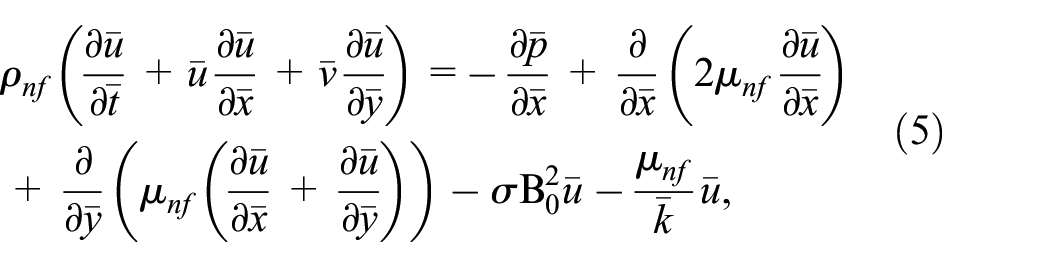
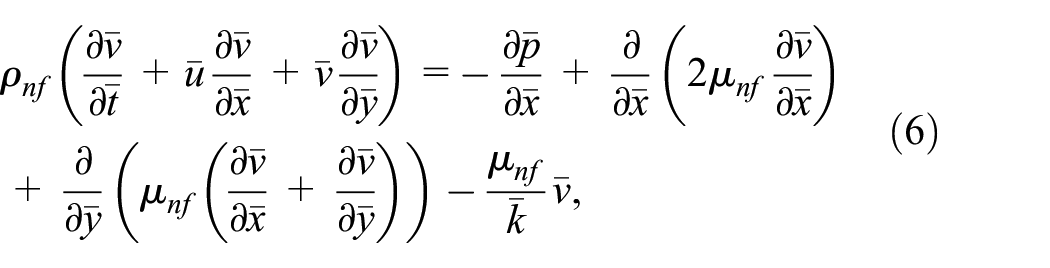

where,
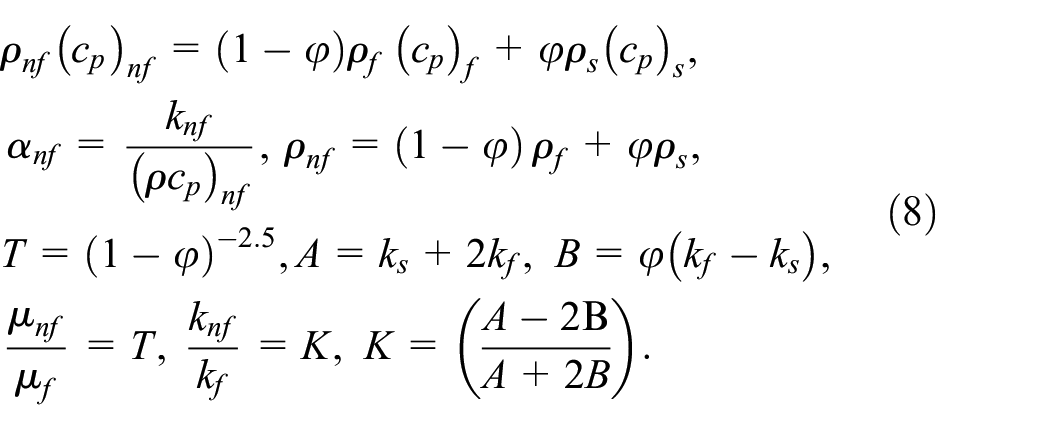
The thermo-physical physiognomies of nanofluid polystyrene in two different base fluids ethylene glycol and kerosene oil are documented in Table 1.44,45 Furthermore, we use the mentioned dimensionless terms:
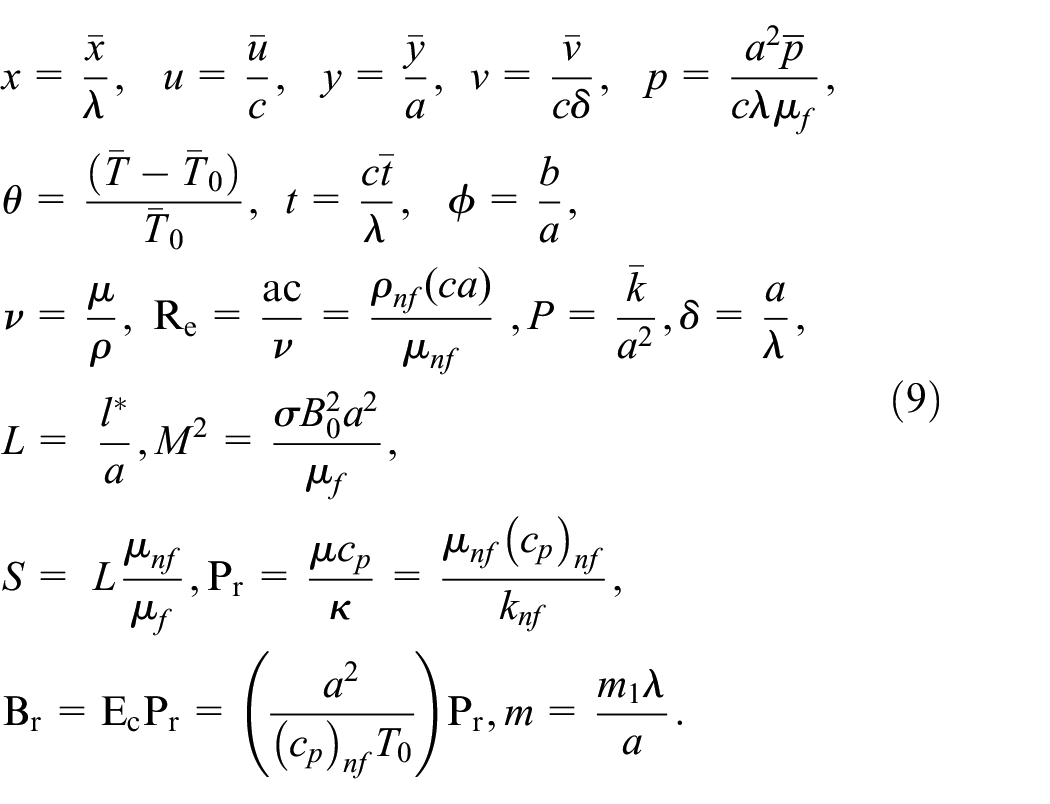
Here, the
Thermo-physical features of nanoparticle with base fluids.

Moreover, we obtain dimensionless formulation of the model by implementing (9) in the non-dimensional system (4)–(8) above along with use of expressions relating stream function with velocity field given by:

Under influence of low Reynolds

Differentiating (11) we get equation free of pressure gradient term


subjected to conditions on the boundary mentioned below:


The conditions
The Analytical solution of the boundary value problem in (11)–(17) brings forward the closed form solutions of temperature profile, stream function, velocity field, volume flow rate, pressure gradient, pressure rise and mean flow rate deliberated mathematically as follows:


where

The volumetric rate of flow is assessed by means of

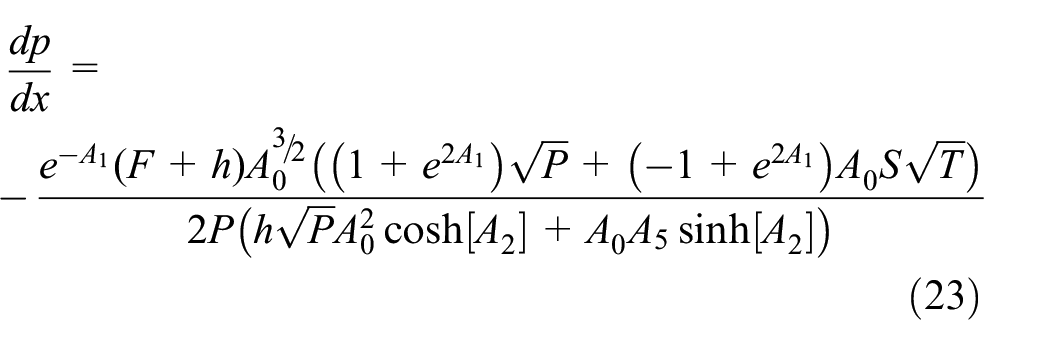
Axial pressure gradient is expressed by:
We can estimate the value of dimensionless pressure rise by the integral expression:

The mean flow rate which is in relation with flow rate considered in wave frame. This relationship can be presented by:

Exact results with graphical behavioral analysis discussion
This segment reflects graphic analysis of behavioral trait followed by velocity, temperature, pumping and trapping phenomenon on the variations of pertinent physical parameters. The non-uniform permeable channel influenced by transverse magnetic field and slipping effect is deliberated generously.
Trait of velocity distribution on variant flow parameters
Figure 2(a) to (g) focuses on analysis of the velocity profile for Hartman number

(a) Sway of
Trait of temperature distribution on variant flow considerations
It is pragmatic in Figure 3(a) to (f) to view the temperature filed illustrations experience changes when parameters Hartman number

(a) Sway of
Trait of pumping characteristics on variant flow controls
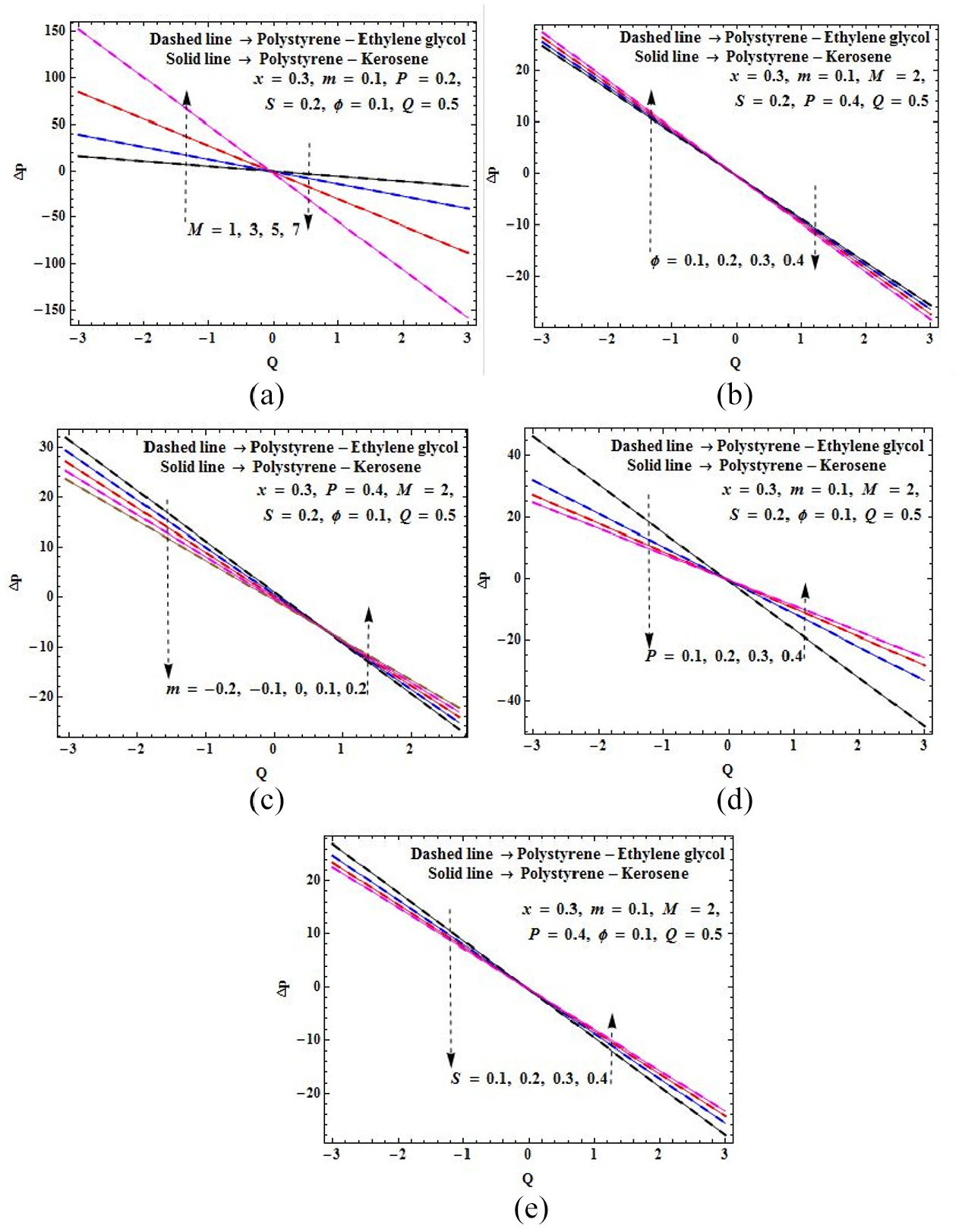
The contents of this section exhibits the influence of emerging parameters Hartman number

(a) Sway of
(a) Sway of
Trait of bolus trapping on variant flow factors
Trapping is an important fascinating happening in the process of peristalsis in which the formed bolus within move along the velocity of streams and bolus that get trapped are then pressed in the pathway of propagating wave with the same speed as of the wave in motion. Figure 6(a) to (d) engrosses on mechanism of bolus trapping for various pertinent parameters Hartman number

(a) Sway of slope parameter
Conclusions
Magneto nanomaterial flow in non-uniform porous channel having finite length is investigated here. The mixture of polystyrene with base fluid ethylene glycol and other base fluid kerosene oil is observed in combined form under the slip phenomenon. The outcomes are described and also graphically illustrated using Mathematica10 command. The findings of the present work analysis on the pertaining parameters Hartman number
The velocity faces diverse relation for enhanced parameter value of
Increasing
Temperature field is directly proportional to increasing behavior of parameters
An enhancement in magnitude of pressure gradient
Pressure rise
The non-uniformity parameter for vales of
Footnotes
Appendix
Handling Editor: James Baldwin
Declaration of conflicting interests
The author(s) declared no potential conflicts of interest with respect to the research, authorship, and/or publication of this article.
Funding
The author(s) received no financial support for the research, authorship, and/or publication of this article.
